My highlight from the show? The one-on-one with Tommy Chong where he signed two High Times magazines of him on the cover. There’s a video of me in a vintage yellow High Times t-shirt sitting on a white CANNA couch talking to Chong. Basking really, what a beautiful genuine soul.
As an aside, I hope to interview him when I’m not quite so smitten.
I discovered High Times in a box in storage as a kid. With them, my mother’s t-shirt from 1975. A natural investigator, I found the artifacts from my folks’ heyday, including their stash grown by my uncle in the Cowichan Valley.
All this to say is that I come by it honestly, for better or for worse. This interest in exploration and the human relationship to substance, as chemists of the imagination.
I had some fun in Edmonton!
Advertisement
Another highlight? The “Tommy Returns Home” interview by his son, Paris Chong. The comedic edge sprinkled with outdated colloquialisms lent itself to a glimpse inside what they called “the Tommy Chong approach to life.”
First a musician and later a comedian – after hearing some of the greats play the guitar, he decided it best to go into comedy full-time.
Besides, “what do you call a musician without a girlfriend?” asked Chong. “Homeless!”
I reflect on the power and genius of the comic. Allowed a hall pass to places otherwise forbade. Not something that can be learnt, really. Techniques massaged but the satire inherent. The secret sauce being the outrageous and the self-deprecating.
Chong spoke about Richard Marin. “Don’t you have a nickname?” he asked. “Yeah, Cheech!”
Advertisement
Chong and Marin? No.
Richard and Tommy?
He left the session screaming it into the wind: “Cheech and Chong!”
From Left: Kieley Beaudry, Alena Jenkins, Luke Dickson, Nick Van Dam.
Crafting for Success
Producing with retailers in mind – expertly moderated by Kieley Beaudry – was a discussion that focused on the producers’ relationship to the retailer, specifically hinged around the premium market segment and the cannabis connoisseur.
Advertisement
Beaudry also presented a call to action for listeners advising they contact the AGLC, instigating a conversation about what they do and do not like about provincial policies.
Speaking from a group of people still in this space six years in, “as a licensed producer, at the end of the day it’s only going to come down to the economics,” said Cannara’s Nick Van Dam. “It’s okay to have a mass marketed brand that’s there for the everyday consumer. For Cannara, we’re targeting a more refined consumer.”
Van Dam suggested to LPs, regardless of market segment, that they should “evaluate and be aware of how a market can potentially change; be aware of the risks.”
Alena Jenkins of FivePoint Cannabis is the last of the boutique cannabis retailers from her original group. She said: “when it comes to inventory decision making, it’s a value proposition. I’m not afraid of bringing in expensive items, in fact I like having expensive items on my menu. But the value has to be there, and it has to be there consistently.
“You get one bad lot, especially when you’re in that premium market, it’s not acceptable and you will lose brand allegiance from that retail purchaser and the consumer. So, if you’re going to be playing in that premium market, you better be coming out with premium products; it’s as simple as that.”
How far we’ve come from dry oregano pot, to the premium weed of the new millennium a quarter of a century in: “when it comes to determining your price, your price must match what you’re producing,” said Beaudry. But the difficulty of the elevated market segment is the reality of running into debt. “We can’t run an entire industry at a loss,” said Jenkins.
Luke Dickson from Simply Solventless Concentrates commented on the seasonality of the industry. Take note of industries with seasonal offerings, such as alcohol and cosmetics. Insofar as rotational SKUs, which we love, some categories are more conducive, like flower and vapes.
“Rosin, not distillate,” said Van Dam. “You can build interesting things with variety, especially when the brand keeps delivering on what they said they were going to do.” And in order to compete with the illicit market, “find out what the consumers of the illicit market are looking for.”

Alexandre Gauthier, Origine Nature & John Slaughter, High North.
The Science of White Ash
The grower workshop on new post-harvest research hosted by Alexandre Gauthier and John Slaughter, in collaboration with McGill University, presented their findings on water activity, organoleptic testing (sensory testing) and the composition of dry flower.
Slaughter spoke of the water activity and the risk of losing three per cent weight of crops if not monitored correctly. He pinpointed the decision to and sometimes pain point revolving around moving flower from the dry room into cure.
“Water activity is the answer for ‘is it ready to leave the dry room?’” said Slaughter. “Is it active, can mould grow on this area? That’s what you all want to know.
“If you really want to know loss on drying, (and this is what international markets do), there are different machines including a vacuum oven machine that will actually tell you what out of this is moisture, not terpenes. That difference and those tests are real; they’re legit.” Slaughter recommends Aqua Lab for precise water activity measurement.
Gauthier spoke about water activity used in other industries such as in food, especially frozen food.” Origine Nature employs strict data collection, especially in visual graph representations. Data is king.
“We trust no one but God. For everyone else, there’s data.”
Tobacco companies always conduct an ash study, and here the experts provided results of their ash studies. “Burning black doesn’t correct itself through curing,” Slaughter said; “water activity in itself will not save you.
“Water activity will make ash whiter by 15-25% but it won’t solve black ash problem.” Other factors to consider include nutrient content and drying techniques, which is why producers use graphs to compare different growing and drying methods.
Gauthier called Rubicon Organics and Jack Daniels the big brothers in the testing space, who are doing an excellent job as well with in house sommeliers and leveraging the Ganjier program. Employ organoleptic testing by trained sommeliers who evaluate taste, aroma and combustion quality. Don’t rely on “band-aid solutions” like chemical additives without first comprehending their full effects on the plant.
“Get ego out of the way and grow to what the consumer wants,” said Gauthier.
Slaughter knows “every country online is buying Canada’s weed.” We need the standardization that makes consistent and predictable products for export. “Medical grade products must have analytics dialed in,” he said. “We believe in Canada and want to be the No. 1 worldwide known for great cannabis.”
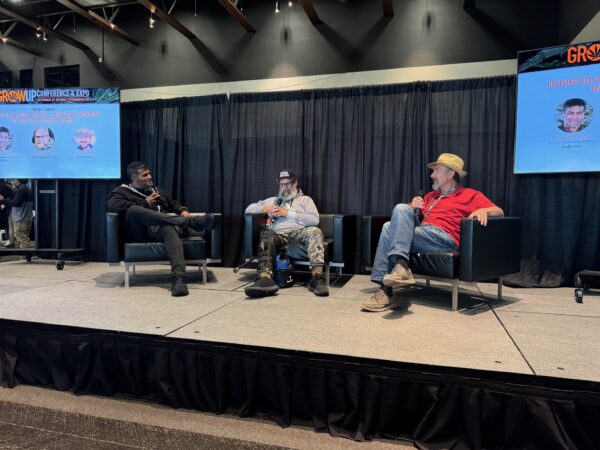
Moderator Dr. Av Singh, Dustan McLean & Ron Herrington.
Growers and Genetics
The emphasis on pro growers at each of these events is paramount. Whether they’re the Indigenous entrepreneurs and leaders in the space who are healing their communities and returning peoples’ abilities not only to walk with ease using cannabis products, but to dance and celebrate in ceremony.
Or they are the legacy market breeders and geneticists who are crafting the next smoke for the people. At the end of the day it’s about everyone’s ability to work together.
To welcome the illicit market into the legal market. To unite the regulated market with the sovereign red legacy market, where the wellness factor underpins all the work being done in this space, through the acknowledgement that we’re all open for business and are interested in a common future in good health and prosperity.
The Growers Lunch, toasting those who are the beating heart of this market sponsored by Biofloral, was another great success.
And as partial sponsors since 2018, publisher Adam Szpakowski and I welcomed a room of growers and ancillary businesses. Even I admitted to have been a ‘Fuck Corporate Weed’ kinda gal, and you all changed my mind.
But even in a corporate environment, we learn by listening to the elders that it is the pursuit of economic equality and mutual respect that brings us all together. And we thank the geneticists who offer a road map for the coming years in this industry, such as with Dustan McLean and Ron Herrington who are diversifying the gene pool by introducing heirloom genetics.
“2.5 years ago I finished fruit,” said Herrington, “and now I’m into funk. I want serious gas,” he said; “camphor smell. Not so much herbal but camphor and gassy smell.”
He predicts that over the next 3-4 years, the trends will be in favour of camphor flavours.
As well as Skunk: Skunk is coming back.
Here, here! To all of us here together.