(Globe Newswire) Charlottetown, P.E.I and Skopje, North Macedonia – Advanced Extraction Systems Inc and Pharmarolly Holdings B.V. are excited to announce that Pharmarolly has successfully passed the stringent euGMP audit and obtained full euGMP certification for their pharmaceutical facility. This achievement underscores both companies’ unwavering dedication to meeting the highest European standards for pharmaceutical manufacturing.
This certification reflects Pharmarolly’s adherence to the stringent regulations established by the European Medicines Agency (EMA). It ensures that their facility and processes are maintained at the highest levels of quality and safety, reinforcing Pharmarolly’s position as an industry leader.
“Achieving euGMP certification is a testament to our team’s hard work and dedication to quality,” said Steve Malloy, CEO of Pharmarolly. “We have set ourselves a high bar, and meeting the rigorous requirements of the euGMP audit demonstrates our steadfast commitment to delivering pharmaceutical products that meet the highest standards. This milestone is a significant step in our journey, and we’re excited about the opportunities it brings.”
Peter Toombs, CEO of AESI, added, “We are thrilled to see Pharmarolly achieve this important milestone. Their dedication to excellence and strict adherence to euGMP guidelines have been evident throughout this process. AESI has long been a leader in the natural products space, including the cannabis industry, and we continue to see significant success through our partnerships and projects. We are honored to have been part of Pharmarolly’s journey and look forward to continuing our partnership as they expand their reach in the pharmaceutical industry.”
Advertisement
This achievement not only validates the quality of Pharmarolly’s operations but also highlights their strong partnership with AESI, whose technology and expertise have supported the company’s efforts to achieve and maintain the highest standards in pharmaceutical manufacturing.
(Globe Newswire) Toronto – Avicanna Inc. a biopharmaceutical company focused on the development, manufacturing and commercialisation of plant-derived cannabinoid-based products is pleased to announce that through its majority-owned subsidiary Santa Marta Golden Hemp the company completed the commercial export of Aureus branded products into Singapore.
The commercial export included Aureus branded purified Cannabigerol (“CBG”) which is a part of the company’s portfolio of cannabinoid active pharmaceutical ingredients. This transaction also marks the 18thinternational market for Aureus-branded products, first export into Asia and 21st market for all Avicanna products which further validates the company’s expertise in navigating complex regulatory processes for its commercialization efforts internationally.
Recently released reports suggest that hallucinogenic mushrooms may be the most popular psychedelic drug of choice for the public. The reports also determined that most individuals preferred microdosing over a full trip, with one study observing a 1,250% increase in internet search history on microdosing.
The study, which also found that psilocybin searches began outpacing LSD in 2019, was conducted by epidemiologist Eric Leas. The study also determined that the increase in curiosity on microdosing correlated with changes in policies related to both psychedelics and marijuana.
In his study, Leas observed that the more liberal a state became related to drug use, the more interest in microdosing rose in the state. His findings were reported in “JAMA Health Forum.”
A separate study by Rand Corp also estimates that roughly eight million adults in America have used psilocybin in the last 12 months. This makes the drug the most popular hallucinogenic substance of 2023. Psilocybin use surpassing other popular hallucinogens was a surprise to Beau Kilmer, codirector of the RAND Drug Policy Research Center, who was also the lead author of this study.
MDMA was the runner-up, with LSD following close behind. The study surveyed almost 4,000 individuals and determined that about one-half of those who tried psilocybin preferred microdosing. This trend seems to have caught on in varying circles, from suburban moms to individuals in tech.
Kilmer explained that while there was no universal way to define microdosing, it was often regarded to be in the range of 0.05 to 0.1 of a full dose.
The study also determined that most psilocybin microdosers had taken the drug on one or two occasions, while 11% revealed they consumed the drug for more than six days. Additionally, over one-half of those surveyed admitted to taking whole, dried or fresh mushrooms, roughly 14% imbibed a drink or tea, and about a quarter of them took mushrooms in processed form.
When asked why they consumed psilocybin, most respondents gave reasons such as social enjoyment and fun, existential exploration and personal development, and mental health.
The director of the Translational Psychedelic Research program at UCSF, Dr. Joshua Woolley, claims that microdosing isn’t the same as what is being studied in clinical trials evaluating psychedelics’ effectiveness in managing a range of mental-health conditions.
While not much is known about microdosing, a recent review suggests that it may improve cognition and mood. However, not everyone agrees with this opinion, with some noting that it is premature to make a judgment on the safety or effectiveness of microdosing. The work being done by companies such as Seelos Therapeutics Inc. (NASDAQ: SEEL) could help to bridge some of those knowledge gaps.
About PsychedelicNewsWire
PsychedelicNewsWire (“PNW”) is a specialized communications platform with a focus on all aspects of psychedelics and the latest developments and advances in the psychedelics sector. It is one of 60+ brands within the Dynamic Brand Portfolio @ IBN that delivers: (1) access to a vast network of wire solutions via InvestorWire to efficiently and effectively reach a myriad of target markets, demographics and diverse industries; (2) article and editorial syndication to 5,000+ outlets; (3) enhanced press release enhancement to ensure maximum impact; (4) social media distribution via IBN to millions of social media followers; and (5) a full array of tailored corporate communications solutions. With broad reach and a seasoned team of contributing journalists and writers, PNW is uniquely positioned to best serve private and public companies that want to reach a wide audience of investors, influencers, consumers, journalists and the general public. By cutting through the overload of information in today’s market, PNW brings its clients unparalleled recognition and brand awareness. PNW is where breaking news, insightful content and actionable information converge.
To receive SMS alerts from PsychedelicNewsWire, text “Groovy” to 888-902-4192 (U.S. Mobile Phones Only)
Please see full terms of use and disclaimers on the PsychedelicNewsWire website applicable to all content provided by PNW, wherever published or re-published: https://www.PsychedelicNewsWire.com/Disclaimer
The Israeli Government has released its preliminary decision regarding accusations that Canadian cannabis companies are dumping low-cost cannabis products in the Israeli medical cannabis market.
The preliminary findings have determined a fair price and profit margin for Canadian companies selling cannabis into the Israeli market. A final version of the report, with finalized recommendations, is expected later this year.
The commissioner has decided against imposing a temporary guarantee of any levies and will provide his final recommendations on the matter in the investigation’s final findings.
The companies involved have a period of 30 days to submit their comments and supplementary arguments in accordance with the findings of this decision before the publication of the final findings.
The investigation was announced in January 2024 by the Commissioner for Trade Levies at the Ministry of Economy and Industry, Danny Tal.
In the course of the investigation, it was determined that the large volume of cannabis sold into the Israeli medical market from Canada was having a significant impact on both the local market and domestic companies’ ability to compete.
These products, determined Tal’s report, were sold at lower prices that, he argues, do not reflect the normal course of business and at prices that are lower than production costs or from their prices in the Israeli market, especially given the additional costs of exporting cannabis from Canada.
An example of some of the Canadian cannabis products available in the Israeli market.
Many Israeli cannabis companies told the investigators that they were forced to sell products at or below cost due to competition with lower-priced Canadian cannabis. Producers also said they were forced to destroy large amounts of cannabis they could not sell, in part due to these imports.
Cannabis Magazine, an online publication in Israel, says that many Israeli medical patients have preferred Canadian cannabis because it is seen as a higher quality than locally-produced products. However, the report also notes that the quality of cannabis from licensed Israeli companies has improved in recent years.
Israel imported 78,394 kg of cannabis from 2020-2023, with 62,345 kg coming from Canada, or about 80%. Other countries of origin were Portugal, Uruguay, and Uganda.
The investigation looked into all Canadian cannabis companies selling products into the Israeli market. They specifically visited Organigram, Decibel, and Pure Sunfarms who welcomed investigators to look closer at their facilities and books.
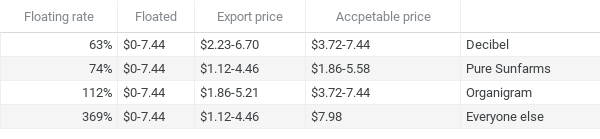
Once the investigators determined an accepted price and an export price per gram of cannabis, the commissioner calculated overflow rates in the complaint products for each of the three companies that cooperated with the investigation and for the rest of Canada.
Based on these factors, the investigator determined that these companies are entitled to an 8% profit on products sold into their local market. The investigation also determined that a fair price for Canadian cannabis sold into the Israeli market was about $2-8 a gram (in Canadian dollars).
Based on investigations into Canadian production costs, including packaging and shipping, as well as additional export costs, the commissioner recommends a floating levy or tariff of 63% for Decibel, 74% for Pure Sunfarms, 112% for Organigram, and 369% for all other producers.
The preliminary report states that the commission will also submit a report on its findings to the World Trade Organization.
All prices in CAD unless otherwise noted
The floating prices exist, explains a notice by the commissioner (Translated), “when the foreign producer exports the goods at prices lower than their production costs or their price in the country of origin. Such imports are defined in the World Trade Organization as “unfair trade” and according to the WTO’s Export Convention, the country may protect its domestic market in such cases by imposing an export levy, which compares the import price to the price that reflects fair competition.”
“Sales at floating prices,” it continues, “may arise in cases where the foreign manufacturer suffers from excess inventory that is not sold in his local market alongside a limited validity of the goods that affects his ability to store unsold production surpluses, or in cases where he wishes to capture market share in the importing country even at the cost of a continuous damage to his profitability due to long-term considerations, range of penetration and establishment of its activity in foreign markets.”
The report found that Organigram exported about 5,000-1,000 kg of cannabis flower to Israel in 2023. The investigator determined that a fair price for their products on the market was NIS$10-20, or about CAD$3.75-$7.50 per gram. NIS is the new Israeli Shekel.
The investigator found an acceptable price for Decibel’s products in the Israeli market was also about NIS$10-20. Pure Sunfarms’ products were determined to be about NIS$5-15 per gram, or CAD$2-6.
The report notes that the Israeli market faces similar challenges to the Canadian market and others around the world, dealing with market contraction after an initial rush, over-supply, and other issues.
Many Canadian companies have touted their export sales to countries like Israel as a way to command a better price than in the domestic market and deal with the large volume of product in their vaults.
(Business Wire) Edmonton — Papa’s Herb, a rapidly expanding cannabis brand in North America, has partnered with Edmonton’s Plantlife to exclusively sell its disposable vape brand at the Great Outdoor Music Festival this weekend in Edmonton, Alberta. AGLC regulations were updated on February 1, 2024, allowing for cannabis sales direct to event attendees in age-gated settings. Alberta is the first province to make these changes, consequently creating new job opportunities.
“It’s an honor to be the brand of choice at the Great Outdoors Comedy Festival and we thank Plantlife for the opportunity,” said Aaron Nathaniel, CEO at Papa’s Herb. “Cannabis and comedy is the perfect combination and our RNTZ and Lemon Cherry Gelato disposables are the perfect pairing for a great weekend of laughs with our friends in Edmonton.”
Ian Scott, owner of Plantlife Cannabis in Edmonton, spoke to the event’s popularity and how cannabis is the perfect addition to make the festival even better.
“Now in its fourth year, the Great Outdoors Comedy Festival is one of the most beloved in Canada,” he said. “Great comedy is made better when paired with cannabis and Papa’s Herb is the ideal partner to execute this special event with. Plantlife is honored to be invited to sell as its exclusive cannabis retailer. We can’t wait for the weekend.”
Advertisement
Papa’s Herb disposable vapes will be available for sale directly beside the stage in the Garden by Plantlife, offering RNTZ and Lemon Cherry Gelato flavors among other adult-use cannabis products.
Representatives from Papa’s Herb and Plantlife are available for comment.
About Papa’s Herb
Papa’s Herb is a leading cannabis brand known for high-quality, affordable products, available in over 4,000 dispensaries across North America. Rooted in family values and inspired by Papa’s story from Miami in 1985, the brand honors his legacy of providing exceptional, accessible products. At Papa’s Herb, we continue his tradition of quality and value, offering a diverse range of cannabis products for all users.
Businesses in Kentucky looking to grow, process or sell medical cannabis can start submitting applications for licenses on Monday, July 1, 2024. Governor Andy Beshear announced this as part of an expedited effort to have products on the market by early 2025.
Healthcare providers, including advanced-practice registered nurses and doctors, can also start applying to certify qualified patients for purchasing medical cannabis. The process will be overseen by the state’s Board of Medical Licensure and Board of Nursing.
The state’s medical marijuana program is officially scheduled to kick off on Jan. 1, 2025. The legislation, passed in 2023 with bipartisan support in the GOP-dominated state assembly, legalizes medical marijuana for individuals with a range of debilitating conditions. Beshear signed the law promptly, and his administration has been diligently working on the program’s regulations ever since.
To accelerate the process, Beshear signed additional measures this spring, advancing the timeline for marijuana business registration by six months.
To help applicants, the state has made several YouTube seminars, a handbook for business license applications and other materials available. Companies have until August 30 to submit their licensing applications. According to Beshear, the objective is to have medical marijuana accessible by January, coinciding with the legalization of these goods.
Medical marijuana cards will be available for application starting the first of the year to patients with qualifying diseases such as multiple sclerosis, cancer, chronic epilepsy and post-traumatic stress disorder (PTSD) as well as chronic pain and nausea.
Eric Friedlander, the secretary of Kentucky’s Health and Family Services, underlined the commitment of the state to providing affordable and safe access to medical marijuana for people with qualifying conditions.
Beshear noted in April that the first round of company licenses would be distributed by the state through a lottery. The program’s goal, according to Sam Flynn, director of the state’s Office of Medical Marijuana, is to guarantee that marijuana licensing is equitable, open and focused on the needs of customers.
Initially, the state will issue 48 store licenses, distributed among 11 regions, with each area receiving at least four licenses. Most counties will be limited to one dispensary license each, except for the counties housing Lexington and Louisville, which will be allocated two licenses each.
The first wave of the license lottery is scheduled for October 2024. A restricted number of licenses for cannabis cultivation and processing will also be issued. Beshear mentioned that the license caps are designed to prevent market saturation, which could negatively impact both patients and businesses. The program has the flexibility to expand based on demand and the inclusion of additional qualifying conditions.
These developments in Kentucky are likely to be welcome news to the entire cannabis industry, including entities such as Green Thumb Industries Inc. (CSE: GTII) (OTCQX: GTBIF), since they mean that the rolling back of prohibition is underway in yet another U.S. state and the people there will soon have the option of using medical marijuana products to manage some of the illnesses they face for which medical cannabis is helpful.
About CNW420
CNW420 spotlights the latest developments in the rapidly evolving cannabis industry through the release of an article each business day at 4:20 p.m. Eastern – a tribute to the time synonymous with cannabis culture. The concise, informative content serves as a gateway for investors interested in the legalized cannabis sector and provides updates on how regulatory developments may impact financial markets. If marijuana and the burgeoning industry surrounding it are on your radar, CNW420 is for you! Check back daily to stay up-to-date on the latest milestones in the fast -changing world of cannabis.
To receive SMS alerts from CNW, text CANNABIS to 888-902-4192 (U.S. Mobile Phones Only)
Please see full terms of use and disclaimers on the CannabisNewsWire website applicable to all content provided by CNW, wherever published or re-published: https://www.CannabisNewsWire.com/Disclaimer
Law enforcement says the same charge against a Moncton woman was withdrawn. Lebourque was arrested as the owner, and the woman was arrested as an employee of the first business.
At the first business on Collishaw, a 44-year-old woman and a 45-year-old man were reported as arrested and subsequently released pending further investigation.
At the second business on Halifax St, a 53-year-old woman, Corrine Frances Courtney of Boundary Creek, was arrested and subsequently released pending further investigation.
Courtney recently pleaded not guilty to possession of cannabis for the purpose of selling it without being authorized to do so. A three-day trial is scheduled for July 2025.
In an image that was shared with media at the time, an array of cannabis products, from dried flower and pre-rolls to flavoured vape pens, edibles, and cash, are visible.
New Brunswick recently passed legislation to give its peace officers more powers to enforce provincial cannabis rules. A representative with the province says more than 100 illegal cannabis stores are operating there as of April 1. Despite this new bill, the province maintains that it cannot enforce its cannabis rules on businesses operating in First Nations communities and reserves.
Peace officers with New Brunswick’s Department of Justice and Public Safety arrested two people and seized contraband cannabis products from a dispensary in Saint John while executing a search warrant on June 19.
In March, peace officers with the New Brunswick Department of Justice and Public Safety arrested two people and seized contraband cannabis and other illegal products from two unlicensed cannabis stores.
The province has recently announced several new licensed cannabis locations, including one on Germain Street in Saint John, intending to supplant these types of unlicensed stores.
Social workers are pushing for President Joe Biden to fully eliminate marijuana from the Controlled Substances Act (CSA), arguing that there is a need for the drug’s decriminalization. This comes even after the White House proposed that the drug be downgraded to Schedule 3 from Schedule 1.
In a letter penned to Biden, 148 social workers explained that cannabis criminalization had torn apart families, mainly affecting communities of color. They called attention to the fact that their profession allowed them to witness the serious harm that cannabis criminalization had caused, adding that cannabis remaining under the CSA would ensure suffering brought about by prohibition, both collective and individual, would continue to grow.
This, they explained, would mean parents would lose their kids, kids would lose their homes and members of different households would be prevented from accessing public benefits.
In their letter, the social workers cited current law that stipulates individuals convicted of drug offenses could lose benefits afforded to the public such as access to housing and welfare aid. The group of social workers, United for Marijuana Decriminalization, also discussed how the use of cannabis was still a federal crime, even though 88% of Americans are in favor of the drug’s legalization. They also touched on how the current laws implemented at the local and state levels had created different sets of circumstances in various parts of the country, further exacerbating disparities in opportunities and outcomes of different peoples.
This sentiment was echoed by Mel Wilson, senior policy advisor at the National Association of Social Workers, who noted that for many decades, cannabis criminalization had resulted in the arrest and incarceration of millions of Americans, the majority individuals of color.
In their letter, the group delved deeper into how cannabis criminalization disparately affected people of color, discussing the reality of how some communities in legal states could build wealth from legal cannabis sales and benefit from the law while communities of color would be subject to losing their families, jobs, homes and freedom over the same drug.
The group also cited figures showing that almost 80% of kids in the foster care system were removed from their homes because of drug-related causes.
In their request, they urged the president to take executive action to put an end to these harms while still supporting reform measures in Congress. This, the group noted, would help families thrive.
Other groups behind United for Marijuana Decriminalization include the National Cannabis Industry Association, Better Organizing to Win Legalization, Minority Cannabis Business Association, National Association of Black Cannabis Lawyers, Students for Sensible Drug Policy, Parabola Center and Drug Policy Alliance.
These increasing calls for major reforms to the federal marijuana policies echo the changes that businesses sch as Verano Holdings Corp. (CSE: VRNO) (OTCQX: VRNOF) have been hoping to see so that the regulations under which they operate can be fairly uniform across the country instead of the current sharp conflicts between federal and state policies.
About CannabisNewsWire
CannabisNewsWire (“CNW”) is a specialized communications platform with a focus on cannabis news and the cannabis sector. It is one of 60+ brands within the Dynamic Brand Portfolio @ IBN that delivers: (1) access to a vast network of wire solutions via InvestorWire to efficiently and effectively reach a myriad of target markets, demographics and diverse industries; (2) article and editorial syndication to 5,000+ outlets; (3) enhanced press release enhancement to ensure maximum impact; (4) social media distribution via IBN to millions of social media followers; and (5) a full array of tailored corporate communications solutions. With broad reach and a seasoned team of contributing journalists and writers, CNW is uniquely positioned to best serve private and public companies that want to reach a wide audience of investors, influencers, consumers, journalists and the general public. By cutting through the overload of information in today’s market, CNW brings its clients unparalleled recognition and brand awareness. CNW is where breaking news, insightful content and actionable information converge.
To receive SMS alerts from CNW, text CANNABIS to 888-902-4192 (U.S. Mobile Phones Only)
Please see full terms of use and disclaimers on the CannabisNewsWire website applicable to all content provided by CNW, wherever published or re-published: https://www.CannabisNewsWire.com/Disclaimer
The NECANN New Jersey Cannabis Convention will be held in partnership with 420NJevents at the Atlantic City Convention Center, September 6-7. As the NECANN family continues to grow every year, the turnout this year is expected to cross 4,000+ attendees with 200 exhibitors showcasing their innovative business ideas.
The NECANN New Jersey Cannabis Convention has developed robust networking and business connections since its first event in 2019. The convention will be attended by influential canna traders, license holders, dispensary owners, suppliers, investors, ancillary industries, and industry leaders from the East Coast and beyond. New Jersey has a thriving cannabis market, and the NECANN Convention is considered a powerful business platform for the region’s cannabis trading community.
Local traders, growers, and entrepreneurs, set up exhibitor booths to showcase their innovative products, and services. Industry thought leaders and experts will share insights on important trends in the cannabis industry. Attendees can discover the newest canna products and enjoy the unique experiences for which the New Jersey NECANN event is well known.
The NECANN New Jersey Convention strives to unite the local cannabis community by offering phenomenal networking and business opportunities for the region. The event will be graced by important cannabis industry leaders and investors looking for the best investment avenues. Local traders can leverage this key opportunity to learn the latest industry trends in order to stay in line with growing competition. They can also connect with serious investors to establish long-term business ties.
The NECANN event is one of the largest cannabis events in the northeast. The event offers collaborative business opportunities and high returns for sponsors, exhibitors, traders, and regional cannabis businesses. Exhibitor spaces and sponsorships are available for interested parties.
CannabisNewsWire (“CNW”) is a specialized communications platform with a focus on cannabis news and the cannabis sector. It is one of 60+ brands within the Dynamic Brand Portfolio @ IBN that delivers: (1) access to a vast network of wire solutions via InvestorWire to efficiently and effectively reach a myriad of target markets, demographics and diverse industries; (2) article and editorial syndication to 5,000+ outlets; (3) enhanced press release enhancement to ensure maximum impact; (4) social media distribution via IBN to millions of social media followers; and (5) a full array of tailored corporate communications solutions. With broad reach and a seasoned team of contributing journalists and writers, CNW is uniquely positioned to best serve private and public companies that want to reach a wide audience of investors, influencers, consumers, journalists and the general public. By cutting through the overload of information in today’s market, CNW brings its clients unparalleled recognition and brand awareness. CNW is where breaking news, insightful content and actionable information converge.
To receive SMS alerts from CNW, text CANNABIS to 888-902-4192 (U.S. Mobile Phones Only)
Please see full terms of use and disclaimers on the CannabisNewsWire website applicable to all content provided by CNW, wherever published or re-published: https://www.CannabisNewsWire.com/Disclaimer
Marijuana will no longer be prohibited for Division 1 athletes following a vote by the National Collegiate Athletic Association (NCAA). The decision comes approximately five months after the association’s Division I Council recommended the change.
The new policy highlights that cannabis should be viewed similarly to alcohol because it isn’t a performance-enhancing substance. Further, the change follows a 2022 policy revision that increased the allowable THC levels for college athletes, bringing the NCAA’s rules in line with the World Anti-Doping Agency (WADA).
The new rule modifies the NCAA’s drug-testing guidelines for student-athletes participating in postseason football and sports championships, applying retroactively to remove any current penalties for marijuana-related violations.
NCAA council head, Josh Whitman, said in a news release that marijuana does not provide athletes with an unfair edge and that the drug-testing policy is intended to protect the fairness of competition. The NCAA further noted on social media that cannabinoids will be treated just as other substances that do not enhance performance, such as alcohol, with a focus on harm reduction for problematic marijuana use.
The reform is based on the NCAA’s CSMAS preliminary recommendations made last June, which suggested that all three governing bodies of the NCAA remove cannabis from the prohibited substances list. While Division I has voted on the proposal, Divisions II and III have yet to make their decisions.
The CSMAS’s recommendation recognized the shortcomings of the prior regulation and said that prohibiting and testing and punishing for the use of cannabis did not support the association’s view that the substance is not performance enhancing; rather, the regulations supported a harm-reduction approach.
Other sports associations have also revised their cannabis-testing regulations in light of changing state laws. For instance, as part of a collective bargaining agreement, the NFL and its players’ union decided in 2020 to stop suspending players for using cannabis. The NFL has also invested significantly in researching whether CBD can be a viable alternative to opioids and its potential for chronic pain management.
Further, the UFC declared in December that, per previous revisions, it would take cannabis off its list of prohibited substances. However, prior to a UFC event in February, a California athletics association stated that fighters could still be penalized by state laws for having THC levels above a specific threshold.
While supporters applaud these changes, WADA has come under fire for sticking to its prohibition of cannabis. A WADA panel argued in August of last year that cannabis usage goes against the sporting spirit, implying that athletes who use it become less than ideal role models and that their possible impairment may put others in danger.
As more sports bodies recognize that the prohibition of marijuana in the past wasn’t based on sound scientific reasons, they are likely to amend their rules and allow athletes to freely partake of the medical or recreational cannabis products from licensed companies such as Cronos Group Inc. (NASDAQ: CRON) (TSX: CRON), which could further boost the growth of the industry.
About CNW420
CNW420 spotlights the latest developments in the rapidly evolving cannabis industry through the release of an article each business day at 4:20 p.m. Eastern – a tribute to the time synonymous with cannabis culture. The concise, informative content serves as a gateway for investors interested in the legalized cannabis sector and provides updates on how regulatory developments may impact financial markets. If marijuana and the burgeoning industry surrounding it are on your radar, CNW420 is for you! Check back daily to stay up-to-date on the latest milestones in the fast -changing world of cannabis.
To receive SMS alerts from CNW, text CANNABIS to 888-902-4192 (U.S. Mobile Phones Only)
Please see full terms of use and disclaimers on the CannabisNewsWire website applicable to all content provided by CNW, wherever published or re-published: https://www.CannabisNewsWire.com/Disclaimer










Recent Comments