(CNW) Calgary — Decibel Cannabis Company Inc., a market leader in premium cannabis and extract manufactured products would like to provide an update to its shareholders and stakeholders.
Over the past month, the Company has executed a series of initiatives to improve operating efficiencies and focus on reducing expenses. These came in the form of process optimization, portfolio rebalancing, right-sizing labour and new market exploration. The purpose of this release is to provide some insight into these initiatives that form the basis of our new business strategy.
“Unfortunately, our stock has taken a hit over the last while. This is disappointing and shareholder value is something we will focus on. Our balance sheet needs to improve, and I believe we are taking the right steps to do so. Decibel has consistently outperformed its peers by market share, revenue generation and profitability despite what our valuation may suggest. We are implementing operational and strategic enhancements that we anticipate will form the basis of a stronger and more resilient company allowing us to grow and take back market share,” said CEO Benjamin Sze.
Domestic Flower Strategy
Advertisement
QWEST was the preeminent dried flower brand in 2018 when Decibel was formed. Over the past few years, our business focused on the highly scalable ready-to-consume product strategy. This has left an opportunity for the Company to re-align and refocus on our dried flower consumer, where we significantly under-index category market share. Over the next month, we are excited to relaunch QWEST, delivering a value proposition that does not exist in market today.
“QWEST started off as a premium brand. As our product mix shifted to RTC, we failed to deliver on consumer expectations in the dried flower category, while the market evolved around us. The upcoming relaunch of QWEST is focused on delivery of exceptional value to the flower consumer. This platform, once established in Canada, will give us optionality both domestically and internationally and is expected to show market share gains,” said CMO Warren Matzelle.
International Markets
We are also excited to announce that we have begun shipping vapes to Australia and expect to ship our first flower and vape products to the UK in early Q3 2024. With these shipments we expect our brands to be just as successful internationally.
Portfolio Optimization
The Company has completed a review of our product portfolio and lifecycle patterns. SKU portfolio have been optimized ensuring we remain true to the General Admission, VOX and Qwest brands. Our refreshed portfolio gives us meaningful participation in critical segments in vape, infused pre-roll, standard pre-roll and flower. Ensuring we have the right mix of products to meet the needs and wants of our consumers.
“Decibel has been very good at identifying market trends and ensuring we are competitive in the categories we participate in. I believe by optimizing on our product mix, we will better serve consumers and support our retailer partners,” said CRO Adam Coates
Rightsizing Initiatives:
Capex initiatives were put on pause with dollars being allocated to revenue generating activities alongside process improvements and right sizing of the business. These initiatives are intended to realize an estimated annualized reduction in SG&A by approximately $2 million. In addition to the rightsizing, work has been done to improve working capital and significantly reducing AP.
“With all the implementation, we expect to materially strengthen our balance sheet, positioning the Company better to capitalize on opportunities in the future,” said CFO Stuart Boucher.
Cultivation Reorganization
Dried flower processing has been reorganized across our facilities. These changes will allow us to increase efficiencies at each facility while ensuring we have quality checkpoints that are consistent across the organization. These changes are expected to allow a path to scale additional production while maintaining the great quality as required by consumer demand.
“Changing the flow of how cannabis flower moves through our various facilities will allow each operation to focus on its core competency. This flexibility enables us to quickly scale up and down our supply to match the ever-changing demand profile irrespective of whether that demand comes through international sales or domestic wholesale,” said COO Kris Newell.
Change in Auditor
The Company’s former auditor KPMG LLP has exited the Canadian cannabis industry and therefore will not be standing for re-election at the Company’s AGM. As a result the Company will be appointing a new auditor within the month of July 2024 and, following which, the Company intends to announce the date of our AGM. KPMG LLP will remain engaged to review the Q2 2024 financial statements to the extent requested by the Company.
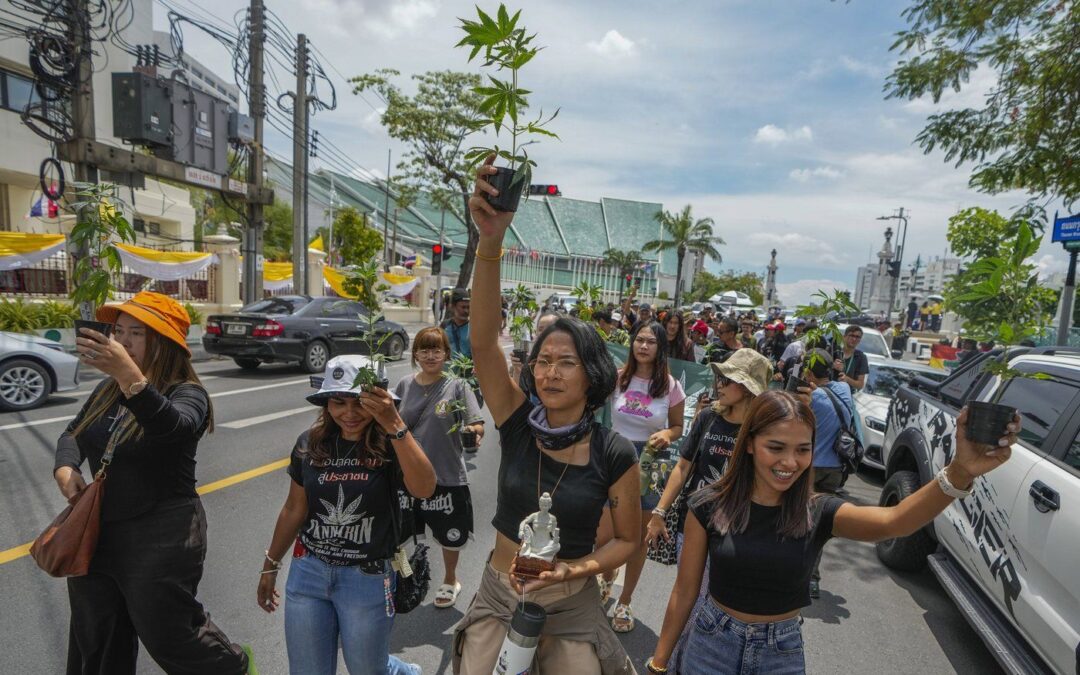
BANGKOK (AP) — Two years after marijuana was decriminalized in Thailand, nearly a hundred of its advocates marched to the prime minister’s office Monday to protest a possible ban on general use.
A health ministry drug control committee approved Friday a proposal to relist cannabis as a narcotic to be only allowed for medical and research purposes. The proposition is set to be submitted to the Office of the Narcotics Control Board this week, and if agreed on, will take effect Jan.1.
Cannabis activists and entrepreneurs, some carrying potted marijuana plants, gathered at the United Nations headquarters in central Bangkok Monday as they prepared to head to the Government House, nearly 1 kilometer (0.62 miles) away.
Advertisement
Prasitchai Nunuan, a representative of a pro-cannabis network of individuals, addressed the protesters, saying that marijuana should be separately regulated by the health ministry instead of criminalizing the plant yet again. He accused the government of outlawing the drug to allow only a few interest groups to benefit from its medical uses.
“This fight for cannabis is not only for medical security or people’s rights but also for destroying the monopoly of politicians taking (its) benefits away from the people,” he said.
Chokwan “Kitty” Chopaka, a cannabis shop owner in Bangkok and activist, also accused the current Thai Cabinet of allowing politics to manipulate such a decision and called on officials to come up with a policy that benefits the majority of people.
“Who are you to judge what they use it for and how they use it?” she added.
Police barricaded the road leading to the Government House, effectively stopping the protesters from marching ahead. who then set up a camp in the area and announced they would remain in place until the government responded to their demands. An official later received the group’s written petition.
Pock Pechthong, a cannabis grower who joined Monday’s march, said while more regulations are needed, a radical rollback will hurt a lot of people who have invested in the business.
“Everybody’s spent a lot of money already. I’m a grower, so our main concern is not being able to grow or use it,” he said.
After cannabis was decriminalized in 2022, it was initially said that it would be allowed only for medicinal use, but in practice, the market remained virtually unregulated, prompting public backlash and concerns over misuse and crime, which the government has cited as reasons for the proposal.
Last month, Health Minister Somsak Thepsuthin said the ministry conducted an online survey and that no less than 80% of the 111,201 participants approved the ban. However, the results were not publicly shared.
Bhumjaithai Party, headed by Anutin Charnvirakul, spearheaded decriminalizing marijuana in the country and promised at the time farmers in its stronghold in the impoverished northeast that it would be a new cash crop.
Anutin, who headed the health ministry in 2022, pushed for an amendment to the Narcotics Law, dropping cannabis from the list of controlled substances. Currently the interior minister, the party head has publically opposed the proposed ban, saying while Bhumjaithai does not support recreational uses of cannabis, the rollback will impact the cannabis industry.
In the last couple of years, we have seen the District of Columbia and 24 other states legalize the recreational use of marijuana. Fourteen other states have also approved the drug for medical use. Of the total number of states that have legalized recreational use, New York is the only state that doesn’t penalize the drug’s use in public.
Now, some GOP legislators claim that the public consumption of cannabis is a nuisance to individuals who don’t like the smell. Advocates of cannabis legalization argue that legislators are overstating the scale of the issue and using the smell as a cover for their actual problem, which is that marijuana shouldn’t be legal.
Paul Armentano, National Organization for the Reformation of Marijuana Laws deputy director, states that legislators who have an issue with public consumption of cannabis are those opposing a change in cannabis policies and seeking excuses to support their positions.
This doesn’t mean that individuals in different cities and states haven’t complained about or mentioned issues with cannabis smell. However, most of the attention on the matter seems to be directed at New York. A quick search of “smell,” “cannabis” and “public” on Google shows that most stories focus on New York City, often referred to as the media capital of the world.
For residents of New York, the smell is the least of their worries when it comes to marijuana. This is mainly because the implementation of its recreational use program has been regarded a disaster, with Governor Kathy Hochul herself referring to it as such.
GOP state assemblyman Michael Novakhov represents some parts of Brooklyn. He stated that while he had nothing against individuals consuming cannabis, his constituents didn’t want their kids exposed to the drug. In 2023, Novakhov proposed a measure that would have banned the public use of marijuana unless approved by local governments. However, this measure and a senate version of it didn’t get past the committee stage.
Many apartments in New York do not allow smoking; most do not have patios or balconies either. This makes it hard for people to consume the drug in their homes. With this in mind, Novakhov highlighted the need for marijuana lounges to be established, as they have been in other states.
He gave the example of people drinking alcohol in bars and added that he’d like to see those who use marijuana in public be illegally fined but not arrested. Thus far, New York has yet to issue any licenses on on-site consumption because officials haven’t created regulations for these businesses.
Cannabis entities such as Tilray Brands Inc. (NASDAQ: TLRY) (TSX: TLRY) hope that solutions are found that address the interests of those who would like to consume marijuana products in designated public spaces or in their homes while also respecting the wishes of those who aren’t interested in the substance.
About CannabisNewsWire
CannabisNewsWire (“CNW”) is a specialized communications platform with a focus on cannabis news and the cannabis sector. It is one of 60+ brands within the Dynamic Brand Portfolio @ IBN that delivers: (1) access to a vast network of wire solutions via InvestorWire to efficiently and effectively reach a myriad of target markets, demographics and diverse industries; (2) article and editorial syndication to 5,000+ outlets; (3) enhanced press release enhancement to ensure maximum impact; (4) social media distribution via IBN to millions of social media followers; and (5) a full array of tailored corporate communications solutions. With broad reach and a seasoned team of contributing journalists and writers, CNW is uniquely positioned to best serve private and public companies that want to reach a wide audience of investors, influencers, consumers, journalists and the general public. By cutting through the overload of information in today’s market, CNW brings its clients unparalleled recognition and brand awareness. CNW is where breaking news, insightful content and actionable information converge.
To receive SMS alerts from CNW, text CANNABIS to 888-902-4192 (U.S. Mobile Phones Only)
Please see full terms of use and disclaimers on the CannabisNewsWire website applicable to all content provided by CNW, wherever published or re-published: https://www.CannabisNewsWire.com/Disclaimer
SNDL Inc. announced that it completed the acquisition of the principal indebtedness of Delta 9 Cannabis Inc. from Connect First and Servus Credit Union Ltd. for a purchase price of $28,138,284. As a result, SNDL has become Delta 9’s senior secured creditor with a first-priority security interest in all of the assets of Delta 9 and certain Delta 9 subsidiaries. The Purchased Indebtedness brings Delta 9’s total indebtedness owing to SNDL to $40,653,352.
SNDL Inc. also announced that it had entered into an agreement to offer to purchase all of the issued and outstanding shares of Indiva and the business and assets of the Indiva Group. The Bid Agreement has been entered into in the context of Indiva’s CCAA proceedings as part of a sales process where the Indiva Assets will be marketed to prospective purchasers.
The Ontario government has told four of its largest provincial agencies, including the Ontario Cannabis Store (OCS), to allocate 25% of their annual advertising spending to Ontario publishers. StratCann has reached out to the OCS for more information on their past annual advertising expenditures for context. We’ll share that with our readers when the OCS can respond.
Health Canada is hosting a hybrid meeting on July 10 with representatives from several cannabis industry associations discussing various updates from Health Canada on topics such as licensing, compliance, medical access, cannabis inspections, legislative changes, and more. It will include members of AQIC, C3, C-45, Craft Cannabis BC and the Canadian Chamber of Commerce.
Village Farms International, the parent company of Pure Sunfarms, is listed as the 95th largest business in BC by revenue on their performance for the 2023 fiscal year, according to BCBusiness.
The Canadian Cannabis Spot Index was assessed at $4.50 per gram this week, or $3.37 after excise taxes are subtracted, down from last week’s C$4.56 per gram, according to Cannabis Benchmarks.
PEI Cannabis wishes those attending the Cavendish Beach Music Festival this weekend to have fun and be safe. Unfortunately, that safe fun can’t include smoking or vaping cannabis, as the festival website notes that smoking is not allowed due to provincial regulations.
A Canadian woman admitted that she smuggled almost $1.8 million of cannabis into Bermuda. No quantity of cannabis was noted in news reports, just a dollar value.
Collective cannabis growing clubs were allowed to begin in Germany on July 1 formally, but confusion around licensing, regulations and other aspects of the new laws continue to be a challenge.
A federal judge in the US dismissed a lawsuit by several Massachusetts cannabis businesses who argued that the federal prohibition on cannabis is unconstitutional, saying only the US Supreme Court could overturn its 2005 ruling upholding the law.
A move to legalize medical cannabis in North Carolina appears to have died on the vine after the state House of Representatives did not take up the bill.
However, the Eastern Band of Cherokee Indians Tribal Council in the same state voted to allow the sale of cannabis, opening the door for North Carolina’s first recreational cannabis dispensary to open by the end of the summer, despite being illegal there.
Finally, one in four admissions to adult mental health ward in 2023 on Guernsey, an island in the English Channel, was likely to be linked to cannabis use, a report has found. The figures are based on “clinical judgement,” which means there could be other contributing factors, but doctors think it is more likely to be linked to cannabis than not, reports the BBC.
I’m wondering if maybe it’s time to stop conflating money with abundance. I see so many books, workshops, articles out there about how to attract more abundance in your life, and the assumption is always there, that this means attracting more money. I guess the idea is, that if you have more money, then you will be able to do whatever you want, and then you’ll be happy.
Every time I see something like this, it strikes me how shortsighted this approach is.
We have the old saying, “time is money”, that has become a whole way of life. I guess the idea is that when you have more money, you’ll have more time. But that doesn’t really make sense. What this saying, “time is money”, really tells me, is that money is limitation, and that whenever you deal with money, you’ll be dealing with limitation. Because time is limitation. In astrology, time, and limitation are ruled by Saturn, which is just the polite way of saying Satan. Saturn is ego, limitation, and time. The Opponent. Eventually, for everyone and everything, time runs out.
It can be very interesting and revealing to watch your energy very closely as you deal with money issues in your life. This may be more obvious to people who have very little money, than to those who have plenty, but i’d like to suggest that a very similar process happens for both, and that is one of limitation.
For those with less, it may manifest more in a fearful way, worrying about survival. Whereas for those with more money, the fear may manifest more in a way of distancing ourselves from others, insulating ourselves especially from those who don’t have, and shutting down our capacity to feel. Otherwise how can a billionaire just hold on to all of that money, seeing that there are SO many beings everywhere going without even their most basic needs ?
For myself, i notice a subtle kind of contraction that comes over me, every time i have to deal with money in some way, whether it is the process of obtaining it, or the process of spending it, because there is scarcity built into the money. The money system as it is set up now, is one of scarcity. There’s simply not enough for everyone in the current system, in which the banks print money with impunity, and then loan it and charge interest on it to boot. Because there is not enough money borrowed into existence to pay the interest owed, someone comes up short, always. And so we are pitted against each other, each one struggling, trying not to be the one who comes up short. Meanwhile, those who created it with a keystroke, didn’t lift a finger to make what it will take years of work to pay back. That is just not fair. The money game is rigged.
And in order to win at that game, we end up being willing to do whatever it takes to get the money, without any consideration of the wider effects what we are doing will have on the world around us and the community at large. Apparently, is no problem for us to profit from the misfortune of others and the destruction of the planet, as long as we don’t see the connection directly. We put on the suit and tie, have fancy corporate logos, big desks, and all the suffering magically goes away. Our mutual fund invests our money in Coca Cola, but it’s all part of a big investment fund, and we don’t really know or care about all the people being poisoned as long as our “investment” grows.
At this point it really seems that those who attract the most money are, for the most part, getting that money by profiting off the misfortunes of others, whether directly, or indirectly. I feel this is due to the debt based control system of money. Most of us are naturally motivated to share our energy with each other, but what we usually end up doing with money the way it is, is to pass around negative energy, because the debt based money actually is an IOU, a minus.
How many of us do something to get money, that otherwise we would not be doing? I have a feeling it is a very large percentage, from the looks of things. Even if it is something we enjoy doing, we may not particularly feel like doing it just to get money. Something changes in the process when money becomes the purpose. I am really starting to wonder if it slowly but surely eats away at our souls, and our capacity to feel. And even more than that, our capacity to connect to the Source itself.
How different when we do something just for the love of it ! Especially when that something brings real benefit to others. And if that happens to attract money, then we have money that has been purified, by our love. So perhaps some money is more valuable than other money, depending how we got it.
I’d like to speculate that the entire function of money is to pull us out of our center, and to keep our attention fastened into the illusion of the 3 dimensional world. Many are now waking up to the fact that the money system as it is, is nothing but a system of limitation, slavery, and control. Perhaps now it is time to really examine our relationship to money in the light of this. We can really watch how we feel, in “real time”, as we deal with money.
What is true abundance? Where is it? How do we access it?
Abundance is the very essence of Eternity. We have been trained to think of eternity as somewhere else, some place that maybe we will access after we die, after a very very long time. Somehow we think of eternity as a very long amount of time, and far away from here. No, here we are stuck in time, a very limited place, and then after our prescribed amount of time, we will die. Just like our bank account. Limited. Sure, you may have a million dollars, but that’s it. It is not infinite, endless, and always replenished. When you have spent the million, you’re broke. What kind of abundance is that??
(Sure, your million bucks can “earn” interest, but the problem with that is that somewhere down the line, out of your view, someone else goes without, in order for you to receive that interest. And others work their butts off to receive a small fraction of what your money “earns” while you are otherwise amusing yourself. If what’s good for you is not good for everyone, then perhaps it is time to rethink some things.)
What if i tell you that Eternity is here now, always, without beginning or end, and effortlessly available to each and every one of us, without any obstruction of any sort? How does that sound?
In eternity, all is already accomplished. There is no struggle, no obstruction, no strife. Everything is complete. There is no death, no limitation, no suffering, no disease.
This realm is always available to us. We can live in it now, at the very same time as being here in this dimension. Living like this is what will transform this world into the world we would like to see.
Osho said: “I live my life based on 2 principles. One, I live as if today was my last day on earth. Two, I live today as if I am going to live forever.”
So many of us are trying our best to live the first part of this, which is admirable advice in and of itself, but the entire quote is radically brilliant. Because we ARE both infinite and finite. And the infinite knows no scarcity.
The money has been hijacked, and is being used to control us, by some not so friendly forces, the offstage parasitic puppet masters. I wrote about this already in my piece called Free Money, but it is worth exploring further.
To be really free, we have to live as eternal beings. There is no hurry, because time is not an issue. There is no worry because the Source is inexhaustible. No scarcity, no loss.
So what can we do? How can we begin living beyond money? For starters, I’d like to suggest “money fasting”.
Really, to me, money appears like an addiction. Perhaps we should treat it like an addictive substance, which can perhaps be not good for our health. Perhaps we need to free ourselves from the addiction. Like a drug addict, going through withdrawal.
We always just assume if we had a lot of money, things would be so much better. But look at the billionaires and trillionaires of this world ! Some strange and for the most part miserable, if not downright evil characters, if you ask me. Of course there are always exceptions, but this seems to be a trend. And they definitely have no scruples whatsoever about profiting from the misfortunes of others. In fact really, the more the better for them. The suffering of others is food for them.
So with money fasting, we can practice living beyond money, by having regular days, one per week, or more, where we have nothing to do with money whatsoever. No dealing with it, no earning it, no spending it. No thinking about it. And notice the difference in how you feel.
And spend the time doing something you love to do.
Really the reason we want a lot of money is so we will never have to think about it, right? So perhaps we can cut to the chase, and not think about it, as much as possible, even if we only have a little. The minute we start thinking about it, or doing things with money as the goal, we are gone from the present. And when we are gone from the present we lose our magnetism to attract abundance.
What is it that has REAL value? To me, the true value comes from our capacity to appreciate, which is really about being present and beholding the beauty directly in the moment. That word, “appreciate”, has been hijacked by the financial industry to mean that whatever you own increases in value. “Interest” is another word that has been stolen. Your interest is your attention, which is sourced in your eternal substance.
We can also simplify life a lot, reducing all expenses, not as in self deprivation, but as in lightening the load. We really don’t need so much to be happy. Even a dog can demonstrate that. A very simplified life is a release from many burdens. We can create more space in our lives for the inner process. More silence. More nature. More creativity. More naps. Less clocks. Less machines. Jump off the wheel !
If we do not awaken to our own direct eternal source of light, it will be used, like a battery, to power the false god misery play that is going on now. It’s one way or the other. Be a light unto yourself, or be a battery for the machine. If you choose to ignore, you become a battery by default. Your permission is assumed if you do not consciously withdraw it. That’s the way the world of commerce and law is set up. It is all set up to use your energy.
So when you participate in that game you are being used. You receive some perks, but that is not freedom.
It is time to grow beyond money. The system is so grossly and obviously unfair, that we can see it is time for a change at that level. Until that changes, we are not going to see any real progress. The banking and financial system is controlled by a massive parasite, that has been sucking the blood of humanity, figuratively AND literally, for a long long time.
Don’t get me wrong. Money in itself is not so much the problem, as what the money system has now become. It doesn’t take a rocket scientist to see that it is not fair. And it is very easy to see, too, who is responsible for it, at least here in the 3D level of things. Originally it probably was some form of exchange process that simply made things more convenient. But perhaps it is time to outgrow the whole process. it definitely needs a transformation. But first, the parasite that feeds on suffering needs to be removed from the equation.
The most effective thing we can do right now, imho, is to stand aside, free our own energy from it as much as possible, and let it eat itself alive. Because that is what it is about to do. Once it can no longer eat our energy, it will eat itself.
And meanwhile, we can begin doing something we love, for the love of it. Practice putting love before money. If we all begin with this, we will see miraculous changes come about.
i am grateful to whoever created these two wonderful images. Would love to be able to credit you accordingly, so if these are yours, please let me know !
Timeline: 2:23 Sunflowers facing jupiter 5:17 6g 6:306:38 Schumann resonsance 8:40 Where can i find books? 10:42 Mitch the orgone donor 12:00 Shilajit and Pearl 13:38 Eyes 14:25 1000bulbs.com 15:15 Red Light therapy 16:28 Canada, UK, California 17:17 LED lights and fatigue 18:11 *Food falling apart 20:15 GMOS the truth 22:18 Californa Climate change 23:40 Pearl powder and hair growth 24:17 Green Myths 26:02 infared saunas 27:12 gas powered car 28:20 Fractals and food 31:12 inflation 33:07 Crypto 35:20 Joshua Tree cut down? 37:14 *Bill Nye Science Guy 38:30 Billy Ghates 40:00 Lies Europa Last Battle 41:13 internet bans 44:15 Sickness in the US 46:46 GMO cannabis 47:29 Mars Nevada 48:46 Superfoods and Vertigo 50:41 What time to take pearl, dragons blood, and shilajit?
Pennsylvania’s medical cannabis market generated more than $1.3 billion in sales in 2023, despite numerous issues and outages with the state’s mandated track-and-trace software. Operators claim these problems could be avoided if the software provided by MJ Freeway functioned correctly.
Although MJ Freeway recently merged with BioTrack to form Alleaves, it remains the sole provider under a contract established in 2017. Industry operators and a few legislators have voiced frustrations regarding MJ Freeway’s lack of a two-way Application Programming Interface (API) with other approved software used for sales and inventory management. This means businesses must manually input data, such as lab results and POS information, into MJ Freeway, which is both prone to errors and is time consuming. Additionally, when MJ Freeway experiences an outage, such as one that occurred last September, all operations are forced to halt.
Software providers, such as I Heart Jane and Dutchie, have confirmed that the API connection with MJ Freeway is nonfunctional, further complicating matters for businesses.
The situation is exacerbated by the state health department’s delay in implementing a fully integrated API system as mandated by a 2021 rule. State Representative Joe McAndrew expressed his confusion over the monopoly held by MJ Freeway in the state’s cannabis industry. McAndrew presented a resolution to the state legislature in May that would mandate that the health department integrate the required API technology per state law and review its contract with MJ Freeway within a month.
At the moment, medical marijuana enterprises can employ seven software providers certified by the health department; however, not all of them can interface with MJ Freeway. The ambiguity surrounding which platforms can communicate with the mandated software adds to the confusion.
Neil Ruhland, a spokesman for the health department, emphasized the organization’s dedication to safeguarding patient data while also looking for ways to enhance the current setup. Ruhland acknowledged that Pennsylvania already employs a seed-to-sale solution with some API capabilities, but he did not specify which vendors have a functional two-way API with MJ.
Moreover, the state is exploring alternatives to MJ Freeway, as indicated by a public notice posted last November, though the current status of that search remains unclear.
The $10.3 million, five-year contract with MJ Freeway was extended in April 2022. Grown In, a cannabis-related newsletter, said that MJ Freeway can charge medical cannabis licensees an extra $80,000 a year for assistance because of the deal.
As state lawmakers consider three different proposals for legalizing adult-use marijuana, the importance of a reliable seed-to-sale platform becomes more evident. Legalization PA, an advocacy group, estimates that legalizing recreational cannabis could potentially boost the state’s cannabis market to $2.8 billion in yearly sales.
Cannabis advocates thus emphasize the necessity of an effective and interactive software system to prevent the problems encountered in the past few years.
The concerns of industry players in Pennsylvania need to be addressed so that they don’t have to grapple with more challenges than they already face. This will enable them to have a chance at thriving in the same way industry companies such as Aurora Cannabis Inc. (NASDAQ: ACB) (TSX: ACB) are thriving in other legal markets.
About CNW420
CNW420 spotlights the latest developments in the rapidly evolving cannabis industry through the release of an article each business day at 4:20 p.m. Eastern – a tribute to the time synonymous with cannabis culture. The concise, informative content serves as a gateway for investors interested in the legalized cannabis sector and provides updates on how regulatory developments may impact financial markets. If marijuana and the burgeoning industry surrounding it are on your radar, CNW420 is for you! Check back daily to stay up-to-date on the latest milestones in the fast -changing world of cannabis.
To receive SMS alerts from CNW, text CANNABIS to 888-902-4192 (U.S. Mobile Phones Only)
Please see full terms of use and disclaimers on the CannabisNewsWire website applicable to all content provided by CNW, wherever published or re-published: https://www.CannabisNewsWire.com/Disclaimer
(CNW) TORONTO and GLIL YAM, Israel – IM Cannabis Corp., a leading medical cannabis company with operations in Israel and Germany, announces that the board of directors of the company has approved a consolidation of its issued and outstanding common shares on the basis of one post-consolidated Common Share for every six pre-consolidated Common Shares.
The Board has set July 12, 2024 as the effective date of the consolidation and anticipates the Common Shares to trade on a post-consolidated basis effective July 12, 2024, subject to final confirmation from the Canadian Securities Exchange and Nasdaq Stock Market LLC. Upon the competition of the consolidation, the CUSIP and ISIN of the Common Shares will be changed to 44969Q406 and CA44969Q4060, respectively. The company’s name and stock symbols shall remain unchanged.
After giving effect to the consolidation, the Common Shares will be reduced from 13,394,136 to 2,232,357 Common Shares. No fractional Common Shares will be issued in connection with the consolidation. Instead, all fractional Common Shares equal to or greater than one-half resulting from the Consolidation will be rounded to the next whole number, otherwise, the fractional Common Share will be cancelled. The exercise price and/or conversion price and number of Common Shares issuable under any of the company’s outstanding convertible securities will be proportionately adjusted in connection with the Consolidation.
Shareholders of record as of the effective date will receive a letter of transmittal from Computershare Investor Services Inc., the company’s registrar and transfer agent for the Common Shares, providing instructions for the exchange of their Common Shares as soon as practicable following the effective date. Registered shareholders may also obtain a copy of the letter of transmittal by accessing the company’s SEDAR+ profile at www.sedarplus.ca. Until surrendered, each share certificate or direct registration system statement representing pre-consolidated Common Shares will represent the number of whole post-consolidated Common Shares to which the holder is entitled as a result of the Consolidation. No action is required by beneficial holders to receive post-consolidation Common Shares in connection with the Consolidation. Beneficial holders who hold their Common Shares through intermediaries (e.g., a broker, bank, trust company investment dealer or other financial institution) and who have questions regarding how the Consolidation will be processed should contact their intermediaries with respect to the Consolidation.
Fort 20 Farms is a newly licensed indoor micro cultivator in BC’s Lower Mainland, located on a 40-acre farm about an hour outside of Vancouver.
The owner and director, Andrew Neitzel, started the company with two other partners who serve as the master grower and facility manager. After about a year of renovation and applications, they received their licence to cultivate in December 2023.
“We want to make smart decisions as we go forward and create opportunities as we can. With any young business, any decision can be a make-or-break decision.”
A few months later, Fort 20 released its first two crops into the B2B market and under its brand in the BC market through local processor TriCanna—its BC Kemo and Purple Jelly, available in3.5-and 14-gram SKUs and pre-rolls. Neitzel says they plan to offer products through BC’s direct delivery program beginning in July.
Neitzel says the Kemo cultivar is one of the original UBC Chemo strains, and the Purple Jelly is a unique cultivar brought in by Fort 20’s master grower.
Although their first crops were sold into the BC market, the micro cultivators are also considering the export market. They recently received their GACP certification.
Still, they aren’t looking to make any big moves, opting to take each step carefully.
“We’re just putting one foot in front of the other, not trying to do everything at once,” explains Neitzel. “We want to make smart decisions as we go forward and create opportunities as we can. With any young business, any decision can be a make-or-break decision.”
Currently, the priority has been connecting with local retailers in BC and talking to them about the products they have for sale through the BCLDB and through the direct delivery platform.
“We’re out there talking to retailers, letting them know who we are, that we’re just a small team who is passionate about good cannabis, and we have some very unique strains so I think we can help those retailers have something unique.”
Being a micro producer isn’t easy, he adds, but working in agriculture much of his life as a second-generation farmer, he says he’s used to it.
“The cannabis industry is a challenging business. I love agriculture, and with a farming background we’re used to not making money (laughs). Some years are good, some years are bad. The [cannabis] industry is obviously going through a lot of changes right now, and I’m hopeful that the cream will rise to the top and people who put out a good, reliable, clean product will find success. But there’s a lot of competition, and probably a lot of people who do a good job with that. So we’re doing a good job, connecting with people and just taking it one step at a time.”
Secretary of Transportation Pete Buttigieg recently announced that cannabis’ reclassification wouldn’t impact drug testing policies for truckers. While speaking at a congressional hearing this past week, he explained that this was primarily because the U.S. Transportation Department listed cannabis as a substance to screen for.
Buttigieg had been responding to a question tabled during a hearing of the House Committee on Transportation and Infrastructure asked by Representative Rick Crawford. Crawford had brought up concerns about the extensive public safety and health consequences of cannabis rescheduling on the country’s highway system and those who used it, such as members of the American Trucking Associations.
This discussion comes after the American Truckers Associations penned a letter to Buttigieg focused on raising alarms about the rescheduling of cannabis. In its letter, the association noted that such a major shift in policy would have considerable negative consequences for highway safety, endangering all who used the road.
Crawford explained how the reclassification and deregulation of cannabis would increase the number of individuals driving while impaired, then requested the official comment on what the department as a whole was doing to make sure safety-reliant positions and transportation workers would continue to be tested for cannabis use.
In addition, he asked that the department disclose how it planned to address safety in transportation in light of the decision made by the U.S. Department of Justice.
Buttgieg addressed these issues, explaining that the department didn’t expect any testing requirement on drugs to be changed based on the rescheduling decision. He added that the department viewed impaired driving, be it while under the influence of cannabis or alcohol, as a major safety concern.
At the moment, it isn’t clear if other federal employees will need to test for cannabis use if reclassification is approved. Going by current regulations, federal employees are subject to agency-specific and blanket workforce policies.
Additionally, the use of drugs classified under Schedule 1 and 2 of the Controlled Substances Act by federal employees is forbidden under a 1986 executive order issued by former President Ronald Reagan. The decades-old order, which created the Federal Drug-Free Workplace program, still governs many individual agencies.
Some attorneys believe that because this order defined illicit substances as those classified under the aforementioned schedules, cannabis being moved to Schedule 3 would lift restrictions that apply to all federal employees.
During the hearing, Buttigieg also responded to queries tabled by Representative Michael Bost, who asked about the impact of cannabis reclassification on drug testing for subway operators, school bus drivers, truckers and other federal transportation workers.
Cannabis companies such as SNDL Inc. (NASDAQ: SNDL) will continue to watch how the regulatory landscape evolves after the rescheduling is completed, so that they see how those changes could impact their medium- to long-term strategic direction in the markets in which they operate.
About CannabisNewsWire
CannabisNewsWire (“CNW”) is a specialized communications platform with a focus on cannabis news and the cannabis sector. It is one of 60+ brands within the Dynamic Brand Portfolio @ IBN that delivers: (1) access to a vast network of wire solutions via InvestorWire to efficiently and effectively reach a myriad of target markets, demographics and diverse industries; (2) article and editorial syndication to 5,000+ outlets; (3) enhanced press release enhancement to ensure maximum impact; (4) social media distribution via IBN to millions of social media followers; and (5) a full array of tailored corporate communications solutions. With broad reach and a seasoned team of contributing journalists and writers, CNW is uniquely positioned to best serve private and public companies that want to reach a wide audience of investors, influencers, consumers, journalists and the general public. By cutting through the overload of information in today’s market, CNW brings its clients unparalleled recognition and brand awareness. CNW is where breaking news, insightful content and actionable information converge.
To receive SMS alerts from CNW, text CANNABIS to 888-902-4192 (U.S. Mobile Phones Only)
Please see full terms of use and disclaimers on the CannabisNewsWire website applicable to all content provided by CNW, wherever published or re-published: https://www.CannabisNewsWire.com/Disclaimer














Recent Comments