StickIt Technologies Inc., an Israeli technology and cannabinoid company, announces today reorganization and reduction of significant expenses.
As part of the reorganization, the company intends to reduce significant expenses in its activities around the world. The company decided in January 2024 to close the raw materials factory in Galilee, Israel, due to the war and move the raw materials production activity to Calgary, Canada. During the end of the 3rd quarter of 2024, the company intends to close its subsidiary StickIt Thailand Ltd (based in Thailand) in accordance with the government’s statement on ending the recreational use of cannabis in the country. The company also intends to close StickIt Spain’s CBD manufactory and the company’s offices in Barcelona and transfer the producing franchise to a local distributor.
“The world’s cannabis industry is facing many challenges – which affects most companies in the industry and probably affects the share value. It is necessary to reduce costs and try to increase our technology sales worldwide. These actions will save the company about $120,000 CAD a year,” concluded Eli Ben Haroosh, CEO of StickIt Technologies Inc.
The CEO went on to say that during Q3 2024, StickIt’s Research Unit will produce the special THC straw for mass creation.
About StickIt Technologies Inc StickIt is a technology company that invented and manufactures innovative products (“devices”) that can contain varying quantities of CBD/THC for recreational and medical cannabis users. Its operating model is to establish joint ventures/licensees (“partners”) in countries around the world that will establish a production facility in which they will add the cannabinoid content to the “sticks” and “straws” produced and supplied by StickIt. The Company’s precise dosing options cater to a wide range of effects, including painkilling, energizing, focus, sleep improvement, etc., and can be tailored to meet local preferences and regulations. StickIt Technologies serves customers worldwide.
About Ripco Processing Inc. Ripco, known for its innovative cannabis products, brings popular brands like StickIt and StripIt to the Canadian market. StickIt is an infused stick designed to enhance the performance of prerolls, promising to take user experiences to new levels – just StickIt!
The state of California will be allowing the sale and consumption of cannabis at this year’s fair for the first time. While the fair has in the past featured educational booths on marijuana as well as competitions, this will be the first time adults will be allowed to consume and buy the drug.
Embarc cofounder Lauren Carpenter stated that hosting marijuana sales and consumption was a huge milestone in destigmatization as it facilitated a deeper connection between farmers who grow their products with extra care and consumers.
The state fair is set to begin on July 12, 2024, and run July 28, 2024, featuring a 30,000-foot2 consumption area. Any individual aged 21 years and older will be able to review different marijuana products, virtually add them to a cart, then pick the products up at one of the off-site dispensaries owned by Embarc, which is one of the fair’s partners on the expanded cannabis offerings.
James Leitz, executive producer of the Cannabis Competition and Exhibit, stated that this move by the state called attention to the important role of marijuana in the agricultural industry of California, and marked an important milestone in the fair’s 170-year history. Leitz explained that affording patrons the chance to directly engage with and consume different brands and expanding the competition was transformational, particularly when it came to how the public understood marijuana.
California is the second state to allow the sale and use of marijuana on-site, after the state of New York allowed the same at its 2021 fair following the legalization of recreational marijuana.
New York didn’t continue the tradition, however, after its fair prevented public consumption in 2023. However, attendees could still purchase cannabis products from the local growers at a marijuana farmers’ market held together with the event.
The categories at this year’s marijuana awards competition at California’s state fair are also being broadened to include other product categories, including edibles, concentrates and pre-rolls. This has led to a doubling in the number of entries, an encouraging move.
The CEO of the California State Fair, Tom Martinez, stated that the fair made a historic move to allow a marijuana exhibit and competition in 2022. Martinez also revealed that the fair had partnered with Embarc, the state of California and the city of Sacramento, as well as public health and safety infrastructure, to make sure that the event was both community sensitive as well as responsible.
In other news, the California Assembly passed a measure to legalize marijuana cafes in the state.
As different legal marijuana markets evolve to allow the consumption of the substance at events such as state fairs, industry actors such as SNDL Inc. (NASDAQ: SNDL) could attract more customers during those events and convert them into long-term clients.
About CannabisNewsWire
CannabisNewsWire (“CNW”) is a specialized communications platform with a focus on cannabis news and the cannabis sector. It is one of 60+ brands within the Dynamic Brand Portfolio @ IBN that delivers: (1) access to a vast network of wire solutions via InvestorWire to efficiently and effectively reach a myriad of target markets, demographics and diverse industries; (2) article and editorial syndication to 5,000+ outlets; (3) enhanced press release enhancement to ensure maximum impact; (4) social media distribution via IBN to millions of social media followers; and (5) a full array of tailored corporate communications solutions. With broad reach and a seasoned team of contributing journalists and writers, CNW is uniquely positioned to best serve private and public companies that want to reach a wide audience of investors, influencers, consumers, journalists and the general public. By cutting through the overload of information in today’s market, CNW brings its clients unparalleled recognition and brand awareness. CNW is where breaking news, insightful content and actionable information converge.
To receive SMS alerts from CNW, text CANNABIS to 888-902-4192 (U.S. Mobile Phones Only)
Please see full terms of use and disclaimers on the CannabisNewsWire website applicable to all content provided by CNW, wherever published or re-published: https://www.CannabisNewsWire.com/Disclaimer
Through acquisition, management has agreed to use 10% of the profits from logistics business to buy back and retire GTVH stock
“This transition marks a pivotal moment in our journey,” states exec
Management is crafting a comprehensive business plan that substantially expands the company’s growth trajectory
Golden Triangle Ventures (OTC: GTVH) continues to take strategic steps toward expanding and positioning the company for fundamental business income and financial independence. The latest in these steps is the completed acquisition of Cargo Management Group, a multifaceted logistics and trucking operation (https://cnw.fm/IjALN). According to the announcement, through this acquisition, management has agreed to use 10% of the profits from its logistics business to buy back and retire GTVH stock, effectively reducing the number of outstanding shares on a consistent basis as profits are realized. The buyback will commence once the full transition of the logistics business is complete and profits of the business can be realized.
A complete shipping, logistics and trucking operation, Cargo Management Group will be a key component in providing support for GTVH’s Lavish Entertainment division. With the acquisition completed, Golden Triangle is now focused on facilitating the company’s assumption of full ownership of the logistics operation, brokerage business, licenses and all associated assets.
“We are confident about successfully implementing our initiatives, maintaining profitability and significantly scaling the operation,” said Lavish Entertainment president and COO Marco Antonio Moreno. “Our goal is to secure premium, dedicated, high-paying lanes, upgrade our existing equipment, strengthen all operations and expand our business into more lucrative markets, which further supports our other internal projects. This transition marks a pivotal moment in our journey, as we are now boots on the ground working towards a seamless integration, transition and a complete business enhancement on all fronts.”
The acquisition of Cargo Management Group brings a time-tested, proven performer into the Golden Triangle community. Cargo Management Group reported close to $3 million in top-line revenue last year. In addition, the company currently has contracts with numerous prominent corporations, including JB Hunt, CH Robinson, Coyote Logistics and Echo Logistics. Cargo Management Group also holds high-paying specialized loads in the gaming industry to transport slot machines to locations nationwide.
Short-term, GTVH and Cargo Management Group are focused on defining the structure and transition strategy for combining a high-performing shipping and logistics operation into GTVH. In addition, key team leaders are crafting a comprehensive business plan that builds on the strengths of the combined companies, which will substantially expand the company’s growth trajectory. Specifically, the plan will include incorporating all types of trucking freight movements and adding heavy haul to the services offered by GTVH and Cargo Management Group.
“This initiative marks the first of several strategies we plan to implement that aim to optimize our capital structure within GTVH,” said Steffan Dalsgaard, Golden Triangle Ventures president. “Our goal is to develop true fundamental business activities that support all our operations. We have successfully implemented the first part of our four-pillar business model that supports Lavish Entertainment and our flagship Destino Ranch project, and our team is now focused on executing a series of other promising developments. These efforts are designed to further our objective of increasing shareholder value across all facets of our company.”
Golden Triangle Ventures is a multifaceted consulting company that operates as a parent business pursuing ventures in the health, entertainment and technology sectors, along with other sectors that provide synergistic value to these three core divisions. The company aims to purchase, acquire and/or joint venture with established entities within these areas of business. The goods and services represented are driven by innovators who have passion and commitment in these marketplaces. The company plans to utilize relationships and create a platform for new and existing businesses to strengthen their products and/or services. The three points of the Golden Triangle exclusively represent the three sectors the company aims to do business in.
NOTE TO INVESTORS: The latest news and updates relating to GTVH are available in the company’s newsroom at https://cnw.fm/GTVH
About CannabisNewsWire
CannabisNewsWire (“CNW”) is a specialized communications platform with a focus on cannabis news and the cannabis sector. It is one of 60+ brands within the Dynamic Brand Portfolio @ IBN that delivers: (1) access to a vast network of wire solutions via InvestorWire to efficiently and effectively reach a myriad of target markets, demographics and diverse industries; (2) article and editorial syndication to 5,000+ outlets; (3) enhanced press release enhancement to ensure maximum impact; (4) social media distribution via IBN to millions of social media followers; and (5) a full array of tailored corporate communications solutions. With broad reach and a seasoned team of contributing journalists and writers, CNW is uniquely positioned to best serve private and public companies that want to reach a wide audience of investors, influencers, consumers, journalists and the general public. By cutting through the overload of information in today’s market, CNW brings its clients unparalleled recognition and brand awareness. CNW is where breaking news, insightful content and actionable information converge.
To receive SMS alerts from CNW, text CANNABIS to 888-902-4192 (U.S. Mobile Phones Only)
Please see full terms of use and disclaimers on the CannabisNewsWire website applicable to all content provided by CNW, wherever published or re-published: https://www.CannabisNewsWire.com/Disclaimer
Recent report projects global cannabis market to reach $444.34 billion by 2030
MedCana and its subsidiaries are focused on establishing stronghold in this expanding space
MedCana is committed to advancing cannabis production and agricultural technology around the world, while also driving innovation and promoting sustainability
The cannabis industry continues to grow, as it has consistently for the past several years. Recent projections value the global cannabis market at almost $445 billion by 2030 (https://cnw.fm/k4VDg). This is good news for Software Effective Solutions (d/b/a MedCana) (OTC: SFWJ), a leading entity in the cannabis and agricultural technology sectors. Recently, MedCana noted remarkable advancements across its diverse portfolio, which includes five companies focused on pharmaceutical cannabis production, as well as a software company focused on managing processes for plant-to-patient operations (https://cnw.fm/a2HeY).
“The global cannabis market size is projected to grow from $57.18 billion in 2023 to $444.34 billion by 2030, at a CAGR of 34.03% during the forecast period,” reported Fortune Business Insights, which noted that cannabis has been used for thousands of years for its therapeutic and medicinal benefits. “Marijuana legalization is gaining momentum across the globe. This momentum is driven primarily by increasing recognition that the product may have a range of legitimate medicinal benefits and therapeutic applications. It is the most widely cultivated, trafficked and consumed drug worldwide.”
MedCana is focused on positioning itself in this expanding space. The company reports that its subsidiaries are seeing significant success in different parts of the world. Several business units are currently in the final stages of negotiations to determine specific varietals to export to Europe and Australia; both countries are expected to see significant growth in their cannabis markets in coming years. In addition, the company’s South American subsidiary, Eko2o Environmental Solutions S.A.S., is rapidly expanding its reach within the agricultural industry, specifically eyeing growth in the Costa Rica and Central American markets (https://cnw.fm/HxRhQ).
Clearly, MedCana is poised for growth and profitability. The company’s deliberate decision to focus on cannabis production is bearing fruit, with operations working to meet the stringent quality and regulatory standards of the European and Australian markets. When these standards are met, the resulting expansion is expected to significantly boost MedCana’s international presence and open new avenues for growth.
“We are delighted with the progress we’ve made across all fronts,” said MedCana CEO Jose Gabriel Diaz. “The final negotiations for cannabis exportation and the rapid expansion of Eko2o’s technology distribution mark a significant milestone in our journey. We are now closer than ever to achieving profitability and solidifying our position as industry leaders.”
MedCana is committed to advancing cannabis production and agricultural technology around the world, while also driving innovation and promoting sustainability. As the company moves forward with its strategic growth plans, stakeholders can expect to see enhanced profitability and a stronger global presence.
Software Effective Solutions/MedCana is a holding company focused on developing companies in the agricultural technology and cannabis industries. The company remains dedicated to delivering on its promise of building a solid foundation for future growth of its holdings.
For more information, visit the company’s website at www.MedCana.net.
NOTE TO INVESTORS: The latest news and updates relating to SFWJ are available in the company’s newsroom at https://cnw.fm/SFWJ
About CannabisNewsWire
CannabisNewsWire (“CNW”) is a specialized communications platform with a focus on cannabis news and the cannabis sector. It is one of 60+ brands within the Dynamic Brand Portfolio @ IBN that delivers: (1) access to a vast network of wire solutions via InvestorWire to efficiently and effectively reach a myriad of target markets, demographics and diverse industries; (2) article and editorial syndication to 5,000+ outlets; (3) enhanced press release enhancement to ensure maximum impact; (4) social media distribution via IBN to millions of social media followers; and (5) a full array of tailored corporate communications solutions. With broad reach and a seasoned team of contributing journalists and writers, CNW is uniquely positioned to best serve private and public companies that want to reach a wide audience of investors, influencers, consumers, journalists and the general public. By cutting through the overload of information in today’s market, CNW brings its clients unparalleled recognition and brand awareness. CNW is where breaking news, insightful content and actionable information converge.
To receive SMS alerts from CNW, text CANNABIS to 888-902-4192 (U.S. Mobile Phones Only)
Please see full terms of use and disclaimers on the CannabisNewsWire website applicable to all content provided by CNW, wherever published or re-published: https://www.CannabisNewsWire.com/Disclaimer
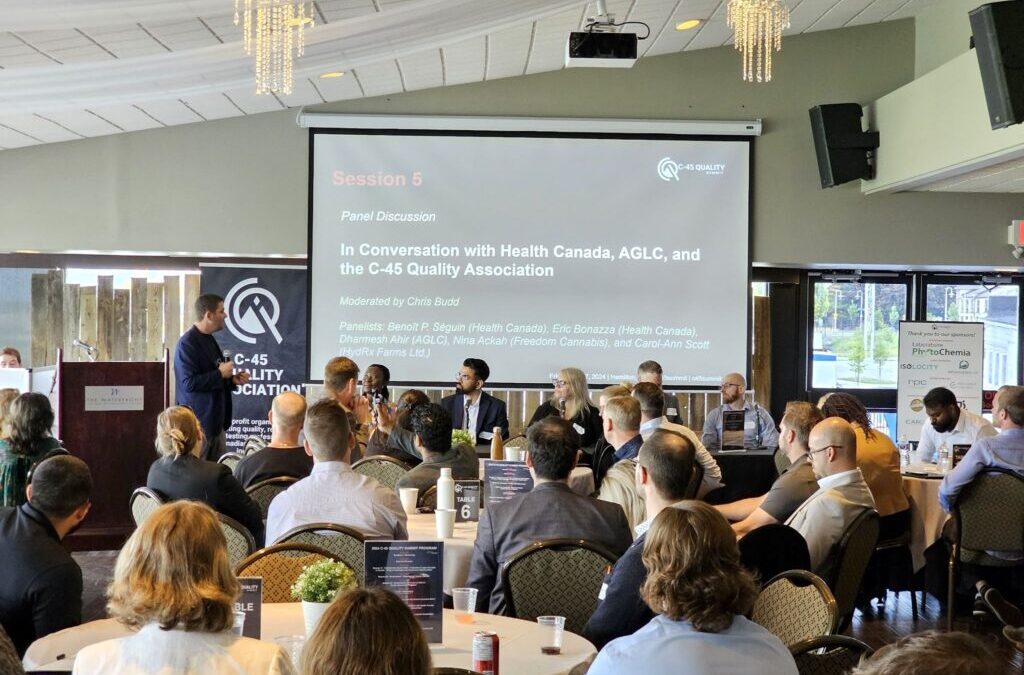
On June 7, the C-45 Quality Association hosted its Quality Summit, bringing together quality, regulatory and lab testing professionals from Canada’s cannabis industry. Billed as an event for networking and discussion to examine current trends, challenges and innovations, the Summit set a high bar. The event featured panels and educational workshops whose participants included people from cannabis labs and suppliers, QAPs, industry executives and public sector managers.
For those wanting to take a deeper dive into quality assurance and cannabis processing, and related regulatory policy the meeting did not disappoint. For example, it’s rare to witness an open exchange with government executives at an industry event, especially where three Health Canada representatives shared the stage and took questions. Wading into the Department’s presentation, Director General Benoît Séguin declared he was open to dialogue. Delegates subsequently peppered him with queries about the Expert Panel Report on the Cannabis Act Legislative Review, advertising and promotion practices, edibles limits and QAP responsibilities.
In the midst of the afternoon government panel, alert participants scanning their cell devices reported that HC had just released its proposed regulatory amendments in the Canada Gazette. After conferring with Brazeau Seller’s, Trina Fraser, Harrison Jordan of Substance Law discovered that several proposals he’d submitted to the Review had been addressed – such as his suggestions that multiple edibles containers be allowed for packing within an outermost container; and that transparent product containers be permitted.
Health Canada’s proposals would remove the 10 mg THC limit for outermost packaging to allow co-packing of multiple product containers and would permit cut-out windows on packaging of dried or fresh cannabis and cannabis seeds.
Advertisement
Jordan then invited Séguin to join him in “smoking a fatty” to the room’s general merriment.
Perhaps the most popular of Health Canada’s proposals was the draft provision to increase the number of permitted alternate QAPs to “one or more” from the current allowance of “up to two,” and to allow delegation of activities while maintaining QAP’s accountability and overall responsibility for compliance. Other streamlining proposals were favourably received, such as labelling changes to improve the clarity of consumer information (e.g., simplifying potency reporting by removing the requirement for equivalency to dried cannabis statements on product labels).
Some further highlights from the day included the following:
Federally, only 2 per cent of inspections identified critical issues. However, 24 per cent found major issues, with the GPP category showing the highest incidence of non-compliance. Overall non-compliance for licensees last year was 5 per cent.
In Alberta, paperwork and shipment quality are major areas of non-compliance for inbound shipments to the AGLC. Other top concerns are master data errors, mislabeling, and vendor legal issues (e.g., packaged on date exceeds age threshold).
Vapes were highlighted by both the AGLC and OCS as the subject of frequent complaints. While Alberta reported 13,067 vape returns that number represents only 0.21 per cent of the over 6 million vapes sold in the province last year. In Ontario, consumers’ top vape complaints were clogging/no vapour, leaking and disposable pen DOA.
National testing standards garnered much interest among attendees. Whether attendees preferred voluntary measures or federal regulations was unclear but there was general agreement on impacts.
The panel on analytical variability cited methodological differences as an issue driving the call for common standards. Panelists agreed that lab shopping, varied sampling procedures and mixed interpretations of SOPs can skew test results. In the end, variability might be good for basic research but it’s “a killer,” as Safari Flower CEO Brigitte Simons put it, where consistency and fast turnaround are needed in a highly competitive business.
The most cathartic session was arguably QAP workplace challenges, where those not privy to the intricacies of quality assurance got a glimpse of how the sausage is made. Production bottlenecks, label printing, the harried life of co-packers, and the trauma of lost batch records triggered gasps and knowing glances.
I came away from the event with a stronger sense of the role quality management plays in cannabis operations, the risks affecting production, and of how staff at LPs work with compliance officials and provincial wholesalers. That the Summit sparked meaningful engagement and concluded on an optimistic note would seem to bode well for Canada’s cannabis industry.
A new study has found that the rate of cannabis-related disorders diagnosed among pregnant women in Québec increased by more than 20% after legalization, while rates for all other drug- and alcohol-related disorders remained stable.
Cronos Group Inc. announced an expansion of Cronos Growing Company (GrowCo), with about $71 million provided by an additional credit facility from Cronos intended to assist GrowCo’s expansion to satisfy domestic and international demand.
MediPharm Labs Corp. announced it has entered into a licensing agreement with Remidose Aerosols Inc. to acquire the exclusive rights to the latter’s cannabis products. Current Remidose customers will be serviced through MediPharm starting August 2024.
High Tide Inc. announced the opening of a new Canna Cabana retail cannabis store in Calgary, opening on June 21. This is the chain’s 80th location in Alberta and High Tide’s 173rd Canna Cabana branded retail cannabis location in Canada.
A cannabis store in Edmonton was robbed on June 17 by a pair local police say were involved in other armed robberies and carjackings.
The Edmonton Police Service (EPS) is seeking public assistance locating the two suspects, Michael Sanderson, 35, and Brandon Gariepy, 38.
Police released footage of the armed robbery of the store located at 131 Avenue and 82 Street, which showed two men approach the counter before one pulled out a gun and pointed it at the clerk. The men took cash from both registers as well as a safe.
[embedded content]
Police say the men have also been identified as suspects in an armed carjacking in the area of 132 Avenue and 82 Street on June 12, and a theft from a Wetaskiwin Walmart on June 16. Both are also wanted in Moose Jaw, SK, for robbery-related charges, and warrants issued by the Moose Jaw Police Service have been extended to Alberta.
Police seek public’s assistance locating armed robbery suspects: The Edmonton Police Service (EPS) is seeking the public’s assistance in locating two suspects wanted regarding an armed carjacking and multiple armed robberies.https://t.co/FpqtqAn4i7pic.twitter.com/aEG5Lbmhx9
Anyone with information about their whereabouts is asked to contact the EPS at 780-423-4567 or #377 from a mobile phone. Anonymous information can also be submitted to Crime Stoppers at 1-800-222-8477 or online at www.p3tips.com/250.
A BC cannabis retailer is partnering with a Vancouver-based Web3 company to develop a virtual cannabis store experience.
ARCannabis, a retail cannabis chain in BC with seven locations, has teamed up with Vancouver’s Metasphere Labs Inc., which recently announced its plans to create an “online cannabis shopping experience with the use of advanced virtual reality (VR) technology.”
The plan is still in the early stages, as the two companies just signed an agreement on June 21. The goal is to develop a platform for consumers to visit a virtual, 3D version of an ARCannabis store, guided by a virtual budtender, to make actual purchases that can be delivered or picked up.
The new VR virtual store will integrate with ARCannabis’ existing backend shopping cart system, powered by another Vancouver tech company, Cova Software. The virtual experience will build on ARCannabis’ current online shopping platform, and provide a chance to interact with that platform in a fully immersive way.
In a press release, Metasphere says the store is also being designed to be embeddable in open metaverse environments and gaming platforms like Fortnite, subject to their terms of service, and presumably with age-gating in place.
“We are thrilled to partner with ARCannabis to bring their vision of a VR virtual store to life,” said Natasha Ingram, CEO of Metasphere Labs. “Our expertise in developing immersive metaverse environments aligns perfectly with AR Cannabis’ innovative approach to retail. This collaboration will set a new standard for the online shopping experience in the cannabis industry.”
Metasphere says it expects the platform to be completed by September 2024.
“We are excited to work with Metasphere Labs to enhance our customers’ shopping experience,” said Joe Le, Co-Founder of ARCannabis. “This VR virtual store will not only showcase our products in a unique and engaging way but also reinforce our commitment to leveraging technology to improve customer satisfaction.”
“In a fully developed bureaucracy there is nobody left with whom one can argue, to whom one can present grievances, on whom the pressures of power can be exerted. Bureaucracy is the form of government in which everybody is deprived of political freedom, of the power to act; for the rule by Nobody is not no-rule, and where all are equally powerless, we have a tyranny without a tyrant.” ― Hannah Arendt, On Violence
Like the proverbial boiling frogs, the government has been gradually acclimating us to the specter of a police state for years now: Militarized police. Riot squads. Camouflage gear. Black uniforms. Armored vehicles. Mass arrests. Pepper spray. Tear gas. Batons. Strip searches. Surveillance cameras. Kevlar vests. Drones. Lethal weapons.Less-than-lethal weapons unleashed with deadly force. Rubber bullets. Water cannons. Stun grenades. Arrests of journalists. Crowd control tactics. Intimidation tactics. Brutality.
This is how you prepare a populace to accept a police state willingly, even gratefully.
You don’t scare them by making dramatic changes. Rather, you acclimate them slowly to their prison walls. Persuade the citizenry that their prison walls are merely intended to keep them safe and danger out. Desensitize them to violence, acclimate them to a military presence in their communities, and persuade them that only a militarized government can alter the seemingly hopeless trajectory of the nation.
It’s happening already.
Yet we’re not just being acclimated to the trappings of a police state. We’re also being bullied into silence and subservience in the face of outright injustice and heavy-handed political correctness, while simultaneously being groomed into accepting government tyranny, corruption and bureaucratic ineptitude as societal norms.
What exactly is going on?
Whatever it is, this—the racial hypersensitivity without racial justice, the kowtowing to politically correct bullies with no regard for anyone else’s free speech rights, the violent blowback after years of government-sanctioned brutality, the mob mindset that is overwhelming the rights of the individual, the oppressive glowering of the Nanny State, the seemingly righteous indignation full of sound and fury that in the end signifies nothing, the partisan divide that grows more impassable with every passing day—is not leading us anywhere good.
Certainly, it’s not leading to more freedom.
This draconian exercise in how to divide, conquer and subdue a nation is succeeding.
It must be said: the various protests from both the Right and the Left in recent years have not helped. Inadvertently or intentionally, these protests have politicized what should never have been politicized: police brutality and the government’s ongoing assaults on our freedoms.
We may be worse off now than we were before.
Suddenly, no one seems to be talking about any of the egregious governmental abuses that are still wreaking havoc on our freedoms: police shootings of unarmed individuals, invasive surveillance, roadside blood draws, roadside strip searches, SWAT team raids gone awry, the military industrial complex’s costly wars, pork barrel spending, pre-crime laws, civil asset forfeiture, fusion centers, militarization, armed drones, smart policing carried out by AI robots, courts that march in lockstep with the police state, schools that function as indoctrination centers, bureaucrats that keep the Deep State in power.
The more things change, the more they stay the same.
How do you persuade a populace to embrace totalitarianism, that goose-stepping form of tyranny in which the government has all of the power and “we the people” have none?
You persuade the people that the menace they face (imaginary or not) is so sinister, so overwhelming, so fearsome that the only way to surmount the danger is by empowering the government to take all necessary steps to quash it, even if that means allowing government jackboots to trample all over the Constitution.
This is how you use the politics of fear to persuade a freedom-endowed people to shackle themselves to a dictatorship.
It works the same way every time.
The government’s overblown, extended wars on terrorism, drugs, violence, illegal immigration, and so-called domestic extremism have been convenient ruses used to terrorize the populace into relinquishing more of their freedoms in exchange for elusive promises of security.
Having allowed our fears to be codified and our actions criminalized, we now find ourselves in a strange new world where just about everything we do is criminalized.
Strangely enough, in the face of outright corruption and incompetency on the part of our elected officials, Americans in general remain relatively gullible, eager to be persuaded that the government headed up by their particular brand of political savior can solve the problems that plague us.
We have relinquished control over the most intimate aspects of our lives to government officials who, while they may occupy seats of authority, are neither wiser, smarter, more in tune with our needs, more knowledgeable about our problems, nor more aware of what is really in our best interests.
Yet having bought into the false notion that the government does indeed know what’s best for us and can ensure not only our safety but our happiness and will take care of us from cradle to grave—that is, from daycare centers to nursing homes—we have in actuality allowed ourselves to be bridled and turned into slaves at the bidding of a government that cares little for our freedoms or our happiness.
The lesson is this: once a free people allows the government inroads into their freedoms or uses those same freedoms as bargaining chips for security, it quickly becomes a slippery slope to outright tyranny.
Nor does it seem to matter whether it’s a Democrat or a Republican at the helm anymore. Indeed, the bureaucratic mindset on both sides of the aisle now seems to embody the same philosophy of authoritarian government, whose priorities are to milk “we the people” of our hard-earned money (by way of taxes, fines and fees) and remain in control and in power.
Modern government in general—ranging from the militarized police in SWAT team gear crashing through our doors to the rash of innocent citizens being gunned down by police to the invasive spying on everything we do—is acting illogically, even psychopathically. (The characteristics of a psychopath include a “lack of remorse and empathy, a sense of grandiosity, superficial charm, conning and manipulative behavior, and refusal to take responsibility for one’s actions, among others.”)
When our own government no longer sees us as human beings with dignity and worth but as things to be manipulated, maneuvered, mined for data, manhandled by police, conned into believing it has our best interests at heart, mistreated, and then jails us if we dare step out of line, punishes us unjustly without remorse, and refuses to own up to its failings, we are no longer operating under a constitutional republic. Instead, what we are experiencing is a pathocracy: tyranny at the hands of a psychopathic government, which “operates against the interests of its own people except for favoring certain groups.”
So where does that leave us?
Having allowed the government to expand and exceed our reach, we find ourselves on the losing end of a tug-of-war over control of our country and our lives. And for as long as we let them, government officials will continue to trample on our rights, always justifying their actions as being for the good of the people.
Yet the government can only go as far as “we the people” allow. Therein lies the problem.
We are fast approaching a moment of reckoning where we will be forced to choose between the vision of what America was intended to be (a model for self-governance where power is vested in the people) and the reality of what it has become (a police state where power is vested in the government).
This slide into totalitarianism—helped along by overcriminalization, government surveillance, militarized police, neighbors turning in neighbors, privatized prisons, and forced labor camps, to name just a few similarities—is tracking very closely with what happened in Germany in the years leading up to Hitler’s rise to power.
We are walking a dangerous path right now.
No matter who wins the presidential election come November, it’s a sure bet that the losers will be the American people.
Despite what is taught in school and the propaganda that is peddled by the media, the 2024 presidential election is not a populist election for a representative. Rather, it’s a gathering of shareholders to select the next CEO, a fact reinforced by the nation’s archaic electoral college system.
Anyone who believes that this election will bring about any real change in how the American government does business is either incredibly naïve, woefully out-of-touch, or oblivious to the fact that as an in-depth Princeton University study shows, we now live in an oligarchy that is “of the rich, by the rich and for the rich.”
Be warned, however: the Establishment—the Deep State and its corporate partners that really run the show, pull the strings and dictate the policies, no matter who occupies the Oval Office—is not going to allow anyone to take office who will unravel their power structures. Those who have attempted to do so in the past have been effectively put out of commission.
Voting sustains the illusion that we have a democratic republic, but it is merely a dictatorship in disguise, or what political scientists Martin Gilens and Benjamin Page more accurately refer to as an “economic élite domination.”
We have been saddled with a two-party system and fooled into believing that there’s a difference between the Republicans and Democrats, when in fact, the two parties are exactly the same. As one commentator noted, both parties support endless war, engage in out-of-control spending, ignore the citizenry’s basic rights, have no respect for the rule of law, are bought and paid for by Big Business, care most about their own power, and have a long record of expanding government and shrinking liberty.
We’re drowning under the weight of too much debt, too many wars, too much power in the hands of a centralized government run by a corporate elite, too many militarized police, too many laws, too many lobbyists, and generally too much bad news.
The powers-that-be want us to believe that our job as citizens begins and ends on Election Day. They want us to believe that we have no right to complain about the state of the nation unless we’ve cast our vote one way or the other. They want us to remain divided over politics, hostile to those with whom we disagree politically, and intolerant of anyone or anything whose solutions to what ails this country differ from our own.
What they don’t want us talking about is the fact that the government is corrupt, the system is rigged, the politicians don’t represent us, the electoral college is a joke, most of the candidates are frauds, and we as a nation are repeating the mistakes of history—namely, allowing a totalitarian state to reign over us.
“We the people” have a decision to make: do we simply participate in the collapse of the American republic as it degenerates toward a totalitarian regime, or do we take a stand and reject the pathetic excuse for government that is being fobbed off on us?
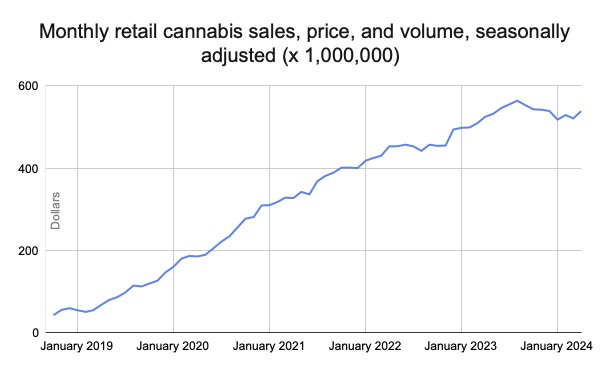
Retail cannabis sales rebounded in February and April after dropping to their lowest in nearly a year in January 2024, according to the most recent figures from Statistics Canada.
Although cannabis sales in Canada still show year-over-year growth, the increase in those sales continues to slow as the market reaches a possible saturation point.
Retail cannabis sales in Canada were $539 million in April 2024, after dropping to $518 million in January, after the holiday shopping season. Those numbers were up $11 million in February to $529 million, then declined again in March before increasing again in April to $539 million.
Early Birds numbers are still down from a record high of $564 million in August 2023, which was followed by five months of declines before bouncing back to $539 million in December. Then, in January 2024, retail cannabis sales dropped to $518 million, using seasonally adjusted numbers. This represents a $20 million year-over-year increase from sales figures in January 2023 ($498 million).
Retail cannabis sales have continued to increase on a year-over-year basis since legalization, but the exponential increases have given way to more modest gains as the market appears to be reaching a ceiling in terms of sales.
From January 2019 to January 2020, sales increased from $54 million to $160 million, nearly tripling. These numbers nearly doubled to $310 million by January 2021 and then increased by about one-third to $418 million by January 2022. By January 2023, that figure was $498 million; in January 2024, it was $518 million, an annual increase of only about 4%.
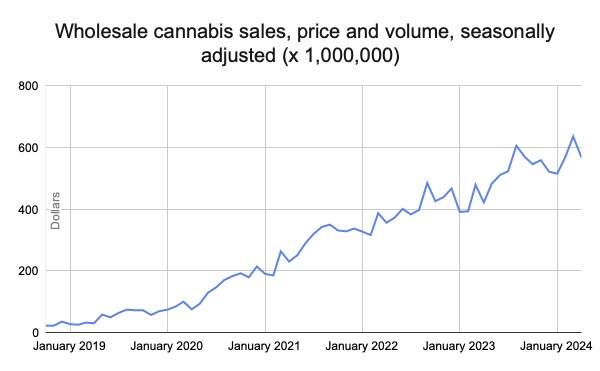
Wholesale sales, price and volume of cannabis (seasonally adjusted) dropped in April from a record high of $636 million in March 2024. Previously, the high water mark in this category was $606 million in August 2023, followed by several months of declines to a low of $515 million in January 2024 before increasing again in February and March.
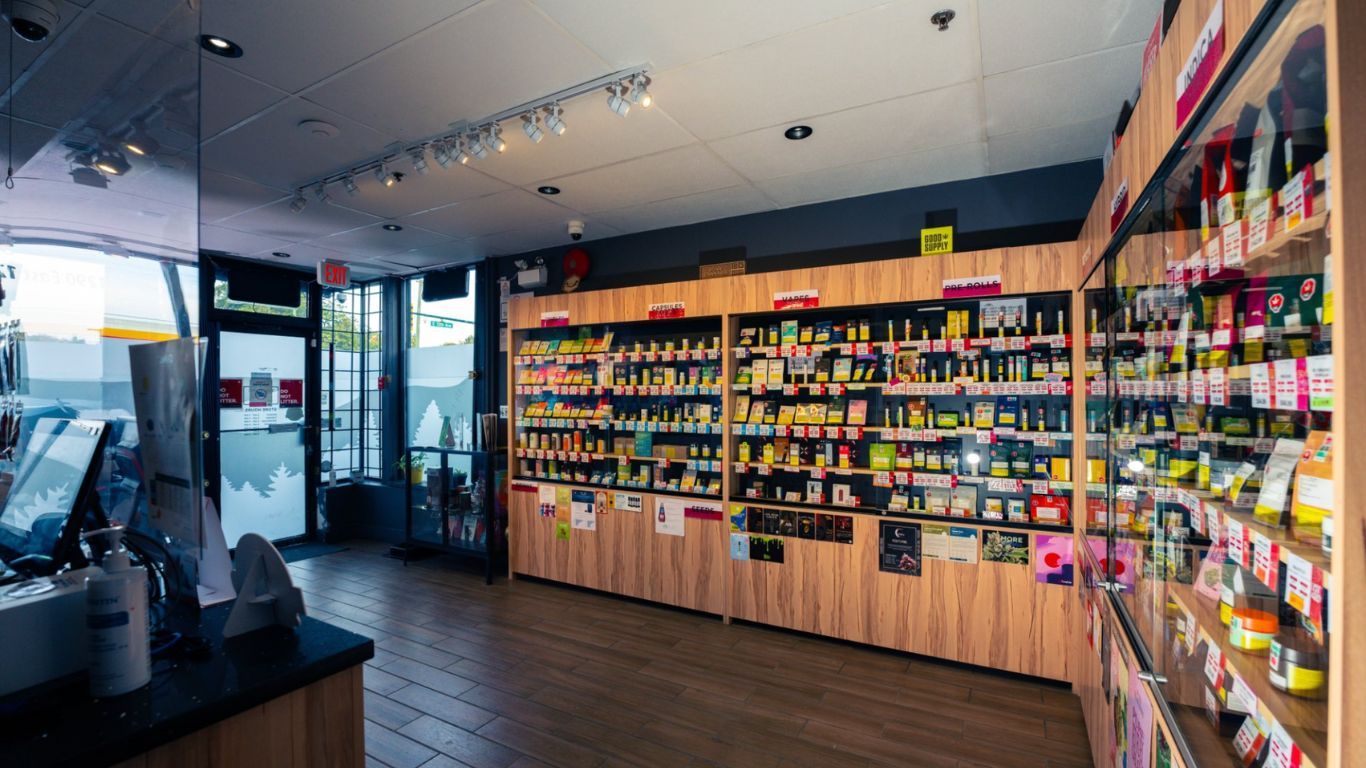
The number of retail stores across Canada also declined by 26 stores As of June 21, 2024 there were 3,663 authorized retail cannabis stores in Canada, down from 3,689 in March. This figure is excluding provincial online stores.
The declines came from BC and Alberta, with BC showing 25 fewer stores and Alberta losing 44. All other provinces showed increases or stayed the same.
British Columbia: 487 public and private stores, either open or “coming soon”; down from 512 in March. (-25)
New Brunswick: 27 public stores, up from 25 in March, plus eight private stores and six farmgate stores for a total of 41 (2 more private stores are expected to open in late June) (+2)













Recent Comments