Atlas Global Brands, the company behind cannabis brands like D*gg Lbs, GreenSeal and Electric Lettuce, along with its subsidiaries, have been granted an initial order under the Companies’ Creditors Arrangement Act (CCAA).
Atlas Global includes GreenSeal Cannabis Company Ltd., GreenSeal Nursery Ltd., AgMedica BioScience Inc., Wellworth Health Corp., 5047346 Ontario Inc., 8050678 Canada Inc. and Tavivat Naturals Inc. as its subsidiaries. The company says the CCAA order will provide an opportunity to restructure its business and financial affairs.
Atlas Biotechnologies Inc. and Atlas Growers Ltd had previously gone into receivership in 2023.
Headquartered in Chatham, Ontario, Atlas Global operates its business of cultivation, extraction, manufacturing, marketing, and distribution through its wholly-owned Canadian subsidiaries, GreenSeal and AgMedica. Atlas Global operates two licensed cannabis facilities in Canada, one of which has European Union GMP certification, and three medical pharmacies in Israel. Atlas Global distributes its products within Canada and to eight countries outside Canada: Australia, Canada, Denmark, Germany, Israel, Norway, Spain and the United Kingdom.
At the end of 2023, Atlas Global employed 185 full-time employees in Canada and two full-time employees in Israel. In early 2023, Atlas announced it was moving its operations from Alberta to Ontario and laying off 50 workers in the process. In August 2023, the company listed a notice of sale for many of its assets. In January 2024, the Agriculture Financial Services Corporation filed a bankruptcy order against Atlas Growers.
A bankruptcy creditor package filed in February of this year lists $3.5 million in total realized assets. It lists the Agricultura Financial Service Corporation as a secured creditor with the company for a total of $8.6 million.
The Atlas Group is scheduled to return to Court for a comeback hearing on June 27, 2024, at which time it plans to seek, among other relief, an Amended and Restated Initial Order, an extension of the stay of proceedings, and interim financing to allow the Atlas Group to stabilize its operations, consider possible transactions, and emerge from the CCAA Proceedings as a going concern.
One of the Company’s creditors, Stoke Canada Finance Corp., has applied to have a receiver appointed over the Company’s receivables and related assets. Unless resolved, that application will be heard at the Comeback Hearing.
The Company says it continues to believe that the protection afforded by the CCAA will allow the Atlas Group to stabilize operations in order to consider potential restructuring transactions that would benefit all stakeholders, including the sale of all or substantially all of the business or assets of the Atlas Group through a court-supervised sales process.
The Biden administration has expressed its opposition to a proposal that would prevent military branches from testing for cannabis use as part of the commissioning or enlistment process, noting concerns about how it could impact military readiness and safety. The White House Office of Management and Budget (OMB) released a statement on June 11, 2024, outlining its policy concerns regarding various elements of the 2025 NDAA. The bill is currently under consideration by the Rules Committee for upcoming House action.
One specific provision that the administration opposes is Section 532. This section would prohibit military branches from requiring cannabis tests for individuals as a condition of their enlistment or commissioning as officers in the Armed Forces. The OMB highlighted that while it has an appreciation for Congress’s intent to expand the pool of potential military recruits, the office opposes Section 532 because it would stop the U.S. Department of Defense (DoD) from testing applicants for delta-8 and delta-9 THC, the active components in cannabis.
Last year, the DoD told legislators that delta-9 THC is the most frequently detected substance in drug tests among active-duty service members. A few military branches have already begun to relax marijuana-related restrictions, including providing waivers for recruits who test positive initially.
In parallel, Republican legislators have introduced a change to the NDAA, which will be reviewed by the Rules Committee. The amendment aims to remove the cannabis-related language from the measure, which had previously been approved by the Armed Services Committee. The Rules Committee will also deliberate on a separate bipartisan amendment to the defense measure. Under the provision, the defense secretary would have to report to Congress on how the agency plans to create, distribute and apply a precise definition for the reenlistment waiver procedure.
This is not the first instance of the Biden administration clashing with congressional cannabis-reform advocates. For instance, the president has routinely included a rider in his budget plans that prohibits the District of Columbia from utilizing local tax revenues to fund the implementation of a recreational cannabis sales system. Interestingly, even with current Republican control, this year’s spending bill has excluded that rider.
Biden has been praised for his other marijuana-related initiatives, even despite these points of dispute. Notably, the U.S. Department of Justice (DOJ) recommended reclassifying marijuana as a result of his directive to reassess the drug’s federal classification. He has also granted two rounds of mass cannabis pardons.
This position of the White House is unlikely to be surprising to marijuana companies such as Software Effective Solutions Corp. (d/b/a MedCana) (OTC: SFWJ) given that such a policy change for the military can only happen once significant reforms have been enacted at the federal level.
NOTE TO INVESTORS: The latest news and updates relating to Software Effective Solutions Corp. (d/b/a MedCana) (OTC: SFWJ) are available in the company’s newsroom at https://cnw.fm/SFWJ
About CNW420
CNW420 spotlights the latest developments in the rapidly evolving cannabis industry through the release of an article each business day at 4:20 p.m. Eastern – a tribute to the time synonymous with cannabis culture. The concise, informative content serves as a gateway for investors interested in the legalized cannabis sector and provides updates on how regulatory developments may impact financial markets. If marijuana and the burgeoning industry surrounding it are on your radar, CNW420 is for you! Check back daily to stay up-to-date on the latest milestones in the fast -changing world of cannabis.
To receive SMS alerts from CNW, text CANNABIS to 888-902-4192 (U.S. Mobile Phones Only)
Please see full terms of use and disclaimers on the CannabisNewsWire website applicable to all content provided by CNW, wherever published or re-published: https://www.CannabisNewsWire.com/Disclaimer
City View Green Holdings Inc., an innovative Canadian-based cannabis-infused edibles manufacturing company, announces that further to its May 6, 2024, news release, it has now completed a first tranche (the “First Tranche“) of its non-brokered private placement (the “Offering“). Under the First Tranche, the Company has issued 9,500,000 Units for gross proceeds of $95,000. No finder’s fees were paid in connection with the First Tranche. All securities issued under the First Tranche are subject to a hold period expiring October 21, 2024, in accordance with applicable securities laws and the policies of the Canadian Securities Exchange (the “CSE”).
The First Tranche comprises the initial portion of the Offering, which is hereby extended, under which City View is selling up to $1,000,000 units of the Company at a price of $0.01/unit. Each unit consists of one common share (each a “Share“) in the capital of the Company and one-half common share purchase warrant (each a “Warrant”). Each whole Warrant entitles the holder thereof to acquire one common share of the Company (each a “Warrant Share“) at a price of $0.05 per Warrant Share for a period of 3 years following the date of issuance; except that, from and after the date that is one year after the closing date, if the average closing price of the Company’s common shares on the CSE is equal to or exceeds $0.055 during any 10 trading day period, then the Company may anytime thereafter accelerate the expiry date of the Warrants to the date that is 30 days following the date on which the Company issues notice to all the Warrant holders of the new expiry date (and the Company will also issue a press release on the same date as it issues notice confirming the new expiry date of the Warrants). Refer to the Company’s May 6, 2024 news release for further details on the Offering.
Rob Fia, the Company’s President, CEO and director (the “Insider“) participated in the First Tranche and purchased 1,500,000 Units for $15,000. Participation by the Insider in this financing is considered a “related party transaction” pursuant to Multilateral Instrument 61-101 – Protection of Minority Security Holders in Special Transactions (“MI 61-101”). The Company is exempt from the requirements to obtain a formal valuation and minority shareholder approval in connection with the Insider’s participation in the Offering in reliance of sections 5.5(a) and 5.7(a) of MI 61-101, respectively, on the basis that participation in the Offering by the Insider did not exceed 25% of the fair market value of the Company’s market capitalization The Company did not file a material change report at least 21 days prior to the closing of the First Tranche as participation of the Insider had not been confirmed at that time.
In addition, City View announces that it has engaged marketing firm Rocket Invest AI Corp (“Rocket Invest AI“), an arm’s length third party, to provide various marketing services through multiple social media platforms as well as facilitating communication with the financial community. The initial term of the agreement is for 3 months effective June 20 2024, for which Rocket Invest AI will be paid $30,000 CAD.
About City View Green Holdings Inc. City View is a leading consumer packaged goods company focused on the development of cannabis infused edibles with the receipt of its Cannabis Act processing license on April 30, 2021. For more information visit: www.cityviewgreen.ca.
Aurora Cannabis Inc., a leading Canada-based global medical cannabis company, today announced its financial and operational results for the fourth quarter and fiscal year 2024. As the fiscal year 2023 consisted of three quarters, the year-over-year comparison quarter for Q4 2024 ending March 31, 2024 is Q3 2023 ending March 31, 2023.
“We are incredibly pleased to be reporting our strongest fiscal year ever at Aurora. Total fiscal year 2024 net revenue increased 21% compared to the trailing four quarters, while adjusted EBITDA was positive on an annualized basis for the first time in our history, reaching $12.8 million. We also strengthened our balance sheet, ending with a strong net cash position of approximately $180 million as of March 31st, and fully repaid our convertible debt,” said Chief Executive Officer Miguel Martin.
“Aurora is the largest global medical cannabis company in nationally legal markets and our leadership is best differentiated by serving the diverse needs of patients across the world. In Q4 2024, global medical cannabis net revenue1 increased 20% year-over-year, supported by the recent acquisition of MedReleaf Australia, where we saw significant growth, along with higher sales in Poland and the UK. We also achieved our highest quarterly adjusted gross margin1 in medical cannabis of 66%, far ahead of our targeted range of 60%. These results are encouraging as we continue to progress towards our next milestone of positive free cash flow by December 31st” concluded Mr. Martin.
____________________________
1 This press release includes certain non-GAAP financial measures, which are intended to supplement, not substitute for, comparable GAAP financial measures. See “Non-GAAP Measures” below for reconciliations of non-GAAP financial measures to GAAP financial measures.
2 Aurora’s only remaining debt is $57.3 million relating to Bevo Farms Ltd as detailed in the FY2024 Financial Statements.
Fourth Quarter 2024 Highlights (Unless otherwise stated, comparisons are made between fiscal Q4 2024, Q3 2024, and Q3 2023 results and are in Canadian dollars)
Consolidated Revenue and Adjusted Gross Profit: Total net revenue1 was $67.4 million, as compared to $64.0 million in the prior year period. The 5% increase from the prior period was mainly due to 20% growth in our global medical cannabis business, partially offset by lower quarterly revenue in our consumer cannabis business, and to a far lesser extent, our plant propagation business.
Consolidated adjusted gross margin before fair value adjustments1 was 49% in Q4 2024 and in the prior year quarter. Adjusted gross profit before FV adjustments1 was $33.3 million in Q4 2024 vs $31.0 million in the prior year quarter, an increase of 8%.
Medical Cannabis: Medical cannabis net revenue1 was $45.6 million, a 20% increase from the prior year quarter, delivering 68% of Aurora’s Q4 2024 consolidated net revenue[1] and 90% of adjusted gross profit before fair value adjustments1. The increase in net revenue1 of $7.7 million was primarily due to higher sales to Australia and Europe in the current period following the success of newly launched innovative cultivars in these markets.
Adjusted gross margin before fair value adjustments1 on medical cannabis net revenue reached 66% for the three months ended March 31, 2024, compared to 60% in the prior year quarter and within the Company’s target range of 60% and above. The adjusted gross margins before fair value adjustments improved through sustainable cost reductions, higher selling prices in Australia, and improved efficiency in production operations, including sourcing for Europe from Canada due to the closure of the Aurora Nordic production facility.
Consumer Cannabis: Aurora’s consumer cannabis net revenue1 was $10.2 million, compared to $14.5 million in the prior year quarter. The decrease was due to our decision to prioritize the supply of our GMP manufactured products to our high margin international business rather than the consumer business, which offers lower margins.
Adjusted gross margin before fair value adjustments[1] on consumer cannabis net revenue[1] was 16%, decreasing from 25% compared to the prior year quarter. The decrease from the prior year comparative quarter is largely due to product sales with lower margins relative to the comparative prior period.
Plant Propagation: Plant propagation net revenue1 was wholly comprised of the Bevo business, that contributed $10.4 million of net revenue1 compared to $10.8 million in the prior year quarter. Historically, approximately 65-75% of plant propagation revenue and up to 80% of EBITDA has been earned in the first half of the calendar year.
Adjusted gross margin before fair value adjustments1 on plant propagation revenue was 25% for Q4 2024 and 36% for the prior year quarter. This shift was due primarily to timing of certain revenues being moved to Q1 2025, the period ending June 30, 2024, which can be expected given the typical seasonality of the plant propagation business.
Selling, General and Administrative (“SG&A”): Adjusted SG&A1 was $31.6 million in Q4 2024, which excludes $8.0 million of restructuring and non-recurring costs. Adjusted SG&A1 was slightly above the Company’s previous target of $30 million due to the incremental SG&A following the acquisition and continuing integration of MedReleaf Australia. Adjusted R&D1, was $0.7 million in Q4 2024, decreased $0.9 million compared to the prior year quarter.
Net Loss: Net loss from continuing operations for the three months ended March 31, 2024 was $20.8 million compared to net loss of $76.2 million for the prior year period. The decrease in net loss of $55.4 million compared to the comparative prior quarter is primarily due to an increase in gross profit of $27.3 million, a decrease in operating expenses of $1.1 million, and a decrease in other expenses of $29.4 million.
Adjusted EBITDA: Adjusted EBITDA1 was $1.9 million for the three months ended March 31, 2024 compared to $2.0 million for the prior year quarter.
Convertible Senior Notes Repayment During the three months ended March 31, 2024, the Company repaid an aggregate of approximately $7.2 million (US$5.3 million), representing the final repayment of the principal amount of its convertible senior notes and Aurora’s cannabis business is now debt free2.
Fiscal Q1 2025 Expectations:
In Q1 2025, the period ending June 30, 2024, the Company expects to achieve consolidated net revenue percentage growth in the mid to high teens from Q4 2024. This expected increase in net revenue is driven by:
Growth in high margin international medical cannabis revenue from recent regulatory reforms in Germany which is expected to increase the size of the market, combined with continued strength in key European markets, as well as incremental revenue from MedReleaf Australia; and
Our plant propagation segment typically experiences a seasonally higher quarter as it completes its peak spring floral sales period.
Consolidated adjusted gross margin for each individual segment are typically similar on quarter over quarter basis, with a higher mix contribution from plant propagation.
Positive adjusted EBITDA should be higher compared to the fourth quarter as a result of revenue growth combined with comparable consolidated margins.
Operating cash flow is expected to improve in Q1 2025 compared to Q4 2024.
Achieving Positive Free Cashflow: The Company views the target of positive free cashflow by end of calendar year 2024 as being achievable because of the following:
Positioned to deliver continued increases in global medical cannabis, building on the growth expected in Q1 2025, driven by the full recognition of revenue in Australia as well as further growth in key European markets.
Operating expenditure and gross margins are positioned to be in line with previously stated targets leading to continued strong positive adjusted EBITDA.
Disciplined working capital management and maintenance capital expenditure of approximately $2.0 million a quarter.
About Aurora Cannabis Aurora is opening the world to cannabis, serving both the medical and consumer markets across Canada, Europe, Australia and South America. Headquartered in Edmonton, Alberta, Aurora is a pioneer in global cannabis, dedicated to helping people improve their lives. The Company’s adult-use brand portfolio includes Drift, San Rafael ’71, Daily Special, Tasty’s, Being and Greybeard. Medical cannabis brands include MedReleaf, CanniMed, Aurora and Whistler Medical Marijuana Co., as well as international brands, Pedanios, Bidiol, IndiMed and CraftPlant. Aurora also has a controlling interest in Bevo Farms Ltd., North America’s leading supplier of propagated agricultural plants. Driven by science and innovation, and with a focus on high-quality cannabis products, Aurora’s brands continue to break through as industry leaders in the medical, wellness and adult recreational markets wherever they are launched. Learn more at www.auroramj.com and follow us on X and LinkedIn.
MediPharm Labs Corp., a pharmaceutical company specialized in precision-based cannabinoids, is pleased to announce it has entered into a licencing agreement with Remidose Aerosols Inc. to acquire the exclusive rights for advanced cannabis products (the “Agreement”).
The Agreement allows for an immediate revenue opportunity as current Remidose customers will be serviced through MediPharm starting August 2024. These existing customers include Canadian direct-to-patient medical platforms and international medical distributors. MediPharm plans to use its existing GMP infrastructure, customer channels and wellness sales expertise to expand the customer base of these advanced products in Canada and globally.
These advanced innovative products fall into two main categories:
1. Metered Dose Inhalers: This metered dose inhaler is the same device used in the pharmaceutical industry. The inhalation format provides rapid onset without the adverse effects of smoking and combustible vape cartridges now being used by cannabis consumers and patients.
2. Pressurized Sublingual Sprays: A metered dose spray that gives users an accurate and repeatable experience. In contrast to commonly available manual pump sprays, this aerosol delivery method has faster onset, better bioavailability and a more pleasant taste and feel, as supported by user feedback.
MediPharm already has the requisite equipment and GMP facility allowing for these product lines to be manufactured in-house with no material incremental capital costs.
The Agreement follows MediPharm’s strategy of continued innovation in non-smokable, more dose-able cannabis-based products. This execution solidifies MediPharm’s position as a global leader in the pharmaceutical and wellness-focused cannabis sectors. New growth opportunities include medical and GMP formats for our international customers as well as unique and advanced products for our current and future clinical research partners that are specifically looking for more dose-able, non-smokeable formats. Finally, the new format offers a new discreet delivery method for our many wellness-oriented cannabis consumers.
“MediPharm Labs is committed to providing access to non-smokeable, precision dosed formats for cannabis patients and wellness consumers. This Agreement, in addition to bringing immediate revenue, opens many new potential global medical opportunities. We thank the Remidose team for trusting MediPharm in taking their R&D and commercialization efforts to the next level, as we work together to bring these products to new markets.” Commented David Pidduck, CEO of MediPharm Labs.
Michael Mayne CEO of Remidose added “As a medical cannabis company committed to providing consumers access to the therapeutic benefits of cannabis in a smoke-free manner, we see this agreement as a key milestone in bringing our products to a global marketplace with a proven, trusted partner in MediPharm Labs.”
About MediPharm Labs Founded in 2015, MediPharm Labs specializes in the development and manufacture of purified, pharmaceutical-quality cannabis concentrates, active pharmaceutical ingredients (API) and advanced derivative products utilizing a Good Manufacturing Practices certified facility with ISO standard-built clean rooms. MediPharm Labs has invested in an expert, research driven team, state-of-the-art technology, downstream purification methodologies and purpose-built facilities for delivery of pure, trusted and precision-dosed cannabis products for its customers. MediPharm Labs develops, formulates, processes, packages and distributes cannabis and advanced cannabinoid-based products to domestic and international medical markets. Website: www.medipharmlabs.com
High Tide Inc., the high-impact, retail-forward enterprise built to deliver real-world value across every component of cannabis, announced today that its Canna Cabana retail cannabis store located at 5308 17 Ave SW Calgary will begin selling recreational cannabis products and consumption accessories for adult use tomorrow, June 21. This opening will mark High Tide’s 173rd Canna Cabana branded retail cannabis location in Canada and the 80th in the province of Alberta.
This new Canna Cabana, situated in the well-established community of Glendale, was already a fully built store when the Company negotiated a lease takeover from the previous operator. Located right off two major thoroughfares through the southwest of Calgary, this new store will benefit from the high volume of residential traffic flowing past it and is a short drive from West Hills Towne Center, a significant shopping node in southwest Calgary.
“I am thrilled to announce the opening of our 80th Canna Cabana in Alberta. As our investors know, market consolidation is underway, and many cannabis retailers are choosing not to renew their existing leases, given the challenging macro environment. Opening new Canna Cabana locations in pre-existing cannabis stores at quality sites is an excellent opportunity for us to grow our retail footprint, saving our shareholders hundreds of thousands of dollars in build-out costs,” said Raj Grover, Founder and Chief Executive Officer of High Tide.
“As I discussed in our earnings call last week, our real estate team has been working hard to meet our goal of adding 20 to 30 new stores in 2024, and we are well on our way. These pre-built stores are a win-win for us and the landlords as they continue to generate rental income from our nationally recognized Canna Cabana brand, given our strong financial covenant. In this way, we are able to get into these fully built, quality sites at a fraction of the cost. We have similar announcements lined up in the coming weeks and months, so stay tuned for more,” added Mr. Grover.
About High Tide High Tide, Inc. is the leading community-grown, retail-forward cannabis enterprise engineered to unleash the full value of the world’s most powerful plant and is the second-largest cannabis retailer in North America by store count1. High Tide (HITI) is uniquely-built around the cannabis consumer, with wholly-diversified and fully-integrated operations across all components of cannabis, including Bricks & Mortar Retail: Canna Cabana™ is the largest non-franchised cannabis retail chain in Canada, with 173 current locations spanning British Columbia, Alberta, Saskatchewan, Manitoba and Ontario and growing. In 2021, Canna Cabana became the first cannabis discount club retailer in North America.
Earlier this week, the governor of Maryland signed an executive order pardoning more than 175,000 cannabis convictions. Governor Wes Moore stated that this pardon would affect thousands of Marylanders who had been convicted of misdemeanors, adding that it was the biggest pardon in the country’s history.
While the pardons will not result in any prior convictions being expunged automatically from an individual’s background check or allow any individual to be released from prison, advocates applauded the move because eliminates barriers to employment, education and housing opportunities. During a news conference, Moore explained that this order would also help change how both society and government viewed individuals who had been deemed ineligible from opportunities because of uneven and broken policies.
Moore also emphasized the pardons don’t erase the fact that Blacks in the state were three times more likely to be arrested for marijuana than Whites, prior to legalization. Moore added that this order also didn’t erase the fact that an individual having a conviction on their record meant they had a harder time with everything, including education, employment and housing.
The state of Maryland legalized the recreational use of marijuana in 2023 after voters passed a constitutional amendment the previous year. It also decriminalized the possession of small amounts of marijuana in 2023.
Heather Warnken, executive director of the Center for Criminal Justice Reform at the University of Baltimore, stated that the pardons were a win for thousands of individuals being afforded a clean slate to pursue employment, education and other opportunities without having to worry about a criminal conviction.
The state’s attorney general, Anthony Brown, stated that the action was long overdue and added that as a country, too much time had ben taken to try correcting the injustices of a system that was supposed to be just for every individual. Brown explained that this move was about racial justice, adding that while it applied to everyone who met the outlined criteria, it was a huge victory for African Americans and other people of color who have been disproportionately arrested, convicted and sentenced for actions that were legal now.
With the pardons ordered, the state’s judiciary is tasked with ensuring that every individual electronic docket is updated to indicate that the conviction has been pardoned by the governor. Governor Moore’s order also directs Maryland’s department of corrections to come up with a process showing a pardon in a person’s criminal record.
These pardons are a welcome step, given that it was baffling for people to remain with convictions for minor marijuana crimes, while various jurisdictions have since made policy reforms that now allow enterprises such as Green Thumb Industries Inc. (CSE: GTII) (OTCQX: GTBIF) to sell marijuana products legally.
About CannabisNewsWire
CannabisNewsWire (“CNW”) is a specialized communications platform with a focus on cannabis news and the cannabis sector. It is one of 60+ brands within the Dynamic Brand Portfolio @ IBN that delivers: (1) access to a vast network of wire solutions via InvestorWire to efficiently and effectively reach a myriad of target markets, demographics and diverse industries; (2) article and editorial syndication to 5,000+ outlets; (3) enhanced press release enhancement to ensure maximum impact; (4) social media distribution via IBN to millions of social media followers; and (5) a full array of tailored corporate communications solutions. With broad reach and a seasoned team of contributing journalists and writers, CNW is uniquely positioned to best serve private and public companies that want to reach a wide audience of investors, influencers, consumers, journalists and the general public. By cutting through the overload of information in today’s market, CNW brings its clients unparalleled recognition and brand awareness. CNW is where breaking news, insightful content and actionable information converge.
To receive SMS alerts from CNW, text CANNABIS to 888-902-4192 (U.S. Mobile Phones Only)
Please see full terms of use and disclaimers on the CannabisNewsWire website applicable to all content provided by CNW, wherever published or re-published: https://www.CannabisNewsWire.com/Disclaimer
While psychedelics have been around for quite a while now — with over 50 years of strong presence in the research field and years in practical medical applications — there’s still a certain stigma around the subject.
Treat depression with ketamine? Psilocybin-assisted retreats in Jamaica as a more effective way to combat stress? Indigenous plant ceremonies that help you overcome chronic anxiety? Among the population that doesn’t follow the trends, these approaches still might raise some eyebrows.
However, today that stigma might be slowly diluting, and rightfully so. The numbers, the science, and the success rate stand by these pioneering methods. Not just “in some distant future”, but now. And we can see it at Open:Minds Expo in Toronto.
Open:Minds
The audience at Open:Minds
Open:Minds positions itself as the world’s first consumer expo for psychedelic therapy. For 2 days in the very beginning of June, dozens of entrepreneurs, practitioners and researchers gathered in Toronto’s The Symes hall.
We’ve decided to join in: after all, the psychedelic extraction industry is largely dependent on this field’s growth and development.
The Symes venue usually hosts large-scale weddings, business coaching sessions, and events like CurlyCon: nothing out of the ordinary. And even though a psychedelic expo might sound unusual for some, it blends in just right.
It is, indeed, an expo: business suits and t-shirts, booths and stalls, flyers, some equipment here and there, and lots, lots of panel discussions.
The three things that make it clearly different from an ordinary trade show at Metro Convention Centre are people, ideas, and the amount of logos that are, in one way or another, related to psychedelic mushrooms.
The People
Open:Minds is not a “professionals for professionals” kind of show with networking at its heart. It’s “industry for the public” instead: a much more needed approach for this field.
“We said “you know what? Where the science is real, there’s got to be a path forward to bring consumers to understand what this world is all about, how can they legally participate, and what can it alleviate.”
When we started, we understood how complex it is for the average person to get onto the Internet and read things, and learn. We’ve realized that they need to talk to the practitioners. So we’ve invited these practitioners to be here, to introduce what they do to the public.
It’s really important for us to educate the public: what this is all about, how it can help, and the fact that doing this recreationally is not a replacement for doing it the right way with a trained practitioner, having someone work as a therapist with you while you’re doing it. That’s where you get the real benefit”
Participants here represent a variety of microiniches within the psychedelic-assisted treatment niche.
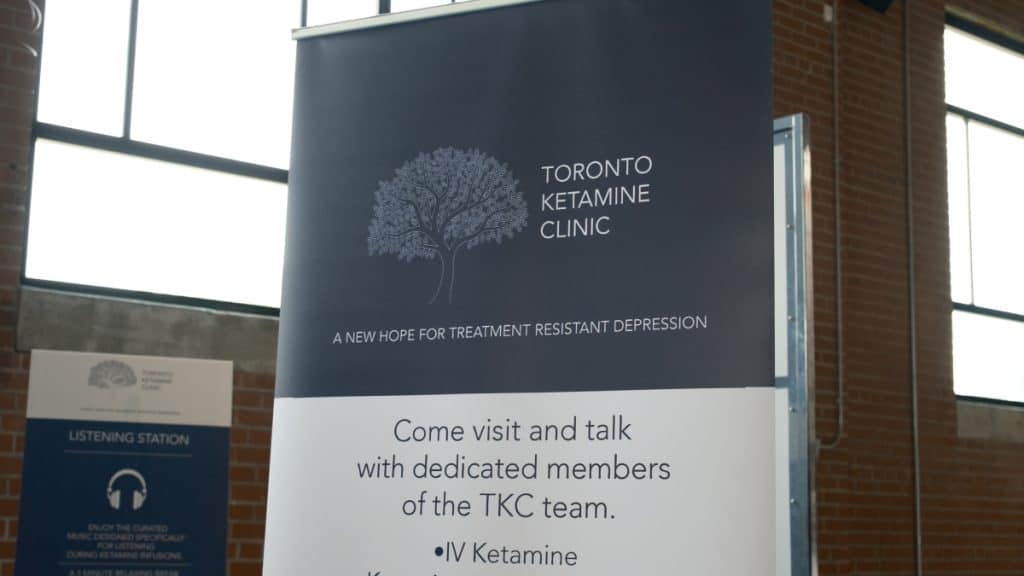
From TKC Toronto Ketamine Clinic we walked to TheraPsil, psilocybin therapy providers’ stall. Listened to a presentation on sex, love, and yoga with Dr. Cat Meyer from SexLoveYoga.com. Checked out Wake Network’s brain scanner that helps UFC athletes monitor their progress in treatment with pyshedelic fungi in Jamaica.
Researchers, advocates, founders, licensed psychologists, psychotherapists, advisors and visionaries. The common trait that was hard not to notice is that science and research seem to be ingrained in pretty much everyone’s background.
And just as many famous scientists that propelled the medical field forward in the past, many at Open:Minds started their journey by the most ethical and representative means of research: experimenting on themselves.
“I was a depression sufferer, years ago and had to go to the States to get this treatment, which did not exist here. So I was one of the people that had a hand in being the first clinic to open up in Toronto for I.V. ketamine.”
It’s more than a single story, though. It’s a pattern:
“I was helped by psilocybin, and my partner was also helped through her journey with cancer by psilocybin, as well as lion’s mane and turkey tail. So I really wanted to bring it to a lot of people, and that’s what took me down to Jamaica.”
“I wanted to heal my own self, and along the path, I’ve discovered everything from yoga to trauma therapy, energetic psychology and psychedelics, how all of these can influence one another for an optimal healing.”
The idea of trying psychedelic therapy personally and succeeding before starting a company in this field highlights another common theme: it’s personal, not just business.
We didn’t hear a lot about revenues and ROI. No mentions of CAGR in the panel, no other cold, profit-oriented whatnots. Not even in the smoking area, where all the fun usually is. A skeptic would suggest that it’s just a typical business facade, but in this young industry, it appears to be not the case.
Sure, we’ve spoken to CIOs and regional development managers, PR people, B2B service providers, catering to the niche. It is, of course, about business, not just advocacy.
However, at the core of it, lies a simple premise: we want to bring the public the solutions it needs. And these solutions actually work.
“The research shows that for I.V. ketamine specifically, which is where I would say 95% of the research has been done on depression, that there’s a 70% response rate. When somebody has tried an antidepressant and it’s failed, their percentage for success goes down. To have something within this population to hit 70% response rate is really quite astounding.
The other thing, you know, that’s really of note is that ketamine works within a matter of hours and ok, two days. Traditional antidepressants usually take 4 to 6 weeks before you can tell whether they’re effective. The fact that it’s working in such a quick, amount of time for depression, for suicidality, that it’s bringing this relief that’s just really tremendously needed.”
— Justin Davies, Founder and CEO of Toronto Ketamine Clinic
It’s not just about clinical research and data. For many present at Open:Minds, it’s proven by their own business experience. Something they work with and see every day.
“We offer programs like microdosing for psychedelic integration, integration, drop in groups, in-person events, and so on. We’ve taken over 400 people through this program already. We’ve had groups with, you know, 20 year old young men with 82 year old women all in one group together. And the connection and the learning and the support they have is just incredible.”
— Dana Harvey, Facilitator & Head of Communications & Partnerships, Gathering Groups
Two of the speakers we’ve talked to mentioned that they expected Canada to be faster in accepting psychedelics. And almost everyone mentions some sort of reluctance that the society, the legal field, or the medical industry are still showing towards psychedelic-assisted treatment.
“I don’t think the medical community is ready for this treatment to be considered a first line treatment. It’s a new treatment. But, you know, the research has been done, and the research is very good and strong on ketamine for depression.”
— Justin Davies, Founder and CEO of Toronto Ketamine Clinic
Even though it might be not quite easy at the moment, the trend is definitely positive:
“The stigma is removing and lowering, but, we do seem to get the same questions over and over. Am I going to do something embarrassing during the journey? Am I going to remember the journey which everybody does, which is wonderful. Am I going to embarrass myself? We’ve heard it all, but we’ve had over 400 people through our retreats, and everybody’s had a really good experience.”
— Nick Murray, co-founder and CEO of WAKE NETWORK
And finally, the Future
Despite the psychedelic wellness field being around for years now, at Open:Minds, we’ve met visionaries and innovators. The first generation of those who make the third wave happen. The fact that an expo like this is legally possible (and has no mass protests right outside the venue) is, in itself, proof of a positive trend.
“I do see a mix of a clinic and a retreat location, and that being the future for the West. So when you go to a clinic that’s specializing in psychedelics, it wouldn’t be your traditional doctor’s office that’s kind of flat, you know, bland and boring. It’ll be very much plant focused. It’ll have, hopefully, an outdoor area, some nature.”
— Nick Murray, co-founder and CEO of WAKE NETWORK
However, the final trump card for the psychedelic-assisted treatment is that it’s not just about psycedelics. It’s “assisted” for a reason.
Be it a licensed anesthesiologist that helps their patients administer a therapeutic dose of IV ketamine or a glass of juice with dried Blue Meanies on a tropical beach during a retreat, psychedelics are merely tools that enable people with more natural means of overcoming mental health issues.
“We actually believe that the opposite of so many of the mental health issues and the many diseases in our community today is that lack of connection.”
— Dana Harvey, Facilitator & Head of Communications & Partnerships, Gathering Groups
Having spent the whole day with those who push the field forward, we see a bright tomorrow for psychedelics.
Only, of course, if the industry continues to keep people at its core.
A drug trafficking investigation in Fort St John, BC, resulted in the seizure of cannabis, psilocybin, vehicles, and cash on June 10, with one adult man arrested.
Fort St John RCMP says its Street Enforcement Team began their investigation after police learned of a “suspicious residence” in the city on May 30. Police believed that the residence was trafficking to minors, which made the issue a priority.
Police located approximately $26,000 in cash, five kilograms of suspected cannabis, cannabis edibles, and 700 grams of psilocybin. Police also seized two vehicles, one they say was used in trafficking contraband and the second the proceeds of crime. The adult male who was arrested was released pending further investigation.
New York governor Kathy Hochul has successfully changed the state’s cannabis tax structure. Starting June 1, 2024, a new flat excise tax replaces the previous potency tax, marking the beginning of the new financial year.
This move is part of New York’s $237 billion budget for FY 2025 and is receiving positive feedback from many in the cannabis industry, especially smaller retailers, processors and social-equity beneficiaries.
With the tax reform, retail marijuana prices are expected to decrease, a significant development as licensed cannabis entities strive to compete with the numerous illegal shops, particularly in New York City. Governor Hochul had criticized the initial rollout of the recreational marijuana market as problematic. Earlier this year, she proposed eliminating the potency tax and implementing a flat 9% excise tax instead.
Previously, the state’s 2021 cannabis act — MRTA — required cannabis operators to pay taxes based on THC content at 0.5 cents, 0.8 cents, and three cents per milligram of flower, concentrates and edibles, respectively.
This sometimes resulted in a 25%–30% tax on typical market prices, according to Naturae cofounder and CEO, Nicolas Guarino. Some products, including tinctures, saw price increases of up to $60 per unit due to these taxes. With the new tax structure, Naturae aims to reduce prices on about 30% of its products, offering discounts between 15% and 35%.
Silly Nice, an NYC-based brand run by Black and veteran entrepreneurs, had to pay around $20,000 in THC taxes during the first quarter of the year, which had a big impact on the company’s profit margins. Cofounder LeVar Thomas is happy about the tax shift, pointing out that it will enable the company to increase the range of products it offers at more inexpensive prices.
Happy Munkey, led by cofounder and CEO Vladimir Bautista, is set to open its first store in Manhattan’s Washington Heights. Bautista believes the new tax will make legal marijuana more affordable and reduce the appeal of the illegal market.
The new rule, however, has little financial effect on larger, vertically integrated company’s such as Chicago-based PharmaCann. These multistate operators, known as registered organizations (ROs), were once in the medical sector and are subject to both retail and wholesale taxes. The economic impact on ROs is neutral, according to Jeremy Unruh, PharmaCann’s spokesperson, and it is still unclear what the true benefits will be for consumers.
PharmaCann was among six ROs permitted to enter the recreational market in December, one year after sales began. The policy change eliminated the three-year waiting time for ROs, nullifying the initial first-mover advantage granted to smaller suppliers and social-equity shops.
Despite the broad support for eliminating the potency tax, the new flat 9% excise tax is causing challenges because of unpaid invoices. Payment delays are a significant issue in the marijuana industry, contributing to the downfall of businesses such as Herbl and MedMen Enterprises.
New York cannabis operators have only 20 more days to collect payments from the previous quarter, a tough task given the financial strains in the industry. Many operators are currently on tax-payment plans with the state.
Guarino noted that while there is a mechanism for collections, the average collection time is about 45 days, even with 30-day net terms, complicating timely tax payments.
The situation in New York State is likely to be studied closely by other cannabis regulators, and this could result in similar reforms within other jurisdictions where companies such as Trulieve Cannabis Corp. (CSE: TRUL) (OTCQX: TCNNF) have operations.
About CNW420
CNW420 spotlights the latest developments in the rapidly evolving cannabis industry through the release of an article each business day at 4:20 p.m. Eastern – a tribute to the time synonymous with cannabis culture. The concise, informative content serves as a gateway for investors interested in the legalized cannabis sector and provides updates on how regulatory developments may impact financial markets. If marijuana and the burgeoning industry surrounding it are on your radar, CNW420 is for you! Check back daily to stay up-to-date on the latest milestones in the fast -changing world of cannabis.
To receive SMS alerts from CNW, text CANNABIS to 888-902-4192 (U.S. Mobile Phones Only)
Please see full terms of use and disclaimers on the CannabisNewsWire website applicable to all content provided by CNW, wherever published or re-published: https://www.CannabisNewsWire.com/Disclaimer















Recent Comments