It has become clear in recent years that obtaining a cannabis license is both expensive and complicated. As a result, many people have found it easier to sell intoxicating products, such as hemp THC beverages. However, this trend may be shifting, especially in California.
Hemp THC beverages are drinks that contain hemp-derived delta-9 THC. You might be wondering how this is possible given the federal law that restricts THC content to 0.3%. Interestingly, these beverages can still be intoxicating without exceeding this limit. For instance, a drink containing 5 to 10 milligrams of hemp-derived THC can be intoxicating while still maintaining a THC concentration below 0.3%, depending on its weight.
California Governor Gavin Newsom issued an order in April for the Alcoholic Beverage Control (ABC) and the Public Health Department (CDPH) to ensure hemp products sold in the state adhere to the law. The initiative, titled California Takes Action to Protect Youth from Illegal Hemp Products, emphasizes the need to prevent mislabeled and misleading products from reaching the market, particularly to safeguard children’s health.
The directive highlighted concerns about highly intoxicating hemp beverages appearing in retail stores, which could easily end up in the hands of minors. Hemp products, distinct from those in the legal market, must adhere to stringent consumer safety regulations, including precise labeling requirements. Failure to comply with these regulations is illegal and can lead to license revocation.
Following the directive, both ABC and CDPH issued general warnings to entities about potentially illegal hemp products.
Last week, CDPH specifically warned consumers against drinking hemp-infused sodas under the Mary Jones branding, alleging that the drinks contained isolate of delta-9 THC. As per the CDPH, state law prohibits the inclusion of THC isolate as a component in hemp products.
This warning, which indicates that CDPH views goods containing THC isolates could be dangerous, might have a big impact on the California hemp THC beverage market. The future actions of CDPH remain uncertain, especially regarding companies that produce hemp THC drinks without using THC isolates. State law grants CDPH and other regulators substantial authority to target companies selling “misbranded” or “adulterated” products. These terms can be interpreted broadly, potentially encompassing any product with intoxicating cannabinoids.
Under California law, “THC” broadly consists of:
tetrahydrocannabinolic acid
tetrahydrocannabinol of any kind regardless of how they are derives (the CDPH may exclude certain isomers from this definition)
any other cannabis compound, except CBD, that CDPH determines to be intoxicating.
This definition indicates that CDPH may examine any psychoactive cannabinoid, not just isolate of delta-9 THC. Additionally, there are federal considerations to keep in mind. Recent proposed amendments to Farm Bill 2024 aim to limit intoxicating cannabis compounds. While the amendments do not specify a restrictive milligram cap for hemp THC beverages, they do exclude products with “quantifiable levels” of THC or other intoxicating cannabis compounds from the definition of hemp. The exact meaning of “quantifiable levels” will be determined by federal regulators, which could result in regulations that effectively ban intoxicating hemp THC drinks.
The actions taken by California regulators to crackdown on hemp intoxicants could help to clarify the boundaries between the THC products from licensed companies in various jurisdictions, such as Cresco Labs Inc. (CSE: CL) (OTCQX: CRLBF), and products synthesized from hemp.
About CNW420
CNW420 spotlights the latest developments in the rapidly evolving cannabis industry through the release of an article each business day at 4:20 p.m. Eastern – a tribute to the time synonymous with cannabis culture. The concise, informative content serves as a gateway for investors interested in the legalized cannabis sector and provides updates on how regulatory developments may impact financial markets. If marijuana and the burgeoning industry surrounding it are on your radar, CNW420 is for you! Check back daily to stay up-to-date on the latest milestones in the fast -changing world of cannabis.
To receive SMS alerts from CNW, text CANNABIS to 888-902-4192 (U.S. Mobile Phones Only)
Please see full terms of use and disclaimers on the CannabisNewsWire website applicable to all content provided by CNW, wherever published or re-published: https://www.CannabisNewsWire.com/Disclaimer
DaySavers, the most compliant and tested pre-rolled cone and rolling paper brand on the market, announced today their partnership with the Cannabis Research Coalition and The Network of Applied Pharmacognosy (NAP) on a first-of-its-kind study called The Science of Smokeability (SOS), which is looking to pay people to smoke pre-rolls for science. SOS is a 2+ year series of scientific experiments focusing on analyzing cultivation and processing metrics to evaluate which variables produce the most pleasant and least harmful smoking experience.
Currently, cannabis is cultivated to maximize yield and cannabinoid content. No study to date has ever evaluated how cultivation practices or post-harvest processing impact the smokeability of the final product. The SOS study promises to contribute significantly to the evolution of the cannabis industry by providing actionable insights that link cultivation and manufacturing practices to consumer experiences. This research not only has the potential to improve product quality and consistency, but also promote sustainability, profitability, and a deeper scientific understanding of cannabis as a medicinal and recreational product.
The study is currently taking place over the course of two years, integrating controlled laboratory data from smoking experiments with consumer research about smoking experience with different variables. The variables that will be studied include variations in mineral content, nutritional content (flushing), nitrosamines (potential carcinogens), moisture content, and the overall effect on ash color, smoke composition, and smoke quality.
Pre-rolls will be distributed to participants in selected phases of the study to gather qualitative feedback. DaySavers will be paying $4.20 to 200 randomly selected individuals, who will receive 2 free pre-rolls and be asked to fill out a qualitative survey comparing the 2 joints. Those interested in smoking pre-rolls for science and getting paid for their participation can sign up here. Individuals not selected as part of the 200 randomly selected participants can still participate in the study through various surveys throughout the study.
Harrison Bard, CEO and Co-Founder of DaySavers and Custom Cones USA, says, “Through this research, we will be shedding light on some major unknowns in the cannabis industry. This type of research exists and has been proven to be extremely important in the tobacco industry, so we are excited to pave the way for a safer and more enjoyable future for the cannabis industry where quality and standards are at the forefront of cannabis cultivation and pre-roll product development.”
The study is being conducted by qualified researchers from various organizations including The Cannabis Research Coalition (CRC), an academic cultivation research group that is developing advanced cultivation techniques aimed at optimizing yield and quality of medicinal cannabis, and The Network of Applied Pharmacognosy (NAP), a nonprofit organization focusing on providing quality cannabis materials and tracking the experience of users. Dr. Allison Justice and Dr. Markus Roggen, two of the top researchers on the study, came together in 2021 for their groundbreaking work in exploring the hypotheses behind the color change of ash in cannabis smoking, sparking widespread interest and discussion. The SOS study has also partnered with Controlled Chemistry, experts in cannabis smoke and inhalation studies for cannabis, leveraging cutting-edge technologies and methodologies.
“This partnership highlights the pivotal importance of industry-wide collaboration and underscores the significance of research initiatives for shaping the future of the cannabis sector. This cross-departmental research collaboration extends beyond mere acquisition of sustainable and profitable cultivation and post-harvest metrics; we are actively establishing the benchmarks for ensuring the highest standards in producing flower intended for combustion,” said Allison Justice, PhD, founder of the Cannabis Research Coalition.
The first phase of findings are expected to be published in the coming months and will demonstrate how to optimize cultivation metrics to save time, money, and resources and enhance product quality. The first phase aims to foster greater brand loyalty and improve sustainable growing methods that maximize profitability for growers. Moreover, many states are hesitant to permit smokable flower due to uncertainties about the substances produced in cannabis smoke. The findings from the SOS study will be shared with ASTM Cannabis, an organization that establishes widely recognized industry standards, and will provide regulators with a solid basis for informed cannabis policy decisions.
DaySavers is a smoking accessories brand by Custom Cones USA, the leading and most trusted manufacturer of pre-rolled cones. DaySavers and Custom Cones USA partnered with the SOS to help pave the way for groundbreaking advancements in cannabis quality, consistency, and improve standards overall for pre-roll production.
Custom Cones USA will also be conducting an experiment for the study aimed at infused pre-rolls, testing different types of infusion processes and analyzing which ones burn the hottest, as well as which convey the most cannabinoids and terpenes. Sponsorship proceeds for the SOS study will be reinvested into the non-profit Network of Applied Pharmacognosy and The Cannabis Research Coalition to support the evolution of cannabis research.
About DaySavers DaySavers is the most compliant and transparent smoking accessories brand on the market, by holding itself to the same compliance standards as regulated cannabis companies. All DaySavers products are tested for heavy metals, microbials, and pesticides. DaySavers is a house of brands that specializes in pre-rolled cones, tubes, blunts, and other innovative pre-roll products. The Fill-a Blunts brand specializes in pre-rolled blunts and Smoke Temple is a brand of luxury pre-rolled smoking accessories, the first product being a pre-rolled cross cone. The DaySavers Expert Panel reviews and approves every product sold on DaySavers.com — giving you the confidence to taste new papers and test the very best smoking tools. We also test all our products just as strictly as regulated cannabis products, something no other rolling paper company does – that’s Simply Superior!
About Custom Cones USA Founded in 2017 by Harrison Bard and Fredrik Rading, Custom Cones USA is a leading pre-roll resource in the cannabis industry. The team has a wealth of knowledge about all aspects of pre-roll manufacturing and the entire pre-roll sector of the cannabis space. From custom-branded pre-rolled cones and wholesale bulk pre-rolled cones, to completely customized pre-roll packaging projects and pre-roll machines, they offer expertise and solutions to companies big and small in all sectors of the pre-roll space. Custom Cones USA wants to help their customers operate with relative ease and ensure both the companies and their customers have the highest quality smoking experience.
About The Science of Smokeability Study The Science of Smokeability (SOS) study is a pioneering 2+ year research project led by Dr. Allison Justice, Dr. Miyabe Shields, Dr. Riley Kirk, Dr. Markus Roggen, and Ashley Manning. This study explores how cultivation and processing metrics impact the smoking experience, filling a critical gap in cannabis research. Unlike past studies focused on yield and cannabinoid content, SOS evaluates the effects of cultivation and post-harvest processing on smokeability, aiming to enhance product quality, sustainability, and consumer satisfaction. By integrating qualitative surveys and quantitative analysis using advanced technology, the study seeks to determine objective measurements of quality to enhance the medicinal value of cannabis and provide consistent quality to consumers. Engaging regular cannabis consumers as experts, the study promotes open dialogue through social media, podcasts, and traditional media, connecting the community with the research process.
About the Cannabis Research Coalition Founded in 2022 by Dr. Allison Justice & Ashley Manning. The Cannabis Research Coalition (CRC) partners with academia and cannabis industry stakeholders to advance the exploration of the cannabis plant. Their mission is to implement science-based research to develop sustainable, efficient, and profitable cultivation techniques. The CRC combines the resources of cannabis industry stakeholders—including individuals and businesses—to fund academic research that provides practical answers to industry challenges. Our cooperative research model, inspired by successful horticulture and greenhouse research collaborations, allows members to benefit from pooled resources, gaining access to cutting-edge, science-based research at a fraction of the cost. By partnering with colleagues, collaborators, and sometimes competitors, our members stay at the forefront of production know-how. For more information, visit www.cannabisrc.org. If you are looking to support cannabis research consider donating via the CRC GoFundMe or by becoming a member
About the Network of Applied Pharmacognosy The Network of Applied Pharmacognosy (NAP) is a non-profit research organization dedicated to accelerating the real-world applications of cannabis and other natural products by bridging the gap between academia, the industry, and the community. Co-founded by Dr. Riley Kirk and Dr. Miyabe Shields, NAP combines rigorous scientific research while prioritizing lived experiences. NAP’s primary projects include longitudinal real-world data analysis, innovative research collaborations ranging from atomic-scale structural biochemistry to consumer evaluations of smoke quality, and impactful science advocacy. With a focus on inclusivity and accessibility, NAP aims to advance the understanding of cannabis, enhance public health, and support the evolving needs of both patients and consumers. For more information, please visit appliedpharmacognosy.org.
Weedmaps, a leading online cannabis marketplace for consumers, has significantly expanded its presence in the New York cannabis market in the first quarter of 2024 with a comprehensive approach that includes sponsoring industry events, offering assistance for legacy operators transitioning to the licensed market, and implementing marketing initiatives dedicated to consumer awareness.
“Weedmaps has been an early and consistent supporter of the New York cannabis community, and a lot of that ground work is paying off with the momentum we’re seeing in the NY market today,” said Jackie Gonzalez-Becerra, Vice President of Revenue at Weedmaps. “Community and culture are the cornerstones of the cannabis industry and our Weedmaps team is committed to showing up and supporting New York cannabis operators as the state ramps up.”
As New Yorkers convert to the legal market, Gonzalez-Becerra says Weedmaps is focused on enlisting all licensed retailers in the market as clients as soon as they come online, with 131 licensees on the platform as of June 6, 2024. As for who is shopping at New York’s licensed dispensaries, Q1 2024 consumer data from Weedmaps begins to paint a picture of who the cannabis shoppers in New York are, and what they’re purchasing:
In the first quarter of 2024, shoppers in New York ordered cannabis flower through Weedmaps more than half the time (53%), which is 5% more than the national Weedmaps average of 48%.
As for edibles, New Yorkers ordered them through Weedmaps 27% of the time, compared to the national Weedmaps average of only 18%.
Vape pens as a category saw much higher orders through Weedmaps nationwide in Q1 with 25% of orders, while New Yorkers only ordered vape pens through Weedmaps 15% of the time.
Q1 2024: Orders by Category through Weedmaps
New York State (Q1 2024)
Nationwide (Q1 2024)
Cannabis Flower
53%
48%
Edibles
27%
18%
Vape pens
15%
25%
Other
5%
9%
Source: Weedmaps order data January 1, 2024 – March 31, 2024
When looking at category orders for consumers aged 50+ and 50 and below through Weedmaps, category preferences begin to emerge:
Consumers over the age of 50 are predominantly ordering edibles through Weedmaps:
45% of consumers nationwide ordered edibles through Weedmaps in Q1, and in New York that number was more than half at 54%.
Nationally, and in New York, consumers under the age of 50 are ordering vape pens through Weedmaps much more frequently than those over 50.
In Q1, 43% of consumers 50 and under ordered vape pens through Weedmaps, while in New York that number was 26%.
Q1 2024: Orders through Weedmaps by Category, Consumers 50+ and 50 and Under
New York State (Q1 2024)
Nationwide (Q1 2024)
Consumers 50+
Consumers 50 and Under
Consumers 50+
Consumers 50 and Under
Edibles
54%
43%
45%
26%
Flower
28%
25%
26%
25%
Vape Pens
15%
26%
25%
43%
Source: Weedmaps order data January 1, 2024 – March 31, 2024
Additional Insights:
New York has a higher Average Order Value (AOV) through Weedmaps than the National average for Q1 ($123.16 in NY vs. $80.78 national)
New York has a 6% higher basket size through Weedmaps vs. the national average in Q1 (2.35 items vs. 2.22 national)
Opportunity for delivery in New York: 44% of orders through Weedmaps were for delivery vs. 60% nationally in Q1 2024
Community-Building Key to New York Market For New Yorkers, shopping for cannabis is about more than just an in-store experience –– it’s also about culture and events. On the Revel, a New York City-based group working to foster an inclusive, collaborative and flourishing cannabis industry via educational and networking experiences, has partnered with Weedmaps since 2021. Together, the two brands have partnered to help ensure community remains the cornerstone of cannabis in New York.
“We’ve seen a lot of California based companies come into New York, spend money, put their logo on things, and partner with the first people they meet –– they fail to do what Weedmaps did so well,” said Jacobi Holland, Co-founder of On the Revel. “Weedmaps brought the right evangelists to be on the ground from the start. They came into our communities, were genuine and authentic, and that was different from a lot of the other California brands trying to break into the market here.”
“It feels good to have partners who believe in us,” said Lulu Tsui, Co-Founder of On The Revel. “We love that Weedmaps started on the ground with the New York industry. We share a similar ethos and belief in the community, legacy, and culture.”
NYC-native and long-time cannabis advocate Vladimir Bautista, CEO of Happy Munkey, recently received his first retail dispensary license. As a legacy operator in New York, Bautista connected with Weedmaps at an event in 2019 and began collaborating with the brand from there.
“Weedmaps has the right intentions for the culture and community in New York, and their work helping minorities and small businesses get visibility will only help our state become the most equitable cannabis market in the country,” Bautista said. “New York has always been the financial, cultural, and hospitality capital of the world and we’re going to see that moving into cannabis with new experiences and new brands coming out of NY.”
Beyond events and partnership efforts, the Weedmaps app and website also serve as a valuable tool for New York residents and tourists alike. With an ever-evolving legal landscape in the state, consumers can help ensure they’re shopping at a legal, licensed cannabis business by downloading the Weedmaps app, or visiting the New York Office of Cannabis Management website.
About WM Technology Founded in 2008, WM Technology operates Weedmaps, a leading cannabis marketplace for consumers, as well as a broad set of eCommerce and compliance software solutions for cannabis businesses and brands in U.S. state-legal markets. WM Technology holds a strong belief in the power of cannabis and the importance of enabling safe, legal access to consumers worldwide. The Company is committed to advocating for full U.S. legalization, industry-wide social equity, and continued education about the plant through key partnerships and cannabis subject matter experts. Headquartered in Irvine, California, WM Technology supports remote and hybrid work for eligible employees. Visit us at www.weedmaps.com.
Tilray Brands, Inc., a leading global lifestyle and consumer packaged goods company, today announced the Good Supply® launch of its ‘Summer Shareability’ campaign, celebrating the good times and vibrancy of the sunny season ahead. As one of the leading brands in Canada, Good Supply has become a favourite among consumers and budtenders alike. This summer, the brand is putting their most shareable and convenient formats front and center, along with exciting flavours that are perfect for any warm weather gathering.
Featured Products for Summer Shareability
Brand-New Multi-Pack Pre-Rolls: Whether you’re a fan of Good Supply’s tried-and-true strains or eager to try something new, their pre-rolls are the perfect addition to any summer outing. This summer, consumers can choose their experience from their latest great strains and enjoy the convenience of a ready-to-go smoke. From their latest pre-roll launches, Good Supply features their new ‘Perk & Work’ Variety Pack featuring 6 x 0.5g Pre-Rolls in 3 different strains – 2x Jean Guy, 2x Inzane in the Membrane, 2x Melon Dream.
Twisted Vapes: Dive into a ready-to-enjoy flavour experience with our *NEW* Twisted Vape. Perfect for those who prefer a quick, flavorful hit, this vape is designed for on-the-go enjoyment. Each Twisted vape is filled to the brim with 1.2g of flavoured distillate for a potent total of 1,000mg of THC with a series of fruity and tropical mixes to choose from, including Purple Monkey and Frozen Watermelon, Orange Swirl and Strawberry Freeze, Mango Passionfruit and Guava Sunrise.
Juiced Infused Pre-Rolls: Share a juicy jolt of fun with friends – Good Supply’s Juiced pre-rolls are infused with extra flavour, making them a delicious and shareable choice for any social occasion. Juiced is available as single 1g blunts, 0.5g pre-rolls, and now in its signature multi-strain 3×0.5g Juiced Discovery Pack rotating fresh new flavours every six months. Among the offerings, flavours include Watermelon Chew, Cosmic Cherry, and more.
Monsters Infused Pre-Rolls: Pass around a beast of a smoke with Good Supply’s Monsters™ pre-rolls, featuring a whopping 2.38g and 42.0% THC (420mg/g). With a unique formulation of strain-specific milled flower infused with strain-specific BHO, coated in extract and dipped in kief, these potent, infused pre-rolls come in Monkey Walker and Golden Guy, are best enjoyed during summer adventures, ensuring a memorable experience for everyone.
Join Good Supply in celebrating another new summer season of good times and great company with their ‘Summer Shareability’ campaign. Whether you’re heading to a beach party, a backyard barbecue, or just hanging out with friends, Good Supply has the perfect product to enhance your summer experience. Find Good Supply’s latest products at your local retailer in select regions across Canada, along with the summer campaign all season long.
About Good Supply Good Supply is one of Canada’s leading cannabis brands and has been recognized as #1 in flower, and best-selling pre-rolls, vapes, and concentrates, and has become a favourite among consumers and budtenders. At Good Supply, good is the new great. Rooted in classic strains that punch above their weight, Good Supply delivers consistent, hard-hitting quality at affordable prices. Explore classic cannabis strains, innovative formats, and new flavours – we are always up for a good time. To learn more about Good Supply and its latest product launches, visit www.goodsupplycannabis.com and follow @goodsupplycannabis.
About Tilray Brands Tilray Brands, Inc. is a leading global cannabis-lifestyle and consumer packaged goods company with four distinct and complementary business segments including medical and adult-use cannabis, medical distribution, wellness foods, and beverage-alcohol. Tilray Brands is on a mission to change people’s lives for the better – one person at a time – by inspiring and empowering the worldwide community to live their very best life, enhanced by moments of connection and wellbeing. Patients and consumers trust Tilray Brands to be the most responsible, trusted and market leading cannabis and consumer products company in the world with a portfolio of innovative, high-quality, and beloved brands that address the needs of the consumers, customers, and patients we serve. A pioneer in cannabis research, cultivation, and distribution, today Tilray Brands’ unprecedented and diversified production platform supports a portfolio of best-in-class brands in over 20 countries including comprehensive adult-use and medical cannabis offerings, hemp-based foods, and craft beverages across North America, Europe, Australia, and Latin America.
For more information on Tilray Brands, visit Tilray Brands, Inc. and follow @Tilray on Instagram, Twitter, Facebook, and LinkedIn.
Voters in Dallas may have the opportunity to decide whether the state should decriminalize marijuana in small quantities in November. This is if members of the city council approve a plan to place a resolution on this year’s ballot.
Chad West, a council member, recently revealed that he would be proposing the Dallas Freedom Act later this month. Organizers revealed that a petition in favor of the change has received more than 50,000 signatures.
West stated that voters in the city and the country at large wanted to decriminalize cannabis, explaining that law enforcement was already burdened and needed to focus on serious crimes instead of arresting individuals with small amounts of cannabis. Putting the resolution before voters via a city-council-proposed amendment instead of a petition would save the city resources as well as time.
In a news release, Ground Game Texas’ executive director, Catina Voellinger, stated that the amendment would remedy historic discrimination, reform cannabis enforcement, end cannabis criminalization and save millions in public funds.
The resolution would direct the police force to stop making arrests or writing tickets for possession of under four ounces of cannabis. Currently, possessing two to four ounces is classified as a class A misdemeanor that can result in a one-year jail term. On the other hand, possessing less than two ounces is classified as a class B misdemeanor and attracts a 180-day sentence.
Similar proposals have been approved in other Texas cities, including Killeen, Austin, Denton, San Marcos, Elgin and Harker Heights. If voters approve, Dallas would become the biggest city in Texas to dodge state laws that ban the recreational use of cannabis.
Texas is one of 26 states around the nation that haven’t fully legalized cannabis. Adam Bazaldua, a Dallas Council member, revealed that he had advocated for such an initiative to be implemented for the last four years, noting that jails were filled with predominantly Black and Brown individuals serving sentences for a drug that was making others millions in more than 30 states countrywide. Bazaldua asserted that the time had come to take action against this injustice.
Recent polls show that most Texans are in favor of cannabis decriminalization. Despite this, there isn’t much hope for a law that favors decriminalization or complete legalization while conservatives are still leading the state.
The growing trend of local authorities becoming impatient with state and federal legislators and opting to pass local measures reforming marijuana regulations is something that industry actors such as SNDL Inc. (NASDAQ: SNDL) could be watching closely because it could eventually trigger larger reforms at a national level.
About CannabisNewsWire
CannabisNewsWire (“CNW”) is a specialized communications platform with a focus on cannabis news and the cannabis sector. It is one of 60+ brands within the Dynamic Brand Portfolio @ IBN that delivers: (1) access to a vast network of wire solutions via InvestorWire to efficiently and effectively reach a myriad of target markets, demographics and diverse industries; (2) article and editorial syndication to 5,000+ outlets; (3) enhanced press release enhancement to ensure maximum impact; (4) social media distribution via IBN to millions of social media followers; and (5) a full array of tailored corporate communications solutions. With broad reach and a seasoned team of contributing journalists and writers, CNW is uniquely positioned to best serve private and public companies that want to reach a wide audience of investors, influencers, consumers, journalists and the general public. By cutting through the overload of information in today’s market, CNW brings its clients unparalleled recognition and brand awareness. CNW is where breaking news, insightful content and actionable information converge.
To receive SMS alerts from CNW, text CANNABIS to 888-902-4192 (U.S. Mobile Phones Only)
Please see full terms of use and disclaimers on the CannabisNewsWire website applicable to all content provided by CNW, wherever published or re-published: https://www.CannabisNewsWire.com/Disclaimer
“Beware the man who would kill a god, the choir whispers, for he will never know peace, and he will drag the whole universe into war to keep him merry company along the way. He will stand before the throne, look the void in the eye, and laugh.” ~Okayophelia
Outflanked by false gods. Outpaced by religious gods. Overwhelmed by contemporary gods. What is a mortal soul to do against such immortal angst? Sit back and let the chips fall where they may? Possibly… Let the gods hang themselves from the noose of their own ignorance? Maybe… Pick a “side” and hope against hope that it’s the correct “side”? Perhaps, but not advisable.
So, what then?
Draw the sword of your own destiny from the hardened rock of your inner scapegoat. Unleash yourself. Go full-frontal boss mode on the fear-based world. Pull the red-hot poker of your own emboldened uniqueness from the fire and sear the outflanking gods right on the flank. Outpace the religious gods by getting so far ahead of the curve that they fall right off, like water off a duck’s back. Overcome the overwhelm of culture by outmaneuvering all so-called answers.
In short: Become a God Killer!
Hang the religious gods from a cross. Crucify them. Transform their blood into wine. Get drunk. Get mad. Get out from under the thousand-year-old oppression of gilded guilt, petty placation, and mock spirituality. Kill the tiny part of yourself that still believes it needs such parochial nonsense to survive.
Overcome the contemporary gods. As Nietzsche surmised, “What I understand of “philosopher”: a terrible explosive in the presence of which everything is in danger.”
Indeed. Everything should be in danger because everything is in danger. Nothing stays the same. Nothing is certain. Nothing is secure. A good philosopher simply has the courage to point this out. A good philosopher understands that there are no absolute answers, only astute questions.
Challenge the Powers That Be. Strategically disobey. Recondition the cultural conditioning of others lest they collapse in upon their own cognitive dissonance. Be audacious. Be impudent. Be insouciant. In a world hung up on being secure, be explosive. Trigger the easily triggered. Beleaguer the bystanders. Drop colorful paint bombs into black and white thinking. Count coup on the Zeitgeist.
Murder all the false gods. Destroy all the gods claiming to be God. The only God is Infinity itself. The only God is the infinite interconnectedness of all things. Anything else is false, faux, fake, makeshift, crude, a derogatory stopgap, religious, and a mockery of God. Line them up on the high hill of your indomitable spirit and kill them with the firing squad of your Soul.
As Lenji Yixyuan said, “If you meet the Buddha on the road, kill him.”
Any Buddha claiming to be the Buddha is false. Any Tao claiming to be the Tao is not the Tao. Any “truth” that can be named is not the Truth. Killing Buddha (false gods, religious gods, contemporary gods) on the road is vital to keep creative evolution in perspective, so as not to get hung-up on any particular notion of Truth.
The bridge to the Overman (the one who sees that God is the infinite interconnectedness of all things) is glued together by the bones of outdated gods and the burnt-out husks of outdated truths. As James Russel Lowell said, “Time makes ancient good uncouth.” So be it.
We are all architects of this bridge to some extent. Some of us are aware of it, but most of us are not. Most of us are cluttered and stuck in stopgap ideologies, fettered by false gods of all kinds. We’re clustered and bottlenecked before the crossroads. We cannot see the bridge through the smoke and mirrors of outdated reasoning.
Unable to individuate. Unable to self-actualize. Unable to self-overcome. Like pre-enlightened Rumis, we’re incapable of seeing that the door to our prison has always been open. We’re unable to see how everything is connected to everything else.
It’s only by killing false gods, by murdering your mollycoddling cultural conditioning, by destroying any given “truth” with the power of your own Truth Quest, that you finally realize that your prison cell was always open.
Sure, it will be scary as hell out there in the unknown. Sure, the existential dread of it might drive you crazy. Sure, it will take courage of the highest order. So what? Buck up, buttercup! There are Dark Nights of the Soul to wrestle into enlightenment. There are Hero’s Journey’s and Labyrinths to conquer. There are egos to put on a leash. There are cocoons to be annihilated in and reborn from. There are infinite masks to wear in your finite life.
Stop walking on the eggshells of your own soul. Stop with the whiney, woe-is-me, self-pity. Stop bowing at the feet of false gods. Stop waiting around for something extraordinary to happen and make something extraordinary happen. Live on purpose, with purpose. Ride like lightning, crash like thunder! Rise up and decapitate all false gods with the Question Mark Sword of your unconquerable soul.
Get out of your own way. Life is too short to remain tight in the bud of your comfort zone. It’s time to bloom. It’s time to come into your own. It’s time to discover your own soul despite what’s been spoon-fed to you by God-fearing men with fear-filled hearts and outdated values.
As Maitreya Friend said in The Holy Book of Destiny, “And when they seek to oppress you, and when they try to destroy you, rise and rise again like the Phoenix from the ashes, until the lambs have become lions, and the rule of darkness is no more.”
Image source:
By Jeff McAteer
About the Author:
Gary Z McGee, a former Navy Intelligence Specialist turned philosopher, is the author of Birthday Suit of God and The Looking Glass Man. His works are inspired by the great philosophers of the ages and his wide-awake view of the modern world.
This article (God Killer) was originally created and published by Self-inflicted Philosophy and is printed here under a Creative Commons license with attribution to Gary Z McGee and self-inflictedphilosophy.com. It may be re-posted freely with proper attribution, author bio, and this statement of copyright. Comments
As the United States moves closer to rescheduling and legalizing cannabis, critical questions emerge about who should benefit from these changes and who is best suited to craft equitable cannabis policies. Big businesses frequently have a big say in what laws are passed, and the cannabis industry seems to be no exception. But who, in the opinion of Americans, ought to have more influence over cannabis laws?
A recent survey by the Parabola Center, a nonpartisan think tank made up of experts in drug policy and law who advocate for marijuana legalization with a special emphasis on small enterprises and individuals, provides insight into public opinion. When respondents were asked who they trusted to develop effective marijuana policies, they provided the following responses:
67%: individuals with firsthand experience
56%: cannabis users
55%: social-equity advocates
24%: representatives from pharmaceutical companies
22%: federal government
18%: executives from the tobacco industry
13%: executives from the alcohol industry
It makes sense that people have little faith in executives in the alcohol and tobacco industries, given the harmful effects of their products. Furthermore, as their regular customer base shrinks, a few of these businesses are keen to join the cannabis space.
When asked about their top concerns regarding marijuana policy, respondents said the following:
68%: promoting social equity
68%: ending cannabis-related arrests
65%: ensuring access to marijuana
49%: fostering a sharing society
42%: preserving cannabis culture
27%: keeping cannabis illegal
The war on drugs, including marijuana prohibition, disproportionately harmed certain communities. Many believe that fair policies could help address some of the injustices caused by past enforcement. In fact, according to 61% of respondents, legalization should help individuals who have been negatively impacted by current prohibitions.
President Joseph Biden has also acknowledged the negative impacts caused by outdated cannabis policies. He stated in 2022 while announcing a review of how marijuana is classified, that many lives have been upended because of failed cannabis policy approaches, and it was time to make the mistakes right.
When asked who should benefit from cannabis legalization, respondents identified the following top three groups:
85%: people using marijuana for medicinal purposes
73%: workers in the marijuana industry
63%: recreational users
Conversely, the least-favored groups included alcohol companies, the tobacco industry, large corporations and pharmaceutical companies.
The survey, conducted in September 2023, involved 404 U.S. adults. Although not extensive, it may be one of the first surveys to explore this particular angle of marijuana policy and legalization.
Entities such as Canopy Growth Corp. (NASDAQ: CGC) (TSX: WEED) will be pleased to see that the general public sentiment is in favor of ending cannabis prohibition at the federal level and allowing experienced industry professionals to be in charge of policy making and implementation.
About CNW420
CNW420 spotlights the latest developments in the rapidly evolving cannabis industry through the release of an article each business day at 4:20 p.m. Eastern – a tribute to the time synonymous with cannabis culture. The concise, informative content serves as a gateway for investors interested in the legalized cannabis sector and provides updates on how regulatory developments may impact financial markets. If marijuana and the burgeoning industry surrounding it are on your radar, CNW420 is for you! Check back daily to stay up-to-date on the latest milestones in the fast -changing world of cannabis.
To receive SMS alerts from CNW, text CANNABIS to 888-902-4192 (U.S. Mobile Phones Only)
Please see full terms of use and disclaimers on the CannabisNewsWire website applicable to all content provided by CNW, wherever published or re-published: https://www.CannabisNewsWire.com/Disclaimer
The Canadian cannabis industry has a higher rate of emissions than its US counterpart, although that rate varies significantly depending on which province.
This higher emissions rate is mainly due to colder climates, requiring more heating of indoor facilities, combined with the efficiency of each province’s electrical grid.
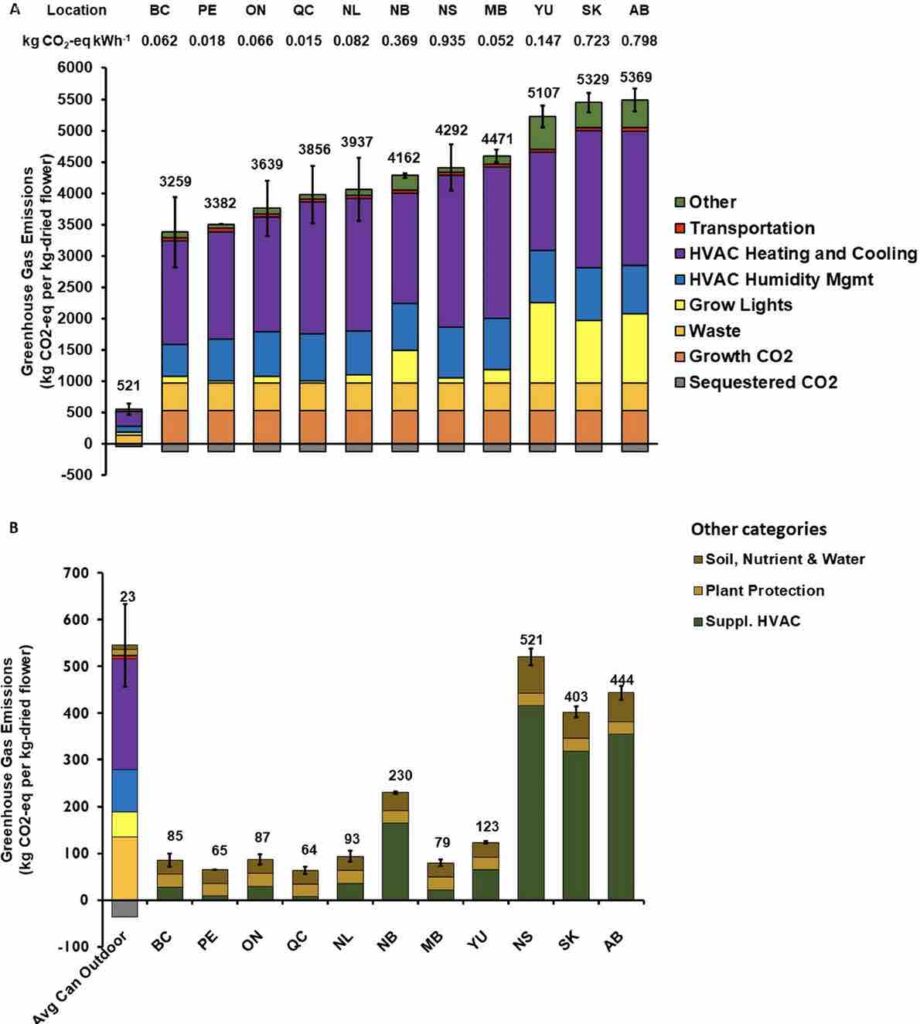
The investigation, led by a researcher at McGill University in Ontario, looks at the “global warming potential” (GWP) of indoor cannabis operations in Canada, calculated on a kg CO2 per kg of dried cannabis flower basis. Although this has been studied in the US, this study is the first to compare American numbers with the Canadian industry.
BC was found to be the most efficient province for growing cannabis due to milder climates and a less polluting electrical grid. In comparison, Alberta was found to be the province with the highest GWP, given its colder climate and more emissions from the power grid used to keep those grow rooms temperature-controlled.
Indoor cannabis operations in colder locations have a higher GWP primarily because of the increased need for natural gas-powered heating, which can account for half of the facility’s GWP. Cannabis grown outdoors can be six to ten times less carbon intensive than indoor cannabis and can reduce those impacts by 90%.
However, the researchers’ assumptions that electrical grid efficiency would be a strong determinant of the GWP of cannabis production was incorrect, as the climate itself was a factor in how much energy was needed. In more humid climates, for example, more power is required to manage that humidity through the growing and drying/curing process, leading to higher GWP.
After BC, PEI, Ontario, and Quebec were the most efficient places to grow indoor cannabis in terms of GWP, while Manitoba, Yukon, Saskatchewan, and Alberta were the least efficient. The research paper also asks if this count is at least partly mediated through incentives for growers in those less-efficient provinces to adopt more carbon-efficient growing methods. In the case of Alberta and Quebec, switching to electrical forms of heating rather than natural gas could lower the GWP.
“Colder locations have higher GWP because of the increased need for NG-powered heating processes. Heating via NG combustion easily accounts for 50% of the GWP. It could be said that production of cannabis grown in QC and AB could be having a disproportionate effect on the carbon footprint of the industry versus cannabis grown in ON and BC. There is a need to question whether incentives for QC and AB producers to adopt carbon-reducing strategy is needed.”
One suggestion the researchers make is to better label and identify less carbon-intensive products for consumers, encouraging them to make more environmentally friendly choices.
Regulatory burdens, an oversaturated market and increasing competition from nearby states have all landed major blows to Colorado’s cannabis market, leaving other states with newer marijuana markets scrambling to avoid the same mistakes
More than 10 years later, 3D Cannabis, the dispensary in Denver’s Elyria-Swansea neighborhood where the historic purchase was made, displays a makeshift sign announcing it is “temporarily closed.” The windows and doors on the side of the building have been boarded up. Plastic bags, discarded coffee cups and other trash collect in the corners of the abandoned parking lot.









Recent Comments