
by Grow Up Conference | Jun 5, 2024 | Cannabis News Wire, Media Partners
- Astrotech Corporation Subsidiary 1st Detect Approved as GSA Vendor; Introduces Advanced Narcotics Trace Detection Technology
- 1st Detect has now received approval from the U.S. General Services Administration (“GSA”) as an authorized vendor for government-related applications
- 1st Detect recently introduced a state-of-the-art Narcotics Trace Detection (“NTD”) narcotics library, which is particularly useful for detection at points of entry and government agencies involved in combating the illicit drug trade
- 1st Detect’s portfolio now includes the TRACER 1000, Explosives Trace Detection (“ETD”) and Narcotics Trace detection
Astrotech (NASDAQ: ASTC), through its subsidiary 1st Detect, is revolutionizing narcotics and explosives trace detection. With recent approval as a U.S. General Services Administration (“GSA”) authorized vendor, 1st Detect is poised to expand its impact across government agencies. TRACER 1000, a cutting-edge detector utilizing ruggedized mass spectrometry technology for superior detection at critical security points. 1st Detect’s commitment to excellence is underscored by its recent achievements and milestones, including its approval by the U.S. General Services Administration as an authorized vendor for key government-related applications (https://cnw.fm/OpXPu). This opens doors to 1st Detect’s products to a wide array of opportunities within government agencies tasked with ensuring national security.
At the heart of 1st Detect’s portfolio lies the TRACER 1000, a cutting-edge trace detector leveraging ruggedized mass spectrometry technology. This instrument represents the pinnacle of innovation in both ETD and now NTD, offering unmatched performance and versatility for security screening applications (https://cnw.fm/i3Fu8).
Key features of the TRACER 1000:
- Ruggedized mass spectrometry technology
- Simple to use interface
- Seamless integration of new narcotics libraries
This development is particularly crucial for airport security and government agencies involved in combating the illicit drug trade by making updates for new drug profiles easy. By incorporating such advancements in mass spectrometry technology widely regarded as the “gold standard” in the industry, Astrotech has set a new standard for accuracy and reliability in narcotics detection.
Astrotech’s commitment to innovation and excellence was on full display at the recent ISC West Conference, held in April in Las Vegas. As a premier event focusing on security and public safety, ISC West provided an ideal platform for Astrotech to showcase its TRACER 1000 trace detector to industry professionals and decision-makers (https://cnw.fm/GajeJ). The company’s participation underscores its dedication to staying at the forefront of technological advancements and addressing the evolving needs of the security market.
Thomas B. Pickens, III, Astrotech’s CEO, and Chief Technology Officer, said: “We are very excited about introducing our narcotics detection library that includes twelve illegal drugs including fentanyl, heroin, and cocaine.” On the occasion, Pickens also said the company was extremely excited to share its user-friendly mass spectrometer the TRACER 1000 with leading industry experts and security industry professionals at the ISC West conference. “This allows us a platform to reach those in the industry across various markets, such as security, checkpoint, military, and law enforcement that strive for quality instrumentation, that requires a minimum amount of maintenance, and want accurate but rapid detection.”
For more information, visit the company’s website at www.AstrotechCorp.com.
NOTE TO INVESTORS: The latest news and updates relating to ASTC are available in the company’s newsroom at https://cnw.fm/ASTC
About CannabisNewsWire
CannabisNewsWire (“CNW”) is a specialized communications platform with a focus on cannabis news and the cannabis sector. It is one of 60+ brands within the Dynamic Brand Portfolio @ IBN that delivers: (1) access to a vast network of wire solutions via InvestorWire to efficiently and effectively reach a myriad of target markets, demographics and diverse industries; (2) article and editorial syndication to 5,000+ outlets; (3) enhanced press release enhancement to ensure maximum impact; (4) social media distribution via IBN to millions of social media followers; and (5) a full array of tailored corporate communications solutions. With broad reach and a seasoned team of contributing journalists and writers, CNW is uniquely positioned to best serve private and public companies that want to reach a wide audience of investors, influencers, consumers, journalists and the general public. By cutting through the overload of information in today’s market, CNW brings its clients unparalleled recognition and brand awareness. CNW is where breaking news, insightful content and actionable information converge.
To receive SMS alerts from CNW, text CANNABIS to 888-902-4192 (U.S. Mobile Phones Only)
For more information, please visit https://www.CannabisNewsWire.com
Please see full terms of use and disclaimers on the CannabisNewsWire website applicable to all content provided by CNW, wherever published or re-published: https://www.CannabisNewsWire.com/Disclaimer
CannabisNewsWire
Denver, CO
www.CannabisNewsWire.com
303.498.7722 Office
Editor@CannabisNewsWire.com
CannabisNewsWire is powered by IBN

by Grow Up Conference | Jun 5, 2024 | Cannabis Prospect Magazine, Media Partners
Aurora Cannabis Inc., the Canadian based leading global medical cannabis company, in conjunction with MedReleaf Australia, is excited to announce the launch of its premium 1.2g resin cartridges in Australia. This expansion marks a significant step in Aurora’s mission to provide high-quality products to patients worldwide. Now available for doctors to prescribe to patients in Australia, Aurora’s new resign cartridges, developed and manufactured at the company’s EU-GMP and TGA-GMP certified facility, will be distributed by MedReleaf Australia.
“We are thrilled to bring premium resin cartridges to the Australian market, a signal of our commitment to expanding patient access to an even greater variety of premium cannabis,” said Kristin Viccars, Interim Managing Director, MedReleaf Australia. “Our products are designed with the highest standards of quality with safety in mind, and we are confident that Australian patients will value the unique experience our cartridges offer. We continue to look at new opportunities to expand our portfolio and patient care.”
The new resin cartridges include offerings from Aurora and IndiMed. The IndiMed brand offering focuses on providing affordable medicine and improving access for patients. The Aurora brand offering features cultivar specific options such as Sourdough and Electric Honeydew, Aurora’s leading proprietary cultivars. All products are full spectrum, ensuring a comprehensive cannabinoid profile for a more effective and balanced experience. These resin cartridges represent a significant advancement for MedReleaf Australia as it continues to expand its product line up in the market. The new resign cartridges are available as of June 4, 2024.
Key features of Aurora and Indimed’s resin cartridges include:
- Exceptional Flavour Profiles: Using high-quality terpenes and pure extracts to deliver rich and authentic flavours.
- High Potency: Ensures a powerful and consistent experience with each use.
- Safety and Quality: Manufactured in state-of-the-art facilities, adhering to strict TGA-GMP quality control and safety standards.
- User-Friendly Design: Easy to use, making it a convenient choice for all patients.
For additional information doctors and health care professionals can contact MedReleaf Australia’s clinical support team or visit their website: www.medreleafaustralia.com.au.
About Aurora Cannabis
Aurora is opening the world to cannabis, serving both the medical and consumer markets across Canada, Europe, Australia and South America. Headquartered in Edmonton, Alberta, Aurora is a pioneer in global cannabis, dedicated to helping people improve their lives. Driven by science and innovation, and with a focus on high-quality cannabis products, Aurora’s brands continue to break through as industry leaders in the medical, wellness and adult recreational markets wherever they are launched. Learn more at www.auroramj.com and follow us on X and LinkedIn.
by Grow Up Conference | Jun 5, 2024 | Cannabis News Wire, Media Partners
The use of machine learning in indoor marijuana cultivation facilities is increasing, with growers using advanced cameras and sensors to sound alarms on threats such as disease or pests, decrease labor costs linked to different level growing tasks and maintain optimal conditions for plant growth.
The primary reasons why marijuana and other indoor cultivation companies are making use of artificial intelligence (AI) or machine learning tech in their facilities include the following:
- Consistency is needed in indoor growing facilities, and artificial intelligence can deliver this.
- Resources such as energy and labor that are required to cultivate marijuana indoors are costly; consequently, tech powered by AI can help decrease those costs.
At the moment, artificial intelligence for indoor cultivation is almost able to monitor and call attention to invisible things such as changes in growth rate in plants. Once consistency is achieved in the future, artificial intelligence may be able to improve rates of growth.
For 22Red’s Head of cultivation, Stephen Hess, artificial intelligence has eliminated most of the logistical and manual work involved in growing marijuana. This has afforded the Arizona-based marijuana company more time to focus on other tasks while also saving on labor costs.
The company implemented the Spyder technology, developed by Neatleaf, at its facility. The technology is comprised of sensors that track data such as humidity, temperature and leaf color at different times of the day for microclimates or individual plants in the facility. This technology then evaluates data collected to detect signs or patterns of stress and presents its findings on a dashboard, complete with light maps, heat maps and charts, for the company to study.
According to Hess, the technology’s recommendations are more accurate because it makes calculations based on what the system has monitored. Before 22Red used this technology, it had to use handheld sensors to collect the same data. In addition, thousands of dollars in salaries were spent annually for employees who did this work.
Now with this tech, the company only pays $600 in subscription fees to Neatleaf along with another $600 monthly for assessments.
It should be noted, however, that not all facilities can accommodate this Neatleaf system. Currently, Spyder cannot collect data from areas that are blocked or too low. This includes vertical growing facilities or facilities whose pillars block the sensors.
22Red isn’t the only company making use of advanced technology in their facilities either. Other companies, such as Jushi Holdings, use equipment with machine- learning to control their building-management system. This has allowed the Florida-based company to efficiently gather and analyze data and produce marijuana more sustainably while also decreasing energy costs.
As more AI solutions become available, a time may come when major cannabis companies such as Aurora Cannabis Inc. (NASDAQ: ACB) (TSX: ACB) largely rely on these systems to grow higher-quality marijuana to address the needs of their customers.
About CannabisNewsWire
CannabisNewsWire (“CNW”) is a specialized communications platform with a focus on cannabis news and the cannabis sector. It is one of 60+ brands within the Dynamic Brand Portfolio @ IBN that delivers: (1) access to a vast network of wire solutions via InvestorWire to efficiently and effectively reach a myriad of target markets, demographics and diverse industries; (2) article and editorial syndication to 5,000+ outlets; (3) enhanced press release enhancement to ensure maximum impact; (4) social media distribution via IBN to millions of social media followers; and (5) a full array of tailored corporate communications solutions. With broad reach and a seasoned team of contributing journalists and writers, CNW is uniquely positioned to best serve private and public companies that want to reach a wide audience of investors, influencers, consumers, journalists and the general public. By cutting through the overload of information in today’s market, CNW brings its clients unparalleled recognition and brand awareness. CNW is where breaking news, insightful content and actionable information converge.
To receive SMS alerts from CNW, text CANNABIS to 888-902-4192 (U.S. Mobile Phones Only)
For more information, please visit https://www.CannabisNewsWire.com
Please see full terms of use and disclaimers on the CannabisNewsWire website applicable to all content provided by CNW, wherever published or re-published: https://www.CannabisNewsWire.com/Disclaimer
CannabisNewsWire
Denver, CO
www.CannabisNewsWire.com
303.498.7722 Office
Editor@CannabisNewsWire.com
CannabisNewsWire is powered by IBN

by Grow Up Conference | Jun 4, 2024 | Media Partners, Stratcann
An Alberta-based cannabis company has recalled several cannabis oils and softgels due to the “presumed presence” of hexahydrocannabinol (HHC), considered by Health Canada to be an intoxicating cannabinoid.
HHC is a “semisynthetic CBD” often synthesized from CBD.
The recall involves six lots of products from cannabis producer iNaturally Organic Inc’s Emprise CBN+CBD 50mg Softgels, NuLeaf Naturals 1800 mg Full Spectrum Hemp Multicannabinoid Oil Softgels, and NuLeaf Naturals 1800 mg Full Spectrum Hemp Multicannabinoid Oil cannabis extracts.
The NuLeaf Naturals oil contains Delta 9, CBC, CBD, CBG, and CBN each at 3 mg per softgel. The NuLeaf Naturals softgels contain CBC, CBD, CBG and CBN, each at 15 mg/ml.
The recalled products were sold in Ontario, British Columbia, Alberta, Manitoba, Saskatchewan, and the Yukon, and through medical cannabis platforms Herbal Dispatch, Open Fields Winnipeg, and Médicibis.
Health Canada says the recall is due to the identified hazard of the presumed presence of hexahydrocannabinol, which consumers may not be aware of. To date, iNaturally Organic Inc. says it has received two adverse reaction reports about these products. Health Canada has received three adverse reaction reports and one complaint related to these products.
There were 8,526 units of Emprise CBN+CBD 50mg Softgels distributed, 2,286 units of NuLeaf Naturals 1,800 mg Full Spectrum Hemp Multicannabinoid Oil Softgels (with Delta 9, CBC, CBD, CBG and CBN each at 3 mg per softgel) distributed, and 2,534 units of NuLeaf Naturals 1,800 mg Full Spectrum Hemp Multicannabinoid Oil (CBC, CBD, CBG and CBN, each at 15 mg/ml) distributed from December 2022 to May 31, 2024.
Health Canada says consumers should immediately stop using the product, either returning the product to where it was purchased or disposing of it.
Mukhdeep Mangat, VP of operations at Emprise, tells StratCann that they have independent lab tests showing no presence of HHC and were surprised by Health Canada’s findings.
“Analytical testing laboratories working with iNaturally Organic did not detect HHC in any of the products prior to batch release.”
“iNaturally Organic received two adverse event reports about all three products combined. Health Canada received three adverse event reports and one complaint. The adverse event reports and complaint total six reports after sale of well over 10,000 units total of the three products, or less than one in 1,000 units.
“iNaturally Organic prioritizes the health of its customers and is investigating Health Canada’s assertion of presumed presence of HHC, despite no evidence of HHC in the products from analytical testing laboratories working with iNaturally Organic.”

by Grow Up Conference | Jun 4, 2024 | Media Partners, The New Agora

The Ego Deconstruction Manual
By Gary Z. McGee
“Most people are asleep, dreaming they’re awake.” ~Ken Wilber
The ego is not the enemy. But it can be. It can be a distraction. It can be a hangup. It can be a boulder on the otherwise clear path of your emergence. But it is a vital part of who you are. So, you must be capable of seeing: “the obstacle is the path.”
When people talk about “getting out of their own way,” they are referring to their ego. Getting out of your own way means figuring out a way to outflank your overreaching ego, which seeks to entrench you in comfort. It means outmaneuvering your cultural conditioning, religious indoctrination, and political programming. It means getting uncomfortable so that you do not become contemptible.
The trick is deconstructing the ego and then using the soul (your unquenchable curiosity, your unconquerable passion, your indominable interconnection with all things) to build it back up in its own image. Let’s break it down…
Leash the ego, unleash the soul:
“God is in all men, but all men are not in God; that is why we suffer.” ~Ramakrishna
The ego is underrated in orientation; it is overrated in individuation.
In your youth it was necessary to develop your ego to achieve discipline; in your maturity, it is vital that you deconstruct your ego to achieve wholeness (individuation, self-actualization, enlightenment). The alternative is bitterness, contemptibility, and self-pity.
Ego deconstruction begins with doubt. It begins with ruthless self-interrogation. It begins with dismantling what has kept your comfort zone intact.
As Descartes said, “If you would be a real seeker of truth, it is necessary that at least once in your life you doubt, as far as possible, all things.”
Doubt teaches you how to iterate through the self like a snake sheds its skin. Always moving forward. Always adapting. Always overcoming the fixed notion of Self.
You must toss your worldview into the raging fire of higher consciousness, which is kindled by the outdated fixtures that once kept you chained inside Plato’s Cave.
Free from the fetters of your foundations, you can finally put Plato’s Cave behind you. The ego takes a backseat. Your soul takes the forefront. With your ego on a leash led by your soul, you become a force to be reckoned with.
Keep humility ahead of hubris:
“We are never definitely right; we can only be sure we are wrong.” ~Richard Feynman
Having made sure that the ego works for the soul and not the other way around, you realize that the real secret to becoming adaptable to the paradox of the human condition is to keep humility ahead of hubris.
You have accepted the fact that you are a fundamentally flawed, fallible, imperfect, and biased mortal. Such humility launches you into a state of nonattachment, where you can touch infinity despite your finitude.
You realize that cognitive dissonance is very real, and it affects us all. And the best you can do is admit that you could be wrong about a great many things. This will keep you ahead of the curve. It will keep questions ahead of answers. It will keep curiosity ahead of certainty. Which will keep your Truth Quest ahead of any given “truth.”
Keep the Shadow and the Trickster forefront within you:
“Belief is the most dangerous thing against truth, because it prevents you from inquiring. It makes you knowledgeable, but it does not make you wise. It can make you a great scholar, a theologian, but deep inside, you are full of darkness, and you don’t know who you are.” ~Osho
Integrate the shadow to know “who you are.” Use the trickster archetype to do so.
Trick yourself into reconditioning your cultural conditioning. Flip the script handed down to you by a fear-based culture. Turn the tables on indoctrination and get out ahead of your beliefs. Outshine the blinding light of outdated “truth.” Realize, as James Russell Lowell said, that “time makes ancient good uncouth.”
Your inner trickster is the ultimate boundary-crosser. No manmade rules or laws can contain it. Trickster remakes the ego by tearing your old ego down through high humor, moral ambiguity, sacred tomfoolery, and strategic transgression, and then dances in the ashes of its destruction.
Trickster cracks open your ego like an egg. What’s revealed is your inner darkness, your festering repression, the tangled knot of your unconscious. But rather than balk, the trickster laughs. Rather than fret, the trickster has a little dance. Rather than freeze, the trickster integrates the darkness and makes the unconscious conscious.
But it is precisely from the dancing, the kicking up of dust and ash, where a brave new ego might emerge. When the ashes and dust settle, the bed of the Phoenix is made manifest, and the Self is allowed to go through the painful iterations of Self-actualization.
Transform codependence into independence into interdependence:
“It is easy in the world to live after the world’s opinion; it is easy in solitude to live after our own; but the great man is he who in the midst of the crowd keeps with perfect sweetness the independence of solitude.” ~Ralph Waldo Emerson
The destructed ego reconstructed is a force of nature. It has the power to “keep with perfect sweetness the independence of solitude” despite the crowd.
Having been built on the cliffs of Vesuvius, the reconstructed ego was forged in solitude. Lifted to the highest heights by the Shadow, lowered to the lowest abyss by the Trickster, the reconstructed ego has the profound ability to hold the tension between opposites.
Such an ego, unfettered by pride, unencumbered by certainty, undeterred by belief states, has blown up so many crossroads that all roads have become crossroads. It has usurped the thrones of so many false gods that dancing a jig over God’s grave has become second nature. It has laughed into the darkness of so many abysses that even the deepest abyss has become a playground for sacred hijinks and High Humor.
With such an ego in tow, you have learned how to live with uncertainty. You have learned how to be comfortable with being uncomfortable. You have reimagined imagination itself. You’ve given birth to the Oversoul of the Overman.
Boundaries dissolve into horizons. The invulnerable world unlocks and reveals its vulnerable underbelly. Destiny becomes a plaything. The Infinite Game reveals itself, and you are the gamemaster. Interdependence trumps independence trumps codependence. The interconnectedness of all things moves through you. God moves through you. And you will no longer pretend to be asleep.
Image source: By Julian Majin
About the Author:
Gary Z McGee, a former Navy Intelligence Specialist turned philosopher, is the author of Birthday Suit of God and The Looking Glass Man. His works are inspired by the great philosophers of the ages and his wide-awake view of the modern world.
This article (The Ego Deconstruction Manual) was originally created and published by Self-inflicted Philosophy and is printed here under a Creative Commons license with attribution to Gary Z McGee and self-inflictedphilosophy.com. It may be re-posted freely with proper attribution, author bio, and this statement of copyright.

by Grow Up Conference | Jun 4, 2024 | Media Partners, The New Agora

Solutocracy – A Way to Govern
Again, I am offering, with additional thoughts, the content of a video I created. I have been speaking of a solutocracy for a long while and many People have asked Me what a solutocracy is. In this article, I hope to clarify.
First, I want address why I call it “demo(n)cracy.” The “demon” part comes from the fact that if enough People want to take what Others own, They can “vote” to do so, and the Ones who are being robbed have no say. It’s two wolves and a sheep deciding what’s for dinner. Rather demonic if You ask Me!
Onwards to what solutocracy is…
Let Us presume We have a society with no rulers. EveryOne is Self-sovereign and may do any Ethical thing They choose. The only “rules” are the three Laws of Ethics (see link below), which cover the things no One would say would be okay to be done to Them.
There is no need for money, as free energy is flowing, robots are doing the necessary things no One wants to do, the Betterment Ethic (see link below) is held widely… And All may live as richly as Each might choose. People are creating things and offering services because They love to create and do what They are doing… Giving the product of Their energy to the Ones who appreciate it, who pay Them in social currency.
They are earning praise, appreciation, lauds, love, thanks, reputation, respect, adoration, attention, bragging rights and other of the social currencies for doing what They love to do. The Ones who do nothing earn no positive currency, but may earn scorn, disrespect, disgust, and other negative currency.
Most have chosen to be connected with a decentralized, open-source web, communicating with Others and sharing awareness of Their products and services. All are able to travel where They wish, when They wish, as both personal and public transport are freely available to All.
Now let Us suppose a problem arises. It does not matter the nature of the problem. Big or small, it is a problem. The One who sees it first goes to the dedicated problem-solving site and reports it. It first shows up on a local level.
It is considered, in this society, that One’s civic duty is to check this site with some frequency – usually daily – to see if any problems have been reported, checking all levels to see if They can offer advice or help. After the problem is reported, Others, encountering the report, see if They can think of a solution, offering it if They can.
They can ask questions and get answers on the post, if They need more information.
If They don’t think it really is a problem, They can thumb it down. If They do think it is a problem, They can thumb it up. If They don’t care, They can move on. If They can help solve the problem, They go to where the problem is.
If the net thumbs-up reaches a certain number, and yet no One has offered a solution, the problem is elevated to a higher level. A regional level. More People can look at the problem, ask questions, make suggestions, and respond if They think They can help. If this level cannot achieve a solution, and the net thumbs-up reach a greater number, the problem moves up to a higher level, reaching more People to work on the problem. And thus it goes to the point that the whole planet is aware and helping to solve for the problem.
If a problem is so big, and the whole planet cannot solve for it… I guess We’d be SOL – but then, if a problem is that big, it would be absurd to think some controlmind (government) would do better.
The problems that such a system can address are limitless.
On the site, there is an emergency section for things that need immediate attention, and People have apps on Their devices (that use healthy frequencies, not the disruptive ones used today) that alert People, who have signed up because They love to help (which many of Us do), when an emergency is reported, allowing Them to respond immediately and directly to help.
Responding to just get in the way earns much negative currency, and might bring Ethical consequences. It is expected that One be close to certain One can help before wading in to solve the issue. And leaders of the moment will emerge within Those who respond.
All problems can be handled in the most efficient and Ethical fashion. No constraints of needing money exist, and only logistics and Ethics need to be considered. Problems can range from someOne choosing unEthical behavior to natural disasters to accidents to breakdown of supply chains…
Rather than passing “laws” (legalates) and enforcing them, as We presently have in place, We are free to do as We choose – as long as We are not creating a problem. There is no pow
er over Others, promoting psychopaths as statist, monarchy, or other top-down controlmind systems do, as also any money system does.
And to be sure… If a problem affects Us, We will be motivated to solve for it – whether it is creating an emotional or physical effect.
In this way We can govern a truly free society. Governance, not government.
.
“When enough of Us know We can create better, We will!” – *Amaterasu Solar*
.
.
.
.
Solutocracy (7 min): https://odysee.com/@amaterasusolar:8/solutocracy:c?lid=eeff9e0c80138ce03e22d76bcd5f2f873ff46b72
The Betterment Ethic vs. the Slave’s Creed (article): https://amaterasusolar.substack.com/p/the-betterment-ethic-vs-the-slaves
The Three Laws of Ethics (article): https://amaterasusolar.substack.com/p/the-three-laws-of-ethics
Blueprint for a Society of Ethical Sovereigns (article): https://amaterasusolar.substack.com/p/blueprint-for-a-society-of-ethical
Electrogravitics: Gravity Control & Energy from the Aether (9 min): https://odysee.com/@amaterasusolar:8/electrogravitics-gravity-control-energy:6?lid=eeff9e0c80138ce03e22d76bcd5f2f873ff46b72
The Third Option: Anarcho-Abundancism (article): https://amaterasusolar.substack.com/p/the-third-option-anarcho-abundancism
One Outcome in Abundance (article): https://amaterasusolar.substack.com/p/one-outcome-in-abundance
There is a Light Bulb… (article): https://amaterasusolar.substack.com/p/there-is-a-light-bulb
.
.
by Grow Up Conference | Jun 4, 2024 | Cannabis News Wire, Media Partners
A recent study featured in the “Psychological Medicine” journal delves into the relationship between adolescent marijuana use and the development of psychotic disorders. The research indicates a significant increase in psychotic disorder risks during adolescence linked to marijuana use, a risk that is particularly pronounced with the stronger marijuana products available today. Interestingly, this increased risk does not extend into young adulthood.
Previous studies have suggested a link between youth marijuana use and psychotic disorders, noting a higher likelihood of such disorders among marijuana users. These earlier studies often relied on outdated data when marijuana was less potent and faced limitations such as small sample sizes and less clinically significant outcomes.
The recent study assessed the relationship between teenage marijuana usage and the likelihood of receiving a clinical diagnosis of a psychotic condition using more recent population-based statistics. The goal of the research was to bring the findings up to speed with the current increase in marijuana potency.
Data were drawn from the Canadian Community Health Survey (CCHS) between 2009 and 2012, linked with Ontario’s administrative health records. The study focused on Ontario residents aged 12 to 24 years of age. Those with incomplete medical records or a history of psychotic disorders were excluded, resulting in a final sample of 11,363 participants.
Information on marijuana use and other substance usage, along with sociodemographic details was collected through interviews conducted both by phone and in person. The follow-up ended in 2018 after a maximum of nine years of monitoring the participants. The analysis accounted for various confounding factors, including sex, age, race, other drug use and income.
Approximately 23.4% of respondents reported using marijuana in the past 12 months, and during the follow-up, 1.2% sought healthcare for psychotic disorders. The analysis revealed a significant association between psychotic disorders and recent marijuana use among adolescents aged 12 to 19 years of age, with an adjusted hazard ratio of 11.21. This was not found in young adults aged 20 to 33 years of age, who had an aHR of 1.29.
Subsequent analysis supported these results, demonstrating an aHR of 26.68 for adolescent cannabis users’ hospitalizations or doctor visits linked to psychotic illnesses. Additionally, a dose-response association was noted, with an aHR of 10.70 indicating that frequent marijuana use among teenagers was associated with a higher risk. An analysis focusing on gender revealed that this link, with an aHR of 9.98, was significant for teenage males.
Additionally, the study discovered a substantial correlation between cannabis usage in the year prior and the utilization of healthcare services for psychotic disorders in the past, indicating a possible reverse causal relationship.
The study’s strengths include the use of representative and high-quality data from the CCHS and linked health records, as well as a validated outcome measure and recent cannabis potency data. However, limitations include a single baseline assessment, self-reported marijuana use, and possible unmeasured confounding measures including family history, trauma and genetic predispositions.
These findings hold important implications for public policy and health, especially concerning the prevention of teenage marijuana use.
This elevated risk of adolescents developing psychosis when they use marijuana makes a strong case for allowing legal marijuana sales by licensed companies such as Green Thumb Industries Inc. (CSE: GTII) (OTCQX: GTBIF) in states because guardrails, including verifying the age of a product buyer, can be implemented to make it harder for teens to access marijuana.
About CNW420
CNW420 spotlights the latest developments in the rapidly evolving cannabis industry through the release of an article each business day at 4:20 p.m. Eastern – a tribute to the time synonymous with cannabis culture. The concise, informative content serves as a gateway for investors interested in the legalized cannabis sector and provides updates on how regulatory developments may impact financial markets. If marijuana and the burgeoning industry surrounding it are on your radar, CNW420 is for you! Check back daily to stay up-to-date on the latest milestones in the fast -changing world of cannabis.
To receive SMS alerts from CNW, text CANNABIS to 888-902-4192 (U.S. Mobile Phones Only)
For more information, please visit https://www.CannabisNewsWire.com
Please see full terms of use and disclaimers on the CannabisNewsWire website applicable to all content provided by CNW, wherever published or re-published: https://www.CannabisNewsWire.com/Disclaimer
CannabisNewsWire
Denver, CO
www.CannabisNewsWire.com
303.498.7722 Office
Editor@CannabisNewsWire.com
CannabisNewsWire is powered by IBN

by Grow Up Conference | Jun 4, 2024 | Cannabis Prospect Magazine, Media Partners
Delota Corp., a leading Canadian omni-channel retailer of nicotine vape and alternative tobacco products is pleased to report it has filed its annual consolidated financial statements, management discussion and analysis, and associated certifications (collectively, the “Annual Filings”) for the fiscal year ended January 31, 2024. The Annual Filings may be accessed under the Company’s SEDAR+ profile at www.sedarplus.ca.
Cameron Wickham, CEO of Delota, commented, “I am very pleased with our fourth quarter and annual results for the year ended January 31, 2024, which includes record annual revenue of $34 million. We have expanded our 180 Smoke footprint across Ontario to 29 stores and strengthened our national e-commerce platform which together, serve over 220,000 loyalty members.” He continued, “We have a defined growth strategy, which includes organic brick-and-mortar expansion in Ontario and select provinces across Canada, as well as strategic M&A to accelerate growth. The industry is primed for consolidation, and Delota is well positioned to capitalize on that. As we continue to expand our platform, we will increase top line revenue and add to bottom line profitability. I am very proud of our team and look forward to continuing to excel in this exciting industry.”
Financial Highlights:
- Total revenue of $34,069,680 for the year ended January 31, 2024 (“Year Ended 2024”), reflecting year-over-year (“YoY”) growth of 31% as compared to the year ended January 31, 2023
- 40% gross profit margin for the Year Ended 2024
- Positive Adjusted EBITDA of $235,552 for the Year Ended 2024
- Total revenue of $10,152,051 for the three months ended January 31, 2024 (“Q4 2024”), reflecting YoY growth of 47% as compared to the three months ended January 31, 2023
- 38% gross profit margin for Q4 2024
- Positive Adjusted EBITDA of $331,138 for Q4 2024
- Segmented Revenue for the Year Ended 2024:
- Vape – B2C: $23,434,410, B2B: $6,874,734
- Cannabis – B2C: $3,760,536
Other Highlights:
- On April 29, 2024, the Company announced the expansion of its product portfolio with the addition of nicotine-based Siberia White Snus pouches through a partnership with GN Canada, the exclusive Canadian distributor and partner with global snus leader GN Tobacco.
- On April 11, 2024, the Company provided a corporate update on its significant growth and progress.
- On April 2, 2024, the Company changed its stock symbol from “LOTA” to “NIC” on the Canadian Securities Exchange. The new stock symbol is intended to better align with its mission of becoming the largest national specialty retailer of nicotine vape and alternative tobacco products.
- On February 5, 2024, the Company completed debt settlements in the amount of $215,000 with certain creditors of the Company to preserve cash for working capital through the issuance of 1,535,715 units of the Company at a price of $0.14 per unit.
- On December 19, 2023, the Company closed a non-brokered private placement of senior secured convertible debenture units for aggregate gross proceeds of $900,000.
- On December 19, 2023, the Company opened a 180 Smoke Vape Store located at 103 10th Street East, Owen Sound, Ontario expanding 180 Smoke’s brick-and-mortar presence to 29 locations.
- On September 25, 2023, the Company’s common shares commenced trading on the Frankfurt Stock Exchange under the symbol “S62”.
About Delota Corp.
Delota is the largest omni-channel specialty vape retailer in Ontario with a mission of becoming the largest national specialty retailer of nicotine vape and alternative tobacco products. The Company’s growth strategy includes aggressively growing its flagship brand, 180 Smoke Vape Store, by expanding its retail footprint organically in Ontario and select provinces across Canada, strengthening its national e-commerce platform, and through strategic M&A to accelerate growth and market consolidation. The Company is committed to expanding its nicotine product assortment, enhancing customer experience, and growing its loyalty accounts, which now exceeds 220,000 members. Investors interested in learning more about Delota can visit www.delota.com.

by Grow Up Conference | Jun 4, 2024 | Cannabis Prospect Magazine, Media Partners
ZYUS Life Sciences Corporation, a Canadian-based life sciences company focused on the development and commercialization of novel cannabinoid-based pharmaceutical drug candidates for pain management, is pleased to announce that its wholly owned subsidiary, ZYUS Life Sciences Inc., has received a Cannabis Drug License issued pursuant to the Cannabis Act (Canada) and Cannabis Regulations. This license pertains specifically to its processing facility located in Saskatoon, Saskatchewan, which is dedicated to the manufacture of pharmaceutical-grade cannabinoid formulations.
Issuance of the Cannabis Drug License compliments ZYUS’ existing standard processing, research, analytical and medical sales licenses and expands the scope of the Company’s license portfolio by enabling ZYUS to manufacture and distribute drugs containing cannabinoids for Health Canada-approved clinical trials in Canada.
Advancing Innovation Through Trichomylin® Softgel Capsules Phase 2 Clinical Trial
As previously announced, ZYUS intends to launch a Phase 2 Clinical Trial in Canada later this year to assess the preliminary efficacy, safety, and tolerability of Trichomylin® softgel capsules in patients with advanced cancer and moderate to severe cancer-related pain. ZYUS’ receipt of the Cannabis Drug License and compliance with applicable quality guidelines issued by the International Council for Harmonisation and Good Manufacturing Practice standards provides a robust framework respecting the Company’s manufacture of Trichomylin® softgel capsules for its Phase 2 Clinical Trial and brings ZYUS one step closer to achieving its goal of obtaining regulatory approval of its proprietary drug product.
Robust Intellectual Property Portfolio
In addition to this licensing advancement, ZYUS has also been granted Patent No. 2022/12127 in South Africa respecting its second drug candidate. The South African patent expands ZYUS’ robust intellectual property portfolio, which is comprised of multiple patent families focused on fixed-dose cannabinoid-based formulations for pain management and other clinically unmet needs. Issuance of the South African patent, together with the recent issuance of the Company’s U.S. patent covering Trichomylin® softgel capsules, underscores ZYUS’ dedication to pioneering novel therapies in the pharmaceutical landscape.
“Receipt of the Cannabis Drug License marks a significant milestone for ZYUS,” said Brent Zettl, President and CEO of ZYUS. “This achievement, alongside the issuance of the first patent for our second drug candidate in South Africa, positions ZYUS as a leader in the development of innovative therapies, aimed at improving patients’ quality of life.”
Grant of Stock Options
Pursuant to the Company’s omnibus equity compensation plan (the “Omnibus Plan”), the Company also announced it has granted stock options to purchase up to an aggregate of 322,175 common shares of the Company, which includes 100,000 options issued to certain members of the Corporation’s senior management. The stock options were priced at $1.08 per option share, being the closing price of the Corporation’s shares on the date of issuance, and are exercisable for a period of five years and have various vesting periods.
About ZYUS Life Sciences Corporation
ZYUS is a life sciences company focused on the development and commercialization of novel cannabinoid-based pharmaceutical drug candidates for pain management. Through rigorous scientific exploration and clinical research, ZYUS aims to secure intellectual property protection, safeguarding its innovative therapies and bolstering shareholder value. ZYUS’ unwavering commitment extends to obtaining regulatory approval of non-opioid-based pharmaceutical solutions, in pursuit of transformational impact on patients’ lives. For additional information, visit www.zyus.com or follow us on X (formerly known as Twitter) @ZYUSCorp.

by Grow Up Conference | Jun 4, 2024 | Garden Culture Magazine, Media Partners
Oyster mushrooms will boost your culinary game. They’re versatile, tasty, and loaded with vitamins, minerals, and antioxidants. They’ll flourish on your kitchen counter or garden with a few simple ingredients – in under four weeks from start to finish. You’ll likely get multiple ‘flushes’ of mushrooms from the same container, too. Introducing “Bucket Tek”!
Why Oyster Mushrooms?
Oysters are among the easiest mushrooms to cultivate at home. They’re hardy, fast-growing, and not picky about their food source or growing conditions. They’ll grow happily on straw inside a bucket with holes in the side – the mushroom clusters will grow out of these when ready.
How does it work?
In nature, mushroom spores germinate on something nutritious – like soil, a dead tree, or manure. Throughout the summer, mycelium will spread through that area (usually turning it white). When it’s fully ‘colonized’ in the autumn/fall, mushrooms will grow out of it to spread their spores; this is what we’re replicating with “Bucket Tek”:
1) Introducing mycelium to a warm, wet ‘underground’ space to colonize inside a bucket.
2) Changing to a cooler, humid ‘fruiting’ stage where the mushrooms appear.
Which Oyster to Grow?
Any ‘side-fruiting’ oyster will work using this method. Pink and Yellow oysters grow well in hotter climates, while Grey/Blue Oysters do better in cooler places. Avoid King oysters, as they like to grow on a flat surface.
What will I need to Grow Oyster Mushrooms?
Ingredients
- Oyster Mushroom Grain Spawn – This is the equivalent of mushroom ‘seeds’; a quick Google search will find many options. 100g is enough for a 10-litre bucket, but you can use more if you want to.
- Straw – This is the ‘substrate’ or ‘soil’ from which the mushroom mycelium will eat and grow. Chopped straw is best, although any will do. Pet shops are a good place for this.
- Gypsum (optional) – Also known as calcium sulfate, this adds nutrients for a better harvest. If you use it, aim for around 5% of the dry weight of the straw you use.
- Boiling water – for pasteurizing straw.
Equipment
- A mixing container – This can be a large cooking pot with lid or a PP5 plastic bucket with lid.
- A large metal spoon
- A container for growing in – A plastic bucket with a lid, a well-washed yogurt pot or any other solid plastic container.
- Drill – This will make the holes the mushrooms will grow out of.
- Medical tape – This breathable tape will cover the holes while the mushrooms are ‘colonizing’ (the ‘underground’ stage of growth).
- A spray bottle – to humidify your mushrooms as they grow.
How to Grow Oyster Mushrooms
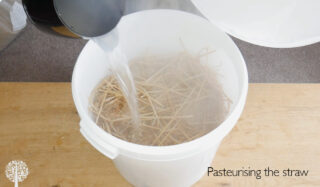
Pasteurizing Straw
- Pour your straw into a clean mixing container.
- If you are using gypsum, add it to the straw.
- Add boiling water and mix to cover the straw. Leave the whole thing to cool.
- Drain the excess water from the container when it’s back at room temperature.
Preparing Growing Container
- Drill 12mm holes 4 inches apart around the outside edges of the growing container. A little smaller will work if you don’t have a drill bit that big.
- Cover each hole with medical tape.
- Drill several tiny holes in the bottom of the bucket for drainage – leave these open.


Mixing in the “Seeds” – and the “Underground” Phase
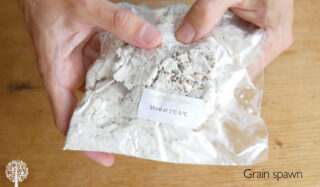
- Massage your grain spawn through the bag to separate each grain.
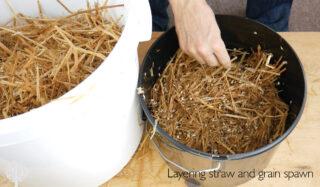
- With clean hands, put a layer of the prepared straw in the bottom of your container.
- Follow this with a scattering of grain spawn.
- Make a ‘lasagna’ from layers of pasteurized straw and grain spawn until you have filled the whole container.
- Put on the lid and leave in a warm, dark, and relatively clean place for two weeks. A good temperature range is 21-24°C (70-70 °F), but each strain will have its favorite colonization temperature, so check you’re meeting its requirements.
The “Overground” Phase – Growing Mushrooms!

- After two weeks, open the container and ensure the whole surface is white. If so, it is time to put your container into “fruiting” conditions.
- Remove the medical tape from the holes and move your container into a cooler place in daylight to encourage the mushrooms to grow. This can be inside or outside – out of direct sunlight.
- Keep the outside of the bucket humid by misting it with a water sprayer a few times a day. If you live in a dry place, you can spray the inside of a plastic bag and put it over the container to create a humidity ‘dome.’ Make sure to remove this regularly to introduce fresh air and extra humidity.
- After a few days, you will hopefully see baby mushrooms appear in the holes. Around five days after this, your mushrooms should be ready to harvest!
Harvesting Your Mushrooms – And Getting a Second Flush
- Your mushrooms are ready when the edge of their caps flatten or turn upwards.
- To harvest, grab a cluster and gently twist it until it comes away from the container. You can harvest mushrooms when they are ready.
- When you have harvested your bucket, rehydrate it – soak it in a bigger bucket of water for around four hours – and then return it to fruiting conditions for the next “flush.” You may get many “flushes” of mushrooms from one bucket.


Enjoy!
Always cook before eating. Oysters are excellent in soups and stews or torn into strips and fried. For a more succulent mushroom, broil them in a bit of water until the pan goes dry – and then throw in some oil to crisp them up on the outside.

If you have too many mushrooms to eat right away, you can store them in a plastic tub with the lid open in the fridge. If you want to preserve your harvest, you can dry them in a dehydrator until cracker-dry, then store them in an airtight container for when you want to rehydrate.
A warning for the big growers – if you intend to cultivate lots of oysters, it’s a good idea to ventilate your fruiting space, as Oyster spores can cause aggravation if inhaled. Large-scale growers use some kind of “fruiting chamber” to achieve optimal conditions in a closed environment – and remove spores using an extractor fan.





Recent Comments