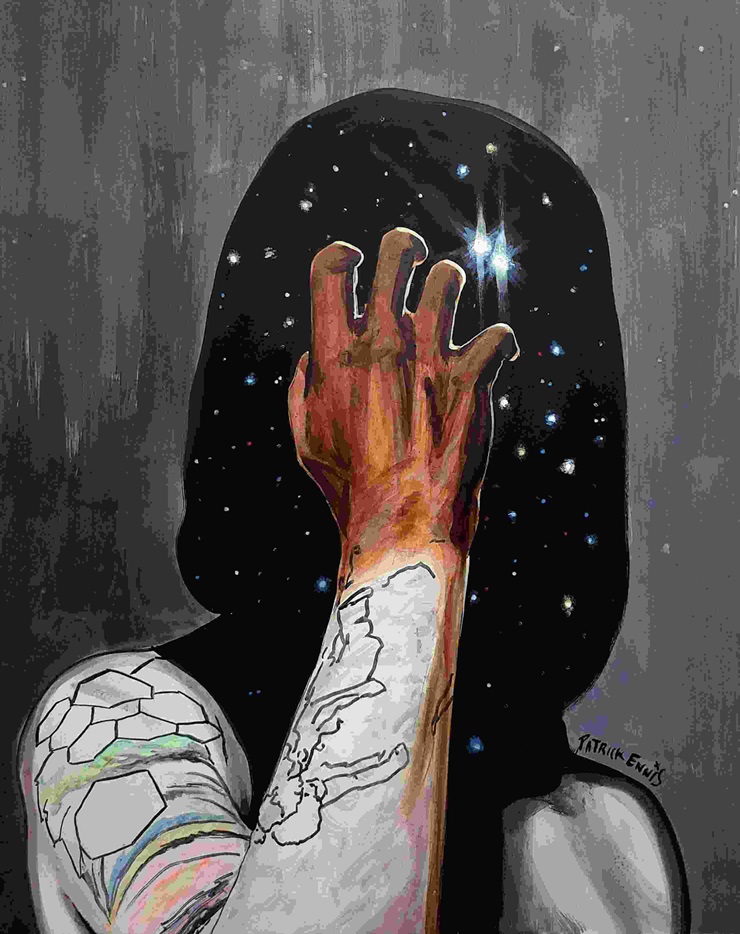
“You desire to know the art of living, my friend? It is contained in one phrase: make use of suffering.”
Henri-Frédéric Amiel, Amiel’s Journal
Depression is the darkest of human experiences. It saps our energy, weakens our will to work, destroys our desire to socialize, decreases our motivation to exercise, and sometimes even jeopardizes our will to live. When depressed, the future looks hopeless, and our self turns into the heaviest of burdens. But perhaps the most pernicious thing about depression is that when caught in its grip it can seem as if there is no way out and no value to the experience. As we will explore in this video, hidden in the darkness of depression is a psychological treasure which can facilitate self-transformation.
“Depression is not necessarily pathological. It often foreshadows a renewal of the personality or a burst of creative activity. There are moments in human life when a new page is turned.”
Carl Jung, Collected Works Volume 16
One of the ways modern psychologists try to understand and treat depression is by isolating its cause. The ending of a relationship, a failed business, the death of a loved one, loneliness, poverty, trauma, or biological, genetic, or chemical predispositions, are some of the many causes which psychologists fixate on. The Swiss psychiatrist Carl Jung believed that facilitating healing was best accomplished not by focusing on the cause of the depression, but on the telos – that is, the purpose, end, or goal a depression is aiming at.
“Depressions always have to be understood teleologically.”
Carl Jung, Conversations with Carl Jung
Or as the psychologist Edward Edinger wrote:
“If you have a dynamic understanding of the nature of the psyche, you will realize, as Jung tells us, that depression, like all other psychological symptomatology, has a telos at its core – a latent purpose – if one can understand it purposefully.”
Edward Edinger, The Sacred Psyche
While the purpose of a depression differs among individuals, in general, a depression can be conceived as the psyche’s attempt to elicit some sort of dramatic change; be it a re-organization of life following a loss, a change in a conscious attitude which has grown stale, or the discovery of unrealized aspects of the personality that one needs in order to rise to the challenges of life. In the Road Less Traveled, M. Scott Peck wrote:
“Since patients are not yet consciously willing or ready to recognize that the “old self’ and “the way things used to be” are outdated, they are not aware that their depression is signaling that major change is required for successful and evolutionary adaptation. The fact that the unconscious is one step ahead of the conscious may seem strange to lay readers; it is, however, a fact that applies not only in this specific instance but so generally that it is a basic principal of mental functioning.”
M. Scott Peck, The Road Less Travelled
It becomes evident that the purpose of a depression is to facilitate dramatic changes when we reflect on the fact that depression is common during transitionary periods, when we are crossing the bridge from one stage of life to another. In mid-life, for example, we begin the slow decline towards old age and death, and during this period depression serves as a catalyst for an inner transformation that prepares us for the second half of life. In volume 8 of his Collected Works Carl Jung observed that:
“Statistics show a rise in the frequency of mental depressions in men about forty. In women the neurotic difficulties generally begin somewhat earlier. We see that in this phase of life—between thirty-five and forty—an important change in the human psyche is in preparation…one’s previous inclinations and interests begin to weaken and others take their place.”
Carl Jung, Collected Works Volume 8
Depressions among young men are also common, as to cross the bridge from adolescence to manhood a major change in the psyche must take place. A young man must overcome his childish dependencies and adapt himself to the challenges, conflicts, and responsibilities of adulthood. In the past, this psychological change was facilitated via culturally sanctioned rites of passage. The male elders of the community subjected a boy to a series of trials, tests, rituals, and initiatory sufferings, which served to break down the boy’s infantile ego and activate his masculine potentials. As one of the characteristics of the modern world is the disappearance of meaningful rites of passage, the psyche of young males is responding to this cultural lack by generating a depression that can initiate the transition from boyhood to manhood.
“For the soul, depression is an initiation, a rite of passage.”
Thomas Moore, Care of the Soul
Or as the psychologist James Davies theorizes in The Importance of Suffering:
“Here we consider the idea that depression is like the ritual elder who snatches the child from his mother’s arms to teach him life’s lessons in the ritual grove. This analogy is especially apposite when we consider societies where the role of the elder has largely disappeared. Individuals in contemporary society, unlike their neighbours in small-scale traditional societies, are progressively bereft of elders who can safely shepherd them through the changes they need to make. Could it be that in the absence of elders something within the contemporary individual emerges to exert a surrogate initiatory function? Could it be that when our social institutions fail to take us down ritually, our organisms contrive other ways to force our descent?”
James Davies, The Importance of Suffering
The primary way in which depression facilitates change is by withdrawing our psychological energy from the external world. Most of the time, most of our energy is fixated on things outside of us. We work a job, cultivate relationships, pursue our goals, make money, exercise, seek stimuli to entertain us, and rarely is our psychological energy directed inwards to the contents of our psyche. But when depressed, external phenomena lose their allure, causing us to enter into a sort of psychological hibernation. The etymology of the word depression means to “de-press”, to press down. Or as Jung put it: “‘Depression’ means literally ‘being forced downwards.’” We feel this downward push of depression physically, as our body feels heavy – like lead. But the most significant downward pressing occurs in the mind. According to Jung, our psychological energy, or what he calls libido, withdraws not only from the external world but also from our consciousness, and descends into the unconscious. Or as Jung explained:
[In depression]…libido [is withdrawn] from the conscious world… as a result of this we must, according to the law of energy, expect an accumulation of value—i.e., libido—in the unconscious.”
Carl Jung, Two Essays on Analytical Psychology
In the unconscious lies the mythological “treasure hard to attain”, which, psychologically speaking, are elements of the unconscious, such as instincts, drives, and unactualized aspects of our personality, which, if discovered and integrated into our conscious personality, have the ability to transform us. For example, a highly rational person may have his capacity for feeling, intuition, or creativity, hidden in the depths of the unconscious. He may reach a point where his one-sided rational attitude towards life has grown stale and meaningless. In response, his psyche may produce a depression, directing his energy inward and downward for the purpose of activating the unconscious contents that are needed to expand his consciousness and renew his life. Or as the psychologist James Hollis writes:
“It takes great courage to value depression, to respect it, not to try to medicate it away or distract ourselves from its misery. Down there is potential meaning, split off from consciousness but alive, dynamic. Although a depression robs conscious life of energy, that energy is not gone. It is in the underworld, and like Orpheus who goes down there to confront, perhaps to charm, the lower powers, so we too are obliged to go down into the depression and find our soul’s greatest treasure.”
James Hollis, Swamplands of the Soul
It is an archetypal idea that the greatest treasures lie in the deepest depths. For this reason, to extract the value latent in a depression, it is necessary to cultivate the courage to fully descend into a depressive state, with as little resistance as possible. In more colloquial terms, we must voluntarily go down towards rock bottom, for as James Davies observed: “much emotional suffering will be simply prolonged or even rendered unproductive by its not being allowed to reach its full depth.” The notion that valuable insights and energies are discovered at rock bottom, and that avoiding the depths of suffering can leave us stuck in a purgatory of depression, has led some renowned therapists to adopt the strategy of nudging patients towards rock bottom. The 20th century British psychoanalyst Neville Symington once treated a young woman whose life was crippled by obsessional neuroses and chronic depression, and as he explains:
“One day she had a vision of her past, strewn with sick episodes, and I said to her, ‘perhaps this is your life.’ I felt terrible about saying it, for she was only young, but I think it was a turning point for her. I sensed that it would have been a mistake not to say it, a mistake to protect her from that despair.”
Neville Symington, Narcissism: A New Theory
In a letter to a depressed woman, Carl Jung explained how, if in her position, he would descend into the dark depths voluntarily. As he wrote:
“When the darkness grows denser, I would penetrate to its very core and ground, and would not rest until amid the pain a light appeared to me…I would turn in rage against myself and with the heat of my rage I would melt my lead. I would renounce everything and engage in the lowest activities should my depression drive me to violence. I would wrestle with the dark angel until he dislocated my hip. For he is also the light and the blue sky which he withholds from me…there is an instinct either to back out of it or to go down to the depths. But no half-measures or half-heartedness.”
Carl Jung, Letters of C. G. Jung: Volume I, 1906-1950
In accepting our depression and riding its regressive moods down into the depths, it is critical that we maintain a sense of objectivity and do not allow the dark angel of depression to lead us into destructive actions that have permanent consequences. Towards this end, it can be helpful to personify our depression and interact with it as we would a close friend. We can listen to our depression, value its viewpoint, and try to discern what it is aiming at, what it wants, and why. But we should never uncritically believe everything it tells us, nor blindly follow its promptings or act on its destructive moods.
…when a fit of depression comes upon him, he must no longer force himself to some kind of work in order to forget, but must accept his depression and give it a hearing. Now this is the direct opposite of succumbing to a mood, which is so typical of neurosis. It is no weakness, no spineless surrender, but a hard achievement, the essence of which consists in keeping your objectivity despite the temptations of the mood, and in making the mood your object, instead of allowing it to become in you the dominating subject.
Carl Jung, Collected Works Volume 7
The renowned Russian writer Leo Tolstoy is an example of a man who maintained his objectivity during an especially harsh depression, which he fell into shortly after reaching the heights of fame and worldly success. In his book A Confession, Tolstoy wrote that:
“I felt that something had broken within me on which my life had always rested, that I had nothing left to hold on to, and that morally my life had stopped. An invincible force impelled me to get rid of my existence, in one way or another….”
Leo Tolstoy, A Confession
Instead of succumbing to this force, Tolstoy maintained his objectivity and persevered in his depression. He continued descending downwards into his feelings of desolation and meaninglessness. He abstained from anesthetizing his suffering with pills or alcohol, and he did not shy away from what he called “the jabbing questions”: “Why should I live? Why should I do anything? Is there in life any purpose which the inevitable death which awaits me does not undo and destroy?”(Leo Tolstoy, A Confession). As a result of his objective perseverance, after 3 years of unending psychological darkness, Tolstoy reached rock bottom where he found the treasure hard to attain. Embryonic aspects of his personality, previously dormant in his unconscious, awakened; and Tolstoy emerged from his depression as a man reborn.
“In every case, one has to ask the fundamental question, what is the meaning of my depression? The well with no bottom always has a bottom, but we must swim down there to see it.”
James Hollis, Swamplands of the Soul
Or as Carl Jung echoed:
“Only when we bear our situation and accept our depression will it be possible for us to change internally.”
Carl Jung, Children’s Dreams Seminar
To help us endure a battle with depression, it is useful to recount some of the benefits which grow in the soil of depression. James Davies references a Dutch study conducted in 2004 which concluded that people who experience a prolonged period of depression are better able to cope with adversity. Depression appears to make them more resilient, and psychologically stronger. Davies also shares anecdotes from his own practice of patients whose lives were dramatically transformed by a depressive episode. For example, one of Davies’ patients started a successful business 8 months after emerging from a depression which almost destroyed him, and as his patient explained:
“When you have been so low, so at the end of life, there is only one way to go – up. Nothing could be as bad as what I went through, so what do I have to fear now? My experience of surviving depression has made me less afraid of life. But I am more courageous not because the world has changed, but because I have changed. The fear of losing everything used to stop me from attempting anything. But if I lose money now, so what! Poverty will not be as bad as where I have been … and where I have been I have survived … knowing this makes me stronger.”
James Davies, The Importance of Suffering
Nietzsche wrote that: “Whoever, at any time, has undertaken to build a new heaven has found the strength for it in his own hell.” Although few would willingly seek out depression, when we find ourselves in psychological hell, we should remember that the dark angel of depression might have a benevolent purpose. It may be facilitating significant change, and pushing our psychological energy downwards towards the discovery of new energies and potentials, which will lead to a renewal of life. Or as James Davies concludes:
“When most people think about the future, they dream up ways they might live happier lives. But notice this phenomenon. When people remember the crucial events that formed them, they don’t usually talk about happiness. It is usually the ordeals that seem most significant. Most people shoot for happiness but feel formed through suffering.”
Thanks to our sponsors for supporting StratCann’s work!
We look forward to welcoming you to Growing Relationships in Kelowna, BC, on Monday, June 10!
Below are the details for our Growing Relationships attendees. Please read the details fully and email us if you have any questions. We suggest you bookmark this page and have it handy on your phone for June 10. We will not have paper agendas but we will have signage at the event.
TIME
The doors open at 8:45am PDT for registration, networking, and a light breakfast; programming will begin at 9:30am. We will end around 4:30pm with some prize give-aways, don’t forget to put your name in the bowl at registration!
VENUE
Growing Relationships is at the Manteo at Eldorado Resort (3762 Lakeshore Rd, Kelowna). We will be in the Waterfront Ballroom & Patio. Look for signage in the lobby of the Manteo hotel at the resort.
► Bring your government-issued ID, this is an age-gated event.
DRESS FOR THE WEATHER
Our event room opens up to our exclusive outdoor lakeside patio. This space will be available for informal networking throughout the day, and for the industry speed-dating if the weather cooperates. You may also wish to enjoy your lunch al fresco, so come prepared!
PARKING
The Eldorado Resort has very limited parking available, typically used for guests registered at the hotel, however the Kelowna Public Parking lot is right beside the hotel and there is a parking lot at Gyro Beach just a short walk to the venue.
EVENT AGENDA
Time
Monday, May 6, 2024
8:45-9:30
Registration & Light Breakfast
9:30-9:40
Welcome & Introductions Presentation
9:40-10:00
Navigating the Green Frontier
10:00-11:15
Industry Roundtable Workshop
11:15-12:30
Industry Speed-dating
12:30-1:30
Lunch
1:30-1:55
Prizes & Presentations
2:00-3:00
CannaTalks Panel: Navigating the Supply Chain
3:00-3:15
Nutrition Break
3:15-4:15
Retail Panel: Realities of Cannabis Retail in BC
4:20-4:45
Closing Remarks… and more Prizes!
INDUSTRY SPEED-NETWORKING: how to prepare
This is a fun and fast-paced experience! We strongly encourage you to practice and perfect your B2B elevator pitch before you arrive: craft a concise 1-minute introduction to showcase your brand and current products. We’ll guide you through this fast-paced activity with the goal of making impactful connections that can be further developed as we move into lunch and beyond.
TETHER EVENT
We’ve partnered with Tether as they deliver their Kelowna Sampling Event the evening before Growing Relationships, on Sunday, June 9. Use promo code STRATCANN for 20% off any ticket type for you and your budtenders – grab your tickets here!
HASHTAGS
Help us keep the relationships growing, use the official event hashtags: #stratcannevents #growingrelationships
FEDERAL & PROVINCIAL REGULATIONS
Please note this event will adhere to all federal and provincial regulations. We appreciate your cooperation, participation and support.
Adult Only Event
This is an adult-only event (19+).
Please ensure you have your government-issued ID with you, or you may be denied entry.
THANK YOU TO OUR EVENT PARTNERS
Insight & News
Browse Categories
Thanks to our sponsors supporting StratCann’s work!
Recent Articles
Are you of legal age in your jurisdiction? By clicking “Enter” you are verifying you are of legal age to view the content of this website, or click “Exit” to leave.
Returning to Ontario after a hiatus, Grow Up hosted their semi-annual conference on site of Canada’s largest provincial cannabis market for a three-day event.
Randy Rowe, Grow Up’s director relocated the event from its usual Niagara location to the Delta Hotels Toronto Airport & Conference Centre, serving as an exclusive container for the event. Exhibitors, headliners and guests commented on the room, where the energy had returned in full force, marked by shoulders brushing and hoarse voices at the end of the three days.
While the High North stage for sessions warranted sitting in the front row to hear presentations in full, the panel points and supporting conversations spilled out into the surrounding rooms and networking events for the full few days.
Legendary American horticulturalist and author of several cultivation books stemming back to the ‘80s Jorge Cervantes said he was “very impressed with the level of knowledge and professionalism,” seen at Grow Up.
Advertisement
“Spain and much of Europe have a lot of catching up to enter the same realm as Canada.” – Jorge Cervantes
Super Panel: Then, Now and Beyond
Cultivation discussions
The heavy weights of the cultivation world took the stage for an all-star panel consisting of the winner of the Lifetime Achievement Award – Hash Queen Mila Jansen, Ed Rosenthal, Jorge Cervantes, and award winning eastern Canadian growers, Alex Gauthier and Chris Crosbie, moderated by Av Singh.
“The all-star panel discussion highlighted the old guys (Mila, Ed and me) plus passed the torch to the young guys (Alex and Chris),” said Cervantes. “I’m so pleased that the dedicated, innovative strong grower/entrepreneurs are dominating the marketplace; They have good sense!”
The infinitely warm and joyous attitude shared by cannabis legends (Tommy Chong included) permeated the show, where outrageous emerging prohibition stories serve as a catalyst for the industry’s continued evolution, with its vibrant legacy roots seamlessly woven into the fabric. These icons never forget those who forged this industry and the sacrifices made along the way, paying homage to the dreamers, the farmers and innovators.
“They call me the Hash Queen because I invented the first machine that separates trichomes from the rest of the plant material,” said Jansen. “I’m so very happy to be here at Grow Up in Toronto, having a good time. I was very lucky I got a prize,” she said. “It’s been a wonderful time here, I really enjoyed myself.”
Rosenthal also drove home the importance of cultivation, thanking the farmers whose mission is to “get the whole country stoned,” equating freedom with the right to farm cannabis. We’re living in the “golden age of post-prohibition,” he said, and the United States is officially consuming more cannabis than alcohol. Drugs won the drug war!
Muskoka Grown’s Melissa Amelia
Subsequent sessions followed the cultivation focus, including one case study presented by Muskoka Grown’s cultivation manager Melissa Amelia about transitioning from HPS to LED grow lights.
In addition to lower boiler and chiller load, and lower replacement and maintenance cost – having converted four of 14 grow rooms – Amelia found consistent THC levels between the two types of lights, but an increase in overall yield and terpene levels. She commented on the earlier purpling of flower under LED, quoting: “The future is full spectrum.”
Triploids, cannabis seeds with three sets of chromosomes, also served as a topic of discussion during a Wednesday morning panel.
Big League Genetics’ Dustan McLean, sat with Steven Tan – 4Plant Corporation, Max Jones of the University of Guelph, and Greater Sacramento’s Benjamin Lind of Humboldt Seed Company, moderated by Amos Bassi – Philips LEDs.
While the “tech” for producing these resilient seeds may not yet be there, “we know it happens naturally in nature and finding those naturally occurring ones will be my focus,” says McLean. “I think they have huge benefits for drought-stricken areas and places like Alberta where fast flowering plants will flourish.”
The panel commented on the potential issues with the delivery of these seeds to industry with haste, akin to the feminization craze, however McLean noted that “guys like Ben are doing it right.”
The Genetic Revolution
Mendo Pavilion
As an extension of the cultivation focus, the Mendo Pavilion, hosted on the expo floor by medical platform Mendo Cannabis, showcased various brands and “served as a central hub” for industry, including retailers, “fostering a vibrant community atmosphere that emphasized innovation and collaboration,” said Jay Schwartz – Mendo’s COO.
“Our focus was not only on product showcases, but also on creating a space where meaningful connections could be made,” said Schwartz. “The on-site consumption lounge and brand presentations added a layer of interactivity that was appreciated by both exhibitors and attendees,” he said, underlining the “overwhelmingly positive” response from industry in the days following the event.
The B2B focus of the first two days “ensured productive business interactions,” while the inclusion of a B2C element on the final day “allowed for consumer and budtender engagement, which was a new and exciting addition this year,” he concluded.
Grower’s Lunch sponsored by Quality Horticulture, Hawthorn Gardens and Grow Opportunity
Grower’s Luncheon
Following two days of consummating new relationships in the consumption lounge, many top growers found themselves indoors to break focaccia and French bread over the 8th annual Grower’s Luncheon.
Hosted by Av Singh and sponsored by Quality Horticulture, Hawthorn Gardens and Grow Opportunity, the event organizer and Grow Up Conference Program Manager Andrew Nunez-Alvarez took charge of the afternoon session and had a hand in crafting the grower-focused trivia questions.
“I would like to genuinely thank all the growers for their hard work and commitment towards this industry and hope that every skilled grower across Canada has a chance to join us for this exclusive, Growers-Only event in the future,” said Nunez-Alvarez.
“As a grower who started off in this industry well over a decade ago, it fills my heart to see a positive shift towards meaningful networking and relationship building amongst legal and legacy growers as the industry evolves,” he said.
“The growers who are actively stepping out of their comfort zone and pushing themselves to become a better grower and leader for their team, are the future of this industry.” – Andrew Nunez-Alvarez
The Hash Queen Mila Jansen, Lifetime Achievement Award winner
A note on the regs
Cannabis consultant Mitchell Osak found Grow Up “had a palpable buzz and cautious optimism for the future, with sentiments ground in hard fought experience and the realities of the sector (excise taxes, product proliferation).”
Osak noted an absence of big LPs in favour of smaller companies and ancillary product suppliers, though “many of the attending companies did reflect a growing maturation of the cannabis ecosystem, including tech providers, resellers and First Nations.”
While Grow Up “still maintained the carnival-like atmosphere of typical cannabis events,” Osak found “lots of LP sizzle on their products but little in the way of meaningful product or brand differentiation that would uniquely delight consumers.”
Denis Gertler also spoke on a regulatory insights panel including a broad mix of topics from retail, the expert panel, the OCS’ THC testing, medical research for the purposes of export, and the AGCO’s mystery shopper program.
While the most advanced international markets focus on medical cannabis products, still dealing with regulatory compliance “is a dog’s breakfast” he said. However, there was plenty to discuss from the local scene, such as some of the issues around minors in retail authorized stores.
“Apparently the AGCO has been doing some checks through their mystery shopper program and there’s very high rates of non-compliance,” said Gertler. “There could be some enforcement action coming, and there could be some further activity around retail inducements in Ontario as well – so that $200,000 fine to Cannabis Xpress wasn’t the only thing going on.”
Gertler relayed of the panel discussion that the OCS will likely terminate their temporary THC testing program on schedule “because they don’t think it’s their responsibility,” he said. “They’ve noticed as soon as they rolled out the program, people started relabeling a lot of their products because they didn’t want to have to be forced to do it.”
Other highlights included what the panel wanted to see differently, including excise tax, advertising and promotion laws and research.
“I talked about research because I think it’s holding us back,” said Gertler. “When we don’t have clinical research, the medical community doesn’t trust us – it’s hampering export to medical markets.”
BC’s T’iitsk’in Spirit Ventures are reviving production at the former CannTrust facility in Ontario, a bumbling break-in at a West Kelowna cannabis store was captured on video, and Ontario retail chain Shiny Bud filed a notice of intention to make a proposal under the Bankruptcy and Insolvency Act.
Councillors in Centre Wellington, Ontario, again declined to allow cannabis stores in their township, citing concerns with their ability to manage locations, as well as some standard reefer madness.
A federal labour arbitrator has given Air Canada the green light to test a strand of a flight attendant’s hair for cannabis after two of the man’s housemates and fellow employees claimed he was smoking a bong and making jokes about hijacking.
A retail cannabis licensee who had their application denied by the Kahnawà:ke Cannabis Control Board had their request for a stay of the retail licence allocation process overseen by the Board denied by a federal judge. The Board rejected the application on the basis that “the Declaration of a Natural Person [he] filed in support of [his] pre-eligibility application did not accurately reflect [his] close personal or business relationship to other applicants.”
Village Farms International, Inc., the parent company of Pure Sunfarms, announced it has increased its ownership of Quebec-based Rose LifeScience Inc. by 10% to hold an 80% interest.
Organigramsigned a three-year supply agreement with Avida Medical in the UK. Over a three-year period, Organigram says it plans to supply 1,700 kilograms of medical cannabis flower to Avida Medical, with 500 kilograms expected to be delivered in the first year of the agreement.
Researchers in Ontario published a paper called Geographic clustering of cannabis stores in Canadian cities: A spatial analysis of the legal cannabis market 4 years post-legalisation. Toronto, Canada’s most populous city, had the most extreme clustering where neighbourhoods in clusters had a median of 10 stores (and a maximum of 25 stores) within 1000 m.
And finally, Denton’s ran a helpful breakdown of the US cannabis rescheduling process and the controversy around a Farm Bill amendment that would effectively ban Delta-8, Delta-9, and THCA.
A recent study in Ontario looking at the effects of edible cannabis on simulated driving and blood THC levels found that driving impairment was not correlated with blood THC.
The study is the first of its kind to look at the impact of cannabis edibles on simulated driving, with researchers using an average dose of around 7.3 mg THC to provide real-world context for the impact legally available cannabis can have on driving.
The 22 participants (sixteen male and six female) were required to have a valid Ontario driver’s licence, to have used cannabis edibles at least once in the past six months, and to drive at least once a month. Participants could be from 19-79 years of age.
Participants were asked to not use cannabis for 72 hours before the test, or any other drugs or alcohol for 12 hours. Researchers gave them three independent, pre-programmed scenarios, including a two-lane rural highway and a “potentially frustrating event” to test the drivers’ speed, and a lateral control test on a four-lane highway to rate drivers’ reaction time.
On average, participants chose to consume about 7.3 mg of THC with 2.14 mg CBD. Eleven chose the maximum of 10 mg THC, while ten chose edibles with 5 mg THC or less. A blood sample was then collected two hours after consuming the cannabis edible or a control candy.
The mean speed of the drivers who consumed a cannabis edible was found to decrease at the two-hour mark, but not at the four or six-hour mark. Some participants noted effects up to six hours after ingestion, with some reporting being less able or willing to drive up to six hours after consuming a cannabis edible.
While past studies have found evidence of increased swerving (“standard deviation of lateral position”) and decreased reaction time after smoking or vaping cannabis, these effects were not observed in this study.
The researchers speculate that this may be due to the relatively low amount of THC consumed, or the inability of the driving simulator to detect small changes in performance.
After two hours, blood THC was relatively low at about 2.8 ng/mL. Blood THC was significantly increased after consuming the cannabis edible, but the mean increases in blood THC were lower than those reported for smoked cannabis. Researchers also found no direct relationship between blood THC and driving impairment, speculating that “the present study suggests that blood THC may not be as useful for detection of impaired driving after edibles as it may be for the smoked route.”
“Analysis of the relationship of blood THC to SDLP (standard deviation of lateral position) or MS (mean speed) revealed no correlation with blood THC, which fits with emerging evidence from studies of smoked cannabis that there is no linear relationship between blood THC and driving impairment.”
The paper also speculates that it’s possible the participants had a high THC tolerance that allowed them to manage the effects of cannabis more effectively.
Twelve of the participants reported using cannabis at least once a day, while another six reported consuming it more than once a week.
The study was approved by the Centre for Addiction and Mental Health (CAMH) Research Ethics Board and the Health Canada Research Ethics Board, and was conducted at CAMH in Toronto, Canada.
The Toronto Star has a video of someone using simulated driving equipment at their research centre.
The BC Civil Forfeiture Office has begun civil forfeiture proceedings against two properties following investigations into the sale and distribution of illicit cannabis by a company operating in Surrey, BC.
The investigations by Surrey RCMP into the illicit sales and distribution of cannabis took place from April 2020 to February 2022. The two properties are located in Maple Ridge and Mission.
During their investigations, police seized cannabis, cash and vehicles they say were used to facilitate cannabis sales and distribution. Following the investigation, the case was referred to the BC Civil Forfeiture Office (CFO). The investigators also learned that the suspected operators of the illicit cannabis distribution company owned the two properties located in Mission, BC and Maple Ridge, BC. The CFO was informed about the properties as they were suspected of being the proceeds of unlawful activity.
In December 2023, the CFO obtained a forfeiture order from the Supreme Court of British Columbia under which the registered owners of the properties were ordered to pay $410,000 to the CFO or forfeit both properties. The court order gives the owners until December 1, 2024, to meet these conditions or forfeit the properties.
The court order listed the conditions of the payment and stated that if the conditions are not met by December 1, 2024, the Director will dispose of both properties.
“Our Frontline, Proactive Enforcement and Asset Forfeiture teams continue to address illicit cannabis sales in our City with the tools available under the Cannabis Act, Cannabis Control and Licensing Act and BC Civil Forfeiture Act,” says S/Sgt Glenn Leeson NCO i/c of the Surrey RCMP Drug Unit. “As this case demonstrates, forfeiture of property identified as the proceeds of unlawful activity or used in committing offences under these acts is a real and expensive consequence for operators of illicit cannabis operations.”
It’s not the first time the provincial government has taken similar actions against those connected to illicit cannabis businesses. BC’s civil forfeiture program was created in 2006 and has come under criticism from civil liberties groups.
In October 2020, the BC Civil Forfeiture Office accused a Crescent Beach resident of using his $2 million home to launder money from a cannabis business with connections to the websites bcbudexpress.com, vancityweedexpress.ca, canadabcbud.ca, buyweedexpress.com and vancityweedexpress.com.
In 2021, the BC Civil Forfeiture Office successfully concluded proceedings against a Courtney residence after a Comox Valley RCMP investigation into drug trafficking offences from 2016.
In a lawsuit filed in 2021, the forfeiture office also sought to seize two homes in Maple Ridge they say were purchased with money from running an illegal pot delivery service called 24K, for more than two years.
In 2022, BC’s director of civil forfeiture was seeking to confiscate cash and eight properties worth nearly $7 million that are alleged to be connected to three illicit cannabis websites.
Harry Houdini vs the Society for Psychical Research
In the last chapter of the series Occult Tesla, you were introduced to the figure of Sir William Crookes, Tesla mentor, Rosicrucian high priest and popularizer of occultism who rose to the ranks of most powerful scientist of the British Empire when he was elected President of the British Royal Society in 1913.
In that location, the peculiar relationship between science and a global occult revival was examined coordinated by the British Society for Psychical Research (which Crookes also led as President). Not only did this occult revival drive a re-organization of the decaying British Empire, but aspired to establish a new world religion premised on demonology, spirit channelling, and a hybrid of western Gnosticism/hermeticism fused with eastern mysticism as outlined by the Theosophist movement.
In this installment, we will be introduced to the efforts to expose this new false world religion by analyzing the life and efforts of one of the least appreciated heroes of recent history… Harry Houdini.
Who was the Real Houdini?
Born in Hungary in 1874, Erich Weiss and his family moved to the USA when he was only four years old and soon found himself inspired by the craft of stage magic, studying everything he could get his hands on. Erich and his brother showed immense skill at the craft and quickly rose in popularity, getting their first big break performing at the 1893 World Fair in Chicago.
Harry Houdini and his wife Bess
By this time, he had changed his stage name to ‘Harry Houdini’ as an homage to a famous french illusionist named Robert Houdin whose work inspired Weiss.
In the groundbreaking 2006 biography The Secret Life of Houdini (which will be cited extensively throughout this essay), researchers William Kalush and Larry Sloman demonstrate that Houdini was recruited to the US secret service in around 1899 as he began touring the world with invitations to perform for presidents, royals and diplomats in courts across Europe and Russia.
In 1900, Houdini met with London spymaster William Melville (then head of Scotland Yard) who would become the co-founder of Britain’s MI6 in 1909. Starting at this time, Houdini began working with police, military leaders and detectives across the USA giving seminars in escaping from handcuffs, lock picking, and other tricks used by criminals, and intelligence agents alike.
Magicians and Intelligence Operations
We know that magicians have wielded great influence since ancient times, and often through use of scientific knowledge kept secret, these magi, priests, and hierophants have managed to wield vast influence over superstitious elites and masses alike. This shouldn’t surprise any informed reader, as the art of managing perceptions (making the false appear true) has been the master key to all power dynamics in all times, so why should our “scientific” modern age be any different?
In Elizabethan England, John Dee (using the moniker agent 007) carried out espionage alongside his channeler Edward Kelley and set the stage for the Rosicrucian transformation of England from a nation to a global empire. Followers of Dee and occultist Sir Francis Bacon had established the British Royal Society which dealt principally in black magic rituals and alchemy even while Sir Isaac Newton played with numerology on behalf of ‘the Invisible College’ of sorcerers (see part 1 of this series).
As we saw in part 2 of this series, even the British Satanist Aleister Crowley worked for British intelligence and believed himself to be the reincarnation of John Dee’s skryer Edward Kelley (a demonologist, necromancer, and alchemist). During World War 1, Crowley worked closely with William Wiseman, British Chief of the New York branch of MI5, as well as George Sylvester Viereck (Tesla’s friend and human vampire).
During World War 2, Crowley worked closely with MI6’s own Sir Ian Fleming (whose James Bond was a composite of John Dee, and British occultist Sidney Reilley). Fleming’s character M (Bond’s handler) was modelled on the same William Melville who collaborated with Houdini after 1900.
In his 1917 book Moonchild, Crowley noted the fusion of intelligence operations and magic stating: “investigation of spiritualism makes a capital training ground for secret service work, one soon gets up to all the tricks.”
Crowley and Houdini Go to the Movies
In 1917, as both Houdini and Crowley were operating in New York, we even find strange parallels as both men were creating film serials with the same director on the topic of magic. Of course, the treatment of the topic of magic was very different with Crowley promoting supernatural occultism in The Mysteries of Myra, while Houdini was exposing international conspiracies to suppress new inventions (in The Master Mystery series). [1]
In Houdini’s Master Mystery, a Justice Department agent named Quentin Locke (played by Houdini) infiltrates a corporation called ‘International Patents Inc’ run by powerful industrialists who use their vast fortunes to purchase inventions in order to keep them off the market and keep society locked into a dependency on out-dated (and monopolized) technologies. Within this 1918 film, Houdini created the first demonstration of an automaton robot used by villains.
The Master Mystery films were such a hit that Houdini was inspired to create his own production company called The Houdini Picture Corporation in 1921 where he produced the 1921 film The Man From the Beyondand the 1923 film ‘Haldane of the Secret Service’.
In Haldane of the Secret Service, Houdini created a composite character based on the very real Viscount Richard Burdon Haldane (1856-1928), a leading figure of the British Empire, Secretary of State under Lord Balfour’s government and the co-founder of Britain’s MI5 and MI6 in 1909 (along with William Melville). The main character of the film (played by Houdini), was a secret agent who infiltrates an organization which murdered his father leading him to a satanic criminal headquarters masquerading as a Catholic monastery in the South of France.
Viscount Richard Burdon Haldane
Describing one of the main characters representing “the chief of the secret government police” for the film ‘The Marvelous Adventures of Harry Houdini’ (unfortunately never made), Houdini wrote: “such a man as would be selected by the brain force of a great nation, to have complete control of the secret service, in fact, a prototype of Flynn- suave, polished, a gentleman and silent as the Sphinx”. [2]
William James Flynn and the Patriotic Tradition of US Intelligence
Here Houdini was referring to the figure of William James Flynn (1867-1928), chief of New Yorks’s secret service from 1912-1917, and director of the young FBI from 1917-1919 who led the anti-corruption purge of the NYPD detective bureau from 1910-1911. [2.5]
Historian Helibert von Felitzer notes of this sting operation:
“Albert’s papers revealed the German ownership of the Bridgeport Projectile Company, the investments in American munitions, market-cornering efforts, investments in newspapers, bribes to American politicians, links of the Deutsche Bank representative, Hugo Schmidt, to the German operation, and payments of the German government to George Sylvester Viereck and the Fatherland.”
As noted in Part 2 of this series, Viereck’s pro-German propaganda magazine ‘The Fatherland’ was edited by none other than Aleister Crowley.
Flowing from the success of this operation, Flynn tracked down the wireless radio communications station based in Long Island that had been transmitting signals to German intelligence (such as information leading to the sinking of the Lucitannia in 1915). Flynn’s interception of messages to the German high command provided the legal justification for the US government’s seizure and destruction of Tesla’s Long Island towers (both the Wardenclyff tower and the Telefunken Wireless Station in Sayville, Long Island, NY) during the war (see part two for that story).
When Flynn’s operatives, working alongside Franklin Roosevelt’s agents in US Naval Intelligence dismantled this Anglo-German network in New York, Tesla’s funding dried up and the wizard was forced into a short-term bankruptcy (although he continued living in five star hotels without any trouble until his death).
The Sleepy Hollow Club
As Richard B. Spence notes in Secret Agent 666, one of Crowley’s leading contacts and paymasters in New York was a figure named John Quinn, an Anglo-American agent of a new private intelligence agency centered in the elite Sleepy Hollow Club of New York. The Sleepy Hollow Club was owned by William Rockefeller and featured the upper crust of America’s brahmin families including the Vanderbilts, Morgans, Cabots, Lodges, and Lowells (to name a few).
Senator Nelson Aldrich (father-in-law of John D. Rockefeller) was another leading member, as was President Wilson’s handler Edward Mandel House- both of whom played a key role in setting up both the Federal Reserve and IRS in 1913.
The Club’s permanent resident was a British agent named Claude Dansey who was tasked with establishing this parallel security agency outside of the influence of the US government.
As Anton Chaitkin points out in Hoover’s FBI and Anglo-American Dictatorship, Dansey ran the agency from 1911-1914 from the Sleepy Hollow Club and Claude Dansey’s protege Ralph van Deman set up a shadowy military intelligence agency called ‘The Black Chamber’ in 1918 (which later became known as ‘The National Security Agency’ in 1930).
After WWI, Van Deman recommended Dansey for a Distinguished Service Medal “for guiding, planning and implementation of an American intelligence service”.
In 1909, Dansey, who had risen to prominence in the Boer War (working closely with Lord Milner and Churchill), became a founding deputy director of Britain’s new spy agency MI5 alongside Viscount Richard Burdon Haldane, and William Melville.
The fact that Dansey created at least two American secret intelligence agencies while also serving as Deputy director of the new British Secret Service (later to be known as MI5) should cause any thinking person to question who exactly has been running the USA over the past century.
During World War II, Dansey would be assigned to create another secretive agency dubbed ‘The Z organization’ that interfaced between British occult intelligence, Nazi occult networks, and once again included both Crowley and George Sylvester Viereck as active members. In the 1988 book ‘All the King’s Men’ historian Robert Marshall demonstrated that Dansey’s pseudo-private intelligence apparatus was behind the sabotage of several networks of French and Dutch anti-Nazi resistance fighters who believed they could trust British intelligence contacts.
The manager of the Sleepy Hollow Club was a powerful financier named Thomas Fortune Ryan who joined J.P Morgan in financing Nikola Tesla’s towers before the war was launched.
Crowley, Viereck, Wardenclyffe Tower and Nikola Tesla
It is interesting to note that William J. Flynn took the position of Director of the fledgling FBI from 1917-1919, where he found himself at odds with Attorney General A. Mitchell Palmer’s tyrannical crackdown on civil liberties dubbed ‘the Palmer Raids’.
By 1920, Flynn, who had worked with Houdini on numerous occasions, was forced into early retirement, whereby the intelligence chief became a film producer of movies that exposed fraudulent mediums!
Where does Houdini fit in?
We know that Harry Houdini had close relations with both American, British and Russian patriots as well as dark forces in all three countries at the same time, so it is worth asking: what side of history did Houdini ultimately side with?
To piece together this important mystery, let’s begin from Houdini’s observations of magic itself.
“My business has given me an intimate knowledge of stage illusions, together with many years of experience among show people of all types. My familiarity with the former, and what I have learned of the psychology of the latter, has placed me at a certain advantage in uncovering the natural explanation of feats that to the ignorant have seemed supernatural.”
In his 1924 book ‘A Magician Among Spirits’ he noted the power which the high priests and magi wielded over superstitious victims stating:
“The ancients’ childish belief in demonology and witchcraft; the superstitions of the civilized and uncivilized, and those marvelous mysteries of past ages are all laughed at by the full grown sense of the present generation; yet we are asked, in all seriousness, by a few scientists and scholars, to accept as absolute truth such testimony as is built up by their pet mediums, which, so far, has been proven to be nothing beyond a more or less elaborate construction of fiction resting on the slenderest of foundations, or rather, absolutely no foundation.”
Houdini’s decision to devote himself entirely to exposing the emergence of a new pagan spiritualism during the final six years of his life was extremely important considering Houdini had risen to the position of the world’s most famous magician and was also president of the Society of American Magicians (from 1917-1926).
As has been already stated in part 10 of this series, the British Society for Psychical Research and especially the figure of its President Sir William Crookes (member of the Hermetic Order of the Golden Dawn alongside Crowley) represented the nerve center organizing a new post-Christian religion dubbed ‘spiritualism’ based upon demonology, magic and all things paranormal.
In 1924, Harry Houdini took note of Sir Crooke’s strange incapacity to discern reality from fraud saying:
“Professor Crookes, even after he was knighted, was of a vacillating mind and for some reason seemed to be deficient in rational methods of discovering the truth, or at least disinclined to put them in force outside of his particular line of science. Possibly, one of the convincing proofs to him may have been the “tricks” played on him by Annie Eva Fay.”
In his 1924 book and throughout his active years as a debunker of paranormal fraudsters which he began in earnest in 1921 and continued until his untimely 1926 death, Houdini directly confronted leading figures of the British Empire’s occult underground including all leading figures running the British (and American) Societies for Psychical Research, including Sir Arthur Conan Doyle, Hereward Carrington, Sir Oliver Lodge and many more.
Sir Arthur Conan Doyle: Frenemy of Harry Houdini
By the end of World War I, Sir Arthur Conan Doyle (1859-1930) had become a controller of America’s spiritualist movement and worked closely with Sir Lodge and William Crookes as manager of the British Society for Psychical Research. Like Sir Crookes, Doyle was also an intimate collaborator of Bram Stoker (vampire popularizer, and member of the Hermetic Order of the Golden Dawn) with whom he co-authored several short stories.
Sir Arthur Conan Doyle and Harry Houdini
Sir Doyle had become enamored with Theosophy and spiritualism in the 1880s, becoming a leading propagandist for the British Empire where he wrote for the Pall Mall Gazette alongside such leading lights of the empire as Lord Milner, Rudyard Kipling, H.G. Wells, Henry Cust, Madame Blavatsky and Annie Besant.
After creating his character Sherlock Holmes in 1887, Sir Doyle worked closely with Winston Churchill, Claude Dansey and Lord Alfred Milner in South Africa during the Boer War, where Doyle won his knighthood in 1902 for his defense of the British Empire’s genocidal foreign policy. Doyle’s fellow imperial writer Sir Rudyard Kipling also won his knighthood at the same time and for the same reasons. The Pall Mall Gazette, founded in 1865, became the principal mouthpiece for the Cecil Rhodes/Arthur Balfour roundtable group, and interfaced closely with the Fabian Society starting in 1885.
In 1912, Sir Doyle found himself deploying trickery to service the “new imperial science” by overseeing an operation that included a Jesuit priest named Pierre Teilhard de Chardin centered in Piltdown, England which professed to “discover” the remains of a proto-human skeleton dubbed ‘The Piltdown Man’. Proven years later to have been a hoax (fusing a dyed human skull with a monkey jaw and carved teeth), the aim of this operation was to fill in the non-existent missing link in fossil records which had embarrassed Darwinists since Thomas Huxley launched the X Club in 1865.
Before and during World War 1, both Doyle and Kipling once again joined H.G. Wells and Henry Cust in the powerful War Propaganda Bureau overseen by Lords Northcliff and Beaverbrook, where the team of imperial creatives put their talents to work generating propaganda to build support for war among British subjects while transforming the image of Germans from cultured neighbors into baby-killing huns.
The British Propaganda Bureau deployed a myriad of techniques of psychological warfare in order to manipulate the minds of the masses towards geopolitical ends desired by the Empire.
After watching Houdini perform a sequence of magic tricks, including mind reading, aparitionism, and levitation, Doyle became enthralled with the magician, believing Houdini to be a practitioner of the dark arts. Despite Houdini’s consistent admissions that every magic trick he performed could be explained using reason, Doyle continued to promote his belief that Houdini was secretly working with spirits.
Don’t Believe Your Senses
Like Sir Crookes, Doyle was a true believer who seemed immune from any attempts to use reason to caste doubt on any paranormal claims, especially photographic evidence of fairies.
At one point, Harry Houdini had asked Doyle to see his collection of spirit photographs (a practice popularized by Sir Crookes in the 1850s), to which Doyle responded “they are too precious to have lying around… but I have something far more precious- two photos, one of a goblin, the other of four fairies in a Yorkshire wood. A fake! you will say. No, sir, I think not. However, all inquiry will be made. these I am not allowed to send. The fairies are about eight inches high. In one there is a single goblin dancing. In the other four beautiful, luminous creatures. Yes, it is a revelation.”
Doyle was so inspired by those fairy pictures, that he even wrote a book called The Coming of the Fairies in 1922 promoting these incredible pieces of evidence of a spirit realm beyond.
Arthur Conan Doyle and demonstrations of spirit photographs of fairies
When the 18 year old girl who took the fairy pictures (Elsie Wright) admitted to making them using a cutout of a fairy from a popular British children’s book (featuring some of Doyle’s own stories), it created a major embarrassment for Sir Arthur’s credibility and the study of ‘spirit photographs’ more generally.
In A magician Among Spirits, Houdini outlined many techniques used by spirit photographers promoted by Doyle saying: “there are various methods of producing spirit photographs. One is to have a table prepared so that a developing pan is placed where an x-ray penetrates to the negative. This produces a “spirit light”. Another is to fix the flash and it is astonishing what these things look like. You get forms and frequently recognize faces in the splotches… A simple method is to have something concealed in the hand and hold it over the lens instead of a cap, and still another is to get the camera out of focus, and snap it secretly, then when the regular exposure is made there is an additional hay something on the plate.”
Houdini was renowned for not only debunking fraudsters, but reproducing every single trick including spirit photography, which Houdini mastered in short time, including his own spirit photographs, telepathy, and aparitionism (making objects appear out of thin air- a technique used by Madame Blavatsky and defended by theosophists to this day).
Houdini and two of his many spirit photographs
Using a variety of techniques built up over decades, Houdini not only exposed frauds more quickly than anyone, but also using his own private intelligence network of informants, as well as collaborators among law enforcement, Houdini would be able to replicate any seance/mind reading trick on the market. Houdini’s inventions included cutting edge electronic devices and a vast array of gadgets.
Houdini the Medium
In one famous instance, Houdini replicated a famous telepathy trick developed by British Society for Psychical Research member named Gilbert Murray.
Gilbert Murray was a close confidante of Sir Doyle and Arthur Balfour who became famous for correctly guessing obscure thoughts in the minds of targets invited into his home.
Houdini made headlines when he invited reporters to his own house where a panel made up of a committee of supporters of Murray were convened to see if Houdini could replicate the famous medium’s results. Among the committee were Wall Street millionaire Bernard Baruch, Gilbert Murray himself, and American Fabian leader Walter Lippmann who were invited to have their minds read.
Psychic Gilbert Murray, and the emblem of the Society for Psychical Research
Houdini’s success embarrassed the spiritualist movement, and it was only years later that it was revealed that Houdini had every room of his house wired with hidden dictaphones and transmitted by an operator concealed in a basement to any desired room in the house that Houdini happened to be stationed in. The electronics were impressive with electron induction wires and coils serving the magician (and all leading psychics) well.
The lesson here is that the success of those magical illusions that appear to defy all natural explanations always involve a mixture of a network of cooperative agents/plants to acquire information of targets, fused with with an array of technological devices unknown to a superstitious audience (and a wily intention to deceive).
On top of electronic tools, Kalush and Sloman noted the vast private intelligence sharing network built up by members of the new spiritualist religion in America writing: “[Houdini]’s adversaries, the fraudulent mediums, had organized themselves into a tight-knit network that routinely shared information. They did this through what was called the Blue Book, a book that contained the names, occupations, addresses, family trees, and other minutiae about potential local marks, information that could disarm them and lead them to believe that the psychic they were consulting had real power.” [3]
Doyle’s Pythian Priestess: Margery Crandon
In an Oct. 29, 1924 article, Houdini called out Sir Arthur Conan Doyle’s charlatanry by saying “Doyle thinks he is a Messiah who has come to save mankind by instructing them in the mysteries of occultism, but instead of that he is misleading the public and his teachings are a menace to sanity and health.”
Doyle was in constant communication with leading occultists in the USA who, by the 1920s had gained deep penetration into the White House and many branches of the US deep state. Sir Arthur was convinced that a woman named Margery Crandon (wife of Boston oligarch Dr. Le Roi Goddard Crandon) would serve the role of his new high priestess in a new age religion that he believed would emerge in the wake of a major world calamity that his own spirit guide persuaded him would soon turn the world upside down [4].
Kalush and Sloman astutely identified the character of Margery Crandon’s ancient precedent writing: “As a medium, Margery was a descendent of Eurycles of Greece, the most famous of the pre-Delphic oracles, who had a “demon” voice that emanated from his chest and made oracular predictions”. [5]
Describing the role which the Crandons would be expected to play in the new religious order, Lady Doyle wrote to the Crandons on September 11, 1926 saying: “My husband’s fine guide [aka: a spirit demon channeled through Lady Doyle] told us that all that you have done is going to have very great results in the future… When the upheaval comes to the world and America is striken as she will be… you will be a great centre and they will flock to you as a bridge of knowledge and hope and comfort… We were also told that Houdini is doomed and that he will soon go down to the black regions which his work against Spiritualism will bring him as punishment”
Margery Crandon deployed a number of tricks ranging from exoplasm oosing out of her bodily orifices, to levitation, speaking to the dead and channeling her primary spirit named Walter (her brother who had died years earlier).
In 1924, Houdini famously debunked Margery Crandon as a scam artist, finding himself in the position as the leading member of a six person panel sponsored by Scientific American devoted to investigating the claims of Crandon’s mediumship. One of the members of the panel was an assistant of British occulist/spy Aleister Crowley named Hereward Carrington (1880-1958).
Hereward Carrington’s Fraud
Carrington was a member of the Society for Psychical Research and assistant James Hysop (American psychiatrist, para-psychologist and Treasurer of the American Society for Psychical Research).
Hereward Carrington
Although sold as a critic of spiritualism, Carrington was a rampant accomplice of fraudulent mediums having been caught assisting the Italian medium Eusapia Palladino in carrying out her table levitation, glowing hand shows, and aparationism in 1908. Carrington even became her manager and co-authored a ‘scientific study’ produced by a team of three experts dubbed ‘The Fielding Report’ in 1909.
It is ironic that the three committee members (Everard Fielding, W.W. Baggally and Carrington) acknowledged Palladino’s rampant fakery, yet also wrote that ‘some genuine supernatural phenomena’ had absolutely occured. It was Carrington that popularized the line that “97% of all spiritualist claims were hoaxes, but 3% were true supernatural phenomena”. {FN}
Eusapia Palladino and a photo of one of her seances
Analysing the Fielding Report’s lazy analysis, American scientist Charles Sanders Peirce later wrote:
Eusapia Palladino has been proved to be a very clever prestigiateuse and cheat, and was visited by a Mr. Carrington… In point of fact he has often caught the Palladino creature in acts of fraud. Some of her performances, however, he cannot explain; and thereupon he urges the theory that these are supernatural, or, as he prefers it “supernormal.” Well, I know how it is that when a man has been long intensely exercised and over fatigued by an enigma, his common-sense will sometimes desert him; but it seems to me that the Palladino has simply been too clever for him… I think it more plausible that there are tricks that can deceive Mr. Carrington” [6]
After Houdini had won over all other members of the Crandon Committee to the conclusion that Marge Crandon was committing fraud, Carrington was the only holdout defending her claims of supernatural powers. Did Carrington stubbornly resist siding with Houdini due to his principles, or was something more illicit at play?
Margery Crandon covered in exoplasm (left) and channeling her dead brother Walter (right)
In later years, Carrington’s personal assistant Henry Gilroy later noted that a sexual relationship had much to do with this anomaly writing:
“Of course, most people don’t know this – but he (Carrington) had a love affair with Margery – on the q.t. They had an understanding that it would not affect in any way the report of the Scientific American magazine as to whether her mediumship was genuine or not. Their little love affair went on for several months and he told me how difficult it was to have their little trysts and get-togethers.” [7]
(left to right): O.D. Munn, J. Malcolm Bird, Medium Margery (Mina) Crandon and Harry Houdini
The New York Herald Tribune wrote of Houdini’s role exposing Crandon on February 7, 1925:
“There are in New York, as there are in every other city in the United States, spirit mediums who make a fat living out of the mental insufficiencies of a part of the people. It is, usually, that part which is unattached to a church and lacks the philosophy to find comfort in the thought of a short, conscious existence. That there are such people may serve as a reminder that Jew and Gentile in their churches have for centuries been fighting this battle that Houdini, the son of a rabbi, now wages in his shrewd, dogged manner. This sort of spirit medium is a type of ghoul that seeks profit from the dead outside of graveyards. The victim is the bereaved person whom the affliction of death has caught unprepared by religion or philosophy.
The claims of ‘Margery’ that she is able to receive at will the spirit of her dead brother are the latest example of the more pretentious medium who seeks scientific endorsement. The fact that her husband, Dr. L. R. G Crandon, has some connection with Harvard University gave her seances an extra touch of distinction. In exposing the falseness of ‘Margery’s claims, Houdini has shown himself far more than a handcuff king. He is a good citizen and a convenient neighbor.”
Spirits in Government
Houdini’s exposure seriously disrupted Doyle’s hopes for a new center for an American gnostic religion, but he also led in exposing the vast penetration of mediums advising every leading member of President Coolidge’s White House during 1926 Congressional investigations[8].
President Calvin Coolidge
Not only was the White House (and much of the Congress) penetrated by psychic mediums during the ‘roaring 20s’, but the Canadian government under Prime Minister William Lyon McKenzie King was no exception.
King had been won over the cause of spiritualism while working as a union negotiator for John D. Rockefeller in 1914 as he began receiving spirit readings which helped him ‘discover’ the solution to resolve the problem of striking workers and abusive oligarchs wishing to crush striking workers. Instead of murdering the workers by using strike busters or corrupt police attacks, Rockefeller’s mediums “helped” King come to the solution of ‘company unions’ that would be controlled by Rockefeller while professing to represent the workers.
William Lyon Mackenzie King and John D. Rockefeller
By 1935, William Lyon McKenzie King was receiving regular messages from his dead mother and dog about what policies should shape Canada while also becoming a full member of the American Psychical Institute (under the name W.K. Venice). The American Psychical Institute was founded by Hereward Carrington in 1921.
As stated earlier in this report, in The Secret Life of Houdini, Kalush and Sloman prove that Houdini was recruited into counter-intelligence using his skills as an illusionist to gain access to the courts and inner clubs of the world (including Germany, England, France and Russia, where Czar Nicholas II asked the illusionist to become his advisor on three occasions).
Always interfacing with patriotic elements of American military intelligence that had exposed the Crowley-Viereck operation during World War One, Houdini used his fortunes to build up his own personal intelligence agency with a vast array of agents across the USA debunking thousands of fraudulent mediums.
Describing the his incredible creation of a vast intelligence organization, Kalush and Sloman wrote “he would be supported by a whole combat division- what he later called ‘my own secret service’- that consisted of a brilliant mechanist in [Amedeo] Vacca, beautiful young female showgirls/undercover agents, private detectives, an eccentric medium/escape artist/poison resister, and even his own niece [Julia Sawyer].” [9]
Houdini’s niece Julia Sawyer (left) and wife Bess (right), would often perform with the magician and also infiltrate fake spirit mediums as part of Houdini’s personal intelligence operation
Not only were the delphic oracles exploiting the masses and the high officials in government exposed, but even the most powerful oligarchs of America’s deep state. On top of the Crandons, Kalush and Sloman write:
“The banner year of his [Houdini’s] crusade was 1926. In January, in New York, he exposed the Reverend John Hill, who manifested Rose Mackenberg’s dead “husband” who wept and knelt before her. Houdini was particularly proud of this catch; Hill was the “self-claimed private medium to the Vanderbilts, Harrimans, Honeywells, Huntingtons and other prominent New York families” he boasted.” [10]
Child Trafficking Rings and Spiritualists
Interestingly, Kalush and Sloman also demonstrate that Houdini not only used his personal secret service for the cause of debunking fraudulent mediums, but also for exposing child trafficking operations operating between London and the USA involving not only spiritualists such as the Crandons, but Sir Arthur Conan Doyle.
This under-appreciated aspect of the story involved an interesting British Member of Parliament named Harry Day.
Left to right: Theodore Hardeen with his son, Joe Hyman, Harry Day, Lord Northcliffe and C. Dundas Slater.
In 1900, Harry Day became Houdini’s British agent during the magician’s first international tour. Among Harry Day’s first acts on the job involved arranging a special program with William Melville (the first chief of Britain’s Secret Service Bureau) who didn’t believe the claim that Houdini could escape from his Scotland Yard prison. When Houdini accomplished the task, Melville offered his endorsement to the American magician and Houdini’s salary rose to the highest of all magicians in the world.
Melville was known under the alias ‘M’ which was why MI6’s own Ian Fleming developed the character of the same name as the boss of James Bond after WW2. The character Bond himself was loosely based on Melville’s star agent Sidney Reilly.
As Houdini and Harry Day discovered, over the course of several years, Doyle’s American networks had been trafficking children from London orphanages using the elite White Star Line without anyone asking questions. One of the control centers in the USA was non-other than Crandon’s occult circle where a body of a homeless boy had recently been found on one of his New York properties.
Writing to Sir Arthur Conan Doyle August 4, 1925 of this troublesome investigation in America, Crandon asked:
“Dear Sir Arthur
Here is a little problem for Sherlock Holmes…In April 1925, our Secret Service Department at Washington received a letter saying that I had first and last sixteen boys in my house for ostensible adoption and that they had all disappeared and advised the Department to look us up. Last week, I had a telephone from the Boston manager of the White Star Line saying that an M.P [Member of Parliament] had sent a long questionnaire to the White Star Line at London concerning the going and alleged return of the English boy. It is quite apparent that there is an enemy here either Houdini or McDougall… I will try to get the name of the M.P. In the meantime, ask Sherlock Holmes to think it over.”
That’s right, Le Roi Goddard Crandon, controller of the most influential medium whom Sir Doyle foresaw as the high priestess of a new religion in America, and controlling force behind the American Society for Psychical Research, was directly asking Sir Arthur Conan Doyle to figure out who was behind the investigations into missing children affiliated with Crandon’s spiritual circle.
Doyle later discovered that the Member of Parliament in question was none other than Harry Day, who had been an intimate friend of Harry Houdini’s for over 20 years.
Kalush and Sloman wrote of Houdini’s involvement into the investigation writing “What Crandon didn’t know was that Houdini had enlisted his newspaper friends at The Boston Herald to do some investigations of their own. On June 12, A.J. Gordon… wrote Houdini: “The U.S. inspectors have been up to see me regarding the boys. Have you heard anything more from England on the matter? As soon as you do forward the information to me, so that I may transmit it to those working on the story with me.”
Kalush and Sloman continue: “Twelve days later Griscom wrote Houdini, telling him: ‘Gordon wants me to ask you… what you are doing to find out about that boy in New Jersey. This… particularly interests us.” At one time, the body of a ‘homeless’ boy had been found on the fringes of the vast estate that Margery inner circle member Joseph De Wyckoff maintained in Ramsey, New Jersey.” [11]
Houdini’s Washington
The fact that Houdini’s strange death occurred during the same period that this investigation was ongoing and while federal legislation banning fraudulent channelers (which had been spearheaded by Houdini himself) may be more than coincidental.
During the congressional hearings on spiritualism, Houdini’s network of informants were frequently asked to testify which resulted in the embarrassing exposure that not only President Coolidge himself (and most of Coolidge’s cabinet) but when it was revealed that even Senator Capper, the man in charge of the Senate version of the anti-spiritualist bill, was a frequent attendee of Washington seances, it was clear that the bill would not be permitted to pass into law.
Congressional records of the testimonies of Rose Mackenberg (Houdini’s star infiltrator of mediums) described her conversations with Washington medium Madame Marcia Coates saying:
“While I was at Madame Coates’s place she said Houdini was up against a stone wall. She said ‘Why try to fight spiritualism, when most of the Senators are interested in the subject? I have a number of Senators who visit me here, and I know for a fact that there have been spiritual seances held at the White House with President Coolidge and his family, which proves that intercommunication with the dead is established.’ Then she mentioned the name of Senator Capper, saying his wife had died recently, and that he attended spiritualistic seances. She also mentioned Senator Watson, Senator Dill, and Senator Fletcher, whose wife is a medium.” [12]
Kalush and Sloman write of Crandon’s control over the American Society for Psychical Research stating: “In 1929, in a letter to British psychic researcher Harry Price, Crandon informed him that a Theron Pierce… had been formally delegated by the American Society for Psychical Research (ASPR), which Crandon controlled by then, to represent that society during Margery’s London experiments. ‘You may further recognize him as a host… to the President and Mrs. Coolidge last summer for three months. Mr. Pierce’s estate was the summer White House.” [13]
Additionally, considering the many death threats by powerful spiritualists from England to the USA, and considering his powerful disruption of a desired new occult revival in the USA, it is likely that the story of Houdini’s accidental death at the age of 52 is more myth than reality.
Since there was never an autopsy and no shortage of threats on his life, Kalush and Sloman explained that it is entirely possible that Houdini was murdered writing: “if someone were hell bent on poisoning Houdini, it wouldn’t have been very difficult”.[14]
Threats to Houdini’s Life
By 1924, Houdini began to receive a vast number of death threats from powerful networks of occultists whom he had exposed. Even Sir Arthur himself thoroughly despise Houdini writing months before Houdini was killed:
“[Houdini] will get his deserts very exactly meted out… I think there is a general pay-day coming soon that we can await it with equanimity”. [15]
Writing another letter to Dr. Crandon, Arthur Conan Doyle stated: “Something will happen to that man H [Houdini]. You mark my words. Better to get between the metals when an express is due, than to block the way of the spirit. I could give many examples. Did you ever hear of the death of Podmore!” (referring to the possible murder of Frank Podmore, a Fabian Society spiritualist who began exposing fake mediums with his critique of the Fielding Report in his book The Newer Spiritualism… before promptly drowning to death in shallow waters in 1910).
Lady Doyle delivered a message to Sir Arthur (actually a channelled message from her spirit demon Pheneas) in September 10, 1926 threatening Houdini with death stating:
“Houdini is doomed, doomed! A terrible future awaits him. He has done untold harm. It will not be long first. His fate is at hand. He, and all who uphold him, will be, as it were, chained together and cast into the sea. Your friends the Crandons will even in this world reap the reward of their brave work… In the fearful crisis which is soon to come, America in her sore need will find that she has here a sure and well tested bridge to that spirit world… They will play a great part in the crisis and it is then that they will fully come into their own”.
After exposing Margery Crandon’s fraudulent tactics during a seance, Margery’s channeled spirit (a ghost named Walter) raged at Houdini saying “You God damned son of a bitch. You cad you…. you won’t live forever Houdini, you’ve got to die. I put a curse on you now that will follow you every day for the rest of your short life.” [16]
In the Summer of 1926, the Crandons and Doyle were joined by William Elliott Hammond- an influential medium and spiritualist priest who wrote ‘Houdini Unmasked’ stating:
“We should like to inform our professional enemies, including Houdini, that the strength of Spiritualism and its numbers are unknown- it should be so. Now that we are being attacked openly we shall focus our numbers, if for no other reason than that of defense. Our enemies seem to say, ‘Be ready, gods, with all your thunderbolts; dash them to pieces… The Crusaders and Houdini will live to learn that we Spiritualists are in this contest, struggle, war or fight… and we intend to stay in it until the end… We say to our professional enemies ‘let slip the dogs of war’ and give battle… Victory is ours of the fighting!” [17]
On February 13, 1926 Houdini’s mortality was weighing heavily on him as he sent his brother an unpublished article scheduled to be printed in Scientific American unmasking spirit fakers writing: “I want you to save this in case anything should happen to me as evidence that the press was stopped and these pages thrown out”.
On top of curses, and death threats, Houdini wrote: “I get letters from ardent believers in spiritualism who prophesy I am going to meet a violent death soon as a fitting punishment for my nefarious work”.
But these threats didn’t deter Houdini, who had resolved his fear of death and comfort in the immortality of his own soul long ago. This resolution of the terror of death was what gave him the creative edge to carry out miracles which most anyone else could only dream of.
Recounting letters between his assistant Gertrude and Houdini, Sloman and Kalush write: “How could Doyle and Lodge delude themselves so? They’re far too intelligent to be dupes of that movement. How can you call it ‘religion’ when you get men and women in a room together feeling each other’s hands and bodies?
The difference between you and them is evident, Harry” Gertrude said… “they are afraid of dying.” [18]
SO what caused Houdini’s death?
The official cause of Houdini’s death on October 31, 1926 was “diffuse streptococcus peritonitis (inflammation of the abdominal cavity) induced by a ruptured appendix which was itself induced, in part, by repeated punches to the stomach” that was inflicted by a strange British student of McGill University in Montreal named Jocelyn Gordon Whitehead.
According to legend, on October 22, 1926, Whitehead (a 29 year old theology student with a shady background) entered Houdini’s dressing room, and challenged the magician to resist a punch to the abdomen. The student proceed to deliver five sucker punches in rapid succession before being torn away by two other shocked students standing nearby.
Despite severe pain, Houdini decided to continue with his North American tour, doing two shows until his fever rose to 102 degrees before finally being taken to a Detroit hospital on October 24. At the hospital, Houdini showed optimistic signs of improvement, until a strange homeopath named Dr. George LeFevre was brought to the Detroit hospital from Montreal where he administered “a secret serum” which was never made public. Within a day, Houdini was dead.
In the wake of Houdini’s death
After his death, Max Malini a friend and colleague of Houdini stated the following: “He made a mistake in bucking up against men like Sir Oliver Lodge and Conan Doyle. Those men are not fakers. They believe in what they are doing. Harry thought they were like the bunco spiritualists he showed up so easily.”
According to Kalush and Sloman, the strange figure of Jocelyn Whitehead is itself covered with mystery.
After debunking the lie that Whitehead was the son of a pool hall owner in British Columbia, or that he graduated from Kelowna High School, it was revealed that Whitehead was in fact the son of a British Consul of Hong Kong and had an English university background prior to arriving in McGill University.
After Houdini’s death, Whitehead became a recluse meeting exclusively with one woman named Lady Marler, the rich heiress and wife of Sir Herbert Marler (ally of Prime Minister William Lyon Mackenzie King and Canadian Ambassador to Japan and the USA). What the wife of a leading Roundtable leader of Canada was doing meeting with an impoverished British trained recluse and son of a leading British civil servant during the years following Houdini’s murder has never been addressed.
Left to right: Sir Herbert Marler, Prime Minister William Lyon Mackenzie King and the only surviving photo of J. Gordon Whitehead
Also never addressed was the true cause of Houdini’s death itself as no autopsy was performed for a diagnosis [diffuse streptococcus peritonitis] that had never resulted in anyone’s death ever before or since. With the explosive revelations of Houdini’s secret life having come to light after the publication of Kalush and Sloman’s biography, Houdini’s great-nephew George Hardeen fought hard to have Houdini’s body exhumed for evidence of poisoning, but was sadly blocked by the family of Houdini’s wife Bess.
Like spiritualist de-bunkers Friedrich Schiller, Percy Bysshe Shelley, Edgar Allan Poe or Kristian Birkeland earlier, Houdini’s untimely death would go unsolved long after his passing. Despite a victory for those dark forces striving to keep society locked in the shadows of superstition, it is safe to say that these great men all understood that within the grand scheme of things, the pure light of truth can only be obscured by darkness for so long.
In our next segment we will continue shedding light not only on the enigma that is Tesla but the dark forces surrounding Houdini’s death by pulling on a valuable thread taken from Houdini’s direct connection to his spiritual brother Edgar Allan Poe.
[1] Stedman, Eric (2010). The Mysteries of Myra. p. 8 [2] Secret Life of Houdini p. 354 [2.5] The Federal Secret Service was originally created by Abraham Lincoln on April 14, 1865 as his last act in office, hours prior to his assassination and served as America’s first official intelligence/counter-intelligence agency. Prior to 1908, the Secret Service was a largely patriotic entity with a full-spectrum mandate under the Department of Homeland of Security designed to deal with counterfeiting, sabotage, espionage, assassination plots both domestically and internationally. After the FBI was created in 1908, it’s mandate was reduced, and with the creation of the IRS, CIA and DEA in the ensuing decades, it’s mandates were reduced even more. [3] Secret life of Houdini p. 460 [4] Writing to Crandon and Margery, Doyle said they after the cataclysm, they “will be the center of American hopes”. [5] Secret Life of Houdini, p.432 [6] Justus Buchler. (2000). The Philosophy of Peirce: Selected Writings, Volume 2. Indiana University Press. pp. 166–167 [7] Lamar Keene. (1976). The Psychic Mafia. Prometheus Books. p. 135. ISBN 1-57392-161-0 “One researcher, Paul Tabori, reports as fact that Hereward Carrington, a noted investigator who brought in a favorable verdict on Margery’s medium-ship, had a sexual affair with her.” [8] Secret Life of Houdini, p. 484 [9] Ibid. p.455 [10] Ibid. p.488 [11] Ibid. p. 472 [12] transcript cited in Kalush and Slomon p. 484 [13] Ibid. p. 524 [14] Ibid. p. 520 [15] Ibid. p. 521 [16] Ibid. p. 430 [17] Hammond, William Elliott. Houdini Unmasked. [Publisher Not Listed]. [1926] [18] Ibid. p.496
In a secluded section of the U.S. Drug Enforcement Administration (DEA) headquarters known as the 12th-floor “bubble,” director Anne Milgram called a special “marijuana meeting” in March 2024 where she made an unusual request: no one was allowed to take notes. During the meeting, she informed her top deputies that the Biden administration was about to reschedule cannabis as a less-harmful substance, a significant move toward federal legalization that the agency has historically opposed.
Moreover, Milgram disclosed that this reclassification would be handled by the U. S. Department of Justice, not the DEA, and the final decision would be signed by Merrick Garland, the attorney general.
Milgram did not provide a reason for this unprecedented decision, and neither she nor the agency has done so subsequently. However, the plan unfolded exactly as she described, marking the most significant change in U.S. drug policy in half a century, without the DEA’s support.
The DEA has not yet determined the proper schedule for cannabis, according to a statement tucked on page 13 of Garland’s 92-page decision, which was released last Thursday. According to the order, cannabis would be moved from Schedule I, which is more restricted and contains narcotics such as LSD and heroin, to Schedule III, which is less restrictive and includes anabolic steroids and ketamine.
Internal documents show that the agency sent a memo to the DOJ in January, requesting more scientific data to determine if cannabis has approved medical use, a crucial factor for reclassification. However, DOJ attorneys overruled the DEA’s criteria, considering them too restrictive.
Several DEA officers, both past and present, indicated that political considerations could be driving this action. Rather than giving the DEA more time to carry out additional research, they think the DOJ is rushing the recategorization of marijuana to aid Biden in winning support from voters for his reelection campaign.
The DOJ’s engagement in the rescheduling process, in the opinion of retired DEA agent Derek Maltz, puts politics ahead of public safety. He underlined that such choices must be supported by scientific analysis.
Tim Shea, a former administrator of the DEA, echoed this statement, stating that Milgram’s absence from the signature shows her support for the DEA personnel. He voiced concern that the agency’s position had been overridden by political interference, which he said demoralized DEA staff.
The White House didn’t immediately respond, but it has said in the past that Biden is devoted to his pledge made during the campaign that no citizen should be imprisoned for marijuana use. DOJ attorneys supported Garland’s order, pointing out that it resulted from different perspectives held by the HHS and the DEA. Last year, HHS recommended rescheduling cannabis, considering it less harmful than drugs such as heroin and cocaine, and recognizing its effectiveness in treating conditions such as pain and anorexia.
Despite this recommendation, the DEA disagreed, citing the increasing potency of cannabis and the rise in emergency room visits due to its use. The DEA’s concerns were cited multiple times in Garland’s order. The DOJ, however, emphasized that it is legally bound to follow HHS’s medical and scientific determinations on drug classification.
The internal conflict highlights the ongoing debate over the risks of marijuana, despite 38 and 24 states legalizing it for medical and recreational use, respectively. Public support for legalization is also at an all-time high, with 70% of American adults in favor, according to a Gallup poll. Critics argue that the DEA’s stance is outdated and not aligned with public opinion.
The reclassification process, initiated by Biden’s 2022 order for a review, is expected to be lengthy. The DEA will take public comments on the proposal before an administrative judge reviews it and a final rule is published. While federal marijuana prosecutions are rare, its classification as a Schedule III drug would still subject it to regulation.
Milgram has not publicly discussed her position on cannabis. Known for her data-driven and progressive approach, she has historically viewed the legalization debate as less critical compared to the fentanyl crisis. Her recent brief announcement to DEA employees stated only that the agency would comply with posting the notice and attachments on its website, leaving her personal views on the matter unclear.
This revelation that the DEA wasn’t party to the recent announcement to reclassify marijuana federally may be of little consequence to the marijuana industry and its major actors such as Cresco Labs Inc. (CSE: CL) (OTCQX: CRLBF) as the resulting policy change will require the compliance of all federal agencies.
About CNW420
CNW420 spotlights the latest developments in the rapidly evolving cannabis industry through the release of an article each business day at 4:20 p.m. Eastern – a tribute to the time synonymous with cannabis culture. The concise, informative content serves as a gateway for investors interested in the legalized cannabis sector and provides updates on how regulatory developments may impact financial markets. If marijuana and the burgeoning industry surrounding it are on your radar, CNW420 is for you! Check back daily to stay up-to-date on the latest milestones in the fast -changing world of cannabis.
To receive SMS alerts from CNW, text CANNABIS to 888-902-4192 (U.S. Mobile Phones Only)
Please see full terms of use and disclaimers on the CannabisNewsWire website applicable to all content provided by CNW, wherever published or re-published: https://www.CannabisNewsWire.com/Disclaimer
Entrepreneurs, traders, enthusiasts, patients, consumers, and service providers of the cannabis industry are invited to attend the Vermont Cannabis & Hemp Convention, a pioneering B2B cannabis industry event on the East Coast. Engaged in organizing conventions since 2014, NECANN believes in bringing together the local cannabis community for better growth and business prospects. The event features the expo, workshops, and programming tracks, in addition to speaker sessions and panel discussions by industry experts. The age limit to attend the conference is 21+.
The NECANN team comprises a group of passionate and talented professionals who design an extensive agenda that involves two days of robust learning, exploration, and networking. The attendees can connect with investors and peers for collaborations and a higher ROI. New businesses as well as seasoned traders exhibit their innovative products and services to leverage the expensive reach of the NECANN platform.
Investors and businesses looking for fresh areas of investment can discover new and exciting products at the exhibition booths. NECANN is a profitable forum for the local community of cultivators, growers, traders, and businesses in Vermont and New England vicinity. The networking connections developed at the NECANN convention will help local retailers expand their reach to earn new businesses and customers.
The convention will feature an impressive line of industry leaders who preside over the speaker sessions at the summit. They will offer their priced insights and strategies on the latest trends in the market. The experts will also talk about the role of AI in shaping consumer experience, the latest regulations, and several other topics of importance. Attendees can customize their schedule and only their bookmarked events.
CannabisNewsWire (“CNW”) is a specialized communications platform with a focus on cannabis news and the cannabis sector. It is one of 60+ brands within the Dynamic Brand Portfolio @ IBN that delivers: (1) access to a vast network of wire solutions via InvestorWire to efficiently and effectively reach a myriad of target markets, demographics and diverse industries; (2) article and editorial syndication to 5,000+ outlets; (3) enhanced press release enhancement to ensure maximum impact; (4) social media distribution via IBN to millions of social media followers; and (5) a full array of tailored corporate communications solutions. With broad reach and a seasoned team of contributing journalists and writers, CNW is uniquely positioned to best serve private and public companies that want to reach a wide audience of investors, influencers, consumers, journalists and the general public. By cutting through the overload of information in today’s market, CNW brings its clients unparalleled recognition and brand awareness. CNW is where breaking news, insightful content and actionable information converge.
To receive SMS alerts from CNW, text CANNABIS to 888-902-4192 (U.S. Mobile Phones Only)
Please see full terms of use and disclaimers on the CannabisNewsWire website applicable to all content provided by CNW, wherever published or re-published: https://www.CannabisNewsWire.com/Disclaimer
Last week, the executive director of the Office of Cannabis Management in the state of New York resigned. In an email, Chris Alexander stated that despite the deep commitment and connection to the work and his team, he had no confidence in his ability to do the job and effectively lead the team under present circumstances.
This move comes after Governor Kathy Hochul expressed her disappointment in January at how the agency had been managed. At the time, the governor referred to the legal market’s launch as a disaster and ordered that a review be conducted into the office by the Office of General Services.
A review criticizing the inexperienced leadership of the cannabis management office was released after the 30-day period lapsed. The report highlighted the inefficiencies observed in the licensing process, among other issues.
In its response, the Office of Cannabis Management criticized the report by the general services office, highlighting that there were considerable omissions and factual misstatements.
The Cannabis Regulators of Color Coalition also criticized the governor for not reinstating Alexander as the agency’s executive director. The advocacy organization referred to the report as inflammatory and biased, noting that the governor’s decision posed a threat to the integrity and progress of equitable marijuana regulation in the state.
The conflicting reports have created tension between the Office of Cannabis Management and the office of the governor. This is further emphasized by Alexander’s decision to resign sooner than was intended.
Earlier this month, the governor also issued a report, noting in a press conference that the time had come for the agency go in a new direction. She also announced that Alexander would be stepping down when his term ended in September. The governor appointed him to the position in 2021.
In a more recent statement, Hochul added that she was grateful for Alexander’s work, mentioning his involvement in the development and passage of the Marijuana Regulation and Taxation Act. Alexander also played a role in the launch of the Office of Cannabis Management. The governor noted that the state looked forward to continuing to build the most equitable and strongest industry in the country, even as the office transitioned into its next phase.
In his resignation, Alexander observed that it had been the honor of a lifetime to lead his team, who he described as dedicated public servants. He added that the last couple of months had been difficult, but he had confidence that the team would stay committed to the objective and move forward.
As the recreational cannabis industry finally gets on its feet and many players enter the market, many ancillary companies akin to Innovative Industrial Properties Inc. (NYSE: IIPR) are likely to mushroom in order to get a piece of the action.
About CannabisNewsWire
CannabisNewsWire (“CNW”) is a specialized communications platform with a focus on cannabis news and the cannabis sector. It is one of 60+ brands within the Dynamic Brand Portfolio @ IBN that delivers: (1) access to a vast network of wire solutions via InvestorWire to efficiently and effectively reach a myriad of target markets, demographics and diverse industries; (2) article and editorial syndication to 5,000+ outlets; (3) enhanced press release enhancement to ensure maximum impact; (4) social media distribution via IBN to millions of social media followers; and (5) a full array of tailored corporate communications solutions. With broad reach and a seasoned team of contributing journalists and writers, CNW is uniquely positioned to best serve private and public companies that want to reach a wide audience of investors, influencers, consumers, journalists and the general public. By cutting through the overload of information in today’s market, CNW brings its clients unparalleled recognition and brand awareness. CNW is where breaking news, insightful content and actionable information converge.
To receive SMS alerts from CNW, text CANNABIS to 888-902-4192 (U.S. Mobile Phones Only)
Please see full terms of use and disclaimers on the CannabisNewsWire website applicable to all content provided by CNW, wherever published or re-published: https://www.CannabisNewsWire.com/Disclaimer
Recent Comments