by Grow Up Conference | May 30, 2024 | Media Partners, Stratcann
A “green wave” of cannabis store employees has been joining a union representing more than 40,000 workers across multiple sectors in Ontario.
UFCW 1006A represents workers at more than a dozen cannabis retail stores in Ontario, with employees at a Sessions Cannabis location in Hamilton, Ontario, recently voting to join the union. The union says it also represents employees at cannabis growing facilities in Canada and the US.
Employees at Superette in Ottawa also recently renewed their contract, covering six workers at the store for three years, to March 28, 2027. Employees at the store had first joined the union in 2021.
The United Food and Commercial Workers Union, one of Ontario’s largest private sector local unions, represents some 42,000 members in industries like grocery retail, food processing, restaurants, hotels, security, retail commerce, laundry, warehousing/distribution, transit, and cannabis.
The Sessions Cannabis in Hamilton, located in Red Hill, is the second Sessions Cannabis location in Hamilton to join the union in 2023. Sessions has five locations in Hamilton and more than 40 stores in Ontario.
The new bargaining group at Sessions Red Hill consists of 10 members working as budtenders and key leads at the store. The union says the key issues for employees who joined the union include benefits, health and safety concerns, staffing, scheduling, workload and increased responsibilities with no additional pay.
“UFCW 1006A is proud to be the best union in Ontario for cannabis workers,” said Union President Wayne Hanley. “With the protection and security of UFCW 1006A representation, cannabis workers are transforming their lives and workplaces for the better. We are proud to welcome our newest members from Sessions Cannabis in Hamilton.”
Workers at Superette Wellington (Tokyo Smoke) in Ottawa also ratified their first union contract in 2021, signing a term from March 28, 2021, to March 27, 2024, covering 25 employees at the cannabis store.
A second, third, and fourth Tokyo Smoke location joined the union in 2021. In 2022, employees at a Tokyo Smoke in Thunder Bay and Toronto joined UFCW 1006A and in 2023 a Tokyo Smoke in Hamilton.
The first Sessions Cannabis location in Hamilton also joined the union in 2021, followed by workers at a Timmins Sessions Cannabis location in 2022.
Workers at Plateau Cannabis in Ottawa voted to Join the union in 2022, as did workers at a Timmins Sessions Cannabis location.
UFCW 1006A is not the only organization representing cannabis workers in Canada. The BC Budtenders Union, a division of UFCW 1518, has slowly been gathering members since it became the first union to represent budtenders in Canada in 2020. Employees at around ten stores in BC have joined the union, as well as one producer (Potanicals).
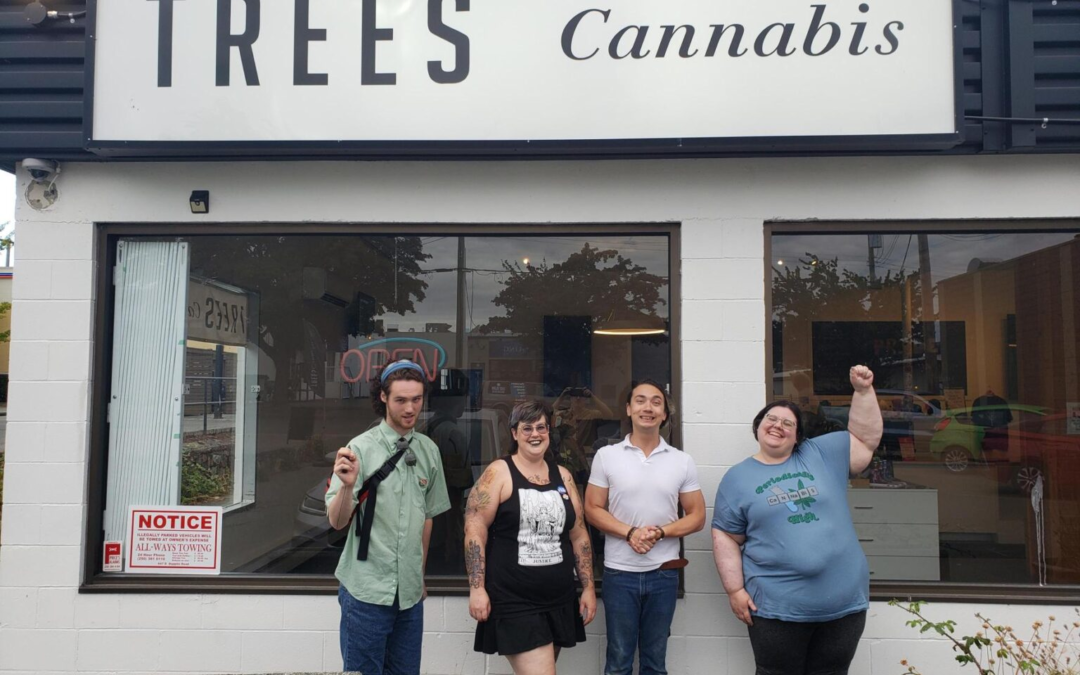
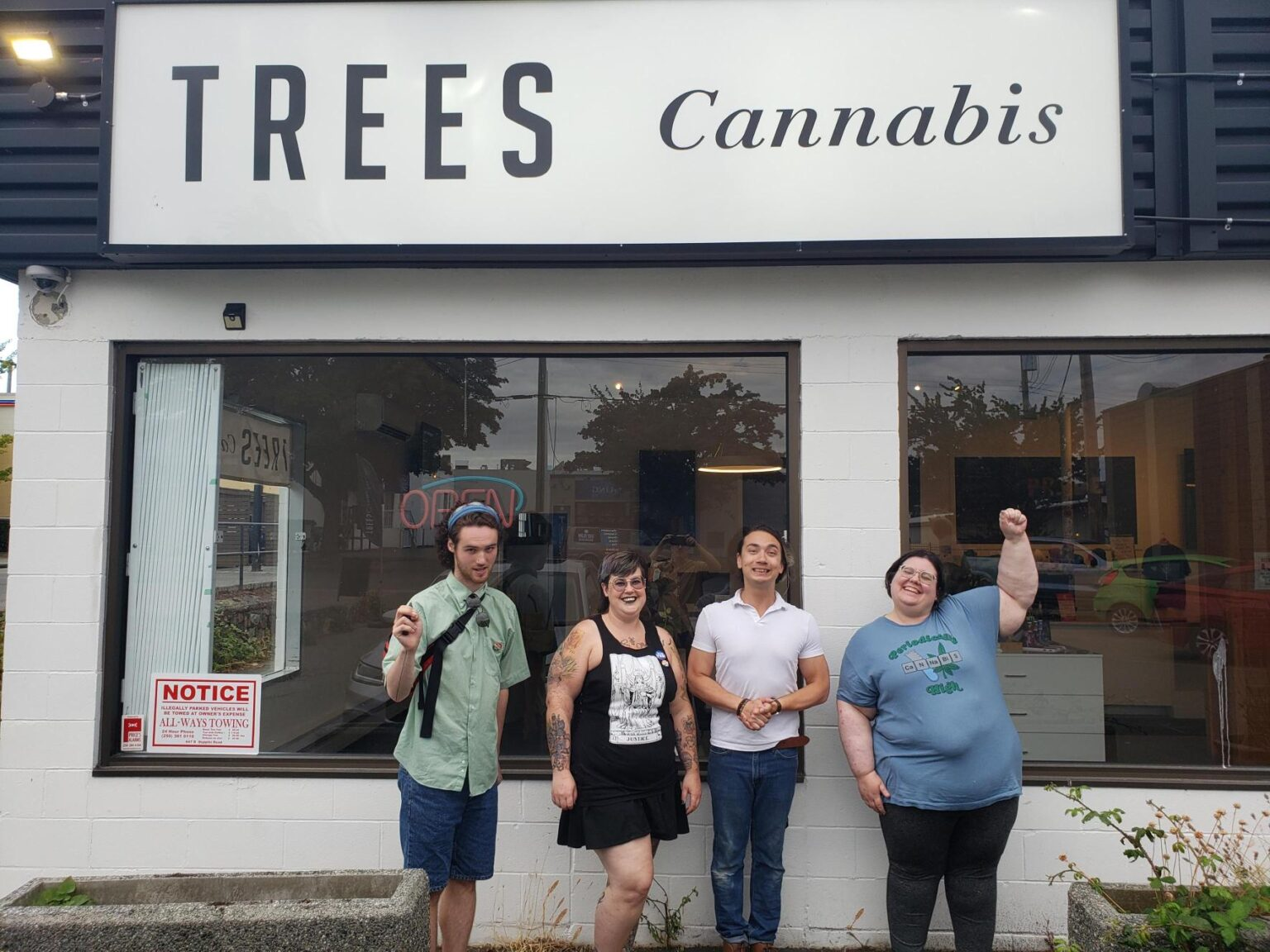
In April, employees at two new Trees Cannabis locations in BC joined a union representing cannabis industry budtenders. The organization is hosting an event in Victoria, BC, on June 15. called Solidariweed, to bring together members and other workers.
In addition, the union recently announced that workers at Canna Cabana in BC have voted to authorize strike action as the organization heads to mediation with the company. This is not a guarantee of a strike, but the option will provide the union with more leverage in those negotiations.
In March, employees at a recently opened Canna Cabana location in Vancouver joined the union. In a post on the union’s Facebook page, it says the two-year contract for those employees includes a 6.5% wage increase, retroactive pay on all wage increases to November 11, 2023, doubling the Call-in premium to $1.00 per hour, and “timely and fair redistribution of cannabis samples from sales reps.”
BC began allowing producers to provide samples to retailers in 2023.
Employees at Eggs Canna on East Hastings in downtown Vancouver voted to join the union in early 2022 but changed course shortly after that, voting to decertify union membership, meaning it no longer acts as their bargaining agent.
by Grow Up Conference | May 30, 2024 | Grow Opportunity, Media Partners
By Natasha Riebe · CBC News
The Alberta government has appointed a panel of experts from several universities to review research on how cannabis affects the brains of people under 25.
More than five years after the federal government legalized cannabis, the province says it’s time to gather and assess more data on how it affects youth.
Read the full story here.
by Grow Up Conference | May 30, 2024 | Grow Opportunity, Media Partners
(Globe Newswire) Toronto — Tilray Brands, Inc. announced the highly anticipated Good Supply® ‘Twisted’ All-In-One Vapes hitting the market, offering a revolutionary way to experience its delicious vape flavours. With the ability to switch between complimentary flavours or combining them for a “twist” – creating a unique third flavour experience of the two flavours enjoyed together, Good Supply has a jam packed vape with a series of unique flavour possibilities all-in-one, ready to go for consumers looking for variety that packs a punch.
With the new Twisted All-in-One vape, consumers can select from three mouthwatering combinations:
- Purple Monkey & Frozen Watermelon: The grape goodness of Purple Monkey and the refreshing fruity coolness of Frozen Watermelon collide in a category-five flavour storm, available in 2 x 0.6g.
- Orange Swirl & Strawberry Freeze: The indulgent creamy citrusy flavours of Orange Swirl and the fresh juicy cooling experience of Strawberry Freeze combine to create a blend of citrus, fruity and vanilla goodness available in 2 x 0.6g.
- Mango Passionfruit & Guava Sunrise: Launching later this summer to join the collection, this additional vape features a blend of Mango Passionfruit and Guava Sunrise, featuring the ultimate tropical tornado available in 2 x 0.6g.
Each Twisted vape is filled to the brim with 1.2g of flavoured distillate for a potent total 1,000mg of THC, delivering a satisfying experience with every puff. The rechargeable battery provides long-lasting enjoyment, allowing users to savour every last drop of flavor. Consumers can mix and match two fantastic flavours or combine them into a unique twist for a customized vaping experience.
by Grow Up Conference | May 30, 2024 | Grow Opportunity, Media Partners
(Globe Newswire) Vancouver – Christina Lake Cannabis Corp. is providing an update with respect to the expected timeline for filing its audited financial statements for the fiscal year ended November 30, 2023, the related management’s discussion and analysis and certificates of its CEO and CFO and its previously announced management cease trade order issued by the company’s principal regulator, the British Columbia Securities Commission, on April 3, 2024.
As previously announced, pursuant to the MCTO, the CEO and CFO of the company may not trade in securities of the company until such time as the company files the Required Documents and the BCSC revokes the MCTO. The MCTO does not affect the ability of other shareholders of the company to trade in securities of the company.
Pursuant to the provisions of the alternative information guidelines specified in National Policy 12-203 – Management Cease Trade Orders, the company confirms that, as of the date of this news release: (a) there have been no material changes to the information contained in the default announcement issued on April 3, 2024 that would reasonably be expected to be material to an investor; (b) there have been no failures by the company to fulfill its stated intentions with respect to satisfying the provisions of the alternative reporting guidelines under NP 12-203; (c) there has not been, nor is there anticipated to be, any specified default subsequent to the default which is the subject of the Default Announcement; and (d) there is no other material information concerning the affairs of the company that has not been generally disclosed.
The company confirms as of the date of this news release that there is no insolvency proceeding against it and there is no other material information concerning the affairs of the company that has not been disclosed. The company expects to file the Annual Filings as soon as they are available. At this time the company anticipates completion no later than June 3, 2024. Following the filing of the Annual Filings, the financial statements for the first quarter, ended February 28, 2024, will be filed within five business days.

by Grow Up Conference | May 30, 2024 | Cannabis News Wire, Media Partners
As New York and the Tri-State area are being touted as one of the largest cannabis hubs in recent times, the CWCBExpo is perfectly timed to bring together the cannabis industry in New York. A premier B2B expo on the East Coast, the CWCBExpo, June 5-6 at the Javits Center in New York, brings in two days of networking events and learning sessions by prominent influencers in the industry. The event will witness industry leaders, investors, influencers, business executives, dispensary owners, educators, medical practitioners, and some of the brightest minds in the cannabis and hemp spectrum.
The CWCBExpo has been hosting events since 2014, offering the cannabis community a common forum for networking and education. Attendees connect with the industry veterans and peers to engage, learn, and collaborate with the best cannabis business opportunities in the market.
Eminent personas from the cannabis spectrum will conduct keynote/speaker sessions discussing some of the most pivotal topics of the cannabis industry, including Josh Kesselman, founder and CEO of HBI International/RAW Rolling Papers. They will share in-depth insights, and speak about the discoveries and latest innovations in the cannabis market.
Several cannabis and hemp companies and service providers will display their products and innovative ideas at the exhibitor booths. The CWCBExpo offers a phenomenal platform for exhibitors to showcase their products and services amongst the top businesses, retailers, and investors of the cannabis community. Investors and businessmen looking for fresh avenues of investment can discover tremendous talent at these exhibitor booths.
Get industry updates, connect with potential investors and collaborators, and leverage the best business opportunities this event has to offer. Apart from the educational sessions and exhibitor displays, the expo hosts several networking opportunities to the attendees including a B2B Rooftop Networking Bash, Women in Cannabis Business Luncheon, Industry Yacht Party, and the NYCRA’s After Party.
To learn more please visit https://cnw.fm/rVsCf & https://cnw.fm/qfcOX.
About CannabisNewsWire
CannabisNewsWire (“CNW”) is a specialized communications platform with a focus on cannabis news and the cannabis sector. It is one of 60+ brands within the Dynamic Brand Portfolio @ IBN that delivers: (1) access to a vast network of wire solutions via InvestorWire to efficiently and effectively reach a myriad of target markets, demographics and diverse industries; (2) article and editorial syndication to 5,000+ outlets; (3) enhanced press release enhancement to ensure maximum impact; (4) social media distribution via IBN to millions of social media followers; and (5) a full array of tailored corporate communications solutions. With broad reach and a seasoned team of contributing journalists and writers, CNW is uniquely positioned to best serve private and public companies that want to reach a wide audience of investors, influencers, consumers, journalists and the general public. By cutting through the overload of information in today’s market, CNW brings its clients unparalleled recognition and brand awareness. CNW is where breaking news, insightful content and actionable information converge.
To receive SMS alerts from CNW, text CANNABIS to 888-902-4192 (U.S. Mobile Phones Only)
For more information, please visit https://www.CannabisNewsWire.com
Please see full terms of use and disclaimers on the CannabisNewsWire website applicable to all content provided by CNW, wherever published or re-published: https://www.CannabisNewsWire.com/Disclaimer
CannabisNewsWire
Denver, CO
www.CannabisNewsWire.com
303.498.7722 Office
Editor@CannabisNewsWire.com
CannabisNewsWire is powered by IBN

by Grow Up Conference | May 30, 2024 | Cannabis Prospect Magazine, Media Partners
The Hash Corporation has entered into an asset purchase agreement (the “Asset Purchase Agreement”) with 1000592191 Ontario Inc. (“191 Ontario”) dated May 23, 2024, pursuant to which 191 Ontario will acquire all or substantially all of HashCo’s assets, which include, but are not limited to, physical inventory and intellectual property relating to HashCo’s business for a total cash purchase price of CA$350,000 plus the value of the Company’s physical inventory on closing (the “Asset Sale”), of which a CA$50,000 refundable deposit has already been paid by 191 Ontario to HashCo’s counsel in trust.
Asset Sale
Under the terms of the Asset Purchase Agreement, 191 Ontario will acquire all of HashCo’s intellectual property and all license, customers, suppliers, partners and collaborators agreements relating to its cannabis-based hashish and other cannabis products. The Asset Sale is expected to be completed in and around Q3 of 2024. It remains subject to the satisfaction of customary closing conditions, including applicable regulatory approvals, and the approval of the Company’s shareholders. The Company intends to hold a special meeting (the “Meeting”) of its shareholder to approve the Asset Sale, at which two-thirds (2/3) of the Company’s shareholders present in person or represented by proxy must approve the Asset Sale. Further information regarding the Meeting and the Asset Sale will be provided in a management information circular, which will be mailed to the Company’s shareholders in due course. Investors are cautioned that, except as disclosed in the management information circular, any information released or received with respect to the Asset Sale may not be accurate or complete and should not be relied upon.
Upon closing of the Asset Sale, the Company will focus its efforts on identifying and evaluating suitable assets or businesses to acquire or merge with, with a view to maximizing value for shareholders. The Company will likely have to raise additional capital to fund such initiatives.
The Asset Sale constitutes a “related party transaction” of HashCo, within the meaning of Multilateral Instrument 61-101 – Protections of Minority Security Holders in Special Transactions (“MI 61-101”) as the Vice-President of Production of HashCo is also the principal of 191 Ontario. The Company determined that the Asset Sale is exempt from the formal valuation and minority approval requirements of MI 61-101 in reliance of the exemption contained in section 5.5(b) as the Corporation’s shares are not listed on a specified market and from the minority shareholder approval requirements of MI 61-101 by virtue of the exemption contained in section 5.7(a) of MI 61-101 in that the fair market value of the consideration of the securities issued to the related parties did not exceed 25% of the Corporation’s market capitalization.
About The Hash Corporation
HashCo is a Canadian company focused on the production and sale of cannabis-based hashish and other cannabis products. HashCo applies its separation and curing techniques to produce a suite of high-quality cannabis resin products, which are all-natural and free of additives and carcinogenic solvents. The Company intends to tailor its product offerings to pay tribute to historic traditions, fragrances and tastes, while upholding the highest health and safety standards. As of the date of this press release, HashCo is actively selling all or substantially of its assets. Upon completing the sale, HashCo will focus its efforts on identifying and evaluating suitable assets or businesses to acquire or merge with, with a view to maximizing value for shareholders.

by Grow Up Conference | May 30, 2024 | Cannabis Prospect Magazine, Media Partners
A need for more sustainably produced food products calls for crops and innovative processes that positively affect the environment and reduce GHG emissions. To leverage this opportunity, Protein Industries Canada is co-investing into a new project with Blue Sky Hemp Ventures Ltd., Virtex Grain Exchange and Thar Process to advance Canada’s protein processing technology, create new high-protein ingredients, and support the commercialization of hemp and canola ingredients.
Using cutting-edge, sustainable, solvent-free technology, combined with Blue Sky’s unique ‘whole plant utilization’ model, the partners will produce high-protein canola and hemp ingredients for applications in food products that are expected to have a negative carbon footprint. These developments are expected to open new markets for truly sustainable baking products, plant-based dairy and meat alternatives.
“This project, led by Blue Sky Hemp Ventures, is a great example of how Protein Industries Canada is helping establish this country as a leader in sustainable processing technology and a supplier of high-quality ingredients,” said the Honourable François-Philippe Champagne, Minister of Innovation, Science and Industry. “The commercialization of hemp and canola ingredients in a sustainable and cost-effective way is creating new economic value, and support for the project will help attract investment from international markets.”
“Canada is a leader in agricultural technology development. This innovative project will help to provide Canadians with more sustainably produced food choices while reducing greenhouse gas emissions and supporting the growth of our ingredient and value-added manufacturing sector,” said the Honourable Lawrence MacAulay, Minister of Agriculture and Agri-Food.
The project focuses on demonstrating the commercial viability of this novel approach to recover the vast majority of oil without using potentially harmful chemicals such as hexane. By avoiding high temperatures and chemical treatments, the resultant meal can be fractionated into high-quality proteins and gluten-free flours at relatively low cost – all while sequestering CO2 through Blue Sky’s ‘whole plant utilization’ model. Working with strategic partners, the project will develop commercial-ready products customized for use in the alternative dairy, meats and baking sectors. This advancement of new canola and hemp processing will create new economic opportunities for Canada.
“There is massive economic potential for Canada in ingredient manufacturing. Through the development of new and sustainable technologies, such as this one, Canada will advance our ingredient manufacturing sector and reach our $25 billion opportunity,” Protein Industries Canada CEO Bill Greuel said. “The Global Innovation Clusters de-risk Canadian innovation to help establish Canada as a leader in sustainable technology and a supplier of high-quality ingredients.”
More than $5.9 million is being invested into this project, with the partners investing $4.2 million, and Protein Industries Canada investing the remaining $1.6 million. The project will scale up CO2 extraction technology, with the project lead, Blue Sky, working to improve the process by testing the oils and assessing the technical and economic impact from hemp and canola crop inputs.
“Blue Sky is excited to commercially demonstrate this high-value project. We truly see this project as a win for farmers by adding more value to canola and hemp crops, to consumers by developing a new range of nutritious and environmentally sustainable ingredients, and to the planet by sequestering CO2 through our whole plant utilization model,” Andrew Potter, CEO of Blue Sky Hemp Ventures said.
Virtex processes and refines canola of which these processes are easily adaptable to hemp. Virtex has been working closely with Blue Sky for several years on refinery projects and will be providing high-fat canola meal for further processing regarding protein extraction.
“Virtex is massively happy and excited to be significantly involved on this project because of the positive, impactful and beneficial options that it offers to our environment and the Canadian food sector. We believe that this project will answer some questions surrounding crop sustainability and offer some solutions to issues related to adding value to canola and hemp,” Stanley Chukwukelu, Quality Assurance / Quality Control Manager of Virtex Grain Exchange said.
Thar will be providing the initial equipment for the project and will be working closely with Blue Sky to design a larger-scale system for deployment to large-scale oilseed crushing facilities as an economic alternative to current processes.
“Canada is leading the way in moving beyond hydrocarbon solvents and into upcycled technologies like supercritical CO2 extraction and we are humbled to play our role with our friends at Blue Sky and Virtex,” Todd Palcic, President and Chief Revenue Officer of Thar Process said.
Protein Industries Canada is one of Canada’s five Global Innovation Clusters. Protein Industries Canada and its members are working to embrace the $25 billion opportunity presented by Canada’s ingredient manufacturing, food processing and bio-product sector. Projects such as these add value to, and create new markets for, Canadian crops, generating local jobs and supporting new economic development in locations across Canada. More information can be found at theroadto25billion.ca.
About Blue Sky Hemp Ventures
Blue Sky Hemp Ventures, founded in 2017 in Rosetown, Saskatchewan, is a private Canadian company at the forefront of whole plant utilization for hemp ingredients, cannabis extracts, and sustainable industrial products. Committed to sustainability and innovation, Blue Sky delivers high-quality wholesale hemp and cannabis products across North America and globally, contributing to a “Better World, Fuelled by Hemp.”
About Virtex Grain Exchange
Virtex Grain Exchange was founded in 2009, in Saskatoon, Saskatchewan and is a corporation owned by over 80 farmers. Virtex is a value-added venture in which farmers grow, process and market non-GMO expeller pressed canola oil for the health food market in North America. Virtex also sells high-fat canola meal into the North American and Chinese markets. Its facility can process 2,500 tonnes of canola per month and is comprised of 45,000 square feet while operating a fleet of 21 railcars for oil distribution across North America. It prides itself on being the only farmer-owned corporation in North America that is fully integrated from farm to table with non-GMO canola to oil.
About Thar Process
Aquareyn through its subsidiary Thar Process, is a platform technology company that has been developing and designing applications and equipment solutions based on supercritical CO2. From extraction to purification to drying to remediation – Aquareyn / Thar Process has done it all for the world’s most innovative pharmaceutical, food, CPG and chemical companies. The company is based in a 78,000 ft2 Pittsburgh facility but provides service and support globally.
by Grow Up Conference | May 30, 2024 | Cannabis Prospect Magazine, Media Partners
Village Farms International, Inc. announces it has increased its ownership of Quebec-based Rose LifeScience Inc. (“Rose”) by 10% to hold an 80% interest.
“Village Farms’ initial 70% acquisition of Rose stands out as one of the most complementary business combinations to date in the Canadian cannabis industry. Since late 2021, the combination of the experienced teams at Rose and Pure Sunfarms have driven Village Farms into the number two share rank nationally as Rose sales grew more than 300% to reach the number two share rank in Quebec, with each closing the gap to number one,” said Michael DeGiglio, President and Chief Executive Officer, Village Farms.
“We have the opportunity to further grow our business as part of Village Farms, while continuing to focus on and support our home market in Quebec,” added Davide Zaffino, co-founder, President and Chief Executive Officer, Rose. The additional 10% of Rose was purchased from Mr. Zaffino and Rose co-founder and Chief Operating Officer, Brian Stevenson. Each will continue in their current roles and, together, continue to own 20% of Rose.
About Rose LifeScience
ROSE LifeScience is committed to ensuring that consumers benefit from the responsible production, sale, and consumption of cannabis in Québec and across Canada. From cannabis cultivation to marketing, commercialization, and logistics, the Huntingdon, QC company plays a key role in the Québec market. In addition to its own products and expertise, ROSE provides specialized industry services to selected producers to encourage a diversified offering in the Québec and Canadian markets. Rose LifeScience is majority owned by Village Farms International (Nasdaq: VFF) with the balance owned and operated by its Québec-based founders. For more information, visit roselifescience.ca.
About Village Farms International
In Canada, the Company’s wholly-owned Canadian subsidiary, Pure Sunfarms, is one of the single largest cannabis operations in the world, the lowest-cost greenhouse producer and one of Canada’s best-selling brands. The Company also owns 80% of Québec-based, Rose LifeScience, a leading third-party cannabis products commercialization expert in the Province of Québec.
by Grow Up Conference | May 30, 2024 | Cannabis Prospect Magazine, Media Partners
Tilray Brands, Inc., a leading global lifestyle and consumer packaged goods company, today announced the highly anticipated Good Supply® ‘Twisted’ All-In-One (“AIO”) Vapes hitting the market, offering a revolutionary way to experience its delicious vape flavours. With the ability to switch between complimentary flavours or combining them for a “twist” – creating a unique third flavour experience of the two flavours enjoyed together, Good Supply has a jam packed vape with a series of unique flavour possibilities all-in-one, ready to go for consumers looking for variety that packs a punch.
With the new Twisted All-in-One vape, consumers can select from three mouthwatering combinations:
- Purple Monkey & Frozen Watermelon: The grape goodness of Purple Monkey and the refreshing fruity coolness of Frozen Watermelon collide in a category-five flavour storm, available in 2 x 0.6g.
- Orange Swirl & Strawberry Freeze: The indulgent creamy citrusy flavours of Orange Swirl and the fresh juicy cooling experience of Strawberry Freeze combine to create a blend of citrus, fruity and vanilla goodness available in 2 x 0.6g.
- Mango Passionfruit & Guava Sunrise: Launching later this summer to join the collection, this additional vape features a blend of Mango Passionfruit and Guava Sunrise, featuring the ultimate tropical tornado available in 2 x 0.6g.
Each Twisted vape is filled to the brim with 1.2g of flavoured distillate for a potent total 1,000mg of THC, delivering a satisfying experience with every puff. The rechargeable battery provides long-lasting enjoyment, allowing users to savour every last drop of flavor. Consumers can mix and match two fantastic flavours or combine them into a unique twist for a customized vaping experience.
Quick recap on the product details:
- Single Flavours or Twisted: Consumers can easily switch between primary flavours of this 1.2g vape that can be enjoyed on their own or combine them for a third unique blend with the push of a button.
- Charged Up: Rechargeable battery ensures maximum usage and lessens environmental footprint of wasted devices.
- Green You Can Feel Good About: Over 131,000kg of plastic diverted from landfills annually from the use of Good Supply’s hemp tube packaging across its products, plus reforestation efforts through Printreleaf™ partnership.
Disclaimer: Twisted vapes are intended for adult use only. Please consume responsibly and in accordance with local regulations.
Good Supply’s Twisted AIO vapes redefine the convenience of their consumer vaping experience while supporting the minimization of repurchases to help to reduce waste across the Canadian cannabis market. Embracing the mindset of ‘Green You Can Feel Good About’, and as part of their larger “Feel Good Highs” strategy, Good Supply consistently re-enforces the notion that consumers can feel good about every aspect of their cannabis purchase, from the product to the packaging that comes with it.
TWISTED All-in-One vapes will be available across Canada starting this summer. For more information on where to find Good Supply, check out www.goodsupplycannabis.com.
About Good Supply
Good Supply is one of Canada’s leading cannabis brands and has been recognized as #1 in flower, and best-selling pre-rolls, vapes, and concentrates, and has become a favourite among consumers and budtenders. At Good Supply, good is the new great. Rooted in classic strains that punch above their weight, Good Supply delivers consistent, hard-hitting quality at affordable prices. Explore classic cannabis strains, innovative formats, and new flavours – we’re always up for a good time. To learn more about Good Supply and its latest product launches, visit www.goodsupplycannabis.com and follow @goodsupplycannabis.
About Tilray Brands
Tilray Brands, Inc. is a leading global cannabis-lifestyle and consumer packaged goods company with four distinct and complementary business segments including medical and adult-use cannabis, medical distribution, wellness foods, and beverage-alcohol. Tilray Brands is on a mission to change people’s lives for the better – one person at a time – by inspiring and empowering the worldwide community to live their very best life, enhanced by moments of connection and wellbeing. For more information on Tilray Brands, visit Tilray Brands, Inc. and follow @Tilray on Instagram, Twitter, Facebook, and LinkedIn.

by Grow Up Conference | May 30, 2024 | Media Partners, Psychedelic News Wire
The state of Colorado is pioneering the way once more as government leaders figure out how to establish and regulate the nascent psychedelics industry. The state was the first to legalize the recreational use of marijuana.
This latest move comes after Colorado became one of the first states in the country to legalize psychedelic drugs and establish policy around their therapeutic use.
Denver Health and Hospital Authority’s Joshua Black stated that while psychedelics had been used for millennia, this was the first time the substances were being approved for use by trained practitioners. Black is a senior research scientist at the Rocky Mountain Poison and Drug Safety Division.
Investigators are set to gain access to new data on psychedelic substances, with research by Black’s team providing suggestions on how Colorado as well as other states could gather and study this data in the future. Black explained that his team’s focus was ensuring that the right data was being collected so that future decisions on the effectiveness and safety of these drugs could be made in a way that maximized their benefit while minimizing potential harm.
In the study, whose findings were reported in “Nature Mental Health,” team members suggested that the following be tracked:
- If a patient was on any other medications at the time of treatment using psychedelics or if they had any comorbidities.
- A patient’s motivation for using psychedelic drugs.
- Whether the psychedelic administered produced an adverse effect or the intended effect, ad whether the patient presented with any concerning symptoms.
- The training and experience of the provider who was administering the treatment.
In his statement, Black revealed that his team observed that rare events in smaller populations became more frequent as the populations grew. He gave the example of cyclical vomiting, which they observed became more frequent following the legalization of marijuana in the state.
At present, the Rocky Mountain Poison and Drug Safety Division is focused on collecting its own data and conducting a focus group with individuals who have used psychedelic substances to treat a mental-health condition.
The researchers’ objective is to understand the psychedelic experience and inform future research on the drugs. Overall, the state is refining its regulations for the industry and is planning to take applications for facilitators by this year’s end.
Other states that have psilocybin industries include Oregon, which has legalized psilocybin treatment facilities. These facilities are already serving patients with a range of mental illnesses.
Start-ups such as Mind Medicine Inc. (NASDAQ: MNMD) (NEO: MMED) (DE: MMQ) will likely follow developments in Colorado to see what systems are put in place to monitor and regulate psychedelic use since it could set a precedent that other jurisdictions follow.
About PsychedelicNewsWire
PsychedelicNewsWire (“PNW”) is a specialized communications platform with a focus on all aspects of psychedelics and the latest developments and advances in the psychedelics sector. It is one of 60+ brands within the Dynamic Brand Portfolio @ IBN that delivers: (1) access to a vast network of wire solutions via InvestorWire to efficiently and effectively reach a myriad of target markets, demographics and diverse industries; (2) article and editorial syndication to 5,000+ outlets; (3) enhanced press release enhancement to ensure maximum impact; (4) social media distribution via IBN to millions of social media followers; and (5) a full array of tailored corporate communications solutions. With broad reach and a seasoned team of contributing journalists and writers, PNW is uniquely positioned to best serve private and public companies that want to reach a wide audience of investors, influencers, consumers, journalists and the general public. By cutting through the overload of information in today’s market, PNW brings its clients unparalleled recognition and brand awareness. PNW is where breaking news, insightful content and actionable information converge.
To receive SMS alerts from PsychedelicNewsWire, text “Groovy” to 888-902-4192 (U.S. Mobile Phones Only)
For more information, please visit https://www.PsychedelicNewsWire.com
Please see full terms of use and disclaimers on the PsychedelicNewsWire website applicable to all content provided by PNW, wherever published or re-published: https://www.PsychedelicNewsWire.com/Disclaimer
PsychedelicNewsWire
San Francisco, CA
www.PsychedelicNewsWire.com
415.949.5050 Office
Editor@PsychedelicNewsWire.com
PsychedelicNewsWire is powered by IBN



Recent Comments