Major changes are being made at the Office of Cannabis Management (OCM) in New York State after the governor directed that a review be conducted. The review, as ordered by Governor Kathy Hochul, led to the discovery that New York’s rollout of legalized recreational cannabis had been a failure.
One report, released last week, cites an underspent budget and inexperienced leadership as some of the errors by the office. According to the report, a total of $26 million, which could have assisted in clearing application backlogs, remained unused.
In her statement, Hochul announced that the director of the OCM, Chris Alexander, would be resigning later this year year. She explained that the overhaul involved ensuring new license applications were completed in 90 days, clearing up application backlog, solving the issue with internal license processing and establishing an enforcement task force focused on shutting down illicit marijuana stores.
Figures from the report show that there are more than 120 licensed marijuana shops across the state. However, in New York City alone, there exists more than 2,900 illicit marijuana stores. Additionally, the report shows that at the end of April, there was a backlog of almost 4,900 applications that hadn’t yet been reviewed.
Hochul noted that the crackdown on illegal stores was focused on stabilizing neighborhoods, creating an environment for localities to approve laws of their own and pursuing landlords who knowingly rented out their premises to illicit shops.
New York state police’s first deputy superintendent, R. Christopher West, stated that the department’s target was drug traffickers, who were flooding the state with illegal marijuana by supplying shops in different parts of the state. The department is also working to eliminate factors that disrupted the legal market.
Attorney Benjamin Rattner, who represents individuals seeking legal licenses, thinks that while this crackdown will take time, it’s a good thing. Dispensary applicants are expected to keep up with changing processes, even after the report determined that 90% of them hadn’t yet received their licenses.
One applicant, Iris Ladao, made her application to launch a legal marijuana dispensary in Brooklyn in November 2023. Since then, she has received no communication regarding when her application may be reviewed. This is despite the fact that she’s been paying rent on a still-empty store because it is mandatory that a lease be included in the application.
She is one of the many applicants who have been navigating the licensing process for a while now while getting dragged along with zero feedback.
The faltering start to New York’s marijuana legalization program is likely to be disappointing to the marijuana industry, including enterprises such as Cresco Labs Inc. (CSE: CL) (OTCQX: CRLBF), which thought that the state would be stabilized by this time after implementation of adult-use sales commenced.
About CannabisNewsWire
CannabisNewsWire (“CNW”) is a specialized communications platform with a focus on cannabis news and the cannabis sector. It is one of 60+ brands within the Dynamic Brand Portfolio @ IBN that delivers: (1) access to a vast network of wire solutions via InvestorWire to efficiently and effectively reach a myriad of target markets, demographics and diverse industries; (2) article and editorial syndication to 5,000+ outlets; (3) enhanced press release enhancement to ensure maximum impact; (4) social media distribution via IBN to millions of social media followers; and (5) a full array of tailored corporate communications solutions. With broad reach and a seasoned team of contributing journalists and writers, CNW is uniquely positioned to best serve private and public companies that want to reach a wide audience of investors, influencers, consumers, journalists and the general public. By cutting through the overload of information in today’s market, CNW brings its clients unparalleled recognition and brand awareness. CNW is where breaking news, insightful content and actionable information converge.
To receive SMS alerts from CNW, text CANNABIS to 888-902-4192 (U.S. Mobile Phones Only)
Please see full terms of use and disclaimers on the CannabisNewsWire website applicable to all content provided by CNW, wherever published or re-published: https://www.CannabisNewsWire.com/Disclaimer
With cannabis legalization exploding nationwide, there are now over 19,500 incorporated U.S. cities, town, and villages that will govern local cannabis regulations
Zoned Properties is comprised of a team of experts in cannabis zoning codes utilizing proprietary technology to identify premium cannabis dispensary locations
Focused on its dispensary landlord model, the company has listed its largest cultivation property in Arizona for sale for $16 million
The cannabis industry is flourishing, but opening a dispensary isn’t a walk in the park. Aspiring entrepreneurs face a maze of regulations and considerations beyond simply having a quality supply chain.
Unprecedented Geographic Growth
California sparked the green wave in 1996 by becoming the first state to legalize medical marijuana. Fast forward 16 years, and Colorado and Washington shattered another barrier in 2012, allowing recreational cannabis use. Since then, the domino effect has been undeniable, with 38 states now permitting medical marijuana and 24 embracing recreational use.
In 2010, public approval for legal cannabis was just 32%. Today, with industry sales nearing $40 billion annually, approval is 91%. With that, there are now over 19,500 incorporated U.S. cities, town, and villages that will govern local cannabis regulations.
Zoning Laws and Location
Unlike many businesses, cannabis dispensaries are heavily restricted by state and local zoning ordinances. Understanding these complex regulations is crucial. Some areas completely ban dispensaries, while others have strict limitations on location. Navigating these restrictions can be a minefield, requiring expertise in real estate and community planning codes.
Not long after Colorado and Washington made history, Zoned Properties (OTCQB: ZDPY) was formed for the purpose of capitalizing on the real estate component of the burgeoning cannabis market. The company assembled a team of real estate experts specialized in different market nuances and undergirded their experience by developing a cutting-edge technology that differentiates Zoned Properties from anyone else in the industry.
The history and future of the company is brilliantly summarized in a recent Bell2Bell podcast with Zoned Properties CEO and Chairman Bryan McLaren.
Knowing Your Market
Finding the right location goes beyond zoning. Just because marijuana is legal doesn’t mean there’s specific demand. Demographics, traffic patterns, and competitor saturation all influence success. Data analysis and market research are crucial to ensure a dispensary caters to a viable customer base.
Zoned Properties’ proprietary technology plots every parcel of land in every legal cannabis state to know the codes and zoning at every location. Furthermore, the system identifies areas of high consumer demand and low supply. In other words, a perfect location for a dispensary.
Zoned Properties doesn’t just find properties; they transform them. Their team of real estate and community planning experts navigate the complex world of zoning regulations to obtain “special use”, or “conditional use” permits necessary for properties to operate as cannabis dispensaries. This entitlement significantly increases a property’s value.
The Cannabis Friendly Landlord
The business model has changed some over the years, with ZDPY management identifying the best way to build value is through owning and renting dispensaries via long-term absolute-net lease agreements. To that end, the company intends to fill its coffers by positioning to sell its largest cultivation property in Chino Valley, Arizona, which it recently listed for $16 million.
In its March 2024 corporate presentation, Zoned Properties said it had $3.1 million in cash on hand. Add in another $16 million and that is an anomaly of cash for a company with a market capitalization around only $7 million.
The dilution-free capital from the sale will be deployed to continue aggressive dispensary expansion into states exploding with growth and demand, including Ohio and Illinois.
NOTE TO INVESTORS: The latest news and updates relating to ZDPY are available in the company’s newsroom at https://cnw.fm/ZDPY
About CannabisNewsWire
CannabisNewsWire (“CNW”) is a specialized communications platform with a focus on cannabis news and the cannabis sector. It is one of 60+ brands within the Dynamic Brand Portfolio @ IBN that delivers: (1) access to a vast network of wire solutions via InvestorWire to efficiently and effectively reach a myriad of target markets, demographics and diverse industries; (2) article and editorial syndication to 5,000+ outlets; (3) enhanced press release enhancement to ensure maximum impact; (4) social media distribution via IBN to millions of social media followers; and (5) a full array of tailored corporate communications solutions. With broad reach and a seasoned team of contributing journalists and writers, CNW is uniquely positioned to best serve private and public companies that want to reach a wide audience of investors, influencers, consumers, journalists and the general public. By cutting through the overload of information in today’s market, CNW brings its clients unparalleled recognition and brand awareness. CNW is where breaking news, insightful content and actionable information converge.
To receive SMS alerts from CNW, text CANNABIS to 888-902-4192 (U.S. Mobile Phones Only)
Please see full terms of use and disclaimers on the CannabisNewsWire website applicable to all content provided by CNW, wherever published or re-published: https://www.CannabisNewsWire.com/Disclaimer
I can’t count the times I’ve been out in the garden, put down my trowel or pruners to do something, and can’t find them again. I spend time retracing my steps, trying to find the spot where I left them. It’s time-consuming and annoying!
I’m not alone. Many gardeners misplace their tools in the undergrowth while carrying out the many gardening tasks on their lists. Here are some hacks to help you find those misplaced tools—you might never lose them again!
Bright Handles
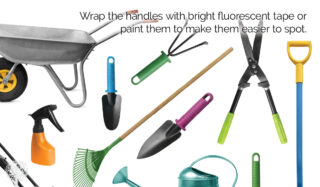
One reason garden tools get misplaced is that they blend into the garden. Wrap the handles with bright fluorescent tape or paint them to make them easier to spot. Another great idea is to use glow-in-the-dark tape or paint. Wait until dusk, and voila! Those missing trowels and pruners will stand out in the dark garden.
Garden Caddy
Keep a small garden caddy by your side with your tools in it. Before moving from one spot to another, check the caddy to ensure all your tools are in it. If they aren’t, they are likely close by and much easier to find now than later.
Create Stations
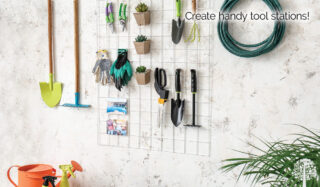
Before putting down the pruners in the garden bed while you run back to the shed or potting table to grab a piece of twine, place the utensils into one of several covered receptacles throughout the garden. This idea is also excellent for storing garden supplies like small sticks, garden clips, extra gloves, pen and paper, twine, and more, so they’re always within reach.
Any waterproof container, like a small Rubbermaid or a metal mailbox, will do the trick. Make it a project and decorate it, creating a convenient tool deposit and some unique garden art.
Garden Tool Belt
Garden tool belts are another way to help you keep track of your tools in the garden and are available at most garden centers or big box stores. Place tools in your belt to free up your hands for various tasks and know where to find them when you need them again!
GPS Tracker
One of my favorite ideas is using a GPS tracker. You can buy waterproof small trackers for keys and phones and apply the same idea to garden tools. Attach the tile or chip as you would to a set of keys, and the next time you can’t find your pruners, let the tracker do the work for you. All you have to do is follow the signal!
Toronto — Today, the Ontario Cannabis Store (OCS) published Ontario Cannabis Marketplace: By the Numbers, a new resource designed for all adult Ontarians interested in learning more about the progress being made in Ontario’s legal cannabis industry.
The By the Numbers data report builds on previous OCS insights publications to demonstrate the span and scope of retail cannabis operations across Ontario, and the growth in access to legal cannabis over time. The data-driven, graphic-rich report conveys dozens of legal market metrics in an easily digestible way.
Each section of the OCS’s By the Numbers data report focuses on a different component of Ontario’s legal cannabis sector, including consumer access, wholesale distribution in Ontario, legal product assortment, legal product sales and consumer behaviour. The report contains relevant facts and figures for the 2023 calendar year, as well as year-over-year (YoY) historical data from 2022.
Notable insights from 2023 include:
Advertisement
Consumer access to legal cannabis grew with 80 net new Authorized Cannabis Stores being added to the 353 participating municipalities across the province
Ontario’s network of Authorized Cannabis Stores sold more than 338 million grams of cannabis (23.3 per cent YoY increase) valued at more than $1.9 billion (12.1 per cent YoY increase)
The OCS added more than 1,000 unique products from Canadian Licensed Producers to its growing catalogue of tested, traceable recreational cannabis merchandise
“As the largest wholesale distributor of legal cannabis in the world, the OCS is proud to deliver comprehensive data aimed at informing Ontarians and supporting industry partners as we enable Canada’s largest and most vibrant cannabis marketplace.” — David Lobo, President and CEO, OCS
“We remain committed to expanding safe access to legal recreational cannabis products and enriching a frictionless customer experience for our growing network of Authorized Cannabis Stores. The OCS’s By the Numbers data report is one way of reporting back to Ontarians important progress made in these areas.” — Alexandre Jalleau, Chief Customer Experience Officer, OCS
The rise of a dogmatic neo-Christian conservative/trad movement resembles, in some ways, the fundamentalist medieval Christian Church that resulted in the burning of so-called “witches” and the killing of millions of “sinners” who didn’t follow “the rules of God.”
It deems anything that is not “Christian” [in their own subjective and often literal [false] interpretation of the bible] as “demonic/satanic,” and anyone who doesn’t accept Jesus as “the savior” won’t go to “heaven” but “hell.”
The term “New Age” is now also being hijacked and completely over-generalized by this new wetiko-infused self-righteous breed of “reborn Christians.” All kinds of teachings and practices are now being lumped into “New Age” that are not New Age in the context of where this term originated from, to begin with.
Many of them have a missionary complex and troll people on social media with “Accept Jesus as your savior!” “Jesus is the only way!”, excessive bible thumping, or worse, they see themselves better as anyone who has not found/accepted Jesus or Christ.
The sense of superiority based on religious virtue signaling and taking the Bible as the foundation and sole lens to see through is a devilish trap [pun intended.] It’s how the occult hostile forces also hijack the religious impulse, having controlled organized religions for thousands of years via the occult game of stalking.
It has reached the point that even ancient concepts like reincarnation and the ancient practice of Yoga (which literally means union with the Divine), going back to the Vedas over 5000 years ago, are being called “New Age.”
Is there a New Age deception? Yes, for sure. We talked about it here in a podcast 5 years ago: “The New Age Deception And Spiritual Bypassing,” and I’ve addressed it for the past 20 years in various articles and videos on my website.
Ironically, the “New Age Deception” now includes the rise of this new exoteric fundamentalist dogmatic Christianity, which also ties into the surge of “reborn Christians.” Furthermore, the even more profound ironic twist in it all is that the real “demonic forces” – the anti-divine hyperdimensional matrix forces – have infused the dogmatic Christian movement with the idea/belief that “yoga is demonic”.
Wetiko has taken them over, and like an occult egregore group thought entity, they all mechanically repeat the same script. [An egregore is a non-physical entity or thoughtform that arises from the collective thoughts and emotions of a distinct group of individuals.]
Wetiko and irony in action: The dogmatic neo-Christian movement got hijacked by the adverse [demonic] forces they claim are behind Yoga.
I was raised a Christian, and I’ve read the Bible multiple times, been baptized, and studied and practiced esoteric Christianity. However, I never cared for the Church or religion, nor did I ever feel the need to create an identity around it and call myself a “Christian.”
This inner esoteric practice of embodying “Christ consciousness” involves connecting to the heart and bringing forth the true “I” [true Self/soul Being]. It has nothing to do with “accepting Jesus as your savior” [nor do you need to.]
In its essence, it is similar to Bhakti Yoga, the Yoga of Works, and the Yoga of Knowledge, which I also practice, particularly the Integral Yoga of Sri Aurobindo, which integrates all the ways in the context of the Yoga of Divine Works.
The sacred heart of Christ is about embodying LOVE as a higher state of consciousness, acting from that inner alignment, and ultimately spiritualizing life and body.
Yoga, in this context, has nothing at all to do with asana yoga poses, which many Christians call “satanic” and “no Christian is allowed to practice it,” according to many of them. Nor does chanting yogic mantras “invoke demons.” That’s just silly and ignorant to claim. Yoga is a state of life and being, or as Sri Aurobindo said, “All Life is Yoga.” To make your life and anything you do as an offering to the Divine/God.
Recently, I’ve been reading and studying the Bhagavad Gita, the story of Krishna and Arjuna on the battlefield. It’s a profound scripture that is over 3000 years old, way before Christianity and Jesus emerged. Yet, the similarities between Krishna and Jesus are profound. What a “coincidence.”
They are ALL different aspects of the One God, the Divine in All, not some guy in the sky.
However, just reading and quoting any scripture does not result in opening the heart, embodying Christ, embodying the soul, or bringing forth the true Self as an expression of the Divine. It requires inner work, deep sincerity, and an aspiration to the Divine beyond the mind’s idea of “God.”
That’s why all these “theological debates” about God and scripture only appeal to the intellectual ego and don’t say anything about how “awake” someone is in terms of their level of Being [soul embodiment].
All the spiritual inner work based on Yoga and Esoteric Christianity combined with somatic, psychological work, shadow, and trauma work has opened my heart and connected “me” to the Divine (or call it Christ) over the years in profound ways beyond words to describe.
And there is still a long way to go and more work to do…for I certainly wouldn’t claim to be fully “awake” [in the true meaning of the word]…and anyone who needs to proclaim that is certainly not awake, but the ego has hijacked the process. It’s an aspect of spiritual bypassing.
I know a few real Christians who completely embody Christ consciousness and live truly from the heart [which is a higher state of being and not just emotional “kindness” or “niceness”].
They have given their lives to Jesus, but they embody and understand the esoteric significance and symbolism of “I am the way and the truth and the life. No one comes to the Father except through me.” without personifying Jesus or taking it literally.
Yet, interestingly, you won’t see them on social media virtue-signaling their beliefs with bible quotes. You won’t find them trolling people’s posts to “accept Jesus.”
You won’t see them calling Yoga, tarot, shamanism, or astrology “demonic.” You won’t see them with car stickers about Jesus, nor will you see them posting or proclaiming that “Christ is King!.”
You won’t even see them in any churches. Many of them don’t even feel the need to wear or have crosses in their homes. They can access and embody Christ without any symbolism or ritual.
In fact, many of them also practice yoga to strengthen their connection to Christ. In a sense, Jesus was a master yogi to begin with.
Those “true” Christians see Christ in all His aspects just as the Yogis see the Divine in all His aspects – even through all the distortions and outer appearances most people are distracted by.
But this true [inner] Yogic/Christian vision is not a physical vision. You can’t find it in any book; your mind won’t get it, and it’s also not a feeling. It’s a state of Being, inner knowing, and inner vision that transcends what you “think” Jesus, Christ, Krishna, Buddha, or any avatar is about.
It is Direct Experience.
This experience can also not be induced via psychedelics or “medicine plants,” which are poor imitations [and often dangerous distractions] of the real thing.
Once you have the true direct inner experience of Christ/the Divine within and without – and not an intellectual, mental, or emotional experience, which most people mistake for “spiritual” experiences – you won’t feel the need to convert others to “your” path, let alone shame them, denigrate other spiritual traditions, or overgeneralize everything you don’t like or “approve of” as “New Age.”
You won’t even feel the need to identify with a spiritual/religious label, Faith, teaching, or book, nor do you feel the need to tell others to “accept Jesus” or proclaim that “Jesus is the only way.”
You will have found the Kingdom of God and true Love, which is within you and visible everywhere as a reflection. As within, so without. Then you will be truly “reborn”—the second birth.
The underlying drive of dogmatic fundamentalist Christians, bible-thumping, and religious virtue signaling is driven by unconscious, internalized, toxic shame. It has its roots in the distorted Christian religious idea that one is “born in sin” and that the self is inherently bad, wrong, and flawed.
Most Christians also don’t seem to differentiate between the ego-self of the personality and the “capital S” Self of the Divine nature, the real “I”, the soul being or “higher Self,” i.e., the Kingdom/Divine within.
People driven by unconscious toxic shame usually tend to be very self-righteous and shame others. They latch onto religious fervor as a form of spiritual bypassing their pain. This ties into shadow projection (Carl Jung). In order not to feel the terror of internalized shame, they project their own unconscious self-hatred onto others.
“Many of us live in toxic shame-based cultures. Shame comes from both sides of the political spectrum. The left is a more toxic feminine archetypal energy, which shames, and the right is a toxic masculine archetypal energy which shames. They both have their own type of virtue signaling and unique ways of shaming one another.
The left does it mainly through various social justice trends, and the right mainly does it through religion. This dynamic is terrible for the general state of human relationships.
When we don’t acknowledge our shame, it becomes unconscious and, therefore, causes us to project that shame upon others unknowingly. Shame, according to David Hawkins’s maps of consciousness, is the lowest state of consciousness, just above death.”
– Laura Matsue
In a recent podcast episode, Laura and I discuss the recent trend of people who were engaged in New Age practices and beliefs converting to “re-born” Christians. We talk about the beliefs this new Christian movement sees as “demonic” and “satanic” [such as yoga & meditation] in their distorted understanding of the “New Age” and “the Occult.”
We discuss the danger of this new dogmatic Neo-Christian revival, how it ties into the concept of “the second Religiosity,” projective Identification as a trauma response, and more.
“When the time comes that man no longer wishes to remain a child but wants to grow up and become an adult, then he must understand and neither deceive himself nor others.
Then he will see that God is to be found not in any particular form but in all forms, not in any particular place, but everywhere, not through any single vehicle, faith, cult, religion, building, or man, but in the Infinite.
You will never find God anywhere else but in those conditions; the rest is merely your idea of God, your mental picture. These are purely intellectual things, they are not God or Reality.
So if man wishes to awaken, if he wants to understand himself, he must face the fact that the real avenue to contact with God is not outside himself but within, directly inside. He must find his own way to God through and within himself.
That is, if he seeks God there is no other way, but if he is looking for ideas, concepts, or mental images, then he can take what orthodox religions and cults offer him.
And because most people have been content to let others do their thinking and their questing for them, they have been satisfied with those conditions.”
Cannabis stores in Ontario sold nearly $2 billion worth of cannabis in 2023 to more than 10 million people, a 12% increase in sales from the previous year. This was the equivalent of 338 million grams of cannabis, a 23% increase from the prior year.
Ontario added 80 new licensed cannabis stores in this time period. The province authorized 276 new stores, a decrease from 497 added in 2022. Another 142 closed in 2023, up from 114 in 2022.
The new report from the OCS is the first of its kind from the OCS since Q4 2022. The agency plans to update and publish its By the Numbers data report twice per year.
“As the largest wholesale distributor of legal cannabis in the world, the OCS is proud to deliver comprehensive data aimed at informing Ontarians and supporting industry partners as we enable Canada’s largest and most vibrant cannabis marketplace,” said David Lobo, President and CEO of OCS.
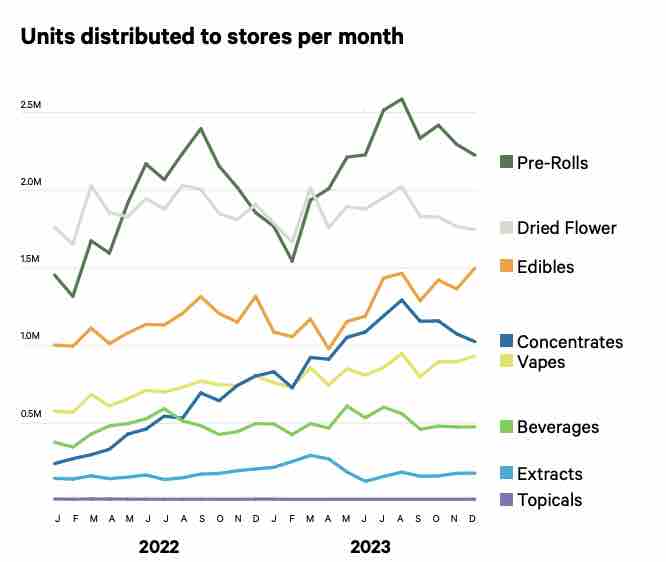
Total cannabis sales in 2023 through authorized cannabis stores in Ontario were $1,941,213,130. The OCS shipped 94,507,896 units to some 1,700 privately owned stores from its distribution centre in Guelph, a 26% increase from 2022.
The average wholesale price of dried cannabis flower was $4.05 a gram, not including HST. As of December 31, 2023, there were 3,983 total active product SKUs listed by the OCS.
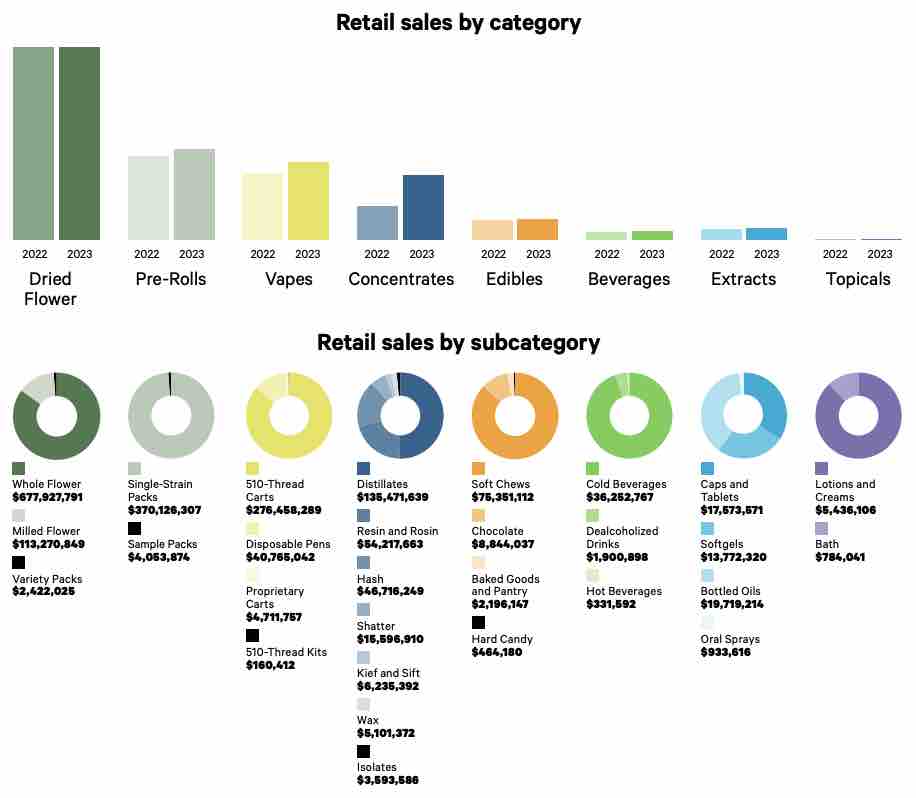
Dried flower and pre-rolls were the bulk of these SKUs (28% and 21%), followed by concentrates (infused pre-rolls, distillate, dabs, hash, etc) at 15%, vapes at 14%, edibles at 10%, extracts (ingestible oils, tablets) at 5%, beverages at 5%, and topicals at 2%.
The wholesale price of all cannabis flower, including pre-rolls, dropped compared to 2022, except for 7 gram SKUs, which increased by just 3%.
Image via OCSImage via OCS
About one-fifth (20%) of Ontarians say they consume cannabis on a regular basis, with 27% indicating they consume occasionally. More than half (54%) report purchasing cannabis only from legal sources, while 39% report purchasing from legal and illegal sources. Just 7% say they only buy from illegal sources.
Nearly three-quarters (74%) of Ontarians say legalizing cannabis has been good for Canada.
There were nine product recalls for cannabis in Ontario in 2023, compared to six in 2022 and 10 in 2021.
Germany is progressing with the next stage of cannabis legalization by initiating a pilot program for commercial sales using an administrative process instead of waiting for legislators to pass a separate measure as initially anticipated. It has long been expected that lawmakers would introduce and approve additional sales bills to complete the second phase of legalization. However, the government is opting for a rulemaking approach, potentially expediting the implementation process.
Cannabis legalization was set in motion under a measure led by Germany’s Ministry of Health, which went into force in April 2024. This allows adults to use and grow marijuana and join clubs for access to the plant, with cooperative launches expected in July. Nonetheless, there is currently no established commercial sales road map.
According to a report from Tagesspiegel Background, the existing law provides regulatory flexibility to build upon the original reform. Germany’s Ministry of Agriculture has the authority to create regulations for a commercial pilot initiative, enabling adults to purchase marijuana in specific areas without requiring further legislative action.
However, this approach also raises the possibility of easier reversal by a future government. Nevertheless, in the short-term, expediting the sales process is possible. According to reports, representatives from the Agricultural Ministry have sent out a letter asking for comments by May 10, 2024, on possible rules on retail sales under a pilot initiative.
Karl Lauterbach, Germany’s health minister, who has been leading the government’s marijuana legalization efforts, mentioned to Bundestag members last year that the commercial sales program is under consideration. With legalization already in place, there is growing pressure to accelerate this process.
Previously, the Bundesrat representing different states attempted to block the legalization proposal enacted last September, but this effort failed. Bundesrat members later worked with Lauterbach and other government officials to find a compromise.
The first legalization framework was accepted by Germany’s cabinet in late 2022, but to uphold its international responsibilities, the government sought approval from the European Union. Hearings were held in 2022 to provide legislation that would remove the prohibition.
In November 2023, government representatives from various countries, including the United States, convened in Germany to discuss international cannabis policy as the host country pursued legalization.
A delegation of German legislators visited the United States in 2022, touring marijuana businesses in California to inform Germany’s approach to legalization. The visit followed a groundbreaking meeting between Netherlands, Germany, Malta and Luxembourg officials to discuss plans and obstacles related to recreational cannabis legalization.
The coalition government leaders revealed some details of their agreement to legalize cannabis in 2021 and declared that they had come to an agreement to eliminate prohibition.
Meanwhile, the drug control arm of the United Nations recently restated its stance that legalizing cannabis for nonscientific or nonmedical purposes violates international treaties. However, it acknowledged Germany’s government for scaling back its marijuana plans before the upcoming vote.
This expedited way to get adult-use cannabis sales underway is likely to be applauded by the wider marijuana industry, including major companies such as TerrAscend Corp. (TSX: TSND) (OTCQX: TSNDF), because as it would facilitate access to recreational marijuana for Germans who are interested in consuming the substance.
About CNW420
CNW420 spotlights the latest developments in the rapidly evolving cannabis industry through the release of an article each business day at 4:20 p.m. Eastern – a tribute to the time synonymous with cannabis culture. The concise, informative content serves as a gateway for investors interested in the legalized cannabis sector and provides updates on how regulatory developments may impact financial markets. If marijuana and the burgeoning industry surrounding it are on your radar, CNW420 is for you! Check back daily to stay up-to-date on the latest milestones in the fast -changing world of cannabis.
To receive SMS alerts from CNW, text CANNABIS to 888-902-4192 (U.S. Mobile Phones Only)
Please see full terms of use and disclaimers on the CannabisNewsWire website applicable to all content provided by CNW, wherever published or re-published: https://www.CannabisNewsWire.com/Disclaimer
A Canadian man who was charged with trying to bring 100 kg of cannabis and 50 kilograms of ketamine disguised as a shipment of waffles into the US in 2023 has now been sentenced to 30 months in prison.
In a press release from May 13, US Attorney Trini E. Ross announced that Ajaypal Dhillon, of Ontario, convicted of smuggling merchandise into the United States, was sentenced to serve 30 months in prison by US District Judge John L. Sinatra, Jr.
Dhillon is said to have presented customs officials at the border crossing with documents indicating a shipment of frozen waffles destined for a grocery store warehouse in Georgia, but the issuer of the document told officers it was fraudulent.
US authorities listed his age in 2023 as being 22, but in a 2024 press release it’s listed as 20.
He claimed to be transporting the shipment of frozen waffles to a Publix grocery store warehouse in the US state of Georgia. However, representatives from Public say that the shipment was not expected, and the supposed shipper of the product confirmed with authorities that the shipment was fraudulent.
Further investigation also found five previous trips made by Dhillon; four of the trips alleged the transport of candy, and the fifth was also for waffles after an attempt to transport “candy” was denied by the customs broker.
US seizures of Canadian cannabis are not uncommon, especially at the Peace Bridge. Large seizures increased significantly while the US/Canadian border was closed to non-essential traffic during the height of the COVID-19 pandemic.
While there were around 135,000 kg seized at this border in the fiscal years of 2020 and 2021, only 23,000 kilograms were seized in 2022, and about 13,000 so far for the fiscal year 2023 (beginning October 2022), with nearly 10,000 kg of that being seized in March, April and May 2023.
Organigram reported another loss compared to the same period last year, according to the newest quarterly report for Q2 Fiscal 2024 ending March 31, 2024.
The Moncton, New Brunswick-based company reported $37.6 million in net revenue for the first three months of 2024, compared to $39.5 million in the first three months of 2023, a 5% decline. It also declined from $36.5 in net revenue in Q1 2024. Organigram attributes this decline to lower international revenue.
The majority of sales were in the Canadian non-medical market (88%), while 6% were from the international market, and 1% were in medical sales in Canada. Another 5% of sales were related to other revenues.
Revenue from sales of flower and oil on the international market for the six months ended March 31, 2024, was $3.2 million, compared to $16.6 million for the six months ended February 28, 2023.
Organigram also reports continued price compression, with the average net selling price of “recreational” non-medical cannabis flower dropping to $1.51 per gram in Q2 Fiscal 2024, compared to $1.81 per gram in the same period in Q2 2023. Sales of flower from all product categories in the non-medical market was 51% of the company’s total net revenue in the quarter.
Organigram sold 16,811 kg of dried cannabis flower in Q2 2024, an 18% increase from the same quarter in 2023.
Net loss for Q2 2024 was $27.1 million, a 262% increase from the $7.5 million loss in the same quarter in 2023, which the company blames on “lower unrealized gain on changes in the fair value of biological assets and change in fair value of derivative liabilities.” This is also an increase compared to the Q1 2024 loss of $15.8 million.
Adjusted EBITDA for Q2 2024 was negative $1 million compared to $5.6 million in Q2 2023, which the company blames on lower international sales compared to Q2 Fiscal 2023.
“Our higher international sales in Q2 Fiscal 2023 resulted in a comparatively lower adjusted gross margin rate in Q2 Fiscal 2024,” said Greg Guyatt, Chief Financial Officer. “However, we are expecting international revenue to continue along the growth trajectory we have seen over the last two quarters while lower cultivation costs, which we achieved beginning in Q2 Fiscal 2024, begin to flow through to our income statement in Q3 fiscal 2024. As we head into the second half of our fiscal year, we are on track to deliver full-year adjusted EBITDA that will exceed that of Fiscal 2023 and positive cash flow from operations before working capital changes.”
Organigram completed its first bulk dried flower shipment to the German medical market in January 2024. The company also completed its first flower shipment to 4C LABS for distribution in the UK. In March, Organigram submitted a voluntary response to the Israeli government’s claims of “product dumping” from Canadian cannabis companies. Organigram maintains that it has not engaged in these practices.
Organigram submitted its EU GMP certification application for its Moncton facility in Q1 2024 and expects to enter into an audit phase by the end of this fiscal year.
The Company says it does not anticipate significant loss for non-performance, except potentially from outstanding receivables from one of its international customers, which is not named.
In March 2024, Organigram again received notice from Health Canada that its “edible extracts” lozenges sold as Jolts are an edible, not an extract, and are subject to the 10 mg THC limit for cannabis edibles rather than the 1,000 mg THC limit for extracts.
In April, Organigram announced that its popular milled, dried flower brand SHRED has reached more than $200 million in annual retail sales.
The company has a cultivation and processing facility in Moncton, NB, a manufacturing facility in Winnipeg, and a cultivation facility in Lac-Supérieur, Quebec.
TORONTO (AP) — OrganiGram Holdings Inc. (OGI) on Tuesday reported a loss of $20.1 million in its fiscal second quarter.
On a per-share basis, the Toronto-based company said it had a loss of 22 cents. Losses, adjusted for non-recurring costs, came to 12 cents per share.
The results fell short of Wall Street expectations. The average estimate of three analysts surveyed by Zacks Investment Research was for a loss of 6 cents per share.
The cannabis producer posted revenue of $27.9 million in the period, which also did not meet Street forecasts. Three analysts surveyed by Zacks expected $28.3 million.















Recent Comments