Cannabis, when used in the right amount, can have calming effects, easing anxiety and alleviating pain. However, determining the appropriate dosage can be challenging. Consuming even slightly too much can lead to a starkly different experience, often referred to as “paranoia” by recreational users, characterized by panic and acute anxiety.
Recent research published in Drug and Alcohol Dependence suggests that one of the aromatic compounds in marijuana, d-limonene, may counteract these anxiety-causing effects. The citrusy compound, found naturally in marijuana, could potentially help users avoid experiencing anxiety attacks, which would increase cannabis’ therapeutic effects.
Marijuana contains more than 500 chemical components, with THC being the primary psychoactive component responsible for the “high.” Additionally, cannabinoids such as CBD are thought to influence the overall experience. Terpenes, aromatic compounds in marijuana, contribute to its unique scent. There’s a longstanding belief in the cannabis community that ingesting products created from the entire plant rather than isolated compounds, including CBD or THC, produces a different, more beneficial effect, a concept known as the entourage effect.
However, the scientific evidence for the effect remains unclear due to the many chemicals involved. Ryan Vandrey, a behavioral pharmacologist at Johns Hopkins University, explains that, despite the lack of conclusive evidence for the entourage effect, it has significantly influenced how marijuana strains are bred and marketed. This concept originated partly from studies suggesting that terpenes such as d-limonene may have anxiety-reducing properties, as indicated in a review paper in 2011 by Ethan Russo.
To investigate whether d-limonene could indeed alleviate THC-induced anxiety, Vandrey and his team conducted a double-blind study involving participants who had previously experienced anxiety while using marijuana. The results showed that increasing concentrations of d-limonene relative to THC led to fewer reported symptoms of anxiety, suggesting a potential therapeutic effect. This effect was most significant when participants inhaled a high ratio of d-limonene to THC, a ratio not typically found in natural marijuana strains.
However, Vandrey cautioned about the preliminary nature of these findings and the need for further research. While d-limonene appears to target anxiety specifically without affecting other aspects of the marijuana high, its mechanism of action remains unclear. Additionally, the study’s limitations, such as using vaporized marijuana and high concentrations of d-limonene, need to be addressed in future studies.
Despite these limitations, the study opens the door to further exploration of terpenes’ role in marijuana effects. Researchers are already investigating other terpenes found in marijuana to better understand their impact.
The potential of terpenes such as d-limonene isn’t entirely new. Folk remedies dating back centuries suggest that compounds found in citrus fruits could counteract the negative effects of cannabis. While these remedies have historical backing, scientific research is just beginning to uncover their true potential.
The entire cannabis industry, including leading companies such as Tilray Brands Inc. (NASDAQ: TLRY) (TSX: TLRY), could pay attention to the outcomes of any additional studies exploring the effects of d-limonene because it could open new opportunities for custom cannabis products.
About CNW420
CNW420 spotlights the latest developments in the rapidly evolving cannabis industry through the release of an article each business day at 4:20 p.m. Eastern – a tribute to the time synonymous with cannabis culture. The concise, informative content serves as a gateway for investors interested in the legalized cannabis sector and provides updates on how regulatory developments may impact financial markets. If marijuana and the burgeoning industry surrounding it are on your radar, CNW420 is for you! Check back daily to stay up-to-date on the latest milestones in the fast -changing world of cannabis.
To receive SMS alerts from CNW, text CANNABIS to 888-902-4192 (U.S. Mobile Phones Only)
Please see full terms of use and disclaimers on the CannabisNewsWire website applicable to all content provided by CNW, wherever published or re-published: https://www.CannabisNewsWire.com/Disclaimer
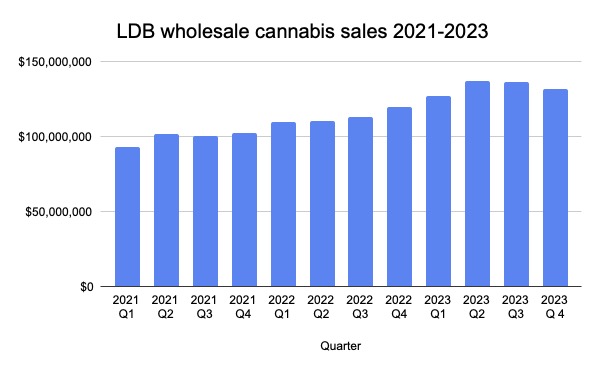
Cannabis sales declined in BC in the first three months of 2024 compared to the last three months of 2023 but still showed year-over-year growth.
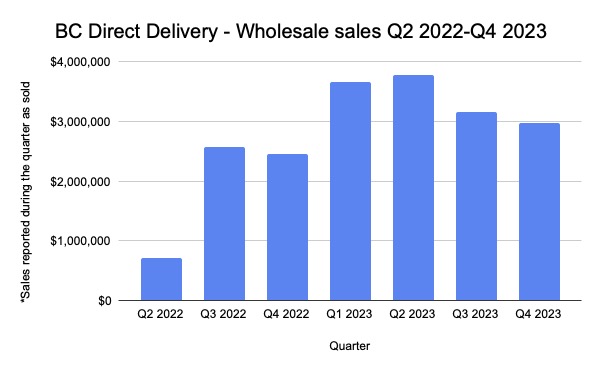
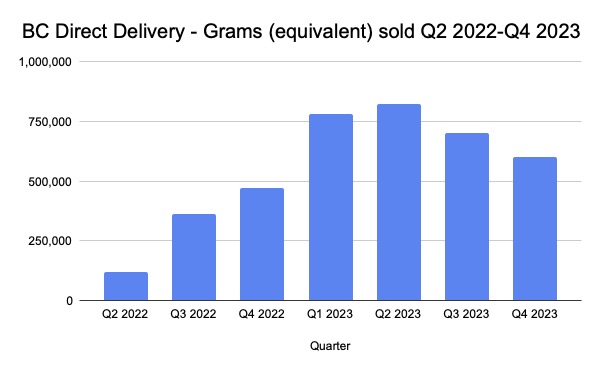
Sales through the Province’s direct delivery program also shrank for the second quarter in a row from their highest point in Q2 2023.
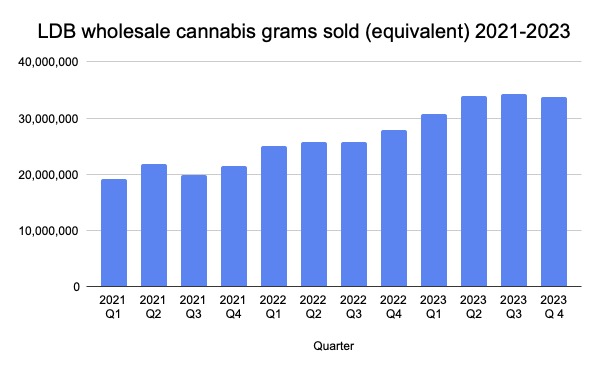
Wholesale grams of cannabis sold in BC (from the LDB to retailers) in January, February, and March 2024 were up 20.9% compared to the same period in 2023. Wholesale sales dollars were also up 10.3% compared to the previous year.
All figures are for wholesale sales through the LDB, including direct delivery.
Despite this year-over-year increase, wholesale dollars on cannabis sales through the Liquor Distribution Branch (LDB) declined slightly in the most recent quarter compared to the two previous quarters.
Wholesale cannabis sales were $132 million in Q4 2024, down from $136.7 million in Q3 and $137.1 in Q2.
This decline is due to the continued lower cost of cannabis, again down in the most recent quarter to a new low of $3.92 for all cannabis and $3.21 for dried flower.
The number of retail stores in the province increased again in the most recent quarter, up to 501, a net increase of five from the previous three months at the end of 2023. The Metro Vancouver area gained five stores compared to the previous quarter (Zone 1), Vancouver Island (Zone 2) gained four, the interior lost four, while northern BC stayed steady with 66.
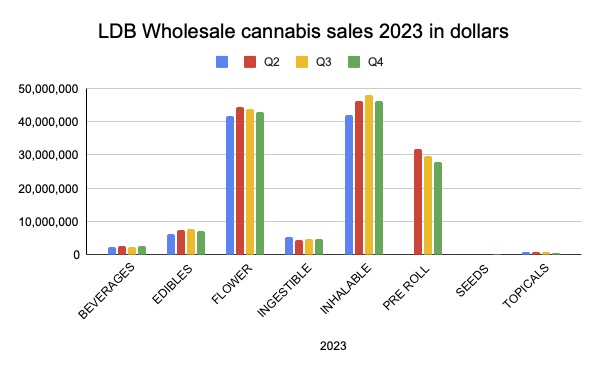
Dried flower and pre-rolls are still the majority of sales in dollars sold (32.5% and 21.1%). However, for several quarters in a row now, inhalable extracts, including products like vape pens and extracts and infused pre-rolls, have been higher than dried flower sales alone, at 35% of wholesale sales in Q4 2023.
Sales of 3.5 gram SKUs of dried flower declined by 33.2% year-over-year (YOY) and 24.8% by grams sold. They declined from the previous quarter as well. Meanwhile, 7, 14, and 28 gram SKU sales increased YOY by 50.9%, 32.6%, and 15.1%, respectively.
Despite these YOY gains, sales of 7 gram SKUs declined slightly from the previous quarter, though 14 gram SKUs remained stable from Q3 2023, and 28 gram SKUs increased slightly.
Edibles were 5.4% of total sales in Q4 2023, cannabis beverages were 1.9%, and topicals were a half percent. The most popular beverages continue to be carbonated drinks by a wide margin (89% of units sold). The most popular edibles continue to be gummies/chews, also by a wide margin (91.2% of units sold).
Disposable vape pens continue to show significant market growth, with $2.4 million in sales in Q4, showing a 91.9% YOY increase and a 72.2% increase in units sold. Despite this increase, disposable vapes accounted for just 5.2% of sales and 6.2% of units sold in this category.
The province sold about 10,000 more disposable vape pens in Q4 compared to Q3. Vape cartridge sales showed modest increases both YOY and compared to Q3.
With just over 1 million units sold in Q4 2023, “other inhalables”, which includes infused pre-rolls, showed considerable YOY growth in sales and units sold (37.9% and 30.9%) but declined slightly from the previous quarter.
This category was also the highest percentage of units sold in the most recent quarter, compared to 40.8% for cartridges.
Resin and rosin sales increased 41.8% (sales) and 53.8% (units sold) YOY and showed modest increases from the previous quarter, while shatter stayed relatively level YOY and wax decreased by 100% (to zero).
BC sold just over seven thousand units of cannabis seeds in the first three months of 2024.
In the topicals category, sales of balms increased by 41.4% YOY and 18.1% in units sold, while declining for both from Q3. Creams, lotions, massage oils, lubricants, and other topicals continued declining YOY and quarterly.
Bath products had a 9.1% increase in sales YOY but a 19.7% decrease in units sold. Sales and units sold in this category were much higher in Q3, potentially related to holiday shopping.
Direct Delivery
Sales through BC’s direct delivery program, which allows certain BC producers to ship products directly to retailers rather than going through the Province’s central distribution warehouse, showed the second consecutive decline in wholesales and grams sold (and equivalent).
There were 602,525 grams sold through this distribution model in Q4 2023 and $2,978,775 in wholesale sales. This is down from 702,478 grams sold in Q3 ($3,167,450) and 821,718 grams sold in Q2 ($3,777,539), the high water mark in both categories since the program began in Q2 2022.
Bucking the trend in overall sales, though, the price per gram of dried cannabis flower sold through direct delivery increased to $4.42 a gram compared to $3.93 per gram in Q3 and $4.18 per gram in Q4 2022.
Flower and pre-rolls are the majority of sales in this sales channel by sales and units sold.
Direct delivery sales of edibles and beverages showed a 90% increase YOY, with a fourth quarterly decline with 2,705 units sold in Q4 2023, compared to 3,439 in Q3, 3,806 in Q2, and 5,209 in Q1. Despite these declines, in terms of dollars sold, this category still increased in the first three months of 2024 compared to the previous three quarters.
Dried flower sales increased slightly from Q3, but were lower than in previous quarters. The province sold more units of pre-rolls in Q4 2023 compared to the previous quarter, but brought in less in sales.
No plants were sold through direct delivery in the first three months of 2024, compared to 102 sold in the first three months of 2022. There were 236 cannabis plants sold through direct delivery in Q2 2023 (July-Sept) for a total of $5,741. In Q1 2023, there were 2,342 cannabis plants sold for $58,597. The LDB has no sales figures for plants in Q3 2023.
Recently, the American Supreme Court agreed to hear a case that involves a trucker who filed a lawsuit against a marijuana company after he was terminated over a failed THC test. In the suit, which was filed in October 2023, the trucker alleged that the failed test was caused by the consumption of a CBD product derived from hemp.
The trucker, Douglas Horn, sued Medical Marijuana Inc. in 2015 under the Racketeer Influenced and Corrupt Organizations (RICO)Act. He claimed that the company falsely marketed the product as having 0% tetrahydrocannabinol (THC), which led him to try it to manage pain. A district court sided with the trucker in its ruling and gave the go-ahead for the suit to proceed. However, Medical Marijuana Inc. appealed the court’s decision at the Supreme Court.
Supreme Court justices have decided to act on the case next week. Horn was represented by Jeffrey Marc Benjamin, of the Linden Law Group P.C.
Generally, RICO cases are linked to large-scale prosecutions of criminal enterprises. However, the statute is also applicable to civil matters. In this case, Horn alleges that he was injured in his property or business because he was fired over a failed THC test. He claims that the company committed wire and mail fraud.
It should be noted that the word “injury” falls under the meaning of business in the RICO statute.
In its ruling, the U.S. Court of Appeals for the Second Circuit stated that the trucker’s termination cost him future as well as current wages, in addition to him losing his pension benefits and insurance because they were all tied to his job.
In a similar case that was settled earlier this year, the DEA had to provide back pay to a special agent and restore pension eligibility after he was terminated in 2019 for testing positive for THC.
In his suit challenging the wrongful termination by the Drug Enforcement Administration, the agent also attributed the positive test to CBD he was taking to manage chronic pain as a substitute for opioids.
The agent, Anthony Armour, also asserted that the federal agency had no grounds to fire him for using what he believed to be a federally legal product, especially with no evidence that his intention was to break the law.
Throughout the suit, the department of Justice acknowledged that he was an outstanding agent during his tenure, which spanned over a decade. In its ruling, the courts also directed that the U.S. Drug Enforcement Agency cover Armour’s legal expenses.
This case is likely to be followed by marijuana companies such as Cronos Group Inc. (NASDAQ: CRON) (TSX: CRON) because its outcome could set some precedents that future lawsuits could refer to.
About CannabisNewsWire
CannabisNewsWire (“CNW”) is a specialized communications platform with a focus on cannabis news and the cannabis sector. It is one of 60+ brands within the Dynamic Brand Portfolio @ IBN that delivers: (1) access to a vast network of wire solutions via InvestorWire to efficiently and effectively reach a myriad of target markets, demographics and diverse industries; (2) article and editorial syndication to 5,000+ outlets; (3) enhanced press release enhancement to ensure maximum impact; (4) social media distribution via IBN to millions of social media followers; and (5) a full array of tailored corporate communications solutions. With broad reach and a seasoned team of contributing journalists and writers, CNW is uniquely positioned to best serve private and public companies that want to reach a wide audience of investors, influencers, consumers, journalists and the general public. By cutting through the overload of information in today’s market, CNW brings its clients unparalleled recognition and brand awareness. CNW is where breaking news, insightful content and actionable information converge.
To receive SMS alerts from CNW, text CANNABIS to 888-902-4192 (U.S. Mobile Phones Only)
Please see full terms of use and disclaimers on the CannabisNewsWire website applicable to all content provided by CNW, wherever published or re-published: https://www.CannabisNewsWire.com/Disclaimer
According to recent statistics, there are 38 states in the US that have legalized cannabis for medicinal use, with 24 of these states legalizing cannabis for recreational use. In states like Los Angeles, Seattle, and Denver, you can buy cannabis easily by walking into a shop and browsing buds. It is no longer considered a sketchy pastime in many social circles, and with more states legalizing the casual consumption of cannabis, it’s important to stay educated.
Although you can use the internet as a means to learn more about cannabis, it’s worth considering reading a book on cannabis that caters to your specific interests. Cannabis books often endure more through vetting and fact-checking before they are published.
So, if your interest is piqued and you want to learn more about everything from cannabis legislation and politics to cooking with cannabis and where the future lies for this plant, read on.
What Are Five of The Best Books On Cannabis?
Hundreds of cannabis books exist, but this doesn’t mean they are all worth reading. If you would like to read some of the best books in this genre and bypass the duds, have a look below:
The Cannabis Health Index by Uwe Blesching
Did you know that there are more than 42,500 scientific papers on cannabis, and many of these focus on how this plant can be beneficial to one’s health? No one has time to scour thousands of papers, but you likely do have time to read a book.
If you’re interested in evidence-based insights into the powerful healing effects of medicinal cannabis, you should read “The Cannabis Health Index,” written by Uwe Blesching, a former paramedic with a PhD in alternative healthcare. This masterpiece of a book features comprehensive insights into over 1,000 studies proving cannabis can treat more than 100 symptoms and diseases, including eye diseases, cancer, inflammatory diseases, infections, and more.
The Cannabis Health Index will take you through a whirlwind of information showing how cannabis-using patients have used and are using this plant for its therapeutic potential. With easy-to-understand condition-specific chapters, usage recommendations, and eye-catching cannabis usage statistics, this book will help you learn more about applying cannabis healthcare as a valid form of treatment in your life.
The Cannabis Grow Bible by Greg Green
Arguably, the most comprehensive but straightforward guide to cannabis gardening written thus far is the book “The Cannabis Grow Bible” written by Greg Green. This book meticulously details how to grow cannabis for recreational and medicinal use and is available as a paperback or spiral-bound tome.
Yet, this book doesn’t simply explain how to grow cannabis; it contains more than 700 in-depth pages filled with highly detailed step-by-step guides for all experience levels, from beginners to expert growers.
Besides offering incredible insights into growing cannabis, “The Cannabis Grow Bible” also provides readers with information surrounding the new advances in cannabinoid extraction techniques and lighting equipment.
Green: A Field Guide to Marijuana by Dan Michaels (with photos by Erik Christiansen)
Sometimes, all you want is a great coffee table book, and if you’re interested in cannabis, you might want to give “Green: A Field Guide to Marijuana” by Dan Michaels a read. With its eye-grabbing visuals that provide up-close shots of cannabis plants, you’ll finally understand why a green plant can also be purple.
This book is a treasure trove of information for those interested in learning more about and admiring cannabis strains. With painstakingly accurate photography, “Green: A Field Guide to Marijuana” shows what buds and different cannabis strains look like up close.
Alongside the photography, readers will enjoy the explanations detailing the botany of a cannabis plant with unique descriptions of flavor, type of high, and lineage. Essentially, readers looking for a breakdown of the cannabis plant will love this book, which is perfect for casual reading.
Bong Appétit: Mastering the Art of Cooking with Weed [A Cookbook] by MUNCHIES
Cannabis is a popular ingredient in gummies, sodas, and alcoholic beverages nowadays, but are you aware it’s one of the best ingredients to cook with? If you’re curious about adding cannabis to your pantry as a staple item alongside the flour, sugar, and eggs, you’ll want to read “Bong Appétit: Mastering the Art of Cooking with Weed: A Cookbook.”
Written by the editors over at Munchies, who inspired the popular Viceland television series, Bong Appetit brings the joys of cooking to a new generation. This book is a budding chef’s dream cookbook, filled with incredibly diverse recipes that produce seriously sophisticated food.
While learning how to cook everything from cannabis-infused butter-basted chicken, french bread pizza, and raspberry and peach pie to weed brownie sundaes and weed chimichurri, you’ll also learn the science of infusing.
So, instead of simply learning the ingredients, you’ll also gain insights into the science of creating common infused ingredients in most recipes, like weed butter, milk, and oils. Not to mention, this book also touches on dosage and pairing flavors and strains!
Brave New Weed: Adventures into the Uncharted World of Cannabis by Joe Dolce
Most of us know a fair bit about the illustrious past of cannabis, but what does the future hold for this plant? In the book “Brave New Weed: Adventures into the Uncharted World of Cannabis” written by Joe Dolce, readers learn the potential answers to this question.
“Brave New Weed: Adventures into the Uncharted World of Cannabis” is an exploratory masterpiece that uses the past as a way to understand how cannabis use might evolve in the coming years through well-researched historical, cultural, and social impacts of this drug.
Unlike other books that have tried to answer the same question, this book doesn’t only base its insights on cannabis in the US. It instead looks at how cannabis use is evolving globally in places like Israel and Amsterdam to put together a better picture of its future after prohibition.
Wrap-Up On The Best Cannabis Books
By reading this list of the best books on cannabis, you’ll have a much deeper understanding of cannabis’s impact on the world and industry. With cannabis infiltrating everything from cooking to healthcare, it’s worth reading up on this plant and its usefulness to determine if it has a place in your life now or in the future.
‘What is old and outlived is not willing to give way, and tries to prolong its anachronistic
existence by various illegitimate means. Thus destructive forces arise within civilization and culture; forces of decline and disintegration.’
G.A. Bondarev
It comes as no surprise to learn that there are forces and players that wish to place the entire earth, and global human civilization, under the domination of materialism. And the character of the Anglo-American nations are perhaps better suited to be the front wave in this process. The forerunners in the promotion and implementation of deep materialism will come from these so-called ‘developed western nations.’ They shall serve as a prototype for the transformation of human society into a realm of deeply embedded techno-materialism. To execute this process, many high-profile people are sought out (such as politicians, financiers, and celebrities) to be the puppets – the marionettes – for promoting this agenda. This is the present state of affairs, regardless of how things may appear upon the shimmering surface. We have arrived upon a defining threshold that will dictate how people will proceed in their life experience upon this planet. How each person decides to pass this threshold will depend upon the choices and decisions they take now and within the proceeding years. As such a threshold approaches in the life of any human society or civilization, greater forces of chaos are unleashed at the same time there is the necessity for a drive towards coherent order. It is the ordering principle that allows a successful crossing of the transformational threshold whilst the chaotic attractor propels people, agencies, bodies, etc, into a distracting path away from the threshold and into an evolutionary dead-end.
Within the previous phase of human civilization, a life of the senses became the defining impulse, with emphasis upon the external, physical aspects. Around the middle to late 19th century a new impulse was introduced into modern western life that had as its aim the familiarization with non-physical realms of reality. This was the beginning of the spiritualism movement, alongside early American transcendentalism, theosophy, and occult themes which were to signal the beginning of a metaphysical impulse to prepare human society for the coming transformational period. Up until this time, human civilization had been immersed in a period of dense physicality and the growth of the individual. There had been a turning away from the metaphysical life, and at the same time many social forces were working to keep the transcendental impulse out of human life. This impulse had been replaced by an earthly static-religious structure based on rigid protocols rather than inspiration from the inner life.
The physical life experience had become one of material content rather than metaphysical exploration. It was coming to a point where it was almost impossible for human culture as a collective to take up the spiritual impulse. This coincided with the explosion of the second industrial revolution and the workhouses for the poor. Spiritual pursuits were a phantasmagorical luxury that few could afford. This situation was dramatically counteracted by the introduction of spiritualism, seances, afterlife phenomena, and eventually the appearance of the ‘Hidden Masters’ into human affairs. For all the controversy against Theosophy and the figures of Helena Blavatsky, Colonel Henry Steel Olcott, and later Annie Besant, the movement had the effect of seeding a new stream of metaphysical ideas and teachings into the modern western era. As mentioned in the preceding essay, this literally opened the floodgates to a flow of personages that arrived upon the new shores promulgating occult, esoteric, and metaphysical teachings. The list is very, very long; and the ground, it seemed, was incredibly fertile. Yet where there is a visible intervention of such forces, they almost certainly attract their counterparts of the denying or negating forces.
As in a game, there are forces seeking to maintain balance and development and those with the aim to disrupt the balance. On the micro level, some of these forces can be recognized as individuals, groups, and organizations. On the macro level, these forces are not to be personified or anthropomorphized (i.e., humanized as specific personalities). Some forces can be recognized as supporting processes of disembodied fantasy; others as pushing for domination of intellect and deep materialism. However, without forces of opposition there would be no true or genuine freedom. The human agency of willpower needs to be exercised and strengthened, and this is accomplished through making choices and decisions, and acting upon them. Without friction there would be no movement – only the illusion of movement. Therefore, there are forces that can be utilized to develop a person’s own development even if these same forces are acting out of their own selfish, and even conflictual, interests. Without the ability to make a choice, the human being becomes a mere automaton. Until we face that dreadful moment (of being a human automaton) we have the challenge to pursue the path of human development through our responses to the counterforces that are blocking human advancement. And this challenge, far from disempowering us, has the opportunity to compel us even greater. These opportunities are what I refer to as the chaotic catalysts. And it appears that some of these ‘chaotic catalysts’ are now very active upon a global level.
A part of our human freedom to choose includes the ability to choose disbelief. What we choose not to believe forms as much of our condition as those things we do choose to believe. In this, certain forces of negation have their function, and it assists us to recognize this. It is within such times as these, of negating forces vying for dominance, that the urge of the metaphysical impulse can be felt by those who are receptive to it. The greater the physical disturbances, the more the metaphysical impulse is sensed in its need to infuse the material life. During moments of condensed, and intense, transformational periods within human evolution, there is likewise an increase in those ‘hindering forces’ that seek to contest the developmental surge. In such times, these disruptive forces increase their presence and interventions in an attempt to hamper, or block, the influence of the subtle forces within the earthly life of humankind. At the same time, it can be said that these ‘chaotic catalysts’ help to make available a period of transformational opportunity through providing disruptions that are more visible and thus actionable. It also marks a time, for those people receptive to influences of spirit-consciousness, to become more aware, alert, and proactively responsive to these impulses.
As the civilizational process comes near to the end of one of its cycles, there is inevitably a greater release of forces – affirming and denying – into the physical dimension. It becomes paramount for the individual to activate the power of human discernment and the choice to seek out order – inner balance and equilibrium – for this will create the necessary vibrational signature (resonance). Because of this, the forces of chaos are strongest in these areas, and seek to diminish balance and order by the most pervasive and intrusive means possible. Within this period of deep materialism (or hyper-materialism), these intrusive means are brought forward through the use of dominant technologies that monitor, track, and regulate human behaviour. Biological forms of social management are to be transferred into artificial structures and arrangements, presided over by machinic, programmed intelligence networks.
The counter-balancing task (the establishment of order) is for those people with receptive capacity to prepare themselves for the infusion of spirit-consciousness (the metaphysical fire) into the physical, and to become as receivers-transmitters for these energies. This requires that a person not only be balanced – bodily, mentally, and emotionally – but also to not be vibrationally entangled with the lower frequencies of dissonance that increasingly plague the physical domain. The alignments with spirit-consciousness are to be more subtle and less visible in outward form. The age of ‘identifiable worship,’ such as through external rituals, dress codes, and other exterior signs of belonging, are to be replaced by a non-dramatized, quiet, and almost unnoticeable inward alignment. The days of external spiritual form have passed. The living spirit is now to be carried quietly, and with dignity, within the human vessel. This is the merger that brings life on earth closer to the spiritualization of matter. The new epoch we are moving into is not one that is to be defined through outer forms but through inward fluidity. This is the Quiet Path.
The intelligence needed now within humankind is one that grasps not the dry intellect but steers inner thoughts towards development of the spirit-consciousness. Intelligence is not something a person has but rather something they use. And the question revolves around how these uses are employed. A person of negative intent can be extremely intelligent and use this for destructive or damaging purposes. The energy of consciousness can be utilized in various ways. Humanity are the vessels for the employment of universal energies, and it would serve us well to recognize this. That is why we are seeing now a huge push for the implementation of AI (machinic intellect) as this opens up a different evolutionary stream and possibilities – possibilities that deny the expansion of human intelligence through spirit-consciousness. However, to not recognize, or acknowledge, that metaphysical events are in operation around us at all times, only gives sustenance to the ‘hardening effect’ of materialism and the entropic forces. It is this hardening within modern life that we must be particularly aware of. This process affects the senses, the perceptive faculties, and the sensitivity to receptivity. An energetic, vibrational hardening or densification, so to speak, creates a blockage for contact with developmental impulses. This is where the path of human will and free choice comes in.
The path of free choice brings with it the responsibility to make those choices. Free choice also means that an individual has the freedom to choose to align with the darker elements, as well as choosing to serve the developmental forces. There may be greater risks in this degree of flexibility, yet choosing to serve without being compelled also accelerates the impulses of development. As it is said, freedom without choice is meaningless. With every step taken towards freedom, a person also gets closer to the darker aspects, for they must be confronted, and a choice made (known as the temptation). The more a person follows the path of freedom, the more they will be confronted with the ‘temptations.’ And by choosing against the temptations (or darker aspects), so is the freedom more whole and complete. The very presence of the entropic, chaotic counterforces gives the choice to align with the path of evolvement greater weight. In other words, the choice of freedom is its fullest when chosen against an opposition to it. Each new temptation can serve to strengthen the presence of spirit-consciousness according to the choices and actions made. Without opposition, a choice carries less weight. And life, we are constantly reminded, does not take place within a vacuum. If this has not been fully appreciated before, then now is certainly the time for its realization. As Rudolf Steiner said in 1908:
The good would not be so great a good if it were not to grow through the conquest of evil. Love would not be so intense if it had not to become love so great as to be able even to overcome the wickedness in the countenance of evil men … You must not think that evil has no part in the plan of creation. It is there in order that through it may come the greater good.1
Life is an amalgam of forces, and their interplay through creation and destruction – order and chaos – creates form and movement. By having the choice of movement, we also accept the responsibility of having to leave things behind once their time is done. Furthermore, momentum requires friction (again, the absence of a vacuum). It is because so few people have the awareness of such processes that there exists a meta-history of those events and processes that have been operating behind the scenes of everyday life. What we generally know of as history, as socio-cultural life, is the shaking of the leaves; what we are unaware of is the wind that blows through the tree.
The entropic, chaotic forces understand the laws of evolutionary development, which means that they cannot oppose them directly but instead they have to move within these currents and try to distort them – to give them a wrong direction, to slow them down or speed them up. That is why we have deception, hidden power, and trickery within our systems as these are the means whereby such forces can project their influence and manifest their power. Yet they cannot act directly, for to do so would be against natural universal laws. They act through duplicity. And, in general, people validate such actions and events through sheer ignorance of the deceit enacted against them. Often, this ignorance is solidified by attachments to lower sensory impacts, influences, and desires. The human is capable of developing their higher faculties through overcoming lower sensate attachments. Some of the people who unleash great tragedies are influenced by occult forces; they bear this responsibility.
Likewise, those individuals capable of aligning with positive, constructive metaphysical forces must also bear this responsibility. However, a distinction in these positions should be made. We should desist from ‘doing battle’ with such negating forces in our physical life, for then we are engaging with them on their playing field – on their energetic level. Beyond the physical, there are ‘events’ taking place unknown to us (the metaphysical forces are aware of the darker occult forces). For us, the responsibility is to gain awareness of the environment in which we are developing the human condition. Human beings do not exist in a neutral environment. Having awareness of those impulses and influences that constitute this environment is critical if we are to have a clarity of perception. Yet being aware of such things does not mean that we need to engage with them. In many instances, we are to observe and, if possible, gain insight into how such interventions and negating influences attempt to sway us. As Rudolf Steiner states: ‘If only enough people would have the impulse today to say: we have first of all to gain insight into these things, the rest will follow!’2 What is necessary is to cultivate a right relation to the things of this manifested world.
Our regular senses are unable to penetrate very far beyond external appearances. That is why people live within a surface, or superficial, layer of experience. And this layer is very deceiving for it is being continuously penetrated by those forces and influences beyond physical perception. The vying forces of chaos and order are not recognized for what they are. Instead, such aspects are often misrepresented as being either ‘good’ or ‘bad’ despite the necessity for such forces to push and pull against one another. Too much of one, and there would be stillness, inertia, and stagnation. Too much of the other, and there would be uncontrolled fluidity and fluctuation. There needs to be a blending. As the mystic-philosopher Gurdjieff said: ‘The higher blends with the lower to actualize the middle.’ Most people are unaware of how these forces operate, let alone that they exist as they do within manifested reality. For this reason, individuals can benefit from acquiring a degree of self-knowledge; otherwise, those with the capacity to comprehend the forces of chaos and order will be driven by outer impulses that they are internally unaware of. The transmutation that faces humankind offers a great potential for moving ahead upon the celestial arc, where the forces of chaos and order play their part for the benefit of evolutionary goals. The more that humanity steps forward upon this path, the more is learnt and understood about the cosmic playing field that constitutes the arena of our lives.
References
1 Rudolf Steiner, a lecture from June 25th, 1908 (GA 104) – https://rsarchive.org/Lectures/GA104/English/APC1958/19080625p01.html
2 Rudolf Steiner, a lecture from December 12th, 1918 (GA 186) – https://rsarchive.org/Lectures/19181212p01.html
According to a new survey, the majority of Americans believe that marijuana is less detrimental to health than tobacco and alcohol. According to the YouGov poll, 64% of participants believe that regular alcohol consumption is riskier than marijuana use, and 63% believe that regular tobacco use is also riskier. The survey conducted from April 5–8, 2024, involved 1,148 adults.
Contrastingly, only a small fraction — 14% — believes that cannabis usage poses a greater threat than regular alcohol consumption. Additionally, 16% of participants stated that marijuana is more detrimental than tobacco. In total, 53% of those surveyed indicated that both tobacco and alcohol are more detrimental to health than cannabis.
These findings align with other recent surveys, such as one conducted by Gallup, which revealed that Americans generally perceive cannabis as less detrimental than cigarettes, alcohol and vaping. Moreover, the survey noted that marijuana use has overtaken cigarette consumption in the United States while vaping is currently behind both.
Similarly, a JAMA poll published last year indicated a shift in public perception, with more people considering smoking cannabis or secondhand marijuana smoke exposure as safer compared to tobacco smoke.
The YouGov poll also revealed that a significant majority of Americans — 62% — support marijuana legalization. This sentiment cuts across political affiliations, with 46% of Republicans, 67% of independents and 71% of Democrats expressing support for legalization.
Regarding usage patterns, 56% admitted to trying cannabis in their lifetime, with 24% reporting consumption within the past year and 17% within the last 30 days. Among those who consumed marijuana in the past year, 24% used it several times daily, 11% used it once daily and 20% used it occasionally.
According to the survey, smoking bud or flower was the most popular (61%) form of use among those who have tried cannabis or CBD. Furthermore, if cannabis were to be legalized countrywide, 67% of nonusers stated that they would keep abstaining. Another 14% expressed uncertainty about trying it, while 6% said they likely would, and 2% said they certainly would.
Meanwhile, another recent survey revealed that more than one-half of the adult population was surprised by the fact that cannabis remains federally illegal in the United States.
Furthermore, a Pew Research Center survey found that 90% of Americans support the legalization of cannabis for either medical or recreational purposes. Most respondents stated that legalization enhances equity in the criminal justice system and helps the local economy.
As perceptions toward marijuana keep changing, cannabis companies such as SNDL Inc. (NASDAQ: SNDL) could see their clientele growing in the different markets in which they have operations.
About CNW420
CNW420 spotlights the latest developments in the rapidly evolving cannabis industry through the release of an article each business day at 4:20 p.m. Eastern – a tribute to the time synonymous with cannabis culture. The concise, informative content serves as a gateway for investors interested in the legalized cannabis sector and provides updates on how regulatory developments may impact financial markets. If marijuana and the burgeoning industry surrounding it are on your radar, CNW420 is for you! Check back daily to stay up-to-date on the latest milestones in the fast -changing world of cannabis.
To receive SMS alerts from CNW, text CANNABIS to 888-902-4192 (U.S. Mobile Phones Only)
Please see full terms of use and disclaimers on the CannabisNewsWire website applicable to all content provided by CNW, wherever published or re-published: https://www.CannabisNewsWire.com/Disclaimer
BizCann invites traders, vendors, entrepreneurs, regulatory authorities, investors, and cannabis enthusiasts, to attend the BizCann Expo being held in Medellin, Colombia, May 18-19, 2024. The BizCann Expo is organized by ZJ Events, bringing the businesses and professionals of the cannabis industry and its ancillaries to a common forum for networking, trading, and learning sessions.
Having spread its reach over several cities in the US, BizCann Expo is being held in Medellin, Colombia, this year to offer phenomenal trading opportunities to local businesses. Due to its favorable location, connectivity, and rich history, Medellin offers the perfect venue for hosting this networking event.
In the year 2023, the event witnessed 50+ speakers, 200+ vendors, and 5,000+ attendees who connected over two days of networking and learning at the BizCann Expo. This year the participation is expected to outgrow last year’s numbers. Industry professionals with fresh and unique ideas can leverage this expo forum to gain visibility among peers, industry giants, and investors.
Entrepreneurs and creative minds with unique business ideas can share their innovations on this platform. Several eminent industry leaders will attend the expo to discuss the latest updates and strategies for successful canna trading. Plant-touching and non-plant touching cannabis businesses will also be represented at the Expo.
The speaker sessions will be conducted by stalwarts of the cannabis industry who have years of knowledge and experience of trading in this industry. They will discuss the latest updates, regulations, challenges, and prospects that lay ahead for businesses to grow and prosper. (Applications for speaker sessions are open.)
CannabisNewsWire (“CNW”) is a specialized communications platform with a focus on cannabis news and the cannabis sector. It is one of 60+ brands within the Dynamic Brand Portfolio @ IBN that delivers: (1) access to a vast network of wire solutions via InvestorWire to efficiently and effectively reach a myriad of target markets, demographics and diverse industries; (2) article and editorial syndication to 5,000+ outlets; (3) enhanced press release enhancement to ensure maximum impact; (4) social media distribution via IBN to millions of social media followers; and (5) a full array of tailored corporate communications solutions. With broad reach and a seasoned team of contributing journalists and writers, CNW is uniquely positioned to best serve private and public companies that want to reach a wide audience of investors, influencers, consumers, journalists and the general public. By cutting through the overload of information in today’s market, CNW brings its clients unparalleled recognition and brand awareness. CNW is where breaking news, insightful content and actionable information converge.
To receive SMS alerts from CNW, text CANNABIS to 888-902-4192 (U.S. Mobile Phones Only)
Please see full terms of use and disclaimers on the CannabisNewsWire website applicable to all content provided by CNW, wherever published or re-published: https://www.CannabisNewsWire.com/Disclaimer
The move to reclassify cannabis in from Schedule I to III is significant and a positive step forward towards full federal legalization of cannabis. The reclassification marks the first substantive change in federal marijuana policy in more than 50 years and is long overdue. Organigram’s extensive operation, exceptional balance sheet, and recently created Jupiter investment pool positions us to succeed at home and in the U.S.
Our recently announced Jupiter investment pool has been designed to allow Organigram to participate in the rapidly evolving U.S. cannabis market. Through this fund, we aim to make strategic investments in international partners, including the U.S., that provide us the opportunity to bring our leading brands and world-class IP to new markets. There is no shortage of opportunities to enter the U.S., and we are actively considering different options. We’ve already launched products stemming out of our partnership with Phylos (seeds and THCV) and we’re looking forward to commercializing products in the U.S. through OBX’s expertise in formulation and product development. With the right U.S. partners, our portfolio of strong brands and our industry-leading IP, we will be well positioned to compete in the U.S. market.
The ZJ Events Vape South America 2024 will be held at the Plaza Mayor Convention Center, Medellin Colombia, May 18-19, 2024. Top manufacturers, buyers, suppliers, users, traders, enthusiasts, and stalwarts of the alternative products industry will be attending the always popular event.
The counterculture and vape trade show will showcase a myriad of alternative products that include herbal products, mood enhancers, vape products, functional beverages, dietary supplements, nootropics, and more.
Suppliers, traders, head shops, and several businesses from the alternative category, will be part of the Expo, to showcase their latest products and services. Attendees can leverage huge discounts, get amazing deals, and explore the most innovative products, all under the fun and exciting environment of the expo.
As traditional and mainstream marketing is difficult for alternative products, an exclusive channel must be available to market and showcase the alternative products. ZJ Events offers the counterculture industry a robust platform with their Alternative Products Expo, where the best of the industry influencers meet, connect, and collaborate.
The event offers:
Registered buyers and brands, with media and marketing partnerships
Mass exposure to new players, industries, and innovations in the counterculture realm
Investors and traders, for discovering new products and trends
Networking with industry veterans and distributors for network expansion and a better ROI
Updates on the latest industry regulations
Vape South America started as Vape Conventions in 2017, evolved into USA CBDEXPO, and has been known as Alternative Products Expo in the United States since 2021. Dedicated booths are available for traders and innovators where they can showcase their innovative ideas and brands. Businesses can opt for different categories of sponsorships like platinum, gold, silver, etc., for extensive marketing by the event organizers.
CannabisNewsWire (“CNW”) is a specialized communications platform with a focus on cannabis news and the cannabis sector. It is one of 60+ brands within the Dynamic Brand Portfolio @ IBN that delivers: (1) access to a vast network of wire solutions via InvestorWire to efficiently and effectively reach a myriad of target markets, demographics and diverse industries; (2) article and editorial syndication to 5,000+ outlets; (3) enhanced press release enhancement to ensure maximum impact; (4) social media distribution via IBN to millions of social media followers; and (5) a full array of tailored corporate communications solutions. With broad reach and a seasoned team of contributing journalists and writers, CNW is uniquely positioned to best serve private and public companies that want to reach a wide audience of investors, influencers, consumers, journalists and the general public. By cutting through the overload of information in today’s market, CNW brings its clients unparalleled recognition and brand awareness. CNW is where breaking news, insightful content and actionable information converge.
To receive SMS alerts from CNW, text CANNABIS to 888-902-4192 (U.S. Mobile Phones Only)
Please see full terms of use and disclaimers on the CannabisNewsWire website applicable to all content provided by CNW, wherever published or re-published: https://www.CannabisNewsWire.com/Disclaimer
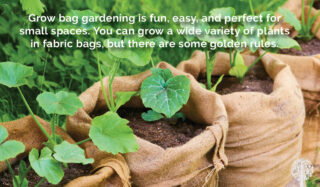
Grow bag gardening is a fun and easy way to get into the growing game. I’ve had great success growing everything from small-size pumpkins and eggplant to tomatoes, potatoes, and flowers in fabric bags. Lightweight and portable, grow bags are perfect for urban areas, patios, and balconies. But before you get started, you should know a few golden rules about growing in bags.
Size Does Matter: What Size Grow Bag Should I Use?
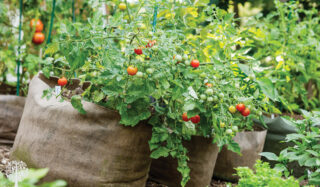
Select grow bags proportionate to your growing plans. For example, I grow a single mini-pumpkin plant in a 25-gallon bag and one indeterminate tomato in a 15-gallon bag. Peppers, cucumbers, and potatoes all do well in 10-gallon bags. Herbs and flowers are fine in 2 to 5-gallon bags. And don’t overcrowd the plants! It’s tempting to cram many seed potatoes into a 10-gallon bucket, but in my experience, three should be your max for a good yield.
Choose Varieties Wisely: How to Choose Crops for Your Grow Bag
The size of the bag matters, and so does crop variety. I generally keep larger-size crops, like squash and indeterminate tomatoes, in my raised beds. That’s not to say it can’t be done, but you’ll have better luck selecting bushier, compact porch varieties for fabric pots. Determinate tomatoes like Patio Girl, Celebrity, Tiny Tim, and Micro Tom are excellent choices. Patio snacker cucumbers and Dragon’s Tongue bush beans are, too, as are Sweetie Pie and Baby Boo pumpkins. One of my favorite things about seed shopping is learning about the fun varieties out there, and there are many for small spaces!
How Often Should I be Watering my Grow Bag?
Plants typically do better in grow bags than in other containers because their roots are aerated and have more growing space. It’s not uncommon to eventually see a web of roots outside the fabric bag! However, using fabric also means the soil will dry out faster because water can easily leach out of the bottom and the sides. Invest in a moisture meter; this tool has been invaluable to my grow bag gardening ventures. While my raised beds have had enough moisture for days in the heat of the summer, my grow bags have rapidly dried out and require more TLC. I like to water my crops in the morning; I’ll wait for the soil to absorb the water and then add more to be sure the roots get the drink they need.
Be Generous With Nutrients
When the water leaches out of the bottom and sides of grow bags, it takes a bunch of essential nutrients along for the ride. Soil quality always matters, no matter the type of garden you grow, but it is crucial with grow bags. Purchase a top-quality and complete urban soil mix, or make one yourself. Ensure the bags contain plenty of compost, worm castings, coconut coir or peat, seaweed fertilizer, and regularly amend. The growing medium has to be able to absorb and retain nutrients and moisture. In his book Grow Bag Gardening, Kevin Espiritu (of Epic Gardening) offers recipes for several different grow bag soil mixes.
Have Fun With It
Like any garden, it’s essential to enjoy the experience of growing your food and flowers. Grow bags are versatile; you can select colors and sizes that suit your style. Place the bags in front of a pretty trellis and let your plants climb. Design different kinds of kitchen combos, whether culinary herbs, a stir-fry bag, or a salsa garden (all sketched out in Kevin Espiritu’s book). Finally, have fun experimenting with different plant varieties. Last summer, I grew giant sunflowers in grow bags scattered around my yard. I had mini-pumpkins trailing out of 25-gallon bags nearby, and it was whimsical, especially in the fall!










Recent Comments