





New Study Suggests Childhood Trauma Doesn’t Cause Challenging Ayahuasca Trips

New Study Suggests Childhood Trauma Doesn’t Cause Challenging Ayahuasca Trips

A new study has disputed the common belief that experiencing trauma in one’s childhood may affect a user’s experience with ayahuasca.

Ayahuasca is a psychoactive brew that has been used by Indigenous cultures in the Amazon and Orinoco basins for millennia for divination, spiritual ceremonies and healing. The brew is comprised of the Psychotria viridis shrub, which contains DMT, and the Banisteriopsis caapi vine.

When ingested, this brew causes altered states of consciousness, which include vivid visions that can last for hours. Traditionally, these psychoactive experiences are sought for spiritual growth and healing and can be guided by experienced shamans.

Ayahuasca’s popularity in the west has increased interest in its possible therapeutic benefits, with some users reporting that the brew relieved symptoms of mental-health conditions including post-traumatic stress disorder, anxiety and depression.

For their study, the researchers recruited 160 individuals from different platforms, including sites such as X, Facebook, Reddit and LinkedIn, as well as sites centered on psychedelic research and community networks. Participants were all required to have had at least one experience with ayahuasca and be 18 years of age and older. All participants were also required to complete a questionnaire that collected data on race, age, gender identity, ethnicity, education level, sexual orientation, psychiatric diagnoses, current annual income, history of psychotherapy, use of psychiatric drugs, number of experiences with ayahuasca and lifetime substance use.

In addition, participants completed the Childhood Traumatic Events Scale, which measures exposure to trauma before age 17. Here, they were asked to rate the effect of traumatic events they experienced.

The researchers analyzed the results from both questionnaires and found no link between previous childhood trauma and the intensity of what one experiences while under the influence of ayahuasca. They also observed no connection between these experiences and psychological growth following a psychedelic trip, which suggests that the benefits may not be assured for every individual.

The study had some limitations, including reliance on self-reported information from participants, which may include possible biases in memory recall. Additionally, the researchers didn’t look into the long-term risks and outcomes of using ayahuasca, nor did they evaluate the role of therapeutic integration after a psychedelic experience.

Future studies may benefit from a deeper assessment of the different types of trauma and their impacts on the psychedelic experience, as well as a more diverse sample.

The study reported its findings in the “Drug Science, Policy and Law” journal. The researchers involved included Ksenia Cassidy, Wendy D’Andrea, Eva Henje and C.J. Healy.

Many other entities, including Mind Medicine Inc. (NASDAQ: MNMD) (NEO: MMED) (DE: MMQ), are conducting studies aimed at understanding how a number of psychedelic compounds can be leveraged for therapeutic purposes. More information could become available about those hallucinogenic substances and the factors that can influence their effects on humans.

About PsychedelicNewsWire

PsychedelicNewsWire (“PNW”) is a specialized communications platform with a focus on all aspects of psychedelics and the latest developments and advances in the psychedelics sector. It is one of 60+ brands within the Dynamic Brand Portfolio @ IBN that delivers: (1) access to a vast network of wire solutions via InvestorWire to efficiently and effectively reach a myriad of target markets, demographics and diverse industries; (2) article and editorial syndication to 5,000+ outlets; (3) enhanced press release enhancement to ensure maximum impact; (4) social media distribution via IBN to millions of social media followers; and (5) a full array of tailored corporate communications solutions. With broad reach and a seasoned team of contributing journalists and writers, PNW is uniquely positioned to best serve private and public companies that want to reach a wide audience of investors, influencers, consumers, journalists and the general public. By cutting through the overload of information in today’s market, PNW brings its clients unparalleled recognition and brand awareness. PNW is where breaking news, insightful content and actionable information converge.

To receive SMS alerts from PsychedelicNewsWire, text “Groovy” to 888-902-4192 (U.S. Mobile Phones Only)

For more information, please visit https://www.PsychedelicNewsWire.com

Please see full terms of use and disclaimers on the PsychedelicNewsWire website applicable to all content provided by PNW, wherever published or re-published: https://www.PsychedelicNewsWire.com/Disclaimer

PsychedelicNewsWire
San Francisco, CA
www.PsychedelicNewsWire.com
415.949.5050 Office
Editor@PsychedelicNewsWire.com

PsychedelicNewsWire is powered by IBN

Salt Spring too small for two cannabis stores, proposed location inappropriate, say residents, council

Salt Spring too small for two cannabis stores, proposed location inappropriate, say residents, council

A BC court has ruled that a community’s rejection of a retail cannabis licence was not unreasonable following an appeal by the retail applicant. 

The appeal was before the Supreme Court of BC in relation to a 2022 application for a cannabis store to operate with a provincial licence in the Village of Ganges on Salt Spring Island.

In a town hall meeting on June 22, 2023, the applicant, Canna Northwest Enterprises Inc., had their application denied by the Salt Spring Island Local Trust Committee (LTC) based on its location’s proximity to schools, a public library, and a public park.

The applicant appealed the decision, seeking a judicial review with the court, arguing the decision was unreasonable and was based on protecting another previously approved cannabis store. 

Several attendees at the town hall meeting expressed concern with both the location of the proposed store and concern that the small community did not need more than one cannabis store. Another store, The Harvest Moon, had been approved by the LTC in April 2020 and is located about one kilometre from the new applicant. Employees of The Harvest Moon spoke out against the new application in the town hall alongside other community members.

In 2021, Salt Spring Island’s population was listed as about 12,000.

The Licensed Retail Cannabis Council of BC (LRCCBC) also provided a submission to the LTC, which, while not taking a specific position on the application, referred to factors such as the inability of regulated retailers to differentiate themselves through pricing or marketing; the problem of excess concentration of retail operations in given locations; and “exceptionally low” profit margins.

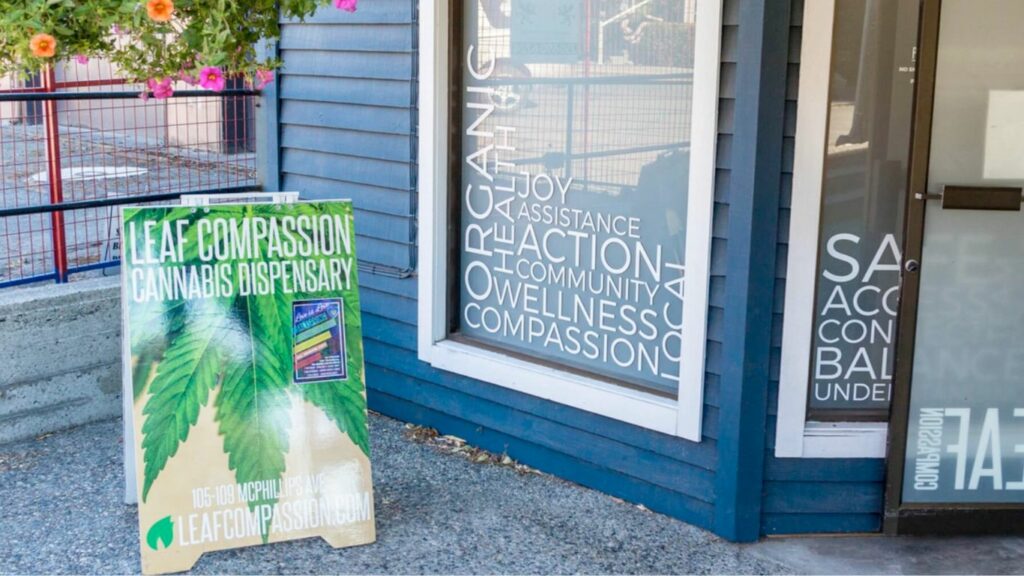
The location of the proposed store was previously home to an unlicensed cannabis store: in 2019, Leaf Compassion Cannabis applied for a licence. At the time, there was no opposition to the location by the community, with the local Advisory Planning Commission recommending that the LTC support the application. 

However, once the supported application was forwarded to the provincial government for approval, the BC Liquor and Cannabis Regulation Branch (LCRB) did not approve the licence. Leaf Compassion’s website now redirects to an unregulated online cannabis store called Barely Legal.

Applications for retail cannabis licences in BC must be approved by both the province and the municipality. 

Arguing for the licence, the applicant’s principal, Mr. Chouinard, submitted a petition to the LTC in support of the application with 90 signatures. Chouinard argued that he was not made aware of concerns regarding location prior to the town hall meeting, was not given notice that the application would be discussed during the town hall, and was not given a meaningful opportunity during the meeting to address the issue of location.

The ruling Justice in the appeal countered these points, noting that concerns with the location had been communicated to the applicant, and that he had had the opportunity to attend any town halls where his application was discussed. 

In his final ruling, Justice A. Saunders ruled that the council’s denial of the application was not unreasonable, and the petitioner was not deprived of procedural fairness.


Canada’s cannabis industry at risk of losing first-mover advantage to US

Canada’s cannabis industry at risk of losing first-mover advantage to US

This week’s announcement that the Biden Administration will move ahead to reclassify cannabis to a much less restricted drug class and ease federal restrictions could be the ray of sunshine the benighted Canadian sector has been waiting for.

Despite becoming legal in 2018, Canada’s pot industry has stalled thanks to over-regulation and the federal government’s decision to avoid tweaking an onerous taxation policy or providing any substantial support to hundreds of businesses led by well-intentioned Canadian entrepreneurs willing to take on this new, green frontier. Challenging business conditions, bad financial decisions, and an unforgiving investor base have seen the space generate massive losses and layoffs even though this industry now provides as much economic contribution to this country as forestry. 

With the US now poised to reschedule cannabis to a Schedule III drug—it will no longer keep company with heroin, LSD and peyote—substances deemed to have no accepted medical use and a high potential for abuse. This will mean that cannabis will be treated like a therapeutic or even a medical drug, where research and development can now be pursued without the threat of incarceration. 

That presents a unique opportunity that Canada’s no-longer nascent cannabis industry may be well-positioned to take advantage of.

The US will now need to follow in Canada’s footsteps in establishing a medical cannabis regime to allow for cannabis products to come to market. Canadian regulations, albeit not perfect, have been carefully developed to abide by international standards and protocols, implemented and amended to foster a market that generates roughly $5 billion annually.

The Canadian government needs to move rapidly to influence Washington to adopt as much from the Canadian medical regime as possible to support the flow of capital, trade and research across the border.

US investors, previously prohibited from wading into Canada’s cannabis market thanks to its federal illegality south of the border, should now be welcomed with open arms into Canada. Upon crossing the border, their dollars will find an industry that knows how to produce high-quality products with low-cost manufacturing.

Our market is also a gateway to Europe, Israel and Australia, as many Canadian companies have invested heavily in their facilities in order to achieve the required accreditation to export cannabis products to those countries for medical purposes.

As well, with Mexico also establishing a liberal cannabis policy, cross-border trade is now an option for cannabis products, such as CBD or low-potency ingestibles, between all three major North American markets. Academic institutions can now work alongside industry with no fear of punishment to pursue more ways this plant can be processed and developed into a wide variety of therapeutic products that can easily participate in clinical trials and pursue obtaining full FDA approval.

Positioning cannabis as a viable ingredient in the future of pharmaceutical medicine unconstrained from US federal restrictions could be the root of a multi-billion dollar industry—a promise that can now soon become reality.

None of this can happen unless the Canadian government shifts from its hands-off approach to the cannabis sector, which it legalized with a stroke of a pen over five years ago and has done little since to support.

Canada has a critical window to get its regulatory and policy house in order. While there are several issues to take under consideration, namely excise tax amendments and implementing a more progressive export policy, Canada should not take this moment for granted.

With the US pot market set to explode, Canada would be wise to avoid blowing this opportunity up in smoke.

~Ivan Ross Vrána and Nathan Mison

Ivan Ross Vrána is the Managing Partner at Diplomat Consulting and Nathan Mison is the Founder and President of Diplomat Consulting. Both have spent decades working with government and industry in regulated markets, including cannabis. 


All Rule and All Government Are Evil to the Core

All Rule and All Government Are Evil to the Core

All Rule and All Government Are Evil to the Core

& the Abandonment of Natural Law

By: Gary D. Barnett

“The science of mine and thine—the science of justice—is the science of all human rights; of all a man’s rights of person and property; of all his rights to life, liberty, and the pursuit of happiness. It is the science which alone can tell any man what he can, and cannot, do; what he can, and cannot, have; what he can, and cannot say, without infringing the rights of any other person. It is the science of peace; and the only science of peace; since it is the science which alone can tell us on what conditions mankind can live in peace, or ought to live in peace, with each other.”

Lysander Spooner: “Natural Law or the Science of Justice

The beauty, simplicity, and justice, of natural law is a thing to behold. It harms no one, and protects everyone; this the essence of freedom. Nothing else is necessary concerning man’s interactions with man, as natural law is based upon the premise of doing no harm to another, no use of force against another, and no infringement upon another or his property. Natural laws alone are the only laws necessary, as any laws prescribed and legislated by one man, or any group of men, over another, is not only immoral, it is immediately destructive of all natural law. Man’s laws are an abomination, and by design are meant to regulate, restrict, harm, or control others, which is a violent afront to the actual rights of all men. No manmade laws that stray in any way from natural law should be tolerated or followed.

The foundation and justification of natural law is centered on truth, honesty, and exacting justice, without any bias or undue force in the process. Each individual has to be responsible for upholding natural law. This can be done independently or with a collective of individuals working together, so long as any and all seeking and protecting justice, do so voluntarily, and without any evidence of coercion. There cannot be any shifting of blame in order to avoid guilt, dishonesty, or power-seeking in any legitimate free society, but of course, a society of this nature is simply peaceful anarchy, strictly based only on natural law. In my days as a child, these lessons were learned very early, as children were taught not to steal, never to harm others or their property and possessions, that what is theirs, is theirs, and what is not, is not, and to protect the natural rights of other children. If only adults could live by the rules of children, what a different world this would be.

The laws of nature, natural laws, do not need to be written down, or commanded by the State, as simply understanding that one cannot do any harm to another, or infringe on another’s life, property, and freedom, is a sufficient understanding of right and wrong. With this knowledge in hand, why then are hundreds of thousands (or more) ‘laws’ made arbitrarily by this heinous government? There is a ‘law’ for seemingly every single aspect of life? As I wrote earlier this year:

“No one, no statisticians, and not even this government itself, has any clue as to how many federal laws exist. No one knows how many rules, restrictions, and regulations there are, and it is impossible to find an answer to this question. The Federal Register alone, the daily repository of all proposed and final federal rules and regulations, has well over 85,000 pages. The Code of Federal Regulations through 2019,  has 186,000 pages, and the Federal Register Pages for the past decade eclipsed 800,000 pages. This alone is unimaginable. But of course, there are more. There is a law for every aspect of our lives in this country, and there are a completely separate set of international laws, State laws, county laws, city laws, and licensing laws for every activity or thought. This is total insanity, and why every single ‘citizen’ can be deemed a criminal at any given moment. Even as far back as in the times of Roman historian Tacitus, he stated that, “The more corrupt the State, the more numerous the laws.” The U.S. has more laws by far than any other nation on earth in history, and therefore is the most corrupt and criminal of all time.”

There are only a few legitimate natural laws to live by in order to respect the rights of man, but with governments, there are no limits to bogus ‘laws.’ In fact, all government laws are against peaceful people, so this government is using the force of arms to compel the masses to obey or else. The State breaks every natural law, while at the same time enforcing its illegal mandates on the entire population. The State lies, cheats, steals, rapes, tortures, commits murder by war, both domestically and internationally, ignoring every natural right, but demands its enslaved population to obey without question its fraudulent legislation. This is the reverse of all sanity and justice.

The real crimes committed by man against man are easily understood, as logic, reason, and common sense will uncover. All one has to understand are the simple tenets of natural law. All real crimes come down to harm by one or more against another or against the many, all driven by aggression. In any society based only on natural law, these crimes can be addressed immediately, and severely if necessary, so long as the initial force is only acted upon due to self-defense. This protective posture, whether by one or many, is completely legitimate, and can not only stop the felonious behavior by the few without resort to any interfering State, but will serve as a major deterrent to those who choose to live by criminal means. In other words, the State is completely unnecessary if honest freedom is sought.

The entirety of this line of thinking breaks down immediately once the State has assumed power, due to the fact that the people at large have acquiesced to rule by the few most powerful. The very idea of government has been promoted since the beginning of time, as a way for the few to control the many; all based on the unnatural concept of extreme fear, which exists in the minds of the irresponsible masses due to anxious trepidation of monsters from afar and within. This unwarranted fear and need for protection is planted in the minds of the people from birth, and throughout their lives, and this is of course done by design in order to subdue the natural traits of self-sufficiency and personal responsibility. Without the chains of government, and its massive propaganda campaigns meant to brainwash all, there would be no need to fear, and therefore, a harmonious and peaceful existence would be not only common, but also demanded by each individual.

This brings to mind a very prescient quote by Etienne de la Boetie that describes the psychological breakdown that occurs once rule in in place and voluntarily accepted:

“It is incredible how as soon as a people become subject, it
promptly falls into such complete forgetfulness of its freedom
that it can hardly be roused to the point of regaining it,
obeying so easily and willingly that one is led to say that this
people has not so much lost its liberty as won its enslavement.”

Natural law is the only road to freedom, and the only sane governing system, as it is self-governing, and without contradiction. Moral behavior and any ‘obligatory’ responsibility for others, on the other hand, cannot be mandated or ordered, it must be voluntary, and dependent on each individual’s want, need, or penchant for charity. It never can be forced or mandatory, made legal or illegal, as moral behavior is only up to each and every individual acting from a position of willing consent.

Governments and those who control governments, are evil to the core, and this cannot be questioned by any individual capable of thinking critically. The only mission of rule is rule, which decimates any idea of freedom and the natural law of mankind. The abolishment of government can only lead to a better place, eliminating the chains that not only bind us, but destroy our very consciousness.

“A man’s natural rights are his own, against the whole world; and any infringement of them is equally a crime; whether committed by one man, or by millions; whether committed by one man, calling himself a robber, or by millions calling themselves a government.”

~ Lysander Spooner, No Treason: The Constitution of No Authority

SUBSCRIBE TO GARY D. BARNETT ON SUBSTACK TO READ ALL FULL ARTICLES AND ARCHIVES!

Gary’s Substack Subscription

Copyright © 2024 GaryDBarnett.com

Permission to reprint in whole or in part is gladly granted, provided full credit is given



https://cultivateelevate.com/antioxidant-trio-6mix-dragons-blood-pearl-powder/?ref=2bfG3v4vqhqnIp

420 with CNW — Is Cannabis Legalization Addressing Harms Minority Communities Suffered?

420 with CNW — Is Cannabis Legalization Addressing Harms Minority Communities Suffered?

image

In 2014, Washington state marked a milestone by opening some of the country’s pioneering legal cannabis stores. At that time, Sam Ward Jr. found himself under home detention due to federal narcotics charges. He eventually went to prison to complete a four-year prison sentence.

Fast forward to today, Ward, a Black American citizen, proudly stands as the CEO of Cloud 9 Cannabis, his own marijuana store. Perched atop a colorful blue and gold throne, he extends a kind greeting to customers looking for early 4/20 discounts while reflecting on his experiences as one of the first to profit from Washington’s effort to open up the cannabis market to people affected by the drug war.

“It’s a remarkable feeling knowing that I’m steering a business, with employees counting on me,” Ward stated. “Simply being a part of something bigger brings immense satisfaction.”

A primary rationale behind legalizing recreational marijuana was to mitigate the harm caused by the uneven application of drug laws, which disproportionately affected communities of color such as Latino and Black communities. Studies consistently reveal that despite similar rates of marijuana use, minorities faced higher incarceration rates compared to their white counterparts.

However, efforts aimed at enabling those most impacted to engage in and benefit from the legal cannabis industry have encountered obstacles. While 24 states and the District of Columbia have embraced legal recreational cannabis use, nearly all have implemented social-equity programs to address the injustices of the drug war.

These encompass various measures, including expunging certain marijuana-related convictions, facilitating access to marijuana licenses and financial aid for individuals with prior marijuana convictions, and allocating cannabis tax revenues to affected communities.

Each state has its own criteria for determining eligibility for social-equity cannabis licenses, which may not exclusively hinge on race. For instance, in Washington, eligibility hinges on factors such as owning more than one-half of the entity, residing for a significant period in areas with marijuana-related arrests, unemployment, high poverty rates, or households with below-median income.

These programs’ execution has been hampered by legal challenges, such as in New York. Currently, New York is facing a new lawsuit despite having settled previous ones, that claims prejudice against minority-owned and women applicants and individuals affected by the war on drugs.

Moreover, concerns arise over large corporations with multistate operations obtaining licenses through social equity, potentially undermining its purpose. In Arizona, legislators raised alarms over licensees’ perceptions of being coerced into ceding power by predatory businesses.

Challenges extend to securing suitable locations due to local bans on marijuana businesses and obtaining bank financing amid federal prohibition. Ironically, factors qualifying individuals for licenses, such as residing in impoverished neighborhoods or having criminal records, hinder their ability to secure necessary funds.

David Penn Jr., another recipient of a social-equity license, faces similar challenges in establishing his marijuana business in Pasco, Washington. Despite financial backing from a friend, he grapples with the reality that grants alone may not suffice to overcome the hurdles he faces.

Washington, a trailblazer in marijuana legislation, recently initiated its social-equity initiative in 2020. However, only in recent months have the first licenses under the program been issued, with only two, including Ward’s store, currently operational.

The state, benefiting from substantial cannabis taxes, has allocated $8 million in grants to assist licensees in the social-equity program with expenses such as renovations, security systems and business coaching. Additionally, $250 million is directed toward communities affected by the war on drugs, supporting initiatives including job training, housing aid, violence prevention and business loans.

As states continue to grapple with the complexities of social equity in the cannabis industry, the experiences of individuals such as Ward and Penn serve as both a testament to progress made and a reminder of the work that remains to be done.

As the challenges faced by social-equity initiatives are addressed, other existing benefits will keep growing for ancillary enterprises such as Innovative Industrial Properties Inc. (NYSE: IIPR) that have carved out a niche for themselves by serving entities directly involved in regulated cannabis operations.

About CNW420

CNW420 spotlights the latest developments in the rapidly evolving cannabis industry through the release of an article each business day at 4:20 p.m. Eastern – a tribute to the time synonymous with cannabis culture. The concise, informative content serves as a gateway for investors interested in the legalized cannabis sector and provides updates on how regulatory developments may impact financial markets. If marijuana and the burgeoning industry surrounding it are on your radar, CNW420 is for you! Check back daily to stay up-to-date on the latest milestones in the fast -changing world of cannabis.

To receive SMS alerts from CNW, text CANNABIS to 888-902-4192 (U.S. Mobile Phones Only)

For more information, please visit https://www.CannabisNewsWire.com

Please see full terms of use and disclaimers on the CannabisNewsWire website applicable to all content provided by CNW, wherever published or re-published: https://www.CannabisNewsWire.com/Disclaimer

CannabisNewsWire
Denver, CO
www.CannabisNewsWire.com
303.498.7722 Office
Editor@CannabisNewsWire.com

CannabisNewsWire is powered by IBN