
by Grow Up Conference | Apr 19, 2024 | Media Partners, Stratcann
A trial between two cannabis companies, one which recently filed for bankruptcy after acquiring the other, is set to begin on April 22.
In late 2023, Final Bell Holdings International, a hardware, packaging, and brand development company serving the cannabis industry, entered into an agreement to sell its Final Bell Canada operation to Canadian cannabis company BZAM.
Following that deal, BZAM then filed for CCAA protection in February, a move Final Bell says contradicts assurances BZAM had given the company prior to signing the agreement.
That deal saw BZAM acquiring Final Bell Canada by issuing $13.5 million in equity in BZAM and granting Final Bell $8 million in promissory notes. At the time, the deal was said to make BZAM the fifth-largest Canadian LP.
Final Bell reacted to BZAM’s announcement by saying it believes that the company’s initiation of CCAA Proceedings constituted an “improper use of creditor protection legislation to evade its creditors, defraud shareholders, and facilitate a related party going private transaction at an unjustified discounted value in order to circumvent a customary going private transaction requiring shareholder and creditor approval.”
On April 16, Final Bell’s written opening statement was shared online, detailing their side of the case, which will be heard in court. In that statement, the company contends that the representations BZAM made to Final Bell during the due diligence process were inaccurate.
This includes claims that BZAM had access to several million in financing from a creditor without reason to believe its main creditor would not continue to extend credit to BZAM. It also contends that BZAM under-reported the amount of money the company owed in back taxes by several million dollars.
BZAM disputes these characterizations for its part, saying it had no idea its credit would not be extended. It also contends that its tax liability did, in fact, increase by $2.7 million from December 5, 2023, to February 15, 2024 (from around $6.4 million to about $9 million), providing a 1,400-page response showing internal emails and their finances.

by Grow Up Conference | Apr 19, 2024 | Cannabis News Wire, Media Partners
A recent yearly report on marijuana sector employment in the United States reveals a nearly 5% increase in full-time cannabis jobs over the past year, marking a turnaround from the approximately 2% decline compared to 2022. Despite this increase, it represents the smallest annual growth since 2017.
According to the report by Vangst, a Colorado-based cannabis staffing company, and Whitney Economics, an analytics company, legal marijuana in the United States now supports more than 440,000 full-time workers. However, the report highlights that job growth was not evenly distributed across the country.
In states such as Michigan where cannabis sales have increased, significant job growth was observed: 11,000 jobs, representing a 39% increase compared to the previous year. Meanwhile, Missouri, in its first complete year of recreational sales, saw an addition of 10,735 jobs. Utah, Rhode Island, New Mexico, New York, Connecticut, New Jersey and Maryland also experienced job growth.
However, more established markets such as Washington and Colorado saw job losses, with the two states reporting a 15% and 16% decline, respectively. California, despite its large market, saw a 6% decrease compared to the previous year. The report attributes these losses to various factors, including cannabis oversupply and a decline in cannabis-related tourism. For instance, the expansion of recreational sales to 20 states has reduced cannabis tourism in Colorado significantly.
Despite these challenges, the report remains optimistic about the industry’s future and predicts a recovery in the upcoming years. It anticipates losses in mature markets to decrease in 2024 and improve once more in 2025.
Looking ahead, the report projects that the legal marijuana industry in the United States will bring in $87 billion by 2035, more than tripling the $28.8 billion it brought in in 2023.
Apart from talking about employment figures, the report also provides insights into the wages of various positions within the cannabis industry. Retail directors make approximately $80,000 a year, whereas trimmers make between $14 to $27 per hour. On the other hand, cultivation directors get about $90,000, while budtenders make about $14 to $22 per hour.
Karson Humiston, CEO and founder of Vangst, noted the importance of their job-tracking initiative, especially considering the lack of federal government involvement in the cannabis industry. While the Vangst report does not delve into the impact of unionization on the industry, it acknowledges the varying trends in state cannabis revenue, noting that sales in new markets tend to grow rapidly. With more states expected to legalize marijuana in the future, the overall cannabis market in the U.S. is projected to continue expanding.
It would be interesting to see the findings of a similar analysis focused on how the marijuana industry is boosting other industries and verticals, such as the real estate niche in which companies such as Innovative Industrial Properties Inc. (NYSE: IIPR) operate and serve marijuana businesses.
About CNW420
CNW420 spotlights the latest developments in the rapidly evolving cannabis industry through the release of an article each business day at 4:20 p.m. Eastern – a tribute to the time synonymous with cannabis culture. The concise, informative content serves as a gateway for investors interested in the legalized cannabis sector and provides updates on how regulatory developments may impact financial markets. If marijuana and the burgeoning industry surrounding it are on your radar, CNW420 is for you! Check back daily to stay up-to-date on the latest milestones in the fast -changing world of cannabis.
To receive SMS alerts from CNW, text CANNABIS to 888-902-4192 (U.S. Mobile Phones Only)
For more information, please visit https://www.CannabisNewsWire.com
Please see full terms of use and disclaimers on the CannabisNewsWire website applicable to all content provided by CNW, wherever published or re-published: https://www.CannabisNewsWire.com/Disclaimer
CannabisNewsWire
Denver, CO
www.CannabisNewsWire.com
303.498.7722 Office
Editor@CannabisNewsWire.com
CannabisNewsWire is powered by IBN

by Grow Up Conference | Apr 19, 2024 | Grow Opportunity, Media Partners
By Gene Johnson
SEATTLE (AP) — Saturday marks marijuana culture’s high holiday, 4/20, when college students gather — at 4:20 p.m. — in clouds of smoke on campus quads and pot shops in legal-weed states thank their customers with discounts.
This year’s edition provides an occasion for activists to reflect on how far their movement has come, with recreational pot now allowed in nearly half the states and the nation’s capital. Many states have instituted “social equity” measures to help communities of color, harmed the most by the drug war, reap financial benefits from legalization. And the White House has shown an openness to marijuana reform.
Here’s a look at 4/20’s history:
WHY 4/20?
The origins of the date, and the term “420” generally, were long murky. Some claimed it referred to a police code for marijuana possession or that it derived from Bob Dylan’s “Rainy Day Women No. 12 & 35,” with its refrain of “Everybody must get stoned” — 420 being the product of 12 times 35.
But the prevailing explanation is that it started in the 1970s with a group of bell-bottomed buddies from San Rafael High School, in California’s Marin County north of San Francisco, who called themselves “the Waldos.” A friend’s brother was afraid of getting busted for a patch of cannabis he was growing in the woods at nearby Point Reyes, so he drew a map and gave the teens permission to harvest the crop, the story goes.
During fall 1971, at 4:20 p.m., just after classes and football practice, the group would meet up at the school’s statue of chemist Louis Pasteur, smoke a joint and head out to search for the weed patch. They never did find it, but their private lexicon — “420 Louie” and later just “420” — would take on a life of its own.
The Waldos saved postmarked letters and other artifacts from the 1970s referencing “420,” which they now keep in a bank vault, and when the Oxford English Dictionary added the term in 2017, it cited some of those documents as the earliest recorded uses.
HOW DID ‘420’ SPREAD?
A brother of one of the Waldos was a close friend of Grateful Dead bassist Phil Lesh, as Lesh once confirmed in an interview with the Huffington Post, now HuffPost. The Waldos began hanging out in the band’s circle and the slang spread.
Fast-forward to the early 1990s: Steve Bloom, a reporter for the cannabis magazine High Times, was at a Dead show when he was handed a flier urging people to “meet at 4:20 on 4/20 for 420-ing in Marin County at the Bolinas Ridge sunset spot on Mt. Tamalpais.” High Times published it.
“It’s a phenomenon,” one of the Waldos, Steve Capper, now 69, once told The Associated Press. “Most things die within a couple years, but this just goes on and on. It’s not like someday somebody’s going to say, ‘OK, Cannabis New Year’s is on June 23rd now.’”
While the Waldos came up with the term, the people who made the flier distributed at the Dead show — and effectively turned 4/20 into a holiday — remain unknown.
HOW IS IT CELEBRATED?
With weed, naturally.
Some celebrations are bigger than others: The Mile High 420 Festival in Denver, for example, typically draws thousands and describes itself as the largest free 4/20 event in the world. Hippie Hill in San Francisco’s Golden Gate Park has also attracted massive crowds, but the gathering was canceled this year, with organizers citing a lack of financial sponsorship and city budget cuts.
College quads and statehouse lawns are also known for drawing 4/20 celebrations, with the University of Colorado Boulder historically among the largest, though not so much since administrators banned the annual smokeout over a decade ago.
Some breweries make beers that are 420-themed, but not laced, including SweetWater Brewing in Atlanta, which is throwing a 420 music festival this weekend and whose founders went to the University of Colorado.
Lagunitas Brewing in Petaluma, California, releases its “Waldos’ Special Ale” every year on 4/20 in partnership with the term’s coiners. That’s where the Waldos will be this Saturday to sample the beer, for which they picked out “hops that smell and taste like the dankest marijuana,” one Waldo, Dave Reddix, said via email.
4/20 has also become a big industry event, with vendors gathering to try each other’s wares.
THE POLITICS
The number of states allowing recreational marijuana has grown to 24 after recent legalization campaigns succeeded in Ohio, Minnesota and Delaware. Fourteen more states allow it for medical purposes, including Kentucky, where medical marijuana legislation that passed last year will take effect in 2025. Additional states permit only products with low THC, marijuana’s main psychoactive ingredient, for certain medical conditions.
But marijuana is still illegal under federal law. It is listed with drugs such as heroin under Schedule I of the Controlled Substances Act, meaning it has no federally accepted medical use and a high potential for abuse.
The Biden administration, however, has taken some steps toward marijuana reform. The president has pardoned thousands of people who were convicted of “simple possession” on federal land and in the District of Columbia.
The Department of Health and Human Services last year recommended to the Drug Enforcement Administration that marijuana be reclassified as Schedule III, which would affirm its medical use under federal law.
According to a Gallup poll last fall, 70 per cent of adults support legalization, the highest level yet recorded by the polling firm and more than double the roughly 30 per cent who backed it in 2000.
Vivian McPeak, who helped found Seattle’s Hempfest more than three decades ago, reflected on the extent to which the marijuana industry has evolved during his lifetime.
“It’s surreal to drive by stores that are selling cannabis,” he said. “A lot of people laughed at us, saying, ‘This will never happen.’”
WHAT DOES IT MEAN?
McPeak described 4/20 these days as a “mixed bag.” Despite the legalization movement’s progress, many smaller growers are struggling to compete against large producers, he said, and many Americans are still behind bars for weed convictions.
“We can celebrate the victories that we’ve had, and we can also strategize and organize to further the cause,” he said. “Despite the kind of complacency that some people might feel, we still got work to do. We’ve got to keep earning that shoe leather until we get everybody out of jails and prisons.”
For the Waldos, 4/20 signifies above all else a good time.
“We’re not political. We’re jokesters,” Capper has said. “But there was a time that we can’t forget, when it was secret, furtive. … The energy of the time was more charged, more exciting in a certain way.
“I’m not saying that’s all good — it’s not good they were putting people in jail,” he continued. “You wouldn’t want to go back there.”

by Grow Up Conference | Apr 19, 2024 | Cannabis Prospect Magazine, Media Partners
by Grow Up Conference | Apr 19, 2024 | Cannabis Prospect Magazine, Media Partners
by Grow Up Conference | Apr 19, 2024 | Cannabis Prospect Magazine, Media Partners
by Grow Up Conference | Apr 19, 2024 | Extraction Magazine, Media Partners
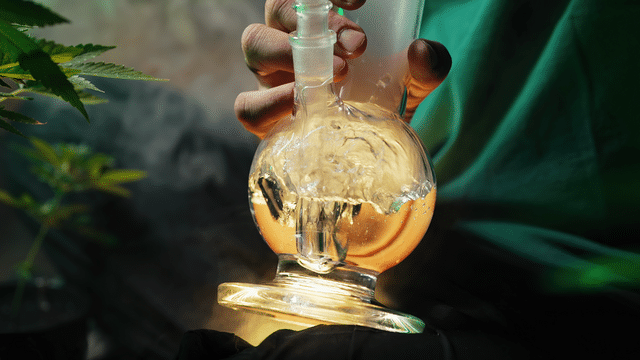
What are the actual historical roots of this widespread tool? First, let’s see where its name comes from: “bong“. For many, it comes from the Thai word “baung” which, to paraphrase, means “wooden/bamboo tube”. But we know for sure that the bong was not born in Thailand. So what are its origins? Since the bong is also a water pipe, many are convinced that it is a direct descendant of the hookah.
We also have little information about the origins of the hookah, it could derive from Persia or India, some say from Egypt. For sure we only know that for the nobles it represented a status, and was used in convivial situations. It was born with the idea of filtering the inhaled smoke with water, with the aim of purifying it. And it is for this characteristic that the bong is considered strongly linked to the hookah.
Asia is another continent that comes into consideration when talking about the origins of the bong. This theory arises from the fact that many studies believe that cannabis derives from this continent, and that the bong is therefore an ancient method for consuming the plant. There are very solid theories on the origins of cannabis, and its use in the history of Asia in general has been widely demonstrated, even in very ancient times. But both the theory of descent from hookah and the theory of Asian derivation are actually superficial and inaccurate.
The Bong in Asia
For some researchers, the first documented trace of the use of this tool dates back to the sixteenth century. In fact, one theory credits the Ming Dynasty as the first users of the water bong. Tobacco was becoming an increasingly profitable plant to grow, and this certainly also contributed to the increasingly widespread use of the bong. Some findings, which mix documented history with legend, claim that Empress Dowager Cixi of the Qing Dynasty was very fond of smoking cannabis from bongs made of silver and jade, and some say she had herself buried with several bongs in her mausoleum. As already mentioned, Asia contributed significantly to the spread of this incredible instrument, especially thanks to the Silk Road, which, with its intense commercial traffic, popularized the use of the bong like never before.
The Origins of The Bong
All the clues could therefore lead one to think that the bong comes from Asia or that it is at most a descendant of the hookah, but some research has disproved these hypotheses by attributing the invention of the bong to the African continent. Several finds of what appear to be the ancestors of modern bongs have been made in the western region of the continent. It was considered logical to think that these tools had been created after 1.600, that is, after the spread of tobacco in Africa, previously “discovered” on the American continent and imported by colonists. All these discoveries, however, did not take into consideration the areas to the east and south of Africa, areas of the continent mistakenly considered more “primitive” than the others.
Researcher J.C. Dombrowski, in the early 1.900s, found objects very similar to water pipes in some caves in Ethiopia. There were a dozen “bongs” dated between 1.100 and 1.400, well before the arrival of tobacco on the African continent. Having found strange traces on these utensils, they were immediately analyzed, and the results were exciting: cannabis residues were found on these primordial bongs. This was more than enough evidence to demonstrate that the bong has a much older African origin than its Asian one.
But the mystery has probably not yet been fully revealed. Although there is clear evidence of the use of the bong in East Africa in the 1.100s, with further studies, tools very similar to prototype bongs have been found, much older than African ones. These findings have called into question everything we thought we knew about the origin of this instrument.
These recent findings have brought to light a Scythian burial mound, the so-called kurgan, dating back 2.400 years ago in what is now southern Russia. Two golden bongs were found in this tomb, containing suspicious traces. After various tests and examinations, the researchers managed to date these two solid gold bongs, back approximately to 400 BC, and above all, equally ancient traces of cannabis and opium were found inside them. For now, these are the oldest findings of tools that were almost certainly used in ancient times as modern bongs. And how has this revolutionary object evolved over 2.400 years?
Bong Evolution
The concept of the bong has remained almost unchanged over the millennia, this was a tool made of bamboo, animal horns, or silver and gold, and over time its design has always changed. The ancient Scythians used to make their bongs from solid gold with very intricate decorations. There was no water cistern, but this sort of vase was connected to a bottle full of water. This connection allowed the smoke to be filtered by the water.
The Scythians used the carburizing technique, which allowed them to control the density of the smoke inside the bong, to maximize the flavor and intensity of each hit. Over time, bongs have evolved. Its design has changed, but not by much. A notable boost to its diffusion is due to the processing of new materials. There are many types of bongs that you can buy today, in plastic, ceramic, and plexiglass, but the material with which the bong saw the peak of its success is glass.
Glass also has a very multifaceted history. The first evidence of glass processing in the Mediterranean dates back to 1700 BC in Sardinia. Around 1000-500 BC, glass works were found in India and China. The boom in glass used as a smoking utensil occurred simultaneously with the cultivation and mass consumption of tobacco. In America, tobacco cultivation was a rapidly developing industry, and so was the glass industry. When these two worlds intersected, the glass bong came to light.
This new evolution of the bong spread like wildfire around 1960–1970, an era of psychedelic experimentation and spiritual emancipation. Even today, glass bongs are the most popular on the market, objects made by professional craftsmen that can cost thousands of dollars. One of the most famous craftsmen of the 60s was Bob Snodgrass, who, fascinated by this instrument, decided to refine this art and contribute to the diffusion of the glass bong throughout the United States, becoming a skilled and famous craftsman over the years. The glass bong is considered the best bong for smoking cannabis.
Why is Bong so Popular?
Over the centuries, the bong has become one of the most popular tools for smoking cannabis. There are many reasons: it is a versatile and very practical tool, there are huge and very expensive ones, as well as cheap and pocket-sized ones. They can be built from different materials, including glass, wood, plexiglass, and ceramic. But what makes the bong such a practical smoking tool? His innovation lay in the use of water, a concept that was counterintuitive to think about, especially in ancient times.
Cannabis, already widely used in the areas of Central Asia, was consumed mainly through and inhalation of its fumes. With the bong, the method remains almost unchanged but with a very interesting (and now almost obvious) innovation: the use of water as a filter. The smoke generated by combustion passes into a small water tank. This sort of filtering softens the intensity of the smoke making the experience decidedly more pleasant and considerably potent
The smoke produced by the bong is more abundant and cleaner than the normal joint, each hit ensures a very massive and concentrated dose of the active ingredient. Furthermore, before being inhaled, the smoke is cooled thanks to the water (or ice) present in the bong tank, which also enhances the flavors of the cannabis used, leaving the and terpenes unchanged. With the bong, the smoker’s experience is more delicate but decidedly more intense, which is why, in all its shapes and sizes, the bong has become the most famous and appreciated smoking tool in the entire cannabis scene.
Conclusions
There’s no doubt that the bong has come a long way from its ancestors 2,400 years ago to today. After the 1960s, there was a very tough fight against drugs by the Nixon administration, but it was in the early 2000s that the US government decided to abruptly slow down all manufacturing of drug-related accessories. All pipes, bongs, and various kits for the consumption of cannabis (and other hard drugs) then became illegal.
Producers and distributors risked up to three years in prison and the confiscation of all their assets. Fortunately, today, public opinion regarding the use of cannabis has changed considerably. There is much more information regarding the use and effects of this substance, and the general public is learning to understand the potential benefits of using this plant correctly.
Consequently, all the related accessories are also rapidly evolving, nowadays, there are vaporizers, electronic bongs, and all the best equipment an enthusiast could wish for. There is no doubt, however, that despite innovations and inventions, nothing will ever be able to replace the classic bong, which, in its simplicity, always remains the best tool for consuming cannabis.
by Grow Up Conference | Apr 19, 2024 | Media Partners, Stratcann
Two cannabis producers are taking a shipping company to court, alleging the company attempted to take the cannabis over the US border, resulting in the seizure of 151 kilograms.
BC-based We Grow BC Ltd. and Alberta-based Westleaf Labs, now known as Decibel Cannabis, filed a notice of civil claim in a BC Supreme Court this month for $834,901, arguing that BC-based Seven Elk Shipping’s actions resulted in the seizure of their product by US border officials.
The notice of claim contends that We Grow BC and Westleaf Labs contracted the shipping company in January 2023 to deliver their cannabis within Canada, with specific instructions not to enter the US.
Then, in May, according to the notice of claim, Seven Elks took possession of several pallets of cannabis in Port Coquitlam, BC, for transport to We Grow in Creston, BC and from Delta, BC, to Westleaf’s facility in Calgary.
The claim contends that on May 17, the day Seven Elk took possession of the product, the company attempted to cross the border at the Peace Arch crossing in BC, where it was seized by US authorities. US customs then destroyed the products or at least refused to return them to any of the companies.
We Grow BC and Westleaf Labs argue that the value of the product was $834,901, which Seven Elk charged $11,901 to deliver.
The two cannabis companies allege Seven Elk’s actions constitute a breach of contract, which has damaged their reputations.
We Grow BC and Westleaf Labs formally announced their collaboration in 2019, combining the BC cultivator’s operations and Qwest brand with the Alberta processor retail and distribution network. At the time, the two companies characterized the deal as creating one of the largest craft producers in Canada.
Seven Elk’s website is no longer active. These allegations have not been proven in court.
by Grow Up Conference | Apr 19, 2024 | Cannabis News Wire, Media Partners
A recently conducted Ipsos poll has found that one-half of Floridians would vote to approve an abortion ballot initiative. The poll included 316 independents, 264 Democrats, and 369 GOP members. It was carried out April 5–7, 2024, with a margin of error of 4.1%.
The survey include more than 1,000 adults in Florida, determining that 16% of them were unsure of their positions and/or hadn’t registered to vote. An additional one-third revealed that they were against the amendment on abortion. The poll also found that 49% of Floridians were in favor of a cannabis amendment.
Those championing for recreational cannabis legalization and abortion rights in Florida will have to work harder, especially since Floridians are expected to vote on proposed amendments regarding these issues this November. For these proposals to be enacted, they must receive at least 60% of votes.
As per the poll results on those who were in favor of the abortion proposal, champions will need at least 10 percentage points more to get the proposal approved. To do this, they’ll have to convince voters while also informing them in the coming months about what the amendments entail.
According to the poll, only about one-half of adults in the state were familiar with the abortion initiative, with 54% of them saying the same about the cannabis measure. The abortion initiative is expected to garner a lot of attention in the state, particularly since Florida’s Supreme Court recently gave the go ahead on a six-week abortion ban. If the abortion initiative is approved by voters, access to abortion would be guaranteed until fetal viability, which is basically until 24 weeks.
It would also permit abortions when necessary to protect the health of a patient, as advised by a healthcare practitioner. The group campaigning for the initiative, Floridians Protecting Freedom, has thus far raised almost $20 million from different abortion-rights groups.
The poll shows that 74% of Democrats were in favor of the abortion proposal, while 17% were against it. In addition, 52% of Independents were also in favor of the proposal while 28% were against it. As for GOP Party members, 58% were against the proposal while 34% were in favor of its approval.
With regard to the cannabis measure, its passage would permit individuals aged 21 years and older to possess up to five grams of marijuana concentrate and up to three ounces of marijuana. The measure’s campaign is being led by Smart & Safe Florida. The group has so far raised almost $55 million, most of which has been spent on signature collection.
Florida governor Ron DeSantis and other GOP members oppose both measures, which may negatively influence the passage of both measures by voters.
Companies that are behind the adult-use legalization initiative, such as Trulieve Cannabis Corp. (CSE: TRUL) (OTCQX: TCNNF), have their work cut out if they are to mobilize a sufficient number of voters to pass the measure at the ballot.
About CannabisNewsWire
CannabisNewsWire (“CNW”) is a specialized communications platform with a focus on cannabis news and the cannabis sector. It is one of 60+ brands within the Dynamic Brand Portfolio @ IBN that delivers: (1) access to a vast network of wire solutions via InvestorWire to efficiently and effectively reach a myriad of target markets, demographics and diverse industries; (2) article and editorial syndication to 5,000+ outlets; (3) enhanced press release enhancement to ensure maximum impact; (4) social media distribution via IBN to millions of social media followers; and (5) a full array of tailored corporate communications solutions. With broad reach and a seasoned team of contributing journalists and writers, CNW is uniquely positioned to best serve private and public companies that want to reach a wide audience of investors, influencers, consumers, journalists and the general public. By cutting through the overload of information in today’s market, CNW brings its clients unparalleled recognition and brand awareness. CNW is where breaking news, insightful content and actionable information converge.
To receive SMS alerts from CNW, text CANNABIS to 888-902-4192 (U.S. Mobile Phones Only)
For more information, please visit https://www.CannabisNewsWire.com
Please see full terms of use and disclaimers on the CannabisNewsWire website applicable to all content provided by CNW, wherever published or re-published: https://www.CannabisNewsWire.com/Disclaimer
CannabisNewsWire
Denver, CO
www.CannabisNewsWire.com
303.498.7722 Office
Editor@CannabisNewsWire.com
CannabisNewsWire is powered by IBN

by Grow Up Conference | Apr 18, 2024 | Media Partners, The New Agora
The Unreal Machine (1): Deadly Enchantment
One of the most world-changing technological discoveries of our recent era has been that of electricity. The word electricity first entered the English language in a 1650 translation of a treatise on the healing properties of magnets by Jan Baptist van Helmont, a Flemish physician and Rosicrucian who worked on the borderline between natural magic and modern chemistry. Many of the earliest books and treatises on electricity described the force in distinctly alchemical terms, with such names as the ‘ethereal fire,’ the ‘quintessential fire,’ or the ‘desideratum,’ being used. Now it is taken for granted how almost everything we use today is plugged into some invisible power grid. We take little or no notice of how our devices and household appliances produce electromagnetic fields that mesh with all the other unseen fields into an ecosystem of electro-energies. These energies are sub-nature. They are part of living existence, yet they are a lower form of life vibration. Electricity, said Rudolf Steiner, is light in a sub-material state. That is, it is a form of light that has fallen below the level of nature and has become what he termed ‘sub-nature.’ It is because of this that Steiner warned humankind to be cautious not to build cultures dependent or based on electricity. An electro-ecosystem will only serve to draw us away from our natural eco-system and into a lower vibrational state of sub-nature. In a lecture from 1925, Steiner says
‘There are very few as yet who even feel the greatness of the spiritual tasks approaching man in this direction. Electricity, for instance, celebrated since its discovery as the very soul of Nature’s existence, must be recognised in its true character — in its peculiar power of leading down from Nature to Sub Nature. Only man himself must beware lest he slide downward with it.’1
Rudolf Steiner made great efforts to outline aspects of the various forces acting against humankind’s development. One of these forces he termed as ‘Luciferic,’ and the aim of these forces was to sever the connection between the human world and the realm of spirit. The other forces he named as ‘Ahrimanic,’ and the intention of these forces was to draw humanity into their realm; that is, to drag human beings further into deep material entanglement.
What makes Steiner’s observation central to my exploration of what I call the Inversion is that he was perhaps the first figure – or spiritual researcher – to publicly refer to electricity as sub-nature, and of its possible relation to entropic or negative forces. Specifically, how anti-developmental impulses – Ahrimanic impulses according to Steiner – are connected with the forces of man-made electricity and magnetism, the same energy processes that information and computing technologies are based upon. As electricity, light is highly compressed into a sub-material construct. The inner qualities of natural light are distorted into an artificial form below that of its original state. And from this, human technologies are created; technology utilizes natural energies condensed into sub-natural – i.e., artificial – states. According to Anthroposophical researcher Paul Emberson:
In a nutshell: technology is that sphere of human activity in which we are transforming the substances and forces of the outer mineral world, giving them new structures, motion, properties and purposes, in accordance with our ideas, our intentions and the destiny of our race.2
Through technology the human being is externalizing its own nature, manifesting an expression in material creations. Such outer creations can be seen as projections of a person’s own nature. The shifts to occur in technology will be reflections of the changes occurring in human beings themselves. Yet since the human being is caught up within the material inversion, becoming ever more entangled within physical matter, such technological creations or ‘expressions’ will not come from a place of pure consciousness. Current technological developments and processes are not only an expression of our wishes and desires – the human ego – but are also expressions of a machinic impulse that runs through humanity via their embodiment in this inverted reality. That is, forces which operate within the Inversion are able to find expression through the medium of technology because such technologies are externalized creations of a humanity through which such forces also operate.
Technology is also an intermediary medium through which humanity can access and interact with other forces and realities. If we examine some of the most recent technological innovations, we can see that there is a marked potential for doing more than processing operations within this current reality. As an example, quantum computing utilizes the properties of quantum states. As quantum science has discovered, such states as entanglement and superposition, particle-wave, demonstrate a correspondence with an underlying quantum vacuum, or quantum unified field. Such a unified field is also related to the zero-point field from which matter-reality manifests. In other words, quantum science connects with an energetic realm beyond spacetime. Within such a realm, other dimensions, other realities exist; and many quantum scientists are cognizant of this potential. David Deutsch, a British physicist and pioneer in the field of quantum physics, stated in 2005: ‘Quantum computation …will be the first technology that allows useful tasks to be performed in collaboration between parallel universes.’[i] Similarly, Geordie Rose, the founder of D-Wave Systems that created the D-Wave Quantum Computer, stated in a similar talk:
Science has reached the point now where we can build machines that can exploit those other worlds…The shadows of these parallel worlds overlap with ours and if we are smart enough, we can dive into them and grab their resources and pull them back into ours, to make an effect in our world.[ii]
Later on, Geordie Rose confessed that when standing next to his quantum computer, ‘it feels like an altar to an alien God.’ Yet just how a person is able to distinguish between an ‘alien God’ and a demon has puzzled humanity with this dilemma for millennia. Around the same time, in 2014, Tesla chief executive Elon Musk was warning of the dangers and high risks of advanced technology, such as artificial intelligence. He famously stated that, ‘With artificial intelligence we are summoning the demon. In all those stories where there’s the guy with the pentagram and the holy water, it’s like, yeah, he’s sure he can control the demon. Didn’t work out.’[iii] As one more example from many, we can point to the large hydron collider at the European Organization for Nuclear Research (known as CERN) which many have suggested could be a means for accessing other dimensions. In a briefing to reporters, Sergio Bertolucci, who is Director for Research and Scientific Computing at CERN, stated: ‘Out of this door might come something, or we might send something through it.’[iv]
The pattern emerging here is that through technology, humanity is opening up the possibility of establishing correspondences with other forces and other realms. However, the inner state of the human being needs to be taken into account here for we are not dealing with external events alone. And when humanity’s lower nature is in contact with, or attracted to, those forces beyond the present physical reality, then a detrimental relationship can be brought into manifestation. As has been stated within the occult sciences, it is more often the lower nature of the human being that is sought out, for alliance and unhealthy bonding.
Humanity is now coming face-to-face with technologies that transcend the known boundaries of physical space and time. These technologies are not being introduced into a vacuum, but into a matter-reality populated by predominantly carbon-based life forms through which conscious energies flow. As yet, there are not only no real understanding of the effects to the biological nervous system and human consciousness; there is no comprehension of the impact this will have upon the inner development of humankind. The great challenge facing humanity as it steps into the future is how to manage its relationship, and increasing merger, with technology; especially in regard to the presence of the ‘machinic impulse.’ What is clear is that for Steiner, and his fellow spiritual-science researchers, these new technologies have tremendous metaphysical weight attached to them. Furthermore, the potential negativity that such technology, and their forces, visit upon humanity may be absolutely necessary for humankind’s continued development. Why this might be is explored in my next essay.
References
1 Rudolf Steiner, “From Nature to Sub-Nature,” Anthroposophical Leading Thoughts – https://wn.rsarchive.org/Books/GA026/English/RSP1973/GA026_c29.html
2 Emberson, Paul (2013) Machines and the Human Spirit. Scotland: The DewCross Centre for Moral Technology, p12
[i] Spoken at a 2005 Ted Talk
[ii] Spoken at a 2015 talk at Ideacity – https://youtu.be/PqN_2jDVbOU
[iii] https://www.washingtonpost.com/news/innovations/wp/2014/10/24/elon-musk-with-artificial-intelligence-we-are-summoning-the-demon/
[iv] https://www.theregister.com/2009/11/06/lhc_dimensional_portals/






Recent Comments