


Cannabis Testing Techniques
Worldwide, Cannabis laboratories are positioned to be a billion-dollar industry, with regulations and international standards always more strict and aligned with the food, chemical and pharmaceutical industries. With the focus on the health and safety of consumers, different cannabis techniques techniques allow to measure residues, harmful substances and the exact quantity of active compounds present in the final plant-derived product.
To make an example, in the USA, federally legal hemp crops are obliged to provide a Certificate of Analysis (COA) document proving the content of the plants, as well as microbial and pesticides analysis. In this document the precise amount of tetrahydrocannabinol (THC) is highlighted in order to prove that the plant and the extract are within the regulatory limits of 0.3%.
Growers and manufacturers producing medical cannabis and derivatives with high content of THC have to provide analyses of cannabinoid levels, microbial amount, pesticides residues, mycotoxins and heavy metals for public health and safety.
Biomass samples for testing are often ground to a homogeneous consistency to allow a consistent and reliable analysis. Edibles are also cut and finely powdered while extracts are diluted in order to avoid oversaturation of the testing machinery and out-of-scale analyses.
Chromatographic Methods
Chromatography is the process of separating a complex mixture in single components. The sample is dissolved into a solvent and this mobile phase is passed through a column containing a stationary phase. Depending on the interaction established with the phases, compounds will be separated and eluted at different times from each other. A detector will be used to transform the amount of each component into a signal. Each signal will be specific for a certain chemical compound and can be used to quantify it.
Depending on the kind of solvents used different types of chromatographic methods exist including: liquid chromatography, gas chromatography or supercritical fluid chromatography. In the case of liquid chromatography, a UV light can be used in order to detect the presence in the sample of conjugated organic molecules such as cannabinoids, or the presence of metals among other molecules.
High Pressure Liquid Chromatography (HPLC)
This method is the most popularly used for cannabis and hemp testing. The sample is separated into its constituents by distributing between the mobile phase (a flowing liquid) and a stationary phase packed inside the column. Depending on the kind of mobile and stationary phases used it is possible to isolate certain substances instead of others. Among the kind of liquid chromatography there are:
- Reversed-Phase;
- Normal Phase;
- Ion Exchange;
- Size Exclusion.
Depending on the kind of analytes, it is possible to use different detection methods ranging from the spectrum area ultraviolet (UV) to the visible (Vis) regions in the 190 – 900 nanometer (nm) wavelength range. For natural products analyses, it is common to monitor 220 nm and 274 nm to determine analytes of interest.
Liquid Chromatography / Time-of-Flight / Mass Spectrometry (LC/TOF/MS)
Known as the most high-resolution solution for scientific research laboratories. This technique combines the selectivity of the chromatographic techniques with the selectivity/specificity of the mass spectral identification using charged particles. The complexity of some environmental samples can be solved through this technique by the accurate analysis of mass measurements of protonated samples and the calculation of the mass to charge ratio (m/z). TOF mass analysis generates increased resolving power of signals on the m/z axis in comparison to other quadrupole mass spectrometers. [2]
Fourier Transform Infrared Chromatography
This technique is used to obtain an infrared spectrum image of the data associated with absorption or emission of a solid, liquid, or gas. A FTIR spectrometer simultaneously collects high-resolution spectral data over a wide spectral range of elements and components.
Gas Chromatography Flame Ionization (GC-FI)
Widely used as the quickest form of elemental test results. Liquid samples are vaporized and sent through a gas chromatograph where they are then burnt with an high intensity flame that ionizes compounds before leading them through the detector. The detector diodes measure the current or flow of substances which are translated into a chromatograph.
Spectroscopic Methods
The electromagnetic spectrum is a primary analytical tool to highlight the electronic structure, physical structure and composition of a given sample. Many kinds of spectroscopy can be used in chemical analysis including:
- Atomic spectroscopy;
- Infrared;
- Ultraviolet and visible;
- Raman;
- Nuclear magnetic resonance.
In a typical spectroscopic analysis, a concentration of a few parts per million of a trace element in a material can be detected through its emission/absorption spectrum.
Atomic Absorption Spectroscopy (AAS)
This technique is used for the qualitative and quantitative analysis of chemical elements present in environmental or biological samples by measuring the absorbed radiation by the chemical element of interest. This method can also determine the concentration of metals while detecting over 70 separate elements in both solid and dissolved samples.
Inductively Coupled Plasma Mass Spectrometry (ICP-MS)
This method ionizes elements using inductively coupled plasma. Ions are sent through a mass spectrometer and analyzed for the m/r ratios. This method, compared to AAS has greater sensitivity, precision and speed.
Inductively Coupled Plasma Optical Emissions Spectroscopy (ICP-OES)
This technique is faster and more accurate than AAS. Moreover, it is generally a cheaper option than ICP-MS. This machinery operates using ICP energies to excite the elements present in the sample, forcing them to emit photons of a characteristic wavelength. By measuring the brightness and wavelength light that is emitted, it is possible to identify and quantify the analytes present.
Wrap Up on Testing Methods
Testing in laboratories which are vetted certified laboratories is a necessary building block of validation in plant extractions and product development. Unfortunately often testing facilities falsify results at the request and payment of irresponsible business agents. This practice must be stopped and governed by standards to preserve the health and safety of consumers. Risk management for laboratory analyses should be audited regularly. For this reason it is always recommended to ask reliable third party labs to perform the analysis and to always ask the COA of the products we buy.
References:
[1] Atapattu SN, Johnson KRD. Pesticide analysis in cannabis products. J Chromatogr A. 2020 Feb 8;1612:460656. doi: 10.1016/j.chroma.2019.460656. Epub 2019 Oct 24. PMID: 31679712.
[2]Imma Ferrer; E.Michael Thurman (2003). Liquid chromatography/time-of-flight/mass spectrometry (LC/TOF/MS) for the analysis of emerging contaminants. , 22(10), 750–756. doi:10.1016/s0165-9936(03)01013-6
Cannabis exporters’ biggest challenges are regulations, not market demand
The biggest challenge facing Canadian cannabis companies entering the export business is getting certified under Good Agriculture Collection Practice (GACP) regulations and the Good Manufacturing Practice (GMP) guidelines, four experts tell StratCann.
Receiving the clinical and pharmaceutical seal of approval is required by countries importing cannabis, and is different from the Good Production Practices (GPP) regulation that governs domestic sales, the experts explained.
Many companies underestimate the time and the expense involved in getting the certifications, according to Atiyyah Ferouz, CEO and founder of consultancy firm AgCann.
“It can take years to validate your process and qualify your products for market entry, and that’s not including things like stability.”
Jeff Abbott, Northern Green Canada
“We give them a timeline of 12 to 18 months, and we give them a price point in the six figures, and they’re usually taken aback,” Ferouz said about her clients.
Australia, Germany, Israel, Argentina, the UK, and the US are the biggest importers of Canadian cannabis, according to Health Canada data from October 2023.
Germany legalized the possession of 25 grams of cannabis for recreational use and three homegrown plants by people over the age of 18 on April 1, the Associated Press reported. The country will allow adults to join non-profit cannabis clubs to purchase a maximum of 25 grams per day on July 1.
According to Jeff Abbott, head of product development at producer Northern Green Canada, Germany has the most significant regulatory hurdles of any cannabis-importing nation.
“It can take years to validate your process and qualify your products for market entry, and that’s not including things like stability,” Abbott said, explaining that Germany’s quality control and assurance program includes cultivar-specific stability standards to provide shelf-life data.
When Northern Green scales up a new genetic formula, they must undertake a country-specific stability run on a cultivar using two or three batches over three months, giving the product a six-month shelf-life, Abbott said.
Companies must then receive individual export permits per country, per amount of flower, and per potency from Health Canada, Abbott continued, and those must correspond with import permits from the country of destination.
The number of applications and permits issued has been increasing annually, with 1,805 permits issued in 2023, 1,421 in 2022, 1,267 in 2021, 1,213 in 2020, and 272 in 2019, according to Health Canada.
Jeff Black, CEO of producer GlassHouse Botanics, said export permits for Germany last for three months, while export permits for Israel are for six months.
“In that time they’re trying to decide do they still want it or not,” Black said of importing companies.
Permits from Health Canada are now typically given out five weeks after the application and used to take only three weeks to process, according to Kayla Mann, chief revenue and financial officer at organic grower Habitat Life.
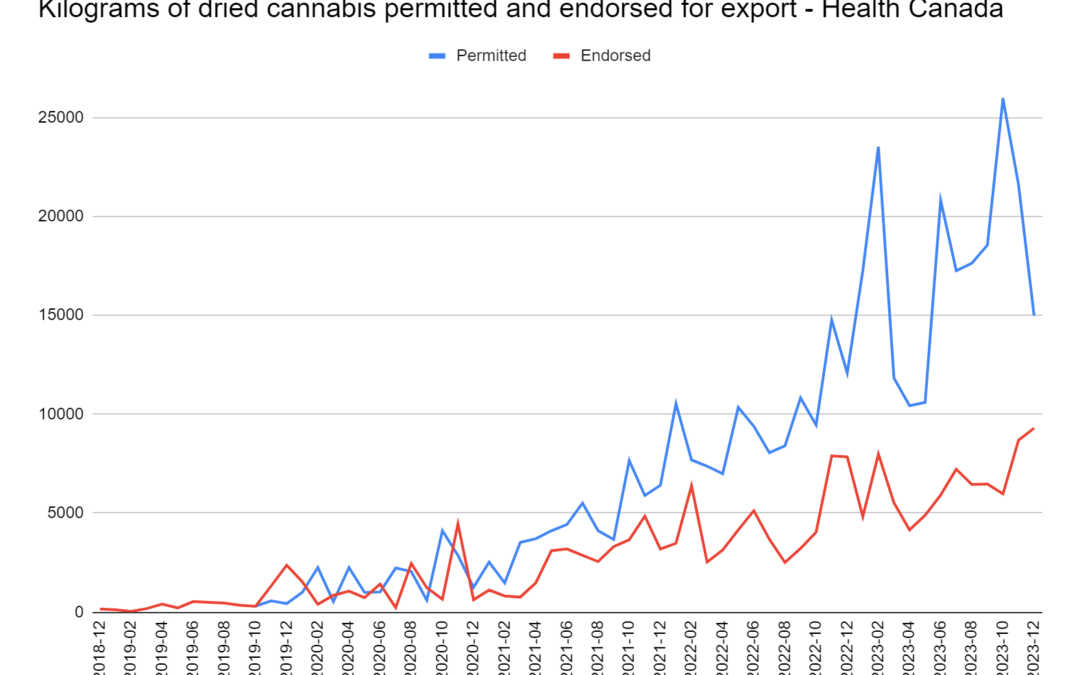
Data from Health Canada shows the amount of permitted and endorsed, or actual cannabis, that left the country has trended upwards.
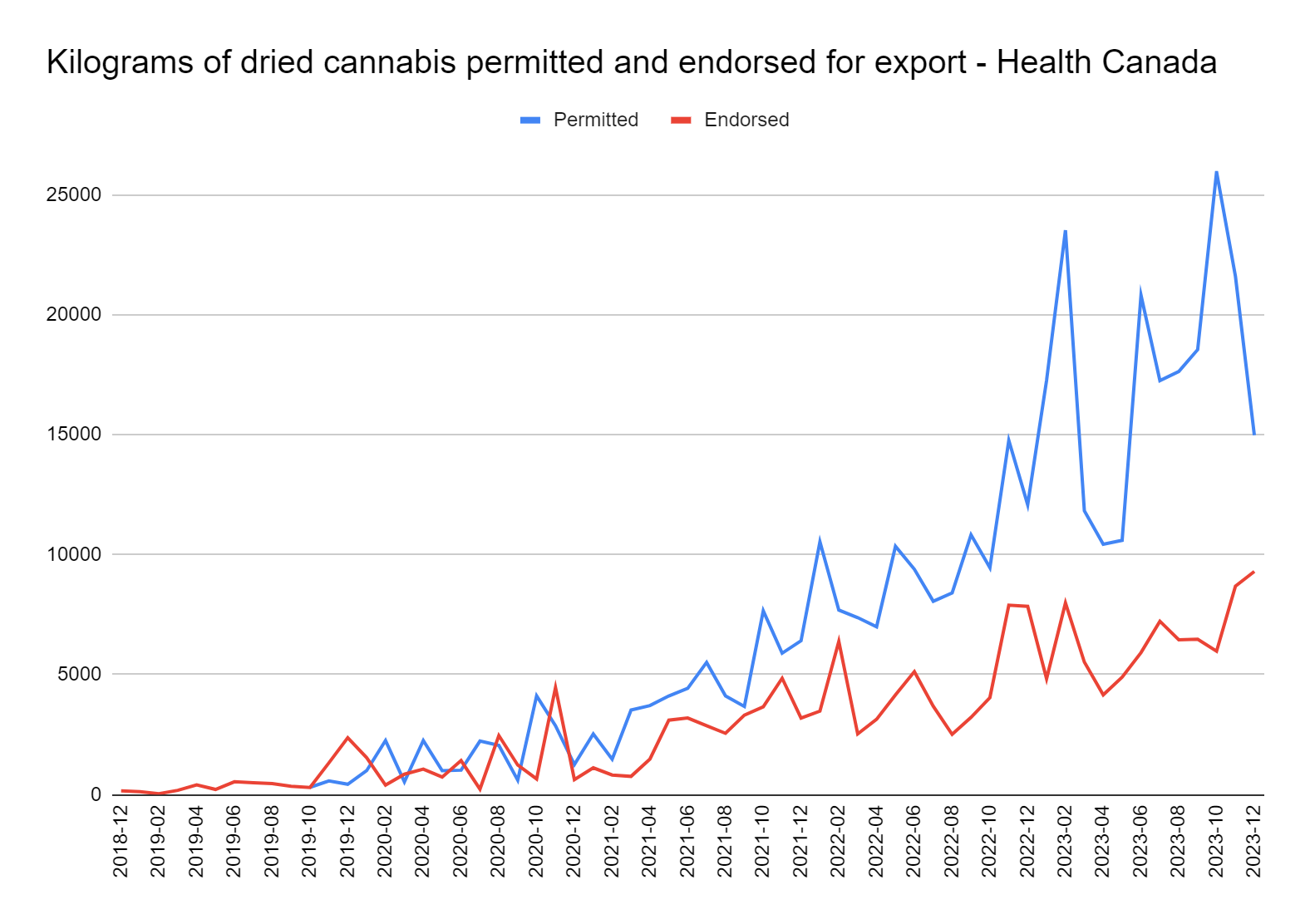
However, the number of permits and actual cannabis exported has dramatically fluctuated.
All the experts StratCann spoke with said those fluctuations were primarily due to ebbs and flows in scheduled shipments, and were not indicative of drop-offs and surges in demand.
But Ferouz pointed out that Australia changed its regulatory requirements for importing cannabis to the stricter GMP practices from GACP regulations as of July 1, 2023, forcing Canadian exporters to pivot.
“I think that might have been part of the drop-off that you saw,” she said.
Israel launched an anti-dumping investigation into Canadian cannabis exporters on January 18, 2024, and specifically addressed ten different Canadian cannabis producers.
Experts said they hadn’t seen any impacts on exports from the investigation and were divided on whether or not dumping was a market-wide issue.
“I have had many Australian clients complain to me that they’re getting what they have called, in their words, ‘absolute garbage’ from Canada, product that’s clearly over a year old that someone has repackaged,” Ferouz said.
Large-volume licensed producers in Canada have a substantial amount of aging cannabis inventory, pointed out Abbott.

This allowed those companies to sell their product at a loss in an attempt to recuperate operating costs.
“The standards set by the government of Israel have allowed a more lenient approval for international producers when compared to countries such as Germany or New Zealand which require EU-GMP certification.”
Black and Mann said they were unaware of a dumping problem in the Canadian cannabis export market.
The surplus of cannabis in 2023 is now gone, Black said, and the dumping allegations may be tied to cannabis from Canada being cheaper.
“I don’t see any collusion or anything saying ‘we’re gonna dump all our bad stuff in Israel at bargain pricing’,” he noted.
Health Canada’s data also illustrates a substantial difference between the amount of cannabis permitted for export and the amount that ends up leaving the country.
In August 2022, the amount of cannabis permitted for export increased while the amount actually exported decreased, and in November 2023, the reverse happened.
Cannabis exporters will regularly acquire large numbers of permits ahead of expected shipments to enable seamless travel across borders, experts explained.
Exports of cannabis oil, on the other hand, hit their peak in November 2022 and have never recovered, Health Canada data shows.
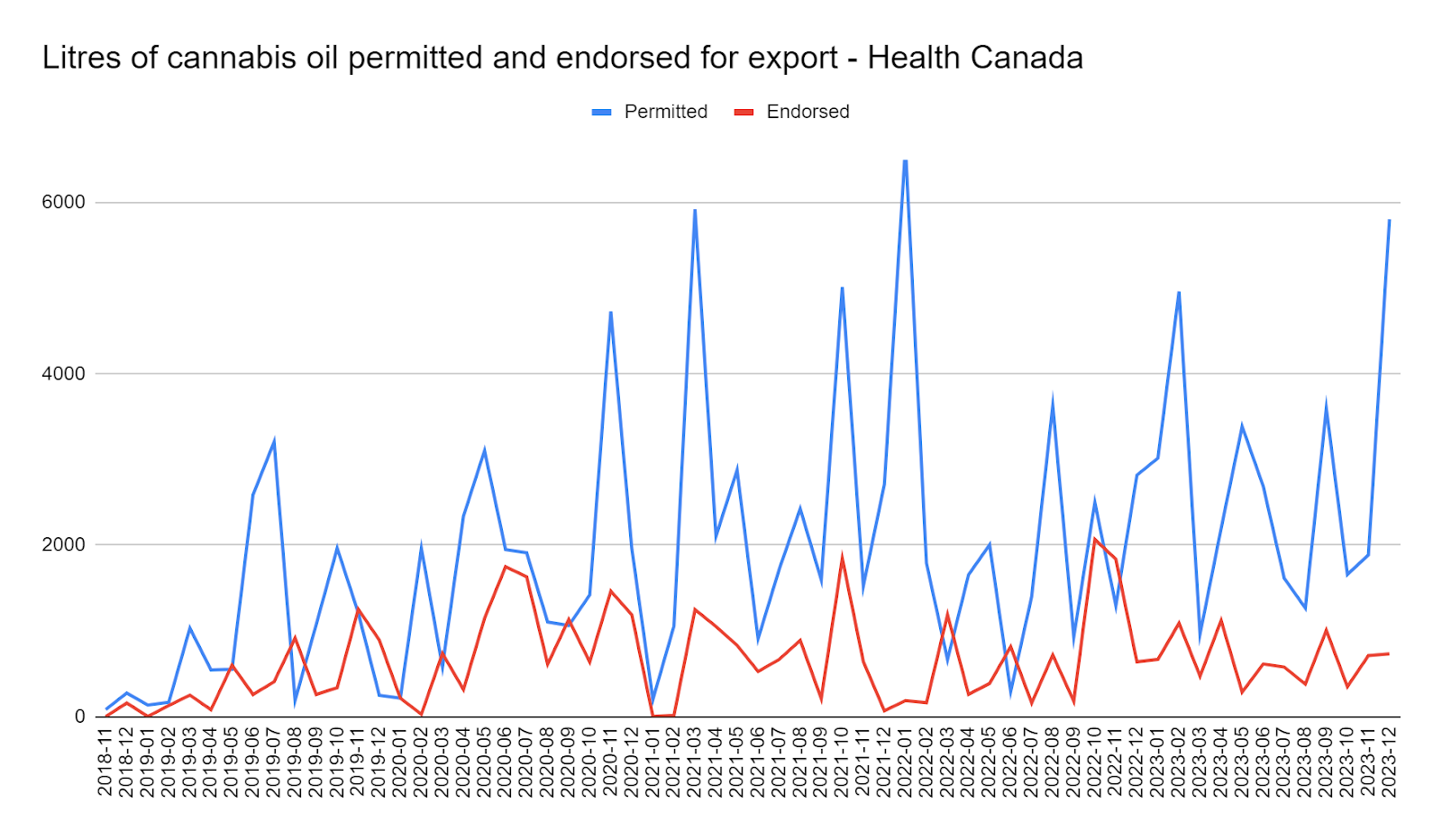
Cannabis oil exports have fluctuated since legalization and have not trended upward over time, unlike dried cannabis. This is because cannabis oil remains a lesser-known product outside of Canada, Abbott explained.

“It’s very niche when it comes to tinctures, especially low potency tinctures, it’s just been a very variable segment of the market for anybody who’s exporting.”
Ferouz agreed with Abbott, adding that not many facilities in Canada have GMP certification for oil.
Exporting cannabis is a lifeline for businesses seeking to avoid domestic excise taxes and sell higher degrees of volume due to lower international competition, experts agreed.
“For most Canadian cannabis companies to become profitable, or to maintain profitability, they need to be looking at the export market because of the ridiculous oversaturation in our domestic market,” Ferouz said.
Black pointed out that cheaper water and electricity in Canada, coupled with a more developed domestic market, gives domestic companies a leg up internationally.
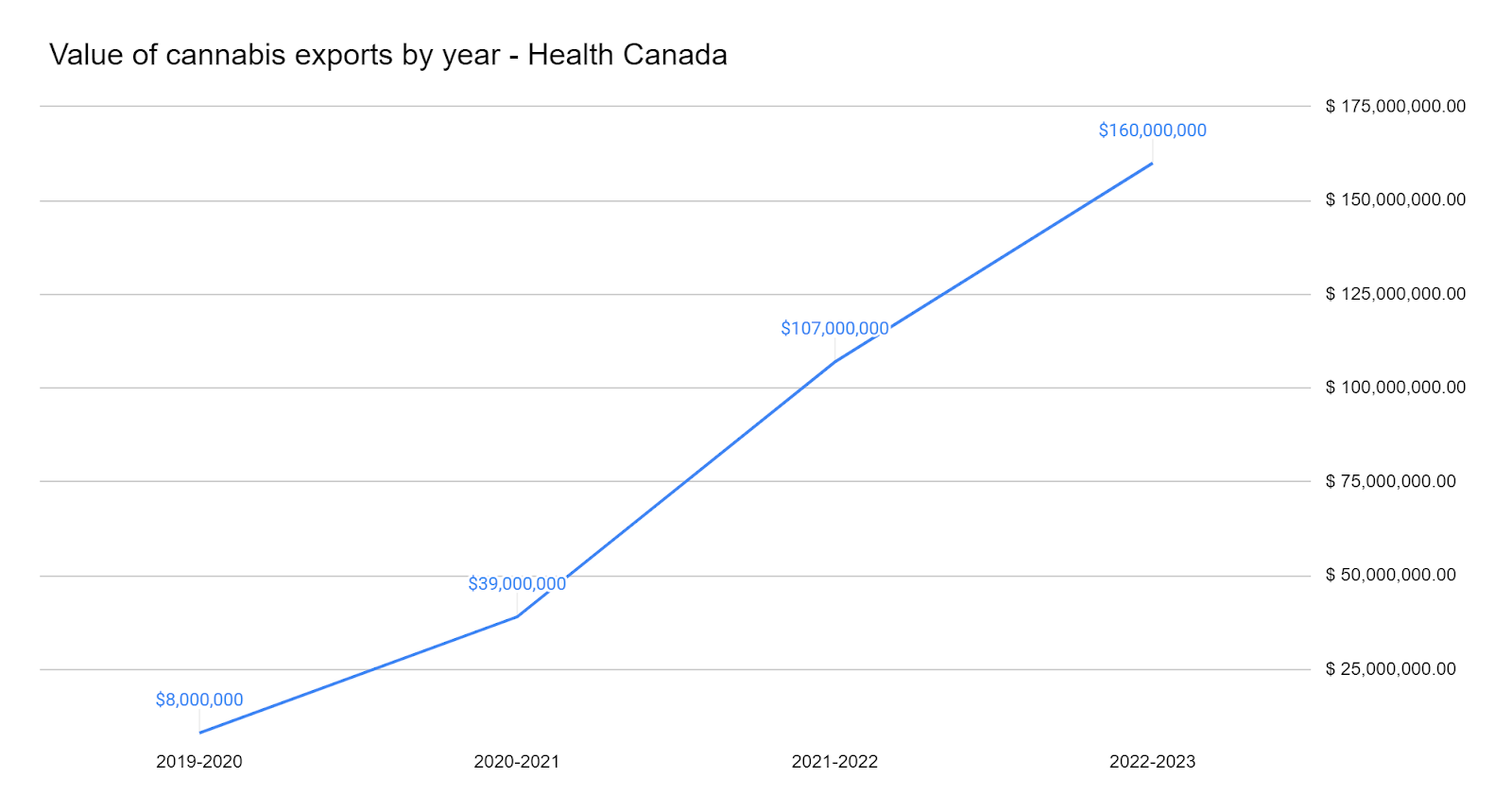
The value of cannabis exports has increased to $160 million in 2022-2023 from $8 million in 2019-2020, according to Health Canada.
Mann said the exporter relies on their import partners, partially because exported product can’t be brought back into the country. “It’s still very high risk, and things are changing rapidly in each of the countries that we’re able to export to now.”
~ William Koblensky Varela is a reporter, editor, and journalist

Reflections on the Cannabis Act Legislative Review’s Final Report, Part 2
Love for smaller businesses?
Following the Final Report’s release owners of smaller cannabis businesses have expressed gratitude that their pain is finally being acknowledged. The Panel admits that operators’ concerns are “well-founded” but before dancing ensues it would be wise to unpack the Panel’s priorities. Reading further, it’s clear that mostly minor measures to alleviate business’ concerns are advocated, so as not to challenge the “overarching public health and public safety objectives of the Act.”
In practice that means no major overhaul of federal taxes, even for smaller producers, since that could lead to lower wholesale and perhaps retail prices to boost consumer demand.
The declining viability of micros and other small businesses is raised, but only because the Panel worries they will return to the legacy sector while illicit operators pass on joining the legal market.
The Panel does point out that provincial distributors hold too much leverage under the current scheme but doesn’t mention that the federal government set up provincial authorities under the current framework. With that barn door open and substantial provincial profits the norm, good luck herding the provinces back in. The Report observes that distributors may not want to deal with larger numbers of small processors, or to add cultivators to the mix as the Panel further recommends. Micro-cultivators might also lack the capacity to meet Quality Assurance requirements needed to deal directly with provincial wholesalers.
Advertisement
Asking the provinces to review their fees, markups, purchasing policies and shelf space allocations are also noble suggestions, but since this is a federal exercise with limited influence over distributors’ operations, these changes won’t happen anytime soon.
A possible solution would be to allow direct marketing by growers and processors to consumers, in addition to on-site farmgate sales.
That option would likely require provincial support as well, but in the meantime expect buck passing between senior levels of government. The feds could decide that direct sales would violate public health goals by proving too stimulative. It’s possible that some provinces will extend their farmgate model to expand producers’ reach, but this will be confined to a few markets with B.C., Ontario, Saskatchewan and perhaps New Brunswick being the most likely to adopt such measures.
Modest administrative and regulatory streamlining is more likely to occur. The Report advocates pulling back unneeded site security measures, simplifying record keeping and reducing reporting requirements, all of which would be desirable but will not make a major difference.
What about social equity?
Unlike U.S. states that have legalized cannabis for adult use the Cannabis Act mostly excludes equity-promoting measures. The Expert Panel calls this a “missed opportunity to address the harms of prohibition,” and encourages participation of racialized and marginalized persons through pre- and post-licensing supports. The Panel calls for supports beyond cultivation and processing activities to include industrial hemp and ancillary cannabis businesses. It also asks Health Canada to consider whether it might waive its requirement for pre-built sites in licensing equity-deserving and small business applicants.
The Report cites two briefs submitted during the process which elaborate on what they may have in mind, which are worth reading for a sense of the ideas in play. I have reported previously on the Competition Bureau’s submission, but not on the brief by the Centre on Drug Policy Evaluation which presses the Panel to endorse not-for-profit business models as an equity pathway into the legal industry. These include member-based sales organizations such as co-ops and ‘compassion clubs’, potentially involving existing producers and ‘in-house’ LPs.
Criteria for participation would address “over-criminalized,” low-income and unrepresented groups, as well as persons from neighbourhoods or areas “disproportionately impacted” by drug laws. Proposed measures feature set targets for industry participation by specific groups, endorse waivers and reduced transactional fees and corporate income taxes, recommend grants and micro-loans, and priority processing of license applications for equity applicants. CDPE’s brief also mentions measures to influence more diverse governance and employment in existing companies, which would mean adding Diversity, Equity, and Inclusion (DEI) programs at firms.
Before jumping into this world with both feet, the government might think carefully about the impact such measures will have on cannabis businesses, especially those struggling to survive in the current market conditions.
The three case studies cited in the submission do not reflect a business perspective, nor detail the experiences of the 12 other states that have appended equity requirements to their cannabis regulations. For example, licensees could be obliged to develop impact and diversity plans and keep statistics on racial and demographic representation within the company for regular monitoring, perhaps reversing some of the red tape cutting benefits advocated in other sections of the Report.
It would be wise to observe how equity policies, many of which are still quite recent, play out in U.S. markets before introducing similar measures here. There is also the question of how relatable America’s history, including its War on Drugs is to Canada.
Medical Cannabis, harm reduction and research gaps
These topics are interrelated: it’s difficult to review the situation with medical issues and not hear about the lack of credible research. That observation applies whether one is looking for guidance on therapeutic uses of cannabis or seeking information on harms and ways to address them. The Panel heard much about the gaps including the limited clinical evidence and research funding, and constrained access which involves the difficulty of finding medical professionals to consult.
The panel recognizes the upending of the Medical Access Program resulting from the wide availability of recreational cannabis, which makes the product easier to buy and credible guidance more difficult to obtain.
Not discussed is the rampant stigma towards cannabis use within some parts of the public health system. For example, the Centre for Addiction and Mental Health posts information heavily slanted to an abolitionist perspective. According to current online guidelines on reducing health risks, CAMH states, “The only way to completely avoid these risks is by choosing not to use cannabis.”
Statements such as these are unhelpful to the 200,000+ registered medical patients who depend on cannabis for a range of reasons such as pain management, lessening dependence on opioids, relief from trauma symptoms, and dealing with the ill effects of cancer treatments. And despite the gaps, recent studies report many promising findings, such as the potential to reduce risk of developing type 2 diabetes, and evidence that cannabis may be used in future for treating fibromyalgia, autism, and skin disorders.
The Panel advocates maintaining and improving access for medical purposes and lays out a number of helpful recommendations including greater use of Good Manufacturing Practices (GMP) for cannabis products, enhanced medical access through pharmacies, increasing the involvement of nurse practitioners, and forming educational partnerships with health professions. Development of clinical guidance documents similar to those used by Israel’s national cannabis authority is offered as a strategy for informing medical practices across the country. The suggestion to have medicinal cannabis follow the same pathway as other drugs by obtaining Drug Identification Numbers for products would be a practical way to support the safety and effectiveness of cannabis medications, facilitate their sale and standardize the submission of insurance claims.
Cost of medicinal cannabis is cited as an access issue. It’s a major reason for the sharp decline in registered patients due to the lower prices of recreational products for those lacking insurance, with only 4 per cent of surveyed users reporting access to full or partial coverage. The good news is that patients say they want cannabis for medical purposes to be treated like prescription drugs, which are often covered by insurance or benefit programs and exempt from excise and sales taxes.
The Panel recommends that Finance Canada should re-examine the excise tax as it relates to medical cannabis, especially if access through pharmacies is to be implemented.
What the Panel thinks about the quality of research into cannabis harms is less clear. There is no shortage of issues worth further investigation with the uptick in child poisonings a chief concern. The report also mentions significant knowledge gaps relating to dosing, high-potency and novel products, mental health and substance abuse, effects on specific populations (e.g., First Nations, Inuit, Métis, and life-stage segments), the prevalence of cannabis use disorders, and the long-term impacts of legalization. The Panel notes that the Canadian Centre on Substance Use and Addiction (yes, the same folks that bequeathed the Guidelines on Low-Risk Alcohol Consumption) will be convening a session of experts later this year — something to watch carefully.
My sense is that medical access could be approaching a crossroads given the lack of available funds.
Researchers could focus on elaboration of harms and publishing alarmist guidance documents, as we’ve seen recently with beverage alcohol, or it could be used to discover new therapies and medical supports. My fear is that funding may be diverted more toward the harms side because that is a well-worn path for public money.
To its credit, the Panel recognizes the lack of clinical medical research during the past seven years and advocates more government funding for this purpose. A recommendation that could cut both ways is to establish a scientific advisory panel to consider the emerging evidence on THC for both medical purposes and health risks. There could be carrots for the cannabis industry on both sides: i.e., research as a focus for jointly addressing harms, and clinical studies to strengthen the case for cannabis’ use in medical practice. Progress in advancing both objectives is probably needed to move past the skepticism of conventional practitioners.
Photo: Adobe Stock
Where to from here?
That’s the $64,000 question.
It’s important to remember that the Final Report is advice to Health Canada. Yes, it’s the government’s lead department, but cannabis interests are also managed by the Department of Finance; Innovation, Science and Economic Development (ISED); Agriculture and Agri-Business and other agencies including the Privy Council Office and PMO.
Some industry commentators are overly optimistic about the likelihood of the Panel’s “observations” involving the provinces. These issues are not only outside Health Canada’s mandate but seem to downplay the different financial interests. The federal government has little leverage and perhaps less inclination to tackle the extra-jurisdictional issues raised given the greater urgency and political importance of housing and environmental policy, to name just two prominent files.
Speaking of environment, the Final Report barely touches on this area and provides one meek albeit needed recommendation — that government “establish indicators related to the environmental impacts of the cannabis industry, collect baseline data and … monitor [and report on] these indicators and their trends.” Apparently no presenters to the Panel’s review discussed environmental impacts apart from wasteful packaging. I suspect that’s because the government didn’t invite the right people to their listening exercise (there’s no mention of environment stakeholders in the engagement process).
However, there is data on the size of the cannabis industry’s carbon footprint (quite large) and much about the impact of energy costs on indoor growing in particular. That said, climate change represents an opportunity for greenhouse and outdoor growing in Canada, as well as an imperative to act.
The Report is largely silent on the role, contributions, and further prospects of Canada’s educational institutions. There are important links between scientific and medical research, mental health care, business education, horticulture, environmental management, and other fields with cannabis. Granted, education is not part of the Legislative Review’s terms of reference, but it is an important contributor to the economy, public health, and social development.
Depressed market conditions and the industry’s early-stage status may be understating the demand for skilled labour, but this was intended to be a forward-looking exercise. Perhaps this area deserves a more focused effort?
Two other federal departments may yet play a consequential role in future developments. One is Agriculture, which oversees the $3.5 billion Canadian Agricultural Partnership program in concert with the provinces. The government recognizes cannabis as an agricultural crop and a large number of programs across the country are open to cannabis businesses.
ISED is the second department that’s stepping forward. A month before the Legislative Review’s Final Report was released the Department announced it was establishing a Cannabis Industry Forum to provide advice to the government on the next steps for the industry.
While some have quibbled about its membership, the Forum provides an explicit business focus for policy and advocacy. If managed well, the Forum could facilitate more in-depth deliberation on issues such as competitiveness, technology, access to capital, trade promotion, labour market issues and help raise the industry’s profile in Cabinet.
My inquiries to ISED only revealed that the Forum “provides a platform to discuss the economic and business context of this sector” and an opportunity to better inform other arms of government.
Time will tell how effective this new government intervention turns out to be, but it’s a move in the right direction.
Another possible benefit of the industry forum is that it’s a development that might survive a change in government. It’s unlikely that all the Legislative Review’s final recommendations will be acted on, but the document marks a watershed in the early years of legalization to help inform what comes next.

Philosophy in Action: A Way of Becoming

Philosophy in Action: A Way of Becoming
By Gary Z. McGee
“To win true freedom you must be a slave to philosophy.” ~Seneca
What does it mean to be a slave to philosophy? It means surrendering yourself to inquiry. It means sacrificing answers for questions. It means allowing fate to drag you kicking and screaming into awe. It means giving up all hope for a “meaning to it all” and instead creating a deeper meaning of your own. It means forfeiting certainty.
Without philosophy we are slaves to our own fallible reasoning. Becoming a slave to philosophy is gaining mastery over what we think we know by not allowing our minds to settle. It keeps the open-ended question mark ahead of the dead-in-the-water period point. It keeps “I don’t know” ahead of “I know,” lest knowing become our end.
Here are seven philosophical dispositions that can move us from merely practicing philosophy to embodying philosophy.
1.) Philosophy should shatter illusions and demolish delusions:
“If it can be destroyed by the truth, it deserves to be destroyed by the truth.” ~PC Hodgell
Philosophy should always be in attack formation. It must always be moving forward. Once it settles into any given idea, belief, or ideal, it loses its philosophical edge. Once it stops questioning, it ceases to be philosophy.
Philosophy is a battering ram, or it is nothing. If it’s not toppling thrones, it’s merely a footstool for the king. Philosophy must never become a footstool. It must never become a crutch. Once it does, it ceases to be philosophy and devolves into religion.
“The king” should fear philosophy, or philosophy isn’t doing its job. Reason should always be worried that imagination will outmaneuver it. Power should always be on its heels before the greater power of humor. God should tremble before man’s mighty question mark sword lest we forget that God was created in our image.
2.) Philosophy should keep courage ahead of comfort:
“As fire is the test of gold, adversity is the test of men.” ~Seneca
Philosophy in action is always in the throes of stretching comfort zones. No safe place is off limits. Philosophers of action understand that comfort zones are good for regrouping after a setback, or for licking wounds, but they are eventually a hindrance to philosophy.
When you become too comfortable you become complacent. You become stagnant in mind, body, and soul. Your inquisitive mind begins to atrophy. Your muscle memory fades. There’s a tendency to fall back on what you’ve learned. You begin to make excuses: “I’m content.” “I’m tired.” “I’ve done enough.”
Great philosophers nip this in the bud early on. They don’t allow their ideas to take root. They dig them up and move them into the next iteration. They stretch their comfort zone until it snaps, allowing the unknown to challenge what’s known. They do it with gusto and aplomb, for many reasons, but mostly to guarantee they don’t become stuck, deluded, trapped, or dogmatic.
3.) Philosophy should choose dangerous questions over safe answers:
“The secret of reaping the greatest fruitfulness and the greatest enjoyment from life is to live dangerously.” ~Nietzsche
Rule number one for the philosopher of action: Don’t settle on answers, ask unsettling questions. Especially regarding the Self.
A philosopher of action utilizes the tool of self-interrogation to the nth degree. It’s the most effective way to get out of one’s own way. It’s a method that aggressively asks mind-opening, heart-expanding, soul-shocking questions. It outmaneuvers cognitive dissonance by “entertaining a thought without accepting it (Aristotle).”
Philosophy in action is about destroying illusions and murdering delusions. It unsettles settled mindsets. It asks forbidden questions. It tests the untested. It put God’s feet to the fire. It’s about counting coup on outdatedness, reordering ancient order, and transforming boundaries into horizons. It pulls no punches. It hangs a scythe over all dyed-in-the-wool period points.
Asking difficult questions and challenging yourself will always be more important than receiving simple answers and pacifying yourself. As Ken Kesey said, “The need for mystery is greater than the need for an answer.”
4.) Philosophy should neither be restricted by tradition nor bounded by convention:
“Elevate yourself above the battlefield.” ~Robert Greene
Philosophy is about taking risks, turning tables, flipping scripts, pushing envelopes, and kicking open third eyes. It questions comfort despite the tiny-hearted. It questions power despite authority. It challenges all Gods.
A philosopher of action is restricted by nothing. Unfettered, he is free to defy. Equal parts firebrand and fountainhead, the world is put on notice. Everything is put on blast. Nothing is off limits. Everything is put under the blade of his pen.
Religions dissolve. Politics fall apart. Ideologies implode. Philosophy itself is taken aback. A philosopher in action is a tempest, a force of nature first, a person second. He is the eye of the storm, and everything is caught in his spinning unforgiving vortex and found wanting.
5.) Philosophy should be Dionysian in nature:
“These poor creatures have no idea how blighted and ghostly this so called ‘sanity’ of theirs sounds when the glowing life of a Dionysian reveler thunders past them.” ~Nietzsche
Under the blinding sun of the Apollonian ideal, a Dionysian philosopher of action is a much-needed eclipse. He’s a beacon of darkness that gives us creative hope despite artless belief. He’s a primal upheaval, an animal frenzy of passion, frivolity, and lightheartedness in the face of over-domestication, apathy, and hardheartedness. He’s the liberation of instinct and insight. He’s the personification of transforming boundaries into horizons.
He dances through the mannequin culture. He thunders past the status quo junkies. He flies high above the steel walls of the Apollonian labyrinth. He sees how Goliath has become an idol, a golden cow, a parasitic icon which has blinded the people of the world from the knowledge of their own imagination and courage.
Foremost, the Dionysian Philosopher of Action is a courage-enforcer, a mettle sharpener, a lion-awakener. Far too long has the culture lived a fear-based lifestyle under the comforting gaze of the Apollonian Goliath. It’s time to cultivate a courage-based lifestyle. It’s time to get mad and wrestle the gods. It’s time to balance the scales, to melt down the golden pedestals of idolatry, to burn down all the uppity high horses, to upset all the parochial apple carts, and to un-wash the brainwash from the minds of thinking men.
6.) Philosophy should stay as close to the edge as possible without going over:
“Failure is the information you need to get where you’re going.” ~Rick Rubin
The philosopher of action is proactive about staying ahead of the curve. He does so by keeping curiosity ahead of certainty. Curiosity gives him his edge. It keeps him ahead of the game. While everyone else is falling all over themselves in the myopic one-upmanship of petty finite games, he’s playing James P. Carse’s Infinite Game.
Curiosity is a philosopher of action’s guiding light in the dark. It’s his beacon of darkness in the blinding light. Why? Because curiosity keeps him on the edge of life. It’s the tip of the spear. It is foremost, utmost, supreme. It is always cutting, despite the world’s attempts at dulling its mettle.
The philosopher of action uses his curiosity like a razor-sharp question mark in the dark. He harnesses its trailblazer essence. He channels its catalyzing synergy. He recalibrates the universe with it. He discovers the cheat codes hidden in the storm. Despite the slings and arrows of vicissitude, despite the worst that life can dish out, despite fear, his unconquerable curiosity keeps him ahead of the curve.
7.) Philosophy should seek power over power:
“The comfortable life lowers man’s resistance, so that he sinks into an unheroic sloth.” ~Colin Wilson
A philosopher of action never sinks into an unheroic sloth. He goes full-frontal boss mode into the adventure of “not knowing as much as he thinks he knows.” He grabs the gods by the throat and forces them to reveal their deepest secrets. He gets power over power through the greater power of a good sense of humor.
A good sense of humor is a philosopher’s saving grace. It keeps him humble yet fierce. Hungry yet grounded. Lighthearted yet lionhearted. Laughing yet laughable. With it he bridges the gap between himself and God.
If, as Jung said, “the main function of religion (finite) is to protect people against a direct experience of God (infinite),” then philosophy’s main function is to drag people kicking and screaming out of religion and into a direct experience with God, with Infinity, with the bare-bones horror of reality in all its existential glory.
Philosophy in action doesn’t balk. It’s autonomous. It’s Contrarian. It’s trailblazing. It creates worlds between worlds that questions all worlds. It gives us the latitude to make mistakes. To create, destroy, and recreate God. It gives us the power to pivot. To interrogate rather than gravitate. To meditate rather than deify. It chooses risk-taking over script-making. It doesn’t settle, it meddles. It mixes it up. It kicks up the dust and knocks off the dross. It chooses improvisation over tradition. It transcends the comfort/discomfort dynamic through sincere nonattachment.
Philosophy in action is a way of becoming an Overman in a world of ordinary men.
Image source: Infinity Sky by Julian Majin
About the Author:
Gary Z McGee, a former Navy Intelligence Specialist turned philosopher, is the author of Birthday Suit of God and The Looking Glass Man. His works are inspired by the great philosophers of the ages and his wide-awake view of the modern world.
This article (Philosophy in Action: A Way of Becoming) was originally created and published by Self-inflicted Philosophy and is printed here under a Creative Commons license with attribution to Gary Z McGee and self-inflictedphilosophy.com. It may be re-posted freely with proper attribution, author bio, and this statement of copyright.

Androgycrats
Androgycrats
Part 2: Weaponizing weak and perverted men
through corruption, conformity, blackmail, and submission
Androgynopolis
The world needs bad men. We keep the other bad men from the door. — Rust Cohle The men of yesterday are never coming back. The transhuman agenda is not just one of species alteration at the DNA level, and iatrogenocide carnage at the reproductive level, it comprises a distinctive component of demolition through gender confusion and sex-specific trait dest…
Read full story
Greek ἀνδρόγῠνος (andrógunos), from ἀνήρ (anḗr, “man”) + γῠνή (gunḗ, “woman”)
Note: This longer-than-normal sequel was going to be divided into a third part, but it works better as one.
Pain In the Brain
A recent study made headlines worldwide proclaiming that men’s and women’s brains work differently, just as honest psychologists and thoughtful wives and husbands suspected, for however long it has been since our species was bred here on earth. This was supposedly a “first-time” scientific discovery that perhaps shocked only those incapable of using theirs.
The study found that Artificial Intelligence can now distinguish male and female brain patterns and thoughts with 90% accuracy. The sex chromosomes we are born with help to determine the cocktail of hormones our brains are exposed to, particularly during early development, puberty, and aging. (Provided this exposure is not interrupted by demons posing as gender transition doctors and therapists who exploit mentally ill mothers with a penchant for child abuse)
Researchers have long struggled to connect sex to concrete differences in the human brain. That the technological capabilities to study these differences coincided with the ascension of militant feminism and a socially engineered war of the sexes didn’t help matters. Political correctness and self-censorship in the academy may have prevented certain impermissible topics from important inquiry, foremost among these are race and sex differences, where taboos illicit an absence of both curiosity and funding.
The neuroscience community had largely considered any observed sex-associated differences in cognition and behavior in humans to be due to the effects of cultural influences. Researchers who did venture down this path grappled with charges of “neurosexism,” or falling prey to embracing stereotypes or being too quick to interpret human sex differences as biological rather than what they absolutely must be without questioning—cultural.
Cultures are malleable. Societies can be reengineered. Biology not so much.
In a world of academic activists, the latter must be denied.
Advances in brain imaging technology showed decades ago profound evidence of neurobiological differences. Still, sociologists and psychologists refused to accept the evidence, preferring to feel smug in their denunciations of any research findings that challenged their political bias, while leveling accusations of bias and prejudice against their more courageous colleagues for daring any scientific undertaking.
Every few years the screeching of feminists against this subject comes in the form of an activist book by academic “scholars.” The most recent iteration by British feminist neurologist (oxymoron?) Gina Rippon seeks to muddy the waters around conclusive research findings. Her book The Gendered Brain follows Angela Saini’s 2017 Inferior and Cordelia Fine’s 2010 Delusions of Gender in the latest faux-academic category of “neurosexism” which has obfuscated attempts to understand sex differences at the brain level.
It has all the cherry-picked wahhmen-as-victim-of-the-patriarchy slants to politically appeal to a feminist audience. Rippon begins with an 1895 quote from social psychologist Gustave Le Bon, who used his portable cephalometer to declare that women “represent the most inferior forms of human evolution.” She even taps Google engineer James Damore who privately shared with co-workers the psycho-biological roots for the absence of women in tech and leadership roles. You might recall that sharing these milquetoast and widely-accepted psychological and biological facts cost Damore his job.
What do these female activist authors have in common?
They aim to blame society and culture for established neuro-biological gender differences and set out to distort sex, gender, and the biological roots of these differences as the product of “bad research,” the fault of continued “stereotypes” in our “sexist society,” which engenders…“neurosexism.”
In other words, any findings by researchers must be the product of neurosexism and not scientific discovery. And those who set out to research this politically fraught topic had better watch out, lest they want to be accused by pseudoscientist feminist activists as “neurosexist!”
If we could simply reengineer society in such a way that Good Citizens don’t notice any gender differences at all then we could all live in one brave new genderless utopia. Right?

Research into the psychological and behavioral differences between males and females provides a foundation for understanding how sex may influence certain traits, based on empirical studies that highlight average differences. These findings offer insights without suggesting “neurosexist” judgments about the behaviors or capabilities of either sex. The key point to remember when reading this compilation is not to make it personal as either a man or woman or assume personal anecdotal evidence disproves these “average differences.”

(References & studies at the end.)
Neuroscience research reveals that the human brain exhibits sex-based anatomical and functional differences. For instance, adjusted for brain size, females’ hippocampi, critical for learning and memory, are larger and function differently than those of males, whose amygdalas, crucial for emotion processing and memory, are larger and also function distinctively.
Studies, including a brain scan experiment of individuals viewing emotional content, showed sex-dependent activity in the amygdala, critical for emotional memory, highlighting implications for mental health issues such as depression and anxiety, which are more common in women while ASD and schizophrenia are more common in boys and men.
The two hemispheres of women’s brains communicate more than men’s, while male activity is more coordinated into local regions emphasizing the necessity of integrating sex differences in neurological research to better understand and treat psychological disorders. These and other neuro-biological differences also explain social and behavioral differences.
Men exhibit higher levels of physical aggression than women, though mostly toward other men. Women are more prone to passive-aggressive behavior, toward both men and women, the latter who instigate competitive desires which can manifest through “shade” formerly known as “gossip.” This difference in aggression and passive-aggression is attributed to both biological influences, such as hormonal factors, and socialization process preferences.
In terms of risk-taking, men show a greater propensity for engaging in behaviors with potential negative outcomes. A meta-analysis by Byrnes et al. (1999) and research by Harris, Jenkins, and Glaser (2006) confirm men’s higher likelihood to take physical and financial risks, linked to evolutionary and social factors, including competitiveness as a motivator for mate attraction.
Men’s hyper-competitiveness, both physically and financially, is deeply rooted in psychobiological factors that are tied to evolutionary pressures. Historically, physical prowess was essential for male competition over resources and mates. In modern sedentary societies, while the physical aspect of competition has diminished, financial competition has emerged as a critical replacement, often reflecting an individual’s ability to accumulate resources and secure a higher social status. This aligns with the concept of hypergamy, or the female preference for partners of higher socioeconomic status, a strategy that maximizes reproductive success and stability.
According to Buss and Schmitt’s Sexual Strategies Theory (1993), men adapt their competitive strategies to meet female mate preferences, which historically favor resource-rich or high-status males capable of supporting offspring.
From an anecdotal ethnographic perspective how many “tech bros” are physically soft, even displaying effeminate traits who have no interest in physical dominance or even self-improvement but have amassed enough riches to have their pick of attractive females who otherwise would never give them the time of day?


Good Citizen
2010: Mining bitcoin from your double wide.
2024:

Women report and exhibit higher levels of emotional expressivity, especially regarding sadness, fear, and empathy. Women also express a broader range of emotions more freely and have a heightened ability to recognize and respond to others’ feelings. While these are important traits in understanding other humans’ health and well-being (even suffering), they may not be the most effective for decision-making in leadership roles.
Case Study Sidebar
Two decades of Sweden’s feminist governing policies destroyed that country. By taking “refugee” empathy to the level of submission in signaling their tolerance for and cultural acceptance of foreign and unassimilable newcomers the demographics of Sweden have changed forever. Sweden is essentially gone. They’re just waiting for the sociocultural returns to come in over the next few decades. Imams in Malmö and Gothenburg openly boast that Sweden will be a Muslim-conquered nation within two generations. The effeminate men of certain political stripes (socialist-communist-liberal-green) and the cadre of feminists in local and national leadership roles were happy to surrender a nation once inhabited by savage Vikings.

This image of Swedish politicians in hijabs says everything. Imagine if Swedish Christian men asked Swedish women to be more chaste and modest in their attire and even to cover up their hair. There would be screeching accusations of misogyny and toxic masculinity perpetuating patriarchy that must be destroyed. They cannot logically see how they imported an actual patriarchic culture that they have already submitted to.
After two generations of replacing the native Swede with African and Arab-born “Swedes,” the native Swedish women are (mostly) happy to submit to a foreign culture that treats women as submissives. The irony of this double standard is lost on their feminist and socialist (libtarded) brains. The problem is much larger than women, or neurobiological sex differences, as historically a nation’s women are only as permissive as its men allow them to be. Worse still, a nation of people without morals, values, or convictions (God, country, family) can be manipulated to accept anything as a replacement.
Who else is behind the destruction of Sweden and other European nations? You’d better not notice Good Citizens, or you might lose your bank account.
End Case Study Sidebar
Communication styles also differ, with women using language more for social connection, while their conversational strategies often emphasize affiliation and support, contrasting with the more assertive, pointed, and independence-oriented communication observed in men.
Spatial abilities present an area where men typically outperform women, particularly in tasks requiring mental rotation and spatial navigation. Interest patterns between sexes show men gravitating more towards systems and things, while women prefer people and relational activities, as confirmed by Su, Rounds, and Armstrong (2009) and Lippa (1998). These distinctions are evident in educational and career choices affecting the distribution of sexes across fields, as mentioned by James Damore to his colleagues at Google.
Understanding the importance of empirical evidence in discussions about sex differences, helps us talk about them, rather than shy away from them for politically convenient reasons.
To sum up this entire non-debate, the differences in male and female brains are highly compatible and complementary when working together to optimize and extract each other’s strengths. In short, women’s brains are said to be wired for empathy and intuition, whereas male brains are more wired to be optimized for reason and action.
Weaponizing Weak Men

Elites at War with the People
Elites at War with the People
By Ramesh Thakur
An important takeaway from the last four years for many governments is the surprising ease of winning public compliance with demands for intrusive behavioural changes that completely reset the balance of rights and responsibilities between citizens, society, markets, and the government. Instead of implementing policies to give effect to voter priorities, the emboldened dominant metropolitan elites are entirely dedicated to the proposition that citizens should be forced to live by their rules on what to say, think, read, watch, do.
A telling indicator is the abandonment in practice of the long-standing principle of informed consent that was codified by the Food and Drug Administration (FDA) last December and came into effect in January.
[…]
Mass Immigration Contradicts Claims of Embedded Structural Racism
The West seems to be in decline economically, militarily, and as a moral inspiration for much of the rest of the world. With self-confidence sapped, its major political parties compete over which of them can be trusted to best manage the decline in order to ensure a soft landing, with slowly depleting wealth, falling standards of living, and global clout and influence shrinking.
[…]
Another indicator is the loss of control over border security. Mass inflow of peoples from diverse cultures with radically differing belief systems, values, and rights is not the best recipe for creating an integrated, harmonious, and cohesive new community – who knew? Instead, other than in countries like Japan that refused to go along with the mantra that uncontrolled ‘immigration and diversity’ are always an unqualified good, existing bonds of cohesion are breaking down with alarming speed and creating fresh security headaches.
Nearly nine million illegal migrants have swarmed across from Mexico into the US during Biden’s presidency. The biggest millstone around the Rishi Sunak government trapped in a political death spiral is the hundreds of thousands of legal and illegal migrants. Some 550,000 migrants came into Australia last year.
[…]
Climate and Trans Extremism
Holly Valance, the Australian-origin former Neighbours soap star, describes Greta Thunberg as a ‘demonic little gremlin high priestess of climatism’ who is treated ‘as a goddess in the classrooms despite contributing to the epidemic of ‘depression and anxiety’ in children.
Trans-activists are erasing the word woman even from motherhood and sexual assaults. Nurses are advised to use words like ‘birthing parents’ and ‘chestfeeding’ as substitutes for mothers and breastfeeding. Harry Potter series author JK Rowling has promised to keep calling transwomen ‘men’ and risk criminal conviction after a new Scottish law, that threatens to severely punish factually correct speech that violates legally correct definitions, came into effect on 1 April, appropriately enough. The linguistic gender madness of the crowds is spreading to esteemed medical journals that are banishing the ‘w’ word and associated language.
In Canada, a Supreme Court justice gratuitously reprimanded a lower court judge for using the word woman, in a sexual assault case no less, instead of a ‘person with vagina.’ That too with the explanation that the single word was confusing in comparison to the clarity of her own preferred phrase. Neither the complainant nor the accused in the case claimed to be transgender and gender identity and language was not an issue before the court. To cap it all, the decision came on International Women’s Day (8 March). I hope someone has forwarded Rowling’s mischievous tweet to the judge: ‘Happy Birthing Parent Day to all whose large gametes were fertilised resulting in small humans whose sex was assigned by doctors making mostly lucky guesses.’
Recording trans-identifying males as women in violent crime statistics, including rape and murder, will only distort and make a mockery of sex-specific statistics on violent crime. This was highlighted with the murder conviction of ‘Scarlet Blake,’ in February. He was recorded as a woman by the police in their official statistics even though sent to a male prison. The Women’s Rights Network pointedly asked: why accept his claim of being a woman against the clear biological evidence when, because of the evidence against him, you didn’t accept his protestations of innocence?
Such are the contradictions when legal fiction collides with the reality of male-female interactions in prisons. Because ‘deadnaming’ is criminalised, his pre-trans name cannot be published. Because the media lacks the courage to fight this en masse, the insanity is slowly but surely normalised.
New age feminists attack alleged male privileges but support men who claim to be women under the banal slogan ‘transwomen are women and trans rights are human rights.’ The push for more women in boardrooms, meant to redress gender imbalance, is subverted when transwomen are included in the female category in gender-specific lists of CEOs.
Cleanse your memory of the aggressive big trans bullies you see in action on the streets intimidating gender-realist critics. The ultimate emotional blackmail card of trans-terrorists is the threat of self-harm and suicide by vulnerable trans snowflakes. Watch any old Bollywood movie and you will quickly discover that the master of emotional blackmail as the tool of choice for ensuring compliance by adult children with parents’ wishes is the Indian family.
To be clear, I have nothing but sympathy for adults who feel genuinely trapped in the wrong body and are more comfortable with dress, appearance, and lifestyle choices better suited to their felt gender. But I draw the line at using trans identity to violate women’s hard-earned rights to dignity, privacy, and safety, from locker rooms and toilets to rape and domestic violence shelters, hospital wards, and prisons. Inclusion for trans should not become an alibi to enable abuse of women. Any gender equality law based on gender self-ID can be quickly corrupted into a predator’s charter that shreds women’s rights. Telling women to subordinate their safety worries to accommodate the wishes of biological males is old-fashioned misogyny.
Wokery and Net Zero Are Strategic Own Goals by the West
UK Business Secretary Kemi Badenoch is surely right to insist that quota-filling clumsy diversity drives are not a substitute for effective action to redress inequalities. Often, instead of unity and inclusion they produce division and alienation. Do Western elites have any real grasp of the mockery and ridicule in which they are held for their indulgence of race baiters and grifters and obsession with pronouns and rainbow flags? They present easy targets for the world’s autocrats to point to the dangers of activist-captured democracy. In a fiery address to the Valdai Discussion Club in Sochi in October 2021, President Vladimir Putin attacked teaching children ‘that a boy can become a girl and vice versa’ as monstrous and ‘on the verge of a crime against humanity.’ He stoutly rejected the demands of transgender rights supporters to end ‘basic things such as mother, father, family or gender differences.’
[…]
The democratic centre has been infiltrated and captured by the elite fringe. Just like those who spoke out against and refused to go along with the Covid narrative, many have been cancelled for calling out the madness of the metastasising wokery. They should take comfort and solace in the truth that by the enemies they make in resisting tyranny, they shall be known for their virtues of courage and integrity.
An even bigger threat to the West’s relative power is the singular determination to destroy its economies and transfer wealth to China through self-harm in the doomed pursuit of Net Zero. The alleged climate emergency has become the de facto battleground for strategic dominance carried out by other means. European manufacturers of solar panels are facing extinction because of the massive influx of Chinese products and the mix of incentives for electric vehicles (EVs). Extra levies on internal combustion engines (ICE) are subsidising China’s already dominant EV industry.
This is over and above the harsh reality that EVs make neither economic, environmental, nor energy security sense when all factors are taken into consideration over the full life cycle of a vehicle. If vehicle emissions were measured in the components and energy requirements in the total production cycle, energy mix in the grid, backup power requirements, impact of tyres and weight, and disposal after end of life, EVs would likely be banned for performing not too well.
The claim of 97 percent scientific consensus behind man-made global warming was always a confected furphy. The new Climate The Movie exposes this big lie with several credible experts questioning the science behind the rush to embrace Net Zero. Countries should look for the energy sweet spot between emissions, reliability, affordability, and collateral costs that lead to ruin. For two-three decades I’ve been hearing that renewables will make emissions-free power supply plentiful, reliable, and progressively cheaper. So far ‘lived’ experience is the exact opposite on all three counts.
[…]
Because of the fixation on CO2 emissions, market forces and consumer choice are not permitted to determine what people buy and what products businesses make and sell. Even conservative governments use state power to dictate production and consumer choices, from nuclear power to EVs. EV sales have been slowing and dealers’ stocks are not budging beyond fleet sales, with the first early signs of pushback even in the latter category. Hertz is cutting its losses and eliminating its EV fleet of hire vehicles. Manufacturers have put production on hold. Sales of hybrids have grown with no range and charging station anxiety.
Emulating the doomed heat pump mandate in the UK, President Joe Biden imposed a government fiat on consumer preference in the US with a sweeping crackdown on petrol cars. Half of all cars sold in the US by 2030 must be electric. Let’s wait and see how this holds up against the bumper sticker opposition ‘Biden is coming for your truck.’ On 21 March Audi issued a second recall of EVs sold in Australia owing to battery fire risk. British citizens have been awakened to the real-world impacts of the rush to embrace heat pumps and EVs. The perennially cash-strapped National Health Service prefers to spend half a billion pounds on switching to electric ambulances instead of hiring more frontline nurses.
[…]
As this shows, people are mobilising to fight back. The ‘Bud Light moment’ has entered marketing folklore as the perfect lesson of go woke, go broke. Hollywood and Disney are relearning that people watch movies and TV shows to be entertained and not to be lectured on moralism. Political activism by the entertainment industry cuts into profits. In the UK, when the BBC reprimanded Justin Webb, a longtime radio presenter, for saying ‘trans women, in other words males’, it caused an internal ‘meltdown’ among female staff who described his statement as fact.
In the US, 16 female athletes have launched a lawsuit against their professional association that allowed Lia Thomas to share a locker room and bathroom facilities with more than 300 women despite ‘full male genitalia.’ This exposed the athletes ‘to shock, humiliation, and embarrassment in violation of their constitutional right to bodily privacy.’ In Alaska, Patricia Silva confronted a man shaving in the women’s locker room, was banned from Planet Fitness gym for violating its policy of inclusive kindness, and posted on X that the gym would rather cancel her membership than protect young women and 12-year-old girls from ‘men with a penis.’
More generally, realisation is dawning across the West, but not yet in Australia, that routine prescription of puberty-blocking drugs to gender-confused young people is child abuse. England banned these for under-18s on 12 March.
[…]
Via https://brownstone.org/articles/elites-at-war-with-the-people/
Main Image by GrumpyBeere from Pixabay

Climate The Movie (The Cold Truth)
Climate The Movie (The Cold Truth)
By Julian Rose
We are rapidly waking up to the massive scam that promotes global warming/climate change as ‘doomsday scenario par excellence’.
In this film (see link below) is a succinct and powerfully presented series of exposes by scientists and climatologists coming clean about the real truth behind the global warming invention.
Highly recommended viewing for all in need of material that can be shared with others needing to be brought up to speed on this vital issue.
Climate Change/Global Warming is the scare tool being used to completely capsize the world economy, destroy agriculture and act as a supposed critical ‘health hazard’ to the global population.
The World Health Organisation has the audacity to claim that it is in a position to also rule on climate issues. So its ‘Pandemic Treaty’, if approved by The World Health Assembly this May 2024, looks like being the basis for placing both climate change and world health under its United Nations/World Economic Forum backed despotic mantle.
Let us be in no doubt that the depopulation agenda is at the forefront of these maneuvers.
Covid, Climate and Health Care are now all weaponised by the elite Big Finance cult that pulls the strings of puppet political chiefs, non governmental organisations (NGO’s) and all operatives that toe the line of the top down status quo.
I would wish that those speaking on this film had had the courage to raise their voices before their retirement. This is where true whistle blowers really come into their own. It takes courage.
Climate The Movie (The Cold Truth) https://vimeo.com/924719370
[embedded content]

https://cultivateelevate.com/antioxidant-trio-6mix-dragons-blood-pearl-powder/?ref=2bfG3v4vqhqnIp

Week in Weed – April 13, 2024
This week in cannabis news, StratCann reported on Ontario’s AGCO issuing a $200,000 fine for “data deals” to a cannabis retail chain. At the same time, the OCS says they are already seeing a decline in high THC cannabis flower following the announcement of their internal testing program in January.
In BC, Surrey will finally begin accepting applications for cannabis stores, while the BC Budtenders Union added new members.
Quebec’s ban on cannabis vapes doesn’t appear to be keeping residents from using them.
Diteba Laboratories Inc. filed a notice of intent, and Tilray shared their most recent financial report.
In other cannabis news…
Business in Vancouver’s Daisy Xiong spoke with Deepak Anand from ASDA Consultancy Services, Julia Cameron from Pure Sunfarms, and Kirk Tousaw from Great Gardener about the recent Cannabis Act report.
Xiong also ran a story on BC cannabis exports, speaking again with Deepak Anand, as well as Paul Furfaro from Village Farms International Inc. (Pure Sunfarms parent company), and Philip Campbell of Herbal Dispatch.
CBC’s Terry Roberts spoke with Brian Keating about the recently closed Argentia Gold, Chris Crosbie from Atlantic Cultivation, and Bruce Keating from the NLC about the challenges facing the local cannabis industry. Retail cannabis sales in Newfoundland and Labrador will be near $90 million for the 2023-24 fiscal year, says the latter Keating.
CBC also ran a story on the challenges facing the medical cannabis sector in Canada. The article includes comments from Erin Prosk of Quebec’s Santé Cannabis, Dr. Mary-Ann Fitzcharles, a spokesperson for the Canadian Medical Association, and a rheumatologist and a pain medicine physician at Montreal’s McGill University.
A study was released last week looking at the demographic and health-and medical cannabis-related factors associated with authorization as well as the differences in medical cannabis use, side effects, and sources of medical cannabis and information by authorization status in Canada. The study involved input from several well-known names in Canadian cannabis, such as Lynda Balneaves, Ashleigh Brown, Matthew Green, Erin Prosk, Lucile Rapin, Max Monahan-Ellison, Eva McMillan, Jonathan Zaid, Michael Dworkind, and Cody Z. Watling.
A master’s student in biochemistry and medical genetics at the University of Manitoba won a competition for her work looking at the epigenetic changes induced by prenatal cannabis smoke exposure.
BC’s Avant Brands launched a $3.88 million non-brokered private placement offering.
Decibel Cannabis Company Inc. announced Benjamin Sze as its new CEO, effective April 8, 2024. Sze previously served as the CEO of Decibel before resigning in late 2020. Former CEO Paul Wilson will be assisting Mr. Sze in handing off leadership of the Company.
Decibel’s sale of Prairie Records to Fire & Flower also closed last week.
High Tide Inc. announced a transition to a new CFO effective May 1, 2024.
SNDL CEO Zach George and CFO Alberto Paredero will participate in several upcoming investor and cannabis conferences, including the International Cannabis Business Conference (ICBC) in Berlin and the Benzinga Cannabis Capital Conference in Miami this month.
Following an NOI filed by Hempsana Inc., the Ontario Superior Court of Justice recently issued an order extending the time within which the Company is to make a proposal to May 24, 2024. Hempsana is a licensed manufacturer of cannabinoid derivative products specializing in extraction, purification, and end-product manufacturing. It owns and operates an 8,880 sq. ft. extraction facility in Goderich, Ontario.
Finally, ABC News in Australia reports that data from Australia’s Therapeutic Goods Administration shows there have been six reported cases of people having adverse reactions to prescribed cannabis since 2019, and two of those cases involved Canadian products.

In the Name of God
In the Name of God
“God is a concept, by which we measure our pain.”
In the Beginning
We profess to know the origins of humanity from ancient civilizations based on history and science. Yet, we fail to understand beyond academia. The proof to confirm this statement is in our behavior and existence, particularly with each other, nature and the universe. Centuries ago, a group of men conspired to write a book that would ultimately dictate to billions of people doctrines for righteousness. Though for many, it is an egocentric endeavor.
Many books have been written for this purpose. However, through the generational imposition of religion, it has become the standard. The Bible does not cause animosity, debate, prejudice and war. It is those who use it as a control mechanism to proliferate the supremacy of their tradition. Much like democracy, the vision of religion is sound, yet its reality has been nothing short of a nightmare. So too is our belief in a singular God.
“I don’t believe in magic.”

Sleight of Singularity
Nothing is one dimensional. The universe is an expression of omnidimensionality. However, humanity clings to existential singularity for comfort, familiarity, knowledge and relativity. When perceived through the socially institutionalized mind, it occurs as a linear timeline; quantified within a three-dimensional domain and often viewed through a filter of duality. In this microcosmic paradigm, it is much easier to influence, manipulate and regulate the masses.
Before the organized control structures of the marketplace, politics and religion, early civilizations had a strong relativity with themselves, each other, nature and the universe. Understanding existed before knowledge, mysticism before dogma and universality before reality. When intelligence superseded the soul, men invented patriarchal singularity, thus diminishing the natural power of the feminine. This matrix is rooted in our minds.

“I don’t believe in the Bible.”
Middlemen of Ministry
Religion spread like a virus across the world, guilting its followers with fire and brimstone and securing the segregation of civilization. The people gathered in congregations, eagerly offering their loyalty, money and prayers. They sacrificed their universal power on the altar of dogma with their blind faith, obedience and spiritual oblivion. The cross stood as an obligatory symbol of enslavement to a vengeful God, enforced by middlemen of ministry.
To follow is societal. To lead is tyrannical. To be is universal. Much is made of leadership in society. Yet, when observed with veracity, its contemporary expression is dictatorship. Most would opt to obey, as it appears to be the easiest path, considering the callous conditions of social reality. Our evasion and renunciation of accountability, integrity and responsibility emboldens the middlemen of ministry; enabled by our fear, insecurity and oblivion.
“I don’t believe in Jesus.”
 Pope Francis raises the Book of the Gospels as he celebrates Mass marking the feast of the Epiphany in St. Peter’s Basilica at the Vatican Jan. 6, 2020. (CNS photo/Paul Haring) See POPE-EPIPHANY Jan. 6, 2020. ” data-medium-file=”https://growupconference.com/wp-content/uploads/itng-iv-2.jpg” data-large-file=”https://iamsaums.com/wp-content/uploads/2024/04/itng-iv.jpg?w=676″ data-id=”6344″>
The Con of Belief
When we believe in something, it does not make it real. No matter how attentively we direct our intention, it often fails to exist in a beneficial way; personally, socially or universally. In essence, belief is a spiritual magic trick to separate us from our soul. Social reality is designed to draw us away from ourselves. It seizes our focus by siphoning our energy into our external environment, causing our spiritual deficiency, upon which the ministry preys.
The imposition of religion coerces us into the obligatory slavery of our soul. The church weaponized the crucifixion to control, guilt, manipulate and condemn its disciples to a sentence of virtual salvation. Religious persecution awaits anyone who dares challenge the Word of God, with all the fire and brimstone its ministers can muster. The con of belief enforces the Will of God as an agenda of imaginary faith in a vain exhibition of righteousness.

“I don’t believe in mantra.”
Congregational Dependence
Any organization exercising coercion, dogma or obligation as its stratagem is a cult. This is certainly not exclusive to religion. We can observe Cabals in the domains of business, media, politics, sports and science. We justify our indoctrination by convincing ourselves it is for our benefit, growth, profit, success or survival, all the while strengthening our enslavement to social reality. Orthodoxy is our dependency upon the simulation of society.
The con is often the same. One or a few leaders preside over the congregation. What is absent is mutual trust. One the individual person has with themselves, and the one the leader empowers upon their devotee to envision and create their own path. However, this dynamic becomes toxic when driven by the egocentricity of the leader. Yet, as much as the minister enforces their doctrine, the believer enables their spiritual slavery with their engagement.
“I don’t believe in kings.”

The Greatest Transgression
Many of the sins admonished by the middlemen of ministry are not as offensive as their blatant disregard for their own doctrine. For centuries, religions have abused, chastised, demonized, exiled, imprisoned, persecuted and executed millions in the Name of God. They built armies, decimated cultures, destroyed nature and propagated fear to turn the people against each other and themselves. All for the purpose of preserving their religious racket to control the theology of the world.
Religion is a vicious cycle of sin, provoked and punished to segregate the people from their soul. First, with an illustration of guilt when the disciple is shown the evil of their existence. Second, an imposed obligation they must accept to remedy their wicked behavior. Third, a feigned lifestyle of righteousness, to which they must aspire, yet will never fulfill. Fourth, the sacrifice of their soul to a manmade God for passage into “Heaven.”

“I just believe in me.”
In the Name of God
“God” is a commercial institution, blasphemed most by those who consider themselves “holy.” We acquiesce our personal power to evade our accountability, integrity and responsibility as a universal being. We even sacrifice our humanity to an imaginary divinity with our dependency on social conformity, popularity and vanity. Religion is a vicious cycle of emulation that oppresses our discovery, empowerment and expression of universality.
We are everything, and we are nothing. All we sense about ourselves is an illusion, as is the social reality in which we engage. It is our habitual belief in authoritarian deceptions which enables our social enslavement. The greatest revelation we will ever experience occurs when we awaken from the religion of reality. We have all been proselytized into a lie, invented by the few to enslave the many, all in the Name of God.
“The dream is over.”
(All quotes taken from the song “God” by John Lennon.)
[embedded content]
https://cultivateelevate.com/antioxidant-trio-6mix-dragons-blood-pearl-powder/?ref=2bfG3v4vqhqnIp
Recent Comments