The greatest get out clause in the game; “I never asked to be born”.
“I never asked for any of this”. But, in shamanic terms the understanding is precisely that; you agreed to enter the world. The suffering you experience now is the price you pay for being born. That’s exactly the deal! That’s Karma….. Would you rather be dead…. ?
No, we have an instinct for survival and that is our primary drive. When we entered the world we also agree on a contract to live according to a set of directives and principles. Our drive and will to survive are evidence of our desire to be able to keep this contract. This is the entire concept. We agree to fulfil our purpose. But what is the purpose? Plainly it is our soul.
The concept of soul in shamanism is more complex than in other religions. In shamanic thought, the soul can be multi-faceted. An individual depending on their character, nature and potential, can possess or manifest multiple aspects of themselves; others only one. It is possible for the soul to migrate to the underworld prematurely, this is soul loss. In this instance, the shaman can be called upon to attempt to recover or retrieve the soul of the person from the netherworld by carrying out a journey there and calling them by their name. The soul is complex and gives rise to our own complexity.
The nature of the body-soul is that it is on a journey, with a distinct birth and death, the passage of our lives from beginning to end. On life’s journey you will be called to make many decisions. The nature of reality, is that all things are destined to be. But in the sense of our free will, with limited foresight, we make choices as to how we are going to deal with these instances of our existence. If we deal honourably, kindly, with these questions, giving the answers that we agreed, in the space of the unborn, then we are fulfilling our potential. If we deal miserably with the world, in life cheating, and acting in opposition to our own ‘soul’ then we can be said to have lost our purpose! Purpose and soul are so intrinsically linked, so as to be indistinguishable from one another.
This “intent” is accepted on entering the world. When we are far from our purpose there is misery, pain, and suffering. This is ignorance and darkness.
The promise we were set to keep; will it be achieved or not…?
The choice is ours as to whether we choose to reach for this potential of becoming an authentic version of ourselves, and manifest our purpose through our will.
In the past year, Colombia’s export of medical marijuana has continued its upward trajectory, although it hasn’t reached the anticipated heights yet. According to data from ProColombia, a governmental body promoting alternative Colombian trade, medical marijuana exports from the country reached a value of $10.8 million in 2023. This marks an 11.3% increase compared to the previous year’s $9.7 million and a notable 96% rise from 2021.
Observers within the industry interpret these latest figures as indicators of the Colombian marijuana market’s ongoing development. Avicanna CEO Aras Azadian highlights the growing recognition of the economic, practical and environmental advantages of cultivating cannabis in Colombia. Azadian anticipates further growth, particularly as pharmaceutical projects such as Avicanna’s Trunerox gain marketing authorization in Colombia and Brazil, leveraging active pharmaceutical ingredients sourced from Colombia.
Trunerox, an Avicanna’s CBD-based medication that targets individuals with Dravet and Lennox-Gastaut syndromes, exemplifies the potential for medical cannabis products. Azadian notes the extended timeline for developing medical marijuana markets, suggesting that only a handful of companies may thrive due to the considerable investment and regulatory hurdles. Despite the challenges, the approval of certain products indicates potential scalability.
In 2023, Colombia’s marijuana exports encompassed diverse products, including dietary supplements, cosmetics and phytotherapeutic products. Notably, the destinations for Colombia’s exports have been evolving alongside changing regulations in other countries. Brazil emerged as the top destination in 2023, surpassing Argentina, then followed by Australia and Germany.
Azadian draws attention to the importance of pharmaceutical cannabis medications such as Trunerox, which can make medical claims and may support Colombia’s exports in the future. Rather than being a raw resource, he sees Trunerox as a finished good that Colombia will sell in large quantities.
Recent regulatory changes in Colombia that extend the timeframe for selling or exporting THC products to 48 months offer further opportunities. This extension, doubling the previous limit, aims to prevent the stockpiling of unsellable cannabis while providing relief to companies with surplus inventory.
Industry responses to the regulatory change vary, with some viewing it as critical, particularly for smaller growers who rely on inventory as capital. Larger producers such as PharmaCielo welcome the extension because it allows them to retain inventory for longer, supporting anticipated growth in international sales.
Despite the expansion of government-funded health insurance to include medical cannabis in late 2022, the domestic market in Colombia faces challenges. Only two medical marijuana drugs have obtained marketing authorization from INVIMA, Colombia’s regulatory body. Additionally, the majority of medical products are magisterial preparations, which face hurdles in scaling due to regulatory constraints and insurance coverage issues.
Avicanna’s head legal director, Ernesto Castilla Bautista, highlights the constraints imposed by the magisterial preparation model, inhibiting economies of scale. He notes the challenges patients face in accessing medical cannabis due to insurance coverage issues, emphasizing the need for products such as Trunerox with INVIMA approval to streamline access and affordability for patients.
The successes being notched by Colombian cannabis exporters are an inspiration to entities such as Tilray Brands Inc. (NASDAQ: TLRY) (TSX: TLRY) that have an interest in making their mark on the global cannabis market.
About CNW420
CNW420 spotlights the latest developments in the rapidly evolving cannabis industry through the release of an article each business day at 4:20 p.m. Eastern – a tribute to the time synonymous with cannabis culture. The concise, informative content serves as a gateway for investors interested in the legalized cannabis sector and provides updates on how regulatory developments may impact financial markets. If marijuana and the burgeoning industry surrounding it are on your radar, CNW420 is for you! Check back daily to stay up-to-date on the latest milestones in the fast -changing world of cannabis.
To receive SMS alerts from CNW, text CANNABIS to 888-902-4192 (U.S. Mobile Phones Only)
Please see full terms of use and disclaimers on the CannabisNewsWire website applicable to all content provided by CNW, wherever published or re-published: https://www.CannabisNewsWire.com/Disclaimer
Despite a provincial ban, a quarter of Quebecers report using cannabis vapes, according to new figures from the Institut de la statistique du Québec (ISQ).
Twenty-five percent of Quebecers who reported consuming cannabis in the past year vaped it.
The study also shows that most cannabis consumers in Quebec get at least some of their cannabis products from legal sources in the province.
Nearly 73% of people in Quebec aged 15 to 17 who used cannabis in the past year reported vaping it, along with 55% of those aged 18 to 20, 14% of those 21-24, 9% of those 25-34, and 3% of those 35-54.
Just under 1% of Quebecers aged 55 and older reported using a cannabis vape in the past year.
Nearly half of Quebecers aged 15-20 who did use a cannabis vape said they did so less than one day per month. About one-quarter of them said they vaped one to three days a month.
Quebec banned cannabis vape pens in 2019. Since there is no legal source for cannabis vapes in Quebec, residents told ISQ that they sourced their vapes from family and friends, from legal sources in other provinces, from illicit suppliers and/or online. Newfoundland and Labrador had also previously banned the sale of cannabis vapes but began allowing them in 2022.
Only about 4% of the total population of Quebec has reported vaping cannabis in the past 12 months.
About half (49%) who said they had vaped cannabis in the past year reported that they did not know the amount of THC in the cannabis they primarily vaped. Younger people were more likely to know how much THC was in their vape products.
Some 46% of Quebecers aged 15 and over said they believed vaping cannabis poses a high health risk, 43% said it represents a moderate risk, and about 11% believe the vaping of cannabis carries no risk or that this risk is minimal.
People over the age of 34 were more likely to see vaping cannabis as harmful than younger Quebecers.
The survey results come from the 2023 Quebec Cannabis Survey (EQC), collected between February and July 2023 from 13,209 people. The first results from the survey were released in October 2023.
The study also shows a slight decrease in Quebecers who reported using cannabis at least once in the past year, from 19% in 2022 to 17% in 2023.
Most Quebecers who consume cannabis do so by smoking it (81%), while 31% reported using edibles and 23% consuming oral cannabis drops such as cannabis oils. These oils are the same active ingredient as in cannabis edibles.
About three-quarters (71%) of Quebecers over the age of 15 who consumed cannabis in the last year reported getting at least some of their cannabis from legal stores in Quebec (SQDC).
Thirty-five percent said they got their cannabis from a family member, friend, or acquaintance, and 11% said they purchased cannabis in person from a legal source in another province. Just 6% reported purchasing cannabis from an illegal supplier.
Almost half (47%) of consumers 21 and older said they purchased their cannabis only from the SQDC in the past 12 months, while another 21% said they bought cannabis exclusively from sources other than the SQDC.
Approximately 21% of people who consumed cannabis in the 12 months preceding the survey obtained it via the Internet from a supplier other than an authorized Health Canada producer or the SQDC, which may give rise to possession of illegal cannabis.
The employees at two new Trees Cannabis locations in BC have recently joined a union representing cannabis industry budtenders.
Workers at two Trees Cannabis locations in Nanaimo have joined their colleagues at other locations across Vancouver Island by joining United Food and Commercial Workers (UFCW) Local 1518, also known as the BC Budtenders Union. The two new locations make Trees Cannabis British Columbia’s first private unionized cannabis chain.
Workers at the two Trees locations in Victoria first joined the BC Budtenders Union in 2021, following employees at Clarity Cannabis being the first to join in 2020. The second two Trees locations recently joined them in solidarity, according to a press release from the union.
“We are proud to welcome UFCW 1518’s newest members as they make history by organizing as the province’s first private wall-to-wall unionized cannabis chain.” says UFCW 1518 President Kim Novak. “These workers are setting a new standard for the cannabis industry, and we anticipate that their achievement will send shockwaves across the cannabis labour landscape, empowering workers across Canada to demand fairness and respect in their own workplaces.”
As of the certification at the Trees locations in Nanaimo, The BC Budtenders Union now represents workers at nine cannabis businesses and 16 locations.
A third Trees location in Victoria joined the union in 2023, but the location is now closed. In 2020, employees at a cannabis store in Vancouver quietly voted to decertify the union a few months after joining, meaning the BC Budtenders Union no longer acts as their bargaining agent.
In March of this year, a recently opened Canna Cabana location in Vancouver also joined the union, and members at The Original Farm recently approved their latest contract with the union.
In a post on the union’s Facebook page, it says the two-year contract includes a 6.5% wage increase, retroactive pay on all wage increases to November 11, 2023, doubling the Call-in premium to $1.00 per hour, and “timely and fair redistribution of cannabis samples from sales reps.”
Trees Cannabis also has five locations in Ontario. In December 2023, Trees announced that it and its subsidiaries would be filing for creditor protection under the CCAA. The group had been seeking additional financing to keep it operating. On December 22, 2023, Trees was granted creditor protection.
So you want to grow a mushroom. Probably more than one. It helps to understand the life cycle of the species you wish to grow to succeed. Many mushroom-forming fungi require the fusion of cells between individuals with different mating types before there is any chance of producing mushrooms. The fusion of two compatible mycelia allows meiosis to occur (eventually), creating genetic diversity in the resulting spores. It’s mushroom sex, but fungi do not exist as males and females; they have mating types, and there can be more than just two.
For example, the model fungi Schizophyllum commune (split gill) and Coprinopsis cinerea (an inky cap) have an estimated 23,000 and 12,000 distinct mating types, respectively. With this many different mating types, the chances are high that any two individual fungi of the same species that encounter each other in the environment will be sexually compatible and able to reproduce. Many mushrooms grown commercially and by hobbyists must undergo some form of sexual reproduction before producing fruit bodies. To understand why, let’s review a typical basidiomycete mushroom life cycle (Figure 1).
How It Works
A single mushroom can release hundreds of millions of spores under ideal conditions throughout its existence. With few exceptions, fungal spores are haploid, meaning they contain a single copy of each chromosome. Most higher organisms, such as mammals, are diploid, having two copies of each chromosome in the nucleus. Any particular spore has little chance of germinating and developing into a fully-fledged fungal colony. But if a spore finds itself in the right place at the right time, it will grow to produce threadlike cells called hyphae, which comprise the mycelium or “body” of a fungus. The hyphae range out into the environment, releasing enzymes to break down organic material to be absorbed back into the mycelium as nutrients.
Homothallic vs Heterothallic
A mycelium derived from a single spore can produce mushrooms if the species is homothallic. However, most mushroom-forming fungi are heterothallic, meaning mating must occur between compatible individuals before fruit body formation and meiosis can happen. The classic example of a homothallic species is Agaricus bisporis, the common button mushroom. Well-known heterothallic species include:
Pleurotus ostreatus (oyster).
Hericium eriniceus (lion’s mane).
Hydnum repandum (hedgehog).
Lentinula edodes (shiitake).
Members of the genus Psilocybe.
The Dikaryon
Haploid fungal cells derived from a single spore contain one nucleus per cell and are called homo- or monokaryons (mono = single, karyon = nucleus). When compatible mycelia of a heterothallic species encounter each other, the hyphae fuse and nuclei from each mycelium migrate into the opposite mycelium, forming a state unique to basidiomycetes—the dikaryon. Functionally, this is a diploid state, but it’s not technically a true diploid because even though there are two copies of each chromosome in each cell, the chromosomes exist in separate nuclei. The nuclei migrate to the tips of the growing hyphae, where the nuclei of opposite mating types pair up and divide synchronously to maintain the dikaryotic state indefinitely. Environmental queues such as nutrient deficiency and temperature and humidity changes trigger fruit body development, nuclear fusion, the completion of meiosis, and the formation of spores on the mushroom’s gill, spine, or pore surfaces. The spores produced in this way are genetic recombinants containing genes from both nuclei that formed the dikaryon.
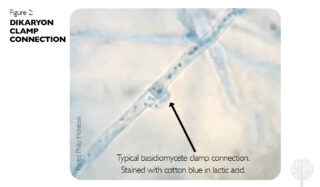
A distinguishing feature of a dikaryon is the clamp connection (Figure 2). A clamp connection is formed at the location on a hypha where a new cell wall will create a septum, dividing the hypha into separate cells. A small hook-like protrusion forms in the reverse direction of growth, and as the two sister nuclei divide, one moves into the hook and migrates back into the cell behind. Using this mechanism, unique to basidiomycete fungi, the fungus maintains two nuclei in each advancing cell of the mycelium, one of each genotype.
Dikaryotic vs Monokaryotic Mycelium
Microscopic observation of hyphae to confirm clamp connections is a sure way to verify a dikaryon (although some heterothallic fungi do not produce clamp connections). With experience, a dikaryotic mycelium can be differentiated from a monokaryotic one by its colonial morphology. A dikaryon often has a much more “ropey” form with thicker, more entwined hyphae. Such a mycelium is called rhizomorphic because of its resemblance to the spreading and branched growth of fibrous plant roots. Some species are a lot more rhizomorphic than others. Monokaryons are generally a lot fluffier and fuzzier without twisted bundles of hyphae. Dikaryons tend to grow a little faster than monokaryons.
So now you know why you generally can’t grow a mushroom from a single spore. It takes two.
(Globe Newswire) Vancouver — Village Farms International has gained national market share for eight consecutive months, making it the fastest growing producer among the top five licensed producers in Canada.1 According to provincial data, the Company has also regained the #1 licensed producer position in Ontario, Canada’s largest provincial market, for the first time since 2022.2
“Our dedicated focus on developing a winning strategy rooted in high-quality flower has allowed us to continue to grow organic market share from a position of strength,” said Michael A. Degiglio, president & CEO of Village Farms International. “Our industry leadership has been earned through our team’s dedication, innovation, and a deep respect and understanding of our consumers, resulting in organic growth with our partner retailers and discerning consumers who come back to our products time and time again.”
Village Farms leads in Ontario with the top-three-selling ounces: Big Pleasures, D. Burger and Pure Sunfarms’ iconic Pink Kush, reinforcing its consistent dominance in the large format category for the past two years. Super Toast, the company’s most recent launch by Pure Sunfarms has also notably emerged as one of the fastest-growing brands in Ontario in just six months taking a significant 20 per cent share of the milled category. This new brand continues to gain momentum nationally as well, as a top-growth brand in Canada.3
Dominance in markets across the country continue to solidify the company’s #2 position as a top producer nationally. In Quebec, Canada’s second most populous province, Village Farms has posted impressive share gains from circa 4 per cent to circa 15 per cent over the past two years, which have significantly contributed to the company’s national momentum. The company not only maintained its #1 position in the flower category in Quebec, but also claims two of the top four brands, Promenade and Pure Laine, in the province from its subsidiary Rose LifeScience.5Meanwhile, in Alberta, the company reached an all-time high market share of 8 per cent in February, gaining nearly three share points since September. Three of the four largest Canadian provinces have met or exceeded Village Farms’ national market share rank, outgrowing their respective markets.4 In the fourth, British Columbia, Pure Sunfarms’ Fraser Valley Weed Co. brand reigns supreme as the #1 flower brand in the province.6
Advertisement
1 Based on estimated retail sales from HiFyre, other third parties and provincial boards. 2 Calculated from sales information provided by the Ontario Cannabis Store (OCS) as of March 31, 2024. 3 Q1 2024 as compared to Q1 2023 based on estimated retail sales from HiFyre, other third parties and provincial boards. 4 Calculated from sales information provided by Alberta Gaming, Liquor and Cannabis(AGLC). 5 Based on estimated retail sales from WeedCrawler from January 1st, 2024 to March 31st, 2024. 6 Calculated from sales information provided by BC Liquor Distribution Branch (BCLDB).
Village Farms has consistently retained the #1 position in the flower category nationally over the past three years.
As of May 2024, the company expects to expand its footprint in Atlantic Canada with products launching in Nova Scotia for the first time, which will mean that every Canadian will have access to Village Farms’ leading brands nationwide.
By Wayne Doyle, Local Journalism Initiative Reporter, BarrieToday.com
At the end of the first half of 2023, Oro-Medonte Township had already blown through its annual legal expense budget.
With an allocation of $428,900 for the year, the township finished the first half with legal expenses of $609,000. Reserves of $200,000 were included in the 2023 operating budget to cover deficit.
At a special meeting of council on March 20 to discuss the recalibration of the 2023-24 budget, council was made aware that legal costs in 2023 had run amok.
Advertisement
According to the legal expense summary presented to council, the township spent $1,094,210 on legal costs in 2023.
A week later, council was advised there was a clerical error that added approximately $125,000 to the final result.
Township officials said this week that the actual legal cost related to cannabis is $436,955 and not $555,435, as was presented March 20.
Backing out the clerical error of $118,480, the township spent $975,730 — more than double the original budgeted amount.
According to the summary prepared for council, the township spent $197,869 on legal costs associated with development services — including $187,572 on legal costs related to short-term rentals, $4,901 on Ontario Land Tribunal appeals and planning matters, and $5,396 on building and septic matters.
The budget allocation for development services was $120,000.
Under environmental services, the township spent $161,482 — including $155,026 on Zone 1 water and $6,456 to the Municipal Service Corporation.
The budget allocation for environmental services was $70,000.
Under shared services, the township spent a total of $490,312 — $436,955 on cannabis, $27,782 on general matters, $14,367 on human rights tribunal, and $11,208 on TRY recycling.
The budget allocation for shared services was $150,000.
“Legal challenges initiated by third parties associated with decisions of township council are outside of the municipality’s control,” Jenny Legget, communications and public relations officer for Oro-Medonte, wrote in an email to BarrieToday.
“Township council and staff are focused on reviewing all available options to address these challenges, with a goal of resolving issues in the most cost-effective way possible,” she added.
In the category of human resources, the township spent $80,917, which is more than double the original budget allocation of $40,000.
Asked to explain the variance, Legget said the township “does not share details pertaining to confidential HR and labour relations matters.”
BarrieToday also asked township officials to explain the legal fees associated with general matters, human rights tribunal and TRY recycling.
“Specific details regarding legal matters are discussed in closed session,” Legget wrote. “Therefore, the township is not in a position to provide specifics pertaining to any legal matter/case.”
Lexaria, a global innovator in drug delivery platforms, has announced the appointment of Nelson Cabatuan, CPA, as its new CFO
Nelson will lend over 15 years of experience in corporate finance and operations, having worked in key organizations within the industry, and will play an integral role in supporting upcoming GLP-1 human clinical studies and overseeing key financial areas of the company
The appointment highlights Lexaria’s confidence in its recently confirmed focus on important GLP-1 studies
Lexaria Bioscience (NASDAQ: LEXX), a global innovator in drug delivery platforms, recently announced the appointment of Nelson Cabatuan, CPA, as its new Chief Financial Officer (“CFO”). Nelson will lead Lexaria’s financial operations, mainly as it looks to double down on GLP-1 human clinical studies for the 2024 calendar year (https://cnw.fm/Ixv3C).
Nelson delivers over 15 years of corporate finance and operations experience within the life sciences industry. Having worked in key organizations such as Rain Oncology, Inc., a late-stage precision oncology biotech company, Lexaria’s management is confident that his skills will be of tremendous value to the company and its growth. Nelson has also served in various roles at Rigel Pharmaceuticals, Inc., including Vice President Finance. He was also a vital member of the executive team that developed and launched TAVALISSE(R) to treat chronic immune thrombocytopenia.
“Nelson’s deep financial leadership experience will be instrumental to the execution of Lexaria’s long-term growth strategy as we continue to maximize the potential use of our DehydraTECH platform for GLP-1 and other therapeutic applications with high unmet needs,” noted Chris Bunka, Lexaria’s CEO.
This appointment follows Lexaria’s recent move to hire a contract research organization for its second GLP-1 human pilot study. The study will explore the company’s patented DehydraTECH(TM) technology for the improved delivery of glucagon-like peptide 1 (“GLP-1”) drugs used to treat type 2 diabetes and weight loss. Nelson will play an integral role in supporting upcoming GLP-1 human clinical studies and overseeing key financial areas of the company.
Nelson is optimistic about joining the company, citing DehydraTECH’s potential and proven track record.
“Lexaria has a significant opportunity in continuing its pursuit as a global innovator in drug delivery platforms as proven by the strong potential of DehydraTECH in GLP-1 and hypertension,” he noted. “I’m excited to join the team and look forward to contributing to the company’s progress in GLP-1 and other areas,” he added.
This appointment affirms Lexaria’s commitment to actualize the roadmap detailed earlier in the year, and its confidence in the direction it has taken to focus on GLP-1 studies.
NOTE TO INVESTORS: The latest news and updates relating to LEXX are available in the company’s newsroom at https://cnw.fm/LEXX
About CannabisNewsWire
CannabisNewsWire (“CNW”) is a specialized communications platform with a focus on cannabis news and the cannabis sector. It is one of 60+ brands within the Dynamic Brand Portfolio @ IBN that delivers: (1) access to a vast network of wire solutions via InvestorWire to efficiently and effectively reach a myriad of target markets, demographics and diverse industries; (2) article and editorial syndication to 5,000+ outlets; (3) enhanced press release enhancement to ensure maximum impact; (4) social media distribution via IBN to millions of social media followers; and (5) a full array of tailored corporate communications solutions. With broad reach and a seasoned team of contributing journalists and writers, CNW is uniquely positioned to best serve private and public companies that want to reach a wide audience of investors, influencers, consumers, journalists and the general public. By cutting through the overload of information in today’s market, CNW brings its clients unparalleled recognition and brand awareness. CNW is where breaking news, insightful content and actionable information converge.
To receive SMS alerts from CNW, text CANNABIS to 888-902-4192 (U.S. Mobile Phones Only)
Please see full terms of use and disclaimers on the CannabisNewsWire website applicable to all content provided by CNW, wherever published or re-published: https://www.CannabisNewsWire.com/Disclaimer
Diabetes is a chronic illness characterized by high levels of blood sugar. There are different types of diabetes, the most common being types I and II. Latest data estimates that by 2045, more than 700 million individuals globally could be afflicted with the illness as its prevalence continued to rise.
Researchers have commenced studies into whether psilocybin may help fight the effects of diabetes. Psilocybin is the primary psychoactive compound found in various species of hallucinogenic mushrooms. In the last couple of years, the compound’s therapeutic potential has been recognized, particularly for mental health disorders such as anxiety, depression and post-traumatic stress disorder.
For their study, the researchers focused on how psilocybin interacted with serotonin receptors in the brain. These receptors, which are also found in the pancreas, play an important role in regulating insulin release and production. In diabetics, this process is disrupted when pancreatic β-cells don’t function properly. These cells, which are responsible for insulin production, become compromised when they are lost or damaged. This makes it hard for the body to regulate blood sugar levels.
Professor Igor Kovalchuk, the author of the study, revealed that the team’s focus was on testing whether psilocybin would have antidiabetic effects. The researchers used a rat insulinoma cell line for their study, given its relevance to human β-cell function.
The researchers began by looking into how pancreatic β-cells exposed to high lipid and high glucose conditions were affected by a specified concentration of psilocybin. These conditions were designed to induce the damage and stress typically observed in the pancreatic β-cells of diabetic individuals.
They discovered that cells treated with psilocybin had better viability compared to those that didn’t receive any psilocybin. This suggests that the psychoactive compound has a protective effect on β-cells, helping to alleviate the impact of metabolic stress linked to diabetes. The researchers also discovered that treating the cells with psilocybin reduced some apoptotic biomarkers in the β-cells. Apoptosis plays a huge role in the loss of β-cells in diabetic patients.
In addition, the investigators observed that psilocybin didn’t considerably improve impaired secretion of insulin under high lipid and glucose conditions. This showed that while the psychedelic could protect β-cells from apoptosis, it didn’t improve their functional response to glucose.
In their report, the researchers explained that their findings offered preliminary evidence that psilocybin microdosing would likely have a positive effect for prediabetic and diabetic individuals. The findings of this preliminary study were published in “Genes” journal. Other researchers involved in the study include Olga Kovalchuk, Dong-Ping Li, Bo Wang and Esmaeel Ghasemi Gojani.
Other research teams at companies such as Compass Pathways PLC (NASDAQ: CMPS) are also studying other potential therapeutic attributes of magic mushrooms, and it is likely that regulator-approved psychedelic medicines could soon become available to patients.
About PsychedelicNewsWire
PsychedelicNewsWire (“PNW”) is a specialized communications platform with a focus on all aspects of psychedelics and the latest developments and advances in the psychedelics sector. It is one of 60+ brands within the Dynamic Brand Portfolio @ IBN that delivers: (1) access to a vast network of wire solutions via InvestorWire to efficiently and effectively reach a myriad of target markets, demographics and diverse industries; (2) article and editorial syndication to 5,000+ outlets; (3) enhanced press release enhancement to ensure maximum impact; (4) social media distribution via IBN to millions of social media followers; and (5) a full array of tailored corporate communications solutions. With broad reach and a seasoned team of contributing journalists and writers, PNW is uniquely positioned to best serve private and public companies that want to reach a wide audience of investors, influencers, consumers, journalists and the general public. By cutting through the overload of information in today’s market, PNW brings its clients unparalleled recognition and brand awareness. PNW is where breaking news, insightful content and actionable information converge.
To receive SMS alerts from PsychedelicNewsWire, text “Groovy” to 888-902-4192 (U.S. Mobile Phones Only)
Please see full terms of use and disclaimers on the PsychedelicNewsWire website applicable to all content provided by PNW, wherever published or re-published: https://www.PsychedelicNewsWire.com/Disclaimer











Recent Comments