
by Grow Up Conference | Apr 8, 2024 | Grow Opportunity, Media Partners
By Vicky McKeever
Growing cannabis indoors uses a lot of energy, obviously resulting in higher emissions.
But some companies are trying to combat that like U.K.-based cultivator Glass Pharms. It claims to be the world’s first firm to grow cannabis indoors in a carbon-neutral way. It actually says it goes one better, and produces in a carbon-negative way.
The company’s greenhouse facility in the south of England gets all its power from an anaerobic digestion plant, which is fed on waste food that would normally go to landfill and release methane as it breaks down.
Read the full story here.

by Grow Up Conference | Apr 8, 2024 | Cannabis Prospect Magazine, Media Partners
by Grow Up Conference | Apr 8, 2024 | Cannabis Prospect Magazine, Media Partners
by Grow Up Conference | Apr 8, 2024 | Cannabis Prospect Magazine, Media Partners

by Grow Up Conference | Apr 8, 2024 | Cannabis News Wire, Media Partners
A new poll has found that almost every three in five individuals in the United States are in favor of home growing marijuana. The poll, which was commissioned by Royal Queen Seeds, found that more than 60% of cannabis consumers aged 21 years and older preferred to grow their own plants instead of purchasing marijuana.
While this isn’t the first or second poll that observed strong support for cannabis legalization overall, it is one of the few that looked into preferences on home growing. In its findings, the survey determined that 59% of grownups believed individuals should have the right to legally cultivate marijuana at home.
With 4/20 approaching, the survey also determined that more than 80% of cannabis consumers who planned to cultivate their own plants planned to buy seeds on the cannabis holiday. In addition, it found that 37% of those surveyed would consider purchasing cannabis seeds as a gift for another on 4/20.
Cannabis may be prohibited at the federal level, but the U.S. Drug Enforcement Administration (DEA) has in the past confirmed that the seeds which produce marijuana are considered legal hemp as long as they don’t contain more than 0.3% THC levels.
The poll also determined the following:
- 56% of individuals who grew their own marijuana had sang to or played music for their plants
- 21% of cannabis consumers would like to try growing their own plants while 29% had already done so
- 49% of individuals who engaged in home growing felt the practice afforded them a sense of confidence while 44% of them felt connected to nature
- 34% of marijuana consumers who grew the plant at home also revealed that they did so because they considered that to be safer than what retailers were selling
- 34% of home growers also felt ease, 46% felt proud of their achievements and 48% felt joyful for growing their own plant
- 43% of home growers also felt it was more costeffective, as compared to purchasing products from retailers.
Additionally, the poll determined that 61% of individuals who planned to cultivate their own marijuana this year were growing it from seeds. This is a huge share, especially when compared to 21% who planned to grow their plants from seedlings or clones.
In a press release, Royal Queen Seeds president Shai Ramsahai stated that all adults should be permitted to cultivate their own marijuana alongside their vegetables and fruits if they chose to, without fear of criminal or financial penalties. Ramsahai explained that there were various reasons why individuals preferred home cultivation, from knowing how the plants were cultivated and cost savings to just having fun.
The findings of this poll are unlikely to offer any surprises to marijuana companies such ask TerrAscend Corp. (TSX: TSND) (OTCQX: TSNDF) since the sentiments expressed are probably those they come across routinely as they serve the customers who patronize their outlets.
About CannabisNewsWire
CannabisNewsWire (“CNW”) is a specialized communications platform with a focus on cannabis news and the cannabis sector. It is one of 60+ brands within the Dynamic Brand Portfolio @ IBN that delivers: (1) access to a vast network of wire solutions via InvestorWire to efficiently and effectively reach a myriad of target markets, demographics and diverse industries; (2) article and editorial syndication to 5,000+ outlets; (3) enhanced press release enhancement to ensure maximum impact; (4) social media distribution via IBN to millions of social media followers; and (5) a full array of tailored corporate communications solutions. With broad reach and a seasoned team of contributing journalists and writers, CNW is uniquely positioned to best serve private and public companies that want to reach a wide audience of investors, influencers, consumers, journalists and the general public. By cutting through the overload of information in today’s market, CNW brings its clients unparalleled recognition and brand awareness. CNW is where breaking news, insightful content and actionable information converge.
To receive SMS alerts from CNW, text CANNABIS to 888-902-4192 (U.S. Mobile Phones Only)
For more information, please visit https://www.CannabisNewsWire.com
Please see full terms of use and disclaimers on the CannabisNewsWire website applicable to all content provided by CNW, wherever published or re-published: https://www.CannabisNewsWire.com/Disclaimer
CannabisNewsWire
Denver, CO
www.CannabisNewsWire.com
303.498.7722 Office
Editor@CannabisNewsWire.com
CannabisNewsWire is powered by IBN

by Grow Up Conference | Apr 8, 2024 | Grow Opportunity, Media Partners
Michael Forbes, recently named one of Canada’s top 50 leaders in cannabis, cultivated his business acumen long ago.
With a background in medicine and experience developing pharmacies and clinics in Western Canada, Forbes found success in the real estate market, eventually paving the way for his licensed cannabis producers and retail chains. The many verticals he oversees with their overlapping interests collectively known as the Forbes Group, demonstrates the validity of his leadership in cannabis, while highlighting an eclectic business narrative engineered with social consciousness at its core.
After receiving a BSc in Pharmaceutical Sciences from UBC, Forbes began his career as a pharmacist in Calgary, and later, “after numerous failed attempts,” finally opened his own pharmacy in Langford, B.C. – his home province. “It took me six months of savings to make it (without drawing any income), and it took nine months to make a dollar,” he says. Forbes conducted himself frugally at the time, while also raising his son. “Those days really shaped my business sense and taught me to only spend on what’s needed.”
During the first nine months of operations, “I literally had to pick and choose between keeping the lights on and ensuring we had enough medications in stock ” he says. “I was janitor, CEO and pharmacist all in one.” From there he opened a second and third location, by “incorporating savings to increase cash flow,” which is how he got into real estate and cannabis businesses.
“The second store was a methadone pharmacy,” says Forbes. In 2010, he was approached by the CDC and the Vancouver Island Health Authority (VIHA), asking if he would run a pilot project called the Pandora Needle Exchange in Victoria’s downtown. “It’s common sense,” he says. “If you prevent patients from sharing needles, you’re going to reduce diseases entering the general population.”
Though he was doing it for free, still contentious illicit drug use sounded the alarm and incited the involvement of law enforcement and the subsequent harassment of patients on his clinic’s doorstep. Forbes eventually responded and relieved police pressure through dialogue with them. “I’ve been in the trade of helping people for a long time,” he says.
When cannabis legalization entered onto the scene, Forbes was approached by prospecting industry players. Interested in the medical side of cannabis, in 2013 he submitted an application for micro producer Sitka Weed Works – now Sitka Legends. Due to “government bureaucracy,” it wasn’t until 2017 that Sitka was licensed.
After establishing two cannabis retail chains, Honeycomb and Clarity, Forbes also became involved with large scale cannabis extractor Adastra. “I knew the shareholders,” he says, “and it was facing some issues.” One of the shareholders asked for help, “so I bootstrapped that and turned it around. It wasn’t easy, and I don’t know why I did it other than I just wanted to help.” Forbes attributes the growth in sales and putting Adastra on the map to “the hard work of the team for achieving this amazing turnaround story.”
Initiating psychedelic dovetailing
With an influx of Canadian cannabis companies amending their licenses for the research and production of psychedelics and other controlled substances, Forbes and Adastra – due to bootstrapping abilities and frugality – were among the first to do this.
“When you see other companies building facilities, I scratch my head,” he says, asking “why aren’t you simply integrating it into the existing cannabis infrastructure?” Forbes points out that amending licenses comes at little cost to the license holder.
While psilocybin is not commodified the way cannabis is and hemp was prior to prohibition, the market conditions for the production and sale of the natural substance remains unclear due to consumption volume and therefore the demand among consumers. However, Forbes argues that when comparing the safety profiles of cannabis and psilocybin, psilocybin is actually safer. “There’s less risk of addiction or abuse,” he says.
It seems the regulation of psilocybin-containing mushrooms is on the horizon in Canada, and Forbes proposes a simpler solution than reliving the legal complexities experienced during the introduction of the Cannabis Act. This approach would bypass the need to further amend subsidiary laws such as driving and residential for specific psychedelic use.
Psilocybin can be grown in a cannabis facility, and dispensaries could in theory sell mushroom products next to cannabis. Instating a Cannabis and Psilocybin Act would mean “dovetailing it all the way through the same infrastructure,” says Forbes. “While I’m against the recreational legalization of some of the other potentially stronger synthetics for Canadians, I do support the legalization of psilocybin.”
If regulators adopted this approach, it could help alleviate the struggling cannabis industry by enabling producers to sell psilocybin. “I like psychedelics, I just think some of them have bigger risks than others,” says Forbes. “So, we have to look at what’s safe; what makes sense. I believe that psilocybin stands separately from the other ones.”
Can industry and social justice intersect?
Last year alone, Adastra made the Canadian federal government well over 10 million in excise taxes. “Do you think that they’ve done enough to curb the illicit market?” asks Forbes. Meanwhile, Sitka stands out as possibly Canada’s only micro-cultivator park, “licensed for individual growers to produce premium craft flower in personal, customized units.” The development of 10 nurseries assists legacy growers in their transition to the legal market, introducing leading talent into the regulated market, and merging industry with tradition.
The Forbes Group also encompasses two cannabis retail chains, and at one point, he held 77 licenses in Canada, saying “ethically, I think it’s much better than owning a liquor store.” Another distinctive quality of these companies is the cultivation of female entrepreneurial leadership. Forbes comments on the team approach at his operations, where the company “plays into everybody’s unique strengths,” and in doing so, has built a desirable work culture by being kind to people.
Forbes sees a potential future merging of psychedelics into the existing cannabis space, “and I see the clinical side of psychedelics merging into longevity; that’s what I’m working on doing.” Transcending the struggle for basic necessities and social equities is the prevalent desire for longevity and wellness into old age. Forbes’ passions also includes self-care through the expression of Ageless Living – a tri-location B.C. clinic offering treatments for healthy hormones, biohacking and support for achieving personalized goals.
The commonalities shared among these verticals reflect West Coast culture, with its ties to legacy growing, drug history and the pursuit of safe supply. Despite gaps in government contributions and the worsening opioid and mental health epidemic, advocates for the proper use of drugs as tools for harm reduction and healing will continue to dominate, eventually moving from grass roots advocacy to destigmatized mainstream programs with the intent of saving and bettering lives.
Individual states of health are vast as they are subjective, and legislative change must occur to achieve these fundamental treatments, “and hopefully with a new government we will see that because it is a legal, viable business,” he says.
For cannabis businesses in 2024, Forbes recommends pacing yourself through the hardships. He says, “I go where the problems are, unfortunately,” though prefers to spend his time in nature: Stanley Park, specifically.
While Forbes works with a spectrum of drugs of all different rankings, in response to our societal disconnection from nature, it is advocacy for plant medicine over synthetics that he pinpoints as a potential remedy for our collective malaise.
by Grow Up Conference | Apr 8, 2024 | Cannabis Prospect Magazine, Media Partners

by Grow Up Conference | Apr 6, 2024 | Media Partners, The New Agora
The Occult Nikola Tesla Part 1
Newton, Rosicrucianism and the Imperial Control of Science
Was Nikola Tesla a great genius, ahead of his time as a modern prophet or ‘electrical wizard’ as some have called him, or is there evidence that something much more insidious was afoot?
It is clear that a larger-than-life mythos has been built up around the figure of Nikola Tesla over the past century.
An image has been passed down to us of a renegade genius misunderstood by those living in his era, constantly financially attacked by the evil financiers who preferred to support the unscrupulous Thomas Edison or Marconi… leaving him poor, digging ditches for food and selling his futuristic patents for money.
But is any of this actually true?
My contention is that scratching at the carefully-crafted “official” narrative of Nikola Tesla’s life and works, extremely dark forces are soon found lurking under the shiny surface which should not be ignored.
In presenting this extremely challenging material, I will present several types of data, ranging from the political dynamics shaping the world in which Tesla lived, the handlers who directly supervised and influenced Tesla both before and after his arrival in the USA, the occult networks which Tesla interfaced with, the scientific discoveries which emerged into the world prior to Tesla’s having made patents for them, and also Tesla’s hyper-materialistic rejection of free will, creative reason or a soul.
Before diving fully into this exploration, I want to be sure that it is understood that the creation of cardboard cutouts is not only common across all facets of societies managed by closed oligarchies, but absolutely necessary to the survival and promulgation of closed oligarchies.
This is especially true in the domain of science.
One of the most shining examples of a scientific cutout prior to the more recent case of Nikola Tesla is none other than Sir Isaac Newton (1642-1726).
In M. Kirsch’s extensive 2013 essay ‘Leibniz vs Venice: The Battle for a Science of Physical Economy’ the Royal Society (and typically Rosicrucian) handlers of Sir Isaac were outlined at great length- including, but not limited to, such names as Robert Boyle, Reverend Bentley, Isaac Barrow and Samuel Clark.
The formation of the Invisible College run as an esoteric society of Rosicrucian Kaballists that took over control of the English government after the ill fated republican English Civil war (1640-1649) is another important consideration to hold in mind when trying to make sense of the vast influence that the British Empire and its Royal Society wields over the structures of scientific practice internationally.[1]
Researcher Tracy Twyman wrote of this college: “Most of the members of the Royal Society were Freemasons, and most coupled their scholarly pursuits with esoteric ones, making the Royal Society appear to be much like the ‘Invisible College’ which Robert Boyle, one of the society’s most prominent members, had previously described. He became an even more prominent member of the society after 1668”.
In Kirsch’s essay, and an associated documentary which this author had the pleasure of working on as art director in 2008, it was revealed how the groundbreaking discoveries of continental scientists like Johannes Kepler, Christiaan Huygens, Jean Bernoulli and especially Gottfried Leibniz were systematically plagiarized by the Newtonians of the British Royal Society. The re-purposed discoveries were carefully removed of their substance and turned into cold symbol-based husks of formulae devoid of any intelligible evidence of HOW those discoveries were made.
To this day, no one has ever been told HOW Newton discovered any of those discoveries to which he is given credit, and the only chests full of Newton’s surviving papers speaks more of alchemical experiments, and numerological calculations into end times rather than actual evidence of scientific work. Within his Principia Mathematica (1687), Newton’s “discoveries” are presented as a codex of encyclopedic descriptive rules without anything to satisfy a curious mind to re-experience the act of discovery that made those “rules” possible. We are left merely with apocryphal tales of apples, but very little in the way of satisfying reason.
Inspecting Newton’s vast array of surviving writings in 1936, none other than Lord John Maynard Keynes, said:
“Newton was not the first of the age of reason. He was the last of the magicians, the last of the Babylonians and Sumerians, the last great mind which looked out on the visible and intellectual world with the same eyes as those who began to build our intellectual inheritance rather less than 10,000 years ago. Isaac Newton, a posthumous child born with no father on Christmas Day, 1642, was the last wonder-child to whom the Magic could do sincere and appropriate homage.”
Caption: Two paintings of Newton by occultist William Blake featuring Newton as a God-man/architect. John Maynard Keynes looks on from the background
The discoveries attributed to this president of the Royal Society, and warden of the Bank of England, who barely spoke a word in public, nor defended his own views in any public debate, were all attributable to earlier discoveries made by real scientists using a method far removed from the radical empiricism promoted by “the great one” whom Keynes even likened in his text above to a new occult messiah.
Kirsch himself makes the following observation of Newton’s leap into Rosicrucianism:
“Newton’s real devotion to alchemy began in 1667 after returning to Cambridge and working with [Lucasian Chair of Mathematics at Cambridge Isaac] Barrow. Newton began reading and making extensive notes in such Rosicrucian tracts as Themis Aurea and Symbola Aureae Mensae Dudecim, and The Fame and Confession of the Fraternity R.C. He adopted the Rosicrucian view, that if one followed the secrets of Rosicrucianism, one would become part of a superior race that could talk to angels, become immortal through discovering the secret elixir, and infinitely wealthy through possession of the philosopher’s stone.”
Caption: Isaac Newton and Kaballistic symbology of the Sephirot floating over the celestial backdrop
From the discovery of universal gravitation removed of the harmonic principles of Johannes Kepler, to the discovery of the infinitesimal calculus of Leibniz (removed of its physical principles and replaced with ‘fluxions’)[2], it is clearly demonstrable that all of Newton’s major discoveries as enshrined in his Principia Mathematica are unoriginal plagiarisms published by real scientists before Newton and in some cases, decades before Newton was even born[3]).
The revolving door between occultists of a Rosicrucian/Kabalistic persuasion as Newton and his Invisible College of handlers were, and the exoteric face of “proper Royal Society-approved” scientific practice is not contradictory, but a constant theme throughout this tale, and the figure of Nikola Tesla is again no exception to this rule.
Now let’s review the only poem ever written by Nikola Tesla titled ‘Fragments of Olympian Gossip’:
“Too bad, Sir Isaac, they dimmed your renown
And turned your great science upside down.
Now a long-haired crank, Einstein by name,
Puts on your high teaching all the blame.
Says: matter and force are transmutable
And wrong the laws you thought immutable.”
“I am much too ignorant, my son,
For grasping schemes so finely spun.
My followers are of stronger mind
And I am content to stay behind,
Perhaps I failed, but I did my best,
These masters of mine may do the rest.”
–Fragments of Olympian Gossip (selection) written by Nikola Tesla in the 1920s to his friend George Sylvester Viereck
This poem is interesting for two reasons:
1) Tesla here firmly lays out his position in favor of Sir Isaac Newton’s cosmology over the new discoveries of curved physical space time made by the pioneering discoveries of Max Planck, Bernard Riemann, Carl F. Gauss, Wilhelm Weber and Albert Einstein. As electrical engineer Jeff Johnson notes: “Tesla was a lifelong defender of the physics of Sir Isaac Newton against the innovations of the upstart Albert Einstein.” As we will see throughout this series, Tesla defended the notion of a totally flat structure to the universe until the day he died, and promoted a form of extreme empiricism far more radical than even Isaac Newton’s
and
2) Tesla dedicated this poem to the world-famous occultist George Sylvester Viereck (1884-1962) with whom he shared the most intimate of relationships for over 25 years. As we will come to see throughout this essay, Viereck is not only a close associate of Satanist Aleister Crowley, but served as the principal Nazi agent of the United States during the 1920s-40s. He is also the mentor of conspiracy researcher Eustace Mullins- but that’s a whole other story onto itself.
We may wish to hold this view of “the two Teslas” (one, a creative genius who loved truth and goodness while another darker Tesla who tangoed with occultists)… but does this hold water? Were those death rays to which he devoted himself to building only about world peace as so many have come to believe… or was something more insidious slithering under the floor boards?
Maybe Tesla’s views on Nazi eugenics might help us begin to piece together an answer to at least some of these questions…
Footnotes
[1] For this exercise, an appreciation for the Rosicrucian roots of the Royal Society can be found in the earlier efforts by occultists like Robert Fludd, Elias Ashmole, Francis Bacon and John Dee in setting the stage for an occult takeover of England transforming the once-viable nation into the seat of a world empire.
[2] Even though to this day BOTH Isaac Newton and Gottfried Leibniz are given honors as have co-discovered the infinitesimal calculus, it is a major embarrassment that only Leibniz’s notation is used in practical science, as Newton’s notation featuring fluxions and infinite sets is nearly worthless.
[3] As outlined in The Harvard Yard, Kepler’s New Astronomy, published in 1609 and Harmony of the World, published in 1619 showcased how Kepler’s three universal laws of planetary motion were discovered decades prior to the birth of Sir Isaac, but also how Newton’s laws reverse engineered and then reconstructed Kepler’s discoveries. This demonstration was additionally outlined in my book Science Unshackled (available by clicking the link below)
Historical analysis, geopolitics, cultural warfare and other studies in Conspiracy Science

by Grow Up Conference | Apr 6, 2024 | Media Partners, Stratcann
Financial reports and restructuring were yet again the theme in the news this week, with Stigma Grow’s parent company releasing their Q2 2024 financial report, Lifeist announcing the restructuring of CannMart after shareholders rejected plans to sell it, and Heritage Cannabis seeking creditor protection.
Also, BC’s second-largest city, Surrey, could again be looking at a plan to allow up to 12 cannabis stores next week, Trudeau was interviewed about Canada’s approach to legalization as part of a French documentary on cannabis, C3 announced its new president, New Brunswick said it can’t enforce its cannabis laws on First Nations reserves, and someone crashed into a weed store in Ontario.
We also shared our monthly cannabis industry jobs update.
Oh, and we had some fun with two April Fool’s Day articles, with satirical takes on Trudeau’s and Poilievre’s stances on cannabis laws that caught some of our readers off guard.
In other cannabis news this week…
CBC covered some of the evolutions of the cannabis market in New Brunswick, with Cannabis NB CEO Lori Stickles, Kevin Clark with Eco Canadian Organic, and Jonathan Wilson from Crystal Cure speaking about new CannabisNB stores and the possibility of consumption spaces and tourism, especially for farmgate operators.
A Nova Scotia court acquitted Chris Googoo this week, an Indigenous man from the Millbrook First Nation who faced counts of possession of cannabis for the purpose of distributing and selling it. The decision means there will be no constitutional challenge related to treaty rights in the case, but Goodoo’s lawyer, Jack Lloyd, told CBC that Googoo will seek to challenge cannabis laws in federal court. More on this story next week from StratCann.
CBC also ran a more in-depth story on this court case and the broader issue in Canada around First Nations jurisdiction as it relates to cannabis laws, speaking with the owners of several Indigenous-owned cannabis stores and First Nations leaders.
The Star ran a story on a number of raids of unlicensed cannabis stores in Ontario last week, including at least one location of the Mississaugas of the Credit Medicine Wheel chain, and at least two locations of Cannabis and Fine Edibles (CAFE). The article also quoted C3’s Rick Savone, Canopy CEO Rick Klein, and High Tide’s Omar Khan, who spoke positively about new provincial funding to target unlicensed stores.
On a similar note, CBC Radio spoke with Corry Van Iersel of True North Cannabis Co., who says he’s frustrated by the lack of enforcement against illicit stores.
Nextleaf Solutions announced the launch of infused pre-rolls with up to 1000mg THC per 3-pack under their Glacial Gold brand, as well as increased distribution for their Glacial Gold softgels.
High Tide announced its fifth Canna Cabana Store in Mississauga.
Christina Lake Cannabis announced a delay in the filing of its 2023 annual financial statements. They now expect to file no later than May 31, 2024.
Organigram Holdings Inc. announced that sales of their Shred brand have surpassed the $200 million mark in yearly retail sales.
And, of course, in International news this week, Germany’s new cannabis laws have come into effect as of April 1. The law allows for personal possession and home cultivation, but not sales. Cultivation “Clubs” will become legal in July.
A judge in New York struck down certain aspects of the state’s new cannabis laws after siding with a lawsuit brought by Leafly that challenged the restriction of cannabis stores advertising on third-party websites.
Although the ruling initially appeared to void the state’s entire regulatory regime, the decision was later amended to show that the judge voided the state rules dealing only with so-called third-party platforms such as Leafly that help marijuana companies market and promote their products.
by Grow Up Conference | Apr 5, 2024 | Media Partners, Stratcann
The city of Surrey, BC, which has banned cannabis stores since the beginning of legalization, will again be considering a proposal to allow up to 12 cannabis stores in the city.
In 2023, Surrey City Council began exploring the possibility of allowing cannabis stores, directing city staff to develop a plan. In July of that year, council sent a plan back to city staff to be reworked to address some councillors’ concerns.
A survey then went out to the public about the proposed plan for up to 12 locations in the city, two for each of six distinct communities: Whalley/City Centre, Guildford, Fleetwood, Newton, South Surrey, and Cloverdale.
The survey results are now available, and Surrey City Council could address the report as early as April 8, the next scheduled council meeting.
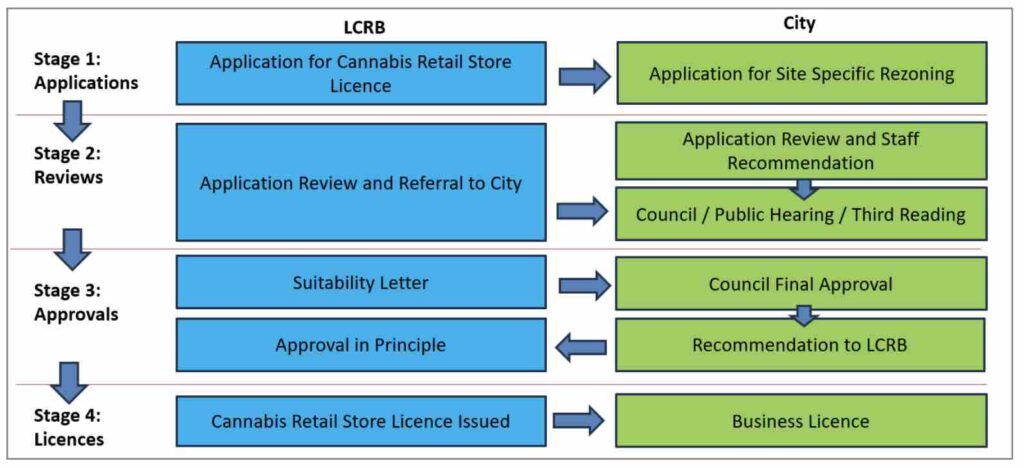
Under the proposed plan, city staff would inform retail cannabis applicants of the results of Surrey’s Request for Expression of Interest (RFEOI) selection process. Up to two applications would then advance to city council for consideration of their site-specific rezoning, including a public hearing, before the possibility of a licence being awarded.
Retail licences also must receive approval from the provincial government.
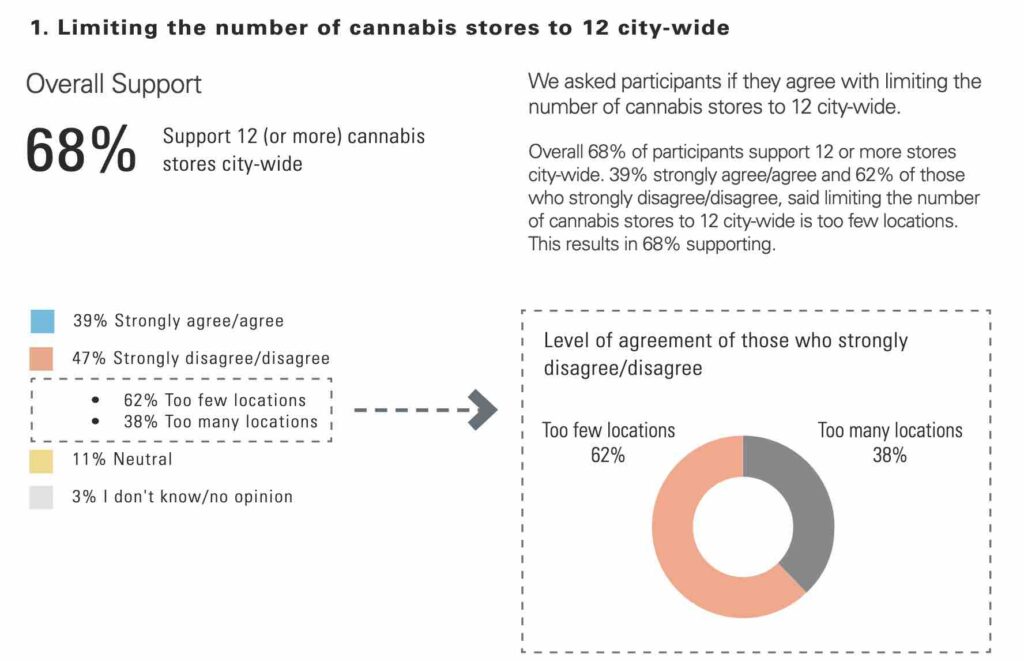
More than 4,000 people responded to the survey, with 96% living in Surrey. About 68% of respondents said they supported having 12 or more cannabis stores in the city. The 47% who strongly disagreed with the proposal said they felt setting a limit of 12 stores was too little, while just 38% of those who disagreed said it was too many.
There were similar results when respondents were asked about the proposed limit of no more than two stores per community in Surrey.
Those supporting more stores in Surrey didn’t necessarily mean they were cannabis consumers, though. Of those who supported having 12 or more pot shops in Surrey, just over half (52%) said they visit stores in other communities or purchase cannabis online, and 51% said they would buy from a store in Surrey.
Related Articles






Recent Comments