At the moment, marijuana remains illegal at the federal level. This is despite the fact that 38 states have legalized its medical use while another 24 states legally allow recreational use. Marijuana advocates believe the Biden administration is missing out on a chance to attract young voters by not legalizing the drug federally.
Thus far, the administration has availed different avenues for cannabis reform, including initiating the process of possibly rescheduling the drug’s status and issuing federal pardons for simple possession. Advocates argue that this isn’t enough, however, noting that President Joe Biden is not addressing marijuana’s criminalization, which has disproportionately affected minorities. The president is also failing to live up to his 2020 campaign promise to decriminalize the use of marijuana and automatically expunge previous convictions.
Progressive legislators in the senate are calling for the administration to deschedule marijuana because this would decriminalize the drug at the federal level. This is much better than rescheduling marijuana, which would reduce restrictions and penalties by moving it from its current Schedule I classification under the Controlled Substances Act to Schedule III.
Last month, a group of Democratic legislators penned a letter to the U.S. Drug Enforcement Administration (DEA) stating that the placement of cannabis in the Controlled Substances Act didn’t align with public opinion or state law and had had a destructive impact on communities.
In a recent interview, Marijuana Policy Project’s director of state policies, Karen O’Keefe, stated that while rescheduling marijuana was better than existing categorization, it was still a far cry from what was needed from the federal government. Numerous polls have shown that a majority of the public is in favor of cannabis being legalized federally. One Gallup survey conducted last year determined that 70% of Americans believed that cannabis should be legal. Another recent survey also underscores public support for federal cannabis reform, with 58% of those polled in favor of the drug being rescheduled.
Currently, President Biden and his likely rival, former President Donald Trump, are polling side by side both in crucial swing states as well as nationally. It is expected that the election could boil down to a couple thousand voters in those states, which gives issues such as cannabis legalized added importance.
At the moment, the DEA hasn’t decided on cannabis’ rescheduling. Additionally, the pardons issued by the Biden administration in 2022 didn’t apply to convictions made at the state level, which means that there’s more work that needs to be done in that space as well.
The cannabis industry, together with leading actors such as Curaleaf Holdings Inc. (CSE: CURA) (OTCQX: CURLF), will have to keep operating within the existing regulatory framework as they await federal reforms that finally regard this industry like any other business.
About CannabisNewsWire
CannabisNewsWire (“CNW”) is a specialized communications platform with a focus on cannabis news and the cannabis sector. It is one of 60+ brands within the Dynamic Brand Portfolio @ IBN that delivers: (1) access to a vast network of wire solutions via InvestorWire to efficiently and effectively reach a myriad of target markets, demographics and diverse industries; (2) article and editorial syndication to 5,000+ outlets; (3) enhanced press release enhancement to ensure maximum impact; (4) social media distribution via IBN to millions of social media followers; and (5) a full array of tailored corporate communications solutions. With broad reach and a seasoned team of contributing journalists and writers, CNW is uniquely positioned to best serve private and public companies that want to reach a wide audience of investors, influencers, consumers, journalists and the general public. By cutting through the overload of information in today’s market, CNW brings its clients unparalleled recognition and brand awareness. CNW is where breaking news, insightful content and actionable information converge.
To receive SMS alerts from CNW, text CANNABIS to 888-902-4192 (U.S. Mobile Phones Only)
Please see full terms of use and disclaimers on the CannabisNewsWire website applicable to all content provided by CNW, wherever published or re-published: https://www.CannabisNewsWire.com/Disclaimer
Efforts to enhance accessibility to medical marijuana are gaining traction in Arkansas as advocates and industry stakeholders push for a constitutional amendment slated for the November ballot. Tim Griffin, the state’s attorney general, recently gave the green light to the proposed amendment’s ballot language after making some revisions. Now, supporters have until July 5, 2024, to secure approximately 90,704 registered voters’ signatures, a crucial step in securing a spot on the Nov. 5, 2024, general election ballot.
The ballot committee supporting the proposal, Arkansans for Patient Access, is led by Bill Paschall, executive director of the Arkansas Marijuana Industry Association. He stated that industry stakeholders are prepared to present the amendment’s case.
The proposed amendment would allow patients to grow their own marijuana plants, which would improve accessibility to the drug. In addition, the measure aims to remove retail limitations on some smokable goods, such as pre-rolled joints, and expand the eligibility for marijuana patients’ ID cards. Notably, it also contains clauses that might allow Arkansas to legalize marijuana for recreational use if federal restrictions change.
The majority of the AG’s requested revisions to the ballot title and popular moniker Arkansans for Patient Access were small, technical adjustments. The most significant modification was adding “medical marijuana” to the title instead of “cannabis.” The amended proposal is now the Arkansas Medical Marijuana Amendment of 2024.
According to Paschall, the initiative’s counsel had reservations about the amended ballot title’s length, but after some consideration, the organization has decided to approve it. In previous election cycles, challengers to ballot initiatives have focused their legal objections on the length of the ballot title.
The proposed changes build upon the existing Amendment 98 of the Arkansas Constitution, ratified in 2016, which legalized cannabis for medical purposes. Important changes include removing restrictions on qualifying medical conditions, increasing the number of healthcare providers certified to certify patients for medical cannabis, and allowing designated caregivers and patients to grow cannabis plants. The proposal also intends to waive ID card registration fees, expand access for out-of-state residents, expedite patient telemedicine assessments and prolong the life of new patient cards.
Additionally, it introduces a recreational marijuana trigger law that, under certain federal regulatory changes, allows adult possession of marijuana up to an ounce. It also suggests protections against legislative changes to constitutional amendments made without voter consent.
While proponents advocate for expanded access to medical cannabis, other groups, such as the Family Council, have opposed the move. This opposition is based on several issues, including concerns about potential recreational use implications. The opposition underscores the contentious nature of the proposed changes.
The cannabis industry and leading players such as Verano Holdings Corp. (CSE: VRNO) (OTCQX: VRNOF) will be hoping that the desired cannabis-law reforms are passed and patients can obtain the expanded access to medical marijuana that they need.
About CNW420
CNW420 spotlights the latest developments in the rapidly evolving cannabis industry through the release of an article each business day at 4:20 p.m. Eastern – a tribute to the time synonymous with cannabis culture. The concise, informative content serves as a gateway for investors interested in the legalized cannabis sector and provides updates on how regulatory developments may impact financial markets. If marijuana and the burgeoning industry surrounding it are on your radar, CNW420 is for you! Check back daily to stay up-to-date on the latest milestones in the fast -changing world of cannabis.
To receive SMS alerts from CNW, text CANNABIS to 888-902-4192 (U.S. Mobile Phones Only)
Please see full terms of use and disclaimers on the CannabisNewsWire website applicable to all content provided by CNW, wherever published or re-published: https://www.CannabisNewsWire.com/Disclaimer
Cronos Group Inc. says it has improved its cash flow in 2023 due to lower operating expenses and increased exposure to international markets.
Cronos, the Canadian company behind cannabis brands like Peace Naturals, shared its Q4 2023 financial results on February 29, reporting $23.9 million in consolidated net revenue for the last three months of 2023 and $87.2 million in sales for the year ending 2023.
This represents a slight increase from $22 million in consolidated net revenue in Q4 2022 and $86.7 million in sales for fiscal year 2022.
However, this net revenue couldn’t cover the costs of doing business for Cronos, which reported $45 million in net losses in Q4 2023, a decline from $76.1 million in losses in the same quarter for 2022. Annual losses were also down, with Cronos reporting $70.4 million in losses for 2023 compared to nearly $155.2 million in 2022.
The cost of sales increased from $71.3 million in 2022 to $74.5 million in 2023.
Cronos says the increase in its year-over-year sales was largely due to higher sales in Canada and exports to Germany and Australia. These improvements were somewhat offset by lower cannabis flower sales in Israel, which it blames on the Israel-Hamas War and increasing competition. Israel has also pushed back against Canadian cannabis producers it accused of “dumping” product into its market, saying it’s undermining local growers.
“In 2023, we significantly improved our cash flow from operations driven primarily by operating expense savings, while simultaneously expanding our portfolio of borderless products in Canada and Israel and entering two international markets, Germany and Australia,” said Mike Gorenstein, Chairman, President and CEO of Cronos.
Croonos sells the brands Spinach, Lord Jones, Peace Naturals, and Lit (Israel).
Kelowna-based Avant Brands Inc. announced its audited financial results for the fiscal year ended November 30, 2023.
The company behind the BLK MK brand brought in record gross revenue of $30.2 million in the year leading up to November 30, 2023, but still recorded a net loss of almost $5.2 million. Net loss from operations alone was $1.5 million in the same period, compared to $8.5 million in the previous year.
This represents a year-over-year increase in gross revenue compared to 2022 and a decline in net loss of $6.6 million for the year leading up to November 30, 2022.
In the most recent report, net revenue was $26.3 million from the sale of 7,105 kg of cannabis, while the cost of sales was nearly $17.3 million. The company paid $3.8 million in federal excise taxes.
The increase in net sales is attributed to a $1.4 million sales growth in recreational revenue and a $5 million sales growth in international export/wholesale.
Recreational cannabis sales accounted for 60% of net sales during the year ended November 30, 2023, with export and B2B sales comprising 39% of total revenue. Avant has exported to Israel, Australia, and Europe. Companies exporting to Israel have faced recent pushback from the industry and government there. Avant says it completed “significant” sales to Israel and Australia in the year ending November 2023, is preparing to fulfill further orders with existing export clients, and is in discussions with new potential clients.
While Avant undertakes some B2B sales, it says its primary focus is on selling flower it produces in-house. It sells an array of its products like BLK MKT, Tenzo, Flowr, Cognōscente and Treehugger brands into markets across Canada, including BC, Saskatchewan, Manitoba, Ontario, Quebec, and Atlantic Canada. It sells products into Alberta through its online medical cannabis portal (www.greentecmedical.ca).
Avante operates six production facilities in BC, Alberta, and Ontario, including four in BC.
The overall weighted average selling price of cannabis sold decreased by 25% to $4.23 per gram. Non-medical cannabis sales averaged $6.31 a gram for the year ended November 30, 2023, compared to $7.18 per gram in the comparative period of the prior year.
Avant says the decrease in the average selling price is primarily due to price compression in the industry combined with product sales and a $300,000 sales provision.
Like many other cannabis companies, the cost of operations increased for Avant compared to the same period in 2022. Operating expenses increased by $1.8 million, or 26%, over the prior year’s comparative period. Avant says this is due to higher regulatory fees, performance bonuses, and estimated professional and audit fees.
The cannabis producer says it has a yield-per-plant of 63-99 grams of flower and 10-32 grams of trim. It says the fair value of its cannabis is $3.69 per gram of flower and $0.2 per gram of trim.
Since its inception, the Company has incurred losses and has an accumulated deficit of $65,913 as of November 30, 2023, which has been funded primarily by the issuance of equity, convertible debentures, secured credit facility and advances from related parties.
“There is a material uncertainty related to these conditions that may cast significant doubt on the Company’s ability to continue as a going concern and therefore, it may be unable to realize its assets and discharge its liabilities in the normal course of business,” it reports in its financial statement. “The Company’s ability to continue as a going concern depends upon its ability to generate profitable operations or raise adequate financing in the future.”
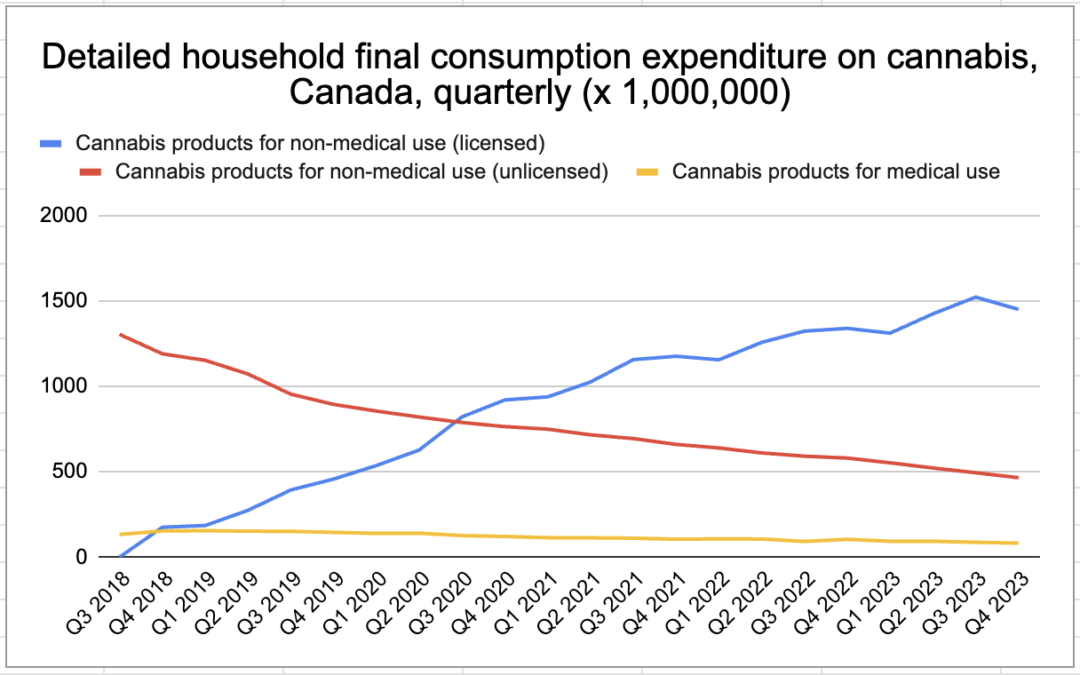
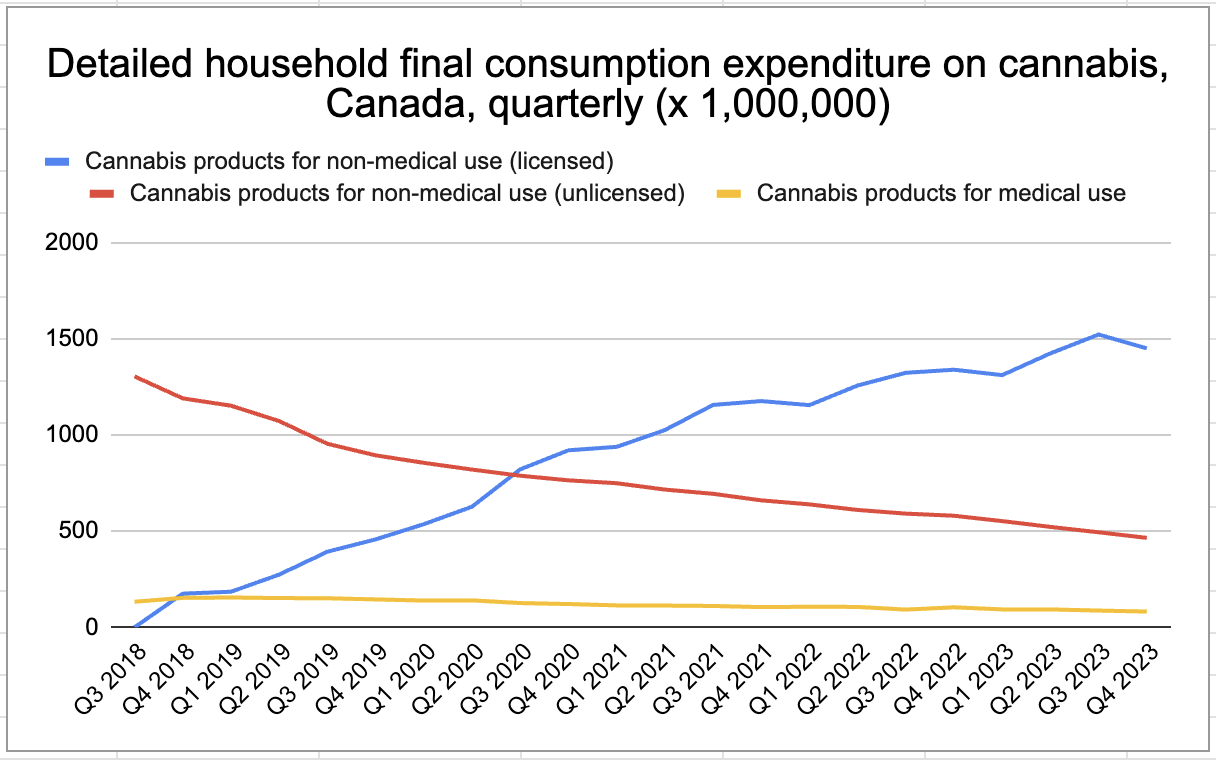
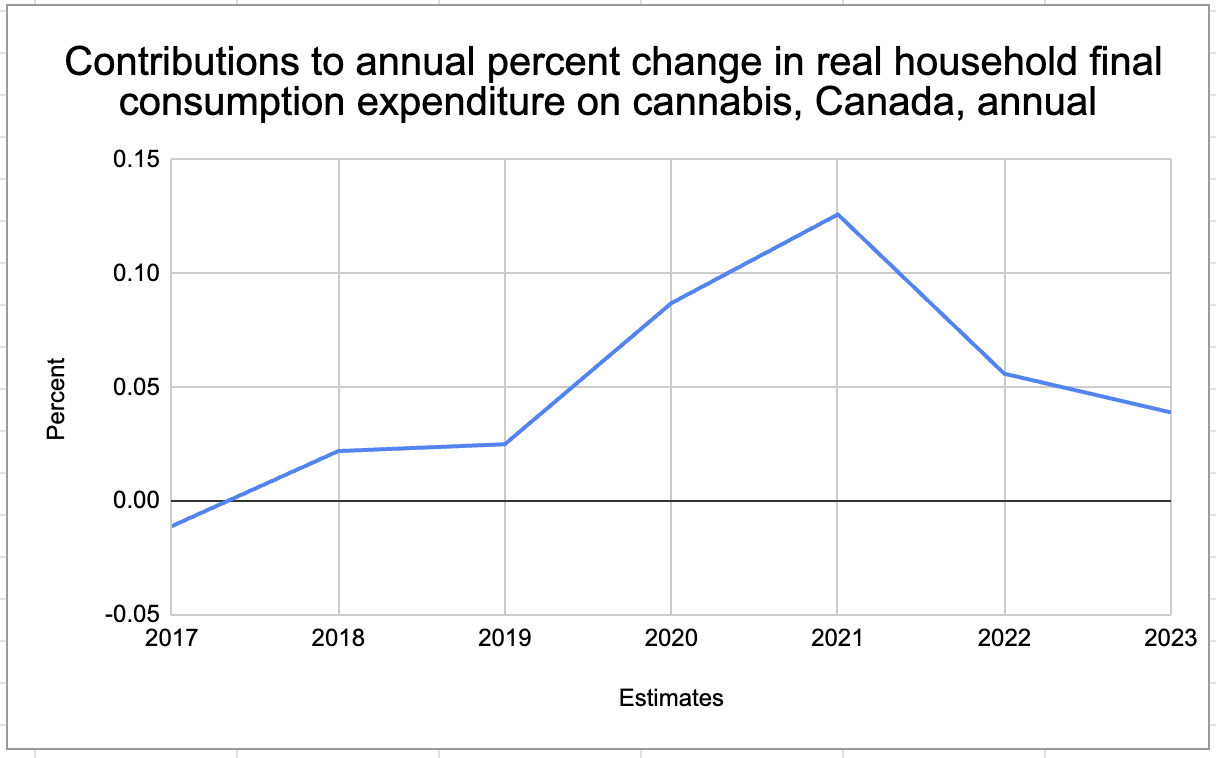
Household spending on cannabis in Canada declined in the last two years, following an increase in the first three years of legalization.
The newest figures from Statistics Canada show the annual percent change in real household final consumption expenditure, with that percentage declining from a 2021 high of 0.126% to 0.056% in 2022 and 0.039% in 2023.
The decline in household spending on cannabis is largely driven by a consistent decline in spending on products from the unlicensed cannabis market. Meanwhile, spending on cannabis from the licensed sector has been increasing on an annual basis, with some quarterly fluctuations.
The most recent quarter reported, Q4 2023, showed a slight decline in this category from a previous high watermark of $1.5 million, but is still up year-over-year.
Household expenditures on cannabis from the unlicensed sector were at a low of $465,000 in Q4 2023, down from about $1.2 million in Q4 2018.
Expenditures of cannabis for medical purposes have also declined, from a high watermark of $155,000 in Q1 2019 to $82,000 in Q4 2023. There is no distinction between sources in this category (elicit or illicit).
“Household final consumption expenditure” refers to the total amount a household spends on goods and services purchased for final use by the household.
Based on current prices, spending on cannabis products for non-medical use from licensed cannabis producers (legal market) fared slightly better than cannabis products for non-medical use purchased from the unlicensed market.
Opinions among adults in New Jersey vary regarding how the state should utilize revenue from the marijuana tax. However, a recent study sheds light on the prevailing sentiment that most residents do not favor directing marijuana tax funds toward antidrug or law-enforcement initiatives.
The study, which was published in the “International Journal of Drug Policy,” polled 1,006 New Jersey residents and gave them seven alternatives for how marijuana tax revenue should be spent, including financing for law enforcement, affordable housing and public health.
The study’s findings, compiled by researchers from Drexel and Rutgers Universities, showed that financing for community-based programs such as education (23%), housing (15%), public health (21%) and transport infrastructure (13%), was preferred over funding for antidrug initiatives (4%) and law enforcement (11%). Findings showed that 13% of respondents did not know where the revenue should be directed.
According to the authors, these findings reflect a desire among the public to invest in essential societal pillars such as public health and education rather than continuing the punitive measures that have traditionally been linked to marijuana laws.
The results shed light on a discussion that has taken place in legislatures and political campaigns around the nation, with proponents of legalization typically opposing plans to utilize marijuana tax revenue to fund the organizations that upheld the harsh drug laws that the repeal of prohibition wants to remove.
The survey results also revealed partisan differences, with Republicans generally supporting funding priorities less than Democrats, especially when it comes to law enforcement. Notably, only one Black participant stated that funding law enforcement was a top priority when it came to cannabis tax revenue, highlighting concerns about the disproportionate impact of marijuana criminalization on Black communities.
The study concludes by stating that marijuana legalization initiatives can address social inequities by reinvesting tax revenue, though further exploration is needed on how this reinvestment can benefit disadvantaged communities and promote health equity.
The data from New Jersey indicates a preference for investing in education, drug treatment and public-health initiatives over law enforcement, reflecting a broader trend in public opinion. This sentiment underscores the potential benefits of formally allocating health- and justice-related funding to address health disparities and historical injustices stemming from punitive marijuana policies.
Similarly, in Ohio, the debate over tax revenue allocation has intensified, with cannabis activists opposing efforts by the Republican-controlled assembly to redirect funds toward law enforcement, contrary to voter-approved legalization measures.
The debates going on regarding how best to utilize the cannabis taxes that companies such as Tilray Brands Inc. (NASDAQ: TLRY) (TSX: TLRY) pay in the states where they operate show how a legal cannabis industry can exert a transformative role upon the jurisdictions that enact drug reform and end prohibition.
About CNW420
CNW420 spotlights the latest developments in the rapidly evolving cannabis industry through the release of an article each business day at 4:20 p.m. Eastern – a tribute to the time synonymous with cannabis culture. The concise, informative content serves as a gateway for investors interested in the legalized cannabis sector and provides updates on how regulatory developments may impact financial markets. If marijuana and the burgeoning industry surrounding it are on your radar, CNW420 is for you! Check back daily to stay up-to-date on the latest milestones in the fast -changing world of cannabis.
To receive SMS alerts from CNW, text CANNABIS to 888-902-4192 (U.S. Mobile Phones Only)
Please see full terms of use and disclaimers on the CannabisNewsWire website applicable to all content provided by CNW, wherever published or re-published: https://www.CannabisNewsWire.com/Disclaimer
“Every moment is an opportunity to be an expression of truth.”
All Things Considered
There is an intensity to the subject matter and style of the articles I publish. For many, it may be read as critical and pessimistic. To others, there is an undeniable resonance with the energy between the lines. I do not take offense when I hear from family, friends and others if the articles land for them as societal cynicism. I have chosen to walk the path of my personal truth. However, being an intuitive person, I sense the responses in comments, likes, shares, etc., or lack thereof. My intentions have never been for profit, and I am not delusional enough to be seduced by popularity. When people experience insights with these articles, even those interpreted as negative, I am fulfilled in my expression.
Delusion, Illusion and Oblivion
We each exist within our personal security bubble. It is almost impossible to differentiate ourselves from our defenses, given our institutional assimilation via our social conditioning and programming. It is our enslavement; imposed by our ambiguity, denial, egocentricity, fear, insecurity and self-righteousness. We are all creators of our experience. In every moment, we have the opportunity for universality. Yet, we dismiss our universal birthright to conform to society. We design our personal delusion to interact with the illusion of reality. Our engagement in this dynamic establishes our oblivion. We satiate ourselves with instinct and intellect, discrediting and refuting everything in opposition of our personal and social bias, narrative and reality.
Duped From the Truth
Personal truth is a social inconvenience. It flies in the face of everything we are conditioned to believe through the enforced programming of education, entertainment, media, politics, religion and science. From the moment we are born, we are conned into a lifestyle of enslavement. We adopt and endorse our external dependence, because we fail to empower ourselves with our soul and the universe. Perhaps the most difficult realization we all face is acknowledging and accepting that we were all duped. Our egos enact an elaborate ruse to spare us from the dreaded culpability, humiliation and suffering we may encounter when we clarify and embody the truth. Howsoever we endeavor to evade our awakening, it is inevitable.
An Awakening
When I was an adolescent, I was confronted with the harsh reality of becoming an adult in society. There was always a gravity of density, conformity and restriction I encountered at every turn. It is extremely emasculating to transition from an eternal expression of being to a finite emulation of humanity. The disturbing truth for me was understanding I would have to sacrifice too much of my soul for the gratification of egocentric “success” in social reality. We may react defensively to this statement in justification of our own personal dependence on egoism, pride, prominence and worth. When we choose to free ourselves from our oblivion, the resonance of our personal truth is all that remains.
“We are not an emulation of existence; we are an expression of experience.“
double exposure of mans head and green trees ” data-medium-file=”https://growupconference.com/wp-content/uploads/ott-xvii-2.jpg” data-large-file=”https://iamsaums.files.wordpress.com/2024/02/ott-xvii.jpg?w=676″ data-id=”6173″>
Recollection of Revelation
As a teenage poet and musical artist, I experienced a unique fluency with creativity and imagination. This empowered me to observe, clarify, understand and embody emotionality, intuition, relativity and universality. What started as an act of adolescent rebellion gradually progressed into a declaration of being. As I aged, it became a daily practice of soul preservation against the imposing elements of social reality. I am fascinated by the energetic, experiential and transformative empowerment of universality. The further I synthesize with my unique progression, the greater experience I encounter as a universal expression. Social revolution does not exist without personal revelation.
The Rub of Relativity
We all have personal experiences in our social engagements. It is almost impossible to find the equilibrium of our being amidst the constant stream of chaos, conflict, density, illusion, intensity, manipulation and programming. These elements modify us from the outside in. We exist in a reality of artificiality, yet we are oblivious to the intricate nuances of its impacts and influence. Our desire for superficial acceptance and belonging with our peripheral relations lures us away from our soul and the universe. There is a limitation to the fulfillment we may share with others because we are segregated from ourselves. No matter how much we invest our energy into our external encounters, the deficiency of our internal experience is the rub of our relativity.
I Am Who Iam
It is illuminating to experience ourselves through the eyes of others. When we can observe ourselves outside of our permanence, it gives us a unique insight into how we occur. It is an existential experience of transcendence, even from our selves. I recall the first time I witnessed another’s fixed perception of me. It was a transformational revelation in which I clarified who I was not. A family member was speaking to me through an interpretive filter of who I was years before. I realized they were unable to see me for who I had become, only with whom they felt most comfortable. I shifted from reacting with aggravation to accepting their perception of me, even though it conflicted with who I truly am.
Life on a Limb
We fail at thriving when overwhelmed with the gravity of surviving. We do not experience life. We merely exist within the engineered parameters of a holographic simulation we collectively accept and adopt as society. This concept is nearly impossible for the assimilated mind to comprehend. Our cognitive dissonance casts stones of “conspiracy theory” in our malevolent quest to discredit, debunk and destroy all things beyond the proverbial box of social reality. Our institutional programming revises our history and annihilates our mystery; accelerating the conflict, disease, fear and insecurity that enacts our enslavement. We live life upon a fragile limb, clinging to social dependence in a desperate plea to proliferate our egocentricity.
Transcendent Sponsorship
Over twenty years ago, I met a woman who helped shift my programmed perception from knowledge to understanding. I have learned that knowing is an intellectual encounter, whereas understanding is a multidimensional experience. For decades, she has expressed her unbridled passion for conscious transcendence with anyone who lent her their listening. Mine happened to be open at the time of our first encounter. Elva Thompson is an author of articles and books, yet these pale in comparison to the awareness and inspiration that transpires in the eternal moments of her conversations. It is ordinary to engage in relativity with others. Yet, extraordinary to be empowered by the resonance of the energy beyond the words.
On the Threshold
We all stand upon the threshold of our unique experience with the universal energetic shift. One humanity has yet to encounter. For many, it may be interpreted as an apocalypse of our existence. For some, it is the manifestation of our transcendence. Howsoever we may choose (or not) to experience this extraordinary new era, our lives are best expressed in who we choose to be. It is either the convenience of artificiality (fear) or the empowerment of universality (love). Whether or not we consider ourselves conscious beings, our personal delusion with the illusion of social reality is the oblivion enabling our virtuality. The truth we embody is the expression of our universality.
“Our personal truth is the resonance of our soul.”
A new study is questioning the accuracy of a method used by police to determine cannabis impairment.
Visual evidence of “eyelid tremors” is one of the processes used by Drug Recognition Experts (DRE) to supposedly confirm if a driver is impaired by cannabis use, including the RCMP.
“Eyelid tremor” is a term that refers to involuntary and intermittent spasms of the eyelid muscles and has often been associated with cannabis impairment. It’s identified under the Drug Evaluation and Classification Program of the International Association of Chiefs of Police.
In Canada, cannabis impairment is often determined by visual inspection of Drug Recognition Experts trained in detecting impairment as part of a multi-step process that includes an examination of a person’s eyes.
The objectives of this study were to assess the accuracy and replicability of identifying eyelid tremors as an indicator of recent cannabis smoking using a blinded, controlled study design.
About 100 people were recruited to participate in the study and divided into three categories: daily, occasional, and no current cannabis use.
Participants then had their closed eyelids video recorded for 30 seconds by infrared videography goggles before and after smoking or vaping cannabis.
Three observers with experience in movements of the eye and medical toxicology then reviewed these videos to determine which individuals had consumed or were impaired by cannabis based on a grading system.
Researchers found that there was no significant association between recent cannabis use and the observers’ assessment that eyelid tremor was present. In fact, cannabis users were less likely to have eyelid tremors.
Because of this, the study says that the weak association between recent cannabis use and eyelid tremor does not support this method in identifying recent cannabis use.
The study concludes that additional research is needed to identify the presence of eyelid tremor more accurately. Furthermore, research should determine the relationship, if any, between cannabis dose and timeline in relation to last cannabis use to eyelid tremor and how, or if, it should be used for cannabis Drug Recognition Evaluator examinations.
A 2021 report from Quebec based on coroners’ and medical examiners’ report data from toxicological analyses found that when cannabis was present, 20 percent had a THC blood concentration between 0.5 and 1.9 ng/mL, 44% between 2.0 and 4.9 ng/mL, and 36 percent over 5 ng/mL. Canada’s prohibited blood drug concentration (BDC) level is between 2 ng and 5 ng THC per ml of blood.
A THC rate below 2 ng/ml does not necessarily indicate recent use, while a rate over 5 ng/ml is associated with impaired driving and recent use. In addition, a rate over 5 ng/ml increases the likelihood of an impairment-responsible crash. Polydrug use was found in 79% of cases.








 double exposure of mans head and green trees ” data-medium-file=”https://growupconference.com/wp-content/uploads/ott-xvii-2.jpg” data-large-file=”https://iamsaums.files.wordpress.com/2024/02/ott-xvii.jpg?w=676″ data-id=”6173″>




Recent Comments