Once prophesied to disrupt numerous industries worldwide, hemp is finally getting its footing in North America.
Industrial hemp is beginning to get a foothold in North America, but the emerging industry still has a long way to go before it becomes the market disruptor some have hoped it would be.
While the industry is still far from achieving the lofty goals of the Hererian utopia many have long envisioned, those working in the space say the last few years have been transformative and point to increased opportunities in the coming years.
The hopes and dreams of cannabis legalization have long included expectations of hemp products becoming a major disruption in various industries, from textiles and papers to manufacturing and, increasingly, home construction.
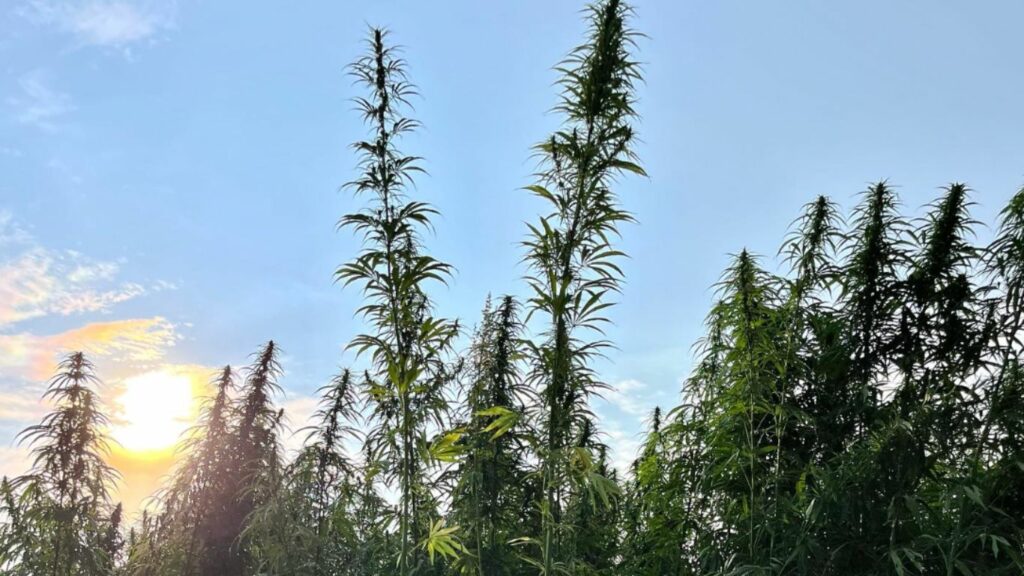
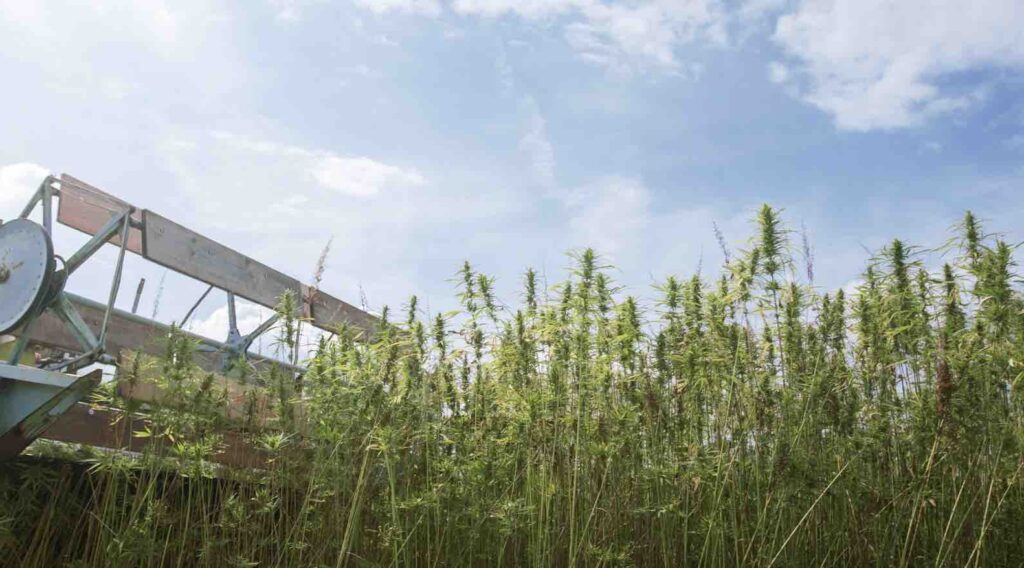
Hemp plants in the Alberta sun at Canadian Rockies Hemp. Image via Instagram
However, with hemp production legal in Canada since 1998 and in the US since 2018, the uptake has been slow, with fits and starts but no solid foothold. As of yet, there have been no significant disruptions from cars made with hemp, or hemp replacing plastics, paper, or textiles.
Instead, hemp farmers in Canada have focussed primarily on seed (or grain, as the industry refers to seed for food production). In the last few years, more farmers have also been growing hemp for fibre.
“You need to develop markets to develop volume in the field. Any crop is worthless if you can’t sell it. So market development is essential.”
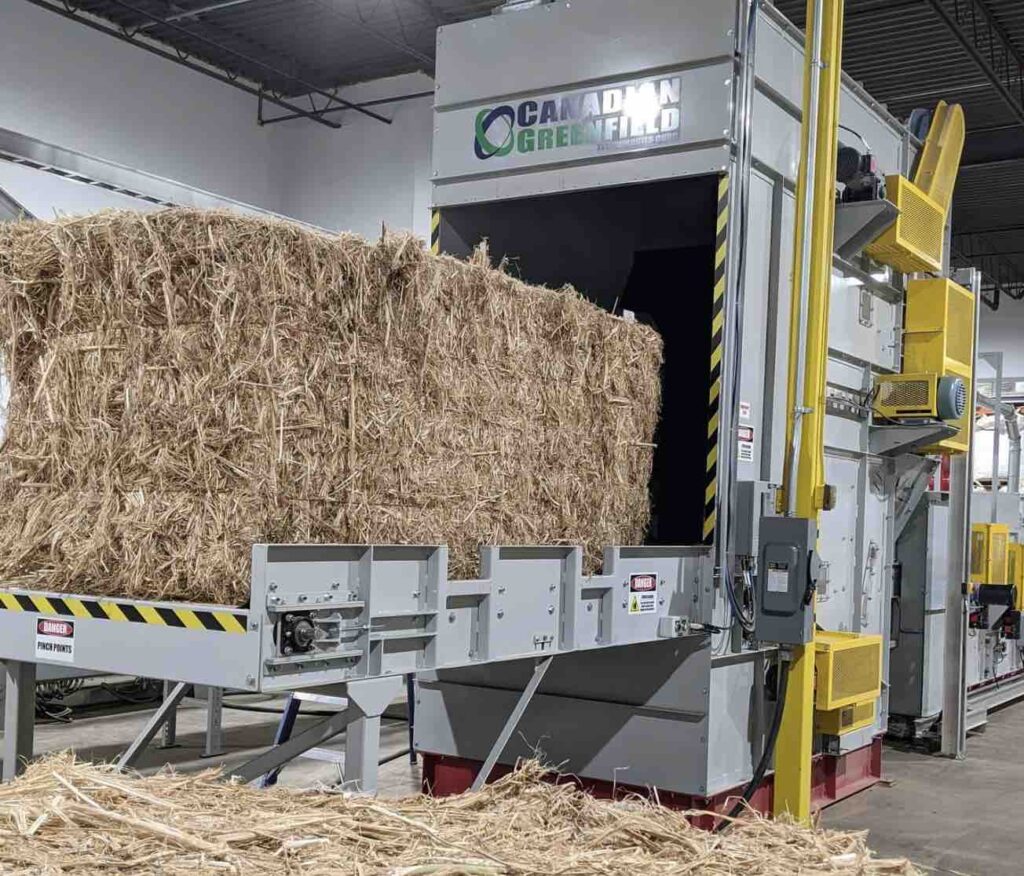
One of the missing pieces that has emerged in recent years that has allowed hemp fibre to become a more viable crop is reliable processing capacity, as well as harvesting equipment and skill.
Without anyone to process hemp hurds for fibre, farmers who wanted to grow hemp mostly looked at growing grain, explains Aaron Barr, the CEO at Canadian Rockies Hemp. So Barr and his partners invested some $30 million in building and equipping a facility north of Edmonton to do just that.
“We started from the ground up, working with growers and producers in the area to understand what they needed to add this crop to their rotation,” explains Barr. “So now, six years later, we’re the largest hemp fibre producer in North America, and we’re turning away more farmers than we can possibly handle right now. We’ve really proven out that aspect of fibre production. Now the secondary component of that is millions and millions of dollars needed for processing capacity of that feed stock.”
So now, six years later, we’re the largest hemp fibre producer in North America, and we’re turning away more farmers than we can possibly handle right now.
Initially, he explains, farmers growing for grain would also try to use their stalks for fibre. However the quality of the fibre from these kinds of plants was not ideal for large-scale processing.
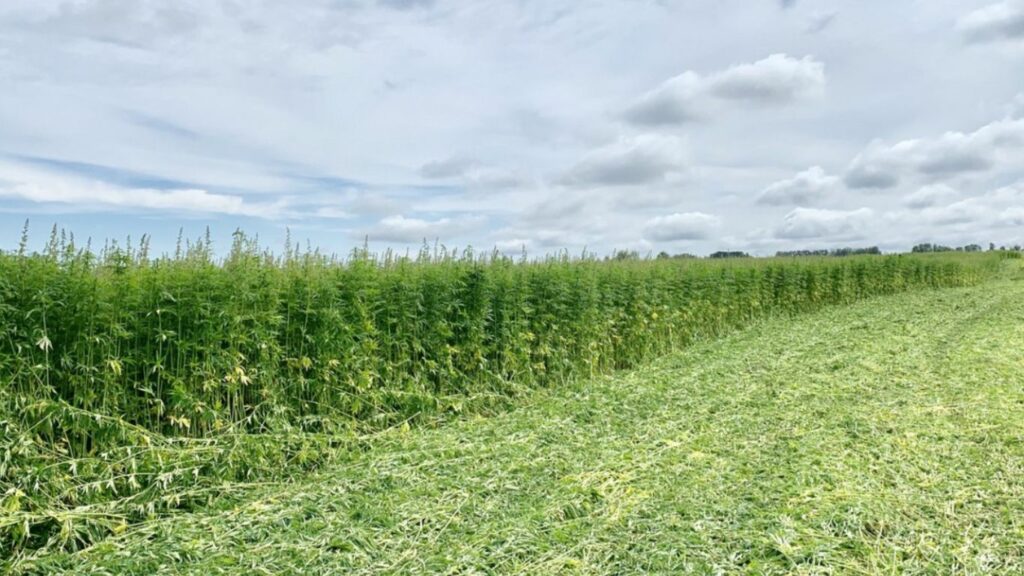
Instead, he began working with local farmers to supply them with specific cultivars that are ideal for hemp production, growing tall, straight stalks that are harvested in mid-summer before the plants spend energy on pollen, seed, or flower production.
This kind of standardization will provide a path for industrial hemp to have a chance to be a real player in the global markets, says Barr, rather than being relegated to niche or novelty products.
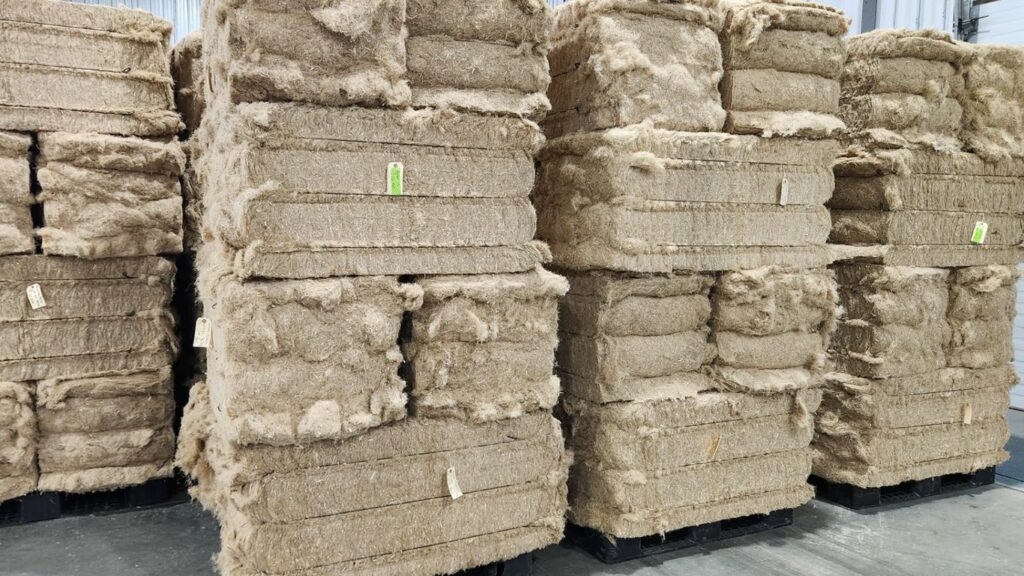
Hemp fibre from Canadian Rockies Hemp to be shipped to the US for insulation. Image via instagram
“If you want to give the manufacturer the exact same product every time, you really need to control that whole supply chain,” he continues. “The varieties, the soil type, how it’s cut, how long it’s rett*, how it’s baled. And then you have the process of decortication. The more you can control with a plant-based product, the more consistent you can get it in the manufacturer’s hands.” (*Hemp fibre needs to be separated from its woody core, either using a mechanical process (decortication) or by the process of “retting” where the plant essentially rots (rets) in the field.)
In 2023, Barr says Canadian Rockies Hemp processed just over 2 million pounds of hemp fibre, which was sold mainly to the US to companies making products like hempcrete, insulation, and animal bedding. Although this is still a drop in the bucket in terms of the needs of larger industries like auto manufacturing, it represents a big step forward from even a few years ago.
“Because of Canada’s regulatory regime, we continue to have a competitive advantage versus some of the hoops the farmers in the US have to go through to grow industrial hemp.”
The real opportunities will be when hemp fibre can compete with products like cotton, fibreglass, and polyester, in terms of price.
“It’s volume based. We’ve done enough market research with manufacturers to know they want significant volume. Right now we’re supplying in the tens of thousands of tons per year, which is very significant, but cotton was about 30 million tons last year just in the US. What we have is just a drop in the bucket in terms of those kinds of industry needs.”
“It’s taken quite a while to get to this point, and we’re still only at the tipping point of the industry before we’re considered a real commodity group. The hemp industry definitely moves slow, but I think the opportunity on the industrial fibre side is the biggest opportunity for this crop.”
One of those businesses buying Canadian Rockies Hemp’s processed industrial hemp is Hempitecture, located in southern Idaho in the US.
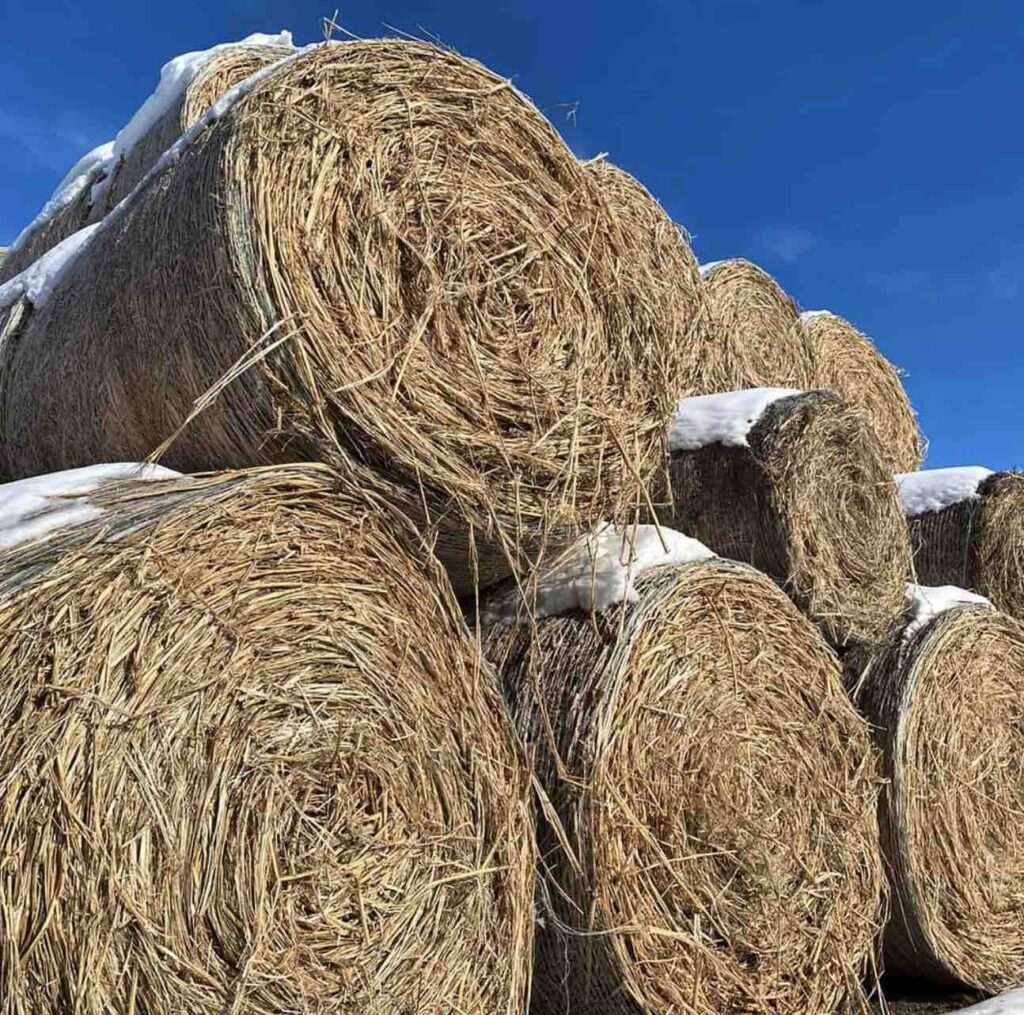
Hemp bales in the field, awaiting processing. Image via Instagram
Mattie Mead, the founder and CEO of Hempitecture, says his company has been sourcing raw materials from Canadian Rockies Hemp for several years, along with a handful of other processors in the Rockies. Hempitecture manufactures different insulation materials, as well as hempcrete, for the construction industry.
Mead says he started Hempitecture in 2018 to produce and manufacture materials primarily for the home construction market, using hemp fibre as the primary ingredient for things like insulation. One of the challenges he quickly ran into, he explains, is that while the US was growing a lot of hemp, much of it was for grain or flower for CBD products.
With Canada first creating rules for industrial hemp production in 1998, Mead says it was an obvious choice to find good, viable fibre.
The company wanted to focus on hempcrete, an alternative to more conventional concrete that used a mixture of hemp hurds in the material, but found scaling the product difficult. This led Hempitecture to also create an array of hemp-based insulation products for the construction industry, often with Canadian-sourced hemp, something they have been able to scale up.
“We were sourcing materials from Canada for some of our earliest projects. Many of our first projects used hemp hurd that was sourced from Canada. We’ve always looked at Canada as an avenue to supply. But obviously, as a US business, we also want to support the supply chain here in the United States.”
One of the current challenges in sourcing US-grown hemp fibre was the same lack of processing infrastructure that Barr referred to.
The rush towards CBD
While the belief in high prices for CBD flower was a contributing factor, Mead also points to the same lack of processing facilities for industrial hemp fibre that Barr referred to, saying it was an “easy gateway” into what people thought was going to be a promising market.
“When industrial hemp was legalized in the United States, there was a huge rush towards CBD hemp,” Mead explains. “The reason it was quicker to take that route was because there’s less infrastructure required for the CBD. So companies could set up with limited capital.”
Instead, that excitement led to oversupply in the CBD market, leading prices to drop and some farmers unable to do anything with large volumes of harvested crops or even plants still sitting in fields.
“For Canadian farmers to supply those ingredients to suppliers that want to include plant-based proteins for their formulations, we can’t even get in the door at 4x the price. We can’t even tout the benefits of the high omegas or the high protein in hemp if you’re four times the price.”
A regulatory change currently making its way through the US Congress could make industrial hemp more viable for American farmers, explains Marne Coit, a cannabis and hemp law and policy expert with Coit Consulting LLC in North Carolina.
The US passed its Agricultural Act in 2014, also known as the Farm Bill, which allowed for hemp production for research purposes. In 2018, the Farm Bill was expanded to allow commercial hemp farming in the US.
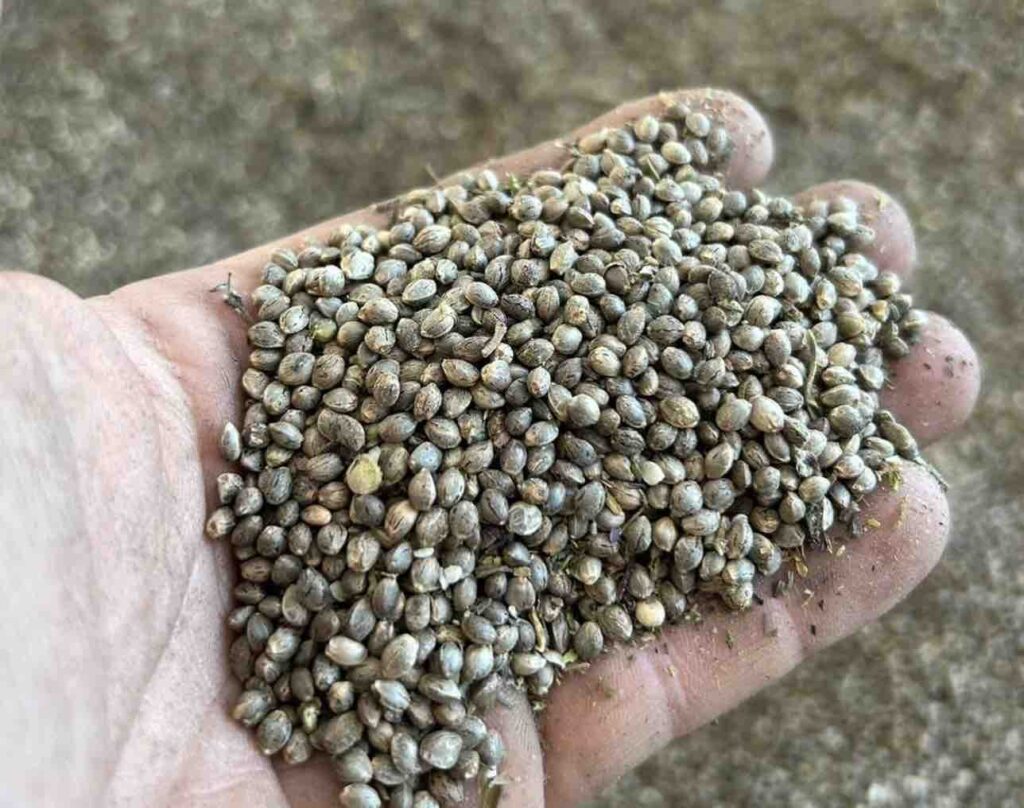
Parent hemp seed production for future grain and fibre hybrids cultivar at Verve Seeds. Image via Instagram
“When the US Farm Bill passed at the end of 2018,” she explains, “it led to this boom in CBD production during the 2019 growing season, but then quickly led to market saturation by the fall of 2019.” But this shift, along with some possible upcoming legal changes, could set the stage for US farmers to begin looking at hemp fibre as a viable crop.
“After the CBD market crashed in the fall of 2019, I think more people have turned towards industrial hemp or turned back to industrial hemp. I think there are more farmers who are coming online to grow.”
It all starts with farmers
Marne is working with Agricultural Hemp Solutions and other groups to get the Industrial Hemp Act (IHA) passed by the US Congress as part of the US Farm Bill. The IHA would lower the regulatory requirements for farmers growing hemp for grain and fibre, such as certain background checks and fingerprinting requirements and removing currently-required THC compliance tests for hemp crops.
Similar to the chicken-and-egg question of needing processing capacity to convince farmers even to plant these crops, if farmers find the bureaucracy of growing hemp too limiting, there won’t be enough farmers to justify investment in processing.
“The goal of the bill is to make it easier in terms of what is happening from the farmers’ perspective because if it’s not easy for them, then the rest of the supply chain doesn’t matter. It starts with the farmers.”
Canada is the epicentre of the North American hemp industry
Working to help farmers utilize hemp crops is a goal of Darren Bondar, the President and CEO of Calgary’s Hempalta Inc.
Hempalta is another fibre processor, like Canadian Rockies Hemp, working with farmers primarily in southern Alberta and Saskatchewan to increase the economic viability of hemp crops. The maturity and sophistication of Canada’s legal framework continues to give it a leg up on the US, says Bondar.
“Because of Canada’s regulatory regime, which is quite reasonable in Canada compared to the US, we continue to have a competitive advantage versus some of the hoops the farmers in the US have to go through to grow industrial hemp,” he notes.
Like Canadian Rockies Hemp, Hempalta sells hemp for construction materials like hempcrete and insulation. It also provides materials for animal bedding made from hemp, a pet litter, a garden mulch, and more. The company also supplied materials for hemp bedding in the giraffe enclosure at the Calgary Zoo.
Hempalta also provides farmers with a way to get paid for the carbon sequestration of their hemp crops—both from carbon sequestered in the roots and soil, and that which is within the hemp hurd itself—another way to make hemp crops more viable for Canadian farmers. By working with a third party, the Hemp Carbon Standard, they can be traded on the voluntary global carbon market.
While cannabis grain for food seed and oils is well established in Canada, Bondar says adding the opportunities of hemp fibre and carbon credits is helping cement Canada as a major hemp-producing country.
“Alberta and Saskatchewan are a hotbed in North America for industrial hemp. The hemp seed market has been well established,” he argues. “And now that they have a market for their fibre and can monetize their carbon credits, this is arguably one of the most lucrative crops that can be grown. We think more and more farmers are going to come on board.”
“I think industrial hemp is about to have its renaissance.”
“There’s been a lot of work done in Canada, a lot of science and research, but we definitely need more seasoned entrepreneurs to jump in so I hope Hempalta is playing a role in that.”
“Alberta and Saskatchewan are a hotbed in North America for industrial hemp.”
Darren Bondar, the President and CEO of Calgary’s Hempalta Inc.
Hemp foods
Greg Herriott has been growing hemp longer than just about anyone in Canada. In 1995, Herriott founded Hempola, Canada’s first hemp brand, providing cold-pressed hemp seed oil for the domestic and global market. He’s seen a lot of highs and lows in the industry, with bursts of excitement and market interest followed by downturns and even market saturation.
Freshly harvested hemp nest to a crop awaiting harvest at Canadian Rockies Hemp. Image via Instagram
Herriott was even involved in the federal government’s industry stakeholder discussions as Health Canada was developing the Industrial Hemp Regulations in 1998, which helped pave a path for many of the opportunities farmers and processors are just now beginning to harness fully, nearly three decades later. He also powers his operations using his own hemp-based biofuels.
Despite all of this, or perhaps because of it, Herriott remains cautiously optimistic about the future of the industry, with an emphasis on the cautious part. One challenge, he says, is educating consumers, as well as the companies who could buy hemp products as an ingredient for their products.
Hemp is now somewhat suffering from the success of cannabis in general, with many people still not understanding that hemp foods do not contain THC, for example.
“Education is paramount. When it comes to selling the health and well-being attributes of hemp food products, consumers today are more confused now than when we started in 1995. Unfortunately, legalization has created a perception challenge for us. I don’t think the hemp food market is growing. It’s static, stagnant.”
One challenge is still regulations. Herriott hopes that moving hemp out of the purview of Health Canada and into Agriculture Canada can unlock more opportunities for the crop and its many agricultural potentials, not just for consumer products but as an array of products for farms like feed for animals. He would also like to see the federal government invest more in educating the market about the value of hemp crops.
“There’s a good solid base of products, but really, it’s an awareness thing, and the awareness thing has to stem from education. And the issue of education is confusion.”
That lack of education means only a small percentage of households even buy hemp food products like oils or seeds. But to Herriott, that’s just an opportunity.
“From one perspective, that’s not a lot of consumers, but from another perspective, that means there’s still a huge, untapped market out there for the hemp food market. It’s a chicken and egg. You need to develop markets to develop volume in the field. Any crop is worthless if you can’t sell it. So market development is essential, and that was our objective from day one in 1995 when we launched Hempola.”
Integrating hemp into the rotation
Jeff Kostuik is the general manager at Verve Seeds in Manitoba, a hemp seed breeder and supplier. One of the biggest challenges he sees the hemp industry in Canada currently facing is the ability to properly scale up to meet the demands of other sectors, as well as consumers.
Like Herriott, he notes the low household adoption of hemp food products, which he says is not just education but also price point. He points out that the same issue is just as true in the hemp fibre space.
If hemp farmers growing for grain can increase their yield through better genetics, supplied by companies like Verve, it could bring costs down enough to make hemp more competitive with other foods and materials.
“When it comes down to it, hemp is just another commodity that has to compete with other ag commodities,” says Kostuik. “And that’s for food or for insulation or hempcrete. We all know the benefits for the environment and everything else, but it has to be close enough in cost for those companies to switch over. Whether it’s for food products or fibre, the cost of goods still has to make sense.”
Many food processors, he explains, are looking for plant-based proteins as an ingredient in their products, something hemp would be perfect for if it was more affordable.
“For Canadian farmers to supply those ingredients to suppliers that want to include plant-based proteins for their formulations, we can’t even get in the door at 4x the price. We can’t even tout the benefits of the high omegas or the high protein in hemp if you’re four times the price.”
The cost per acre to harvest hemp is now relatively the same as growing canola, points out Kostuik, making hemp much more attractive for farmers in the prairies, bringing in from about $500-$800 per acre, depending on several factors.
“Education is paramount. When it comes to selling the health and well-being attributes of hemp food products, consumers today are more confused now than when we started in 1995.”
Greg Harriott, Hempola
He hopes that more farmers will adopt it as a part of their rotation with other crops like canola and wheat or beans, not only as an extra cash crop but also as a way to add to their crop diversity.
“The rotational benefits of introducing another crop are often overlooked. Mother nature doesn’t like us growing just one crop every year. Diversity is key, and with hemp introduced into a new system, you definitely see an advantage in yield for other crops over time because you’re breaking up disease cycles, insects, pests, etc.”
Unleash the powers of unlimited credit / excess capital on a limited, essential resource such as shelter and this is what we end up with: artificial scarcity, rent-serfs and half-vacant neighborhoods.
Ideologies sound wonderful in the abstract, but run aground in the granular real world. The dominate ideology in the world today isn’t a political ideology, it’s the ideology of the market: in this ideology, the market is presented as the ideal problem-solving mechanism, as the interplay of supply and demand and the free flow of capital and labor will automatically fill unmet demand with new supply and provide competition that increases quality and reduces costs.
Let’s consider how the market functions in the real-world U.S. housing market. Take a mixed-use neighborhood of single-family homes with a scattering of low-rise rental buildings. It’s desirable but still affordable to buyers and renters alike.
Enter the bubble economy, the global model for the past 30 years in which unlimited credit is dirt-cheap to corporations and financiers as central banks suppress interest rates to “bring demand forward” by making it cheaper to borrow money to buy assets and products.
This pumps up asset prices as low-cost capital sloshes around the world looking for low-risk cash flows to buy and places to park excess capital that will appreciate as global capital competes for the lowest-risk, most desirable assets.
Real estate in desirable, low-risk locales is an ideal place to park this excess capital. Global capital has no need to rent the flats and homes being snapped up for appreciation; indeed, renting the flats and homes is viewed as troublesome and not worth the hassle.
So global absentee owners start buying properties in the desirable neighborhood. These buyers have zero interest in the livability of the neighborhood or the residents; it’s strictly an investment based on the Prime Directive: maximize the return on capital by any means available.
To capital, properties in the neighborhood are commodities, interchangeable with millions of other properties around the world:we own flats in Zurich, Paris, Bangkok, Singapore, Barcelona and Miami.
Next, corporations discover rents in desirable neighborhoods generate profitable cash flow, so corporations start buying single-family homes and converting them from owner-occupied to rentals. These corporations act as a cartel, operating much like a monopoly as they all have the same access to unlimited credit and the same goal of maximizing return on capital.
Then the short-term rental market generates strong demand by investors large and small for vacation / AirBnB rentals, which are initially highly profitable: those with surplus equity / credit / capital hear of stupendous profits being raked in by absentee owners of short-term rentals, and they join the bidding war of global capital and corporations for homes and rental properties.
Now half the housing stock of the neighborhood is owned by absentee owners and corporations, all guided by a single raison-d’etre: maximize the return on capital by any means available. Now that 25% of the housing stock has been removed from owner-occupancy and long-term renter / residents to serve the short-term rental market, there’s a scarcity of homes to buy or rent.
Another 15% is empty by design, as the owners are overseas investors solely interested in owning real estate in the U.S. as a low-risk place to park some of their excess capital.
So 40% of the neighborhood’s housing stock has been removed from the market for residents, the equivalent of 40% of the housing burning to the ground.
This artificial scarcity enables the corporate owners to jack up rents to nose-bleed heights, and the few non-corporate owners of rentals quickly follow suit. Now the “market rents” are double what they were prior to the arrival of non-resident “market forces.”
As home prices soar, residents who work for a living cannot compete with the unlimited credit lines of corporations and overseas wealth, and so those seeking to own a home must look elsewhere farther afield, or give up the dream of owning a home and resign themselves to life as a rent-serf, barely able to pay the sky-high rents charged by corporations and absentee landlords.
Meanwhile, the conviviality and livability of the neighborhood has been destroyed. The short-term rentals are plagues, as non-resident visitors think nothing of hosting loud parties, ruining the lives of working neighbors. The neighborhood is now dominated by transients, empty dwellings and rentals crammed with people who can’t afford to rent their own flat.
With rents and home prices now unaffordable, the city is pressured to allow the construction of highrise condos by corporate developers. The handful of subsidized below-market rate condos are quickly snapped up, and the market-rate units are purchased by investors, to be left empty (a place to park excess wealth) or as short-term rentals.
The construction of the condo did nothing to alleviate the artificial housing scarcity as only the few subsidized units are affordable to wage-earning residents.
The destruction of the neighborhood is all perfectly logical within the confines of the market: capital was allocated to maximize profits by any available means, and so the market worked perfectly.
The problem with the market is the market doesn’t care about livability or the quality of life or the neighborhood as a social structure, for these are non-market factors.The market views places and people as commodities, interchangeable on a global scale: we own flats in Zurich, Paris, Bangkok, Singapore, Barcelona and Miami. They’re all commodities to be bought and sold to maximize the return on capital, nothing more and nothing less.
What’s missing in this distorted reduction of life to commodities is housing is fundamentally shelter, and an essential human need. Housing isn’t merely an asset that generates cash flow or an asset that serves as a place to park excess wealth. It is first and foremost shelter. But in the market, “shelter” has no meaning except as a source of demand that is no different from the demand generated by capital for cash flows, profits and low-risk places to park excess capital for appreciation.
This is how the U.S. housing market has been transformed by the tyranny of the market: unleash the powers of unlimited credit and excess capital on a limited, essential resource such as shelter and this is what we end up with: artificial scarcity, rent-serfs and half-vacant neighborhoods owned by absentee landlords solely interested in maximizing the return on their capital.
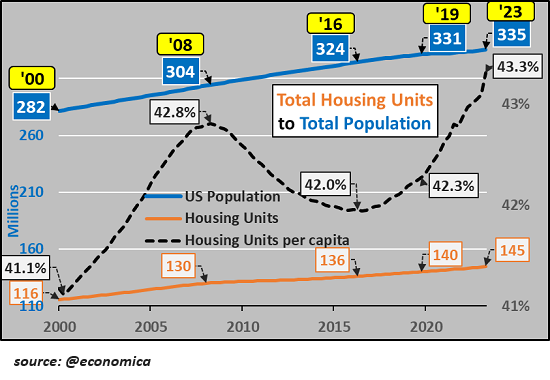
Here we see housing per capita in the U.S. has reached a new high–yet there’s a scarcity of housing. If this is mystifying, please consider the drivers of artificial scarcity.
Subscribe to Charles Hugh Smith’s Substack
Choosing economic self-reliance, navigating global instability and degrowth, managing burnout, invest in yourself.
The Navy is changing its policy for recruits who test positive for cannabis upon arriving at boot camp, choosing to grant waivers rather than dismiss them outright in light of the continuous difficulties the United States military faces in recruiting. Head of the Navy’s personnel policy and plans unit, Rear Admiral James Waters, explained that if a recruit tests positive for cannabis and admits to using it, an assessment is done to make sure there are no underlying problems.
The adaptation aims to align with social laws and provide an opportunity for young people to acclimate to the Navy’s culture during boot camp. This move is a reflection of larger military attempts to solve recruitment deficiencies and lower the boot-camp dropout rate, which is currently approximately 10%, marking one of the lowest in past years.
Waters stressed that with the Navy’s target of recruiting 40,000 sailors by the end of 2024, minimizing the loss of recruits during boot camp is crucial. However, he emphasized that the more permissive attitude is limited to THC testing and doesn’t extend to other substances.
The adjustment follows a similar move by the Air Force, which saw a significant increase in enlistment waivers granted to recruits testing positive for THC than initially anticipated. General Christopher Amrhein, the Air Force’s recruitment service commander, highlighted that the waiver policy helped mitigate the impact of missing the annual recruitment goal for the first time in more than two decades.
The unit reported that it had granted 165 waivers in the first year after they were made available. That is more than three times as many waivers as it had anticipated granting each year.
The Navy and the Air Force’s recent policies represent a departure from previous strict regulations related to marijuana use, particularly in the context of CBD and hemp products. Over the years, various military units have communicated specific rules to their members regarding marijuana use, emphasizing the prohibition of hemp, CBD and marijuana products, even in states where using those substances is legal.
The Navy, for instance, prohibited the use of CBD and hemp products in 2018, with subsequent updates explaining the rationale behind the rule change. Additionally, the Naval War College issued a notice in 2022 stating that marines and sailors could test positive for cannabis if they consumed Pepsi’s Rockstar drink, which contains hemp.
Given the rate at which more people are taking to regulated products from licensed marijuana companies such as Trulieve Cannabis Corp. (CSE: TRUL) (OTCQX: TCNNF), the cannabis waivers offered by the different wings of the armed forces are a rightful response to the changing public perception of this substance.
About CNW420
CNW420 spotlights the latest developments in the rapidly evolving cannabis industry through the release of an article each business day at 4:20 p.m. Eastern – a tribute to the time synonymous with cannabis culture. The concise, informative content serves as a gateway for investors interested in the legalized cannabis sector and provides updates on how regulatory developments may impact financial markets. If marijuana and the burgeoning industry surrounding it are on your radar, CNW420 is for you! Check back daily to stay up-to-date on the latest milestones in the fast -changing world of cannabis.
To receive SMS alerts from CNW, text CANNABIS to 888-902-4192 (U.S. Mobile Phones Only)
Please see full terms of use and disclaimers on the CannabisNewsWire website applicable to all content provided by CNW, wherever published or re-published: https://www.CannabisNewsWire.com/Disclaimer
On December 30th, 2023, it was a balmy 13.2°C in Vancouver, and the garden stubbornly refused a winter nap. While flowering plants in typically cold months may seem uplifting, it creates some garden chaos, and it’s a sign that gardeners need to start adapting to unusual temperature swings.
Changing Climate, Changing Gardens
El Niño is the naturally occurring warming of the ocean in the central and eastern portions of the Pacific that occurs every two to seven years. This affects weather patterns globally, and in southern BC, it generally means a mild and wet winter. Combining the phenomenon with a warming planet can cause some challenges for our plants.
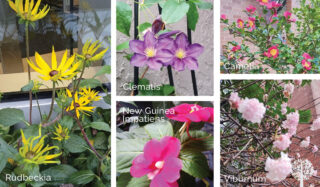
In mid-November, my clematis set new buds and opened. In December, flower stalks appeared on the rudbeckia, which usually blooms in the summer’s heat. The perennial fuchsia kept flowering, and roses bloomed at Christmas! The aphids kept reproducing because the cold never killed them, and they infested my hellebores.
Chill Hours
Many plants growing in cooler climates require several chill hours between 0-7°C. As the temperature drops, the plant receives a signal to go to sleep. When the air and soil warm up in the spring, the plants start growing and reproducing again. We need sleep to feel energized during the day – so do plants!
For example, spring bulbs like tulips and daffodils require 12-16 weeks of chill, giving them time to store soil nutrients and energy to bloom. This is why you plant them in the fall.
What To Do?
You can’t force garden plants into dormancy. Reducing the amount of light a plant receives works for overwintering annuals in the garage but not an entire garden. Plants start to grow in spring, not only because the soil is warming but because the longer daylight hours trigger them. And while less water can convince them to sleep, I have no control over the rain.
So, I adapted and tried to make the best of an unusual situation. I pruned the clematis, which I wouldn’t typically do until early spring. I also hoped it might reset the plant’s clock. I left the roses alone because pruning would cause accelerated growth, and a cold snap, which would inevitably come, would cause frostbite that might kill them. Each plant is different, so each approach had to vary.
I dug down into the soil to see if the daffodils had rooted. Many hadn’t, but I removed the mulch blanket on the soil to cool the bulbs. I left the soil covered around other plants and shrubs to provide nourishment and protection in case the cold came.
I also decided to keep the hellebore out in the rain since water is the best way to eliminate aphids.
Takeaways
My region finally experienced a cold snap in January, but it only lasted two weeks, and temperatures rebounded. Did my efforts work? Time will tell, but the daffodil bulbs are blooming right on cue, and the roses were spared any frostbite. What about next time? I’ll use what worked and expand upon it.
We’ve always known to prepare our gardens for the cold, drought, and heatwaves. But as weather patterns change, gardeners must be prepared for temperature swings at unusual times of the year and adapt to how our gardens will behave. Be mindful and inspect the garden daily, even when it’s supposed to be sleeping. Who said gardening was easy?
(CNW) Vancouver — Burb Cannabis Corp., an international cannabis culture brand and high-end retailer of branded products and apparel, has announced the grand opening date of its eighth cannabis retail store at the University of British Columbia (UBC) – the first dispensary at a major University Campus in the world.
After a nearly three year process, filled with contentious debate and a vocal minority opposition, Burb is excited to announce that at 10am on February 23rd, the doors at 5784 University Blvd in Vancouver will finally open to the public. “This is a significant milestone for our company, not only because it’s our eighth store, the current cap limit in B.C. for any single retail brand, but also because it’s the first cannabis retail store to open on a major university campus anywhere in the world,” said John Kaye, CEO and co-founder at Burb. “We’re planning a full day of events, DJ’s, giveaways, exclusives and most importantly, safe and legal access for our customers who have been patiently waiting,” added Kaye.
Burb’s UBC location will carry a curated menu from flower, pre-rolls and concentrates to topicals, edibles and much more. “Our focus is on offering the best menu possible, with exclusive products you’ll only find at Burb, such the Jellee hand-rolled hash-holes, Book Club Exclusives and limited run merchandise and accessories,” stated Peter Pittson, general manager at Burb UBC and co-founder of Book Club, a cannabis community and products company.
The store will operate Monday through Saturday from 9am to 11pm and Sunday from 10am to 10pm.
Advertisement
A look ahead:
With the current restrictions on B.C.’s private retailers to expand beyond eight stores, as well as the inability for groups like Burb to sell their own branded products inside their stores (tied-house restrictions), the company has been focused on its consumer packaged goods business outside of B.C.
The brand is launching in New Foundland with licensed producer, Atlantic Cultivation, this quarter, while continuing to grow its presence in Ontario and Alberta, launching exclusive new cultivars from famed breeders such as Cactus Genetics in all three provinces.
“It’s frustrating that we can’t sell our own Burb-branded products in B.C., the one market where we live and work. We’re hoping the province adjusts their stance on white labelling rules for private retailers so stores can differentiate and become more competitive,” stated Kaye. “With uncertainties around when this arbitrary eight store provincial cap will be lifted or expanded, we’ve been forced to look for growth outside of our home province. We hope that our collective voices will be heard, through organizations like ABLE BC and the RCCBC. In the meantime, we’ll continue growing our brand in other markets, including California, where we’ve built considerable market presence and awareness,” added Kaye.
(AP) Las Vegas — Nevada regulators have issued the first license to operate a lounge where cannabis can be consumed recreationally, marking the first of what are expected to be dozens of such operations.
The state Cannabis Compliance Board announced Thursday that the license was awarded to a business in Las Vegas following an inspection by agents earlier this week. The lounge — dubbed Smoke and Mirrors — is owned by Thrive Cannabis Marketplace, the state’s largest independently owned cannabis business.
There are currently 19 lounges that have been approved by the compliance board for a conditional license. A final inspection will be required before a license is granted and they can open to the public.
It’s been years since Nevada voters first approved legalizing recreational cannabis. In 2021, lawmakers cleared the way for business owners to apply for licenses to establish on-site consumption lounges.
Advertisement
The state’s cannabis industry had promoted the lounges for their economic development potential and pitched them as a draw for tourists who visit Las Vegas annually but can’t legally use the products in places like hotels.
Thrive Cannabis Marketplace officials said their consumption lounge will open to the public in late February. It will have a range of products for customers — including cannabis-infused cocktails — and will serve as a hub for artists and musicians to showcase their work.
“It’s more than a venue, it’s a platform for the cannabis industry as a whole, where tourists and locals alike can be a part of a new chapter in the evolution of hospitality,” said Chris LaPorte, managing partner of RESET, a Las Vegas-based cannabis hospitality company.
PhD scientist and researcher Justin Czerniawski, VP of R&D for Rad Source Technologies, speaks to a current shift happening in cannabis, from centralized irradiation facilities to smaller, in-house units enabling more control over the final product.
A recurring theme he has heard within the cannabis industry is a reluctance towards shipping flower out for testing due to unwanted changes to the product’s composition. The logistics alone are complicated, says Czerniawski, from a security perspective as well. For this reason, there’s now an increasing demand in North America for standalone irradiation technology, especially among craft or boutique-sized cannabis producers.
GO: When it comes to irradiating cannabis, what are the differences between in-house vs. third party testing?
JC: In Canada, gamma facilities or e-beam are giant, centralized facilities that are used to irradiate, not just cannabis but food and even pharmaceutical products. So these are giant facilities where you load pallets that get wheeled through automatically, the products are exposed and the exposure is far greater than a standalone smaller unit. The exposure is well over 10,000 gray in many instances – gray is a unit of measure that we use.
GO: What happens at third party irradiation labs?
JC: What happens is you have certain batch sizes that you send in, and then you lose control of your product and it’s getting exposed to a lot more radiation than you probably want.
Advertisement
For instance, if it’s shipping in a truck, maybe it’s summertime and the truck gets warm; you’re losing terpenes and LPs no longer have physical control over it.
GO: What is the smallest unit that can be used while still maintaining compliance?
JC: Some people are running 2,000 to 2,500 gray, not over 10,000. And then they can make sure they’re in a controlled environment. They can operate safely on site without having to worry about customer, employee, or product safety. The wavelength itself is tuned to fight the microbes, and that’s it. It affects the DNA of the microbes and once the DNA is destroyed, the microbe itself self-destructs and it’s no longer viable.
GO: Are the cannabinoids and terpenes at larger facilities being damaged?
JC: It’s just as likely, if not more likely, that the damage to the terpene profiles and cannabinoids is actually happening in transit. There’s so much unknown when you lose control over the product, why even take that chance?
The nice thing about the radiation machine is since it’s specifying the use of mould, we can actually get it down to “too few to detect.” Sometimes a product has been on a shelf for sometimes a week, sometimes a month. We’ve seen a lot of recalls where people have gotten their testing levels just under the threshold, but because they’re still viable – total yeast and mould – it’s grown back when it’s retested. Too few to detect is going to be vital, especially in strict markets like Germany.
We’re starting to see higher levels of processing, not necessarily industrial processing, we’re seeing it more like boutique processing – that really seems to be the market.
InBev might own the craft brewer, but the craft brewer still controls their recipe; a similar structure seems to be going on in the cannabis space.
Rad Source Technologies representative Dion Cimini began growing in the legacy market from his home state of Michigan 14 years ago. He’s now spent the last three years working in microbial decontamination with Rad Source and his knowledge of the industry on both sides of the border remains strong. When navigating the different Pharmacopoeia standards that producers need to meet for testing microbials, differing limits must be adhered to depending on jurisdiction.
GO: What is the current microbial limits in Canada?
DC: In Canada, they allow the licensed producer the option to decide which Pharmacopoeia USP that they want to inherit as part of their quality assurance. In Canada domestically speaking, the easiest one is 5.1.a Table C. You can choose from any of the ones you want.
Now, some distributors might want to see cannabis at a different level, which might be 5.1.8 Table B. But most of the time domestically they’ll be going with C because it’s 50,000 Cfu yeast and mould, it’s 500,0000 Cfu at anaerobic microbial and bio tolerance under 10,000 Cfu.
When you look at Table B, your yeast and mould drops to 500 Cfu, your aerobic bacterial drops to 50,000. And then your bio tolerance goes down to 100. Anybody who can pick and choose their testing standard, they’re going to pick the easiest one.
Now for outdoor growers, even though some of those are actually tough, 50,000 for your yeast and mould, well that’s tough for an outdoor grower; that’s hard for a greenhouse grower.
GO: How about shipping internationally?
DC: When you ship your product, internationally. If you were to sell your product into Germany today, now you have to follow the EP 5.1.4, which is 10 Cfus for your total yeast and mold, 100 on anaerobic, and then less than one or absent in one millilitre biotolerant gram negative bacteria. It’s all over the place in other words.
GO: How is a lack of microbial standardization causing issues in the industry?
DC: Hopefully we’ll get some clarity with this new review. I know that it’s an issue because it is all over the place.
Canada, domestically, you can choose, but mostly they’re used the European Pharmacopoeia 5.1.8 or 5.1.4. There’s no standardization of how to test the product. Every lab in Canada is testing product differently. Some are homogenizing, some aren’t. That’s why you see some elevated THC results because they’re not being tested correctly. And they’re being tested into to the to the advantage of the grower.
GO: How are different growing methods and mediums affecting the end product?
DC: It’s all based on climate control. When you’re outdoors or in greenhouse, you’re exposed to the outside; it’s harder to control than it is in an indoor environment. Also mediums, so growing in water versus soil, soil is probably going to increase your likelihood of getting more microbial if microbial is live in the soil.
If you have active organic soils, the same thing, but it really just depends on the control. You could have soil and then put perlite on the top to prevent any kind of bacteria or microbials from getting onto the plant or blowing into the air.
GO: What are the benefits of an in-house irradiation unit?
DC: It’s a better technology because it’s not as hard to operate and you can control the gray levels. There’s also a lot of heat on e-beam. With these machines, you control the heat. It has a chiller hooked up to the unit and you can control different temperature ranges. The lower the temperature, the lower the impact on the product. Having the temperature dialed in is not something you’re able to do that when you send it to a traditional gamma or e-beam facility.
Several Manitoba cannabis companies are at the heart of a notice of claim recently filed in a Manitoba court.
TobaGrown, Inc. and TobaRolling, Inc. filed a notice of claim in Manitoba on February 16 against the owners of Kief Cannabis Company, Ltd. and Lucky Ventures, Ltd. The defendants have 20 days to reply to the notice.
In the claim, Jesse Lavoie, owner of TobaGrown and TobaRolling, claims that the owners of two other Manitoba cannabis businesses unfairly removed him from a business partnership, causing his own companies to suffer significant financial hardship.
TobaGrown’s lawyers contend that the principal of and a shareholder in Kief Cannabis, Jesse Denton, entered into an agreement with Lavoie to allow Toba Rolling to distribute its TobaGrown and other branded cannabis products from Kief’s federally licensed facility.
The claim also contends that Lavoie and Denton entered into an agreement with another Manitoba cannabis entrepreneur, Tim Doerkson, to create the cannabis brand “Lucky Stash” for the Manitoba market.
Although the agreement between TobaGrown and Kief was fruitful, the claim alleges Denton terminated the agreement in 2023, effectively locking the company and its partner brands out of not only the Kief facility but the Manitoba market entirely. TobaGrown now claims that Kief is in breach of contract, owing Toba more than $100,000, as well as equipment and cannabis held at their facility.
It also contends that Denton violated his “fiduciary duties” to the business arrangement, causing TobaGrown to suffer damages it says he is liable for, and that both defendants acted with an intent to injure the economic interests and reputation of Lavoie and the Toba brand.
These allegations have not been proven in court. Neither Denton nor Kief responded to requests for comment.
Lexaria, a global innovator in drug delivery platforms to enhance bioavailability, announced recently that it will focus on GLP-1 applications for diabetes and weight loss for the 2024 calendar year
Chris Bunka, Lexaria’s CEO, has expressed his confidence in the company’s direction, reiterating the intention to demonstrate the superior performance of GLP-1 drugs processed with its patented DehydraTECH(TM) technology
The company looks to build on the success of the early-stage results achieved in 2023, and looks to embark on two human pilot studies, a multi-arm 12-week animal chronic study, a human chronic weight-loss and diabetes study, as well as a multi-month stability testing of DehydraTECH GLP-1
Lexaria Bioscience (NASDAQ: LEXX), a global innovator in drug delivery platforms, recently announced its 2024 R&D plans, with emphasis on GLP-1 investigations. GLP-1 agonists (glucagon-like peptide 1) is a class of drugs used for diabetes and weight loss.
This comes hot on the heels of a successful, active year of R&D in 2023, a year that saw significant strides in developing its patented DehydraTECH(TM) technology including its new foray into GLP-1 drugs. Chris Bunka, Lexaria’s CEO, expressed his confidence and overall optimism in the company’s new direction, reiterating the company’s intention to demonstrate the superior pharmacokinetics and safety/efficacy performance of GLP-1 drugs when formulated and processed with DehydraTECH (https://cnw.fm/5pVk5).
In 2023, DehydraTECH showed positive results in its 8-week study that involved 32 diabetic rodents. The study showed that DehydraTECH-CBD lowered triglyceride levels and body weight differential over the eight weeks, positive results that would also be replicated in its other studies including, but not limited to, hypertension, human hormones, and the overall reduced risk of oral nicotine. This laid the groundwork for Lexaria to explore a new class of molecules it had never worked on before, ultimately quietly launching its top-priority and unpublicized early-stage work program – GLP-1- for weight loss and diabetes control.
In the words of Mr. Bunka, this was a “high-risk program,” mainly because this class of drugs is considered “large molecules,” yet all of Lexaria’s previous investigations were concentrated on “small molecules.” However, by the end of November and early January 2024, the company reported positive interim and final human pilot study results using a single semaglutide dose of a Rybelsus(R) tablet to a matching dose from Rybelsus(R) that had been compound formulated in capsule form using DehydraTECH processing technology enhancements. This was a massive milestone for Lexaria, with Bunka describing the results as “surprising.” Of note was that DehydraTECH processing delivered a statistically-significant higher proportion of the semaglutide and did so more quickly, ultimately having a statistically-significant impact on blood sugar.
GLP-1 drugs have been receiving rising interest recently. Having received FDA approvals as recently as 2021 and 2022, mainly given its health benefits and potential market size, Lexaria understands that this could be the next best thing, hence its focus on this drug class.
“Our R&D plans for 2024 are very tightly focused and will be concentrated mainly on GLP-1 investigations,” noted Mr. Bunka.
“Given the overwhelming interest in the GLP-1 sector, this will be a main focus. We are not at this time planning additional 2024 research in the antiviral, nicotine, or PDE5 sectors. We have solid early-stage data in each of those areas that will allow us to build upon those at the right time,” he added.
Mr. Bunka has reiterated that 2024 will be the year that Lexaria’s hard work will prove its worth. He looks to follow up on the positive early-stage results achieved in 2023, even as it embarks on two human pilot studies, a multi-arm 12-week animal chronic study, a human chronic weight-loss and diabetes study, as well as a multi-month stability testing of DehydraTECH GLP-1. Mr. Bunka is confident that its focus on GLP-1 drugs will yield this outcome.
NOTE TO INVESTORS: The latest news and updates relating to LEXX are available in the company’s newsroom at https://cnw.fm/LEXX
About CannabisNewsWire
CannabisNewsWire (“CNW”) is a specialized communications platform with a focus on cannabis news and the cannabis sector. It is one of 60+ brands within the Dynamic Brand Portfolio @ IBN that delivers: (1) access to a vast network of wire solutions via InvestorWire to efficiently and effectively reach a myriad of target markets, demographics and diverse industries; (2) article and editorial syndication to 5,000+ outlets; (3) enhanced press release enhancement to ensure maximum impact; (4) social media distribution via IBN to millions of social media followers; and (5) a full array of tailored corporate communications solutions. With broad reach and a seasoned team of contributing journalists and writers, CNW is uniquely positioned to best serve private and public companies that want to reach a wide audience of investors, influencers, consumers, journalists and the general public. By cutting through the overload of information in today’s market, CNW brings its clients unparalleled recognition and brand awareness. CNW is where breaking news, insightful content and actionable information converge.
To receive SMS alerts from CNW, text CANNABIS to 888-902-4192 (U.S. Mobile Phones Only)
Please see full terms of use and disclaimers on the CannabisNewsWire website applicable to all content provided by CNW, wherever published or re-published: https://www.CannabisNewsWire.com/Disclaimer












Recent Comments