
Skytree Now Offering Legal Cannabis Growers a Cleaner and Reliable Alternative for Carbon Dioxide using Direct Air Capture Technology

How antidepressants, ketamine and psychedelic drugs may make brains more flexible
The first-line pharmacological treatment for major depressive disorder (MDD) are antidepressant drugs known as selective serotonin re-uptake inhibitors (SSRIs). But a significant proportion of people don’t respond to these drugs.
Given that major depression is a global mental health problem that is on the increase, it is important to find novel pharmacological treatments for those who do not respond to the current ones. But to do that, we need to understand exactly how the drugs work – which we currently don’t.
MDD is a debilitating and distressing mental health disorder, trapping sufferers in a rigid and negative state of mind. There’s even evidence suggesting that this lack of flexibility is associated with cognitive changes, including negative thoughts and biases, and problems with learning and memory.
In our study, published in Molecular Psychiatry, we show that an SSRI called ecitalopram may actually make brains more “plastic” – meaning more flexible and adaptive; more able to facilitate communication between neurons (brain cells). Brain plasticity is simply the ability of neural circuits to change through growth and reorganisation. Learning involves brain plasticity, including changes in neural circuits, and can help people to recover from depression.
Advertisement
One novel treatment option for depression, approved by the US Food and Drug Administration, is intranasal esketamine (an anaesthetic made from ketamine), although it has not as yet been approved for use by the NHS.
The psychedelic drugs LSD and psilocybin are also being investigated for treatment resistant depression in research studies, but are not yet approved by regulatory bodies.
When these studies are conducted, there is careful monitoring by a medical professional to ensure participant safety.
We know that both SSRIs and psychedelics target the same brain receptor (known as the 5HT-2A). By contrast, eskatamine, similar to ketamine, works on a different receptor (N-methyl-D-aspartate or NMDA) and affects the brain chemical glutamate.
So how do SSRIs and psychedelics work to reduce symptoms of depression? At present, we don’t have the full picture. But the 5HT-2A receptor is linked to the brain chemical serotonin, increasing levels of it in the brain. And a recent study has indeed shown that serotonin appears to be reduced in people with depression.
SSRIs, however, also affect the neurotransmitters GABA and glutamate. The latter has been linked to learning, cognition and memory – suggesting SSRI may actually help to restore cognitive function. Although the exact mechanisms of psychedelics are not yet fully understood, their antidepressant effects seem to work in a similar way to SSRIs given their effects on 5HT-2A receptors. However, there are also other reactions to psychedelics, such as hallucinations.
Measuring brain plasticity
All these drugs have therefore been suggested to affect brain plasticity. However, in humans, it can be difficult to estimate levels of brain plasticity. One common method that scientists have used is to measure a protein called the brain-derived neurotrophic factor (BDNF) in blood samples.
BDNF helps brain plasticity by increasing the number of synapses (locations where neurons can communicate with each other), as well as the branches and growth of developing neurons. Synapses are particularly important in brain functioning as they allow transmission of chemical and electrical signals from one neuron to another. Similarly, synapses also store brain chemicals for release.
There have been some studies showing that antidepressant drugs increase BDNF. However, better techniques are required to study plasticity in the human brain.
To develop better drugs, one approach is to find anti-depressant drugs with a faster mechanism of action. According to the NHS website, SSRIs usually need to be taken for two to four weeks before any benefit is felt.
We suspected that one reason for this delayed effect may be that brain plasticity needs to occur with SSRI treatment. As this process involves rewiring, such as the creation of synapses and circuits, it isn’t instant, but is thought to take approximately 14-21 days.
In our study, which was a collaboration between the University of Cambridge and the University of Copenhagen, we used a novel technique to measure plasticity in the human brain, following SSRI treatment, for the first time.
Thirty-two participants underwent positron emission tomography (PET) scanning to detect the amount of a protein called “synaptic vesicle glycoprotein 2A”, or SV2A, in the brain. We know that SV2A is a marker of the presence of synapses. An increased amount would suggest that more synapses are present and therefore that brain plasticity is higher.
Our results showed a rise in this protein as a result of taking escitalopram (an SSRI). We found that, in those taking escitalopram, increased SV2A was associated with increased duration on the drug. Our findings suggest that brain plasticity increases over three to five weeks in healthy humans following daily intake of escitalopram.
This is the first real evidence in humans that SSRIs really do boost neuroplasticity – seen in the brain – and that this is one of the reasons it can treat depression. Similar evidence from studies in the human brain are still required for the psychedelics.
It makes sense that if antidepressant treatment facilitates brain plasticity, this should make it easier for people taking these treatments to learn new things. And we know that the ability to adopt new strategies, and change them if they don’t work (supported by what researchers call cognitive flexibility), is key to recovering from depression.
Disclosure statement:
Barbara Jacquelyn Sahakian receives funding from the Leverhulme Trust and the Lundbeck Foundation. Her research work is conducted within the NIHR Cambridge Biomedical Research Centre (BRC) Mental Health and Neurodegeneration Themes and the NIHR MedTech and in vitro diagnostic Co-operative (MIC). She consults for Cambridge Cognition.
Christelle Langley receives funding from the Leverhulme Trust. Her research work is conducted within the NIHR Cambridge Biomedical Research Centre (BRC) Mental Health and Neurodegeneration Themes and the NIHR MedTech and in vitro diagnostic Co-operative (MIC).

Avicanna’s new research collaboration with a multi-national European-based pharmaceutical company
(Globe Newswire) Toronto — Avicanna Inc. a biopharmaceutical company focused on the development, manufacturing, and commercialization of plant-derived cannabinoid-based products is pleased to announce it has entered into a research collaboration with a multi-national European-based pharmaceutical company.
The research collaboration will initially assess the company’s proprietary SEDDS technology in combination with collaborator’s various drug delivery and pharmaceutical formats to gain a better understanding of proprietary dosage forms with precisely standardized delivery and enhanced bioavailability of cannabinoids. The research collaboration may subsequently assess the possibility of further preclinical research and clinical development.
Under the research collaboration, Avicanna will also provide services for assessing a range of other formulations that may be included in collaborator’s portfolio.
Advertisement
Rad Source Technologies announces new RS420∙Q+
(CNW) Buford, Ga. — Rad Source Technologies, a pioneer in life science irradiation with over 300 units installed globally, announces the RS 420 Q+ Cannabis Decontamination System, a strategic solution filling a capacity gap between their two most popular systems. The RS 420 Q+ empowers cultivators to efficiently decontaminate up to 25 pounds of cannabis per cycle, perfectly positioned between the RS 420 Q and the industrial-grade RS 420 XL
“The RS 420 Q+ fills a critical gap in the cannabis decontamination landscape, offering mid-sized cultivators the scalability and efficiency they need. With its enhanced power, rapid cycle times, and Rad Source’s unwavering commitment to flower quality and public safety, the RS 420 Q+ sets a new standard for delivering safe, and high-quality cannabis to the planet. The RS 420 Q+ marks a monumental leap forward in cannabis decontamination technology.” — George Terry, executive vice president, Rad Source Technologies
The RS 420 Q+ tackles the precise capacity needs of a diverse range of producers. Its 25-pound per cycle capability perfectly fills the void between the RS 420 Q (5-7 pounds) and the RS 420 XL (35-50 pounds). This throughput allows smaller growers to scale up operations efficiently, while offering large-scale producers additional flexibility within their processing lines.
The RS 420 Q+ harnesses the power of the all-new QUASTAR 2 platform, featuring a 35 per cent increase in Photonic StormTM intensity over the QUASTAR. This translates to enhanced microbial inactivation efficacy, ensuring thorough decontamination and better dose uniformity across a wider range of cannabis cultivars and densities.
Advertisement

New Study Says Psychedelics Could Boost Sexual Function
Psychedelics such as LSD and hallucinogenic mushrooms may improve sexual function after one undergoes a psychedelic experience. Researchers are reporting the results of a new study, which they believe is the first study to look into the effects of psychedelic substances on sex.
For their research, the investigators gathered survey responses from an estimated 300 participants prior to and after a psychedelic experience that involved drugs such as magic mushrooms, DMT and ayahuasca. Respondents included individuals who were taking the drugs for ceremonial, wellness or recreational purposes, as well as a small group involved in a trial that evaluated the effect of psilocybin on depression.
The investigators then compared results from both groups in an effort to determine how the psychedelic experience influenced different factors linked to sexual functioning. Their findings showed that on average, individuals reported improvements in different areas of sexual function up to six months after their experience with psychedelics, including sexual satisfaction, sexual arousal, enjoyment of sex, communication, attraction to their partners and connection with their partners.
The researchers also found that almost one-half of participants in the psilocybin clinical trial saw improvements in sexual arousal, interest in sex and sexual satisfaction. In contrast, individuals who were on antidepressant drugs mainly reported declines in sexual function.
Based on their findings, the investigators opined that psychedelics could have a therapeutic use in couples’ therapy. In their report, they explained that the development of psychedelic-based therapies for depression could help avoid sexual dysfunction and other side effects of antidepressants.
The first author of the study, Tommaso Barba, stated that the group’s discovery suggested possible implications for conditions that negatively affected sexual health, including anxiety and clinical depression. Barba, a PhD student at the Centre for Psychedelic Research at Imperial College London, explained that this was significant because sexual dysfunction induced by antidepressants often resulted in individuals stopping their medications and subsequently relapsing. Barba added that attraction to our partners, how we perceived our bodies and our ability to connect to others intimately were all crucial to psychological well-being in sexually active grownups.
In their report, investigators highlighted that even though psychedelics such as psilocybin had shown great potential as a treatment of mental-health issues such as anxiety and depression, self-medication was not advised. They also discussed some of the limitations they experienced, including the reliance on data based on questionnaires. Most of the participants were also heterosexual, white, well educated and employed, which limited how generalizable their discoveries were across varying populations.
The research’s findings were reported in the “Nature Scientific” journal.
There is plenty of psychedelic research going on at the moment, and the world can expect more insights from entities such as Compass Pathways PLC (NASDAQ: CMPS) regarding additional ways in which users of these hallucinogenic substances can experience benefits, especially when used therapeutically.
About PsychedelicNewsWire
PsychedelicNewsWire (“PNW”) is a specialized communications platform with a focus on all aspects of psychedelics and the latest developments and advances in the psychedelics sector. It is one of 60+ brands within the Dynamic Brand Portfolio @ IBN that delivers: (1) access to a vast network of wire solutions via InvestorWire to efficiently and effectively reach a myriad of target markets, demographics and diverse industries; (2) article and editorial syndication to 5,000+ outlets; (3) enhanced press release enhancement to ensure maximum impact; (4) social media distribution via IBN to millions of social media followers; and (5) a full array of tailored corporate communications solutions. With broad reach and a seasoned team of contributing journalists and writers, PNW is uniquely positioned to best serve private and public companies that want to reach a wide audience of investors, influencers, consumers, journalists and the general public. By cutting through the overload of information in today’s market, PNW brings its clients unparalleled recognition and brand awareness. PNW is where breaking news, insightful content and actionable information converge.
To receive SMS alerts from PsychedelicNewsWire, text “Groovy” to 888-902-4192 (U.S. Mobile Phones Only)
For more information, please visit https://www.PsychedelicNewsWire.com
Please see full terms of use and disclaimers on the PsychedelicNewsWire website applicable to all content provided by PNW, wherever published or re-published: https://www.PsychedelicNewsWire.com/Disclaimer
PsychedelicNewsWire
San Francisco, CA
www.PsychedelicNewsWire.com
415.949.5050 Office
Editor@PsychedelicNewsWire.com
PsychedelicNewsWire is powered by IBN

New England Cannabis Convention To Be Held In Boston, MA

Businesses, leaders, enthusiasts, and service providers of the cannabis spectrum are all invited to the NECANN Boston Convention, the 2nd largest B2B cannabis industry event across the globe. Since its 70th booth convention back in 2015, NECANN has come a long way. This year’s convention will feature over 350 exhibitors, several workshops, five full programming tracks, and a day-long financial/investor summit. The age limit to attend the conference is 18+ unless accompanied by a guardian.
The NECANN event is a phenomenal business platform attracting the New England cannabis trading community and other visitors. Influential cannabis industry leaders will be at the event, offering critical knowledge and developing industry insights. Experts will share strategies, ideas, and trends in the cannabis industry, while attendees harness the latest growth opportunities the platform offers. Enjoy unique experiences of networking and communication among peers, investors, and industry leaders.
Discussions will cover a number of important topics ranging from 280 changes and cannabis exit strategies, to insights from experts on sourcing diverse products, exploring funding through social equity programs, building a meaningful business network, and other subjects. Industry leaders will also explain the importance of community involvement, and how data analytics can impact business performance. In addition, the panel will talk about illicit cannabis operators based on recent numbers provided to them.
The NECANN Boston Convention offers numerous business and growth avenues to the cannabis community. You will learn the latest industry trends and technologies to stay competitive in the fast-growing cannabis industry.
Due to popular demand, a THIRD exhibit hall, along with more programming and workshops, will be added.
To learn more, visit https://cnw.fm/5DLNO
About CannabisNewsWire
CannabisNewsWire (“CNW”) is a specialized communications platform with a focus on cannabis news and the cannabis sector. It is one of 60+ brands within the Dynamic Brand Portfolio @ IBN that delivers: (1) access to a vast network of wire solutions via InvestorWire to efficiently and effectively reach a myriad of target markets, demographics and diverse industries; (2) article and editorial syndication to 5,000+ outlets; (3) enhanced press release enhancement to ensure maximum impact; (4) social media distribution via IBN to millions of social media followers; and (5) a full array of tailored corporate communications solutions. With broad reach and a seasoned team of contributing journalists and writers, CNW is uniquely positioned to best serve private and public companies that want to reach a wide audience of investors, influencers, consumers, journalists and the general public. By cutting through the overload of information in today’s market, CNW brings its clients unparalleled recognition and brand awareness. CNW is where breaking news, insightful content and actionable information converge.
To receive SMS alerts from CNW, text CANNABIS to 888-902-4192 (U.S. Mobile Phones Only)
For more information, please visit https://www.CannabisNewsWire.com
Please see full terms of use and disclaimers on the CannabisNewsWire website applicable to all content provided by CNW, wherever published or re-published: https://www.CannabisNewsWire.com/Disclaimer
CannabisNewsWire
Denver, CO
www.CannabisNewsWire.com
303.498.7722 Office
Editor@CannabisNewsWire.com
CannabisNewsWire is powered by IBN

BC allows smoking, vaping cannabis on public patios, cannabis stores can now promote places to consume
BC has announced changes to its cannabis regulations that allow retail cannabis stores to promote a place to consume cannabis or to spend time after consuming cannabis.
Smoking and vaping cannabis on public patios is also now permitted where smoking and vaping tobacco are already allowed, subject to local or Indigenous government bylaws and other rules.
BC first engaged the public about these proposed changes in 2023 as part of a broader industry outreach initiative.
Previously, these were both specifically not allowed under BC’s regulations. The restrictions on associations with another business in Section 5.1.7 of the CRS and PRS Licensee Handbooks have been removed. The language restricting the promotion of a place to consume cannabis or spend time after consuming cannabis is also removed from the CRS and PRS Licensee Handbooks.
The provincial government notes that cannabis consumption is still not allowed in cannabis stores. Licensees must ensure any cannabis consumption near their store is not within their establishment.
Smoking and vaping are prohibited in all workplaces and indoor public spaces in BC. Tobacco and vapour products can be used on an outdoor hospitality patio, such as the patio of a bar, casino, or café, as long as it is within a buffer zone and there are no open windows, doors or active air intakes between the patio and the hospitality venue.
BC has been increasingly focussing on the issue of consumption spaces and cannabis tourism, launching a province-wide engagement paper last year. The What We Heard report from that engagement process was released in January 2023. The report showed significant public support for consumption spaces, balanced with concerns from law enforcement and public health agencies.

When the proposed changes were first floated in 2023, Jaclynn Pehota, the executive director of the Retail Cannabis Council of BC (RCCBC), told Stratcann that the organization’s members were supportive of the proposed changes regarding cannabis consumption locations in BC. However, she notes that the members are primarily focused on several other industry concerns.
“RCCBC’s members are broadly supportive of leaving decisions specifically related to the appropriateness of cannabis consumption on patios to local governments. It seems reasonable that citizens and their representatives are best equipped to decide how to integrate outdoor cannabis consumption in their communities.”
“Membership welcomes the LCRB regularly revisiting BC’s regulatory framework for cannabis. Regular policy review ensures BC’s framework remains in step with the reality of today’s sector,” she added.
Jeff Guignard, Executive Director of the Alliance of Beverage Licensees (ABLE BC), which also offers services for BC’s retail cannabis sector, says he’s excited by the announcement.
“This is great news for BC’s cannabis, hospitality, and tourism industries and we’re immensely grateful to our government partners for their support.
“Not only can businesses now promote places to consume cannabis, but the government has also aligned cannabis consumption rules with the rules for smoking or vaping tobacco. Which just makes sense. It gives businesses much-needed flexibility to serve their cannabis-friendly customers.”
“We’re also excited that government is taking further steps toward cannabis consumption lounges, which will create an entirely new dimension for our growing industry,” he adds. “As we discussed with Solicitor General Mike Farnworth recently, we still have a lot of work to do to support legally licensed retailers. But these small steps in the right direction are clear signs that government is listening, and we as an industry are making important progress.”
Cannabis consumption in BC
One cannabis retailer in Cumberland is currently developing a community space that includes an outdoor cannabis consumption area.
British Columbia’s stance on indoor smoking and vaping restrictions has made outdoor consumption spaces like the one in Cumberland an attractive option, says Max Oudendag,, who has been assisting the owner of Cumberland, BC, Trugreen Cannabis, Michael Arneja on the consumption space.
“We’re excited to be in a position to explore how to break down the stigma of cannabis consumption and find a way to integrate that into a healthy community gathering space,” Oudendag told StratCann late last year.
Related Articles

BC CSU raids cannabis stores on K’ómoks First Nation
BC’s Community Safety Unit (CSU) conducted several raids of cannabis stores operating in K’ómoks First Nation on Wednesday, February 14.
K’ómoks First Nation is located on Vancouver island near Comox.
BC’s CSU is the provincial agency charged with monitoring and enforcing the province’s retail cannabis rules and regulations. CSU investigators can conduct compliance and enforcement activities against unlicensed cannabis retailers and other illegal sellers across the province.
The raids were first reported by Rob Laurie, a lawyer who represents one cannabis operator, the Buddery House, which was raided by the CSU. Laurie says he received a call late Wednesday morning on February 14, informing him of the raid. He’s aware of at least two other cannabis stores in the area that were also raided. These make-up what he calls a “mini green mile,” similar to other concentrations of cannabis stores on First Nations land.
Although the province has long taken the position that BC’s Cannabis Act is a “law of general application” that applies to all of British Columbia, including First Nations’ land, the province’s Minister of Public Safety and Solicitor General Mike Farnworth says there is a concern that this interpretation could be “tested” by actions such as enforcement.

In his observation, Laurie says he believes the CSU is increasing enforcement actions of this kind, which he speculates could be related to an election in BC later this year. Some industry groups, as well as opposition members, have challenged the government on what they say has been a lack of enforcement of provincial rules for cannabis stores on First Nations land.
“They definitely seem to be taking a much more aggressive, and more regular action than in the years leading up to now. Is this really the biggest issue the government should be dealing with, all things considered?”
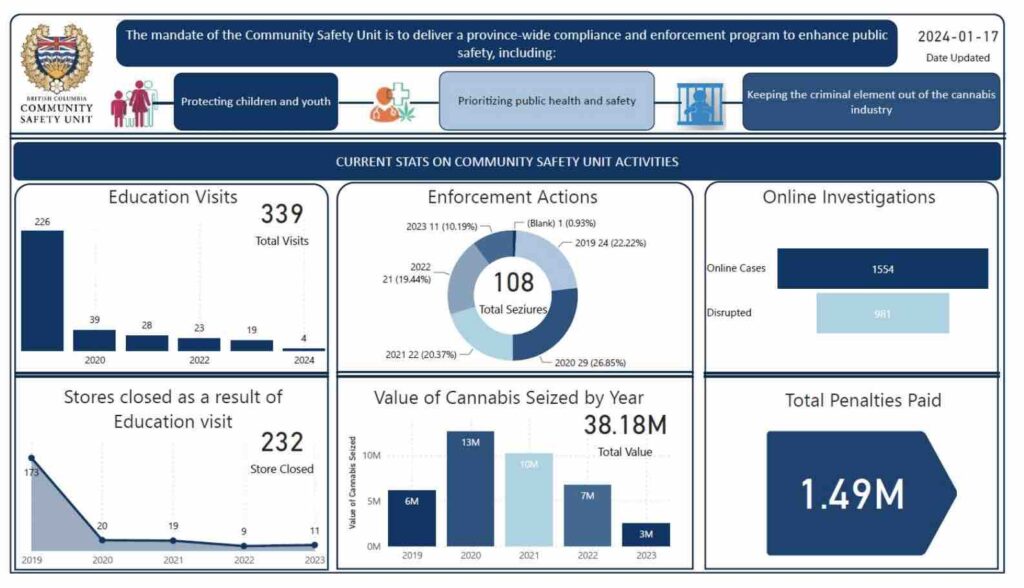
In Parliament last year, BC Minister of Public Safety and Solicitor General Mike Farnworth said that the CSU has also conducted nine enforcement actions on First Nations reserves in the province, seizing about $12 million worth of products.

The province also issues fines to illicit cannabis stores if they refuse to close after several warnings and/or seizures. So far, the CSU has issued at least 58 notices of administrative monetary penalty with proposed penalties totalling approximately $39.9 million, with only about $1.45 million of these penalties already collected.
As of January 2024, the CSU has conducted 339 educational visits, and as a result, 232 unlicensed stores have closed. CSU has investigated 1554 websites involved in the illegal sale of cannabis and has disrupted 981 of those websites.
Under BC’s Cannabis Control and Licensing Act, there are three types of orders issued by the Director of the Community Safety Unit (CSU) with respect to the issuance of administrative monetary penalties (AMPs); Concession Orders, Compliance Orders, and Reconsideration Orders.
A representative with BC’s Ministry of Public Safety and Solicitor confirmed with StratCann via email that the CSU “conducted enforcement” on February 14, 2024, but was unable to provide information or comment on any specifics regarding action taken by the CSU. They did not answer if they had been invited to the community by K’ómoks First Nation leadership.
The representative said that BC’s Cannabis Control and Licensing Act (CCLA), is a law of general application that applies across B.C., including on lands governed by First Nations.
“All along, the aim has been to achieve voluntary compliance; however, we have been very clear that CSU will employ a progressive enforcement approach against those who continue to operate without a licence. Escalation of enforcement action is determined on a case-by-case basis and considers factors such as public safety, the integrity of the legal market, and partner and community concerns. To legally sell retail cannabis products in B.C., retailers must obtain a licence from the Liquor and Cannabis Regulation Branch (LCRB).”
StratCann also reached out to three of the targeted cannabis stores, and K’ómoks First Nation, for comment. None were available as of press time.
420 with CNW — Teenage Brains More Susceptible to Cannabis Harm
Only 35% of 12- to-17-year-olds believe that smoking cannabis at least twice a week carries a major risk, according to the 2021 National Survey on Drug Use and Health (NSDUH). This low perception of risk among teenagers is concerning and is partly fueled by the widespread availability of marijuana, leading to the mistaken belief that it is entirely safe, states Beth Ebel, a pediatrician affiliated with Seattle Children’s Hospital and the University of Washington School of Medicine.
The main psychoactive ingredient in cannabis, THC, alters brain chemistry to produce a “high.” The THC may have unexpected consequences on the brain, especially in young people, according to Ebel, who highlights that these effects could result in addiction and psychosis as well as other long-term health problems.
Notably, THC concentrations in modern cannabis plants are far higher than in previous generations; the potency can reach 20% or more. Furthermore, THC levels in concentrated marijuana products such as shatter and wax can reach up to 95%, which makes them much more potent and worthy of their own classification, according to Yasmin Hurd, a neuroscientist at the Icahn School of Medicine at Mount Sinai.
The adolescent phase is especially precarious for marijuana use, given the ongoing development of the brain, notes Hurd. At this point, the brain experiences major changes, including the formation of new connections, the strengthening of preexisting ones and the pruning away of superfluous ones. THC, however, interferes with the endocannabinoid mechanism, which is essential for brain growth and other physiological processes, severely affecting this developing process. Research on growing brains — both in people and animals — shows that THC has deleterious effects that result in long-term deficits in learning and memory.
For instance, a 2019 study by Hurd and her team on THC-injected teenage rats revealed abnormal nerve cell connections in the prefrontal cortex, an area of the brain essential for emotional control and problem-solving. Similarly, teens’ prefrontal cortex thinning was shown to be accelerated in marijuana users’ MRI scans, a sign of aberrant brain development, according to a 2021 study.
In addition to impairing cognition, teenage cannabis use increases the likelihood of mental-health issues such as anxiety and sadness, according to a 2023 study. Notably, individuals with marijuana-use disorder are more prone to experiencing mental-health issues, with higher rates of depression and suicidal thoughts observed among adolescents who misuse marijuana.
Furthermore, the age at which marijuana use first occurs has a substantial impact on the risk of developing a marijuana use disorder, with adolescents showing a higher vulnerability than young adults.
Teenage cannabis usage frequently results from coping mechanisms for different stressors, including anxiety or sadness, highlighting the intricate relationship between substance abuse and mental health. Misuse of cannabis, however, can worsen symptoms related to mental health, creating a harmful cycle of greater usage and elevated anxiety.
Daily cannabis usage during adolescence is linked to negative effects in adulthood, including substance misuse, suicidal thoughts and reduced educational attainment, according to longitudinal research. Additionally, there is evidence linking marijuana addiction to the development of schizophrenia. Specifically, young boys are more likely to experience an association between marijuana use disorder and new occurrences of schizophrenia.
These concerns about the potential effects of cannabis on teenage brains illustrates why licensed cannabis companies such as Prime Harvest Inc. implement stringent age-verification systems so that only those of age can purchase products from their retail outlets.
NOTE TO INVESTORS: The latest news and updates relating to Prime Harvest Inc. are available in the company’s newsroom at https://cnw.fm/PRIME
About CNW420
CNW420 spotlights the latest developments in the rapidly evolving cannabis industry through the release of an article each business day at 4:20 p.m. Eastern – a tribute to the time synonymous with cannabis culture. The concise, informative content serves as a gateway for investors interested in the legalized cannabis sector and provides updates on how regulatory developments may impact financial markets. If marijuana and the burgeoning industry surrounding it are on your radar, CNW420 is for you! Check back daily to stay up-to-date on the latest milestones in the fast -changing world of cannabis.
To receive SMS alerts from CNW, text CANNABIS to 888-902-4192 (U.S. Mobile Phones Only)
For more information, please visit https://www.CannabisNewsWire.com
Please see full terms of use and disclaimers on the CannabisNewsWire website applicable to all content provided by CNW, wherever published or re-published: https://www.CannabisNewsWire.com/Disclaimer
CannabisNewsWire
Denver, CO
www.CannabisNewsWire.com
303.498.7722 Office
Editor@CannabisNewsWire.com
CannabisNewsWire is powered by IBN
Recent Comments