Research into psychedelics has increased significantly in the recent past, with growing evidence to support their therapeutic benefits for a range of disorders, among them alcoholism and depression. Now, a new study has found that people who use psychedelics such as psilocybin and LSD may experience increased unusual visual occurrences.
The study looked into the possible side effects of psychedelics when used in a recreational setting. The focus outside of clinical settings comes from concern that using these drugs in uncontrolled environments may not be safe.
For their research, the scientists looked into the intensity and prevalence of visual experiences among the general population, with the aim of better understanding the risks involved with psychedelic use in everyday environments. They recruited a cohort made up of more than 9,000 participants from the United Kingdom and the United States. These individuals were chosen to match the demographic makeup of their respective nations in terms of age, sex and ethnicity to ensure proper representation.
Once this was done, the researchers gathered baseline data on the use of psychedelics by the participants during a two-month period. In addition to reporting any use of psychedelics, each individual’s visual anomalies were also recorded. These experiences included seeing colors increase in intensity and observing halos around objects.
Two months later, this exercise was repeated, with the aim being to offer a longitudinal glimpse into the link between visual experiences and the use of psychedelics. In their report, the researchers stated that they observed a correlation between first-time use of psychedelics and increased unusual visual occurrences. Participants who first used psychedelics during the study saw a significant increase in these visual experiences, in comparison to those who had used the drugs previously. This indicates that people who haven’t used psychedelics before may experience more pronounced visual anomalies.
The researchers also assessed the prevalence of certain types of visual disturbances, noting that increases in intensity or brightness of colors were more frequent among psychedelic users.
The study did have some limitations, among them the reliance on self-reported information, as this could be affected by recall bias. The study’s observational nature also made it challenging for causation to be conclusively proven, despite the establishment of a link between unusual visual phenomena and psychedelic use.
The study’s findings were reported in the “Journal of Psychopharmacology.” The researchers involved included Otto Simonsson, Ludwig Honk, Cecilia UD Stenfors, Peter S. Hendricks, Walter Osika and Simon B. Goldberg.
These research findings make a compelling argument for the use of psychedelics in only clinical settings. It is notable that drug-development companies such as Mind Medicine Inc. (NASDAQ: MNMD) (NEO: MMED) (DE: MMQ) are focusing on bringing to market psychedelic medicines that are to be prescribed by doctors, with none of the companies focusing on the recreational use of these substances.
About PsychedelicNewsWire
PsychedelicNewsWire (“PNW”) is a specialized communications platform with a focus on all aspects of psychedelics and the latest developments and advances in the psychedelics sector. It is one of 60+ brands within the Dynamic Brand Portfolio @ IBN that delivers: (1) access to a vast network of wire solutions via InvestorWire to efficiently and effectively reach a myriad of target markets, demographics and diverse industries; (2) article and editorial syndication to 5,000+ outlets; (3) enhanced press release enhancement to ensure maximum impact; (4) social media distribution via IBN to millions of social media followers; and (5) a full array of tailored corporate communications solutions. With broad reach and a seasoned team of contributing journalists and writers, PNW is uniquely positioned to best serve private and public companies that want to reach a wide audience of investors, influencers, consumers, journalists and the general public. By cutting through the overload of information in today’s market, PNW brings its clients unparalleled recognition and brand awareness. PNW is where breaking news, insightful content and actionable information converge.
To receive SMS alerts from PsychedelicNewsWire, text “Groovy” to 888-902-4192 (U.S. Mobile Phones Only)
Please see full terms of use and disclaimers on the PsychedelicNewsWire website applicable to all content provided by PNW, wherever published or re-published: https://www.PsychedelicNewsWire.com/Disclaimer
This represents an increase in revenue of $3.3 million and a decrease in net loss of $37.2 compared to the same period in the prior year.
Aurora attributes the decrease in net loss primarily to an increase in gross profit of $32.7 million and a reduction of operating expenses of $10.4 million, offset by an increase in other expenses of $5.9 million.
Adjusted gross profit before fair value adjustments was $32.4 million in Q3 2024, compared to $28.0 in the prior year quarter, an increase of 15.7%.
Revenue from sales of cannabis for medical purposes was the bulk of Aurora’s revenue, at over $48 million. The company attributes this growth primarily to expansion of its export market in the most recently reported quarter.
Aurora also announced that one of its wholly owned subsidiaries has acquired the remaining approximately 90% equity interest of Indica Industries Pty Ltd (“MedReleaf Australia”). MedReleaf Australia holds the number two position in the Australian medical cannabis market.
“Fiscal 2024 is on track to be our strongest to date, driven by the continued strength of our differentiated business model and our focus on profitable global medical cannabis markets. Our international medical net revenue grew 41% year-over-year in Q3, demonstrating Aurora’s ability to meet diverse patient needs in markets across the world,” said Miguel Martin, Chief Executive Officer of Aurora, in a press release.
“The acquisition of MedReleaf Australia will make Aurora the largest global medical cannabis company in nationally legal markets and will allow us to leverage our success in providing pharmaceutical grade cannabis across 15 countries,” Martin added. “MedReleaf Australia is expected to be immediately accretive to Adjusted EBITDA, while accelerating our path to generate positive free cash flow this calendar year.”
Revenue from Aurora’s plant propagation program also increased compared to the same quarter in the previous year, from $6.6 million to $7.3 million.
Aurora has nearly $300 million in working capital and more than $112 million in biological assets, compared to more than $400 million in working capital and $93.7 million in biological assets in the same quarter of the previous year.
Federal and provincial tax revenues flowing directly to revenue funds
Since legalization, Canada’s cannabis industry has delivered substantial revenue to the federal government, as well as to the provinces and territories.
This income comes from a variety of sources, but by far the most significant contributor is the excise tax: with the exception of Manitoba, the provinces and territories receive 75% of excise revenue, and the federal government 25%.
The numbers have become substantial, with this money mostly going into general revenue, with no specific earmark for policing, health, or municipalities.
The numbers also reveal the extent of the economic pain within the industry, with the CRA owed over $200 million in excise duty.
Government cannabis revenues in steady climb
Public Accounts of Canada reports on revenues earned and expenses incurred for its fiscal year, which is between April 1 and March 31 of the following year (i.e. fiscal year 2022-23 ran from April 1, 2022, to March 31, 2023).
The following table represents the amount the federal government has collected annually from cannabis duties since legalization:
Fiscal Year
Federal
Provincial & Territorial
Total
2022-2023
$227,059,146
$736,102,823
$963,161,969
2021-2022
$160,243,306
$577,006,587
$737,249,893
2020-2021
$108,903,363
$395,763,093
$504,666,456
2019-2020
$52,037,312
$210,805,029
$262,842,341
2018-2019
$18,360,732
$76,040,081
$94,400,813
Total
$566,603,859
$1,995,717,613
$2,562,321,472
These amounts reflect the CRA’s administration of Cannabis Duty and Information Returns provided by the licensed cultivators, producers, and packagers of cannabis and/or cannabis products on behalf of the federal, provincial, and territorial governments.
The information specific to producers is not available. As such, the figures include all revenues administered by the CRA.
The government has yet to collect a staggering amount of money in excise duty.
“As at March 31, 2023, the total amount receivable for Cannabis duties is $221,238,299,” says Sylvie Branch, a CRA spokesperson. “This outstanding balance represents funds owed to the CRA and is not broken by federal, provincial and, territorial components.”
Following the Money
Upon announcing legalization, the Government of Canada committed close to $46 million over a five-year period to cannabis public education and awareness and up to $274 million for law enforcement, border detection, and deterring drug-impaired driving.
However, the federal government is not following a policy wherein cannabis excise revenue is allocated explicitly to cannabis-related issues regarding public health or law enforcement.
“There is no cannabis excise account,” says Caroline Feggans, a spokesperson with the Department of Finance. “All federal revenues, including those from cannabis taxation, are deposited in the Consolidated Revenue Fund (CRF). Funds from the CRF are used for the disbursement of all Government of Canada expenditures, investments, and transfers. The Government of Canada doesn’t in actual practice earmark any of its revenues, including those from taxation, for disbursement towards specific activities or initiatives.”
Health Canada tells a similar story. The ministry charges for application screening, security clearances, and import/export permits, as well as an Annual Regulatory Fee, which covers not only activities covered by Health Canada but also the Canada Border Services Agency, the Public Health Agency of Canada, and Public Safety Canada, “to support the objectives of the Cannabis Act with respect to the legislation and regulations of cannabis.”
However, despite the naming of requirements for specific agencies, all revenues collected through cannabis fees are deposited into the CRF and don’t go directly to Health Canada or any other agency.
“Health Canada has collected a total of $220.4 million in fee revenue since legalization,” says Tammy Jarbeau, a spokesperson for Health Canada. “Of the $220.4 million, the ‘Sales of goods and services—rights and privileges’ fee made up $200.8 million of total revenues collected, and the ‘Services of a regulatory nature’ fees made up $19.6 million of total revenue collected.”
These figures differ from the annual Public Accounts of Canada Reports, since the annual Health Canada Fees Reports are based only on cash collected and not only-invoiced amounts. Overall revenue from fees covers a portion of eligible program costs, which in 2022-23 represented 49%. Unsurprisingly, the remaining regulatory program costs are paid for through general revenue.
Ontario Cannabis Store now a major revenue driver
A similar scenario is playing out with regard to how the provinces and territories allocate their cannabis revenues, with Ontario cannabis sales driving significant revenue. For example, the Ontario Cannabis Store’s (OCS’s) first dividend payment of $150 million to the provincial government’s CRF was made on September 27, 2023.
“This will be reflected in its Financial Statements for the year 2023-24, and in Public Accounts of Ontario when published later in 2024,” says Mike Hajmasy, Senior Communications Advisor with OCS. “The government directed a process for OCS to make regular dividend payments, based on the agency’s net income, going forward.”
This degree of transparency is welcome, with Ontario and the OCS able to provide an outlook for next year, as per below, with the expectation that 2023-24 will incorporate OCS’s pricing changes, including margin reductions, effective September 11, 2023.
However, as with the federal government, Ontario’s funds aren’t being earmarked for cannabis-related issues, however those might be defined, and are instead going directly into the provincial CRF.
“In its simplest terms, the CRF is the account into which the government deposits taxes and other revenues,” says Scott Blodgett, a Senior Media Relations Advisor with the Ontario Ministry of Finance. “Once this money is collected, the government withdraws the money it requires to cover its expenditures, so there is no specific breakdown of how much of cannabis revenues goes for policing, health, etc.”
One notable exception is the OCS’ new Social Impact Fund, which provides financial support to cannabis-related programs, services and research.
“Financial resources for OCS’s Social Impact Fund are pulled from a portion of its net income that is allocated annually towards social responsibility initiatives,” says Hajmasy. “For its pilot year, $500,000 was allocated to the Fund. This amount will be reviewed annually, with the aim of expanding the program where feasible.”
British Columbia also reports the provincial sales tax received from the sale of cannabis. This is not insignificant, amounting to approximately $155 million from legalization in October 2018 until the end of 2023. BC has also recovered almost $4.7 million in yearly cannabis licensing fees as of December 2023.
In BC, as elsewhere, all of this revenue has a familiar destination.
“The earnings BC receives from cannabis sales, PST, licensing and excise tax—along with revenue from other sources—are directed into the Province’s CRF,” says Erin Hughes, a Public Affairs Officer with the province. “This fund supports vital public services that people rely on like health care, education, and child care.”
In Alberta, the Alberta Gaming, Liquor and Cannabis Commission (AGLC) collects a six percent markup on all cannabis products, which is becoming a significant source of revenue.
“The AGLC implemented a 6.0 per cent markup on wholesale cannabis products starting on February 25, 2022, which forms part of our net operating income numbers,” says Karin Campbell, Manager, Communications, at the AGLC. “This contributed $2.4 million in revenue in 2021-22, and $35 million to the provincial government for 2022-23.”
Since legalization, 2023 was the first year that cannabis operations at the AGLC recorded a positive net revenue of $18 million. As in other jurisdictions, cannabis net income in Alberta is transferred to the province’s General Revenue Fund.
Government officials argue that it’s common practice for governments to use a Consolidated or General Revenue Fund as the source of money for government programs. They argue that, at the end of the day, cannabis revenues really are funding municipalities, public security, and even healthcare.
The challenge is that there is no direct relationship, and it is difficult to determine if legalization has increased costs in areas such as policing or public health.
However, in the case of Ontario, the government argues that its support for municipalities goes above and beyond what could be earmarked from cannabis-specific revenue.
“The province will be providing local governments approximately $2.7 billion in funding from the CRF in 2023 by means of a variety of programs,” says Hughes, from Ontario’s Ministry of Finance. “The funding in 2023 alone is $1.6 billion more than the province provided to local governments in 2018, the year in which cannabis was first legalized. By comparison, the province has received less than $100 million in cannabis excise tax revenue in 2023 and has received less than $260 million since the tax was first imposed.”
This is an important argument in that while a provincial government may not explicitly share its cannabis revenue with municipalities, it can sometimes argue that funding for local governments has increased by a much larger amount than could be generated through participation in cannabis revenue sharing.
What is clear is that, given all the pain experienced by the industry as government coffers fill, many industry participants are arguing for financial relief and policy reform. This is particularly acute with the CRA and the excise duty, as well as Health Canada and its fees related to licensing, inspections, compliance/enforcement, and even policy.
A wholly owned subsidiary of Australian Biortica Agrimed, Apollo Green specializes in unique genetics and provides access to plant breeder’s rights protection with DNA fingerprinting of all genetics. The arrangement with Apollo Green also opens Rua Bioscience’s genetics to existing sales channels in to Europe, North America, and Australasia.
Apollo Green, located about 20 minutes east of Ottawa, is licensed as a cultivator and processor but bills itself as a cannabis nursery with a focus on unique genetics.
Oisín Tierney, Director of Business Development at Apollo Green, says the company, which primarily serves as a B2B nursery for commercial cultivators, is focussing on bringing in genetics from breeders around the world.
“We’re very excited to be partnering with Rua,” Tierney tells StratCann. “They are one of many breeders to work with at the moment. Ultimately, at Apollo Green we’re on a mission to offer cultivators curated phenotypes from reputable breeders from all over the world.”
“We’re always cultivating partnerships with breeders. We never stop pheno-hunting, and our ultimate goal is to be a one stop shop for unique genetics for the commercial market.”
“What we’re looking at is genetics with landrace traits that are different to what you might find, typically, in North America.”
Oisín Tierney, Apollo Green
Tierney says part of their goal is to help refresh or reinvigorate cannabis genetics, especially in North America, which become so focused only on high THC cultivars. Although it has imported genetics before, this will be the first time the company has brought in live clones from outside the country.
“We’re Looking for genetic variability,” he explains. “The traits of (cannabis) genetics are being condensed. And variety is being reduced as the industry continues to breed, especially in commercial production. So what we’re looking at is genetics with landrace traits that are different to what you might find, typically, in North America.
For their part, Rua Bioscience is equally excited by the partnership and the ability to bring their unique landrace cultivar to other growers around the world through Apollo Green.
“We are excited about this partnership with Apollo Green and Biortica Agrimed, as it aligns perfectly with our vision to take our unique strains to the world,” said Paul Naske, CEO of Rua Bioscience. “This is more than just an agreement; it’s a bridge connecting New Zealand’s exceptional cannabis genetics to the world.”
“We welcome Rua to the Apollo Green and the Biortica Agrimed family,” said Tom Varga, CEO of Biortica Agrimed.
Licensed to cultivate since 2016, Rua Bioscience is a Māori community-owned company that launched its first prescription medicine in April 2022.
Officials believe the recent California desert killings may have resulted from a dispute over cannabis. After responding to a wellness check request outside the El Mirage community, San Bernardino County Sheriff’s deputies recently discovered the bodies of six individuals at a remote dirt crossroad in the Mojave Desert.
Deputies found the victims in and near two vehicles at a remote intersection after one of the victims called the police and said that he had been shot but didn’t know his location. After tracking the victim’s phone’s location, deputies discovered five bodies in a Chevy Trailblazer and a Dodge Caravan as well as a sixth body some distance away.
Sheriff Shannon Dicus has now revealed that law enforcement officers arrested five suspects in San Bernardino County. According to Sgt. Michael Warrick, the incident “appears to be a dispute over marijuana,” although the scale and reason for the cannabis dispute is still unknown.
California voters legalized recreational cannabis in 2016 via Proposition 64, a ballot initiative that allowed adults 21 years of age and older to possess and consume up to an ounce of recreational cannabis, as well as grow up to six plants at home for personal consumption.
The measure was endorsed by many public figures, including Lt. Governor Gavin Newsom and former Los Angeles Mayor Antonio Villaraigosa; the legislation also was thought to cripple the illegal cannabis trade in California.
However, Sheriff Shannon Dicus says the San Bernardino County desert and other places have been under siege by illegal cannabis growers after the measure’s passage. The sheriff says his office executed 411 illegal grow-related search warrants in 2023 and seized 655,000 cannabis plants, 74,000 pounds of processed cannabis and approximately $370 million. Officers executed 11 of these search warrants in the area immediately adjacent to where the murders took place.
The El Mirage incident is the latest act of violence tied to the cannabis black market in remote areas of California where the cannabis black market is flourishing. Law enforcement is becoming increasingly concerned with the rising death toll and general violence involved in these incidents, especially as illegal cannabis spreads across inland desert communities in Southern California.
The California desert region is now home to multitudes of illegal cannabis farms and has seen a marked increase in violent crime, say residents and law enforcement. Sheriff Shannon Dicus observes that the cannabis black market has become a plague in the San Bernardino County region and notes that cartel activity is certainly involved.
This tragedy highlights the safety risks that the black market poses in the jurisdictions where cannabis is legal. Actors such as Trulieve Cannabis Corp. (CSE: TRUL) (OTCQX: TCNNF) are working to avail safe marijuana products to users in lieu of untested products from illicit sources.
About CNW420
CNW420 spotlights the latest developments in the rapidly evolving cannabis industry through the release of two informative articles each business day. Our concise, informative content serves as a gateway for investors interested in the legalized cannabis sector and provides updates on how regulatory developments may impact financial markets. Articles are released each business day at 4:20 a.m. and 4:20 p.m. Eastern – our tribute to the time synonymous with cannabis culture. If marijuana and the burgeoning industry surrounding it are on your radar, CNW420 is for you! Check back daily to stay up-to-date on the latest milestones in the fast -changing world of cannabis.
To receive SMS alerts from CNW, text CANNABIS to 888-902-4192 (U.S. Mobile Phones Only)
Please see full terms of use and disclaimers on the CannabisNewsWire website applicable to all content provided by CNW, wherever published or re-published: https://www.CannabisNewsWire.com/Disclaimer
Howsoever we may assimilate ourselves into society, we are an expression of universal energy, unique to the resonance of our soul. It is all we are before we are born into three-dimensionality. During our birth, we experience a traumatic energy schism that segregates us from our spirit and the universe. From infancy to childhood, we are still in flow with our soul. That is, until we are conditioned by control, egocentricity, fear, insecurity, self-righteousness and vanity. We are then besieged by institutional, hereditary, personal and social programming via education, entertainment, ideology, lineage, media, politics, religion and science.
The Beginning of Our End
By the time we enter early adulthood, most of our institutionalization is complete. Once this takes root, our personal and social programming commences. We are even awarded for our conformity with certificates, degrees, doctorates and licenses; compartmentalized into careers and tethered to a pseudo-social paradigm. Our pride and prejudice take precedence. We enroll in the rank and file of humanity, charging into the simulation of an interactive, virtual reality. We fill the empty spaces of our lives with activities, amusements, attachments, beliefs, dependencies, dramas, professions, possessions, status and wealth. Unbeknownst to us, we have sealed the fate of our enslavement.
Collage of human head, molecules and various abstract elements on the subject of modern science, chemistry, physics, human and artificial minds ” data-medium-file=”https://growupconference.com/wp-content/uploads/ahot-ix-1.jpg” data-large-file=”https://growupconference.com/wp-content/uploads/ahot-ix-3.jpg?w=676″ data-id=”6041″>
Sensual Simulation
Our lives are a sequence of circumstances, transpiring in a sensory artificiality. This is the true reality we refuse to accept or understand. We assign meaning and value to our encounters, feigning sanity with our social triviality. We perform roles of personality, steeped in frequent confusion, delusion and illusion. We amuse, dispute, gratify, fantasize, patriotize, romanticize and traumatize ourselves to escape a social normality that does not exist. Then we wonder why we cannot relate with others, while we fail to experience relativity with ourselves. The happiness and fulfillment we believe we have is a projection, enacted in a sensual simulation.
Crashing the Program
If our conditioning is not apparent in this new era, we have entirely enslaved ourselves into society with our personal delusion and oblivion. Our reliance on external gratification, meaning and self-worth assimilates us into vicious cycles of acquiescence, compliance, dependency and lunacy. We are eagerly devoted to our captivity, deciding to follow the regime of authoritarian entities and organizations, rather than pioneer our personal path to freedom. The origin of our emancipation is our willingness to observe, clarify and dismantle our virtual tethers to society. We must crash the programming of our sense-based existence to embody our soul.
“Humanity is a program in the simulation of social reality.”
All Things Shiny and Bright
Everything in our social reality is a holographic projection. The scientific communities are aware of this eventuality, yet they neglect to report its proven evidence. It does not serve the authoritarian agenda for societal control. In essence, their funding would be revoked. Money sponsors the matrix of reality. Humanity is exploited and victimized by its conditioned dependence upon and obsession with monetary currency. Our personal power originates from our soul; and our energy flows where our attention goes. Therefore, the simulation stimulates our reactivity to extract our essence. It is our engagement in society which enables our enslavement.
On the Threshold
Seldom do we express our soul amidst the chaos and dysfunction of society. We may have fleeting epiphanies, insights and even the semblance of transformation. Yet, it is impossible to observe and experience universality within the insular bubble of our egocentric existence. Our necessity for control, order, routine and security confines our consciousness. Occasionally, circumstances may remove us from our comfort zone to encounter life beyond our anxiety, doubt, fear, ignorance, insecurity and oblivion. However, when we are on the threshold of universal discovery, we often yield, retreating to the refuge of our personal delusion; within the illusion we interpret as reality.
The Path Least Travelled
Most draw their distinction from society as an utterance of ego. Few create this diversity as an expression of their soul. Humanity has a propensity to sacrifice its universality for a peripheral occupation in the simulation of social reality. We are an energetic expression of omni-dimensionality. Yet, we condemn ourselves to a three-dimensional existence, sentenced with a life of dichotomy. Our personal programming conditions us into social mimicry. We are eternal beings with infinite possibility. The path least travelled is our unique opportunity to discover and explore our creativity, diversity, relativity, transcendence, transformation and universality.
Universal Currency
The currency of the universe is energy. Our soul is its unique expression. The synergy between the universe and our soul is universality. Our intuition conducts this energy to the centers of our being. The omni-dimensional energy torus in our heart center synthesizes our universality in an infinite flow. The frequency of its revolutions establishes the energetic signature of our being. Our heart center transmits this energy into electrical impulses, inspiring our neural pathways. This is translated into energetic signals, which empower our body. The omni dimensional expression of our being is the manifestation of our universality.
An Heir of Transcendence
Social reality resonates on a dense-vibrational frequency. It is engineered to enslave us into intellect and instinct. We enable this dynamic with our engagement via our attachment and reactivity to social stimuli. Our symbiosis with social reality alters, distorts and manipulates our being, diminishing our universal awareness into the primordial duality of sensualism. The universal energetic shift of the new era empowers us to observe our enslavement, transform our experience and transcend the matrix of society. Our collective birthright is to cross the threshold of human history and become an expression of universal mystery.
“Life is merely a program in the experience of transcendence.”
I adore witch hazel and its whimsical blossoms! In my climate, the lemon-yellow ribboned flowers pop open in early February and bloom into March. Some people grow this plant for its medicinal qualities; others grow it simply because it adds beauty to the garden.
Witch hazel is a member of the Hamanelidacease family and needs space. It can reach 9 meters tall and 4.5 meters wide at full maturity! I’m okay with that because the bigger it grows, the more intriguing blooms it produces.
Light, Soil, and Hardiness
Caring for witch hazel requires minimal effort; it likes moist soil and thrives in part shade to full sun. The home gardener must water regularly and prune after it blooms to promote next year’s buds.
The more endearing thing about witch hazel is its love of the cold. It is hardy to climate zone 3 (-40°C). Most varieties of witch hazel demand a chill period of at least 7°C to bloom.
Propagation and Transplanting
Witch hazel can be grown in a pot, perfect for smaller garden spaces. But the tree propagates through the spreading of underground suckers, so it can eventually feel confined if kept in a container. Cutting off the suckers as they emerge from the ground will help contain the spread. It’s also a great way to propagate a new tree! Dig up the suckers with as much of the root as possible and transplant them into a new container or in the ground.
Transplanting an entire plant is possible, but despite its hardy deposition, witch hazel is a homebody. It doesn’t like change and can go into shock. This may mean dropping leaves and no blooms for a season or two.
Pests and Diseases
The usual suspects are the most common annoyances for witch hazel: deer, aphids, leaf spot, or powdery mildew may attack the plant. A good hosing of water should do the trick in removing aphids. Add a deer barrier around the tree trunk to keep bigger pests at bay.
Common Varieties
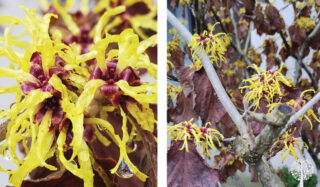
In addition to American witch hazel, these varieties are the most popular for the home garden, all producing the quintessential yellow blossom with a plum center.
Chinese witch hazel(Hamamelis mollis) grows up to 26 feet tall and is hardy to climate zones 5-8.
Japanese witch hazel (Hamamelis japonica) grows 10 to 15 feet tall; it blooms from January to March.
Ozark witch hazel(Hamamelis vernalis): Native to the Ozark Mountains in Arkansas and Missouri, this species blooms in February.
Fun Facts
Witch hazel is the only blossoming tree in North America with flowers, ripe fruit, and next year’s buds on its branches simultaneously!
Witch hazel adds to the garden’s biodiversity by providing food for pollinators and homes for nesting birds. This plant is a great conversational centerpiece, especially for history buffs. First Nations and early settlers used witch hazel to find underground water sources, wells, and aquifers. A forked or bent witch hazel branch was used as a divining rod. If the branch twisted or dipped, this indicated the presence of underground water. The practice was called “water-witching” and led to the plant’s common name, witch hazel.
Join me next month as we garden and grow together!
Legislators on the House Healthcare Regulation Subcommittee recently approved a resolution that would impose a THC cap on adult-use marijuana products. THC (tetrahydrocannabinol) is one of the two primary compounds found in marijuana, with the other being CBD (cannabidiol). However, unlike THC, CBD doesn’t induce a high when ingested.
The approved resolution, HB 1269, contains an amendment that increased the proposed limit on THC for cannabis flower from 10% to 30%. Representative Ralph Massullo, who introduced the resolution, stated that his proposed cap on THC was based on the fact that not much was known on the potential long-term harms and benefits of cannabis products with high THC content. He added that the panel’s task was keeping the public safe and it was important to keep this in mind
This decision comes as highly potent THC products become more available because more states are legalizing cannabis. Concerns have, in the past, been raised about links between mental-health issues and products with high THC content, particularly in developing brains. The approved initiative would establish a 10 mg THC serving size for edibles and place a 60% THC limit on all other cannabis products.
During the final vote, four members voted against the initiative. Among them was Representative Robin Bartleman, who argued that preparing a package that included a suite of recreational marijuana regulations was better suited. Similar concerns were expressed by Representative Kelly Skidmore, who stated that the THC limit was something legislators would have had to address if voters approved adult-use cannabis. She further noted that the decision to do so now was premature because there was a lot more that needed to be discussed.
Some panel members also noted that while they did have reservations about the initiative, they still supported it. This includes Representative Adam Anderson, who stated that low THC limits could result in people consuming more cannabis, which would have additives or materials that were possibly harmful. Anderson noted that he supported the measure because he felt it was the responsibility of legislators to be proactive. The legislator also applauded Massullo’s efforts as well as his productivity on the matter.
Representative Gallop Franklin II, who also voted yes on the measure, noted that individuals often sought products from the illegal marketplace, which wasn’t regulated. He added that hazardous additives in unregulated products could cause more harm than THC itself.
The initiative will take effect 30 days after voters approve any constitutional amendment to enact legalization. The entire cannabis sector, including major players such as Curaleaf Holdings Inc. (TSX: CURA) (OTCQX: CURLF) is likely to be concerned by this way of legislatures preemptively imposing restrictions on a matter that voters are likely to approve.
About CannabisNewsWire
CannabisNewsWire (“CNW”) is a specialized communications platform with a focus on cannabis news and the cannabis sector. It is one of 60+ brands within the Dynamic Brand Portfolio @ IBN that delivers: (1) access to a vast network of wire solutions via InvestorWire to efficiently and effectively reach a myriad of target markets, demographics and diverse industries; (2) article and editorial syndication to 5,000+ outlets; (3) enhanced press release enhancement to ensure maximum impact; (4) social media distribution via IBN to millions of social media followers; and (5) a full array of tailored corporate communications solutions. With broad reach and a seasoned team of contributing journalists and writers, CNW is uniquely positioned to best serve private and public companies that want to reach a wide audience of investors, influencers, consumers, journalists and the general public. By cutting through the overload of information in today’s market, CNW brings its clients unparalleled recognition and brand awareness. CNW is where breaking news, insightful content and actionable information converge.
To receive SMS alerts from CNW, text CANNABIS to 888-902-4192 (U.S. Mobile Phones Only)
Please see full terms of use and disclaimers on the CannabisNewsWire website applicable to all content provided by CNW, wherever published or re-published: https://www.CannabisNewsWire.com/Disclaimer
(Globe Newswire) New York and Winnipeg — Manitoba Harvest, the global leader in hemp foods and a wholly-owned subsidiary of Tilray Brands, Inc., is partnering with Bioactives companyBrightseed to revolutionize the functional fiber market with a breakthrough product: Manitoba Harvest Bioactive Fiber. This multi-benefit fiber solution, powered by Brightseed® Bio Gut Fiber, is now exclusively available at Whole Foods Market stores nationwide.
Furthering Manitoba Harvest’s 25-year commitment to transform consumer health through the power of hemp, NEWBioactive Fiber helps close the fiber gap for consumers. Manitoba Harvest Bioactive Fiber leverages Brightseed’s novel ingredient made from upcycled hemp hulls, the outer shells of hemp seeds. AI-led research identified hemp hulls as an untapped source of dietary fiber and gut-health beneficial bioactives.
Jared Simon, president of Manitoba Harvest and Tilray Wellness, expressed excitement about the launch, stating, “With the debut of Manitoba Harvest Bioactive Fiber, we’re not just introducing a product; we’re rediscovering the nutritional capacity of hemp after nearly 70 years in the dark. Bioactives are gaining huge strides in nutrition science but are largely undiscovered and remain underutilized in health foods. At Manitoba Harvest, we’re on a mission to harness the wellness potential of hemp with simple health solutions that contribute to a sustainable future.”
Science has established that dietary fiber is essential for supporting gut health including digestion, bowel regularity and weight management, but today, 95 per cent of Americans do not consume the recommended daily intake of fiber. Manitoba Harvest Bioactive Fiber provides six grams of both soluble and insoluble fiber per serving and is the only fiber solution containing two powerful hemp-based bioactives for gut health.
Advertisement
“Manitoba Harvest is a visionary leader bringing hemp to consumers worldwide. We are thrilled to be working with such an impassioned partner to bring forward new discoveries on hemp’s health value out of the lab and onto consumer shelves,” said Sofia Elizondo, co-founder and chief operating officer of Brightseed.
“Bioactives are the unsung heroes of proactive health and today, the majority of people don’t consume enough to capture the full impact of their benefits. Now that our AI Forager is powering the discovery and understanding of bioactives at an unprecedented rate, our mission at Brightseed is to transform those insights into accessible and powerful wellness products across the globe.”











 Collage of human head, molecules and various abstract elements on the subject of modern science, chemistry, physics, human and artificial minds ” data-medium-file=”https://growupconference.com/wp-content/uploads/ahot-ix-1.jpg” data-large-file=”https://growupconference.com/wp-content/uploads/ahot-ix-3.jpg?w=676″ data-id=”6041″>







Recent Comments