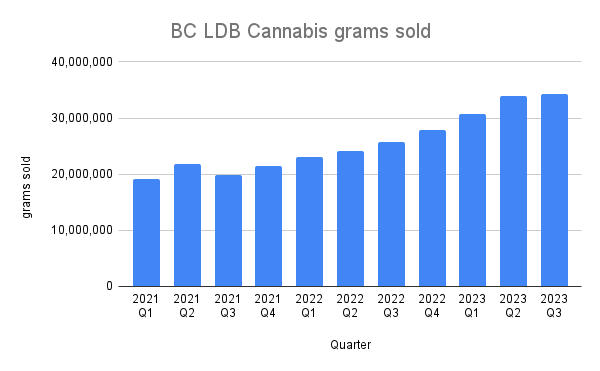
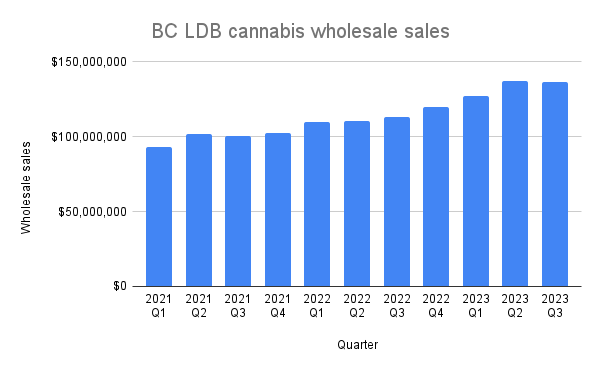
The declining price of cannabis means wholesale cannabis sales in BC in the last three months of 2023 were down from the previous three months, even as the volume of cannabis sold increased.
The figures were released as part of the BC Liquor Distribution Branch’s (LDB) Q3 report for 2023, covering October, November, and December.
Following an ongoing trend over several reporting periods now, 28 gram and 3.5 gram SKUs sold the most in terms of dollars, while 7 gram and 14 gram formats saw the most significant year-over-year increase in terms of dollars and grams sold.
Sales of 3.5 gram SKUs were down 21% from the same period last year in terms of dollars and 14% in terms of grams sold.
Sales (in dollars) of 7 gram SKUs increased by 81% and 80% in grams sold, while 14 gram SKUs increased 26% (in dollars sold) and 45% in grams sold. Sales in dollars in the 28 gram category increased 11%, while they also increased 18% in grams sold.
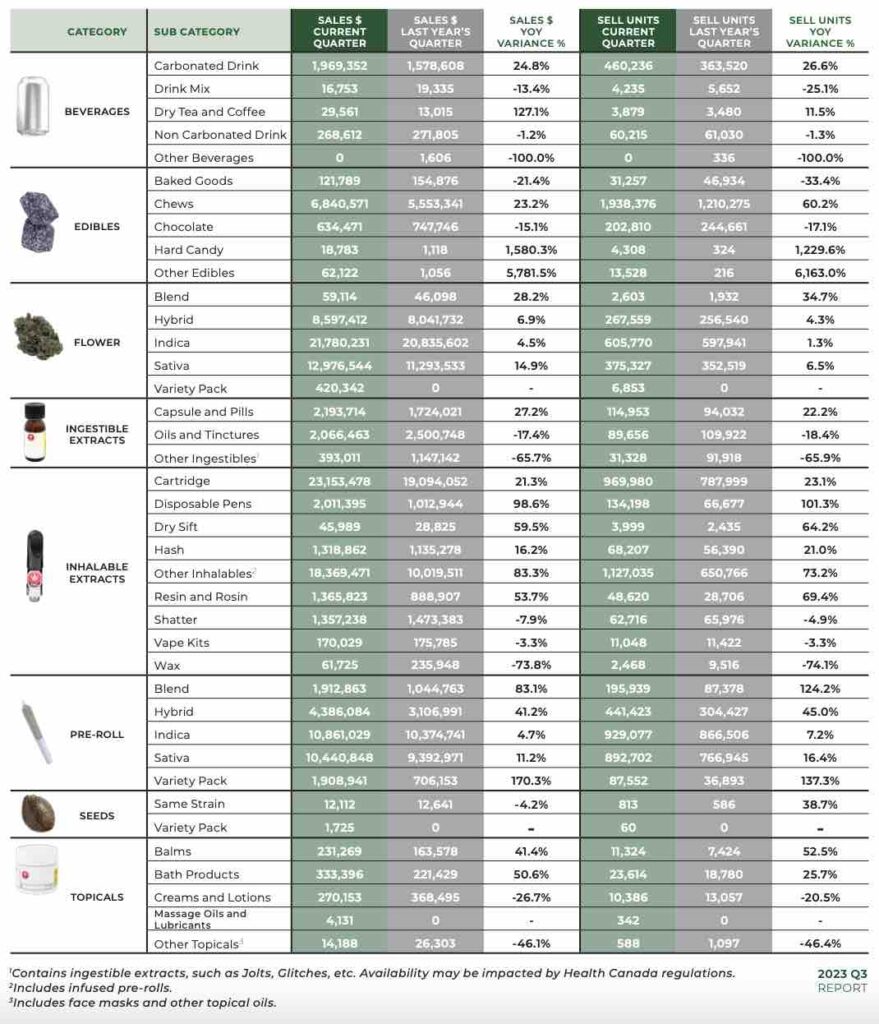
Sales were up for all producers in terms of units sold and year-over-year sales except for ingestible extracts, which declined following Health Canada’s ruling that some of these products are non-compliant.
Sales for beverages were up 21% from the same period last year in terms of dollars sold and units sold, edibles by 19% in sales and 46% in terms of units sold, flower sales in dollars were up by 9% and 4% by units, inhalable extracts sales were up 40% and 45% in units, pre-rolls up 20% and 34% in units, seeds up 10% in sales and 49% in units, topicals up 9% and 15%.
Ingestible extract sales were down 13% in terms of dollars and 20% in terms of units. Drilling down in this category, oils and tinctures were down 18% in dollars sold and units sold, while capsules and pills increased by 27% in dollars sold and 22% in grams/volume. Other ingestibles (i.e. products like lozenges that are consumed as edibles but classified by producers as extracts) were down nearly 66% in sales and SKUs sold.
Sales of disposable vape pens saw a significant increase, by about 100% in sales and units. Sales of shatter, vape kits, and wax were down in dollars and volume. Wax saw the biggest decline, with 74% less sold in dollars and SKUs.
Infused pre-rolls saw a big jump, with an 83% increase in sales and 73% increase in units sold. Resin and Rosin sales increased by 54% in dollars and 69% in SKUs.
Cart sales were up 21%, while units-moved increased by 23%.
The most popular edibles were chews or gummies, with 89% of sales, followed by chocolate at 8%, baked goods at less than 2%, and edibles and hard candies at 1%.
Infographic via bcldb.com
Inhalable extracts are divided with carts at about 48% of sales in dollars sold, followed by inhalable extracts like infused pre-rolls at 38%. Disposable vape pens were about 4% of sales, followed by resin, rosin, shatter, and hash at under 3% each.
Direct Delivery
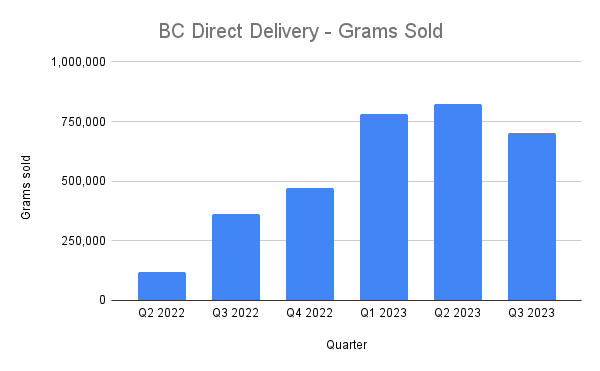
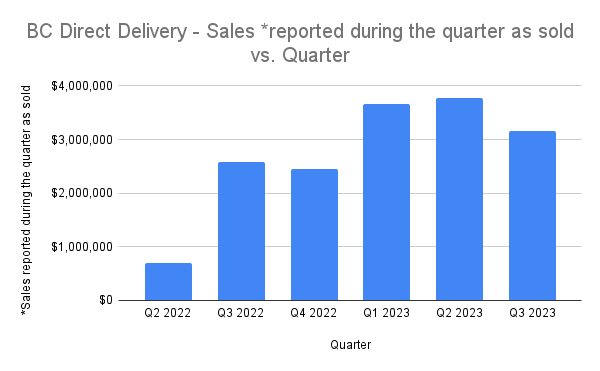
Sales in Direct Delivery increased as well, with 702,478 grams sold in Q3 2023 compared to 362,180 last year, a 94% increase in volume for a total of $3,167,456 in sales, compared to $2,575,585 in the same quarter in 2022.
However, this was a decline from the previous quarter, where sales were 821,718 grams sold for a total of $3,777,539 in sales.
Wholesale sales in Direct Delivery increased by 23% from the same period last year, with almost $3.2 million sold. The average price per gram sold in DD was $4.51, and $3.93 for flower, down from $7.11 and $6.45 last year.
This decline in sales from Q2 2023 was driven by lower sales of cannabis flower, with $2,259,307 in Q2 and $1,863,265 in Q3. Pre-roll sales were $896,215, down from $968,026 in the previous year.
via bcldb.com
Sales of edibles and beverages were up 25% from the same quarter last year, with $16,169 sold in Q3 2023 vs $12,945 in Q3 2022.
Ingestible Extracts were way up compared to the same period last year and last quarter. In Q3 2023, sales of this product category were $24,502, doubling from $12,923 in Q2 2023 and tripling from Q3 2022’s $8,773.
America was one of the first countries on the globe to adopt cannabis reform and repeal prohibitionist cannabis laws, at least at the state level. The country is now home to the largest cannabis markets on the globe and earns billions of dollars annually from fees and cannabis sales.
Twenty-four states already allow recreational cannabis sales, but several of them passed adult-use cannabis policies in the past couple of years and are still working out the kinks in their markets. However, players in some of America’s youngest recreational cannabis markets are grappling with increasingly stringent rules and regulations that have the potential to stifle their growth. The cannabis industry is already known for its strict rules and numerous fees, which often raise the cost of business and make it hard for businesses to turn a profit.
However, newer markets are taking it a step further with outright bans on certain cannabis products and harsh limitations on marketing, product design and packaging as well as much lower potency caps. Consequently, cannabis operators in young markets such as Maryland, Arizona, New York and Missouri are now facing new policies that could increase the already high cost of business even further and cripple these markets before they can truly soar.
Missouri’s recreational marijuana market is looking at another potential inventory shortage as dozens of manufacturers and brands wait for hundreds of thousands of their product stock-keeping units to receive approval. This expanding backlog, which prevented many brands from entering Missouri’s adult-use market, is due to child safeguards included in new packaging rules that were published in July.
Marijuana product manufacturers in Missouri have been waiting for several weeks now after the Missouri Department of Health and Senior Services (DHSS) passed guidelines limiting cannabis packaging to a single primary color and up to only two symbols or logos featuring different colors.
Operators in New York are also struggling to follow newly passed packaging rules for recreational cannabis while businesses in Maryland have barely any room to market their brand, retail stores or cannabis products on most conventional marketing channels.
Cannabis regulators in Maryland have also banned the sale of cannabis elixirs and concentrates, which are best-sellers in other recreational markets. They also passed capped THC levels in individual edibles at 10 milligrams and 100 milligrams per package. According to Wendy Bronfein, the cofounder of Maryland cannabis operator Curio Wellness, the current environment simply isn’t conducive to business.
For companies that may be looking to expand into different markets, such as Aurora Cannabis Inc. (NASDAQ: ACB) (TSX: ACB), the tightening restrictions being imposed on the new markets may be a serious matter of concern.
About CNW420
CNW420 spotlights the latest developments in the rapidly evolving cannabis industry through the release of two informative articles each business day. Our concise, informative content serves as a gateway for investors interested in the legalized cannabis sector and provides updates on how regulatory developments may impact financial markets. Articles are released each business day at 4:20 a.m. and 4:20 p.m. Eastern – our tribute to the time synonymous with cannabis culture. If marijuana and the burgeoning industry surrounding it are on your radar, CNW420 is for you! Check back daily to stay up-to-date on the latest milestones in the fast -changing world of cannabis.
To receive SMS alerts from CNW, text CANNABIS to 888-902-4192 (U.S. Mobile Phones Only)
Please see full terms of use and disclaimers on the CannabisNewsWire website applicable to all content provided by CNW, wherever published or re-published: https://www.CannabisNewsWire.com/Disclaimer
Missouri voters approved a recreational cannabis measure in 2022, joining the growing number of states with adult-use marijuana markets. However, the legalization measure did not address how employers would handle compensation for employees who sustain workplace injuries while under the influence of cannabis.
Currently, employees may have their compensation and death benefits cut by up to 50% even if they hadn’t consumed cannabis for days but still tested positive for THC. This mostly stems from the fact that existing cannabis tests aren’t accurate and cannot properly connect blood THC levels to actual intoxication. Worker compensation attorney Bradley Young says this hasn’t changed even after voters legalized recreational marijuana because cannabis is still prohibited at the federal level.
Republican Representatives Sherri Gallick and John Voss have introduced measures that would add cannabis to the state’s workers’ compensation law. Under Missouri’s workers’ current compensation law, employees whose on-the-job injuries are sustained “in conjunction with nonprescribed controlled drugs” face a 50% reduction of their benefits.
According to Young, Missouri state law currently doesn’t classify marijuana as a nonprescribed controlled drug despite its status at the federal level.
Gallick’s bill would exempt medical cannabis patients who were using cannabis with a physician’s prescription while Voss’s measure does not include similar language. Another measure introduced by Jefferson City Republican Senator Mike Bernskoetter also mirrored the language in Voss’s bill.
However, both measures have faced opposition from Democrats and Republicans on the House Insurance Policy Committee. Republican Representative Richard West noted that his biggest problem with the measure is that the technology to accurately measure marijuana impairment doesn’t exist. He noted that employees can still lose 50% of their benefits if they have some cannabis in their systems from prior use but aren’t impaired during a workplace injury under the bill.
Young argued that after serving as a workers’ compensation defense attorney for three decades, he had never seen a case where a judge cut a worker’s benefits for using cannabis weeks, or even days, after the injury.
Several lawmakers criticized existing testing methods for their inaccuracy in properly measuring cannabis impairment. Most cannabis tests will show positive results even if an individual consumed marijuana several hours or even days prior and isn’t impaired at the moment of testing.
Conversely, alcohol impairment tests are incredibly effective at measuring intoxication levels on the spot. Without accurate cannabis impairment testing technology, West wondered whether the state would have to prevent people from consuming a legal substance in their free time.
When asked when efficient cannabis-testing technology will be available, Young said he represents a company that bought technology to determine if THC is active at the moment of testing. The technology is currently expensive, but Young said it would be more affordable next year.
The discussions in Missouri show that despite the existence of regulated markets in different states and countries where companies such as Tilray Brands Inc. (NASDAQ: TLRY) (TSX: TLRY) operate, many reforms still need to be considered to end manifestations of prohibition.
About CNW420
CNW420 spotlights the latest developments in the rapidly evolving cannabis industry through the release of two informative articles each business day. Our concise, informative content serves as a gateway for investors interested in the legalized cannabis sector and provides updates on how regulatory developments may impact financial markets. Articles are released each business day at 4:20 a.m. and 4:20 p.m. Eastern – our tribute to the time synonymous with cannabis culture. If marijuana and the burgeoning industry surrounding it are on your radar, CNW420 is for you! Check back daily to stay up-to-date on the latest milestones in the fast -changing world of cannabis.
To receive SMS alerts from CNW, text CANNABIS to 888-902-4192 (U.S. Mobile Phones Only)
Please see full terms of use and disclaimers on the CannabisNewsWire website applicable to all content provided by CNW, wherever published or re-published: https://www.CannabisNewsWire.com/Disclaimer
How Tyrannical Governments Stifle Political Dissent
By John & Nisha Whitehead
“No president from either party should have the sole power to shut down or take control of the internet or any other of our communication channels during an emergency.”—Senator Rand Paul
What’s to stop the U.S. government from throwing the kill switch and shutting down phone and internet communications in a time of so-called crisis?
After all, it’s happening all over the world.
Communications kill switches have become tyrannical tools of domination and oppression to stifle political dissent, shut down resistance, forestall election losses, reinforce military coups, and keep the populace isolated, disconnected and in the dark, literally and figuratively.
As the Guardian reports, “From Ukraine to Myanmar, government-run internet outages are picking up pace around the world. In 2021, there were 182 shutdowns in 34 countries… Countries across Africa and Asia have turned to shutdowns in a bid to control behaviour, while India, largely in the conflict-ridden region of Jammu and Kashmir, plunged into digital darkness more times than any other last year… Civil unrest in Ethiopia and Kazakhstan has triggered internet shutdowns as governments try to prevent political mobilisation and stop news about military suppression from emerging.”
In an internet-connected age, killing the internet is tantamount to bringing everything—communications, commerce, travel, the power grid—to a standstill.
Tyrants and would-be tyrants rely on this “cloak of darkness” to advance their agendas.
In Myanmar, for example, the internet shutdown came on the day a newly elected government was to have been sworn in. That’s when the military staged a digital coup and seized power. Under cover of a communications blackout that cut off the populace from the outside world and each other, the junta “carried out nightly raids, smashing down doors to drag out high-profile politicians, activists and celebrities.”
These government-imposed communications shutdowns serve to not only isolate, terrorize and control the populace, but also underscore the citizenry’s lack of freedom in the face of the government’s limitless power.
Yet as University of California Irvine law professor David Kaye explains, these kill switches are no longer exclusive to despotic regimes. They have “migrated into a toolbox for governments that actually do have the rule of law.”
This is what digital authoritarianism looks like in a technological age.
Digital authoritarianism, as the Center for Strategic and International Studies cautions, involves the use of information technology to surveil, repress, and manipulate the populace, endangering human rights and civil liberties, and co-opting and corrupting the foundational principles of democratic and open societies, “including freedom of movement, the right to speak freely and express political dissent, and the right to personal privacy, online and off.”
For those who insist that it can’t happen here, it can and it has.
In 2005, cell service was disabled in four major New York tunnels, reportedly to avert potential bomb detonations via cell phone.
In 2009, those attending President Obama’s inauguration had their cell signals blocked—again, same rationale.
And in 2011, San Francisco commuters had their cell phone signals shut down, this time, to thwart any possible protests over a police shooting of a homeless man.
With shutdowns becoming harder to detect, who’s to say it’s not still happening?
Although an internet kill switch is broadly understood to be a complete internet shutdown, it can also include a broad range of restrictions such as content blocking, throttling, filtering, complete shutdowns, and cable cutting.
As Global Risk Intel explains:
“Content blocking is a relatively moderate method that blocks access to a list of selected websites or applications. When users access these sites and apps, they receive notifications that the server could not be found or that access was denied by the network administrator. A more subtle method is throttling. Authorities decrease the bandwidth to slow down the speed at which specific websites can be accessed. A slow internet connection discourages users to connect to certain websites and does not arouse immediate suspicion. Users may assume that connection service is slow but may not conclude that this circumstance was authorized by the government. Filtering is another tool to censor targeted content and erases specific messages and terms that the government does not approve of.”
How often do most people, experiencing server errors and slow internet speeds, chalk it up to poor service? Who would suspect the government of being behind server errors and slow internet speeds?
Then again, this is the same government that has subjected us to all manner of encroachments on our freedoms (lockdowns, mandates, restrictions, contact tracing programs, heightened surveillance, censorship, overcriminalization, shadow banning, etc.) in order to fight the COVID-19 pandemic, preserve the integrity of elections, and combat disinformation.
These tactics have become the tools of domination and oppression in an internet-dependent age.
It really doesn’t matter what the justifications are for such lockdowns. No matter the rationale, the end result is the same: an expansion of government power in direct proportion to the government’s oppression of the citizenry.
According to Global Risk Intel, there are many motives behind such restrictions:
“For instance, the kill switch serves to censor content and constrain the spread of news. This particularly concerns news reports that cover police brutality, human rights abuses, or educational information. Governments may also utilize the kill switch to prevent government-critical protestors from communicating through message applications like WhatsApp, Facebook, or Twitter and organizing mass demonstrations. Therefore, internet restrictions can provide a way of regulating the flow of information and hindering dissent. Governments reason that internet limitations help stop the spread of fake news and strengthen national security and public safety in times of unrest.”
In this age of manufactured crises, emergency powers and technofascism, the government already has the know-how, the technology and the authority.
Now all it needs is the “right” crisis to flip the kill switch.
This particular kill switch can be traced back to the Communications Act of 1934. Signed into law by President Franklin D. Roosevelt, the Act empowers the president to suspend wireless radio and phone services “if he deems it necessary in the interest of national security or defense” during a time of “war or a threat of war, or a state of public peril or disaster or other national emergency, or in order to preserve the neutrality of the United States.”
In the event of a national crisis, the president has a veritable arsenal of emergency powers that override the Constitution and can be activated at a moment’s notice. These range from imposing martial law and suspending habeas corpus to shutting down all forms of communications, restricting travel and implementing a communications kill switch.
That national emergency can take any form, can be manipulated for any purpose and can be used to justify any end goal—all on the say so of the president.
The seeds of this ongoing madness were sown several decades ago when George W. Bush stealthily issued two presidential directives that granted the president the power to unilaterally declare a national emergency, which is loosely defined as “any incident, regardless of location, that results in extraordinary levels of mass casualties, damage, or disruption severely affecting the U.S. population, infrastructure, environment, economy, or government functions.“
Comprising the country’s Continuity of Government (COG) plan, these directives (National Security Presidential Directive 51 and Homeland Security Presidential Directive 20), which do not need congressional approval, provide a skeletal outline of the actions the president will take in the event of a “national emergency.”
Just what sort of actions the president will take once he declares a national emergency can barely be discerned from the barebones directives. However, one thing is clear: in the event of a perceived national emergency, the COG directives give unchecked executive, legislative and judicial power to the president.
The country would then be subjected to martial law by default, and the Constitution and the Bill of Rights would be suspended.
The internet kill switch is just one piece of the government’s blueprint for locking down the nation and instituting martial law.
There may be many more secret powers that presidents may institute in times of so-called crisis without oversight from Congress, the courts, or the public. These powers do not expire at the end of a president’s term. They remain on the books, just waiting to be used or abused by the next political demagogue.
Given the government’s penchant for weaponizing one national crisis after another in order to expand its powers and justify all manner of government tyranny in the so-called name of national security, it’s only a matter of time before this particular emergency power to shut down the internet is activated.
Then again, an all-out communications blackout is just a more extreme version of the technocensorship that we’ve already been experiencing at the hands of the government and its corporate allies.
Packaged as an effort to control the spread of speculative or false information in the name of national security, restricting access to social media has become a popular means of internet censorship.
In fact, these tactics are at the heart of several critical cases before the U.S. Supreme Court over who gets to control, regulate or remove what content is shared on the internet: the individual, corporate censors or the police state.
Nothing good can come from techno-censorship.
As Glenn Greenwald writes for The Intercept:
“The glaring fallacy that always lies at the heart of pro-censorship sentiments is the gullible, delusional belief that censorship powers will be deployed only to suppress views one dislikes, but never one’s own views… Facebook is not some benevolent, kind, compassionate parent or a subversive, radical actor who is going to police our discourse in order to protect the weak and marginalized or serve as a noble check on mischief by the powerful. They are almost always going to do exactly the opposite: protect the powerful from those who seek to undermine elite institutions and reject their orthodoxies. Tech giants, like all corporations, are required by law to have one overriding objective: maximizing shareholder value. They are always going to use their power to appease those they perceive wield the greatest political and economic power.”
As I make clear in my book Battlefield America: The War on the American People and in its fictional counterpart The Erik Blair Diaries, these censors are laying the groundwork to preempt any “dangerous” ideas that might challenge the power elite’s stranglehold over our lives.
Whatever powers you allow the government and its corporate operatives to claim now, whatever the reason might be, will at some point in the future be abused and used against you by tyrants of your own making.
By the time you add AI technologies, social credit systems, and wall-to-wall surveillance into the mix, you don’t even have to be a critic of the government to get snared in the web of digital censorship.
Eventually, as George Orwell predicted, telling the truth will become a revolutionary act.
WC: 1805 ABOUT JOHN W. WHITEHEAD
Constitutional attorney and author John W. Whitehead is founder and president of The Rutherford Institute. His most recent books are the best-selling Battlefield America: The War on the American People, the award-winning A Government of Wolves: The Emerging American Police State, and a debut dystopian fiction novel, The Erik Blair Diaries. Whitehead can be contacted at staff@rutherford.org. Nisha Whitehead is the Executive Director of The Rutherford Institute. Information about The Rutherford Institute is available at www.rutherford.org. Publication Guidelines / Reprint Permission
John W. Whitehead’s weekly commentaries are available for publication to newspapers and web publications at no charge. Please contact staff@rutherford.org to obtain reprint permission.
We began last time with the philosophical discipline, the first step thereof being a meditation practice. On this path there must be a continual effort to moderate emotions and so even peak experiences in meditation are to be viewed with a certain conscious detachment. Likewise, off the cushion, all of life’s emotional see-saws must be seen the same way, as the transient vapours of passing mood and feeling that they are. Ultimately, the ancient teachings inform us, on this path reason, not emotion should rule in the end. All strong, passionate emotions, such as anger, are to be curbed. If they can not be, in the heat of the moment, as soon as they can the disciple on the path is asked to seek to understand where and why the emotional reaction originated. In this, the path is better suited to individuals who have left the garden of youth and find themselves in the years of middle age – but of course the path is open to all with a willing heart and mind.
The next and closely related imperative is the relinquishing of the ego. It can be a bitter medicine to swallow to give up the biases of our conditioned minds. And this is exactly what our minds are. We are all individuated packages of consciousness, here living a temporal third-dimension life in human form and we are programmed from the moment we arrive here – beginning with the first lessons from our parents and then our teachers and playmates and then bosses and mates and so on. We are programmed too by the arrangement of cosmic patterning that comprises our birth chart, crystalised at our first breath. Yet beyond all of this our consciousness is part of the consciousness – just as the waves are part of the ocean. The ego is charged with maintaining awareness of the limitation of our individuality. Without this we would have no sense of where we ended and the world began. Our ‘instinct’ to survive would be muted. Our creativity and self-expression probably non-existent. But unfortunately, the ego can so easily take over the driver’s seat of our consciousness. When this occurs we lose the capacity for detachment from the flux of emotions, the only way to peace, and we lose our ability to reason.
“Every time a man thrusts his ego into a train of thought its balance is disturbed and its truth-value distorted. If he is to judge every fact by the standards of his earlier experience alone he will thereby prevent new knowledge from arising.” (PB)
In essence, we have forgotten who we really are, the grandeur of who we are, and instead we have fallen into the habit of identifying ourselves with our conditioned version of who we think we are – the illusory self-image – an image that we form through the life process. We forget it is precisely that – an image. And a limiting one at that. It is not who we are. Christopher Wallis, teacher of the Tantrik tradition wrote in his beautiful book ‘Tantra Illuminated’ the following:
“The process by which consciousness moves from the unmanifest state of absolute potential into manifest particularity necessarily involves concealment or forgetting. For in order for Consciousness to manifest itself in one particular form, it must conceal or suppress all other possible forms. In order for God to fully become you, and therefore embrace Herself as you, She must temporarily forget everything about Herself that is not you. Thus the coalescence of Consciousness into embodied form is necessarily an act of self-limitation – but one that is freely chosen.”
God, Shiva-Shakti Consciousness is contracted down into specks of individual self-hood – ie us. The contraction as Wallis points out, necessitates a forgetting or concealment. The teachings of the Hidden Philosophy of Truth came out of an innate desire to remember. We all have this spark of desire within us. We know not whether it will manifest as a burn to know the truth, to begin the quest, in this lifetime, or the next.
Regarding the ego, Tantrika teaches the ego is not to be totally annihilated but rather purified and expanded ‘until it simply melts into all that is.’ (CW) Wallis points out the ego simply means ‘what you think you are, so expanding it means expanding your sense of self.’ How does this fit with the Hidden Teachings (Beyond Yoga) of Paul Brunton – one of the west’s early interpreters of the ancient wisdom? PB states, as per the quote above, that every time the ego intrudes into a train of thought, its balance is disturbed and therefore its truth value is distorted. This is because of our prior conditioning. If a new idea conflicts with our intrinsic beliefs we are likely to reject it. This is what he is calling ego – a package of conditioning wrapped up in a self-image. The Tantrika teachings, whilst not denying the reality of our conditioning and self-image, tell us to ‘purify and expand’ all of that – ie the ego. Which I take to mean the cracking open of our awareness of the One consciousness – contracted and concealed in our forgetting as it is – to reveal the beauty of who we really are.
The genuine philosophy, PB reminds us, requires us to cast aside the conceit and vanity of egoic preconceptions and prejudices – the quest of truth demands we do. The simplest way to understand this challenging sounding imperative is to remember to forget the word ‘I’. Using the word ‘I’ unconsciously keeps us stuck in a particular set of personal beliefs – so many of them inaccurate, others purely pathological.
“It is a pathological fact that the various forms of insanity and mental disorder are rooted in the ego and all the obsessions and complexes are likewise connected with the I.” (PB)
The obsession with ‘I’ prohibits us from the truth because it quarantines the mind within the boundaries of its own beliefs: bigotry, prejudice, rationalisations in defence of preferences… the list is long. Reason will always lose out when egoism is calling the shots.
“All this means that those who have the strongest personal views are the most difficult to lead to truth. Such persons need to absorb the lesson inculcated by Jesus: “Except ye become as little children ye shall in no wise enter the kingdom of heaven.” (PB) This means putting aside all prejudice coming from experience and preconceptions coming from conditioning. Further, it means, dropping the words ‘I think’, ‘I believe’, ‘I know’…… Opinion is not truth.
The Hidden Philosophy asks us to develop the faculty of reason. This faculty is known as buddhi – commonly translated as intellect. The buddhi is our means of formulating conceptions, decisions, judgements and discernment. It is also the power of imagination. The ancients tell us discernment is the highest of all the limbs of yoga and ‘the only one that directly leads to liberation.’ (‘Tantra Illuminated.’) We are told this is so because on the spiritual path discerning between what is to be held close and what is to be laid aside is crucial – it determines what is beneficial and what is not.
Of course the logical question is, how does our buddhi know what is most beneficial for us? There is more than one answer to this but the easiest is to say – it doesn’t ultimately matter, if we regard all experiences as learning experiences. A higher response though is to say the buddhi which is not lead by the ego (an expanded ego we might say) connects us with our innate voice of intuition (the Higher Self). It is this intuitive voice which guides our discernment to lead us to the truth and the truth will always be beneficial for us.
In the meantime, we are all ‘victims’ of our subliminal impressions of past experiences. In Sanskrit – our samskaras. All our experiences leave impressions and the impressions are like pattern makers dictating how the flow of life is interpreted by us. Samskaras disrupt and impede the buddhi. They trip us up – whether the psychological wounds of childhood or the traumas of later life experience – all coalescence within the psyche as grooves, like the ones in old records. These samskaras are inextricably linked to what we call the ego. That is, our self-identity package, the one we form over time is created in large part by our impressions of past experiences – the good the bad and the ugly. The astrological chart shows, to one who knows how to read it, the areas and nature of the most potent of these samskaras. One on the path of the hidden truth is advised, at the outset, to learn the secrets of the cosmic patterning – without becoming too obsessed with the ‘I’. Things happened. Life here, for all of us, babies, children, young people, old people, is nothing but a pile of experiences and many of them are painful. It is a challenge but one on the quest of truth will accept willingly – to train oneself, over time and with a committed meditation practice, to detach intellectually and emotionally from habitual identification with what happened. Often we don’t even know what happened of course. And then the samskaras are even harder to ferret out. Once they are brought to consciousness they can be processed, digested fully, and eliminated. We have no choice but to trust the others will dissolve over time as we learn to expand our egos – or drop them – choose your language. And then there is this….a further thought to leave you with …..
“Finally, we should note that in Tantrik Philosophy, the buddhi is not localized in the brain but extends throughout the body. Thus samskaras of different kinds are distributed throughout the body and can be released by the physical as well as the mental practices of yoga. We experience the buddhi on different levels of the body; for example when we speak of ‘gut instinct,’ we refer to an aspect of the buddhi’s intentionality associated with very deep, unconscious samskaras which we tend to feel in the viscera, the enteric nervous system. However, without the practice of yoga, the gut instinct in which we place so much trust might in fact be based in fear and lead us badly astray.” (‘Tantra Illuminated’ – Christopher Wallis).
See you down the road…
Lover of words, writer, astrologer, philosopher, yogini, mother of 4, grandmother of 7, I have been on the Quest since the 70s – to know Truth. Grateful – with full consciousness to be here in this pivotal transition to a new way of being.
While palliative and end-of-life care are designed to relieve physical symptoms and make patients as comfortable as possible, there aren’t a lot of protocols to alleviate the psychological distress that often accompanies incurable illnesses. Psychedelics have exhibited significant potential as mental-health treatments in several initial studies and have shown that they can treat significant mental distress in conditions such as depression and post-traumatic stress disorder (PTSD) with few if any side effects.
EU scientists are already working on a clinical trial studying the impacts of psilocybin, the main psychoactive agent in magic mushrooms, against atypical Parkinson’s disease, multiple sclerosis, chronic obstructive pulmonary disease and amyotrophic lateral sclerosis. The EU-funded research will feature a much wider cohort of patients than previous studies to determine if psychedelics can relieve hard-to-treat depression in people with terminal conditions. This will be the first time the European Union provides full funding (more than $7 million) for a psychedelic study. The European Union will award the funding through its Horizon Europe Program.
The study will involve treating 100 patients in four sites in Portugal, the Netherlands, Denmark and the Czech Republic under the coordination of the Netherlands’ University Medical Center Groningen (UMOG). Study participants will take part in several therapy sessions and receive two doses of psilocybin starting with a lower dose followed by a higher one; some participants will receive a placebo. Unlike the majority of prior psychedelic studies, the EU-funded trial will use two doses of psilocybin instead of a single dose.
In this case, the initial smaller dose is to help patients become accustomed to the psychedelic experience before they receive the larger doses.
UMCG psychiatrist and lead investigator Robert Schoevers says the number of psychedelic trips required for the treatment to be effective is one of the major questions in the nascent psychedelic research field. He said that the researchers would explore whether a single dose followed by psychotherapy is sufficient for long-term relief.
Past studies have found that only one dose can offer respite against numerous symptoms of poor mental health, especially when the treatment is accompanied by psychotherapy. On the other hand, conventional mental-health treatments such as antidepressants usually require daily use over several weeks or even months to be fully effective, and they often cause moderate to severe side effects.
The research team will partner with health-technology assessment bodies and regulators to draw up the study protocol before beginning the trial in January 2025 and issuing its findings sometime in 2027.
The findings of this study will add onto the body of scientific data that psychedelic companies such as Compass Pathways PLC (NASDAQ: CMPS) have uncovered in their different R&D activities.
About PsychedelicNewsWire
PsychedelicNewsWire (“PNW”) is a specialized communications platform with a focus on all aspects of psychedelics and the latest developments and advances in the psychedelics sector. It is one of 60+ brands within the Dynamic Brand Portfolio @ IBN that delivers: (1) access to a vast network of wire solutions via InvestorWire to efficiently and effectively reach a myriad of target markets, demographics and diverse industries; (2) article and editorial syndication to 5,000+ outlets; (3) enhanced press release enhancement to ensure maximum impact; (4) social media distribution via IBN to millions of social media followers; and (5) a full array of tailored corporate communications solutions. With broad reach and a seasoned team of contributing journalists and writers, PNW is uniquely positioned to best serve private and public companies that want to reach a wide audience of investors, influencers, consumers, journalists and the general public. By cutting through the overload of information in today’s market, PNW brings its clients unparalleled recognition and brand awareness. PNW is where breaking news, insightful content and actionable information converge.
To receive SMS alerts from PsychedelicNewsWire, text “Groovy” to 888-902-4192 (U.S. Mobile Phones Only)
Please see full terms of use and disclaimers on the PsychedelicNewsWire website applicable to all content provided by PNW, wherever published or re-published: https://www.PsychedelicNewsWire.com/Disclaimer
(CNW) Smiths Falls, Ont. — Canopy Growth Corporation will release its financial results for the third quarter fiscal year 2024 ended Dec. 31, 2023 before financial markets open on Feb. 9, 2024.
Following the release of its third quarter fiscal year 2024 financial results, Canopy Growth will host an audio webcast with David Klein, CEO and Judy Hong, CFO on February 9, at 10AM EST.
Lexaria, a global innovator in drug delivery platforms, has announced its GLP-1 research plans for the 2024 calendar year
The company will kick off its chronic dosing animal study in March/April, followed by the human pilot study #2, kicking off at around the same time
The third human pilot study will start in May/June followed by a chronic dosing human study that will involve 70-90 pre-diabetic and type-2 diabetic human patients
These studies will evaluate DehydraTECH for the improved delivery of GLP-1 drugs, designed to support prospective commercial partnering with global pharmaceutical companies
Lexaria Bioscience (NASDAQ: LEXX), a global innovator in drug delivery platforms, has announced its research plans for the evaluation of its patented DehydraTECH(TM) technology for the improved delivery of GLP-1 drugs designed to support prospective commercial partnering with global pharmaceutical companies.. This builds on the success achieved from a recent human pilot study, which yielded impressive results, demonstrating superior pharmacokinetic (“PK”) oral delivery performance of the DehydraTECH-enhanced GLP-1 drug, semaglutide, which is currently available commercially as Rybelsus(R) (https://cnw.fm/Z5F9w).
Kicking off at the end of Q1 or the beginning of Q2 is Lexaria’s chronic dosing animal study – an obese rat diabetic-conditioned study that will run for 12 weeks. The study will involve approximately 12 study arms and 6-10 animals per arm. It will also explore varied DehydraTECH formulations of semaglutide and liraglutide, alone and together with DehydraTECH-CBD, to evaluate overall efficiency.
Lexaria will also kick off human pilot study #2 in March/April. This study will involve up to 8 healthy volunteers and seek to explore the effectiveness of a single dose of oral ingested DehydraTECH-semaglutide capsules. It will seek to determine whether GLP-1 drug absorption via this route is effective and well tolerated as an alternative to the conventional oral ingestible route. It will evaluate blood sugar control, tolerability, and PK, with the DehydraTECH compositions compound-formulated using commercially available Rybelsus tablets as the semaglutide input material.
The third human pilot study will be in May/June, studying a single dose of orally ingested DehydraTECH-tirzepatide capsules to evaluate tolerability, PK, and blood sugar. The capsules will be compound-formulated using Zepbound(R). This product is currently administered by injection only but will be used as an input material to produce the capsules used for the study. This will set Lexaria up for its chronic dosing human study, which will involve 70-90 pre-diabetic and type-2 diabetic human patients, dosing daily using oral DehydraTECH capsules for 12 weeks. The study will also evaluate tolerability, PK, weight loss, blood sugar levels, and more.
The chronic dosing human study’s primary goal will be to compare DehydraTECH-processed semaglutide capsules to DehydraTECH-CBD capsules alone and together in combination, relative to a placebo control over an extended period. Insights from this study will also inform the company’s long-term stability testing, which will seek to explore the chemical and microbiological purity and stability of select DehydraTECH compositions that it prepares for this and future animal and human studies.
These studies highlight what is set to be a significant year for Lexaria. The ambitious goals show confidence in its DehydraTECH technology and its viability in the market.
NOTE TO INVESTORS: The latest news and updates relating to LEXX are available in the company’s newsroom at https://cnw.fm/LEXX
About CannabisNewsWire
CannabisNewsWire (“CNW”) is a specialized communications platform with a focus on cannabis news and the cannabis sector. It is one of 60+ brands within the Dynamic Brand Portfolio @ IBN that delivers: (1) access to a vast network of wire solutions via InvestorWire to efficiently and effectively reach a myriad of target markets, demographics and diverse industries; (2) article and editorial syndication to 5,000+ outlets; (3) enhanced press release enhancement to ensure maximum impact; (4) social media distribution via IBN to millions of social media followers; and (5) a full array of tailored corporate communications solutions. With broad reach and a seasoned team of contributing journalists and writers, CNW is uniquely positioned to best serve private and public companies that want to reach a wide audience of investors, influencers, consumers, journalists and the general public. By cutting through the overload of information in today’s market, CNW brings its clients unparalleled recognition and brand awareness. CNW is where breaking news, insightful content and actionable information converge.
To receive SMS alerts from CNW, text CANNABIS to 888-902-4192 (U.S. Mobile Phones Only)
Please see full terms of use and disclaimers on the CannabisNewsWire website applicable to all content provided by CNW, wherever published or re-published: https://www.CannabisNewsWire.com/Disclaimer
We’ve all experienced moments of clarity in life, times where, personally or professionally, we finally take a second and realize that things can’t continue at the same rate. For Riley Cote, that moment of clarity came after a fierce fight with Donald Brashear, arguably one of the toughest guys to ever play in the National Hockey League.
“The whistle went, and I knew it was going to happen,” Cote recalls. “I was in the corner, and he was coming from the net, and I got in a bad spot up against the glass. He’s a lefty, and he just starts pounding away. Normally I’d fall over, but I got caught up against [the glass]. I probably took two or three more shots than I should have.”
Cote himself is no stranger to toughness and joins the ranks of Brashear and fellow hockey tough guy Georges Laraque. As a young player, he aspired to be in the NHL and quickly learned that he needed to define himself to stay in the league. So Cote took on the role of an enforcer, battling his way through 60-minute games. He played eight years of pro hockey, four with the Philadelphia Flyers, racking up 411 penalty minutes and engaging in 50 fights. So the moment he and Brashear dropped their gloves that night in Philly wasn’t unexpected, but he describes that fight as a turning point in his life. Cote played the rest of the game, only realizing the following day in the shower how badly he’d been hurt.
“I blew my nose, and all of a sudden, I felt like a balloon behind my eye instantly swell up, and my eye sealed shut. And I’m like, ‘what did I do?’”
The team’s medical trainers and a doctor determined Cote had a cracked sinus. Despite also likely suffering a concussion, Cote boarded the team bus to play the next game.
“The whole bus ride to New Jersey the next day, I was like, ‘what am I doing? This is not very fun anymore,’” he says.
Cote initially enjoyed his NHL gig a lot, but the novelty wore off as the seasons went on. Throughout his career, Cote tells me he suffered many injuries, many of which he still feels the effects of today. He’s had multiple surgeries to repair his knees, wrist, nose, and eyes. Along with several diagnosed concussions, he knows there were also more than a few undiagnosed ones. He rolled with the punches, so to speak, and rehabbed through it all. But after his fight with Brashear, he began to understand the negative impact his enforcer role had on him. So he played one more season, finally deciding to hang up his skates in 2010.
“It just wears on you,” he explains. “It’s this chronic state of anxiety. It’s fight or flight, and you’re in the middle, unsure when the fight will happen. So it took its toll, for sure.”
Banging The Drum
After retiring from pro hockey, Cote says he felt emotionally and spiritually drained; he suffered from depression and an alcohol dependency. Whether it was too many concussions or simply his state of mind, Cote knew that something had to change. So he began looking for ways to self-heal using plant-based medicines instead of prescription drugs.
Cote had a long-standing relationship with cannabis; he’d used it throughout his career to recover and improve his performance. But he admits he’s never used it mindfully until after he retired from the NHL. He knew it made him feel better but only began appreciating the plant’s medicinal and therapeutic benefits after extensive post-hockey research.
He says he started banging the drum early for North American standards, hosting a small music festival in Philadelphia in 2011 called The Hemp Heals Music Festival. The goal was to help raise awareness about the hemp plant and its many nutritional, medicinal, and industrial uses.
After taking so many hits to the head throughout his hockey career, Cote’s priority was brain health. So he started researching psilocybin and mushrooms, including their neuroregeneration and neuroprotective properties. Little did he know that he was about to embark on a life-changing journey that would help his brain and lead him to discover a new identity, one focused on self-love and holistic healing.
“Much like cannabis, I started using these other plant medicines and mushrooms to help with my concussion-related issues, my depression, my substance abuse stuff,” he says. “Ultimately, I found it was helping me transition into the real world and shed the old Riley; shed the skin of this identity I was carrying and detach from that so [I could] recreate and find myself.”
A New Identity
And recreate himself he did. Cote transformed from an NHL tough guy to an advocate for natural medicines and those seeking purpose. He is the founder of the Hemp HealsFoundation, a non-profit that helps people boost their quality of life using hemp and cannabis products. He co-founded Athletes For Care, an organization dedicated to helping athletes find themselves and opportunities after their pro careers end. He has spent years diligently studying plant medicine, mindfulness, and yoga. As a co-founder of Bodycheck Wellness, Cote promotes non-toxic, plant-based pain management and self-healing treatments. His company specializes in organically grown, hemp-derived CBD extracts and mushroom blends that reduce inflammation and recovery time, optimizing everyday performance. He speaks openly about his experience with mushrooms and how they’ve helped him close chapters from his past and be more present and productive. Cote says finding that sense of calm, peace, and self-respect was simultaneous with his decision to approach using mushrooms with intention.
“I felt it instantly. I felt […] these ‘aha’ moments and these insights,” he explains. “This space it creates of letting go of things you’re attached to. Not material things, but ideas and stories you’ve told yourself about who you think you were.”
Magic Mushroom Ceremonies
Cote is adamant that approaching psilocybin with intention differs significantly from using mushrooms recreationally. Unlike in a party setting where many things can go wrong, Cote refers to ‘Magic Mushroom Ceremonies,’ during which participants are offered a safe space for the experience under the guidance of a ceremonial leader. No outside distractions can potentially cause anxiety and influence the ‘trip.’ The resulting meditative state lasts about five hours, and Cote says the mushrooms will show you what you need to see during that time. He describes intense moments of healing, forgiveness, and self-awareness. He talks about ditching the chronic state of anxiety and letting past trauma go, emerging from the experience satisfied with how life unfolds.
“There’s more freedom,” he explains. “You’re able to see the world more clearly and navigate more skilfully, and without knowing what the future looks like, you’re okay with how [everything] is.”
The mushroom retreats take place where psychedelics are legal, like in Jamaica. While the ceremonies are essentially a spiritual experience leading to deep emotional healing, the physical benefits can’t be ignored. Cote equates it to yoga, where a physical release often leads to emotional calm. He believes that by letting go of the psychological things that bog us down and interfere with spiritual growth, our bodies move and function better.
“Your body feels a little more spacious,” he explains, “and I think it’s because you’re carrying around less stress. Your nervous system is a little more regulated. So, therefore, you feel more spacious versus more tense.”
Of course, life isn’t miraculously perfect after an experience with psilocybin, as we constantly have to work on our psyches. But Cote says the mushrooms give you enough at that moment to continue forward on your journey of healing.
A Love For Plants
In speaking with Cote, you can see and feel his appreciation and love for plant-based medicine, yet, he is never pushy about experimenting with psychedelics. He understands many people are hesitant, so his role is to be present and helpful to anyone curious about trying mushrooms as medicine. He says people contact him regularly, wanting to learn more about how psilocybin might be able to help them. He’s introduced fellow NHL alumni Steve Downie and Daniel Carcillo to psilocybin. Psychedelics positively impacted Carcillo, who suffered the mental and physical effects of too many concussions and slipped into a deep depression after his career ended. He has since started his own psilocybin company to help others with traumatic brain injuries.
But Cote connects with more than former and fellow athletes; he’s worked extensively with war veterans, who, like many athletes, have difficulty finding their identities after leaving service. He says psychedelic medicines extend beyond head trauma and PTSD, so you don’t have to be an ex-athlete or soldier to benefit. Psychedelics can also help those suffering from depression and anxiety, allowing them to let go of the past and live in the present moment. Cote describes psilocybin as a conscious-forming fungus that helps create awareness and draw attention to daily behaviors and thought patterns. The result is a slower pace that allows people to work on themselves and be better humans, no matter their situation.
“I honestly believe that everybody needs this,” he says. “Everybody could use [psychedelic medicine] in some way, shape, or form. Because we all have our own issues that we can make sense of; we’re all carrying some trauma whether we think we are or not.”
The Future Of Psilocybin
Several ongoing studies are looking at psilocybin’s effects as an anti-inflammatory on the brain. Cote hopes we can learn from our past to improve our futures. After all, psychedelics were used in ancient civilizations during spiritual healing practices. Cote equates his experience using plant-based medicines to our ancestors passing the baton and teaching us how to be spiritual beings again.
Slowly but surely, people are again noticing the psychedelic space. In November 2022, voters in Colorado legalized psilocybin for anyone aged 21 and up, the second state to do so after Oregon. While it will be years before Colorado’s legal framework for psychedelic drugs is up and running, supporters of plant-based medicines view it as a massive step in the right direction. In his current line of work, Cote says it’s evident that people are desperate for something different from what the current health model offers.
“I think the psychedelic space is going to help truly reform what medicine is and how people heal,” he says. “To me, we’ve taken the spirit out of healing and bastardized it. We’ve made it one-dimensional, single-molecule pharmaceutical drugs. We medicate the shit out of people. There’s no getting to the root cause of any of this stuff. We just suppress it; we just bury it.”
Cote emphasizes that using psilocybin or cannabis as medicine isn’t about getting high; like prescription drugs, many people have also bastardized plants. He uses the cultivation of various strains of cannabis with ridiculously high THC levels as an example. Instead, he believes the way forward is to use plant medicine with intention and integrity. We can apply this same philosophy to our daily lives, supporting local farmers, cultivators, and breweries, practicing mindfulness, being kind, and tapping into deeper spiritual and physical energies. Some may say that’s all too granola, but Cote describes it as exciting.
“It’s an amazing time to be alive,” he says. “There’s this renaissance of awakening happening through plant medicine, sacred plant medicine, and consciousness.”
Is the world ready for it? Only time will tell. But Cote is patiently waiting, ready to help others find those moments of clarity, peace, happiness, and appreciation for the present moment and everything plants provide.
A coalition of military veterans’ organizations is joining a growing number of entities encouraging the U.S. DEA to reschedule cannabis
The call to reschedule cannabis has gained momentum since the U.S. HHS sent a letter to the DEA supporting the change
Operating as MedCana, Software Effective Solutions has five divisions focused on pharmaceutical cannabis production
A growing number of organizations are calling for the rescheduling of cannabis from a Schedule I substance per the Controlled Substances Act (“CSA”) to a Schedule III substance. The most recent group to voice is support of the change is a coalition of military veterans (https://cnw.fm/rbI0F). Companies operating in the cannabis space, including Software Effective Solutions (d/b/a MedCana) (OTC: SFWJ), are paying close attention to the mounting demand because the rescheduling would significantly change the landscape.
“A coalition of military veterans’ organizations is pushing President Joe Biden to ensure that the ongoing administrative review into marijuana’s scheduling status is completed in a ‘timely manner’ and also take steps to ‘counter’ misinformation while pursuing broader reform,” reported a recent Marijuana Moment article. “In a letter sent to the president last week, multiple veterans-focused groups expressed appreciation for his directive initiating the marijuana review last year, which led the U.S. Department of Health and Human Services (‘HHS’) to recommend that cannabis be moved from Schedule I to Schedule III of the Controlled Substances Act.”
The article quoted a letter from the group noting that “this process represents a significant opportunity for our nation to lead with science over fear, and begin righting the wrongs of prohibition. . . . The actions taken by your administration and HHS have been historic, and lay the groundwork for the significant work ahead, including the need to ensure that the Drug Enforcement Administration (‘DEA’) expeditiously accepts the scientific and medically founded recommendation.”
The call for cannabis rescheduling on the CSA list is not new, but it has gained momentum since the U.S. HHS sent a brief letter to the head of the U.S. Drug Enforcement Administration. “The letter, obtained via Freedom of Information Act (‘FOIA’) request by Law360 reporter Sam Reisman, confirmed certain previously reported details such as the date of the correspondence, August 29, [2023,] and the author, HHS Assistant Secretary for Health Rachel Levine,” reported Marijuana Moment (https://cnw.fm/GSapR).
“But it was redacted to exclude the substance of the message such as the scheduling recommendation itself, as well as the scientific review portion that was attached to the letter,” the article continued. However, “HHS is believed to have advised DEA to move marijuana from Schedule I to Schedule III of the Controlled Substances Act (‘CSA’), and the law enforcement agency is now carrying out its own review before making a final determination.”
A change in the rescheduling would almost certainly benefit Software Effective Solutions, a global infrastructure and holding company in the cannabis industry. Operating as MedCana, the company currently has five divisions focused on pharmaceutical cannabis production, as well a software company focused on managing processes for plant-to-patient operations. The recent acquisition of an irrigation and greenhouse technology company has rounded out MedCana’s portfolio of holdings.
MedCana’s focus is on developing clients and companies in Latin America, initially in Colombia, and partnerships with laboratories, research facilities and hospitals throughout the world. The company is committed to building the technology, laboratories, growing facilities and scientific teams needed to provide premium pharmaceutical-grade cannabis extracts to the world.
For more information, visit the company’s website at www.MedCana.net.
NOTE TO INVESTORS: The latest news and updates relating to SFWJ are available in the company’s newsroom at https://cnw.fm/SFWJ
About CannabisNewsWire
CannabisNewsWire (“CNW”) is a specialized communications platform with a focus on cannabis news and the cannabis sector. It is one of 60+ brands within the Dynamic Brand Portfolio @ IBN that delivers: (1) access to a vast network of wire solutions via InvestorWire to efficiently and effectively reach a myriad of target markets, demographics and diverse industries; (2) article and editorial syndication to 5,000+ outlets; (3) enhanced press release enhancement to ensure maximum impact; (4) social media distribution via IBN to millions of social media followers; and (5) a full array of tailored corporate communications solutions. With broad reach and a seasoned team of contributing journalists and writers, CNW is uniquely positioned to best serve private and public companies that want to reach a wide audience of investors, influencers, consumers, journalists and the general public. By cutting through the overload of information in today’s market, CNW brings its clients unparalleled recognition and brand awareness. CNW is where breaking news, insightful content and actionable information converge.
To receive SMS alerts from CNW, text CANNABIS to 888-902-4192 (U.S. Mobile Phones Only)
Please see full terms of use and disclaimers on the CannabisNewsWire website applicable to all content provided by CNW, wherever published or re-published: https://www.CannabisNewsWire.com/Disclaimer















Recent Comments