(CNW) Long beach, Calif. and Toronto — Glass House Brands Inc., one of the fastest-growing, vertically-integrated cannabis companies in the U.S., is pleased to announce it has been named to the 2024 OTCQX® Best 50, a ranking of top performing companies traded on the OTCQX Best Market last year.
The OTCQX Best 50 is an annual ranking of the top 50 U.S. and international companies traded on the OTCQX market. The ranking is calculated based on an equal weighting of one-year total return and average daily dollar volume growth in the previous calendar year. Companies in the 2024 OTCQX Best 50 were ranked based on their performance in 2023.
Kyle Kazan, Glass House co-founder, chairman and CEO stated, “This achievement reflects our team’s hard work and dedication, maintaining the highest standards of business practices, and delivering rapid growth while operating in the dynamic cannabis industry landscape. Being recognized as a top performer on the OTCQX for the past year is a validating milestone for Glass House. I’d like to thank our talented team, loyal customers, and stakeholders who have all played a crucial role in our success. I’d also like to express our gratitude to the OTCQX for providing a trading platform in the United States on which our stock has been able to expand its investor audience as the company has grown.”
Last year saw many regulated recreational cannabis markets record significant growth in their sales. While established markets such as Colorado recorded slight declines in sales, states such as Maine and Arizona saw growth in their markets. Below, we examine adult-use sales using data from regulators in different states.
Arizona
Recreational sales started strong last year, with monthly recreational cannabis sales peaking in March at $100 million. The state launched its adult-use cannabis market in 2021.
Washington State
Adult-use cannabis sales in the state have relaxed since the pandemic, with the state selling only $1.14 billion in recreational cannabis through November last year. The figure is a slight decrease from the $1.18 billion recorded in 2022 for the same period.
California
Despite its record-breaking sales during the pandemic, the marijuana market in California has seen sales slip from late 2021. Between 2021 and 2022, year-over-year sales dropped by more than 10%. In 2023, this figure reduced to 8%, which is promising but still doesn’t represent true recovery.
Michigan
The state, which outsells California when it comes to adult-use cannabis, didn’t record any significant decline in its growth last year. Figures show that year-over-year sales dropped to 48% between 2022 and 2023, from 55% in 2021 to 2022. It is expected that recreational sales will be strong in 2024.
Colorado
Decreasing year-over-year marijuana sales over the last two years brought Colorado’s market value to its prepandemic levels. Figures show that between January and October 2023, recreational marijuana sales reached $1.15 billion. This is slightly lower than the figures recorded over the same period in 2019.
Oregon
Last year, the state’s recreational sales totaled $901 million. This is quite a drop, especially when compared to sales in 2020 and 2021, which surpassed $1 billion. It is expected that adult-use sales in Oregon may recover this year.
Connecticut
The state’s first year of adult-use sales brought in almost $131 million, with forecasts expecting it to reach $145 million.
Maryland
Last year, the state’s new recreational marijuana market raked in $331 million. Its location on the East Coast and its population density make it a market to watch this year.
Maine
Despite the state’s recreational marijuana market hitting new highs in sales last year, its growth has begun to slow. While this is expected in new markets, its decline is a bit more extreme.
Rhode Island
In 2023, the state brought in $74 million in total recreational cannabis sales. This figure is significantly higher than its sales projection of $50 million. Rhode Island’s market is expected to continue growing in 2024.
These successes registered at state level could be because consumers are taking to the legally produced cannabis products made by numerous enterprises such as Verano Holdings Corp. (CSE: VRNO) (OTCQX: VRNOF) and other state-legal cannabis businesses.
About CNW420
CNW420 spotlights the latest developments in the rapidly evolving cannabis industry through the release of two informative articles each business day. Our concise, informative content serves as a gateway for investors interested in the legalized cannabis sector and provides updates on how regulatory developments may impact financial markets. Articles are released each business day at 4:20 a.m. and 4:20 p.m. Eastern – our tribute to the time synonymous with cannabis culture. If marijuana and the burgeoning industry surrounding it are on your radar, CNW420 is for you! Check back daily to stay up-to-date on the latest milestones in the fast -changing world of cannabis.
To receive SMS alerts from CNW, text CANNABIS to 888-902-4192 (U.S. Mobile Phones Only)
Please see full terms of use and disclaimers on the CannabisNewsWire website applicable to all content provided by CNW, wherever published or re-published: https://www.CannabisNewsWire.com/Disclaimer
New data shows that states that have legalized recreational cannabis recorded a short-term boost in college applications from prospective students. The colleges also received more applications overall. The data was collected in a study, which had its findings recently published in the “Contemporary Economic Policy” journal.
The researchers used the Integrated Postsecondary Education Data System to obtain data on various college metrics, including detailed tuition prices prior to and after financial aid applications, school application numbers and demographic characteristics of students.
The study determined that applications for colleges in states the year that recreational cannabis was legalized increased by more than 5%. It should be noted that the results controlled for tuition prices, school quality and conditions in the labor market, which could affect decisions on student applications.
The researchers also determined that the biggest schools had the strongest gains, observing a 54% rise in applications as compared to similarly sized institutions in states that had not legalized recreational cannabis. Additionally, public universities and colleges benefited more in comparison to private institutions. This is despite the fact that applications for private institutions increased in legal states.
These findings matter because they demonstrate that states legalizing recreational marijuana may benefit institutions of higher learning. Increased applications also afford schools a larger and a higher-achieving pool to select students from and may help improve an institution’s academic profile.
The study’s results fit into a bigger body of research examining what affects student choices when it comes to college applications.
The researchers determined that, similar to how institutions recorded an increase in SAT scores and applications when they had good sports teams, institutions recorded increases when they were located in legal states. The data suggests that students may factor local policies into their choices during college applications.
Team members also analyzed state laws to determine when recreational cannabis would be available to students, noting that as long as recreational cannabis was legally available before the end of January, which is when most applications were due, cannabis could probably impact the application decisions of prospective students.
Despite all these findings, the researchers still cannot ascertain why freshmen who often come straight from high school and haven’t attained the legal age to consume recreational cannabis might base their decisions on the drug’s availability. Additionally, the researchers cannot identify with clarity the portion of applications that come from out-of-state students and helps drive applications following legalization. The researchers are now focused on examining how legalized cannabis affects student outcomes for all learning institutions.
As more studies are done on how the wider community is impacted by cannabis legalization, it could emerge that legal sales from licensed operators such as TerrAscend Corp. (TSX: TSND) (OTCQX: TSNDF) may have more socioeconomic benefits than initially thought.
About CNW420
CNW420 spotlights the latest developments in the rapidly evolving cannabis industry through the release of two informative articles each business day. Our concise, informative content serves as a gateway for investors interested in the legalized cannabis sector and provides updates on how regulatory developments may impact financial markets. Articles are released each business day at 4:20 a.m. and 4:20 p.m. Eastern – our tribute to the time synonymous with cannabis culture. If marijuana and the burgeoning industry surrounding it are on your radar, CNW420 is for you! Check back daily to stay up-to-date on the latest milestones in the fast -changing world of cannabis.
To receive SMS alerts from CNW, text CANNABIS to 888-902-4192 (U.S. Mobile Phones Only)
Please see full terms of use and disclaimers on the CannabisNewsWire website applicable to all content provided by CNW, wherever published or re-published: https://www.CannabisNewsWire.com/Disclaimer
Politicians and corporate managers have an enviable record of self-enrichment but very little to show in terms of putting the long-term interests of the citizenry above their own short-term gains.
This week’s focus is on self-reliance, a topic of increasing relevance than is more complex that it may seem.
Sociologists differentiate between high-trust and low-trust societies: in high-trust social orders, citizens tend to trust institutions and each other to conform to social norms, enabling strangers to trust a vast circle of transactions and socio-economic ties. Low-trust societies are plagued with distrust of authority and institutions and fear of getting taken advantage of by strangers, so the circles of trust are small, inhibiting social mobility and economic growth.
Economies and political systems can also be understood as high-trust or low-trust. If the political system excels at rewarding insiders and incumbents while leaving critical problems unsolved, citizens have little reason to trust the system.
The same is true of economies that greatly enrich insiders and incumbents at the expense of the citizenry via monopoly/cartel price-gouging, shrinkflation, degrading the quality of goods and services and the immiseration of standard services, forcing customers to “upgrade” from wretched to merely dismal.
Conventional pundits and economists are constantly whining that Americans “just don’t get it”: they tout our soaring per capita wealth, i.e. we’re getting richer, so everyone should be delighted, yet only 20% of the public are “satisfied with the way things are going.”
What the well-compensated pundits and economists are ignoring (or are paid to ignore) is the decay of the U.S. from a high-trust-functional to a low-trust-dysfunctional society and economy: Americans will still go out of their way to aid strangers, but their trust in institutions has plummeted to lows, as has their trust in the political-corporate elites’ leadership: politicians and corporate managers have an enviable record of self-enrichment but very little to show in terms of putting the long-term interests of the citizenry above their own short-term gains.
People understand the name of the game now is to spout all the expected optimistic PR of “innovation” and “serving the public” while maximizing their private gain at the expense of the nation. Offshoring America’s essential industrial supply chains wasn’t done to serve the nation; it was done to maximize profits, 90% of which flow to the top 10%. Pushing us into debt servitude is highly profitable, but it isn’t benefiting us or the nation.
Americans were told to trust long, hyper-globalized single-source supply chains as “efficient” (i.e. profitable) and trustworthy, yet they’ve discovered these supply chains are vulnerable and fragile. Americans were told that corporate monopolies were selling them “innovations” when in fact they were being sold highly addictive (and therefore highly profitable) goods and services.
Americans were told that their financial security was increasing even as the U.S. economy became increasingly dependent on hyper-financialized asset bubbles and central bank bailouts, the precise opposite of stability. Rather than producing more financial security for the bottom 80%, these “innovations” greatly expanded the gulf between the wealthy and the increasingly precarious bottom 80%.
Americans were told to trust that the hyper-centralization of political and financial power would benefit them, when the evidence is piling up that this hyper-centralization has increased the dysfunction of core institutions and the fragility of essential systems.
Doesn’t it ring hollow to glorify our soaring wealth while households declare bankruptcy due to medical bills, college students sign up for a lifetime of debt servitude to pay tuition and inflation has destroyed 20% of every wage earner’s paycheck just since January 2020? All that “soaring wealth” is asymmetrically distributed, but let’s not talk about that, let’s talk about statistics that mask that asymmetry.
What the well-compensated pundits and economists are paid to ignore is the concentration of the vast majority of all this new wealth and income in the top 10%. Soaring wealth only widens wealth inequality; it doesn’t benefit the nation, it weakens its foundations by accelerating the decay of trust in core institutions and systems.
What happens when high-trust decays to low-trust is the circle of reliable, trustworthy sources and people shrinks to the local, decentralized level. Rather than trust Big Ag, Big Fast-Food and supply chains of highly processed glop to feed us, we start turning to local sources of real food.
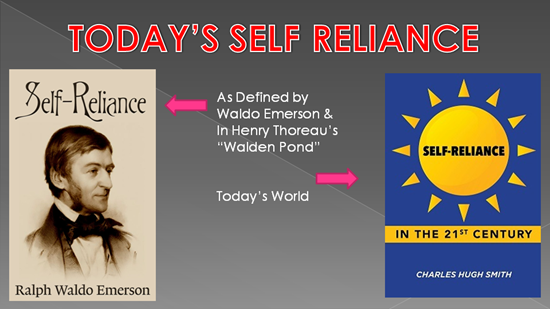
In the same way, we rediscover the value of thinking for ourselves rather than accepting self-serving memes-of-the-day. We rediscover the value of what Ralph Waldo Emerson wrote about in his 1841 essay Self-Reliance (free text, Project Gutenberg).
Emerson counsels us to “be our best selves,” and not to count property wealth above all else. (“They measure their esteem of each other by what each has, and not by what each is.”)
Emerson understood that the values of a society are the foundation of its economic order. A system lacking any principles and values other than greed and self-enrichment is a rotten structure doomed to collapse. It is not just the larger socio-economic order that needs a rock-solid value system; each individual must ground their choices and actions in a value system they have embraced on their own. (“Nothing can bring you peace but yourself. Nothing can bring you peace but the triumph of principles.”)
What Emerson is espousing is self-reliance, in thought, in values, and in economic and financial matters. In today’s world of crumbling hyper-globalization, self-reliance extends to the practical world of where our essential goods and services are coming from.
We discuss how the American economy has changed over the past 40 years, to the detriment of the nation’s values and the security of its citizenry, and what self-reliance means today– the topic of my book Self-Reliance in the 21st Century. (Read the first chapter for free.)
How can we best navigate our low-trust, increasingly dysfunctional society and economy? By strengthening our own self-reliance.
Addiction refers to a condition in which an individual is not able to stop engaging in a behavior or using a substance. Gambling addiction is a behavioral addiction that stimulates the reward system of the brain, much as alcohol and drugs do. This addiction is often treated using behavioral therapy, particularly cognitive behavioral therapy, which replaces unhealthy and irrational beliefs with positive, healthy ones.
Now, researchers at the Center for Psychedelic Research are using brain imaging to understand behavioral addictions such as gambling and discover new approaches to treat these addictions. They are particularly focused on psychedelic treatments, given the promising results observed in their use in treating substance addictions.
Dr. Rayyan Zafar revealed that the researchers were focused on learning whether psilocybin therapy could restore or reverse the dysfunction observed in the brains of gamblers.
The therapeutic use of psychedelics such as psilocybin and LSD has grown over the last couple of years, with numerous clinical trials on their effectiveness in treating mental conditions, including anorexia, depression and obsessive-compulsive disorder being conducted. In the past, Zafar has used functional magnetic resonance imaging to research the neurobiology of gambling addiction. The results, which are yet to be published, show that when gambling addicts were presented with videos associated with gambling and videos associated with other primary rewards such as food, their brains lit up in regions of the brain that process rewards in response to the gambling videos, which wasn’t observed in healthy control subjects.
The researchers are now focused on conducting a trial to observe whether the mechanisms identified are impacted when psilocybin is administered. Their research is being funded by a UKRI Impact Acceleration Account grant designed to lessen the gap between scientific discoveries and their applications.
The investigators’ main objective is to determine whether there is an effect on brain function that is linked to the clinical end point, something that demonstrates that a person’s dysfunctional reward circuits have been reset or recalibrated. The use of brain imaging will help personalize the therapeutic process even further, with Dr. David Erritzoe adding that their interest is in determining whether imaging could help forecast patient reactions as well as how they respond to the treatment. Erritzoe highlights that psychedelic therapy affects an individual’s perception of the world, allowing them to enter an expanded state of consciousness.
The development of this approach will involve a partnership between Central and North West NHS Foundation Trust and the Center for Psychedelic Research. A brand-new MRI system is also being installed at Invicro, which will collaborate with Imperial College London on the research.
These studies will add to the available body of information on psychedelics generated by various stakeholders such as Seelos Therapeutics Inc. (NASDAQ: SEEL).
About PsychedelicNewsWire
PsychedelicNewsWire (“PNW”) is a specialized communications platform with a focus on all aspects of psychedelics and the latest developments and advances in the psychedelics sector. It is one of 60+ brands within the Dynamic Brand Portfolio @ IBN that delivers: (1) access to a vast network of wire solutions via InvestorWire to efficiently and effectively reach a myriad of target markets, demographics and diverse industries; (2) article and editorial syndication to 5,000+ outlets; (3) enhanced press release enhancement to ensure maximum impact; (4) social media distribution via IBN to millions of social media followers; and (5) a full array of tailored corporate communications solutions. With broad reach and a seasoned team of contributing journalists and writers, PNW is uniquely positioned to best serve private and public companies that want to reach a wide audience of investors, influencers, consumers, journalists and the general public. By cutting through the overload of information in today’s market, PNW brings its clients unparalleled recognition and brand awareness. PNW is where breaking news, insightful content and actionable information converge.
To receive SMS alerts from PsychedelicNewsWire, text “Groovy” to 888-902-4192 (U.S. Mobile Phones Only)
Please see full terms of use and disclaimers on the PsychedelicNewsWire website applicable to all content provided by PNW, wherever published or re-published: https://www.PsychedelicNewsWire.com/Disclaimer
We can learn to be happy. We can encourage others to be happy, too. But unlike the 3Rs, happiness cannot be taught. Welcome to the school of life, where it’s up to you.
Happiness is not a plastic thing. Think of happiness as a portal to freedom than as an escape from sadness. We have the ability and freedom of choice. Unfortunately, many of us have refused both the ability and the freedom to choose. Happiness is more a byproduct of attitude than of opportunity or luck. You can develop that attitude by choosing to get out and to be active, by forcing yourself to grasp opportunities and by engaging in them.
Health and happiness go hand in hand. How we respond to problems is an indicator of our health, and a passport to our happiness. Peace and happiness go hand in hand. Peacefulness comes from enjoying life’s meaningful things, from enjoying our natural and cultural surroundings.
Happiness has a taste for reality. Feeling deeply is an affirmation of true happiness. Contentment lies within yourself, don’t seek it elsewhere. If the world seems cold to you, kindle a fire to warm up from the inside; it will keep out the chill.
Bliss is happiness by another name. Bliss is double happiness, happiness drunk on happiness, happiness on a mission. Aim first to be happy, find contentment before capacity. Let your mission find you. They say a cat has nine lives, so don’t be surprised if a late-life mission springs within you, too. Just because you’re getting on, or have had a full career, doesn’t mean there isn’t more in store. It’s not what happens to you, or even what you do, that makes you happy or sad. Bliss is connecting you, deeper layers of the real you, with what you do. A blissful existence happens on the inside, not the outside, though its waves will echo widely.
If you pursue happiness, it will elude you. But if you focus on the needs of others and work on meeting people, and doing the very best you can, happiness will find you at any age. You know it in your dear old bones. Simple, but true.
Oh, that smile looks so good on you.
…………………
“When you look at a group of seniors in a community, you always notice some do not look their age. Blanche Black is one such senior. She has eternal youth and is always busy writing and going about. I never think of her as a senior. Her book is an inspiration to seniors now and to seniors in the future.”
— Margaret Lazaruk, Pharmacist
“This slim, attractive volume of the collected writings of Blanche Black, freelance writer, poet, and dynamic “advanced age citizen,” takes a positive look at aging. Beyond Declining Years: The Art of Aging offers the wisdom of a woman who has embraced life in all aspects, both the good and the bad. It is a book meant to be picked up whenever you feel in need of insightful musings, whether you are suffering declining health, have lost a loved one, or just need reassurance that growing old is not the end of life.
Blanche Black — an octogenarian poet, columnist, and longtime activist on seniors’ issues — keenly observes people as part of nature, and shows her respect for the cycles of life. Blanche is down-to-earth but never retiring — she is a real go-getter! Once nominated Canada’s Mother of the Year, she celebrates Canada Day, Mother’s Day, and holidays throughout the year by writing newspaper tributes on the topic of among. After all, who among us isn’t aging?
Here in the West, a lifestyle of unnecessary spending has been deliberately cultivated and nurtured in the public by big business.
Companies in all kinds of industries have a huge stake in the public’s penchant to be frivolous with its spending, and in the documentary “The Corporation,” a marketing psychologist shows just how easy it is to increase sales by targeting nagging children, and the effect that nagging has on the parents’ spending.
“You can manipulate consumers into wanting, and therefore buying your products. It’s a game,” – Hughes, co-creator of “The Nag Factor.”
This is only one small example of something prevalent in our culture, that companies don’t make sales by promoting the virtues of their products, but by creating a culture of hundreds of millions of people that buy pointless stuff to chase away dissatisfaction. This is reminiscent of the analogy of culture as “hungry ghosts”; a culture of people who constantly want and need, but are never satisfied.
We buy stuff to cheer ourselves up, to keep up with the Jones’, to fulfill our childhood vision of what our adulthood would be like, to broadcast our status to the world, and for a lot of other psychological reasons that have very little to do with how useful the product really is. How much stuff is in your basement or garage that you haven’t used in the past year?
The 40 Hour Working Week
The ultimate tool for corporations to sustain a culture of this sort is to develop the 40-hour work week as the normal lifestyle. Under these working conditions, people have to build a life in the evenings and on weekends. This arrangement makes us naturally more inclined to spend heavily on entertainment and conveniences because our free time is so scarce.
The last thing people want to do after a hard day at work is exercise, improve themselves, delve into their passion, or question the way things are. Relief and gratification are usually the first and foremost things the public will be looking for. The eight-hour workday developed during the industrial revolution in Britain in the 19th century, as a respite for factory workers who were being exploited with 14- or 16-hour workdays.
As technologies and methods advanced, workers in all industries became able to produce much more value in a shorter amount of time… You’d think this would lead to shorter workdays. But the 8-hour workday is too profitable for big business, not because of the amount of work people get done in eight hours, but because it makes for such a purchase-happy public. Keeping free time scarce means people pay a lot more for convenience, gratification, and any other relief we can buy. It keeps us watching television, and its commercials. It keeps us unambitious outside of work and for the most part, apathetic.
We’ve been led into a culture that has been engineered to leave us tired, hungry for indulgence, willing to pay a lot for convenience and entertainment, and most importantly, vaguely dissatisfied with our lives so that we continue wanting things we don’t have. We buy so much because it always seems like something is still missing.
Interestingly, the more people I talk to, the more they seem like they don’t even want to live this way. The question is why are we still doing it?
Very little time is spent stepping outside of our current knowledge and ways of knowing to explore what else is possible. We typically are just creating from our past and the cynicism of being ‘realistic.’ We are also stuck in combative thinking, attempting to point blame everywhere we look.
Very little attention is paid to new and emerging possibilities. This is sort of a paradox because attention is being hijacked by more dramatic, polarizing, or distracting content. Thus there is little incentive for content creators to create this content as it is downgraded in social feeds, plus people don’t engage with it as much.The lack of incentive to create this content then becomes culture. The “top thinkers” out there are constantly coming up with clever debates, gotchas and arguments that come in Instagram clips and YouTube shorts, all designed to grab attention instead of provide deeper thought.
In 2023, we are now faced with the advent of AI and automation that will inevitably take away some jobs over time – and so it should given these techs can be used to give humans more free time. But will the economy shift to make life easier for human beings as they lose work? Or will reliance on the government become the next leg forward? It seems like a system overhaul is the only reasonable way to address this issue.
An Economy Based on Frivolous Addictions and Gratification
Western economies have been built in a very calculated manner on gratification, addiction, and unnecessary spending. We spend to cheer ourselves up, to reward ourselves, to celebrate, to fix problems, to elevate our status, and to alleviate boredom. Can you imagine what would happen if all of the Western world stopped buying so much unnecessary crap that doesn’t add a lot of lasting value to our lives? The economy would collapse and never recover.
All of our well-publicized problems, including obesity, depression, pollution, and corruption are what it costs to create and sustain a trillion-dollar economy. For the economy to be “healthy,” this world has to remain unhealthy. Healthy, happy people don’t feel like they need much they don’t already have, and that means they don’t buy a lot of junk, don’t need to be entertained as much, and they don’t end up watching a lot of commercials.
The culture of the eight-hour workday is big business’ most powerful tool for keeping people in this same dissatisfied state where the answer to every problem is to buy something.
You may have heard of Parkinson’s Law? It is often used about time usage: the more time you’ve been given to do something, the more time it will take you to do it. It’s amazing how much you can get done in twenty minutes if twenty minutes is all you have. But if you have all afternoon, it would probably take way longer.
Most of us treat our money this way. The more we make, the more we spend. It’s not that we suddenly need to buy more just because we make more, only that we can, so we do. It’s quite difficult for us to avoid increasing our standard of living (or at least our rate of spending) every time we get a raise.
Do We Need to Live in the Sticks to Escape This?
I don’t think it’s necessary to shun this whole ugly system and go live in the bush, but we could certainly do well to understand who big commerce really wants us to be. They’ve been working for decades to create millions of ideal consumers, and they have succeeded. Unless you’re a real anomaly, your lifestyle has already been designed.
The perfect customer is dissatisfied but hopeful, uninterested in serious personal development, highly habituated to the television, working full-time, earning a fair amount, indulging during their free time, somehow just getting by, and completely oblivious to the way their life has been manufactured, and will actively defend these prison walls.
Is this you? Maybe it’s time to free yourself. After all, Collective Evolution’s motto has always been “Change Starts Within.”
Please doubt everything I say with healthy skepticism. Find out for yourself whether there is truth in any of it. Consider this a friendly dialogue between two people sitting in a park.
Attending MJBizCon is a daunting exercise which is both the event’s charm and challenge. With over 100 speakers and more than 50 sessions covering women in leadership, cultivation, finance, cannabis science, and many other topics it’s impossible to capture the full experience. It’s also the largest trade show in the business, attended by some 35,000 participants and more than 1,400 exhibitors.
Given the number of topics featured, I passed on the psychedelic industry sessions and focused instead on U.S. and global markets, regulatory developments, social equity, business strategies, consumer marketing and retail trends.
As many already know, each state is different so it’s difficult to gain a sense of what’s happening in the U.S. as a whole. However, discussions did yield insights on tax rescheduling, equity and diversity issues, and market dynamics in the U.S. and abroad.
What’s new for U.S. markets?
On that last point, there was much buzz about the expected impact of adding Florida to the legal marketplace. Most commentators presumed that the April 2024 ballot initiative for adult use would gain approval although it remains an “x” factor.
Advertisement
With 21 million residents, millions of annual visitors and a rapidly growing population, legalization should provide a major boost to demand.
As Kim Rivers, Trulieve CEO noted, the state’s medical use initiative passed with a 72 per cent approval rating, and there is still room for growth of that market of 900,000 users. She indicated that Florida’s recreational market is projected to reach US$6 billion in annual revenue. Other states will also help drive industry growth, according to Rivers, with New York and Ohio just getting started and Pennsylvania expected to reach $4 billion annually.
The panel on Mature Market Regrowth asked to address the question of whether there is cause for optimism, did not provide a clear answer. Panelists agreed that the lack of national distribution infrastructure and federal banking services hampered the industry’s development, even in a large state such as California. Quipped Vince Ning co-CEO of wholesale platform Nabis, “Mature does not mean sophisticated.” When the legal and commercial ecosystem is cash-driven, unsound, and businesses are not paying their bills it has a ripple effect across the sector, panelists agreed. As Guy Rocourt, CEO of wellness brand Papa and Barkley remarked, “There’s lots of cannabis but with all the hoops, taxes and a lack of retailers it still feels like an illegal market.”
Despite regional differences, some overall consumer trends are emerging across markets.
As in Canada, price compression is hitting multiple categories. That includes pre-rolls, unlike Canada where prices of this product are increasing.
Discounting is pervasive and profitability has been declining in most markets since 2017. Customer demographics are changing, as presented by Buck Dutton, VP Marketing at Native Roots Cannabis. There is marked growth in the 65+ segment where use has nearly tripled from three per cent in 2016 to more than eight per cent in 2022 (sources: NY Times and National Survey on Drug Use and Health). Data reported by the Brightfield Group show growth over the past year in three segments: “Aging Ailers,” “Budheads” and “Stressed-out Millennials.”
However, the overall market is getting younger as Gen Z enters the picture. The average age of Native Roots customers since 2019 has been steadily dropping from 53 per cent under age 39 to 61 per cent in 2023. Other data reported during the conference echoes findings on Gen Z’s. Nearly two-thirds of this demographic are still underage, so there’s huge potential here.
U.S. federal policy changes in ’24?
In the absence of federal legalization and cannabis-friendly regulations, most businesses are still challenged, as many speakers stated or inferred. Rescheduling of the federal tax applied to legal cannabis businesses was mentioned often, with observers foreseeing change being implemented in 2024. IRS tax code 280E prohibits U.S. cannabis businesses from deducting commonly permitted expenses from gross income, which is still seen as derived from “trafficking” of an illegal Schedule I substance.
Last September the federal Dept. of Health and Human Services recommended that cannabis be migrated to Schedule III by the U.S. Drug Enforcement Agency (DEA), effectively eliminating 280E.
According to some analysts, such a move would lower cannabis business tax rates from an average of 80 per cent to 28 per cent. According to Virgil Grant, co-founder of California’s Minority Alliance, the repeal of 280E will allow him to recoup 30 cents on the dollar for his business. On the other hand, National Cannabis Roundtable Policy Director, David Mangone sees limited benefit from Rescheduling, perhaps due to state and municipal taxes rising to fill the gap.
The other major policy topic being speculated was the proposed SAFER Banking Act. The legislation’s passage is far from a sure thing, according to most although several commentators expressed optimism.
SAFER—The Secure and Fair Enforcement Regulation Banking Act—was introduced in September 2023 and approved with amendments in early October by the Senate Committee on Banking, Housing and Urban Affairs.
Currently in Committee hearings, the proposed legislation would enable cannabis businesses to access basic banking services such as bank accounts and credit card processing. Without these services businesses are hampered in conducting basic transactions and are more vulnerable to crime. Speculation was all over the map, but it was noted that the Bill has bipartisan support and is being pushed by major financial services firms. The question is, will it be one of the 200 bills that make it to the President’s desk for signing in 2024, from the roughly 4,000 introduced each year? The Bill must still pass both the Senate and the House during an election year, adding further uncertainty.
Social equity and diversity a defining feature
Social equity considerations are often baked into state legalization bills to redress harms from the US War on Drugs through which Black Americans and persons of colour have been disproportionately penalized. But social equity and diversity considerations are a pervasive feature beyond state licensing, as federal prohibitions which still bolster the W.O.D. continue to inhibit banking, impede interstate commerce, threaten public safety, and constrain small cannabis businesses. Part of SAFER’s impetus is to fight crime by reducing the need to keep cash in stores.
In a fascinating session on the current landscape for state and federal legalization, panelists profiled the District of Columbia as a jurisdiction strewn with barriers to developing a cannabis sector to the detriment of its Black American population, the District’s largest racial group.
The requirement that each state grow, process, and sell its own cannabis hampers smaller jurisdictions from developing an integrated market. In D.C.’s case, there is little room for agriculture and federal prohibitions prevent cannabis products and accessories from crossing state lines. Other jurisdictions are less affected but companies seeking access must replicate infrastructure within each state, not an efficient business model.
Social equity was also discussed in sessions where one might not expect it to be a factor. On a craft cannabis panel, Loriel Alegrete, owner of social impact brand 40 Tons, shared a live call with the audience from a prisoner serving time on a simple possession charge. The company directs all proceeds from T-shirt sales to support persons of colour incarcerated for non-violent cannabis offences. This was another example of how social equity issues are woven into industry sub-sectors, in this case fashion retailing.
German market a big focus
Sessions on Global business addressed a range of international markets but paid special attention to Germany’s medical market, as well as the government’s plans to legalize recreational cannabis. European cannabis markets are quite fragmented, unlike other EU sectors and at least seven years behind North America, according to Benedikt Sons, CEO of pharma wholesaler, Cansativa. As Europe’s largest economy, Germany naturally commands considerable attention. The government also subsidizes half of medical users; a factor that Sons sees as a big driver in the country’s evolution towards becoming the continent’s main medical cannabis market. Currently, Germany is one of only three “free” European medical markets according to Son, who defines other countries’ markets as tightly controlled, early/slow or subject to exceptional access. He also identifies Switzerland as a market in transition and notes that several others are running pilot programs and not fully operational.
Deepak Anand of ASDA Consultancy Services shared additional insights about the German medical market, noting it was the first to import cannabis to serve growing domestic demand. Domestic production of 2.6 tonnes is supplied by three licensed cultivators, two of which (Tilray, Aurora) are Canadian.
The German market is also highly dynamic, with new products appearing on pharmacy shelves every few weeks. Pharmacy purchases have grown quickly, from less than 1000 kg of flower/equivalent in 2017 to just under 15,000 kg. in 2022. An aspect of the market’s dynamism is a growing demand for high-THC products with content as high as 30%+ according to Sons, a figure that may prompt skepticism by Canadians due to reports here of inflated lab figures.
Plans for legalizing recreational cannabis in Germany are still taking shape although full-scale commercialization is not yet feasible. Over the next five years Sons sees only limited regional commercial markets being established. As Germany will be “the first domino to fall” its experience will influence other markets. Debate may be heating up as Anand put it, but Europe’s appetite for recreational cannabis remains limited.
Still, there is an apparent cultural shift toward a more liberal outlook, enabling private domestic production and use in Portugal, Spain, Malta, Czechia, and the Netherlands. In terms of commercialization beyond medical use and cannabis clubs, the Netherlands recently announced a supply chain test project in 11 municipalities, and Switzerland has pilots underway in selected cities and cantons. Last year Luxembourg announced plans to legalize cannabis as well. Above all, those looking to enter German and other European markets were advised not launch business plans based on the expectation of future regulatory developments.
Canadian grocery store chain Loblaw Companies Ltd. has entered its fifth year of lobbying the provincial Ontario government, led by conservative Doug Ford, for widespread expansion of marijuana sales, ostensibly so the company can expand its own cannabis footprint.
Loblaws, as it’s commonly known, already has two dispensaries in the medical marijuana industry, but it’s been attempting for years now to change a rule that prohibits medical cannabis businesses from also selling recreational marijuana, Global News reported.
The grocery giant has more than 2,400 stores across Canada, according to the company website, and has held numerous meetings with representatives of the Ford government in Ontario since 2019, Global News reported, citing “internal government documents” obtained through freedom of information laws. Those meetings included representatives from the attorney general’s office.
Advertisement
Among Loblaws’ primary lobbying goals:
Repealing restrictions on cannabis sales at establishments that also sell food and snacks.
Allow “store within a store” models, similar to how some wine companies have pop-up locations within Loblaws grocery stores.
Repeal a ban on online retailers from selling cannabis goods.
Changing rules to allow medical cannabis dispensaries to also sell recreational marijuana.
Both of Loblaws’ dispensaries operate under the company’s “C-Shop” brand, with one in the Ottawa suburb of Embrun, Ontario, and another in North Bay, Ontario. The company has applied for “several” more dispensary locations, but has been stymied thus far in its attempts to enter the adult-use marijuana trade.
But the grocery giant’s attempts appear to be “ongoing,” Global News reported, and it may yet find a receptive ear within the Ford government, which has been sympathetic to large corporate business interests.
At least one Canadian cannabis company, High Tide, was excited about the prospect of Loblaws becoming a marijuana retailer.
“We welcome anyone who wants to enter the cannabis market — competition is good increased access to local stores is good,” Omar Khan, chief communications and public affairs officer for High Tide (Nasdaq: HITI) (TSXV: HITI) (FSE: 2LYA) told Global News.

















Recent Comments