(CNW) Smiths Falls, Ont. – Canopy Growth Corporation, today announced that it has entered into subscription agreements, dated as of January 9, 2024, with certain institutional investors in a private placement offering of 6,993,007 units at a price per Unit of US$4.29 for aggregate gross proceeds of approximately US$30,000,000.
The purpose of the offering is to provide the company with additional liquidity of US$30MM to further strengthen Canopy Growth’s financial position. Proceeds are expected to be used to pay down debt, which is consistent with the company’s strategy for overall debt reduction, as well as for working capital and other general corporate purposes.
Each Unit will be comprised of (a) one common share of the company and (b)(i) one Series a common share purchase warrant or (ii) one Series b common share purchase warrant.
Each warrant will entitle the holder to acquire one common share from the company at a price equal to US$4.83. The series a warrants will be exercisable immediately following the closing of the offering for a period of five years from such date and the series b warrants will be exercisable for a period commencing on the date that is six-months following the closing of the offering and ending on the date that is five years following such date. The company has also agreed to provide the investors with customary registration rights.
Advertisement
The closing of the private placement pursuant to the subscription agreements is expected to occur on or about January 10, 2024, subject to customary closing conditions.
This news release is issued pursuant to Rule 135c under the Securities Act of 1933 and shall not constitute an offer to sell or a solicitation of an offer to buy these securities, nor shall there be any sale of these securities in any state or other jurisdiction in which such offer, solicitation or sale would be unlawful prior to the registration or qualification under the securities laws of any such state or other jurisdiction. Any offering of the securities under the resale registration statement will only be by means of a prospectus.
(Globe Newswire) New York and Toronto — iAnthus Capital Holdings, Inc., a leading national cannabis consumer packaged goods company and owner of MPX-NJ dispensaries in New Jersey, announces a strategic partnership to bring Grön, the renowned, woman-owned producer of handcrafted cannabis-infused edibles to the New Jersey market.
This collaboration marks a significant step in ensuring New Jersey consumers have access to the world’s most beautifully delicious edibles. The initial launch of Grön Sugar-Coated Pearl gummies is now available at all MPX-NJ locations and across dispensaries throughout New Jersey.
“This partnership with Grön represents a major milestone in our promise to bring the best cannabis experiences to our customers. By leveraging Grön’s expertise in creating premium edible products in our state-of-the-art facility, we are set to make a significant impact in the New Jersey market and our MPX-NJ branded adult-use dispensaries in Pennsauken, Gloucester Township, and Atlantic City,” said Richard Proud, CEO of iAnthus.
“On a personal note, we are thrilled to partner with Christine and the entire Grön team. As one of the leading female-owned and led businesses in the cannabis industry, their commitment to the culture of cannabis, and to producing products of the highest quality, sets them apart from their competitors. Our mission is to positively enhance the cannabis industry, and working closely with Grön continues us down that path.”
Advertisement
Under this partnership, Grön will produce its full range of acclaimed edible products at the iAnthus Pleasantville, NJ facility, ensuring the highest standards of quality and safety for the customers of New Jersey. The Grön expansion strategy allows the brand’s team of experts to oversee the production in New Jersey, ensuring product consistency across the highly coveted and growing cannabis market.
The collaboration will see the launch of Grön wholesale operations in the state, along with overseeing a steady roll-out of new products available to New Jersey customers, while providing enhanced marketing support to amplify the position of both businesses across the state. The partnership advances expansion plans for Grön in New Jersey and establishes a hub on the East Coast for the company’s future growth.
“We are thrilled to partner with iAnthus and embark on this journey together, marking a significant chapter in the story of Grön and our growth and innovation,” said Christine Smith, founder and CEO of Grön.
“New Jersey marks our fifth market expansion, a testament to our approach and dedication to reaching cannabis enthusiasts across the U.S. Our Sugar-Coated Pearl gummies, now available at all MPX-NJ locations, are just the beginning of an exciting entry in this burgeoning market, and we look forward to becoming a staple in the lives of New Jersey consumers. This venture is not just about entering a new market; it’s about building connections, creating moments, and elevating the cannabis experience.”
Grön edibles will debut in New Jersey with the launch of Sugar-Coated Pearls, made with natural fruit flavors and infused with cannabis extract. The 10-pack of pearls are available in six flavors and a variety of unique cannabinoid ratios including, CBD, CBN, and THC that offer a wide range of effects for every consumer preference.
In 2024, Grön will continue expanding its product offering with the launch of a full range of edible products specifically catering to diverse consumer preferences and tailored to the local market trends. The Grön full line of edibles includes: The MEGA Pearl — a single-serve 100 mg sugar-coated gummy that is five times larger than the standard Sugar-Coated Pearls; Pips — decadent 5 mg, candy-coated chocolate pieces made with Fair Trade chocolate; and Grön Chocolate — the original chocolate bars that established Grön in 2015.
The dynamic landscape of the Canadian cannabisindustry has been nothing short of transformative these past five years. Upon legalization, several LPs emerged as key market players, howeverthe recent shuttering of many cultivation facilities belongs to industry giants. Meanwhile, midsize LPs have displayed remarkable adaptability, navigating the challenges of running a cannabis business with limited capital and, in many cases, finding success.
Supply and demand shifts
The initial rush in the early days of cannabis legalization saw a proliferation of massive cultivation operations, often coupled with efforts to bring processing, extraction, packaging and other activities in-house. The goal was clear: meet the projected demand of a budding industry. However, the reality was these grand-scale operations proved to be highly inefficient.
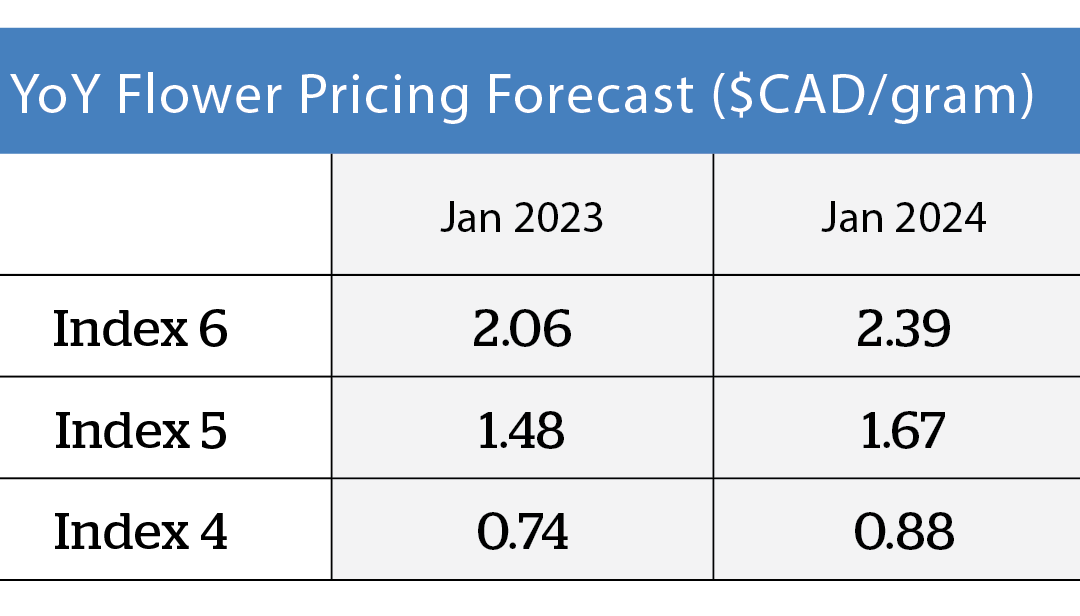
The oversupply issue hit its peak in late 2022 at the Canadian Cannabis Exchange (CCX), with wholesale prices reaching an all-time low of $0.74/gram in Q4 2022. The plunge in prices partially stemmed from the oversupply issue and from smaller LPs not having a path to access provincial retail markets. LPs big and small found themselves grappling with the repercussions of rapid expansion, vaults full of inventory and managing over-built facilities. Awash with products, the natural consequence was a struggle to maintain pricing above breakeven. Now the tides are turning.
Over the past few years, reports have shown a 32 per cent decrease in indoor and greenhouse cultivation from 2.2 million to 1.5 million square meters. Some large industry players such as Sundial, Canopy and Aurora, had to make the painful decision to close large cultivation facilities. Similarly, several smaller LPs have also had to shutter operations or scale back cultivation rooms. These closures have disrupted established supply chains and resulted in shortages across several product categories. With this, we have seen buyers willing to pay higher prices to secure quality product. Transactions near and above $3.00 per gram wholesale are creeping back into the market for new harvests of high THC (30%+), craft-grown product.
Advertisement
Emerging midsize LPs
Amid the over-supply turmoil, midsize LPs, often nimble and more flexible in their approach, found a way to adapt. The challenge of running a business with limited capital led them to focus on efficiency, innovation and specialization. Their ability to pivot became a driving force in the industry’s transformation. We’ve observed a market shift toward right sizing the cultivation footprint and activities offered to meet market demands, focusing on core competencies and building effective teams.
Regulatory challenges and pricing dilemmas
Nevertheless, challenges persist and many of them revolve around regulation. Taxation, licensing fees, limits on marketing activities and the burden of reporting activities are among the hurdles LPs face. Many of them will need to change to increase industry viability, but the most direct factor on wholesale pricing down pressure stems from the provincial buyers.
Provinces have been hesitant to raise cannabis prices, influenced by their need to compete with the illicit market on top ofthe public’s insistence on lower prices driven by a 4.8 per cent inflation increase.
Wholesale buyers are also constrained in their ability to raise their purchase price for products due to the fixed SKU prices set at the provincial level. Multiple buyers are now vying for the same use cases at similar wholesale pricing levels. Those buyers willing to increase wholesale purchase prices often find themselves unsustainably compromising their own margins to fulfill purchase orders, and unless provincial prices increase, the market will continue to face a ceiling on pricing and depressed margins.
CCX has however witnessed substantial growth in international trades, with an average transaction price of $4.10/gram.
As we approach 2024, critical questions will shape the upcoming year in cannabis: Will provinces and consumers accept higher prices for cannabis products? Will we continue to see facility shutdowns without a clear path to profitability? Will the CRA enforce the collection of back taxes from LPs? Will the legislative review of the Cannabis Act bring meaningful reform? The answers to these questions will determine the direction of the Canadian cannabis industry, shaping its challenges and opportunities in the years to come.
Steve Clark is regarded for his expertise in business development. He co-founded Canadian LP 314 Pure and advises on multiple industry boards. Steve’s innovative drive is the force behind CCX’s success, where he currently serves as founder and CEO.
Clarence Cocroft, the owner of Tru Source, a medical marijuana dispensary in Olive Branch, Mississippi, is contending that the ban on medical marijuana advertising in Mississippi is hindering his dispensary’s ability to attract customers. He claims that this prohibition infringes upon his freedom of speech, a claim central to the federal suit filed on Nov. 14, 2023.
The lawsuit targets the regulatory authorities overseeing these restrictions, including the state’s health department, the revenue department, and the state’s bureau of alcohol and beverage control.
While medical cannabis is now legal in Mississippi for persons with qualifying conditions and a medical marijuana card, the state law explicitly forbids dispensary owners and cultivators from promoting marijuana products. To establish a medical marijuana shop, one is required to obtain a dispensary license, obtain a sales tax registration and incur considerable fees. Additionally, patrons must possess a medical marijuana card and be at least 21 years old to enter a dispensary.
Tru Source relies on limited advertising channels, including word of mouth, on-location signage and its website. Cocroft, however, faces restrictions preventing him from promoting the dispensary through other mediums. He highlights that potential customers might remain unaware of the store’s existence unless they happen to pass by.
Represented by the Institute for Justice (IJ), a nationwide libertarian nonprofit law firm, Cocroft’s lawsuit challenges the constitutionality of commercial speech regulations. Katrin Marquez, an attorney for Cocroft, points out how these regulations, viewed through the lens of the First Amendment, impede business growth.
When Tru Source was established, Cocroft invested in billboards in the north of the state for advertising but had to lease the locations to other businesses, such as a casino, capable of legally promoting their products. The case and the resultant media attention have attracted new customers to Tru Source, increasing daily visits from about 15 to 20 patients to 20 to 30 patients picking up medical marijuana products.
Cocroft argues that the ban on advertising not only affects dispensary owners but also impacts cultivators. If dispensaries can’t promote products, their purchasing capacity diminishes, causing financial losses for cultivators. He questions the disparity, noting that industries such as alcohol, medications, casinos and strip clubs can advertise statewide, while marijuana dispensaries face restrictions.
Cocroft highlights the financial burden borne by those invested in Mississippi’s medical marijuana industry, where millions of dollars have been spent in pursuit of helping patients navigate a novel business landscape. In his view, the unequal advertising regulations create a puzzling dichotomy where certain industries can freely advertise, while others, such as Tru Source, face stringent limitations.
It isn’t just cannabis companies in Mississippi that are hamstrung by restrictions on advertising. Other enterprises operating elsewhere, such as SNDL Inc. (NASDAQ: SNDL), are also grappling with limitations on how and where they can advertise their products.
About CNW420
CNW420 spotlights the latest developments in the rapidly evolving cannabis industry through the release of two informative articles each business day. Our concise, informative content serves as a gateway for investors interested in the legalized cannabis sector and provides updates on how regulatory developments may impact financial markets. Articles are released each business day at 4:20 a.m. and 4:20 p.m. Eastern – our tribute to the time synonymous with cannabis culture. If marijuana and the burgeoning industry surrounding it are on your radar, CNW420 is for you! Check back daily to stay up-to-date on the latest milestones in the fast -changing world of cannabis.
To receive SMS alerts from CNW, text CANNABIS to 888-902-4192 (U.S. Mobile Phones Only)
Please see full terms of use and disclaimers on the CannabisNewsWire website applicable to all content provided by CNW, wherever published or re-published: https://www.CannabisNewsWire.com/Disclaimer
Canadians bought more than $16 billion worth of cannabis in the first five years of legalization | StratCann
Thanks to our sponsors for supporting StratCann’s work!
Canadian cannabis stores sold more than $16 billion worth of cannabis products from October 2018 to October 2023, according to the newest figures from Statistics Canada.
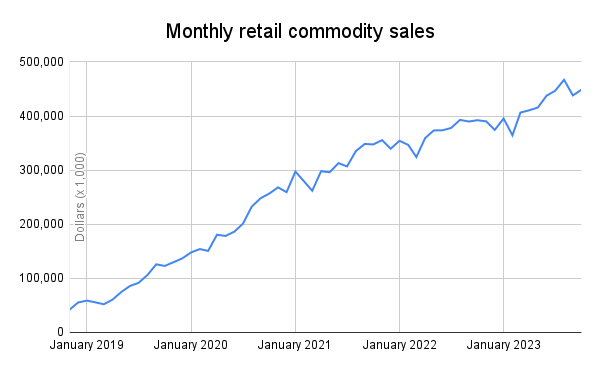
Despite monthly fluctuations, Cannabis sales continue to climb in Canada year over year, with more than $448 million sold by the nearly 3,700 cannabis retailers nationwide as of October 2023. This is an increase from about $392 million in October 2022, although down from an August 2023 high of almost $467 million.
Monthly retail cannabis sales across Canada, October 2018-October 2023
The number of retail stores across Canada also continues to grow, although the pace has slowed considerably compared to the first four years of legalization. As of January 2024, there were 3,694 cannabis stores in Canada, excluding provincial online stores.
British Columbia: 510 public and private stores either open or “coming soon”
Thanks to our sponsors supporting StratCann’s work!
Recent Articles
Are you of legal age in your jurisdiction? By clicking “Enter” you are verifying you are of legal age to view the content of this website, or click “Exit” to leave.
Researchers at Johns Hopkins University will be studying the effects of marijuana therapy by closely monitoring 10,000 medical cannabis patients over a five-year period. The study, backed by a generous $10 million grant from the National Institute on Drug Abuse (NIDA), is a collaborative effort with federal researchers and the nonprofit Realm of Caring.
Together, the researchers will amass comprehensive data encompassing delivery methods, product chemical composition, dosage, potential medication interactions and other intricate facets of treatment.
Ryan Vandrey, cocreator of the study and a professor at the Johns Hopkins University School of Medicine, expressed the research team’s objective to comprehend the health impacts of therapeutic cannabis use. The comprehensive study aims to shed light on the diverse landscape of marijuana products, recognize their differences and identify areas of promise. Vandrey emphasized the need to narrow the focus to distinguish helpful products from those that might pose risks, tailoring the research to specific populations and therapeutic purposes.
Despite the increasing volume of cannabis research, federal marijuana laws have posed significant obstacles to scientific exploration. The study recognizes that with more than three-quarters of states legalizing medical cannabis, there is a considerable gap in understanding due to federal restrictions.
The National Cannabis Study is designed to follow a representative cohort of approximately 10,000 patients, spanning from cannabis naivety to a year or more of marijuana use. Johannes Thrul, a mental health professor at the Johns Hopkins Bloomberg School of Public Health, explained that the assessments will be more frequent in the initial stages, acknowledging that patients are likely to experiment with different products to find what best addresses their symptoms.
While Johns Hopkins pursues this independent initiative, the National Institutes of Health (NIH) has expressed the need for a new Resource Center for Marijuana and Cannabinoid Research. The initiative aims to tackle the challenges and barriers hindering cannabis research. Numerous federal health agencies have prioritized overcoming these barriers due to the cumbersome and costly registration process scientists face when trying to access marijuana given its current Schedule I status under the Controlled Substances Act.
Significantly, the Drug Enforcement Administration (DEA) is actively reviewing the policy classifying marijuana as a Schedule I drug, prompted by a recommendation from the HHS to reclassify it to Schedule III. This potentially signals a shift in the regulatory landscape, opening avenues for more streamlined and accessible marijuana research.
Cannabis companies such as Green Thumb Industries Inc. (CSE: GTII) (OTCQX: GTBIF) are likely to await the findings of the study as those findings could provide valuable insights into the specific ways in which customers are benefiting from the medical marijuana products they buy.
About CNW420
CNW420 spotlights the latest developments in the rapidly evolving cannabis industry through the release of two informative articles each business day. Our concise, informative content serves as a gateway for investors interested in the legalized cannabis sector and provides updates on how regulatory developments may impact financial markets. Articles are released each business day at 4:20 a.m. and 4:20 p.m. Eastern – our tribute to the time synonymous with cannabis culture. If marijuana and the burgeoning industry surrounding it are on your radar, CNW420 is for you! Check back daily to stay up-to-date on the latest milestones in the fast -changing world of cannabis.
To receive SMS alerts from CNW, text CANNABIS to 888-902-4192 (U.S. Mobile Phones Only)
Please see full terms of use and disclaimers on the CannabisNewsWire website applicable to all content provided by CNW, wherever published or re-published: https://www.CannabisNewsWire.com/Disclaimer
Much has been made about how we identify with ourselves. This person is a man, and that person is a woman. Anything outside of the socio-physio realities of our masculinity or femininity is often condemned, discouraged, judged, mistaken and ridiculed. The fear and insecurity of humanity exhibits feigned attempts at acceptance, love, peace and understanding. Even when it has no direct impact or influence on the antagonist(s), we strive to degrade gender diversity out of existence. Society may never be ready to acknowledge, approve or empower a transcendent experience with its sexuality. Being is much more than just identifying as a man, woman or otherwise.
The Era of Balance
During the pandemic, I chose the opportunity available for all of us to go within and align, center, ground and relate with universality. In my experiences, I discovered and embraced the multidimensionality of being to bring equilibrium within and fulfill a profound relativity with my soul. This is not to declare I shifted into a different gender. It is to articulate we all have male, female and transcendental elements of our being, regardless of our physical manifestation. Whether or not society chooses to accept the recent revelations of gender diversity, we are in the evolutionary progression of the Age of Aquarius. The era of universal balance.
Archaic Existence
Patriarchal men need not fear that women will rule the world. Yet, this is probably a good idea, given the destruction mankind manifests in its quest for egocentricity, supremacy and worth. Primarily, men are aggressive, brutal, competitive, primeval and obtuse. These masculine qualities have oppressed women into amity, empathy, nativity and passivity. Toxic masculinity and femininity are instinctual, intellectual and emotional epidemics, condemning men and women into a one-dimensional existence within the social paradigm of duality. We sever our relativity with our soul when we sentence ourselves to the singularity of gender identity.
Unfulfilled Intimacy
Our relativity is not only expressed in how we connect with others, but in how we relate with ourselves. Engaging in personal and social intimacy is often a material and peripheral encounter. When we consider all the physical, mental and emotional conditions we bring to our relationships, rarely is it ever a fulfilling experience. Given the lackadaisical awareness many express in their relations, it is not surprising that contemporary sexuality results in toxicity. When we attempt to fill our personal void vicariously through another, we become a vortex. The loneliness we feel with our significant other is often far worse than the one we endure alone.
“Embodying our soul empowers our relations.”
The Toxicity of Gender
Many tend to camouflage themselves with the social shield of their physical gender. As we mature, we till our personal roots deeper into man or womanhood, accepting a life sentence of one-dimensionality. Our oblivion to the universal nature of our complimentary sexualities becomes suppressed, further complicating the fulfillment of our being and our relations. An unbalanced male may project the aggression of anger, competition, judgement, machismo and strategy, while an imbalanced female may retreat into the passivity of drama, helplessness, hopelessness, oversensitivity and resignation. Embodying a singular gender identification is a suppression of transcendental being.
Over the Rainbow
Gender diversity has exploded throughout society. Many may feign acceptance, empathy and understanding with alternative communities to be “socially correct.” For others, declaring sexual diversity is an evolutionary expression of being. Though these discoveries are ringing in a global revolution of sexuality, our destiny is to establish our unique balance, and transcend the boundaries of gender to become a universal being. Both men and women have masculinity, femininity and divinity. Equilibrium within creates the foundation upon which our relativity with the universe is experienced through our heart and intuition. We are not one delineation, we are all.
A Balanced Being
When men accept their femininity and women embrace their masculinity, universal balance is established in our heart center. This allows us to be present to our intuition and soul. Without this symmetry, we cannot become an expression of universality. The energy of the universe is ever transforming, empowering us to evolve, expand and progress. We are universal beings having human experiences. The universe empowers us to embody our omnidimensionality. When we are related with our soul, in flow with our intuition and centered in our heart, we are a balanced being of universality.
A Personal Shift
For the last few years, I have become more intimated with universality. This relativity is very distinct from gender identification. The experience transcends masculinity, femininity and sexuality. The balance of all creates a being within to express universal energy. As a man, I observe my anger, bias, negativity, reactivity and violence. When my expression is universal being, I experience calm, clarity, positivity, proactivity and tranquility. By no means is this a profession of perfection. For me, it is a personal shift of balancing all elements of my being to create relativity with my soul and be in the energetic flow of universality. This transcends the boundaries of gender identity.
Any Color You Like
Human perception is steeped in black and white. In the wake of this duality, our perceptions often turn gray. The patriarchy vilifies the rainbow as a representation of deviant sexuality. In the eyes of society, transcendent expressions of being are exiled beneath the gravity of social transgression. The toxicity of gender one-dimensionality projects fear and insecurity, condemning us to the enslavement of identity singularity. This new era is our opportunity to release our personal and social programming to express our totality. A balanced being is not about identifying as a singular gender. It is the empowerment and embodiment of our soul.
“We are an expression beyond imagination.”
Editor: Video Chat to Come – Uncovering, so to speak – More on Gender and Awareness!
The combination of BZAM and FBC creates a Canadian cannabis powerhouse, significantly advancing core tenants of BZAM’s mission: (i) to deliver the brands and products consumers want; and (ii) to be a favoured partner of the retailer community nationwide.
“It has been our vision to be Canada’s favourite source for cannabis. Bringing FBC under the BZAM umbrella takes us forward in realizing this vision as we combine our broad flower and 2.0 product portfolio with some of the biggest international brands and products in the cannabis universe including Jeeter, Cookies, Sherbinskis, and our existing Canadian JV partner Wyld,” said Matt Milich, BZAM’s CEO.
Pursuant to the transaction, FBHI, the sole shareholder of FBC, has received 90,000,000 common shares of BZAM (the BZAM Shares) at a deemed price of $0.15 per BZAM Share, representing approximately one-third of the issued and outstanding shares of BZAM following the closing of the Transaction.
Advertisement
The BZAM shares issued to FBHI are subject to a lock-up, with 1/3 of the BZAM thares being released on the 4-month, 8-month, and 12-month anniversaries of the date of issuance of such shares. As part of the Transaction, FBC will retain an unsecured promissory note issued to FBHI, or an affiliate, in the amount of $8 million, bearing zero percent interest until March 31, 2025 and ten percent interest thereafter until the maturity date of June 15, 2027.
As part of the transaction, Greg Boone has joined BZAM as president and Jennifer Maccarone has joined as VP of operations, while Christy Zhou assumes the role of Chief Legal Officer at BZAM. Matt Milich will remain as Chief Executive Officer of BZAM.
In addition, FBHI appointed a nominee, being Kay Jessel, to the board of directors of BZAM (the Board), joining existing BZAM board members Bassam Alghanim, who continues as chair of the board, Chris Schnarr, Sherry Tross, Keith Merker, Wendy Kaufman, and Sean Bovingdon.
Kay Jessel is an experienced economist, asset manager and investment banker, with a track-record of successful capital markets transactions and strategic advisory services for corporations, creditors, and equity owners. Mr. Jessel has held director positions in public and private companies in North America and Europe, including Fila Golf, Inc., HeartForce Medical Inc. and Biokronix Inc. Mr. Jessel also co-founded Melchior Kapital AG, a prominent Swiss-German portfolio asset management company specializing in venture capital. His experience has been leveraged by companies worldwide to raise approximately a quarter of a billion dollars in financing. At FBHI, he serves as Executive Director, generally overseeing operations, securityholder communications/investor relations, and fund-raising. Mr. Jessel holds a Diplom-Kaufmann degree from Hamburg University, which is equivalent to an MBA.
(CNW) Montreal — Cannara Biotech Inc., a vertically integrated producer of premium-grade cannabis and derivative product offerings at affordable prices with two mega facilities based in Quebec spanning over 1,650,000 sq. ft., today announced it has retained Independent Trading Group (ITG) to provide market making services in accordance with TSX Venture Exchange policies.
ITG will trade the securities of the company on the TSXV for the purpose of maintaining an orderly market. In consideration of the services provided by ITG, the company will pay ITG a monthly fee of $6,000 from the company’s available cash for a minimum term of one month and renewable for successive one-month terms thereafter.
Either Party may terminate the arrangement by providing written notice to that effect 20 days prior to the end of the then current term. The services provided by ITG will commence on January 8, 2024. The company and ITG are unrelated and unaffiliated entities and ITG has no interest, directly or indirectly in the company or its securities. ITG will not receive shares or options as compensation, nor have they indicated any immediate intent to acquire shares of the company through the open market or otherwise. The capital used for market making will be provided by ITG.
Astrotech’s newest subsidiary, Pro-Control, will use the company’s mass spectrometer technology to improve purity, and yields of distilled chemicals
Pro-Control delivers value by improving lost yields and delivering found profits directly to the bottom line with little, which the company believes will lead to an overall increase in profitability
Astrotech believes that the Pro-Control MVP has the ability to routinely improve yields from 20% to 30%
The company is introducing its proprietary ATi Mass Spectrometer Technology into the vast chemical manufacturing and process control markets
Astrotech (NASDAQ: ASTC), is an instrumentation company that is focused on commercializing its proprietary ATi Mass Spectrometer Technology(TM) that is now used in airports and agriculture applications throughout the world.
Astrotech continues to expand its ATi Mass Spectrometer Technology into new markets and has announced the introduction of its newest Pro-Control-1000(TM) product line of instrumentation designed to improve chemical manufacturing efficiencies. Astrotech is also announcing the creation of its newest wholly owned subsidiary, Pro-Control, Inc. that has been awarded an exclusive ATi field-of-use license for worldwide chemical manufacturing and process control applications.
The Pro-Control-1000(TM) mass-spec is ideally suited for use in the chemical manufacturing industry due to its rugged design and highly reliable chemical analysis.
The Pro-Control-1000(TM) is easy to operate with daily auto-calibration and auto-tune. The custom library feature makes it easy to create a unique chemical library. And the programable user interface adapts to every chemical manufacturing application and testing protocol.
The Pro-Control-1000(TM) product line includes two models:
The Pro-Control-1000-D1(TM) is a fully automated mass spectrometer that is configured to continually analyze the process gases while adjusting the PLC controls (temp, flow, pressure), for Maximum Value Processing (max purities and yields).
The Pro-Control-1000-D2(TM) is a manually prepared test that analyzes in-process liquids while providing graphical feedback needed to adjust the operating parameters (temp, flow, pressure) for maximum efficiency.
According to Mordor Intelligence, the global mass spectrometry market is estimated to reach $6.37 billion in 2023 and is expected to grow to $8.63 billion by 2028 at a CAGR of 6.25%. The market’s growth is being driven primarily by the technological advances in the mass spectrometer device market. The key market players are continuously working to advance existing products and launch innovative advanced mass spectrometer devices into various applications including chemical manufacturing (https://cnw.fm/DxoIo). Pro-Control is offering its proprietary mass-spec technology to customers that are interested in significantly improving the purity and yields and profits from the manufacturing of distilled chemical products.
Thomas Pickens, CEO and CTO of Astrotech said, “The company is very excited to be introducing our new Pro-Control, Inc. subsidiary along with the very capable Pro-Control-1000(TM) family of rugged mass-spectrometers. The ideal Pro-Control customer is a large-volume manufacturer of chemical products seeking to improve bottom line profits. We believe that Pro-Control MVP can routinely improve manufacturing yields from 10% to 30% and we are excited to introduce our technology to the vast chemical manufacturing market.”
NOTE TO INVESTORS: The latest news and updates relating to ASTC are available in the company’s newsroom at https://cnw.fm/ASTC
About CannabisNewsWire
CannabisNewsWire (“CNW”) is a specialized communications platform with a focus on cannabis news and the cannabis sector. It is one of 60+ brands within the Dynamic Brand Portfolio @ IBN that delivers: (1) access to a vast network of wire solutions via InvestorWire to efficiently and effectively reach a myriad of target markets, demographics and diverse industries; (2) article and editorial syndication to 5,000+ outlets; (3) enhanced press release enhancement to ensure maximum impact; (4) social media distribution via IBN to millions of social media followers; and (5) a full array of tailored corporate communications solutions. With broad reach and a seasoned team of contributing journalists and writers, CNW is uniquely positioned to best serve private and public companies that want to reach a wide audience of investors, influencers, consumers, journalists and the general public. By cutting through the overload of information in today’s market, CNW brings its clients unparalleled recognition and brand awareness. CNW is where breaking news, insightful content and actionable information converge.
To receive SMS alerts from CNW, text CANNABIS to 888-902-4192 (U.S. Mobile Phones Only)
Please see full terms of use and disclaimers on the CannabisNewsWire website applicable to all content provided by CNW, wherever published or re-published: https://www.CannabisNewsWire.com/Disclaimer















Recent Comments