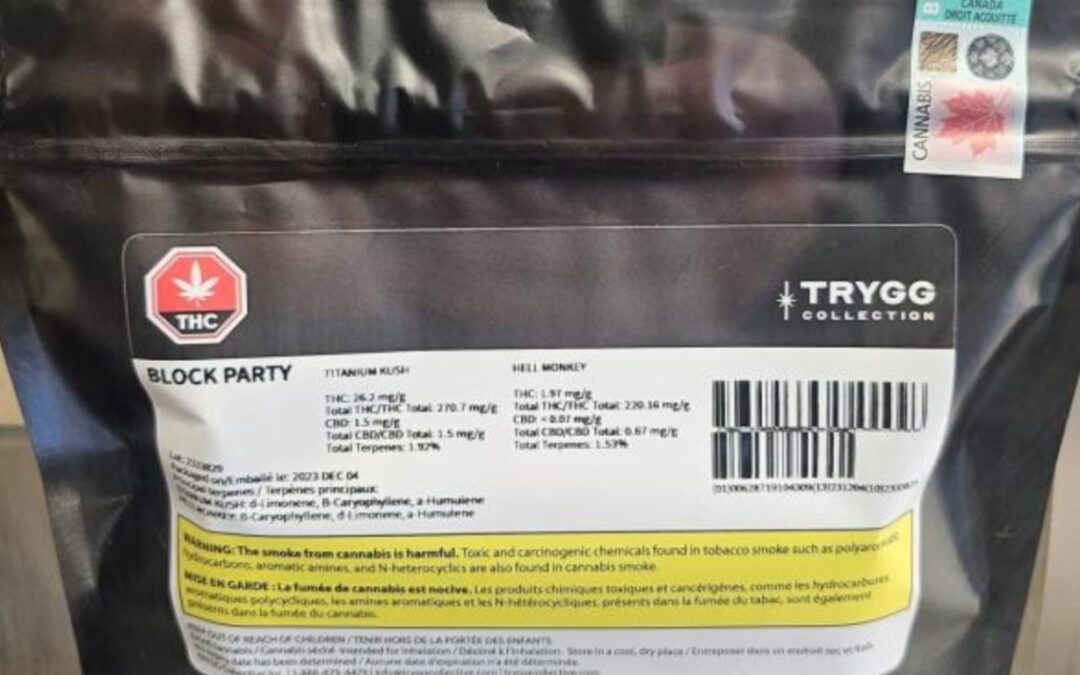
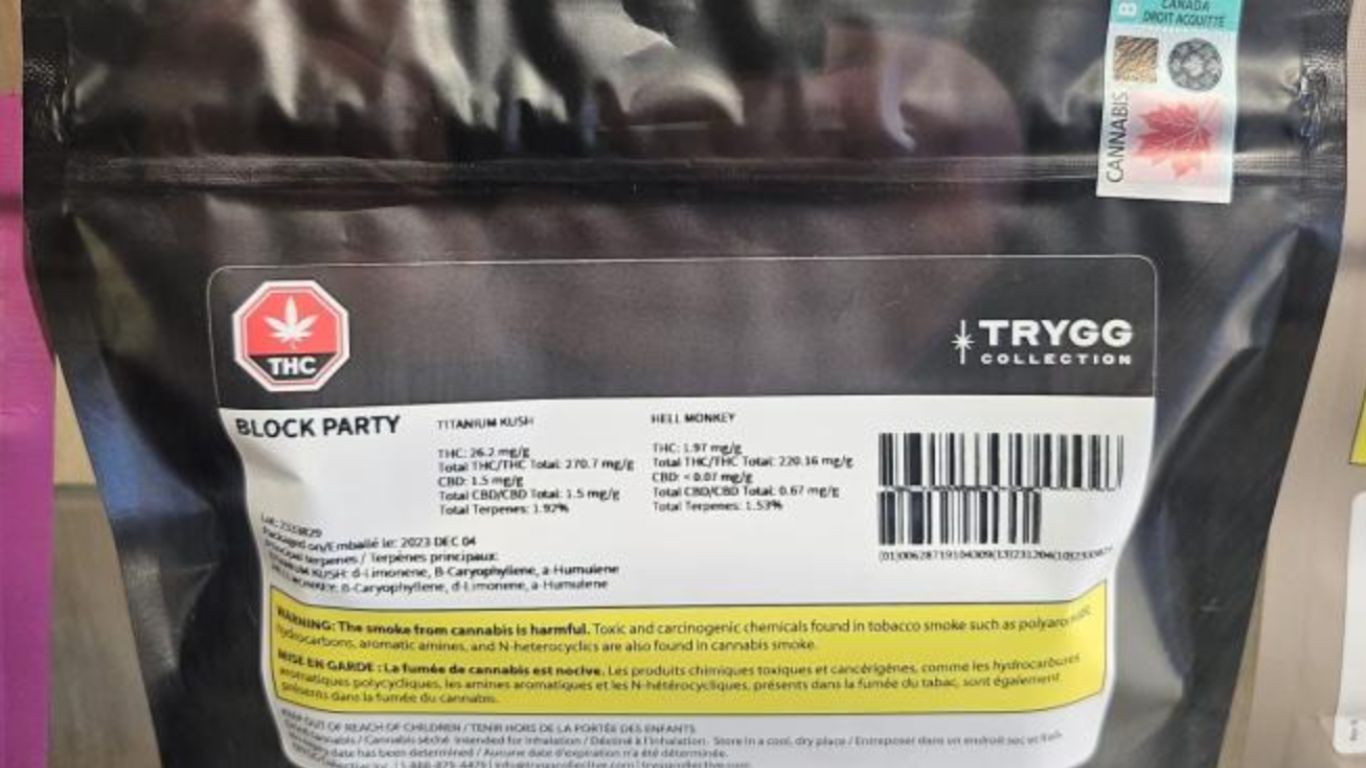
Flowerchild Research has recalled one lot of its Trygg Collection Block Party Variety Pack of pre-rolls sold in BC due to a labelling error.
These products, which contain 20 half-gram pre-rolls of Titanium Kush and Hell Monkey, did not have the required net weight, units, intended use, and product format listed on the label.
The recalled product was sold from December 5, 2023 to December 13, 2023, and there were 1,559 units of recalled products sold (Lot 2333829).
Neither Flowerchild Research nor Health Canada have received any complaints or reports of adverse reactions related to the recalled lot.
Labelling errors remain the most common reason for cannabis product recalls in Canada.
The state of New York’s labor department recently published sample job descriptions for various positions in the marijuana industry. Their intention is to allow prospective employees to evaluate their qualifications to work in different roles in the growing industry while also helping firms streamline hiring processes.
In a statement, a representative of the department said that marijuana’s legalization had created significant opportunities, and the department of labor was committed to supporting businesses as well as those seeking employment in the state as the industry continued to expand. The department began posting the sample descriptions earlier this month. They include example positions in delivery, cultivation, retail, and product manufacturing and hospitality as well as sampling and testing jobs.
Some positions are entry level, such as managing retail inventory or trimming, while others require skilled individuals for roles such as cannabinoid extraction, management or laboratory testing. The job-description samples are posted on the department’s Cannabis Career Exploration site and are meant to be used as education resources for those seeking employment. The website also includes a page on how to find cannabis jobs and links to marijuana education opportunities.
The department also released a statement noting that this online resource was put together to help New Yorkers explore working in the marijuana industry. It further noted that the resource would also help those seeking employment to evaluate their skills to find a focus area and determine what education or training they would need to succeed in their chosen careers. The department then added that the resources could be used as a starting point for businesses as they start hiring their workforce.
The sample postings come just weeks after the state’s Supreme Court lifted an injunction that prohibited state cannabis regulators from processing new retailer licenses. This move will allow the New York marijuana market to expand significantly.
In a press release, the Cannabis Control Board’s chair Tremaine Wright stated that the decision brought relief to hundreds of those with provisional licenses whose businesses had been sidelined. Wright then noted that the board remained focused on upholding a transparent and fair process as it continued to support and grow the state’s marijuana industry.
New York Governor Kathy Hochul also wrote on social media that the decision by the supreme court meant there should be more places to buy tested, safer and legal marijuana stores would launch faster. Currently, however, there fewer than 30 licensed retailers for adult-use cannabis in the state.
It is expected that the court’s decision will also reduce the number of illicit operators in the market, who currently make up a significant fraction of the marijuana market.
Marijuana industry actors elsewhere, including group leader Aurora Cannabis Inc. (NASDAQ: ACB) (TSX: ACB), are likely to welcome the steps that are being taken to get the industry finally going in New York State since the state has faltered several times in its attempts to roll out regulated sales.
About CNW420
CNW420 spotlights the latest developments in the rapidly evolving cannabis industry through the release of two informative articles each business day. Our concise, informative content serves as a gateway for investors interested in the legalized cannabis sector and provides updates on how regulatory developments may impact financial markets. Articles are released each business day at 4:20 a.m. and 4:20 p.m. Eastern – our tribute to the time synonymous with cannabis culture. If marijuana and the burgeoning industry surrounding it are on your radar, CNW420 is for you! Check back daily to stay up-to-date on the latest milestones in the fast -changing world of cannabis.
To receive SMS alerts from CNW, text CANNABIS to 888-902-4192 (U.S. Mobile Phones Only)
Please see full terms of use and disclaimers on the CannabisNewsWire website applicable to all content provided by CNW, wherever published or re-published: https://www.CannabisNewsWire.com/Disclaimer
After nine and a half years of purchasing cannabis from Canadian Licensed Producers, one thing has remained stubbornly constant: inconsistencies and a high probability of disappointment when buying dried flower products.
It should come as little surprise to a struggling industry that many consumers still refuse to partake in when, for the entire period since legalization, it has lacked the most obvious measure that would aid it in building consumer confidence: letting consumers see and smell what they are buying at point-of-sale, through a bulk distribution/deli-style retail channel.
Any experienced cannabis enthusiast can attest that “the nose knows”. If one has any level of appreciation for cannabis at all, they know the joy and/or dissatisfaction of holding a recently opened bag/jar up to their nose and taking a deep inhale.
Prepackaging-only regulations prevent upfront visual and aromatic assessment, forcing consumers to rely on overly-weighted tertiary factors, such as THC and other numbers on a label, an LP’s backstory, appealing packaging, salesperson’s recommendations… everything and anything other than the actual product in front of them, that they are about to buy.
These images show the contents from two 7g packs of the same product from the same LP that I purchased several weeks apart for the same price.
The current Canadian legal in-person recreational retail experience offers no substantive advantage over an online store. Meanwhile, in jurisdictions outside of Canada that do allow legalized deli-style retail, its impact can be measured by improved consumer demand and experience.
For instance, Oregon’s legal system offers pre-packaged flower products and deli-style retail. The market shows a clear preference (~95% of retail stores offer bulk flower products) toward deli-style “craft” (higher quality) dried flower products from smaller/micro/craft producers.
Limiting the Canadian market to pre-packaging hinders not only consumers but also those smaller/micro/craft producers. Tipping the scales in a market drowning with bought-out shelf space, filled with lower quality, mass-produced flower, hidden inside eye-catching opaque packs featuring inflated numbers at rock-bottom prices.
Prepackaging-only increases logistical costs and environmental impacts for all involved, as smaller packs take up more shipping space to transport fewer products. It prevents other possible ‘green’ initiatives, such as the possibility of reusable/refillable containers that could reduce plastic waste at a retailer-end consumer level. Prepackaging-only hinders product flexibility, as pack size impacts provincial tenders/acceptance, as well as movement through retail stores.
A Consumer Perspective
I just want to find the same dried flower product, in the same brick-and-mortar retail location, in different pack sizes. A consumer looking for a smaller pack to sample first may have to choose a full or half ounce, or vice versa, to want an ounce and buy 8 x 3.5g packs, each carrying a premium price instead of potential bulk savings.
So far, prepackaging-only has demonstrated little to no evidence in preventing diversion, with recent retail store robberies linked to people reselling those stolen packs. There’s no reason a bulk distribution system also can’t maintain similar levels of control over inventory tracking. Bulk wholesale packs can still be excise stamped. Nothing changes anywhere along the distribution chain, where someone is counting packs, and a calibrated scale is a small investment to retailers who opt into carrying bulk products.
While bulk distribution won’t solve all of Canada’s cannabis industry’s problems, its impact would be significant. It would provide a solid base to improve/build consumer confidence, shift the focus away from numbers on a label, and boost the bottom lines of smaller/micro/craft LPs.
~Surley Semantics is a long time cannabis consumer and Twitter punditand can be found at@Surlysemantics
The sun rose this morning to cast a revitalizing light on the beginnings of a new year and our chances of reawakening in the spirit of truth, liberty, freedom and peacefully living together as God intended. None of that was anywhere to be found in the past year of sown darkness, discord and disunity. From my perspective, that light emerged from behind Montana’s jagged mountainous landscape and where it shined as a reminder to everyone to be steadfast in its rays because pure light sanitizes everything if it’s permitted to shine.
It was a reminder that we, The People, decide whether the light shines down upon us or not. We decide if it shines down onto our clarity on the truth, which brings crystal clear skies and the full, pure light of liberty and freedom. We also decide if the light is instead blocked by impenetrable storms of enshrouding darkness caused by a truth lingering in the shadows of obscurity. It means that we, The People, bear down in binary fashion where it’s incumbent upon each and every one of us to reconcile the truth of 2023 as the impetus to stand in the light for 2024 or stand in darkness forever.
If we, The People, choose unity in favor of sown division and we permit the light to shine, it will illuminate new horizons and fresh opportunities launched from the traditional resolutions. In surviving an historically unprecedented year of darkness, we embark upon the most important year in U.S. history knowing that 2024 teeters on a knife’s edge with known cataclysmic outcomes on one side and a restored Constitutional Republic bathed in light on the other. The knife’s edge makes it an exercise in duality that is perfect as a 2024 New Year’s resolution for everyone: WISE-UP and RISE-UP [or be a slave forever.]
To wise-up means reconciling the truth to accept the reality of known cataclysms already in the queue. The same people who brought you modern day concrete, steel and glass structures that collapse into their own footprints, fake “pandemics” and stolen [s]elections are bringing you Marxist communism for the long haul and that, folks, is both known and cataclysmic.
To rise-up means to stop these cataclysms from happening. That means reconciling the truth about the asymmetrical, irregular and undeclared war being waged against us and uniting as a true People to intercede on those warfare tactics and mechanisms. In early 2020, that was a simple as refusing to wear a mask. Had everyone embraced the drug abuse slogan “Just Say No” on the front-end of the “pandemic” and just went on with regular life, the “pandemic” horse would have never left the barn.
We’ve been at war for several years whether people care to accept that fact or not and the horse is most assuredly out of the barn.
The first rule of war is divide and conquer and right now, Americans are divided in unprecedented fashion and flirting with being conquered.
Therefore, interceding on this war requires national unity as an imperative first step and that requires a cause.
The cause is fundamental: WISE-UP and RISE-UP or be a slave forever.
In early 2020, I began kicking two dead horses that I would kick over and over and over: 1-COVID-19 is never going away and 2-These people will never stop until they are made to stop.
Today, on the first day of 2024, the “pandemic” is still here and these people haven’t stopped because we never made them stop.
The reports of increased COVID “cases” and the return of mask mandates on the same electoral timeline as 2020 tells us so.
Today, on the first day of 2024, we can embrace the light to do something about that.
Today, on the first day of 2024, we unite to resolve that it’s time to WISE-UP and RISE-UP or be a slave forever.
Being a slave forever was never an option whether it be forced upon us or otherwise and on that, we stand resolute.
Legislators in Ukraine recently gave their final approval for a measure that will legalize the use of medical cannabis nationally. The measure has been forwarded to President Volodymyr Zelensky’s desk, who is in favor of reform, to be signed into law. The law shall come into effect six months after the president signs it.
The measure will legalize medical marijuana use for patients diagnosed with serious illnesses and PTSD linked to the country’s ongoing war with Russia. Russia invaded Ukraine in February 2022, with experts noting this was an escalation of the Russo-Ukrainian war, which began in 2014.
In order to obtain the needed approval for the legalization, a petition calling for special procedure, which needed the signatures of 150 members, was circulated. Olga Stefanyshina, a member of Parliament, revealed recently that a total of 164 signatures were collected, which cleared the way for the bill’s passage. It should be noted that the bill’s language explicitly lists war-borne, post-traumatic stress disorder and cancer as the only eligible conditions qualifying patients to receive medical marijuana.
Despite this, the health committee’s chair revealed earlier in the year that legislators heard daily from individuals with other ailments, including epilepsy and Alzheimer’s disease. The measure’s approval reschedules marijuana from a List I drug to a List II drug. While drugs under the former category are strictly prohibited, those in the latter category are available for therapeutic use if one has a prescription.
It is expected that the Ministry of Agrarian Policy will have regulatory authority with regard to marijuana cultivation as well as processing operations. On the other hand, the State Agency on Medicines and the National Police will oversee and enforce authorities associated with the drug’s distribution.
The bill also permits the import of raw marijuana materials from other nations, in an effort to ensure patient access.
In a translation, MP Maria Mezentseva stated that the government leaders had accounted for the various fundamental issues emphasized by colleagues and that it was crucial to not trust fake information that was making the rounds on various social media platforms. Mezentseva added that the law on medicinal marijuana was aimed solely at providing treatment for nationals who truly needed it.
The president discussed his stance on medical cannabis legalization earlier this year. During his address to parliament, Zelensky stated that the most effective policies as well as the best practices and solutions needed to be applied in the country, so Ukrainians didn’t have to endure the stress, pain and trauma of war. He also noted that fairly legalizing marijuana-based medicines for all those who needed them, with appropriate scientific study and controlled production, was key.
Companies such as Tilray Brands Inc. (NASDAQ: TLRY) (TSX: TLRY) could explore supplying some of the needed medical marijuana products to Ukraine since they already have some experience availing these products to a number of markets within the EU bloc.
About CNW420
CNW420 spotlights the latest developments in the rapidly evolving cannabis industry through the release of two informative articles each business day. Our concise, informative content serves as a gateway for investors interested in the legalized cannabis sector and provides updates on how regulatory developments may impact financial markets. Articles are released each business day at 4:20 a.m. and 4:20 p.m. Eastern – our tribute to the time synonymous with cannabis culture. If marijuana and the burgeoning industry surrounding it are on your radar, CNW420 is for you! Check back daily to stay up-to-date on the latest milestones in the fast -changing world of cannabis.
To receive SMS alerts from CNW, text CANNABIS to 888-902-4192 (U.S. Mobile Phones Only)
Please see full terms of use and disclaimers on the CannabisNewsWire website applicable to all content provided by CNW, wherever published or re-published: https://www.CannabisNewsWire.com/Disclaimer
Researchers from the University of Saskatchewan (USask) are exploring the hidden history of psychedelic drugs and working to expand the world’s clinical and cultural understanding of hallucinogens. Most of the public is unaware of the rich history of psychedelics, let alone their potential medical benefits, and Dr. Erica Dyck from USask is looking to fill this critical knowledge gap by cataloging essays and research into a book.
A recent resurgence in psychedelic-related research has found that numerous classic psychedelics can treat debilitating mental disorders with few side effects. Studies have found that psychedelic-based treatments can offer long-term relief against mental ailments such as treatment-resistant depression, eating disorders and post-traumatic stress disorder (PTSD) at relatively small doses when they are paired with traditional talk therapy.
However, while the scientific and medical communities are only now learning about the therapeutic applications of psychedelics such as psilocybin (magic mushrooms), MDMA and ayahuasca, indigenous communities from around the world have been using psychedelics for spiritual, ritual, and even therapeutic reasons for centuries. With psychedelics enjoying significant scientific and mainstream interest over the past decade, Dyck and her team sought to compile stories that relate to psychedelics’ clinical and cultural history.
Titled “Expanding Mindscapes: A Global History of Psychedelics,” the new book was published by MIT Press and covers the discovery, use and cultural impact of psychedelics such as psilocybin and LSD through the 20th century. Dyck, who also serves as the History of Health and Social Justice’s Canada Research chair and College of Arts and Science professor said hallucinogens have a “distinctive: place in medical history thanks to their role in several cultural movements and medical contexts. She explained that the book covered 20 articles showcasing the exciting and dynamic history of psychedelics that takes place outside of locations such as Berkeley, San Francisco and Harvard.
To learn more about the historical role of psychedelics from various communities around the world, the professor requested papers on the role of hallucinogenic drugs in various cultures and used them as the basis for her new book. For example, one chapter in the book examines how gender influenced both doctors and patients in France during the mid-1900s when therapeutic psychedelic use was allowed; the chapter was written by USask’s 2023 Banting Postdoctoral Fellowship recipient Dr. Zoë Dubus, PhD. According to Dubus, doctors prescribed psychedelics to women as part of different treatments much more often and women did not have the same leeway to refuse psychedelic treatments that men did.
As more people gain an understanding of the long history of psychedelics, it may become clearer why companies such as atai Life Sciences N.V. (NASDAQ: ATAI) have invested so heavily in commercializing therapeutic formulations from these substances.
About PsychedelicNewsWire
PsychedelicNewsWire (“PNW”) is a specialized communications platform with a focus on all aspects of psychedelics and the latest developments and advances in the psychedelics sector. It is one of 60+ brands within the Dynamic Brand Portfolio @ IBN that delivers: (1) access to a vast network of wire solutions via InvestorWire to efficiently and effectively reach a myriad of target markets, demographics and diverse industries; (2) article and editorial syndication to 5,000+ outlets; (3) enhanced press release enhancement to ensure maximum impact; (4) social media distribution via IBN to millions of social media followers; and (5) a full array of tailored corporate communications solutions. With broad reach and a seasoned team of contributing journalists and writers, PNW is uniquely positioned to best serve private and public companies that want to reach a wide audience of investors, influencers, consumers, journalists and the general public. By cutting through the overload of information in today’s market, PNW brings its clients unparalleled recognition and brand awareness. PNW is where breaking news, insightful content and actionable information converge.
To receive SMS alerts from PsychedelicNewsWire, text “Groovy” to 888-902-4192 (U.S. Mobile Phones Only)
Please see full terms of use and disclaimers on the PsychedelicNewsWire website applicable to all content provided by PNW, wherever published or re-published: https://www.PsychedelicNewsWire.com/Disclaimer
After a 1994 car accident, Dustan McLean went searching for pot to treat his pain and paid $15 for a gram that was full of seed, effectively catalyzing the resourceful grower’s journey into cannabis. From popping stray beans to the creation of several legacy operations in Alberta, McLean went mainstream in 2018 with the inception of Parkland Flower (the acquisition of which led to the LP’s closure in March of this year). Though the work he was doing in genetics and seed output at Parkland encouraged his transition to Nine Lions Biosciences — a Leduc, Alta.-based tissue culture and genetics lab that headhunted the grower of nearly 30 years.
GO: One of the largest circulating issues for growers is hop latent viroid. How are you helping to minimize the risk?
DM: As soon as we pop the seed – as soon as there’s a root – it gets tested, and if it shows anything, it’s gone. Anything we bring in generally we ask to have a pre-test done to make sure it’s clean before coming into the facility, and then we do our own backup testing in house to double check it. And then if we’re still concerned, we’ll send it off to a third party and have it verified. We still get some genetics out of California for sure, but it’s from very trusted sources.
GO: Are you mostly working with Canadian genetics?
DM: A big thing for me is championing Canadian genetics and some of the breeders up here because I think the world is sleeping on what we can provide. I try to create genetics that are good for outdoor growers in Alberta and B.C. Anywhere in Canada you want to grow outdoor, I want to provide a genetic that can really work for you. In Alberta, it’s almost impossible to do outdoor photoperiod because we have the twilight here, so we’re trying to create plants that fast flowers and we’re very close to having a cultivar in Alberta that will finish in September/ early October, that’s also weather resistant, because we’ve got some crazy weather happening now.
That’s the kind of work myself and a lot of my friends are putting in, is to breed those true Canadian genetics that can withstand the harsh realities of weather in this country. My Cherry Cake went 28 days without water – having something like that in drought areas is massive. We use a lot of resources to grow this plant, so having a plant that only needs 70 per cent is pretty big.
Advertisement
GO: What other cultivars are you most excited about?
DM: I’m still a big fan of our Motorhead. It’s resistant, grows nicely and is very tasty; it’s really good for commercial use. Hash Face is a nice extract plant. Permanent Marker is another. I’m always looking two-to-three years down the line. I’m really looking into Diesels and Hazes right now and trying to get a lot of the longer running plants out onto the market. Everyone wants to get their five-and-a-half runs in every year, but they don’t realize you can do four runs with a really nice sativa, get a good quantity out of, and it’ll sell out. People are looking for the daytime weed all the time and there’s not a lot out there.
GO: What would you like to see change in this industry?
DM: I’m a big fan of our Oreo Blizzard, but it’s not high enough on the numbers. I’m trying to get people off this numbers kick. We’ve gone from THC, to CBD, to terpenes and now flavonoids. How about we just look at the plant as a whole? We’re missing some amazing genetics because of numbers, and that kills me as a breeder. There are studies coming out showing how high THC might actually be harmful. There’s a percentage of younger men going into irreversible psychosis because of high THC cannabis use in their teens. We’re morphing this plant so fast; we need to start looking at what we’re doing to this plant. I’m a big proponent of data over dogma.
GO: How do you think Nine Lions is helping shape the dialogue?
DM: We’re gathering data that will help us sell genetics for specific grows but it’s tough because every grower thinks theirs is the best. It’s tough telling people that a plant I have might be better for them commercially. They might have an amazing plant that knocks your socks off, but to grow it commercially is a nightmare. I’m trying to steer people into saving them. One of the lessons I learned was we grew a bushy crop staff needed to defoliate so much that in the end we lost money because of the overhead that went into it. We had other runs that needed no attention, and we crushed it in sales. So, you’ve got to pick your stuff smart or else you’re going to bury yourself in the burn rate on your overhead.
(CNW) Calgary — High Tide Inc., the high-impact, retail-forward enterprise built to deliver real-world value across every component of cannabis, welcomes today’s amendment of Ontario Regulation 468/18 under the Cannabis Licence Act, 2018 that increases the number of stores that licensed retail cannabis operators and their affiliates can operate from 75 to 150.
“We welcome Ontario’s move today to make good on its previously stated intent to double the provincial store cap to 150. The increase comes as some operators who have a franchise model are already approaching, or have exceeded, 75 stores in the province. The move will have a positive impact on Ontario’s cannabis retail market as it brings the province closer to Alberta, Saskatchewan and Manitoba, which don’t have a store cap and have demonstrated success at illicit market capture,” said Raj Grover, founder and CEO of High Tide.
“This change not only levels the retail playing field in Ontario but also creates a significant growth opportunity for High Tide and others that will help Ontario’s legal cannabis industry better compete with an entrenched illicit market, creating new jobs for Ontarians and increasing tax revenue for the province. As of July 2023, the 50 Canna Cabana stores we had open in Ontario had an average annual run rate that was 3.4 times our provincial peers’. Accordingly, an additional 100 locations will help meaningfully boost our revenues and power our growth trajectory over the next couple of years, further solidifying our leadership position as the largest non-franchised cannabis retailer in the country. With this change, our long term growth target has now shifted upwards to 300 bricks and mortar stores in Canada,” added Mr. Grover.
Vancouver — The British Columbia Supreme Court has blocked new provincial laws against public consumption of illegal substances.
The ruling in favour of the Harm Reduction Nurses Association imposes a temporary injunction until March 31, with the judge saying “irreparable harm will be caused” if the laws come into force.
The Restricting Public Consumption of Illegal Substances Act was passed by the legislature in November, allowing fines and imprisonment for people who refuse to comply with police orders not to consume drugs in certain public places.
Advertisement
The nurses association argued the act, which has yet to come into effect, would violate the Canadian Charter in various ways if enforced.
But Chief Justice Christopher Hinkson said in his ruling issued Friday that it was unnecessary to turn to those arguments, since the “balance of convenience” and the risk of irreparable harm weighed in the plaintiff’s favour.
“I accept that lone drug use may be particularly dangerous due to an absence or a diminished degree of support in the event of an overdose,” Hinkson’s ruling says.
“When people are isolated and out of sight, they are at a much higher risk of dying from an unreversed overdose.”
The law would allow police to order people to “cease using an illegal substance in a specified area,” or to leave that area.
The places specified in the act include sports fields, beaches, or parks, within six metres of building entrances and within 15 metres of a playground, skate park or wading pool.
People who refuse could be fined up to $2,000 and imprisoned for up to six months.
The act would give police discretion to arrest those who don’t comply and seize and destroy their drugs.
Lawyer Caitlin Shane for the nurses association said the injunction, pending a constitutional challenge, shows “substance use cannot be legislated without scrutiny.”
Shane said in an interview that most people who use drugs in B.C. “live in communities that do not have safe, legal indoor spaces to use drugs.”
She said the court granting the injunction was a “welcome decision” because even though the act hadn’t been brought into legal effect, it was already being enforced by police.
“We have heard, kind of, on the ground from people in communities around B.C., that police have already begun attempting to enforce this law, which was never in effect,” Shane said. “So this judgment makes absolutely certain and confirms the fact that the law is not enforceable. It is not in effect and it can’t be used against people.”
Shane said the law “stands against” the provincial government’s public positions about “appropriate responses to drug use and the toxic drug supply.”
“A law like this imposes even greater burden and hardship on people who are already being failed by B.C.’s laws and policies respecting drug consumption,” she said.
In October, the province said the new laws aligned with rules around tobacco, alcohol and cannabis use, providing “a consistent approach throughout the province.”
According to the BC Coroners Service, at least 13,317 people have died due to unregulated drugs in B.C. since a public-health emergency was declared in April 2016.
In an update issued at the end of last month, the service said unregulated drugs had claimed at least 2,039 lives in the first 10 months of the year.





![Wise-up and Rise-up [or be a slave forever]](https://growupconference.com/wp-content/uploads/https3A2F2Fsubstack-post-media.s3.amazonaws.com2Fpublic2Fimages2Fc362fb1e-3aa5-4819-8d79-0c08efe9e14d_640x828-640x675.png)







Recent Comments