“So my optimism is no mild and unreasoning satisfaction. A poet once said I must be happy because I did not see the bare, cold present, but lived in a beautiful dream. I do live in a beautiful dream; but that dream is the actual, the present – not cold, but warm; not bare, but furnished with a thousand blessings. The very evil which the poet supposed would be a cruel disillusionment is necessary to the fullest knowledge of joy. Only by contact with evil could I have learned to feel by contrast the beauty of truth and love and goodness.”
The impetus to write a paper focusing on optimism as its primary subject, is oft carried with the dual apprehension of subsequently being swiftly pelted with stones by an angry mob or exiled by critics from “civil society” as an unforgivable fool, with the understanding that those witless enough to follow such a path are always inevitably led to a most terribly tragic ruination, and thus those infected with such mental derangement are best left alone…per chance that it is infectious.
Well I should inform the reader before they go any further, that such a condition is indeed most infectious, and thus you have been warned!
Such opprobrium of optimism reminds me of Plato’s dialogue “Gorgias,” where Socrates (now in his elders years) is mocked by Callicles for being a philosopher in his old age:
Callicles: And this is true, as you may ascertain, if you will leave philosophy and go on to higher things: for philosophy, Socrates, if pursued in moderation and at the proper age, is an elegant accomplishment, but too much philosophy is the ruin of human life. Even if a man has good parts, still, if he carries philosophy into later life, he is necessarily ignorant of all those things which a gentleman and a person of honour ought to know; he is inexperienced in the laws of the State, and in the language which ought to be used in the dealings of man with man, whether private or public, and utterly ignorant of the pleasures and desires of mankind and of human character in general. And people of this sort, when they betake themselves to politics or business, are as ridiculous as I imagine the politicians to be, when they make their appearance in the arena of philosophy.
Philosophy, as a part of education, is an excellent thing, and there is no disgrace to a man while he is young in pursuing such a study; but when he is more advanced in years, the thing becomes ridiculous, and I feel towards philosophers as I do towards those who lisp and imitate children. For I love to see a little child, who is not of an age to speak plainly, lisping at his play; there is an appearance of grace and freedom in his utterance, which is natural to his childish years. But when I hear some small creature carefully articulating its words, I am offended; the sound is disagreeable, and has to my ears the twang of slavery. So when I hear a man lisping, or see him playing like a child, his behaviour appears to me ridiculous and unmanly and worthy of stripes. And I have the same feeling about students of philosophy; when I see a youth thus engaged,—the study appears to me to be in character, and becoming a man of liberal education, and him who neglects philosophy I regard as an inferior man, who will never aspire to anything great or noble. But if I see him continuing the study in later life, and not leaving off, I should like to beat him, Socrates; for, as I was saying, such a one, even though he have good natural parts, becomes effeminate. He flies from the busy centre and the market-place, in which, as the poet says, men become distinguished; he creeps into a corner for the rest of his life, and talks in a whisper with three or four admiring youths, but never speaks out like a freeman in a satisfactory manner.
To Callicles, philosophy is an acceptable, even a necessary part of our development during youth to obtain nobility. However, it becomes something suddenly abhorrent when practised during adult years and is absolutely sickening to behold in one’s elder years, to the extent that Callicles states he feels the desire to beat such a person (insinuating Socrates), for they reek of weakness and effeminacy to which he cannot stand.
In this sense, optimism shares a similar plight with that of philosophy. Optimism too is regarded as something charming and wonderful to behold in a young child and, if the child were imbued by its opposite and were mostly cynical of all things, we would think there was something most dreadfully wrong.
This is a rather curious thing since it is expected that by the time we reach adulthood, we will partake more in cynicism than of optimism, with the gap ever widening as we age. In fact, as we progress through our adult years it is most often the case that we no longer really have a concept of what optimism is, it resembling more a mirage, a dream than something tangible and partaking in reality, or at best we relegate it to “a state of mind” where one can overcome personal barriers but that is typically the extent. The majority conclude by their middle years that optimism does not really have an effect in the governance of the world that we live in – it cannot end wars, alleviate poverty or make society more just. Nobody changes themselves first to fit an optimistic future yet to become, people are pragmatists and will only change if there is something to be gained, “the proof is in the pudding” so to speak.
If this is truly the state of affairs, and the world is governed by selfish pragmatism, why do we encourage our children to dream, to believe in goodness, to oppose injustice and to be defenders of virtue in the world they live in? Why do we tell our children epic stories of heroism and overcoming the odds, invoking wildly vivid imaginations of fantastical upon fantastical? Why do we do such a thing if the world they will step into is truly ugly, cold, unimaginative, unremorseful and ultimately unchanging? Aren’t we preparing their spirits to be shattered and broken? Are we not serving them up to be devoured? Why encourage the cultivation of something during youth, only to dismiss its application in adulthood and condemn its victims to a life of torment!?
It is a terrible thing to invoke a lively imagination, only to stifle it when it is ready to mature its meanderings into more cogent challenges as to why things are the way they are and not otherwise.
In truth, to behold a child makes us all momentary converts of optimism. A child is one of the most striking refutations of a cynical outlook of humankind, for a child is full of love, an insatiable curiosity, adventure, and is a natural rebel to anything authoritarian. Thus, many classical children’s stories may be best understood as not something written for just children, but rather was written as an effect of being in the presence of a child’s mind, that is, it is the child that is re-invoking the archaic relic of imagination in those adults who can “listen” and “remember” the secret language of a child’s imagination.
Thus we should ask ourselves, why do we believe in a world of goodness and virtue when we allow ourselves to re-enter the imaginative mind of a child, as an adult? Is this a form of regression? Is such a person running away from reality, no different from a lunatic; completely dysfunctional and thus of no use to society?
As Callicles made the point, what use is philosophy as a “career”? What contribution to the world of grown men can philosophy possibly make? It is also Callicles’ conviction that justice is the rule of the superior over the inferior, the strong over the weak. Though in some ways our society is different from that of Callicles in ancient Athens, in this conception, we are not very unlike each other.
In our world, money and influence are just as much ascribed to what constitutes power and “what makes the world go round” as it did during Callicles time.
“But when I hear some small creature carefully articulating its words, I am offended; the sound is disagreeable, and has to my ears the twang of slavery.“
Interestingly, what Callicles considers noble in a child’s development is the very thing that he associates with an abiding slave in later years. The reason for this is because Callicles equates a “real man” to be one that invokes power. A child plays in philosophy as exercises for the mind but is expected to throw away this form of play when they reach adulthood and use such lessons purely in the pursuit of power. In the eyes of Callicles, anyone who does not pursue power is weak and effeminate and partakes more in slavery than in freedom; for it is the most powerful who are the most free and the least powerful who are the most enslaved.
But what if money and influence were not the ultimate culmination of power? What if true power resides somewhere else? Wouldn’t we also have to conclude that wherever this true power resides would also have to be the determining governing force of the world we live in and what ultimately shapes our very own character?
Then came Love, bearing in her hand The torch that is the light unto my feet, And softly spoke Love: “Hast thou Entered into the treasures of darkness? Has thou entered into the treasures of the night ?
– A Chant of Darkness (an excerpt of the poem by Helen Keller)
To answer such a question we will look at one of the unlikeliest of individuals, or so you may think, Helen Keller.
Helen Keller was born June 27, 1880, in Tuscumbia, in a little town of northern Alabama. About nineteen months later, in the dreary month of February, Helen caught an acute congestion of the stomach and brain. Helen describes it in her autobiography ‘The Story of My Life‘ as such:
The doctor thought I could not live. Early one morning, however, the fever left me as suddenly and mysteriously as it had come. There was great rejoicing in the family in that morning, but no one, not even the doctor, knew that I should never see or hear again.
I fancy I still have confused recollections of that illness. I especially remember the tenderness with which my mother tried to soothe me in my waking hours of fret and pain, and the agony and bewilderment with which I awoke after a tossing half sleep, and turned my eyes, so dry and hot, to the wall, away from the once loved light, yet came to me dim and yet more dim each day. But, except for these fleeting memories, it all seems very unreal, like a nightmare. Gradually I got used to the silence and darkness that surrounded me and forgot that it had ever been different, until she came – my teacher – who was to set my spirit free. But during my first nineteen months of my life I had caught glimpses of broad, green fields, luminous sky, trees and flowers which the darkness that followed could not wholly blow out. If we have once seen, “the day is ours, and what the day has shown.”
For about five and a half years Helen grew up in complete darkness and silence without any means to gather information of her surroundings or means of communication, other than basics wants. She lived moment to moment, her world was shaped purely by a whirlwind of raw emotion from euphoric pleasure when she got what she wanted to a fury of rage in the form of wild screams and kicks when she didn’t.
Helen describes one of these moments of rage that nearly led to the death of her younger sister:
once I discovered my little sister sleeping peacefully in the cradle [Helen’s baby doll’s cradle]. At this presumption on the part of one to whom as yet no tie of love bound me I grew angry. I rushed upon the cradle and over- turned it, and the baby might have been killed had my mother not caught her as she fell. Thus it is that when we walk in the valley of twofold solitude we know little of the tender affections that grow out of endearing words and actions and companionship. But afterward, when I was restored to my human heritage, Mildred and I grew into each other’s hearts, so that we were content to go hand- in-hand wherever caprice led us, although she could not understand my finger language, nor I her childish prattle.
Helen lived this way, in an almost feral condition until she met her teacher, Anne Sullivan, who was sent from the Perkins Institute for the Blind. Luckily, Helen’s mother had heard of the institute from Charles Dicken’s ‘American Notes’ which describes Laura Bridgman, the first documented deaf-blind person to have ever been educated, and this was accomplished at Perkins.
Helen was an unruly child and rather mischievous. The first day Anne Sullivan arrived to their homestead (she was to live in the same house as Helen’s teacher), Helen managed to lock Anne Sullivan in her room and hid the key. No amount of commotion could sway Helen to reveal the location of the key and her father had to help Anne out of her room through her bedroom window and onto a ladder. Helen only produced the key months later.
As Helen describes it herself, in her “still, dark world…there was no strong sentiment or tenderness.” Helen could not love anything in this state, for she had no link to the world of thought, of ideas. The world of Helen was an impatient world of desires and disappointments, how could one be patient if one didn’t even have a concept of a day, let alone a concept of the treasures of the past and the riches of the future?
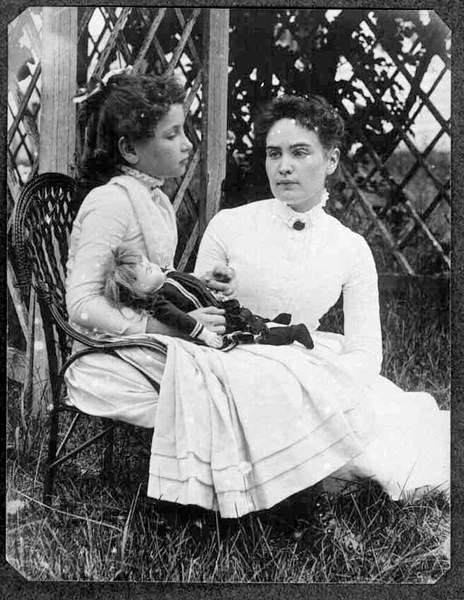
Helen Keller (to the left) and Anne Sullivan (to the right)
Anne Sullivan was in the process of teaching Helen the sign words for objects around the house. At first amused at the new game, Helen was eager to learn the hand tricks, however, soon grew tired of it suspecting it to be more a mandatory chore than a real game. Helen was especially frustrated with how there could be a word for cup and a different word for the water in the cup. To Helen, it made perfect sense that the water in the cup should also be called cup, and the exercise was left for another day.
The next day, Helen grew into a fury over Anne attempting to return to the exercise on cup vs water, and she threw the doll that was given to her as a gift the day of Anne’s arrival (Helen would find out much later that it had been carefully made by the blind girls at the Perkins Institute), she describes the situation as such:
I became impatient at her repeated attempts and, seizing the new doll, I dashed it upon the floor. I was keenly delighted when I felt the fragments of the broken doll at my feet. Neither sorrow nor regret followed my passionate outburst. I had not loved the doll. In the still, dark world in which I lived there was no strong sentiment or tenderness. I felt my teacher sweep the fragments to one side of the hearth, and I had a sense of satisfaction that the cause of my discomfort was removed. She brought me my hat, and I knew I was going out into the warm sunshine. This thought, if a wordless sensation may be called a thought, made me hop and skip with pleasure.
We walked down the path to the well-house, attracted by the fragrance of the honeysuckle with which it was covered. Some one was drawing water and my teacher placed my hand under the spout. As the cool stream gushed over one hand she spelled into the other the word water, first slowly, then rapidly. I stood still, my whole attention fixed upon the motions of her fingers. Suddenly I felt a misty consciousness as of something forgotten a thrill of returning thought; and somehow the mystery of language was revealed to me. I knew then that “w-a-t-e-r” meant the wonderful cool something that was flowing over my hand. That living word awakened my soul, gave it light, hope, joy, set it free! There were barriers still, it is true, but barriers that could in time be swept away.
I left the well-house eager to learn. Everything had a name, and each name gave birth to a new thought. As we returned to the house every object which I touched seemed to quiver with life. That was because I saw everything with the strange, new sight that had come to me. On entering the door I remembered the doll I had broken. I felt my way to the hearth and picked up the pieces. I tried vainly to put them together. Then my eyes filled with tears; for I realized what I had done, and for the first time I felt repentance and sorrow.
It is most striking to note here, that Helen described her first realisation that there was such a thing as language as an immediate connection, an immediate understanding that there was such a thing as thoughts, which required the use of language to not only communicate with others but with ourselves in the form of inner dialogue. Not only this, but Helen credits her new awareness of thought as what directly gave her almost immediate access to the feeling of repentance and sorrow.
Helen recounts how shortly after, she came to understand the concept of love:
I remember the morning that I first asked the meaning of the word, “love.” This was before I knew many words. I had found a few early violets in the garden and brought them to my teacher. She tried to kiss me: but at that time I did not like to have any one kiss me except my mother. Miss Sullivan put her arm gently round me and spelled into my hand, “I love Helen” “What is love?” I asked. She drew me closer to her and said, “It is here,” pointing to my heart, whose beats I was conscious of for the first time. Her words puzzled me very much because I did not then understand anything unless I touched it. I smelt the violets in her hand and asked, half in words, half in signs, a question which meant, “Is love the sweetness of flowers?” “No,” said my teacher. Again I thought. The warm sun was shining on us. “Is this not love?” I asked, pointing in the direction from which the heat came. “Is this not love?” It seemed to me that there could be nothing more beautiful than the sun, whose warmth makes all things grow. But Miss Sullivan shook her head, and I was greatly puzzled and disappointed. I thought it strange that my teacher could not show me love. A day or two afterward I was stringing beads of different sizes in symmetrical groups two large beads, three small ones, and so on. I had made many mistakes, and Miss Sullivan had pointed them out again and again with gentle patience. Finally I noticed a very obvious error in the sequence and for an instant I concentrated my attention on the lesson and tried to think how I should have arranged the beads. Miss Sullivan touched my forehead and spelled with decided emphasis, “Think.” In a flash I knew that the word was the name of the process that was going on in my head. This was my first conscious perception of an abstract idea. For a long time I was still I was not thinking of the beads in my lap, but trying to find a meaning for “love” in the light of this new idea. The sun had been under a cloud all day, and there had been brief showers; but suddenly the sun broke forth in all its southern splendour. Again I asked my teacher, “Is this not love?” “Love is something like the clouds that were in the sky before the sun came out,” she replied. Then in simpler words than these, which at that time I could not have understood, she explained: “You cannot touch the clouds, you know, but you feel the rain and know how glad the flowers and the thirsty earth are to have it after a hot day. You cannot touch love either; but you feel the sweetness that it pours into everything. Without love you would not be happy or want to play.” The beautiful truth burst upon my mind I felt that there were invisible lines stretched between my spirit and the spirits of others.
This is again incredibly striking, Helen is describing here that her first realisation, her first understanding of love was not through a physical act of love, for ex. a warm hug, a tender caress, kiss on the cheek, pat on the head, etc, but rather, through her ability to conceptualise love as an abstract idea, through her teacher’s emphasis on the process of thought. Only when Helen understood love as something all encompassing and yet something that could not be touched, did she have an understanding of the most profound form of love, like “invisible lines stretched between my spirit and the spirits of others.“
Thus I came up out of Egypt and stood before Sinai, and a power divine touched my spirit and gave it sight, so that I beheld many wonders. And from the sacred mountain I heard a voice which said, “Knowledge is love and light and vision”
…Have you ever been at sea in a dense fog, when it seemed as if a tangible white darkness shut you in, and the great ship, tense and anxious, groped her way toward the shore with plummet and sounding-line, and you waited with beating heart for something to happen? I was like that ship before my education began, only I was without compass or sounding-line, and had no way of knowing how near the harbour was. “Light! give me light!’ was the wordless cry of my soul, and the light of love shone on me in that very hour…As my knowledge of things grew I felt more and more the delight of the world I was in.
Helen Keller (to the left) and Anne Sullivan (to the right). Anne Sullivan reading a book to Helen who is “listening” by using her hand on Anne’s mouth.
Thus it was not the sense of touch that brought me knowledge. It was the awakening of my soul that first rendered my senses their value, their cognizance of objects, names, qualities and properties. Thought made me conscious of love, joy, and all the emotions. I was eager to know, then to understand, afterward to reflect on what I knew and understood, and the blind impetus, which had driven me hither and thither at the dictates of my sensations, vanished forever.
– ‘The World I Live In’
I think this a good time to address some of the criticism I have encountered of Helen Keller, namely that she is a “privileged, white person” from a very well-off family, and thus had access to the best resources (despite her living five and half years in silent darkness) and that her “achievements” are thus over-inflated and celebrate more her privilege rather than anything she achieved of her very own merit. This criticism of Keller seems to be making the point that anything achieved with privilege, including education, is not due to personal merit as well, and that those who were born impoverished, as well as deaf-blind, are unjustly relegated to the shadows unable to shine and receive well-deserved recognition for their struggles in the wake of the titanic celebrity of Helen Keller, such as Geraldine Lawhorn, a black deaf-blind woman who lived during the same period as Helen Keller and who only had the opportunity to achieve a degree at the age of 67 in 1983 (Helen Keller was the first deaf-blind person to achieve a degree at the age of 24 in 1916).
I think this is a dangerous line of argument, and rather than address how to resolve the inequality and poverty of sectors of society, it rather condemns those who have access to resources and tools of learning. Education is treated as a privilege, it should not be the case but it is, not everyone has access to an equal education. However, is the solution to this inequality to attack the education? Or, rather, does it not make more sense that the unequal opportunity to access such an education is what needs to be addressed and corrected. A quality education, that is an education on how to cultivate thought, reflection, hypothesize, problem-solve, this is the true solution to ending the greatest epidemic of poverty- the poverty of ignorance. We do not rise by dragging others down.
It is absurd to state that Keller’s privilege was a setback to others, rather her success was proof that the mind’s understanding was not ultimately dependent on our sense-perception to determine reality, and that the mind rather came at an understanding of reality through abstract thought. It is not often discussed in this light, but the very existence of Keller as a phenomenon was a challenge to how science and empirical knowledge were taught. Keller was a living disproof of these dominant theories of what constituted ‘mind’ and ‘reality.’
What these critics of Keller fail to understand is that her triumph is not that of just individual triumph, it is a shared triumph for what makes us truly good and truly human, no matter what part of the world you come from, what language you speak and what culture you were immersed in, Keller’s story is a universal story that we can all relate to and learn from. It showcases how we access our most profound self, through the realm of thought, and dare I say it, philosophy.
The silent worker is imagination which decrees reality out of chaos.
– Helen Keller
As my experiences broadened and deepened, the indeterminate, poetic feelings of childhood began to fix themselves in definite thoughts. Nature – the world of touch – was folded and filled with myself. I am inclined to believe those philosophers who declare that we know nothing but our own feelings and ideas. With a little ingenious reasoning one may see in the material world simply a mirror, an image of permanent mental sensations. In either sphere self-knowledge is the condition and the limit of our consciousness. That is why, perhaps, many people know so little about what is beyond their short range of experience. They look within themselves – and find nothing! Therefore they conclude that there is nothing outside themselves, either.
A deaf-blind person ought to find special meaning in Plato’s Ideal World. These things which you see and hear and touch are not the reality of realities, but imperfect manifestations of the Idea, the Principle, the Spiritual; the Idea is the truth, the rest is delusion.
“The Idea is the truth, the rest is delusion,” though Keller had been thrown into a world of silent darkness, she was able to find her way back to her mind and soul, and this path was completely devoid of any experience through sense-certainty. Though Keller had encountered at such a young age a terrifying adversity, she had conquered it, and was now ahead of most. For through her ordeals she discovered where truth lies and recognized the folly of a “practical reality,” which though most treated as concrete fact, was in actuality the delusion, they were “missing the forest for the trees.”
Helen continues in her paper:
Thus from philosophy I learn that we see only shadows and know only in part, and that all things change; but the mind, the unconquerable mind, compasses all truth, embraces the universe as it is, converts the shadows to realities and makes tumultuous changes seem but moments in an eternal silence, or short lines in the infinite theme of perfection, and the evil but “a halt on the way to good.”
Here Keller makes the point that our mind, even a mind immersed in silent darkness is unconquerable and embraces the universe as it is, that is, the organizing of understanding within the mind is akin to a universal understanding, an understanding based in natural law. Our minds were shaped by natural law and thus we are its adherents.
“Man looks within himself and in time finds the measure and the meaning of the universe.“
Thus, with this understanding, evil is not something that exists exterior to us but rather, exists within us, it represents the struggle between ignorance and wisdom, and this struggle is always a spiritually painful one, for we feel that a part of us must die for the other part to grow. To know evil is to know this struggle and if one is successful in conquering it, one cannot help but become an optimist in consequence: “The very evil which the poet supposed would be a cruel disillusionment is necessary to the fullest knowledge of joy. Only by contact with evil could I have learned to feel by contrast the beauty of truth and love and goodness.”
Optimism, that is, not the optimism of the foolish nor the fanciful but the wise, is thus something that does not partake in the present and is in a sense, the understanding of what constitutes the direction of the future based on the recognition of the fundamental laws of the universe that are grounded in the good, the true and the ever-perfecting.
Philosophy constantly points out the untrustworthiness of the five sense and the important work of reason which corrects the errors of sight and reveals its illusions. If we cannot depend on five sense, how much less may we rely on three! What ground have we for discarding light, sound, and color as an integral part of our world? How are we to know that they have ceased to exist for us? We must take their reality for granted, even as the philosopher assumes the reality of the world without being able to see it physically as a whole.
Ancient philosophy offers an argument which seems still valid. There is in the blind as in the seeing an Absolute which gives truth to what we know to be true, order to what is orderly, beauty to the beautiful, touchableness to what is tangible. If this is granted, it follows that this Absolute is not imperfect, incomplete, partial. It must needs go beyond the limited evidence of our sensations, and also give light to what is invisible, music to the musical that silence dulls. Thus mind itself compels us to acknowledge that we are in a world of intellectual order, beauty, and harmony. The essences, or absolutes of these ideas, necessarily dispel their opposites which belong with evil, disorder and discord. Thus deafness and blindness do not exist in the immaterial mind, which is philosophically the real world, but are banished with the perishable material senses. Reality, of which visible things are the symbol, shines before my mind. While I walk about my chamber with unsteady steps, my spirit sweeps skyward on eagle wings and looks out with unquenchable vision upon the world of eternal beauty.
-‘The World I Live In’
There is a reason why the great scientist Gottfried Leibniz stated “we live in the best of all possible worlds,” to which Voltaire, mocked in his hyperbole “Candide.” Why did one of the greatest scientists of all time conclude that we live in the best of all possible worlds?
Leibniz was remarking on the laws of the universe, such as the principle of least action, to which even during Fermat’s days in studying the behaviour of light through least action, it was recognised as a “moral attribute” to the principles of physics. The universe was not random but was rather ordered, and the order was a harmonious order!
An optimist thus, is no different from a philosopher who is no different from a scientist who is no different from a poet. All of these rely on the ability to see the world beyond sense-perception, and even beyond what it is in the present, for what it will become in the future. In other words, their thoughts are located in a future that is yet to become.
Therefore, power does not lie in wealth and influence which is the true valley of the deaf and the blind (those who have yet to awaken to their mind and soul and are thus the truly enslaved), but rather power is to be in union with these higher principles of the universe, based in natural law as understood through the works of Plato.
What has been built can also be torn down, but the Idea never belongs to an individual, in fact, its origin is not even located in an individual nor a collective. Rather, an Idea exists as a Truth independent of us. This is why an Idea pertaining to truth cannot be destroyed, because it ultimately is not contingent upon our fleeting and inconsistent recognition of such things. Truth does not suddenly come into existence because we claim it so, and thus, it is beyond suppression and is beyond destruction. This is also why the mind will always have access to an Idea pertaining to Truth, when given the right tools for imagination and thought, such that the mind will always find its way back again to its hearth; Truth, as known through love of wisdom.
In this context, it is no great cost that one be mocked by the many in adhering to the principles of optimism, for to be an optimist is to have access to dreams, and as Helen states in her paper on ‘Optimism‘, “I do live in a beautiful dream; but that dream is the actual, the present – not cold, but warm; not bare, but furnished with a thousand blessings.“
Yet remove the dream-world, and the loss is inconceivable. The magic spell which binds poetry together is broken. The splendor of art and the soaring might of imagination are lessened because no phantom of fadeless sunsets and flowers urges onward to a goal. Gone is the mute permission or connivance which emboldens the soul to mock the limits of time and space, forecast and gather in harvests of achievement for ages yet unborn. Blot out dreams, and the blind lose one of their chief comforts; for in the visions of sleep they behold their belief in the seeing mind and their expectation of light beyond the blank, narrow night justified. Nay, our conception of immortality is shaken. Faith, the motive-power of human life, flickers out. Before such vacancy and bareness the shock of wrecked worlds were indeed welcome. In truth, dreams bring us the thought independently of us and in spite of us that the soul may right
Her nature, shoot large sail on lengthening cord,
And rush exultant on the Infinite.
– ‘The World I Live In’
Helen Keller
Feature Cover Image: Rembrandt’s “Landscape with the Rest on the Flight Into Egypt”
A recent analysis from the Tax Foundation, a Washington, D.C.-based nonprofit think tank, suggests that the nationwide legalization of cannabis across all states could significantly boost annual cannabis tax revenue, projecting it to reach $8.5 billion. The foundation proposes a comprehensive federal and state taxation model for cannabis, aiming to keep costs low to discourage illicit sales while advocating for higher tax rates on more potent marijuana products.
The current state-by-state approach to marijuana taxation, according to the report, is chaotic. Therefore, there is a need for a reevaluation of the existing framework considering both public health and revenue implications.
According to the report, cannabis sales generated nearly $3 billion in tax revenue for legal states in the past year. The foundation anticipates that this figure could nearly triple if marijuana were legalized nationwide.
While drawing parallels to tobacco and alcohol taxation may seem logical in theory, the report argues that the lack of a standardized marijuana product makes this approach impractical. Unlike tobacco, marijuana lacks a universally recognized product form, and its intoxicating component, THC, poses challenges in measurement comparable to alcohol content.
The proposed alternative is a taxation system based on weight or potency, depending on practicality, instead of the current method of percentage-based taxation on sales price. A weight-based system, according to the foundation, is effective for capturing harm from smokable products. It also provides a simpler entry for new products into the market, avoiding excessively high barriers for product testing solely for tax purposes.
The Tax Foundation highlights three key lessons from state experiences with marijuana taxation. First, it advises keeping tax rates low enough for legal markets to compete with the illicit market, preventing impaired effectiveness due to excessively high tax rates. Second, it recognizes the significant revenue potential of legal marijuana markets but cautions that it may take years to materialize, with potential volatility under certain tax models. Third, the foundation stresses the importance of consistency across jurisdictions, particularly as interstate commerce becomes a possibility.
Currently, most state marijuana markets impose excise taxes on cannabis products, with rates ranging from 6% in Missouri to 37% in Washington state. Some states, including New York and Connecticut, have integrated potency-based tax policies, though this approach remains uncommon.
Although various federal proposals to impose additional taxes on cannabis have been introduced, short-term advancement is unlikely. Nevertheless, the United States Census Bureau is monitoring state-level marijuana tax trends, providing an interactive map detailing the proportion of state revenue from cannabis taxes.
Given the amounts of tax dollars that sector players such as Trulieve Cannabis Corp. (CSE: TRUL) (OTCQX: TCNNF) are already paying, a projection of $8.5 billion in taxes on a national scale is possible if the right regulatory measures are put in place to facilitate legal sales while curbing the black market.
About CNW420
CNW420 spotlights the latest developments in the rapidly evolving cannabis industry through the release of two informative articles each business day. Our concise, informative content serves as a gateway for investors interested in the legalized cannabis sector and provides updates on how regulatory developments may impact financial markets. Articles are released each business day at 4:20 a.m. and 4:20 p.m. Eastern – our tribute to the time synonymous with cannabis culture. If marijuana and the burgeoning industry surrounding it are on your radar, CNW420 is for you! Check back daily to stay up-to-date on the latest milestones in the fast -changing world of cannabis.
To receive SMS alerts from CNW, text CANNABIS to 888-902-4192 (U.S. Mobile Phones Only)
Please see full terms of use and disclaimers on the CannabisNewsWire website applicable to all content provided by CNW, wherever published or re-published: https://www.CannabisNewsWire.com/Disclaimer
Cannabis stores in Canada continue to be targets for robbers and burglars, while retailers say they are doing what they can to mitigate risks.
A recent string of violent armed robberies in Calgary made headlines in the last few weeks, adding to the number of burglaries, thefts and vandalism at cannabis stores in several provinces in recent weeks and months.
Police recently made arrests related to that string of armed robberies in Calgary, and two men were also recently arrested on charges relating to another armed cannabis store robbery, this time in Gleichen, Alberta, just outside of Calgary.
A business in BC was also recently burglarized on December 6, with $2,500 worth of cannabis products stolen from a store in Masset, on Graham Island in Haida Gwaii. The thieves gained entry by breaking the front window of the store.
Cannabis growers and processors have not been immune, either. Earlier this year, at least two cannabis producers in BC’s Lower Mainland were the victims of early-morning burglaries.
Retailers say they are having to spend more money to secure their stores as this new “cost of doing business” continues.
Brionne Lavoie, the owner of the Frontier Cannabis store in Masset that was recently burglarized, says he’s now installing heavy vault doors on his storage rooms to avoid similar break-ins in the future. In addition, the value of the cannabis stolen and damage to the store was below the deductibles for his insurance.
“At the end of the day it’s all deterrence,” says Lavoie. “If someone wants to break in or cause harm, they’re going to find a way without the extent of bank security, it’s just one of those things.”
Lisa Bigioni, co-founder and CEO of Stok’d Cannabis, which has four retail locations in Ontario and experienced two break-ins the week before Christmas 2022, told StratCann earlier this year that they have made several upgrades to their properties.
“Metal gates have now been installed in our stores, and we sleep a lot better at night. It’s been costly. The gates were about $2,000 per store.”
“The fact that we’re compliant with our security cameras helped us capture them in action,” says Bigioni. “And this helped the police find them. In both cases, the police arrived before we did. The detective assigned to the cases was fantastic, and kept us well-informed along the way. Based on the evidence, he was confident the guys would be caught, which they were less than a week later.”
Ryan Roch, who owns two cannabis stores just outside Calgary, says he has a similar perspective, saying retailers can guard against this by being more vigilant with security measures.
“Just keep your head on a swivel,” says Roch. “Do cash drops on a regular basis so there’s no excess cash sitting around. Make sure security cameras are working. Make sure staff are properly trained. Make sure you have panic buttons. There’s a lot you can do to make sure it’s a much safer environment.”
Scientists from the Imperial College London’s Center for Psychedelic Research have published a study indicating that psychedelics are linked to adverse outcomes when users are in stressful environments and have limited social support. Published in the “Scientific Reports” journal, the study delved into the potential negative psychological effects associated with psychedelic drug use.
The study found that in the absence of social support, psychedelic users are at risk of experiencing psychological issues such as panic and persistent anxiety, especially if they are in particularly stressful environments.
With the recent resurgence in psychedelic research contributing to significant hype around the mental-health benefits of hallucinogens such as psilocybin (magic mushrooms), MDMA and LSD, researchers thought to counter by focusing wholly on the negative aspects of psychedelic consumption. Several studies have found that psychedelics can be quite effective at alleviating the symptoms of typically hard-to-treat mental disorders, especially when it is paired with traditional talk therapy. While the psychedelic itself is critical to the treatment, the therapy part of psychedelic-assisted therapy is essential to creating the best treatment outcomes.
But while all of the studies associating psychedelics with mental-health benefits take place in tightly controlled environments, most psychedelic use happens outside of research settings. Consequently, researchers worried that the growing body of psychedelic research may not be fully representative of how psychedelics can affect individuals outside of controlled research or medical environments.
Study author Rehecka Bremle says she and her team were interested in finding the potential risk factors that contribute to negative psychological responses during or after psychedelic consumption. The research team ran a two-phase study that first involved an online survey composed of the Challenging Experience Questionnaire (CEQ) to measure negative experience intensity as well as other questionnaires. A second smaller group of 15 from the pool of 84 participants was then chosen for in-depth interviews by experts in the mental-health field.
Participants reported going through frightening or negative experiences (bad trips) while under the influence of classic psychedelics such as LSD. Anxiety and panic were the most reported symptoms. Researchers also found that some participants experienced derealization and flashbacks of their negative experiences.
The research team notes that factors such as drug purity and dosage, frequency of use, polysubstance use and drug-quality concerns may also contribute to negative outcomes. Furthermore, they found that unsafe or stressful environments as well as limited social support during and after the psychedelic experience contributed to negative outcomes.
A lot is still being discovered about how to leverage the benefits of psychedelics, and the studies that are being conducted by startups such as Seelos Therapeutics Inc. (NASDAQ: SEEL) could reveal additional nuances pertinent to tapping the medicinal attributes of these hallucinogens.
About PsychedelicNewsWire
PsychedelicNewsWire (“PNW”) is a specialized communications platform with a focus on all aspects of psychedelics and the latest developments and advances in the psychedelics sector. It is one of 60+ brands within the Dynamic Brand Portfolio @ IBN that delivers: (1) access to a vast network of wire solutions via InvestorWire to efficiently and effectively reach a myriad of target markets, demographics and diverse industries; (2) article and editorial syndication to 5,000+ outlets; (3) enhanced press release enhancement to ensure maximum impact; (4) social media distribution via IBN to millions of social media followers; and (5) a full array of tailored corporate communications solutions. With broad reach and a seasoned team of contributing journalists and writers, PNW is uniquely positioned to best serve private and public companies that want to reach a wide audience of investors, influencers, consumers, journalists and the general public. By cutting through the overload of information in today’s market, PNW brings its clients unparalleled recognition and brand awareness. PNW is where breaking news, insightful content and actionable information converge.
To receive SMS alerts from PsychedelicNewsWire, text “Groovy” to 888-902-4192 (U.S. Mobile Phones Only)
Please see full terms of use and disclaimers on the PsychedelicNewsWire website applicable to all content provided by PNW, wherever published or re-published: https://www.PsychedelicNewsWire.com/Disclaimer
(CNW) Toronto — Trees Corporation, today announced that the company and its subsidiaries, Ontario Cannabis Holdings Corp., Miraculo Inc., 2707461 Ontario Ltd., OCH Ontario Consulting Corp., and 11819496 Canada Inc., have received an order for creditor protection from the Ontario Superior Court of Justice under the Companies’ Creditors Arrangement Act (CCAA).
The Trees Group has been actively pursuing additional financing to raise capital to fund its operations, and engaged a financial advisor to assist the Trees Group with reviewing strategic options, including financing options. Following such review and after careful consideration of all available alternatives, and consultation with legal and financial advisors, the directors of the Trees Group determined that it was is in the best interests of the Trees Group to file an application for creditor protection under the CCAA.
The Initial Order includes, among other things: (i) a stay of proceedings in favour of the Trees Group, and (ii) the appointment of Ernst & Young Inc. as the monitor of the Trees Group.
The Trees Group sought creditor protection under the CCAA in order to receive a stay of proceedings that will allow the Trees Group to work with the monitor to facilitate the development of an orderly process designed to streamline its operations and conduct a Court-supervised sales process to obtain a going concern solution for its operations and maximize the value of the Trees Group’s assets for the benefit of its stakeholders.
Advertisement
The board of directors of the Trees Group will remain in place and management will remain responsible for the day-to-day operations of the Trees Group, under the general oversight of the monitor.
It is anticipated that Cboe Canada will place the company under delisting review and there can be no assurance as to the outcome of such review or the continued qualification for listing on the Cboe.
By Eve Cable, Local Journalism Initiative Reporter
THE EASTERN DOOR
The community is edging closer to the first cannabis dispensaries opening, with the Kahnawake Cannabis Control Board (KCCB) announcing they will be accepting completed pre-eligibility forms for dispensary licences starting next month.
“We’ve discussed that we’ll meet as the applications come in, so it could be on a weekly basis, depending on the number of applications we get,” said Tara Jacobs, chairperson of the KCCB. “We’ll go through them one by one as a board.”
Advertisement
Forms are available on the KCCB website, cannabisboard.org, and should be filled out to ensure prospective license holders meet the required criteria to operate a dispensary. Eligibility includes being over the age of 21 and being on the Kahnawake Kanien’keha:ka Registry (KKR), and applicants will also have to provide a proposed location that respects the guidelines set out in the regulations of being more than 300 metres away from schools, daycares, and similar establishments.
“(The location) doesn’t have to be owned by them. They’re able to present it as they’ll be renting the locale,” said the Cannabis Control Office (CCO) operations manager Matthew Ferrante. “But the proposed location should be where the dispensary would eventually open.”
Work for cannabis sale in Kahnawake to begin has been in production since 2018, when the Cannabis Control Law was partially enacted. Various delays, including those caused by the pandemic, have contributed to slow movement on the file. Jacobs is pleased progress is finally being made.
“It’s a relief because the community has waited a long time for this, I’m sure we have frustrated people, and that’s understandable,” she said. “But we’re going to get the ball rolling, and I’m looking forward to seeing how it goes. I just thank the community for being patient with us, and with just a little bit more patience, in the near future we will have dispensaries open in our community.”
The pre-eligibility forms are solely to ensure candidates meet the minimum expected criteria, and are not indicative of the likelihood of an individual being granted one of the three dispensary licences that will eventually be given out in the community. There are certain factors that may be reviewed on a case-by-case basis, such as prior criminal records.
“I wouldn’t discourage anyone who has a criminal record to apply, it’s up to the board’s discretion,” said Ferrante. “I had a couple of community members reach out and say that they have a criminal record for tobacco, and tobacco in the community is fully legal but they’ve been caught bringing it to another reserve, say in Ontario. Obviously, other crimes such as fraudulent activity and selling of illegal substances will be looked at more strictly.”
The KCCB has also reached quorum, after a number of reshuffles within its membership. Most recent was Rhonda Kirby’s resignation from the board in October. This week, it was announced that Darlene Alfred would be joining the board as the third member for a three-year term, joining Jacobs and David Diabo.
“Darlene brings a lot of knowledge to the table,” Jacobs said. “She’s engaged in community events and community politics, and I believe she’s going to help us out a great deal.”
Previously, the board had a quorum with two members and was able to make decisions concerning cannabis legislation, but would have been in a bind if issues such as conflicts of interest arose. With three members, one will be able to recuse themself should a conflict of interest with potential applicants arise, a situation the board acknowledges could happen.
“If there’s a conflict of interest, for example if I were to have a family member apply, I’d step aside, and Darlene and David would work on that, which is why we really need three,” Jacobs said. “It’d be their decision.”Jacobs added that if a situation arose where two members of the three-person board had a conflict of interest with an applicant, the process would be looked at to ensure the applicant could be evaluated fairly.
The applications will be accepted from Monday, January 8, to Friday, February 9, at 4 p.m. and can be submitted in person at MCK’s Client-Based Services (CBS) reception in a sealed envelope to the attention of the KCCB and Ferrante.
We spend more time in our bedrooms than in any other room. And while most of that time is spent sleeping, it isn’t the only thing most of us do there. But whatever you’re doing, may I suggest these five plants to help green up your space?
Golden Pothos
Do a quick search for air-purifying plants, and you’ll find list after list of plants claiming to be excellent for cleaning your air. Unfortunately, the research around these claims isn’t unanimous. One scientist who believes plants have air purification value is former NASA research scientist Bill Wolverton. Wolverton was part of the team that conducted a now-famous NASA study on the effectiveness of plants on air quality, and one of the plants that he recommends is the golden pathos. And what makes this one even better is how easy it is to maintain!
Boston Fern
Wolverton says, “The Boston fern is one of the most effective plants for removing airborne pollutants.” But, while you don’t need a botany degree and an uber-green thumb to maintain a Boston fern, they aren’t as plug-and-play as some other plants. They require placement in a room that provides them with plenty of sunlight, and, native to humid areas, you’ll also want to mist this guy daily.
With its long sword-shaped leaves rising from the soil, the sansevieria plant makes a visual statement in any room. However, with its ability to purify the air and remove toxins, the bedroom makes a good home for this one. Also, the sansevieria plant, aka Mother-In-Law’s Tongue, makes for good bedroom feng shui, as it’s thought to bring good luck – and couldn’t we all use a little good luck in the bedroom?
Mondia Whitei
Mondia Whitei, aka White’s Ginger, has no air-purifying abilities. But according to some, it can take care of everything else. Found in Africa, the plant has been touted for its medicinal benefits for generations, including as a remedy for heartburn, indigestion, flatulence, gonorrhoea, abdominal pain, constipation, bilharzia, asthma, and high blood pressure. However, it’s the plant’s use as an aphrodisiac and as a cure for impotence that makes it most relevant to our list. While most scientific research has focused on rats, some research has suggested that Mondia Whitei improves human sperm motility.
Note: Regarding effective air purification, scientist Bill Wolverton recommends at least two “good-sized” plants per 100 square feet of interior space.
Oceanic Releaf CEO Taylor Giovannini details ownership of 25 per cent of the Newfoundland retail market and the commitment and inspiration behind the LP’s inception. The company’s significant growth is in alignment with the impact of cannabis on Giovannini’s life, having experienced a personal journey of aiding a family member’s medical cannabis use and the pivotal ‘aha’ moment that ensued.
James Strain, director of cultivation and master grower at Dycar Pharmaceuticals, brings legacy market knowledge to his post-harvest technique. Here, Strain provides seven steps for perfecting the final product, starting with flushing the plants and ending with a slow cure, to achieve a smooth, tasty and potent product. Strain’s cultivation column ranked No. 9 in Grow Opportunity‘s most-read articles of 2023.
From UBC Vancouver’s Spirit Plant Medicine Conference, this article serves as a recap of two presentations about best practices when facilitating psychedelic therapy, and an overview of psychedelics: the good, the bad, the ugly. These leaders in psychedelics make room for people to express and to better understand themselves, using impactful quotes such as, “plants can teach you who you really are and why you haven’t been yourself.”
The 2023 Top Grower Award for the standard LP category went to Genevieve Newton, director of cultivation at Stewart Farms. Newton describes her journey into corporate cannabis and how it eventually lead to the east coast and to her current role in cultivation, overseeing micro-cultivators and export logistics, research and development and more.
Cannabis attorney Matt Maurer shares his findings from the final report and its implications in preparation for the March 2024 when a second phase when new information will be made public regarding amendments to the Cannabis Act review by the government-appointed expert panel. The panel will specifically addressing the health and consumption habits of young persons and the use of cannabis on Indigenous persons and communities, in addition to home growing regulations and more.
New this year, the Top Grower Award winner for the micro-cultivation category goes to Brian and Chanttelle Rusk of Into the Weeds located in Rocky Mountain House, Alta. The couple began their journey into cannabis cultivation by medical necessity as well as interest in the various cultivars and plant properties. Now with three full-time employees, the team seeks to continue national and international expansion along with multiple other ancillary businesses operating out of their home base.
Pure Sunfarms VP of brand Maria Guest provides insight into the current top-performing product format as well as predictions for 2024, including the continuation of flower, pre-rolls and infused pre-rolls as leading categories. Guest relays the importance of staying fresh and relevant, especially when it comes to consistent cannabis quality, while continuously monitoring industry trends.
Grow Opportunity editor Haley Nagasaki shares a brief recap of the year and of the Top Grower awards program from the editorial in the November/December issue of the magazine. “From Genevieve we learn patience and perseverance over the long haul… Brian teaches not to shy away from one’s instinct and to strike without hesitation when it comes to filling gaps and meeting needs.”
In the inaugural International column, Aqualitas COO Josh Adler describes the company’s recent achievement as the first organic producer of cannabis in the country to be greenlit for international export. The news serves as a reflection on European market’s emphasis on high quality, organic medical cannabis, as well as recognition to the company’s triumph this year in receiving their drug establishment license.
Freelance writer Jake Hribljan spoke to Carmel Cannabis along with three American organizations and cannabis companies about the detriment of the 2023 wildfire season and its effect on outdoor cannabis cultivation. While some advocate for the continued cultivation of outdoor cannabis for preferred terpene expression and overall sustainability, the reality is that it is becoming increasingly difficult to do so. Ontario’s Carmel has developed a hybrid greenhouse model for plant production that works with the shifting climate and can still save on energy. Hribljan’s article ranked No. 1 most read digital article on the Grow Opportunity platform in 2023.
(CNW) Calgary — High Tide Inc., the high-impact, retail-forward enterprise built to deliver real-world value across every component of cannabis, announced that its Canna Cabana retail cannabis store located at 11501 Buffalo Run Blvd Tsuut’ina, Alberta will begin selling recreational cannabis products and consumption accessories for adult use on Saturday, December 23. This opening will mark High Tide’s 160th Canna Cabana branded retail cannabis location in Canada, the 78th in the province of Alberta and the first Canna Cabana on the Tsuut’ina Nation.
Opening in the Taza Development of The Shops of Buffalo Run, this brand-new Canna Cabana will serve community members of the Tssut’ina Nation, South West Calgary residents and the surrounding rural communities. Situated steps away from an internationally recognized membership-only wholesale grocery and retail chain, this new store stands out among other strong anchor tenants such as banks, quick-service restaurant chains, and major discount retailers. Located just off the newly completed section of Stoney/Tsuut’ina Trail, Calgary’s ring road, this store will welcome ELITE and Cabana Club members as one of the only cannabis stores within a two-kilometre radius.
“I am excited to announce the opening of the 160th Canna Cabana store in Canada and the first of our flagship retail cannabis stores on the Tsuut’ina Nation. The Shops at Buffalo Run is a high-traffic retail power centre with direct access to an estimated 100,000 community members and residents. Coupled with strong anchor tenants and few competitors, this Canna Cabana is well positioned to become a high revenue store,” said Raj Grover, founder and chief executive officer of High Tide.
“I would like to thank the Tsuut’ina Nation and the Taza Development group for welcoming the Canna Cabana brand into this exciting new development. This store builds upon our existing partnerships with First Nations communities in Manitoba, including the Opaskwayak Cree Nation and the Nisichawayasihk Cree Nation. I look forward to announcing a slew of additional store openings before the New Year,” added Mr. Grover.
Advertisement
“We are continuously striving to provide an inviting and convenient space for both businesses and consumers, and the continued growth and diversity of amenities, retail, and service offerings available in The Shops at Buffalo Run is a testament to our dedication towards that goal,” said James Robertson, president of Taza Development Corp.
“Our commitment to bringing top-notch retailers and businesses to the area is reinforced through this new addition, and we are confident that it will be a welcomed addition to the retail mix,” added Mr. Robertson.
ABOUT THE TSUUT’INA NATION
The Tsuut’ina Nation has a rich and enduring history, with roots predating the establishment of the City of Calgary and the Province of Alberta. Since entering Treaty 7 with the Crown in 1877, the Tsuut’ina people have maintained a fully independent culture and have made significant strides in progress and innovation. Governed by a Chief and Council, the Tsuut’ina Nation operates its own Administration, Business, and Service programs, including Tosguna (Police), the Tsuut’ina Fire Department, Public Works, and Civic Services.
ABOUT TAZA DEVELOPMENT CORP.
Taza Development Corp. is a joint venture between Canadian real estate company Canderel and the Tsuut’ina Nation, a reserve home to over 2,300 community members adjacent to the City of Calgary, Alberta. Over the next 25+ years, their 20-member team, governed by a Board of Directors, will oversee the development of three distinct yet interconnected communities—Taza Park, Taza Crossing and Taza Exchange—on 1,200 acres of land, bringing about significant social and economic prosperity to the community, while solidifying its place as a key player in Canada’s real estate market.
A new survey has determined that the use of marijuana in teens hasn’t increased even as more states legalize the drug’s use across the country. The survey was funded by the National Institute on Drug Abuse (NIDA) and carried out by researchers at the University of Michigan. It determined that rates of past-year marijuana use remained stable for all grades that took part in the survey, even as more cannabis markets opened and expanded for adults countrywide.
During a webinar last week, NIDA’s chief of epidemiological research Marsha Lopez stated that no significant increases had been observed with no increase in perceived availability being recorded either. The survey, which questioned teens on the use of delta-8 THC products, found that past-year cannabis use stood at 29%, 17.8% and 8.3% for 12, 10th and 8th graders respectively.
Delta-8 THC is one of the many psychoactive cannabinoids found in the cannabis sativa plant, of which hemp and marijuana are two varieties. Products based on this cannabinoid are typically derived from hemp and sold in mainly unregulated markets, though some states have enacted bans or restrictions.
Between 2020 to 2022, 11 more states legalized the use of cannabis. Data from the survey shows that the liberalization of cannabis policies in these newly legal states didn’t translate into increased perceptions of availability among the youth, with Lopez noting that the perceptions were actually trending downward. This is despite the fact that 2022 recorded the highest ever use of recreational marijuana and some psychedelics. The survey’s results also show steadier decreases in the perception of harm of using marijuana.
The results support advocates’ stand against arguments that legalizing adult-use marijuana would cause underage use to increase. In fact, findings show that in regulated markets where IDs were checked and other safeguards set up, youth access was restricted. In addition, the survey found that there was relatively low prevalence of daily marijuana use, which had been steady for the last decade.
The investigators also compared a range of cannabis-related indicators from teens living in states in which marijuana is illegal and states that have legalized medical use. They observed no statistically significant differences in past-year rates of use across all grades examined, regardless of state medical cannabis laws.
With regard to teens who do consume marijuana, the majority of them revealed that they smoked the drug, but the survey observed a shift in consumption methods, with more teens switching to edibles or vaping.
In a press release, Richard Miech, the survey’s team lead, highlighted the importance of monitoring the use of this drug among teens moving forward.
The findings from the survey possibly trigger thoughts of “we told you so” from cannabis industry participants such as Aurora Cannabis Inc. (NASDAQ: ACB) (TSX: ACB) that have always believed that setting up regulated markets for cannabis could reduce teen access to the substance.
About CNW420
CNW420 spotlights the latest developments in the rapidly evolving cannabis industry through the release of two informative articles each business day. Our concise, informative content serves as a gateway for investors interested in the legalized cannabis sector and provides updates on how regulatory developments may impact financial markets. Articles are released each business day at 4:20 a.m. and 4:20 p.m. Eastern – our tribute to the time synonymous with cannabis culture. If marijuana and the burgeoning industry surrounding it are on your radar, CNW420 is for you! Check back daily to stay up-to-date on the latest milestones in the fast -changing world of cannabis.
To receive SMS alerts from CNW, text CANNABIS to 888-902-4192 (U.S. Mobile Phones Only)
Please see full terms of use and disclaimers on the CannabisNewsWire website applicable to all content provided by CNW, wherever published or re-published: https://www.CannabisNewsWire.com/Disclaimer















Recent Comments