Have you put up your Christmas tree yet? We only ask because December 19th is ‘Look for an Evergreen Day,’ which means you’re right on time if you’re only getting around to finding your tree now. So what will it be? A classic spruce, pine, or fir tree? Or will you be decorating something unique for the holidays? Whatever you choose, we have a few tips to help you find your perfect evergreen.
Support Local
Firstly, we encourage you to shop local! Many small-scale Christmas tree growers badly need support right now. Unfortunately, we’re facing yet another tree shortage, with some reports saying climate change is partly to blame. So, if your heart desires a real tree (vs an artificial one – such a heated debate!), support a local farm or vendor.
Think Outside Of The Box
If chopping a tree down isn’t your thing and you still can’t bear the idea of going with a fake one, plenty of unconventional and eco-friendly ideas exist, including decorating houseplants, evergreen branches, or wooden stick trees! Look at your garden; see what’s already there, and build on that for your holiday decor.
Other options include small-scale farmers who grow evergreens in pots and rent them to families. The trees are collected at the end of the holidays and cared for until you rent them again next season.
Keeping The Green
Finally, at the end of the holiday season, please dispose of your Christmas tree responsibly! We’re all about green even after the needles start falling, so consider mulching or using the tree as fish food or bird habitat.
Last week, the Drug Enforcement Administration (DEA) suggested that DOC and DOI be classified under Schedule I of the Controlled Substances Act in its latest notice. DOC (2,5-dimethoxy-4-chloroamphetamine) and DOI (2,5-dimethoxy-4-iodoamphetamine) are both psychedelic drugs of the amphetamine and phenethylamine chemical classes.
In its latest notice, the DEA stated that the medical and scientific basis for suggesting the ban was that these hallucinogens had no known medical value and a high potential for abuse. This is despite the fact that the agency possesses no evidence demonstrating a high abuse potential or directly linking the compounds to severe health events.
In its notice, which was published in the federal register, the DEA explained that until now, there had been no reports of distressing responses or death linked to DOI in medical literature and noted that the physiological dependence liability of DOC and DOI in humans and animals wasn’t reported in medical and scientific literature.
The agency then added that anecdotal reports posted by individuals online indicated that the compounds had hallucinogenic effects, which made it reasonable to assume that they had significant capability to be a hazard to the safety of the community and the health of users.
This is not the first time the agency has recommended a ban on these drugs either, having tabled a proposal in 2022 for the same action. However, in its new proposal, the administrative process of appealing for a hearing to challenge the laws or facts that govern the scheduling action has been amended.
The proposal also states that the decision on whether hearings will be held to address such matters shall be made by the administrator. This addition points to the agency making it harder for outside parties to contest the proposal.
Last year, the matter was contested by researchers who requested a hearing on the scheduling ban, with Panacea Plant Sciences also filing a motion disputing the change in policy.
Despite the new changes, the psychedelic research and development company is sounding the alarm once more. The company’s CEO and founder, David Heldreth, stated in an interview that the response to its rally to fight the illogical rule by the DEA had been amazing. He revealed that the psychedelic community from scientists and lawyers to community activists as well as individuals had come together to oppose the agency’s prohibition mindset.
Thus far, Heldreth noted, Panacea had touched base with at least 10 groups that wanted to support or be involved in the legal fight against the agency’s attempt to criminalize DOC and DOI. These compounds, he argued, were intrinsically important to scientists and the scientific study of the body and mind.
For companies that have firsthand experience of the challenges associated with studying Schedule 1 substances, such as Compass Pathways PLC (NASDAQ: CMPS), the DEA’s plan to ban additional psychedelics brings a bitter taste to the mouth because it means these companies will have to go through endless hoops to gain authorization to conduct studies involving those compounds.
About PsychedelicNewsWire
PsychedelicNewsWire (“PNW”) is a specialized communications platform with a focus on all aspects of psychedelics and the latest developments and advances in the psychedelics sector. It is one of 60+ brands within the Dynamic Brand Portfolio @ IBN that delivers: (1) access to a vast network of wire solutions via InvestorWire to efficiently and effectively reach a myriad of target markets, demographics and diverse industries; (2) article and editorial syndication to 5,000+ outlets; (3) enhanced press release enhancement to ensure maximum impact; (4) social media distribution via IBN to millions of social media followers; and (5) a full array of tailored corporate communications solutions. With broad reach and a seasoned team of contributing journalists and writers, PNW is uniquely positioned to best serve private and public companies that want to reach a wide audience of investors, influencers, consumers, journalists and the general public. By cutting through the overload of information in today’s market, PNW brings its clients unparalleled recognition and brand awareness. PNW is where breaking news, insightful content and actionable information converge.
To receive SMS alerts from PsychedelicNewsWire, text “Groovy” to 888-902-4192 (U.S. Mobile Phones Only)
Please see full terms of use and disclaimers on the PsychedelicNewsWire website applicable to all content provided by PNW, wherever published or re-published: https://www.PsychedelicNewsWire.com/Disclaimer
The recreational cannabis market in Connecticut has hit a snag less than a year after it was launched. At the time of its launch, the market had 13 retail outlets. However, latest figures show that overall sales of recreational as well as medical marijuana have dipped, which isn’t common for a new market.
Total marijuana sales from October dropped from the $25.2 million recorded the previous month to $24.8 million. Recreational sales made up roughly $14.7 million of the total sales, with state data showing that since August, recreational sales had risen by only 5%.
Experts attribute this decline in sales to a lack of variety in products sold to consumers, which has seen many visit stores in neighboring states such as Massachusetts. The dip in sales also reflects a combination of other factors, including high barriers for those who would like to enter the market; regulatory restrictions such as bans on products including pills and capsules; and more municipalities restricting recreational sales and other marijuana businesses.
White Oak Bridge CEO Justin Frytz stated that most consumers in Connecticut choose not to visit dispensaries in the state because the product quality doesn’t meet their standards. Frytz also noted that consumers preferred going to Massachusetts because the product quality is better and they have more choices. He pointed out that manufacturers had shortened or cut production runs on some medical cannabis product lines in favor of recreational products that could generate higher margins and were more scalable. This, he argued, affected medical patients who couldn’t get quality products and also stymied the full potential of the market.
Wholesale marijuana product purchase data also demonstrates a huge discrepancy on category choice in Connecticut, especially in comparison to other recently launched recreational markets.
Leaflink, a marijuana wholesale technology platform, tracked wholesale volume in Connecticut via its online marketplace. The platform determined that an average store in the state bought roughly 400 product stock-keeping units, a figure that is significantly lower than those from its counterparts in Missouri and Maryland.
Data from Leaflink shows that in Missouri, where recreational sales launched in February, the average retailer purchased about 1,000 store-keeping units. In Maryland, where adult-use sales begun in July, the average dispensary in October purchased 1,200 store-keeping units.
Also impacting the situation is the fact that the vertically integrated market is dominated by businesses such as Green Thumb Industries Inc. (CSE: GTII) (OTCQX: GTBIF), Verano Holdings Corp and Curaleaf Holdings, which operate in multiple states.
About CNW420
CNW420 spotlights the latest developments in the rapidly evolving cannabis industry through the release of two informative articles each business day. Our concise, informative content serves as a gateway for investors interested in the legalized cannabis sector and provides updates on how regulatory developments may impact financial markets. Articles are released each business day at 4:20 a.m. and 4:20 p.m. Eastern – our tribute to the time synonymous with cannabis culture. If marijuana and the burgeoning industry surrounding it are on your radar, CNW420 is for you! Check back daily to stay up-to-date on the latest milestones in the fast -changing world of cannabis.
To receive SMS alerts from CNW, text CANNABIS to 888-902-4192 (U.S. Mobile Phones Only)
Please see full terms of use and disclaimers on the CannabisNewsWire website applicable to all content provided by CNW, wherever published or re-published: https://www.CannabisNewsWire.com/Disclaimer
In an effort to become more “asset-light”, Canopy says it has sold off its ownership in a skincare and wellness brand for a fraction of what it paid just a few years ago.
Canopy announced that it had completed the divestiture of its This Works skincare and wellness brand to Inspirit Capital, a London-based investment firm, early morning on Monday, December 18.
“We are resolutely focused on achieving North American cannabis market leadership, and this completed sale represents a further step to enable this through the transformation of Canopy Growth into a simplified, asset-light, cannabis-focused business,” said Canopy CEO David Klein in a press release on Monday.
“In addition to realizing the proceeds from this sale which will further strengthen our financial position, we’re pleased to have found a buyer that is committed to the continued development of the This Works brand.”
Canopy made headlines in 2019 when they initially purchased This Works for $73.8 million. At the time, the cannabis company said the deal was a “key aspect of a multi-faceted hemp and CBD strategy” that “currently includes thousands of acres of hemp production across several continents, hundreds of millions of dollars of capital investment into hemp-derived CBD production and processing, rapid expansion across the European Union and other key regions, and the introduction of new CBD-infused products and brands to the global beauty, wellness, and sleep solution space.”
Since that time, Canopy has significantly scaled back its approach to the cannabis market, seeking to focus on a handful of higher-end cannabis products rather than dominating in every possible category.
This Works is Headquartered in London, England, and offers a range of skincare and sleep solution products.
Earlier this year, Canopy announced that it would sell its flagship facility in a former Hershey factory in Smiths Falls, Ontario, back to Hershey Canada for $53 million. Canopy, then known as Tweed Marijuana, acquired the former chocolate factory in 2013 for $7 million.
A facility that Canopy built in PEI sat idle for years, unused as of a year ago. Canopy’s own documents show that in 2018, the company committed to paying more than $24 million over five years to a numbered company that owns the land. On January 5, 2023, in an email to CBC News, Canopy confirmed it continues to lease the land but said it wasn’t ready to discuss next steps.
Canopy recently announced a deal for share consolidation in an effort to ensure it maintains a listing on the TSX and NASDAQ.
According to the company’s recent financial reports, the gross margin for Canopy’s This Works segment was $2.9 million in the first quarter of fiscal 2024, compared to $2.6 million in the first quarter of fiscal 2023. The gross margin percentage was 48% of net revenue in the first quarter of fiscal 2024, consistent with 48% in the first quarter of fiscal 2023.
Revenue from This Works was $6 million in the first quarter of fiscal 2024, as compared to $5.5 million in the first quarter of fiscal 2023.
Alberta has announced several changes to their retail cannabis regulations that will come into force on January 31, 2024, including allowing cannabis retailers to operate temporary sales locations at adult-only events like trade shows and festivals.
Other changes include allowing cannabis retailers to keep their products in locked display cases when the store is closed rather than moving these products into a secured storage room at the close of every business day, and removing restrictions on sales and transfers between cannabis retailers to further allow Alberta Gaming, Liquor and Cannabis (AGLC) to establish resale markup limits.
“We’ve been looking at the cannabis market to determine what’s working, what needs to be improved, and what’s redundant or unnecessary while protecting public health and safety,” said Dale Nally, Minister of Service Alberta and Red Tape Reduction.
“These changes are the result of our latest work to help curb the illegal cannabis industry and continue providing choices Albertans can trust.”
Raj Grover, founder & CEO of High Tide Inc., which operates numerous cannabis stores in Alberta and across Canada, said he’s pleased by the announcements.
“I am thrilled with these common-sense changes, such as allowing cannabis retailers to operate temporary sales locations for adults at festivals and trade shows. The removal of unnecessary red tape for the cannabis industry will safeguard the tens of thousands of jobs that have been created since legalization.”
Nathan Mison, the president of Diplomat Consulting, who helped lobby for these changes, says they have been in the planning stage for some time now. All three changes, he argues, will be very beneficial for the Alberta retail sector, from allowing cannabis sales at events, to saving retailers money by not needing to dedicate staff hours to moving product each night and morning, to being able to shift products between stores.
“This a huge step forward, unlocking cannabis as a vehicle for tourism and hospitality and we’re absolutely thrilled by this step and we look forward to seeing cannabis festivals. And hopefully can open the door to cannabis lounges.”
Randy Rowe, the owner of the Grow Up industry conference, which will take place September 29 – Oct. 1, 2024, says he’s happy with the move.
“Allowing retailers the option to temporarily sell products at trade shows and festivals is a huge step in the right direction. Consumers need to have safe and open access to cannabis while in an adults-only environment. It opens our industry trade show to include consumers in the festivities”
The AGLC has made several other changes to its cannabis rules and regulations this year, including: removing restrictions for retail cannabis store signage to allow for more flexibility in store names; simplifying the steps required for age verification for online licensed cannabis websites to more closely align with those in other provinces; and reducing listing fees for licensed producers by 83% and shipping fees for retailers by 11%.
In October of this year, AGLC also shared with producers that it would begin sending them reports detailing sales of their products on a regional basis. AGLC will also share an “Alberta Regional Report” detailing all AGLC sales to retailers of general product categories for the month on a regional basis.
While producers will only receive the regional reports on their own products, the Alberta Regional Report will be available to all cannabis producers who sell into Alberta. The report will be anonymized and will apply to any product supplied by at least four cannabis producers.
British Columbia recently announced a similar program, although it goes even further, providing producers with sales information down to the specific store.
A new research project looking at THC levels in different products on the Canadian market is once again highlighting the lack of reliably labelled dried cannabis flower.
The lead researcher involved in the project says this is a failure by Heath Canada to set and enforce reasonable variability limits on Cannabis Flower or pre-rolls, leading to a lack of credibility in the market domestically and internationally.
Rob O’Brien, CEO and CSO at Supra Research and Development, an analytical testing lab in Canada that includes cannabis testing in its repertoire, says he worked with seven other labs across Canada to sample an array of cannabis products and compile the results. O’Brien has shared similar results on the subject in the past.
The goals, says O’Brien, were to more effectively highlight the extent of the problem in Canada and prove that analytical testing labs can accurately test cannabis without much deviation between them.
While the issue of THC inflation is relatively well-known, one of the reasons some have suggested for a lack of enforcement of THC levels on dried flower is the level of deviation in results depending on the lab used. But what these results show, says O’Brien, is that different labs all testing the same or similar samples can still come up with results that are relatively close to each other.
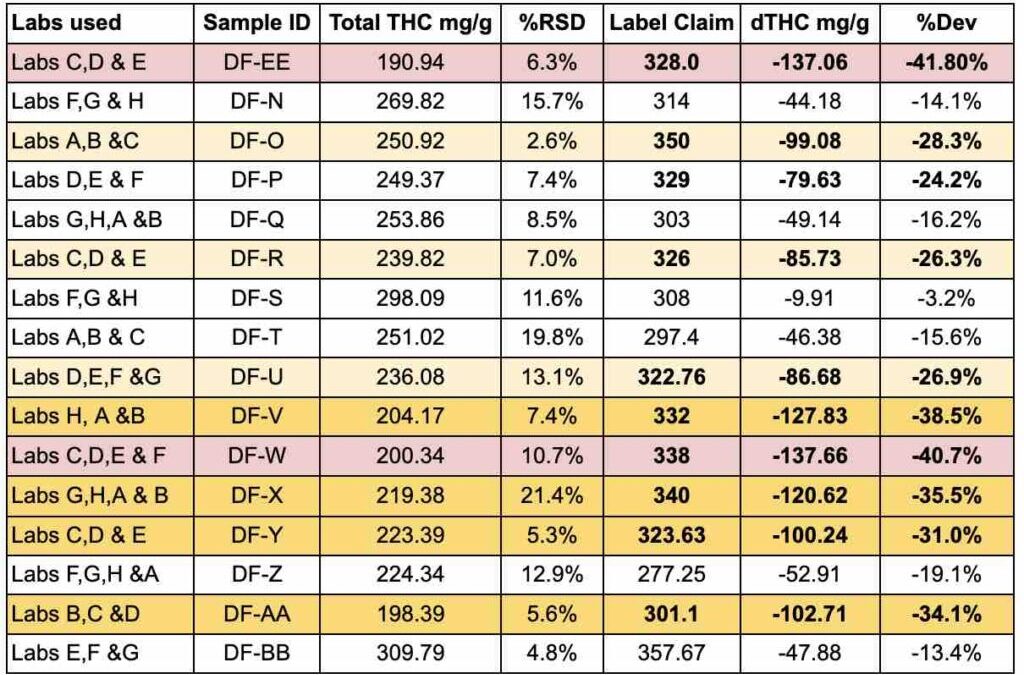
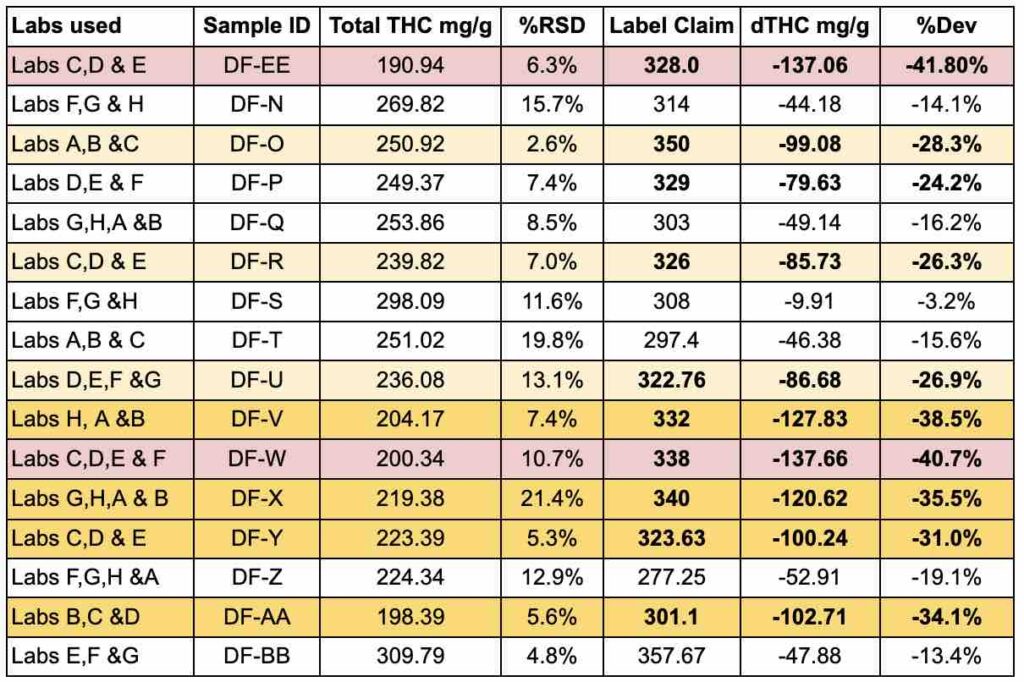
Summary Dried Flower Results. Column one shows which labs tested the sample ID’d in column two. Column three shows the actual THC result. Column four shows the variation between labs that tested the sample. Column five shows the THC on the label. Column six shows the difference in THC levels measured in mg/g. Column seven shows the deviation between label claim and secondary testing by percent.
This is highlighted by the project’s findings, which showed not only the deviation between the posted THC levels on the label of a cannabis product but also the deviation in the results between those labs. Three to four labs would receive the same sample, and in most cases, their results came within the same range, showing that when these labs use the same methodology, they can arrive at relatively similar measurements.
“Clearly there have been suggestions that there are THC inflation problems in the Canadian and US marketplaces. And people have been trying to identify the source of that and fingers have been pointed in many directions, including the accuracy of labs in Canada,” says O’Brien.
“I think it’s undermining the whole industry in Canada and the US,” he adds. “I think it’s outrageous that these shenanigans are allowed to continue. Health Canada is partially responsible because they’re not enforcing reasonable limits. And this clearly shows that if they do set reasonable limits, Producers can be within 15% of label claim.”
Summary Pre-roll Results
How it worked
The research, conducted by eight analytical testing labs in Canada, tested 16 different brands of 3.5 g dried flower products available in several provincial markets, four different brands of pre-rolls (non-infused), and 15 different brands of infused pre-roll flower product.
Researchers used an allowable variance for the dried flower and pre-rolls of 25% and 15% for infused pre-rolls, similar to the allowable limit within federal cannabis regulations. Note: this means, for example, that a product labelled as having 30% THC could be over or under that number by 7.5 percentage points, or 23.5% THC or 37.5% THC.
More than half (nine) of the samples from the 3.5-gram dried flower SKUs were found to be more than 25% below the stated label claim, and two of those were more than 40% lower than the label claim.
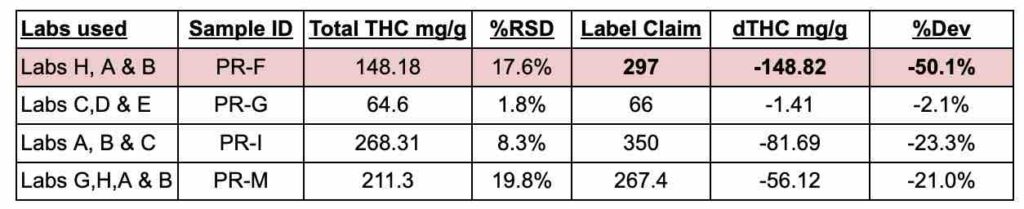
Meanwhile, only one of the four brands of non-infused pre-rolls was outside the 25% allowable range, with one sample coming in just 2.1% lower than the label.
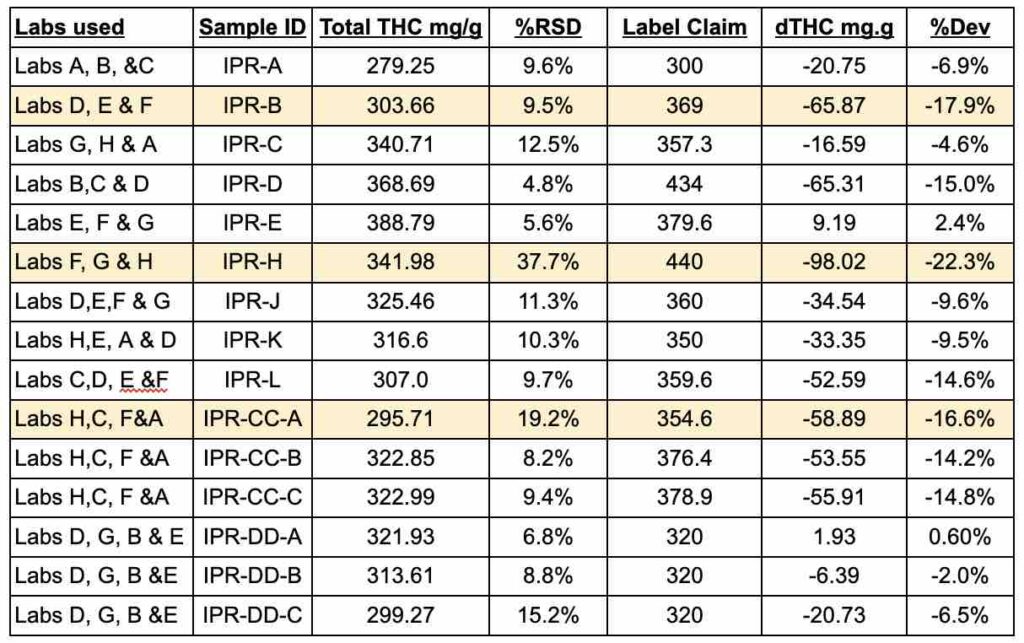
For the infused pre-rolls, only three samples were outside the 15% range, and none were outside the 25% range.
None of the dried flower or pre-roll samples were above the stated label claim, while two infused pre-rolls showed results slightly above the label claim.
Summary Infused Pre-roll Results
While some may point to the issue being devious labs, the resulting research paper, which O’Brien shared with StratCann, speculates the issue may have more to do with sample bias by producers who are selecting top colas or other high-THC flowers as their representative sample instead of sampling the finished product after it’s packaged.
Related Articles
The fact that there was greater THC inflation and label inconsistency in the dried flower samples from the research project highlights this issue more, O’Brien says. Since pre-rolls are more likely to be homogenized as part of the manufacturing process, there is less variation between the label claim and the actual products.
The issue is even more pronounced with infused pre-rolls, which are considered an extract under federal regulations and, therefore, subject to a strict 15% deviation allowance.
While a cannabis flower may have a certain level of THC at harvest or after drying and curing, the process of processing and packaging that flower results in a loss of Trichomes that significantly reduce the THC content, which is why he says these products should be tested after packaging rather than before.
“While we cannot pinpoint the origin of the discrepancies, we can speculate that the label claims >30% higher than the actual Total THC concentration in the finished product may be using artificially high COA’s from a harvest rather than testing products after being handled and processed into the finished form,” says the paper. “Active cannabinoids are compartmentalized in fragile trichome structures that can easily be dislodged during mechanical processing. Non-processed flowers may have a higher amount of cannabinoids than processed flowers.”
Still, the paper doesn’t entirely discount the possibility that some labs are also inflating numbers.
“Furthermore, there is also the probability that some labs are artificially generating high COA’s or that the producers are sending samples that are doctored. However, these possibilities can not be determined from this type of study.”
Three or four packages of each brand were obtained from cannabis stores in several provinces. These were then sent to a central lab, sorted, and randomly sent to the other labs involved in the study.
Although they’re not releasing the names of the specific brands they tested because they don’t want to harm any brand, O’Brien says the full data set will be shared with Health Canada and provincial cannabis distributors. The hope is that when producers with accurate label claims are contacted, they will permit the publication of their name to create positive news stories about this issue.
More information about these results, including all participating labs, is expected to be released at a future date.
The Department of Health and Human Services (HHS) recently released a set of documents pertaining to its recommendation to move cannabis from Schedule I to III under the Controlled Substances Act (CSA). The documents also encompass an in-depth evaluation conducted by the health agency regarding the acknowledged medical value of marijuana.
Included in the newly revealed materials are correspondences from HHS officials to DEA administrator Anne Milgram and the rationale behind the recommended reclassification, backed by an exhaustive eight-factor analysis mandated by the CSA. Despite the release, a significant portion of the pages is heavily censored, and some have been entirely withheld.
The documents became accessible online, courtesy of attorneys Shane Pennington and Matt Zorn, coauthors of the On Drugs blog. Zorn had previously submitted a Freedom of Information Act (FOIA) request to obtain these records. In response, HHS scrutinized 252 pages, releasing only two pages in full. An additional 236 pages were partially redacted, and 14 were entirely withheld.
The disclosed documents broadly outline contemporary scientific findings that have emerged in recent years, after a previous denial of a petition to reschedule cannabis. HHS suggests that these developments may now warrant a reconsideration of cannabis scheduling.
The current examination primarily focuses on the modern scientific considerations surrounding currently accepted medical use (CAMU) for cannabis. It also delves into new epidemiological data regarding marijuana abuse, a perspective absent in the 2015 HHS evaluation of marijuana under the CSA’s eight-factor analysis.
HHS acknowledges the complexity of determining the abuse potential of cannabis, emphasizing that it involves multifaceted dimensions. The health agency underscores that there is no singular test or assessment that comprehensively characterizes the abuse potential, making it an intricate consideration.
HHS director of FOIA litigations and appeals, in a letter to Zorn, explained that redactions were made under a FOIA provision exempting intra-agency memoranda or letters not available by law to parties outside an agency engaged in litigation with the agency.
HHS had earlier released a highly redacted version of a one-page letter from the health agency to the DEA in response to public records requests by various entities, including lawyers and news organizations.
Marijuana businesses such as Cronos Group Inc. (NASDAQ: CRON) (TSX: CRON) are likely to analyze those released documents in order to glean insights into the possible policy direction that may emerge over the coming years.
About CNW420
CNW420 spotlights the latest developments in the rapidly evolving cannabis industry through the release of two informative articles each business day. Our concise, informative content serves as a gateway for investors interested in the legalized cannabis sector and provides updates on how regulatory developments may impact financial markets. Articles are released each business day at 4:20 a.m. and 4:20 p.m. Eastern – our tribute to the time synonymous with cannabis culture. If marijuana and the burgeoning industry surrounding it are on your radar, CNW420 is for you! Check back daily to stay up-to-date on the latest milestones in the fast -changing world of cannabis.
To receive SMS alerts from CNW, text CANNABIS to 888-902-4192 (U.S. Mobile Phones Only)
Please see full terms of use and disclaimers on the CannabisNewsWire website applicable to all content provided by CNW, wherever published or re-published: https://www.CannabisNewsWire.com/Disclaimer
A man, and a woman, must make the choices in life that are best for them. Heart sourced seems most honest to me. What is your purpose, and if your missing said answer, how can you find what you’re not aware of yet. Perhaps it is simply a matter of learning, or recalling, to be honest with yourself no matter the consequences or voices that stand against your Happy Destiny.
Stay Awesome and Teach Yourself! Cambell
If not yet, try these full frequency flower essences! For myself and Lorenzo and others we know personally they are literally helping us to work our own wonders. Cambell and Lorenzo!
How to Order Yours Today! Offer Expires Dec 31/2023
Use your affiliate link for either Healing Support promo or for Heartmend promo.
Add 3 Healing Support (combination essence) and 3 Blue Eyed Grass to the shopping cart, then go to checkout and enter the coupon code for this promo which is: HSHOLIDAYS (not case sensitive).
You will only pay for the Healing Support. The Blue Eyed Grass will be free.
Or (One Coupon Per Order, But You May Order Twice if you Wish)
Add 6 Heartmend to shopping cart,. You only pay for 4, 2 will be free with when the coupon code HMHOLIDAYS is used.
For any other order you may still used our coupon code TheNewNow to receive 11% off.
Recent Testimonials from Credible Sources
”Just to let you know the two bottles have arrived safely. Already I recognize ‘distance attunement’ to my deeper healing needs.”
J.R.
”I did get the FlorAlive order and started the healing support essence. So far I’ve noticed I am more sensitive to things, as if my Cancer Crab shell has softened. I am also remembering more of my dreams a little more vividly. I do like it. ”
R.L.
”I’ve used up my bottles of Blue Eyed Grass and Healing Support with effective results.”
C.P.
As for me, I was lucky enough to have Dr. Davis do a personal session and create a unique blend which has worked wonders in opening my abundant path. Lorenzo
Toronto — Organigram Holdings Inc. is pleased to announce that Greg Guyatt CPA, CA, formerly of Pheona Holdings Inc., has been appointed to the role of chief financial officer effective January 8, 2024. Guyatt will lead Organigram’s finance and IT divisions and will report directly to Beena Goldenberg, Organigram’s chief executive officer.
Guyatt is a seasoned financial executive with over 25 years of international public company and private equity backed company experience. He joined Phoena as chief financial officer in 2019 before assuming the position of chief executive officer in 2020. Prior to joining Pheona,Guyatt was chief financial officer of Greenspace Brands and held various progressive senior finance positions at Kingsett Capital and Sears Canada.
“I am pleased to welcome Greg to the Organigram executive management team. Greg brings tremendous experience to the team and will be a valuable contributor to the Company as we focus on Organigram’s ambitious growth plans with a core objective of delivering bottom-line results.” — Beena Goldenberg, CEO, Organigram
Guyatt replaces Paolo De Luca who had stepped in as interim chief financial officer following the departure of Derrick West in November. The company thanks Paolo for his support and looks forward to him dedicating his focus as chief strategy officer, which includes leading the Jupiter initiatives following the announcement of the proposed follow-on investment by BAT.
Terran Biosciences, a drug developer based in New York, announced recently that it had obtained patent approval for its psychedelic drugs from the U.S. Patent and Trademark Office. The drugs, which have been designed to treat neurological and psychiatric disorders, are based on psilocybin, namely psilocybin edisylate and psilocybin HCI.
Terran Biosciences describes the drugs as the world’s first new polymorphs and salts of psilocybin, noting that the patents will include techniques for treating the aforementioned disorders.
Dr. Sam Clark, Terran CEO and founder, stated that the company was approaching its goal of providing patients with accessible and affordable psilocybin treatment options. Now, the company is focused on acquiring approval from the FDA for its psilocybin variations. It hopes to have the drugs on the market within five years after said authorization has been obtained.
Currently, the company supplies researchers with psychedelics for their studies and clinical trials.
In addition, the company also obtained approval for what it terms orally active prodrugs of 5-MeO-DMT and DMT. DMT, or N,N-dimethylltryptamine, is a psychedelic and hallucinogenic that occurs naturally in many animals and plants. When ingested, this drug is known to produce intense but brief psychedelic effects.
5-MeO-DMT is a psychedelic classified under tryptamines. This compound can be found in the glands of the Sonoran desert toad or Colorado river toad. Similar to other tryptamines, the compound is used as an entheogen in South America. These psychedelics are generally injected or smoked, or they need a monoamine oxidase inhibitor to be activated orally. Terran has found a way to eliminate this requirement, however. The drugs are currently being tested in clinical trials, with the company noting that it is focused on acquiring FDA approval for these drugs as well.
In other news, the patent office also offered Terran Biosciences a notice of allowance for its ibogaine derivative. Ibogaine is a psychoactive substance found in plants in the Apocynaceae family, such as the Tabernanthe iboga shrub. This shrub is mainly found in central Africa. Ibogaine is known to be an effective treatment for substance-use disorder.
Currently, Terran Biosciences has one of the largest drug-development programs in the psychedelic industry. It is conducting experiments with varieties of psychedelics such as LSD, MDMA and 2CB for the treatment of a range of conditions.
This news from Terran Biosciences comes as psychedelic treatments continue to gain mainstream acceptance in the United States. Legislators from the House and Senate agreed to direct funding toward psychedelic research in a recently approved defense bill.
Many other companies, such as Mind Medicine Inc. (NASDAQ: MNMD) (NEO: MMED) (DE: MMQ), are also focused on advancing the psychedelic medicine field, and we could soon see a flurry of new drug applications and patents being filed by these startups in the nascent industry.
About PsychedelicNewsWire
PsychedelicNewsWire (“PNW”) is a specialized communications platform with a focus on all aspects of psychedelics and the latest developments and advances in the psychedelics sector. It is one of 60+ brands within the Dynamic Brand Portfolio @ IBN that delivers: (1) access to a vast network of wire solutions via InvestorWire to efficiently and effectively reach a myriad of target markets, demographics and diverse industries; (2) article and editorial syndication to 5,000+ outlets; (3) enhanced press release enhancement to ensure maximum impact; (4) social media distribution via IBN to millions of social media followers; and (5) a full array of tailored corporate communications solutions. With broad reach and a seasoned team of contributing journalists and writers, PNW is uniquely positioned to best serve private and public companies that want to reach a wide audience of investors, influencers, consumers, journalists and the general public. By cutting through the overload of information in today’s market, PNW brings its clients unparalleled recognition and brand awareness. PNW is where breaking news, insightful content and actionable information converge.
To receive SMS alerts from PsychedelicNewsWire, text “Groovy” to 888-902-4192 (U.S. Mobile Phones Only)
Please see full terms of use and disclaimers on the PsychedelicNewsWire website applicable to all content provided by PNW, wherever published or re-published: https://www.PsychedelicNewsWire.com/Disclaimer





















Recent Comments