
by Grow Up Conference | Dec 8, 2023 | Media Partners, Stratcann
Calgary Police are asking the public for help in identifying multiple suspects believed to be connected to a series of violent armed robberies at several cannabis stores in the city.
Following a previous press release for late November, police in Calgary now says there have been 12 cannabis store robberies in the city, including one incident where the suspects kicked the store clerk unconscious and brandished a knife.
Weapons such as a handgun and a hammer have also been used in other reported incidents, say police.
Police shared CCTV images with the hope of identifying the suspects and encouraging the public to be wary of suspicious behaviour or activity near cannabis retail stores.
Law enforcement say they believe it is the same group targeting stores for cash and cannabis product which can be re-sold illegally. The suspects are described as males wearing dark clothing, hoodies with the hoods pulled up, masks and gloves.
Robberies and burglaries of cannabis stores are not uncommon, and stores in Calgary have been previously targeted. Cannabis growers and processors have not been immune, either. Earlier this year, at least two cannabis producers in BC’s Lower Mainland were the victims of early-morning burglaries.
Alberta recently repealed its rule requiring stores to have window coverings that retailers said made their employees less safe in such incidents

by Grow Up Conference | Dec 8, 2023 | Extraction Magazine, Media Partners
From pain relief to improved memory, western medicine is starting to embrace plant based medicines as viable therapeutic options. This is something that has been accepted in Eastern cultures for centuries, as the medicinal use of cannabis extends back to 4000 BC in countries like China, India, and Tibet. [1] Prior to the modern prohibition, cannabis was often cultivated in eastern cultures extending from China to Ancient Greece and Rome.
At the same time, on the opposite side of the planet, Mesoamerican cultures were cultivating a different plant for its medicinal benefits: cacao beans, the precursor to chocolate. [2] The chocolate we have available today is not as psychoactive as cannabis, but its invigorating and euphoric effects still exist in the chocolate we eat today. In fact, the divergent opinions on these two products may not be warranted, as they both produce a chemical response in the brain and positive effects throughout the body. The question is, how similar are these responses, and how do they interact with each other within the body.
The History of Chocolate and its Uses
While the effects of cannabis are far more potent and obvious, it is worth evaluating the history and physiological responses of chocolate as it has evolved over the last several centuries. Evidence of chocolate use dates back to 600 BC in the Pre-Columbian Olmec, Inca, and Aztec civilizations. [3] Originally used to treat fatigue, fever, and weak hearts, it was brought to Europe in the 1500s by the Spanish Conquistador Hernán Cortes.
There, more than 100 medicinal uses were identified, including weight gain for emaciated patients, nervous system stimulation for apathetic patients, and improvement of digestive and kidney health. At the time, chocolate was mainly consumed as a warm drink, along the same lines as coffee. It wasn’t until 1847 when the British chocolate company Fry & Sons combined cocoa powder with cocoa butter and sugar to create “eating chocolate,” the first version of chocolate bars we know today. [4] While chocolate products slowly shifted from being seen as medicinal to food products, the therapeutic properties did not disappear.
Thanks to developments in neuroscience, it is possible to document some physiological and chemical responses that chocolate provides. One study found that the elevated levels of flavonoids may provide several benefits to the brain. [5] This includes anti-inflammation, neurocognitive improvements, and can help relieve intestinal discomfort. The study concludes these benefits stem from chocolate’s undocumented neuroprotective benefits that promote neurogenesis through neuro-modulatory proteins while simultaneously increasing blood flow. While this research is still in early stages, it may prove promising in treating conditions like dementia, strokes, and age related cognitive decline. All of this is promising, but it may prove especially beneficial when mixed with other therapeutic plants like cannabis.
Combining Chocolate and Cannabis
While the medicinal use of cannabis goes back thousands of years as well, the data of how it affects the brain has only recently been recorded. Similar to chocolate, the neurological benefits may provide a botanical solution for multiple physical and neurological conditions.
Cannabis has been shown to have anti-inflammatory, neuroprotective, and digestive benefits for its users. [6][7][8] All of these side effects compliment the advantages of consuming chocolate, but there is one important detail to note. While not only contributing to the wellbeing of the patient, cannabis supplements chocolate’s benefits by interfering with them. This is because the effects of the two products, while having similar in nature, stem from different reactions with the body and brain. Chocolate reduces inflammation by increasing blood flow, while cannabis slows white blood cell reaction and inhibits immune system proteins. [9][10] Both provide pain relief, but in different ways. Similarly, chocolate aids digestion by having a high fiber content, while cannabis relies on limiting stomach acid to minimize intestinal discomfort. [11][12]
The neuroprotective benefits are harder to identify, but chocolate’s flavonoids work on different parts of the brain than cannabinoids. [13][14] So while the evidence here is not definitive, the early results are promising. When taken together, this means that chocolate and cannabis have the potential to work together without interfering and inhibiting each other. This means that it may be possible for patients to develop a treatment strategy that can be customized to face their maladies on multiple fronts. All while using safer, natural alternatives to pharmaceutical products.
Building Effect Treatment Strategies
The logic follows that since chocolate and cannabis both treat various disorders in different ways, then their combined effect should produce better results. Luckily, data is already emerging to support this theory, but there is a caveat. [15] Neither chocolate nor cannabis are considered lethal in high doses, but both can cause significant discomfort when consumed in large amounts. It is important for patients who consume chocolate and cannabis together to be wary of how much they are ingesting. This may also vary by specific products, but effective measurements have been developed to determine exactly how much cannabis may be infused into various chocolate products. [16] With this in mind, this can also serve as an advantage. Not only do cannabis and chocolate run the risk of amplifying each other’s downsides, they also can increase the advantages. [17]
Research is still in its early stages, and it is important to recognize that the evidence to support this is only corollary at this point and not definitive. [18] That being said, cannabis and chocolate provide more than physical pain relief, but also mood elevation and can minimize each other’s downsides. An example of this would be chocolate covering cannabis’s taste or the lower stomach acid combating chocolate’s acidity. So while both of these plant usages originated from very different societies, they may serve to complement each other in several perfect ways.
References:
- Aggarwal, Sunil K., et al. “Medicinal use of cannabis in the United States: historical perspectives, current trends, and future directions.” Journal of opioid management 5.3 (2009): 153-168.
- Lippi, Donatella. “Sin and pleasure: the history of chocolate in medicine.” Journal of agricultural and food chemistry 63.45 (2015): 9936-9941.
- Dillinger, Teresa L., et al. “Food of the gods: cure for humanity? A cultural history of the medicinal and ritual use of chocolate.” The Journal of nutrition 130.8 (2000): 2057S-2072S.
- French, Michael. “Modernity in British advertising: selling cocoa and chocolate in the 1930s.” Journal of Historical Research in Marketing 9.4 (2017): 451-466.
- Sokolov, Alexander N., et al. “Chocolate and the brain: neurobiological impact of cocoa flavanols on cognition and behavior.” Neuroscience & Biobehavioral Reviews 37.10 (2013): 2445-2453.
- Gallily, Ruth, Zhannah Yekhtin, and Lumír Ondřej Hanuš. “The anti-inflammatory properties of terpenoids from cannabis.” Cannabis and cannabinoid research 3.1 (2018): 282-290.
- Iuvone, Teresa, et al. “Neuroprotective effect of cannabidiol, a non‐psychoactive component from Cannabis sativa, on β‐amyloid‐induced toxicity in PC12 cells.” Journal of neurochemistry 89.1 (2004): 134-141.
- Naftali, Timna, et al. “Cannabis for inflammatory bowel disease.” Digestive Diseases 32.4 (2014): 468-474.
- Kuebler, Ulrike, et al. “Dark chocolate attenuates intracellular pro-inflammatory reactivity to acute psychosocial stress in men: A randomized controlled trial.” Brain, behavior, and immunity 57 (2016): 200-208.
- Mukhtar, Amna H., and Nabiela M. Elbagir. “Effect of Cannabis sativa on hematological indices in rats and men.” Pak J Nutr 10 (2011): 313-316.
- Ortega, Nadia, et al. “Effect of fat content on the digestibility and bioaccessibility of cocoa polyphenol by an in vitro digestion model.” Journal of agricultural and food chemistry 57.13 (2009): 5743-5749.
- Abdel-Salam, Omar. “Gastric acid inhibitory and gastric protective effects of cannabis and cannabinoids.” Asian Pacific journal of tropical medicine 9.5 (2016): 413-419.
- Nehlig, Astrid. “The neuroprotective effects of cocoa flavanol and its influence on cognitive performance.” British journal of clinical pharmacology 75.3 (2013): 716-727.
- Lu, Hui-Chen, and Ken Mackie. “An introduction to the endogenous cannabinoid system.” Biological psychiatry 79.7 (2016): 516-525.
- Beal, Kerry. “Considerations in the addition of cannabis to chocolate.” Current Opinion in Food Science 28 (2019): 14-17.
- Yousefi‐Taemeh, Maryam, and Demian R. Ifa. “Analysis of tetrahydrocannabinol derivative from cannabis‐infused chocolate by QuEChERS‐thin layer chromatography‐desorption electrospray ionization mass spectrometry.” Journal of Mass Spectrometry 54.10 (2019): 834-842.
- De Bruijn, Suzanne EM, et al. “Explorative placebo-controlled double-blind intervention study with low doses of inhaled Δ9-tetrahydrocannabinol and cannabidiol reveals no effect on sweet taste intensity perception and liking in humans.” Cannabis and cannabinoid research 2.1 (2017): 114-122.
Iftikhar, Amna, et al. “Applications of Cannabis sativa L. in food and its therapeutic potential: From a prohibited drug to a nutritional supplement.” Molecules 26.24 (2021): 7699.

by Grow Up Conference | Dec 8, 2023 | Grow Opportunity, Media Partners
Police in Calgary say there have been 12 cannabis store robberies in the city since November 14th.
Calgary police say it’s believed the same group is responsible for the series of robberies.
They say one incident involved suspects brandishing a knife and kicking a store clerk unconscious.
Police describe the suspects as males wearing dark clothing, hoodies with the hoods pulled up, masks and gloves.
by Grow Up Conference | Dec 8, 2023 | Grow Opportunity, Media Partners
(Globe Newswire) Chicago and Vancouver — Green Thumb Industries Inc., a leading national cannabis consumer packaged goods company and owner of RISE Dispensaries, today announced the retirement of Richard Drexler from its Board of Directors, effective December 8. Drexler joined Green Thumb’s Board in 2022 and served as chair of the audit committee. Following his departure, Richard Reisin will assume the role of chair of the audit committee. Drexler will continue to support the Board in a short-term consultant role to ensure a smooth transition.
“I would like to thank Richard for his valuable contributions to Green Thumb over the past year,” said Green Thumb Founder, chairman and chief executive officer Ben Kovler. “His strong guidance has been integral to our Board, and I appreciate all his support, including his offer to stay on in a consulting capacity for a short transition period. On behalf of our entire team, we wish Richard all the best in his retirement and on the tennis court.”
Richard Drexler added: “It has been an honor to work alongside the Green Thumb leadership team, and I know I will be leaving them in great hands with Richard Reisin. I have no doubt the company will continue to achieve great success in the years to come, and I look forward to cheering them on as an investor in the business.”

by Grow Up Conference | Dec 8, 2023 | Media Partners, Stratcann
The owners of a chain of cannabis stores that operate on First Nation land in Canada had one of their stores appropriated by a BC First Nation in 2020.
The Indigenous Bloom chain of stores has operated cannabis stores at various times in the past within several First Nations communities across Canada, primarily in British Columbia.
The corporation signed an agreement in 2019 with the Tseycum First Nation Band (TFNB) and a company called Tseycum Limited Partnership, both located on Vancouver Island, to operate a store on reserve land within the community. The term of the lease was for five years, beginning on September 24, 2019. The Dispensary opened for business on April 18, 2020.
However, in Summer 2020, the First Nation took over the store, telling the owners of Indigenous Bloom that the previous agreement for co-ownership of the business was not valid.
Indigenous Bloom took the TFNB to court, asking for their equipment, inventory, the modular building they installed, and cash from the business to be returned to them. The court denied their application.
The background
At around 11 pm on August 30, 2020, the manager of the cannabis dispensary was contacted by a security company, informing them that an alarm inside the business had been triggered.
The manager instructed the security company to call RCMP and then made her way to the store to see for herself what was happening. When she arrived just after midnight, the manager, identified in court records only as Ms Dick, says she saw numerous cars around the store, with people going in and out of the business, removing items.
In addition, all of the store’s signage had been removed, and someone was working on the security system.
Dick then told the court she was approached by a representative of the TFNB who informed her that the store was now the property of the First Nation.
Shortly after, Dick contacted IBC’s Vice President Brent Story, who arrived and began documenting activities at the cannabis store, saying he saw trucks loaded with Indigenous Bloom property and product and saw band leaders directing the activity.
On August 31, 2020, the store reopened as Frankie’s, operated by members of TFNB.
Indigenous Bloom submitted to the court that it was seeking to recover more than $350,000 in lost profits and other associated costs, which included cash on hand in the store, the value of cannabis products and equipment, as well as the building the store operated out of.
The agreement they claimed they had with the First Nation was for Indigenous Bloom to retain 49% of profits, with the First Nation and associated limited partnership operating the business on a day-to-day basis.
For their part, representatives from TFNB and Tseycum Limited Partnership (TLP) say the Buckshee Lease signed by TFNB was invalid because these leases contravene the Indian Act. They also told the court that the documents had not been signed by the named First Nation’s or TLP’s representatives.
As such, they contend that Indigenous Bloom did not have the right to operate the business or even be present on their land. A Buckshee lease is an unregistered lease made between a band member or the band itself with an interest in land and a lessee. Courts in the past have considered them unenforceable.
Although Indigenous Bloom had sought the injunction against TFNB and TNB, citing concerns for the precedent the First Nation’s actions could create, the court disagreed. While representatives for Indigenous Bloom characterized the takeover of the store as a “heist” and “robbery”, and of vigilante justice, the court disagreed, noting that their claims to rights with regard to the reserve land are not without merit, “They are not outsiders,” wrote the judge.
Related Articles
by Grow Up Conference | Dec 8, 2023 | Grow Opportunity, Media Partners
By Timothy Schafer, Local Journalism Initiative Reporter
THE NELSON DAILY
The ship has been righted for cannabis retail operations in Nelson.
There will be a reduction in the business licence fee that cannabis retail operations pay to the City of Nelson, after a request from cannabis retailers made in 2022 to reduce licence fees for “retail: recreational cannabis” was approved and adopted.
The previous fee for a recreational cannabis retail store was $2,500 per year. However, a City staff report had recommended that it was “reasonable” to amend the cannabis retail business license fees to match “retail wine and beer” — dropping the fee from $2,500 to $210.
The previous fee that cannabis retail businesses paid was more than twice what the highest fee any other city business paid — chartered bank at $1,040 — and there was no rationale for the price point, said City director of Development Services and Climate Leadership, Sebastien Arcand.
“This will bring the business licence fee in line with other similar businesses,” he said in his report to council on Nov. 7.
It would be appropriate for the City to lower the cannabis retail business licence fee to match that for retail wine and beer, Arcand said in his report.
“The high cannabis retail business licence fee reflects that when they were first created in the wake of legalization, there was some speculation that the City resources these businesses might require would be higher than of a typical business,” said Arcand.
City departments involved with business licensing — for the departments of issuance, inspection and enforcement — determined that cannabis retail did not require additional resources. In addition, neighbouring municipalities were also consulted to compare fees for cannabis retail.
The review concluded that the fees in Nelson were significantly higher.
Cannabis retailers are to be informed of the amendment now that it is adopted.
By the numbers
In 2023, the City issued four business licenses for cannabis retailers.
If this number remains the same in 2024, the City would see a reduction of $9,160 in business licensing revenues.
In review
At the time of request, City staff considered reviewing the entire Business License Bylaw and associated business license fees to ensure that all fees are fair and reasonable.
A comprehensive review of the Business License Bylaw and associated fees will be required in the next few years, Arcand noted.
“A complete review of the bylaw would be a significant undertaking and should be adequately resourced and included in departmental workplans. Staff will be determining when and how the review should best take place in the future,” said Arcand.

by Grow Up Conference | Dec 8, 2023 | Cannabis News Wire, Media Partners
A policy analyst from TD Cowen says that cannabis legalization in the United States is “inevitable” and believes that it is just a question of weathering a bumpy legislative landscape for the next several years. Originally, many analysts thought federal cannabis legalization was finally on track after the Democrats secured the House, Senate and White House, especially as President Joe Biden had based part of his campaign on cannabis reform.
However, while the Biden administration has taken some cannabis-related action, including issuing a mass pardon for people with certain cannabis-related convictions, the administration has barely made any moves to legalize cannabis at the federal level.
With President Biden’s first term fast approaching its end, many pundits and investors are quickly losing hope for federal cannabis legalization, particularly in the next couple of years. Capital investment in the state-legal cannabis industry is extremely low, and the AdvisorShares Pure U.S. Cannabis ETF, current holder of all U.S.-based marijuana companies, is trading at just $6.80 a share down from around $52 a share in early 2021.
Federal prohibition has made operating in the cannabis sector almost untenable; cannabis businesses are barred from interstate commerce, they struggle to obtain investment and financing, and they aren’t allowed to make normal business tax deductions. Even so, TD Cowen policy analyst Jaret Seiberg says federal legalization is inevitable. Polls show that a majority of the American population is in favor of either decriminalization or outright legalization, and a cadre of top lawmakers has thrown their weight behind cannabis reform.
Bipartisan legislation such as the SAFER Banking Act seeks to legitimize the cannabis sector by allowing industry players to access financial services from banking institutions. Senate Majority Leader Chuck Schumer and other senators have also been working on a bill that would legalize cannabis at the federal level.
In addition, a group of Massachusetts cannabis businesses has filed a lawsuit alleging that the Controlled Substances Act, which classifies cannabis as a Schedule I controlled drug, is an unconstitutional infringement on the power of states with legal cannabis. Although a favorable ruling wouldn’t make interstate cannabis trade any easier, it would significantly ease the operations of already existing cannabis businesses by granting them access to essential financial services, such as bank accounts and cashless payments.
Legalization may also be spurred by executive action. For instance, Biden recently asked the U.S. Department of Health and Human Services (HHS) to review marijuana’s federal status as a controlled substance. Subsequently, a letter dated Aug 29, 2023, which was obtained by Bloomberg, revealed that a top HHS official had recommended that the Drug Enforcement Agency (DEA) reschedule cannabis from Schedule I of the Controlled Substances Act (CSA) to Schedule III.
The cannabis industry, including enterprises such as Curaleaf Holdings Inc. (CSE: CURA) (OTCQX: CURLF), awaits any definitive action taken by the DEA as this will have a major effect on the trajectory of the marijuana industry in the United States.
About CNW420
CNW420 spotlights the latest developments in the rapidly evolving cannabis industry through the release of two informative articles each business day. Our concise, informative content serves as a gateway for investors interested in the legalized cannabis sector and provides updates on how regulatory developments may impact financial markets. Articles are released each business day at 4:20 a.m. and 4:20 p.m. Eastern – our tribute to the time synonymous with cannabis culture. If marijuana and the burgeoning industry surrounding it are on your radar, CNW420 is for you! Check back daily to stay up-to-date on the latest milestones in the fast -changing world of cannabis.
To receive SMS alerts from CNW, text CANNABIS to 888-902-4192 (U.S. Mobile Phones Only)
For more information, please visit https://www.CannabisNewsWire.com
Please see full terms of use and disclaimers on the CannabisNewsWire website applicable to all content provided by CNW, wherever published or re-published: https://www.CannabisNewsWire.com/Disclaimer
CannabisNewsWire
Denver, CO
www.CannabisNewsWire.com
303.498.7722 Office
Editor@CannabisNewsWire.com
CannabisNewsWire is powered by IBN
by Grow Up Conference | Dec 7, 2023 | Cannabis News Wire, Media Partners
New research has found that the legalization of cannabis may be linked to a drop in the use of cigarettes and alcohol by young adults. For their study, the researchers surveyed 311 individuals aged 18 to 20 years of age who were living in Los Angeles prior to and after the state legalized the recreational use of cannabis in 2016.
The participants were divided into two groups: prelegalization and postlegalization, with the latter group having 139 participants.
The researchers found that despite increased normalization of marijuana use and increased access to the drug, legalization did not cause the frequency of marijuana use to increase. However, they did observe a shift in the use of edibles after legalization. This, the researchers theorized, could point to a substitution effect that may have resulted from increased access to marijuana via diversion of marijuana from adult-use or medical marijuana dispensaries or a medical marijuana recommendation.
With regard to the use of other substances, the researchers observed a drop in cigarette and alcohol use among participants in the postlegalization group. This, they argued, suggested the possibility of a protective effect provided by marijuana or potentially ongoing changes in attitudes and norms toward the drug.
The study, which was funded by the National Institute on Drug Abuse, reported its findings in the “Journal of Psychoactive Drugs.”
The study’s findings counter arguments made by prohibitionists on the potential impact of legalizing marijuana, as the data also showed no significant rise in the use of cannabis among young adults who hadn’t attained the minimum age that’d allow them to access retail dispensaries. In their report, the researchers recommended that future studies monitor whether stable rates of marijuana use and reductions in the use of cigarettes and alcohol would be sustained as participants attained legal age to access these substances. They also recommended that research focus on how these trends altered or continued as participants entered adulthood.
This is not the first study to observe a possible substitution effect. Research that was published recently in the “International Journal of Mental Health and Addiction” reported that the legalization of medical cannabis was linked to a lower frequency of use for nonprescribed opioids. Separate research published in October also found that legal access to CBD products brought about considerable reductions in opioid prescriptions.
Earlier in August, another study determined that cannabis was significantly linked to decreased cravings for opioids for individuals who were using them without prescriptions. This suggests that expanding access to legal marijuana by letting various companies such as Canopy Growth Corp. (NASDAQ: CGC) (TSX: WEED) operate may offer individuals safer substitutes.
About CNW420
CNW420 spotlights the latest developments in the rapidly evolving cannabis industry through the release of two informative articles each business day. Our concise, informative content serves as a gateway for investors interested in the legalized cannabis sector and provides updates on how regulatory developments may impact financial markets. Articles are released each business day at 4:20 a.m. and 4:20 p.m. Eastern – our tribute to the time synonymous with cannabis culture. If marijuana and the burgeoning industry surrounding it are on your radar, CNW420 is for you! Check back daily to stay up-to-date on the latest milestones in the fast -changing world of cannabis.
To receive SMS alerts from CNW, text CANNABIS to 888-902-4192 (U.S. Mobile Phones Only)
For more information, please visit https://www.CannabisNewsWire.com
Please see full terms of use and disclaimers on the CannabisNewsWire website applicable to all content provided by CNW, wherever published or re-published: https://www.CannabisNewsWire.com/Disclaimer
CannabisNewsWire
Denver, CO
www.CannabisNewsWire.com
303.498.7722 Office
Editor@CannabisNewsWire.com
CannabisNewsWire is powered by IBN

by Grow Up Conference | Dec 7, 2023 | Garden Culture Magazine, Media Partners
I have been growing indoors for many years. Like all growers, I have encountered many mistakes and problems. However, these have only made me a better gardener in the long run. I could share countless tips, but these five will likely impact your growing game best.
Keep a Grow Diary
There are many ways to keep notes! Write them on a pad, log them on your phone, or use a wall chart. Just make sure you do it! I cannot stress enough how much being able to track my cultivation history has helped me learn and succeed as a grower.
Writing down a brief list of everything you do and when you do it will help you spot mistakes, successes, and growth patterns. Before long, you will have a tried and tested foundation of knowledge upon which to build.
Prevention Is Better Than Cure

Indoor grow rooms are ideal places for insects to thrive. They love the hot, humid climate and the abundance of tasty plants. An infestation of bugs like aphids, spider mites, and thrip can be devastating. Pest infestations often snowball quickly; the reproduction rate is remarkably high, especially in warm conditions. For example, a female aphid can produce up to 12 offspring a day, which will reach adulthood and start reproducing themselves after only a week!
Using my three-day pest checklist religiously means you will spot the signs of any infestation while still having a chance to control and eradicate it. It will also remind you to ensure the environment is suitable for your plants and not in a zone attractive to insects.
Three-day Checklist
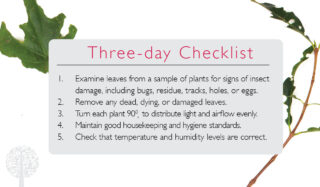
- Examine leaves from a sample of plants for signs of insect damage, including bugs, residue, tracks, holes, or eggs.
- Remove any dead, dying, or damaged leaves.
- Turn each plant 90 ̊ to distribute light and airflow evenly.
- Maintain good housekeeping and hygiene standards.
- Check that temperature and humidity levels are correct.
Reservoir Recommendation

When using a system with a tank or reservoir to feed plants, you should change it completely every seven days, regardless of the nutrients used. Plants do not consume nutrients and water equally. Therefore, the nutrient strength in the hydroponic reservoir will fluctuate. Do not just top up the feed! If you do and then take the EC measurement, and it comes out correct, it does not mean that what is in the tank is what your plants need. The EC reading only tells you the level of salts present in the water. It cannot tell you the levels of individual elements. Nutrients can also start to dissolve or calcify after a few days, changing the properties of your nutrient solution.
You will replenish your plants with fresh, accurately dosed feed in a clean environment by fully draining and cleaning your tank every seven days. It will prevent any problems before they start. Regular cleaning also helps prevent water from stagnating and developing fungi and bacteria.
Keep Your Grow Room Clean

Think of the grow room as a restaurant kitchen. It’s your workroom and place of creation. Suppose it is clean, sanitary, and well-organized. In that case, you can get much more out of it at a better quality rate than messy, cluttered, and unclean.
Inadequate hygiene standards increase the chances of a pest infestation or an attack of mold or mildew. Space also equals safety in a grow room; the combination of running electricity, hot lights, and water could quickly become a recipe for disaster.
So, ensure the cables are tidy and not covered and that everything is appropriately spaced. As a result, your plants will be happier and healthier, and you will find a more desirable working environment produces better results.
Buy The Best You Can Afford

Money talks, and never is this more accurate than in indoor gardening. When it comes to equipment, 99% of the time, you get what you pay for. This does not mean that you must buy the top range but certainly do not buy the cheapest. Cheap nutrients will be full of cheap industrial-grade elements, and inexpensive lights won’t give you the actual outputs of PAR or PPFD. Unfortunately, there are too many unscrupulous firms out there that are only concerned with making money.
The more technology and quality equipment in your grow room, such as fan speed controllers or LED lights, the easier and more manageable you will find things and the better results.
Buying quality also ensures your safety and peace of mind with warranties, guarantees, and customer service. Budget brands are okay for amateur small grow projects. But they are not generally reliable enough for anything more significant or long-term. They will often cost you more in lost yields and other problems. So buy quality and get it right the first time.

by Grow Up Conference | Dec 7, 2023 | Media Partners, The New Agora
The Great Awakening
Are You Ready To Cross The Threshold
And Accept The Sacred Sacrifice?
By Bernhard Guenther
The process of Awakening, especially at the beginning – the “Initiation” – is not an experience of a “great enlightenment” with feelings of “oneness, love, and bliss.”
Yes, it may have aspects of a positive experience at first [for some], but ultimately, it is a Shamanic descent into the “underworld”, battling with demons within and without. It brings up everything that is not in alignment with Truth – anything within the seeker that stands in the way of realizing the true Self and embodying the Divine Force.
It is Law, and it is necessary; hence, as Sir Aurobindo said, metaphorically speaking: “None can reach heaven who has not passed through hell.”
In other words, a true impulse towards Awakening brings up EVERYTHING – our wounds, blindspots, traumas, shadow, and lower nature weaknesses, which we previously have suppressed, avoided or indulged in, justified, externalized and rationalized away – all of which the occult hostile forces target, feed of, tempt us with, and heighten for us to confront and transmute in the alchemical fire within – to help bring forth the psychic being (soul essence) within and to be reborn in one’s true Self.
Likewise, as our eyes and perceptions are cleansed through this initiation [and consecutive initiations] and ongoing internal work, facing the darkness within, we will see more and more evil in the world as the darkness is coming out of the shadows where it was lurking behind appearances.
Nothing is hidden anymore. All is revealed. Nothing can be unseen, and there is no turning back to the old self with all its conditioned desires and illusory separate independence from all that IS.
As Within, so Without, As Without, so Within.
It’s a widening on all levels. An Ascent and Decent at the same time. As Satprem noted: “The more Light the Seeker possesses, the more Darkness he uncovers.”
We then realize that nothing was hidden all along but that we were living in a dream world, dreaming to be awake.
This is the first step, symbolized in the film “The Matrix” when Neo first wakes up In the “real world,” unplugs his tubes, and sees fields of humans plugged into the Matrix in their dream state as the machines were “feeding off” of them, harvesting them for their energy/life force.
It’s a very accurate symbol of the state of consensus humanity and the sleeping masses.
Neo came face to face with what Gurdjieff called “the horror of the situation.” It is the first [necessary] shock for the seeker out of many more to come.
At the same time, the more we make the darkness conscious, expose and reveal ALL [within ourselves and without, in the world], and transmute it, the more Light and True Love we can access and anchor within ourselves and in the world – the more creative power, free will, and TRUE freedom we can access as well.
But this “Free Will” is not “our” own very limited egoic will anymore. It’s a higher level of Being in alignment with Divine Will – our higher/true Self, which acts as a transducer for Divine Will as the ego personality takes a backseat.
This is the call for the Sacred Sacrifice – as all esoteric traditions have conveyed in their own words. It means to give oneself to the Divine and surrender to your higher nature, which is the only state of Being that can transcend the Matrix and that the occult forces cannot touch – to be in this world but not of this world.
Once we tap into that infinite all-powerful Force in surrender to the Divine, we will have the most powerful effect on the world, guided by the Divine as his faithful servant through every battle and hardship in the ongoing work to spiritualize our Being and the World, transmuting Lead into Gold.
This is the Great Awakening we’re called to – the Great Adventure we’re currently embarking on, and many of us came here purposely to be part of it.
Right here. Right now.
But this journey is not a walk in the park. It’s a long journey. There are many traps, detours, pitfalls, and temptations steering the seeker away from his mission – nor is everyone ready for it until a future incarnation cycle when the soul is ripe enough to engage in the Great Work.
The inner call is the measure. Sincerity, integrity, surrender [to the Divine], and an unconditional sincere call and yearning for TRUTH, whatever it may turn out to be, are the Keys to the Kingdom of God [within]. The doors are shut to anyone else who does not pay with him/herself, for nothing is “free” in the entire universe.
Are you ready to cross the Threshold and accept the Sacrifice?
Godspeed
Bernhard Guenther
TIME OF TRANSITION
EMBODIED SOUL AWAKENING





Recent Comments