A recent review of scientific psychedelic research has suggested that hallucinogens such as psilocybin (magic mushrooms) and LSD may be more effective at managing pain compared to opioids. The review indicates that classic psychedelics may be effective at mitigating the physical agony caused by pain disorders such as fibromyalgia and injuries.
Furthermore, the review noted that the efficacy of these substances can increase over time because they can simultaneously help patients deal with symptoms of mental anguish as well, essentially killing two birds with one stone in a way traditional pain medications such as opioids never could.
The past couple of years have seen psychedelics take center stage in many scientific and mainstream discussions due to their purported efficacy against numerous mental disorders. Studies have found that these compounds can alleviate hard-to-treat conditions such as post-traumatic stress disorder (PTSD) and treatment-resistant depression with few side effects, especially when paired with traditional talk therapy.
On the other hand, opioids can be extremely effective at first, but continued use causes patients to suffer increased tolerance to the medication, addiction and even life-threatening respiratory depression. If psychedelics could function effectively as opioid substitutes, which the study suggests, patients with chronic pain disorders would have a safer, side-effect-free treatment option for their physical pain.
Given that many patients with chronic pain go on to develop issues such as anxiety and depression, psychedelics could also be instrumental in soothing their emotional and psychological distress. Psychedelics have proven to be especially effective at providing long-term relief against disorders such as depression with minimal doses, making these hallucinogens a viable multipurpose treatment for chronic pain patients.
Research has found that psychedelics tackle pain differently. While traditional opioids alleviate pain by blocking pain signals in the central nervous system, psychedelics such as psilocybin and LSD are especially effective at treating nociplastic conditions such as irritable bowel syndrome (IBS) and fibromyalgia because they act on serotonin receptors.
The review notes that researchers have been studying psychedelics for pain treatment since the mid-1960s in small-scale studies that pointed to LSD as a potent painkiller that was superior to even opioids in conditions such as gangrene and cancer. However, even though many Americans now use LSD and psilocybin to self-treat cluster headaches with relative success, modern research into their pain-relieving properties has been limited. Further research into the connection between psychedelics and pain coupled with large-scale clinical studies could result in the development of psychedelic-based treatments for pain.
The work being done by enterprises such as Compass Pathways PLC. (NASDAQ: CMPS) could also clearly establish the role of psychedelic substances for other clinical conditions in addition to pain, which aren’t being treated effectively with the existing medications.
About PsychedelicNewsWire
PsychedelicNewsWire (“PNW”) is a specialized communications platform with a focus on all aspects of psychedelics and the latest developments and advances in the psychedelics sector. It is one of 60+ brands within the Dynamic Brand Portfolio @ IBN that delivers: (1) access to a vast network of wire solutions via InvestorWire to efficiently and effectively reach a myriad of target markets, demographics and diverse industries; (2) article and editorial syndication to 5,000+ outlets; (3) enhanced press release enhancement to ensure maximum impact; (4) social media distribution via IBN to millions of social media followers; and (5) a full array of tailored corporate communications solutions. With broad reach and a seasoned team of contributing journalists and writers, PNW is uniquely positioned to best serve private and public companies that want to reach a wide audience of investors, influencers, consumers, journalists and the general public. By cutting through the overload of information in today’s market, PNW brings its clients unparalleled recognition and brand awareness. PNW is where breaking news, insightful content and actionable information converge.
To receive SMS alerts from PsychedelicNewsWire, text “Groovy” to 888-902-4192 (U.S. Mobile Phones Only)
Please see full terms of use and disclaimers on the PsychedelicNewsWire website applicable to all content provided by PNW, wherever published or re-published: https://www.PsychedelicNewsWire.com/Disclaimer
While an excess supply of wholesale cannabis flower has been driving prices down over the past few years, it is possible cannabis sellers are beginning to gain some leverage over buyers.
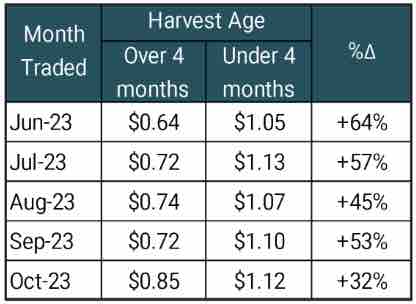
The average price of cannabis flower on the B2B wholesale market increased in October, a trend that has continued month-over-month for much of 2023. Unsurprisingly, smaller-batch, fresh cannabis with higher THC commands higher prices, with a four-month threshold for age making a significant price difference.
These prices are expected to continue to improve for sellers, predicts the Canadian Cannabis Exchange (CCX), who provided data from their monthly reports to StratCann.
CCX is a B2B exchange for cannabis and hemp products in Canada.
The average price for dried cannabis flower in October, the most recent data available, was $1.10/gram, an increase of 6.8% from the September average of $1.03/gram.
Weighted Average Price ($/gram) by Age of Product, Dried Flower Index 4-6 – via CCX
Pricing, of course, fluctuates significantly depending on the quality of the cannabis, with cannabis trim going as low as a few pennies a gram and recently harvested, higher-THC flower commanding closer to $1.45/gram. Interestingly, these figures were down from $1.91/gram in September.
Steve Clark, CEO of the Canadian Cannabis Exchange, says it seems the market seems to be recovering for wholesale flower prices.
“The Canadian market dynamics seemed to evolve as multiple sellers’ production capacities came offline in 2023. At CCX, we also observed consistent demand from domestic buyers, along with a growing pull from international markets. While it appears we’ve reached the bottom in wholesale pricing, potential expected or unexpected variables could introduce volatility, such as a new quality standards program like the temporary OCS THC testing or export/import tariffs.”
Another possible sign of the beginning of the end of the “glut” of bulk cannabis on the market is the decreasing lot sizes available. The average lot size was 27.9 kg in October, a 39% decline from the average lot size on the Exchange in August. (46.1 kg). The decline in lot size also means fewer bulk discounts, which CCX also contributes to their belief that prices will continue to increase, providing sellers more leverage over buyers than they have seen in years.
Year-over-year prices show even more upward movement on price for dried flower, with THC levels listed at 30% and higher increasing by 81%, while 20-29% THC stayed relatively level, and 15-20% decreased by 21%.
After several months of stability, the price of CBD isolate dropped to a new market low of $1,832/kg in October, a 13.8% decline from September’s price of $2,125/kg.
Demand for extracts like bubble hash, live resin, and shatter has also been strong in 2023, driven by the significant demand for infused pre-rolls, one of Canada’s fastest growing product categories. Hash is the most common of these products, selling at $4,500/kg in October.
By Marc Lalonde, Local Journalism Initiative Reporter
IORI:WASE
The Mohawk Council of Kahnawake gave the go-ahead for retail sales of cannabis in the community to begin when it voted to lift the moratorium on sales and possession for retail sales during its Monday meeting– and the chief responsible for the dossier said she expects sales to begin in the New Year.
“It’ll be early in the New Year,” MCK Chief Tonya Perron said. “It won’t be in, like, July of the new year. It’ll be pretty early.”
Advertisement
The lifting of the moratorium allows the Kahnawake Cannabis Control Board (CCB) to begin issuing the three licenses that will be available for sales of cannabis, and possession of cannabis for sale, as soon as they are able to get through what Perron expects will be a mountain of work on awarding those licenses.
“From what I’ve heard there are likely to be a lot of people applying for the licenses. If everyone who has come up to me in the community and asked me about it goes ahead with an application, there will be a lot of work for them to get though,” she said, adding that it represents a major decision and a fairly monumental occasion.
“Yes, it’s a pretty big deal,” she said. “The CCB will begin taking applications very soon, and they’ll open up the application process for a finite amount of time. The community will be advised and it’s going to be very, very shortly that they will open up the application process.”
The moratorium had been in place since 2018, and was enacted just after Canada first legalized the retail sales of the cannabis.
At the same time as it lifted the moratorium, the MCK enacted the law regulating dispensary and dispensary licenses.
“It’s all dependent now on how many applications the CCB receives for licenses,” Perron said. “However fast that process goes is because what happens after this is up to them.”
CCB chair Tara Jacobs wouldn’t put a firm timeline, but did say she hopes to have the ball roiling “as soon as possible. I can’t put a firm timeline on it, but I would agree with Tonya (Perron) that we want to have everything up and running early in the New Year.”
A CCB open house and information kiosk in late summer attracted a number of community members, so Jacobs said she is definitely expecting there to be more than three qualified applicants.
“We got a handful of community members that stopped in. A lot of them had questions, so yes, we are anticipating more than three (applications),” she said. “In that case, we would hold a lottery.”
By Brenda Sawatzky, Local Journalism Initiative Reporter
THE NIVERVILLE CITIZEN
November 30 saw delegates from all over rural Manitoba converge on the Keystone Centre in Brandon for the annual convention of the Association of Manitoba Municipalities (AMM).
Premier Wab Kinew addressed the attendees, inviting them into a more level relationship with his party going forward.
Advertisement
While forming his government, he said, he’d received some sage advice on working with municipal leaders.
“This person said, if you want to get things done — economic development, healthcare — you need to change the way the province deals with municipalities,” Kinew said. “And you need to start treating municipalities like a serious order of government, and show them respect, on the same level that you treat your own government and other levels of government. That’s what our team fully intends to do.”
In readiness for the premier’s visit, the AMM created a cabinet brief. Essentially, it read like a wish list of items the AMM would like to see from the provincial government in the coming year.
Fair Share of Tax Revenue
First and foremost, municipalities are asking the province for their fair share of tax revenues.
“Municipalities rely on property taxes to generate revenues while being responsible for 60 percent of public infrastructure and only receiving less than 10 cents of every tax dollar to complete the job,” the brief states.
As well, the AMM asked the province to consider providing a more equitable share of PST revenues. In 2017, they pointed out, the tax revenue share provided to municipalities was repealed by the province.
Today, the AMM is asking the government to consider rebating the more than $25 million in PST paid on an annual basis by municipalities.
Municipalities would also like to receive a cut of the cannabis taxation revenue.
“Since the legalization of cannabis, municipalities have been on the front lines in local communities where cannabis is legally produced, sold, and consumed. However, no funding support has been provided to Manitoba municipalities.
In this case, the AMM is asking the province to work together with municipal leaders to develop a fair revenue sharing model.
Public Safety
According to a research poll commissioned by the AMM this past summer, only five percent of Manitobans feel safer in their community than they did three years ago, while 56 percent feel decidedly less safe.
At least in part, rising crime rates are behind those numbers. They say this is connected to a revolving door of criminals being released by the courts back into local communities.
“Municipalities have been ringing the alarm on increasing crime rates in their communities since the prairie provinces experience higher rates of rural crime compared to other areas of the country,” states the brief. “Frontline police officers are becoming less visible in local communities as they deal with increased administration-type work or participate in court hearings related to repeat offenders.”
To begin remedying this situation, the AMM has called for the province to increase municipal police funding. As well, they are asking the province to put extra pressure on the federal government to implement tougher bail protocols for repeat offenders and prioritize spending on programs designed to reduce crime.
First Responders and Doctor Recruitment
In recent years, despite first responder shortages, the College of Paramedics of Manitoba (CPMB) has made it more difficult for emergency volunteers to opt into the first responder program.
According to the AMM, Manitoba’s fees to take the training are the highest in Canada and the training hour requirements have nearly tripled from a year ago.
To address this, the AMM is asking the NDP government to establish a Medical First Response service-delivery model that acts independently of the CPMB framework.
Similar staffing shortages are being felt across all levels of medical professional staff, especially in rural areas.
The AMM wants the government to expedite their plan to recruit and retain health professionals. As well, they’d like the province to accelerate credential recognition and increase regional settlement incentives for foreign-trained doctors and other professionals.
A Modernization of Education Funding
The AMM brief expressed support of the mandate laid out by the previous Progressive Conservative government to phase out education property taxes over the next few years. However, they would like to see a new funding model created that is equitable and provides long-term sustainability.
The AMM also recommends rescinding the $5,000 school tax rebate cap for Manitoba farmland.
Here it is, the much-anticipated Top Grower Award (TGA) issue and final magazine of 2023 for Grow Opportunity. This year our TGA judges — Av Singh, David Kjolberg, Stacie Hollingworth and Mohyuddin Mirza — reviewed dozens of nominations in the standard LP and micro cultivation categories. The latter being new this year. Scores were calculated upon cultivation skill and knowledge, innovation, sustainability and leadership, followed by a round two virtual tour of our finalists’ facilities.
The award, now in its fifth year, recognizes talent dedicated to growing excellent cannabis with outstanding merit just as it highlights those cultivation leaders who operate with humility and a distinct team spirit. All of these positive attributes are defined by our winners this year.
A hearty thank you is also in order to our TGA 2023 sponsors,CANNA and Grodan101, whose esteemed products and services offer invaluable support to the global cannabis enterprise. Thank you to our judges, sponsors and honourable nominees, and congratulations to our winners, Brian and Chanttelle Rusk crowned top growers in the micro cultivation category forInto the Weeds, and to Stewart Farms’ Queen Genevieve Newton, winner of the standard LP category.
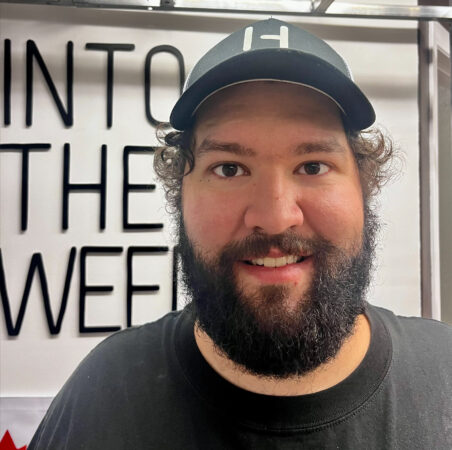
Brian Rusk, 2023 TGA winner, micro LP category. Photo: Into the Weeds
From Genevieve we learn patience and perseverance over the long haul. She exemplifies how to go with the flow while focusing on the task at hand, no matter the strength of the raging current. Brian teaches not to shy away from one’s instinct and to strike without hesitation when it comes to filling gaps and meeting needs. And from them both we see truth and dedication to ourselves and to our loved ones when being proactive about mental health and wellbeing, folded in with a positive, self-starting attitude that sets the dreamers apart from the achievers.
Advertisement
There is no doubt that 2023 has been an utter whirlwind for the Canadian cannabis industry.
Aside from the nuances that occurred spanning regulatory updates, international expansion, the integration of AI/new tech, and the development of new product offerings, perhaps some of the most important advances this year stemmed from the need for cannabis businesses tocontinue building trust through transparency and continued education.
Cannabis businesses engage with industry peers, shareholders and with the public through increased means of transparency proving efficacy of operations, services and products alike, with an uptick in third-party testing and intimate in-person events. Companies are also increasing proactivity using scientific study and research in the development of brand loyalty and team building. These and other triumphs instill a sense of optimism for 2024 and beyond.
In light of recent shifts at home and abroad, we at Grow Opportunity are also welcoming new columns and voices to the platform next year, including a regular column on international market trends, new voices in cultivation, as well as a higher altitude Drug Laws column penned by cannabis attorney Rob Laurie of Ad Lucem Law Corporation. Laurie’s writings will look to equip producers with insights into laws whose influences will assist business decisions through the decriminalization of certain substances occurring on a global level and an influx of controlled substances dealer’s licenses on home soil.
As the industry continues to expand and contract like the living organism that it is, we see innovation and strong interpersonal relationships at its core, which carries over into the theme we celebrate with this award. Put your hands together for Brian and Genevieve, our 2023 Top Grower winners.
Happy holidays from everyone at Grow Opportunity, and we’ll see you back here in 2024 with fresh perspectives on the growing opportunities in cannabis.
During a recent panel discussion at MJBizCon, industry insiders expressed hope for a positive shift in the status of marijuana under the Biden administration. The anticipation is that marijuana could be rescheduled, potentially reducing the burdensome taxes imposed on marijuana businesses by Section 280E of the federal tax code.
However, amid this optimism, the panel acknowledged the existing challenges in the industry and the necessity of taking calculated risks to unlock future benefits. An illustrative example is Virgil Grant, an industry veteran who, despite enduring a six-year federal prison sentence for operating a legally sanctioned medical cannabis business in California, remains undeterred in his commitment to the cannabis sector.
Grant, now the CEO of a California marijuana retail chain and cofounder of the California Minority Alliance and the Southern California Coalition, highlighted the ongoing challenges faced by the industry. Recently, his bank closed his account, creating significant obstacles for essential financial operations such as payroll and lease payments. Rather than succumbing to these challenges, Grant is actively advocating for the passage of the SAFER banking bill, emphasizing its potential to facilitate access to crucial services and capital. He also advocates for ending the imposition of Section 280E on marijuana companies, a sentiment shared by fellow industry stakeholders.
At MJBizCon, Grant shared the stage with other prominent figures, including Kim Rivers, CEO of Trulieve Cannabis, and David Mangone, director of policy at the National Cannabis Roundtable. These individuals participated in a session titled “Cannabis Industry Outlook: Trends, Obstacles, and Strategies to Survive,” which delved into the risks undertaken by industry players in the hope of long-term rewards.
For Rivers, the risks involve a substantial investment of $40 million in advocating for adult-use legalization in Florida and pursuing a $143 million tax redemption from the IRS for payments made between 2019 and 2021. Rivers clarified that Trulieve, unlike some companies, has chosen not to defer tax payments under 280E, emphasizing its commitment to paying taxes in full and on time.
Despite these financial risks, Rivers remains optimistic about the potential $150 million IRS refund. “We’ll let you know if any big checks come through,” he said. The overall theme of the session emphasized the resilience required to navigate the current challenges and uncertainties in the cannabis industry.
In the first presentation of the day, MJBizDaily editorial team members presented predictions for the coming year. These included the reclassification of marijuana from Schedule I to III and the possible elimination of Section 280E. Other predictions encompassed the unlikelihood of a takeover of the cannabis industry by major pharmaceutical firms, increased legalization of recreational cannabis in states such as Pennsylvania and Florida, growing interest from investors in the marijuana industry and the diminishing significance of marijuana in the 2024 presidential election due to bipartisan support for federal cannabis reform.
The expected easing of the tax burden on the marijuana industry in the United States would make it possible for industry actors such as Cresco Labs Inc. (CSE: CL) (OTCQX: CRLBF) to earn a decent profit from their operations, gaining the financial muscle to push ahead with bringing more innovative products to market.
About CNW420
CNW420 spotlights the latest developments in the rapidly evolving cannabis industry through the release of two informative articles each business day. Our concise, informative content serves as a gateway for investors interested in the legalized cannabis sector and provides updates on how regulatory developments may impact financial markets. Articles are released each business day at 4:20 a.m. and 4:20 p.m. Eastern – our tribute to the time synonymous with cannabis culture. If marijuana and the burgeoning industry surrounding it are on your radar, CNW420 is for you! Check back daily to stay up-to-date on the latest milestones in the fast -changing world of cannabis.
To receive SMS alerts from CNW, text CANNABIS to 888-902-4192 (U.S. Mobile Phones Only)
Please see full terms of use and disclaimers on the CannabisNewsWire website applicable to all content provided by CNW, wherever published or re-published: https://www.CannabisNewsWire.com/Disclaimer
The Police State Wants Us To Be a Nation of Snowflakes
By John & Nisha Whitehead
“This boy is Ignorance. This girl is Want. Beware them both, and all of their degree, but most of all beware this boy, for on his brow I see that written which is Doom, unless the writing be erased.”—Charles Dickens, A Christmas Carol
What a year.
It feels as if government Grinches and corporate Scrooges have been working overtime to drain every last drop of joy, kindness and liberty from the world.
After endless months of being mired in political gloom and doom, we could all use a little Christmas cheer right now.
Unfortunately, Christmas has become embattled in recent years, co-opted by rampant commercialism, straight-jacketed by political correctness, and denuded of so much of its loveliness, holiness and mystery.
Indeed, the season for giving has turned into the season for getting…and for getting offended.
To a nation of snowflakes, Christmas has become yet another trigger word.
When I was a child in the 1950s, the magic of Christmas was promoted in the schools. We sang Christmas carols in the classroom. There were cutouts of the Nativity scene on the bulletin board, along with the smiling, chubby face of Santa and Rudolph. We were all acutely aware that Christmas was magic.
Fast forward to the present day, and Christmas has become fodder for the politically correct culture wars.
One publishing company even re-issued their own redacted version of Clement Clarke Moore’s famous poem “Twas the night before Christmas” in order to be more health conscious: the company edited out Moore’s mention of Santa smoking a pipe (“The stump of a pipe he held tight in his teeth, / And the smoke, it encircled his head like a wreath.”)
In the politically correct quest to avoid causing offense, Christmas keeps getting axed.
Examples abound.
Schools across the country now avoid anything that alludes to the true meaning of Christmas such as angels, the baby Jesus, stables and shepherds.
In many of the nation’s schools, Christmas carols, Christmas trees, wreaths and candy canes have also been banned as part of the effort to avoid any reference to Christmas, Christ or God. One school even outlawed the colors red and green, saying they were Christmas colors and, thus, illegal.
Students asked to send seasonal cards to military troops have been told to make them “holiday cards” and instructed not to use the words “Merry Christmas” on their cards.
Many schools have redubbed their Christmas concerts as “winter holiday programs” and refer to Christmas as a “winter festival.” Some schools have cancelled holiday celebrations altogether to avoid offending those who do not celebrate the various holidays.
In New Jersey, one school district banned traditional Christmas songs such as “Joy to the World” and “Silent Night” from its holiday concerts. A New Jersey middle school cancelled a field trip to attend a performance of a play based on Charles Dickens’s “A Christmas Carol” because some might have found it “offensive.”
In Texas, a teacher in Texas who decorated her door with a scene from “A Charlie Brown Christmas,” including a scrawny tree and Linus, was forced to take it down lest students be offended or feel uncomfortable.
In Connecticut, teachers were instructed to change the wording of the classic poem “Twas the Night Before Christmas” to “Twas the Night Before a Holiday.”
In Virginia, a high school principal debated about whether he could mention Santa or distribute candy canes given that they were symbols of Christmas.
In Massachusetts, a fourth-grade class was asked to list 25 things that reminded them of Christmas. When one young student asked if she could include “Jesus,” her teacher replied that she could get fired if Christmas’ namesake appeared on the list.
Things have not been much better outside the schools, muddled by those who subscribe to the misguided notion that the Constitution requires that anything religious in nature be banned from public places.
In one West Virginia town, although the manger scene (one of 350 light exhibits in the town’s annual Festival of Lights) included shepherds, camels and a guiding star, the main attractions—Jesus, Mary and Joseph—were nowhere to be found due to concerns about the separation of church and state.
In Chicago, organizers of a German Christkindlmarket were informed that the public Christmas festival was no place for the Christmas story. Officials were concerned that clips of the film “The Nativity Story,” which were to be played at the festival, might cause offense.
In Delaware, a Girl Scout troop was prohibited from carrying signs reading “Merry Christmas” in their town’s annual holiday parade.
Clearly, Christmas has become one of many casualties in the misguided dispute over the so-called “separation of church and state,” a controversy that has given rise to a disconcerting and unconstitutional attempt to sanitize public places of any reference to God or religion.
Yet there’s a really simple solution to this annual angst of whether students and teachers can display Christmas-related posters, wear Christmas colors of red and green or sing Christmas songs, and that is for government officials to stop being such Humbugs and create a vibrant, open environment where all expression can flourish.
While the First Amendment prohibits the government from forcing religion on people or endorsing one particular religion over another, there is no legitimate legal reason why people should not be able to celebrate the season freely or wish each other a Merry Christmas or even mention the word Christmas.
After all, the First Amendment affirms the right to freedom for religion, not freedom from religion.
Hoping to clear up the legal misunderstanding over the do’s and don’ts of celebrating Christmas, The Rutherford Institute’s Constitutional Q&A on “Twelve Rules of Christmas” provides basic guidelines for lawfully celebrating Christmas in schools, workplaces and elsewhere.
Yet while Christmas may be the “trigger” for purging Christmas from public places, government forums and speech—except when it profits Corporate America—it is part and parcel of the greater trend in recent years to whittle away at free speech and trample the First Amendment underfoot.
Anything that might raise the specter of controversy is avoided at all costs.
We are witnessing the emergence of an unstated yet court-sanctioned right, one that makes no appearance in the Constitution and yet seems to trump the First Amendment at every turn: the right to not be offended.
In this way, emboldened by phrases such as “hate crimes,” “bullying,” “extremism” and “microaggressions,” free speech has been confined to carefully constructed “free speech zones,” criminalized when it skates too close to challenging the status quo, shamed when it butts up against politically correct ideals, and muzzled when it appears dangerous.
At the slightest hint of trouble, government officials (and corporations) are inclined to chuck anything that might be objectionable.
Yet when all is said and done, what the police state really wants is a nation of snowflakes, snitches and book burners: a legalistic, intolerant, elitist, squealing bystander nation willing to turn on each other and turn each other in for the slightest offense, while being incapable of presenting a united front against the threats posed by the government and its cabal of Constitution-destroying agencies and corporate partners.
You want to know why this country is in the state it’s in?
The answer is the same no matter what the problem might be, whether it’s the economy, government corruption, police brutality, endless wars, censorship, falling literacy rates, etc.: every one of these problems can be sourced back to the fact that “we the people” have stopped thinking for ourselves and relinquished responsibility for our lives and well-being to a government entity that sees us only as useful idiots.
The Greek philosopher Socrates believed in teaching people to think for themselves and in the free exchange of ideas. For his efforts, he was accused of corrupting the youth and was put to death. However, his legacy lived on in the Socratic method of teaching: posing questions that help young and old discover the answers by learning to think for themselves.
Now even the ability to think for oneself is in danger of extinction.
As Rod Serling, creator of the classic sci-fi series Twilight Zone and one of the most insightful commentators on human nature, once observed, “We’re developing a new citizenry. One that will be very selective about cereals and automobiles, but won’t be able to think.”
We face an immense threat in our society from this drive to obliterate our history and traditions in order to erect a saccharine view of reality. In the process, we are creating a schizophrenic world for our children to grow up in, and it is neither healthy nor will it produce the kind of people who will be able to face the challenges of a future ruled by a totalitarian regime.
As I make clear in my book Battlefield America: The War on the American People and in its fictional counterpart The Erik Blair Diaries, you can’t sanitize reality. You can’t scrub out of existence every unpleasant thought or idea. You can’t legislate tolerance. You can’t create enough safe spaces to avoid the ugliness that lurks in the hearts of men and women. You can’t fight ignorance with the weapons of a police state.
What you can do, however, is step up your game.
Opt for kindness over curtness, and civility over censorship. Choose peace over politics, and freedom over fascism. Find common ground with those whose politics or opinions or lifestyles may not jive with your own.
Do your part to make the world a little brighter and a little lighter, and maybe, just maybe, we’ll have a chance of digging our way out of this hole.
WC: 1732
Main Image: http://lumpygravy.deviantart.com/art/THE-BUDDY-CHRIST-28588410
In Minnesota, individuals aged 21 years and older are permitted to legally possess and use marijuana. However, despite being legal at the state level, marijuana remains prohibited under federal law. This legal nuance is particularly pertinent for immigrants who haven’t obtain U.S. citizenship, according to Julia Decker, the policy director at the Immigrant Law Center of Minnesota.
Decker emphasizes the federal control over cannabis, noting that engaging in any related activities or possessing marijuana could result in immigration consequences, potentially leading to deportation. This distinction holds regardless of one’s legal status, even if an individual possesses a green card or other lawful immigration documentation.
The complexity arises because, under Minnesota state law, an individual might possess a small quantity of cannabis for personal use without facing criminal charges. However, immigration applications often inquire about any uncharged or unconvicted criminal acts, complicating matters for applicants swearing under penalty of perjury or oath. Even in the absence of a criminal case, Decker warns of potential consequences.
Linus Chan, a clinical professor of law at the University of Minnesota Law School, points out the challenge attorneys face in navigating a system where the distinction between state and federal law isn’t always clear. He notes that people often overlook the difference between state and federal law when determining whether an act constitutes a crime. This lack of clarity extends to areas such as conviction expungements, where a state expungement may not carry weight at the federal level.
The federal immigration law, as Chan points out, provides no exceptions for medically prescribed cannabis or employment at a dispensary. Although a marijuana conviction doesn’t automatically hinder naturalization or trigger deportation, the risks are heightened for individuals lacking citizenship, according to both Chan and Decker.
Decker underscores the necessity of recognizing the arbitrary nature of legal distinctions, especially concerning marijuana laws. She suggests that, particularly in the context of citizens versus noncitizens, the disparities in legal standards can seem fundamentally unfair across various issues.
As cannabis legalization in Minnesota is still in its early stages, Decker recommends individuals navigating the immigration system seek advice from immigration lawyers. Meanwhile, legal experts closely monitor how these changes may impact the future citizenship prospects of Minnesota residents.
The shifting legal landscape prompts a proactive approach for immigrants, ensuring they comprehend the nuances and potential ramifications within the complex intersection of state, federal and immigration law.
These legal contradictions between federal and state law also create complexities for marijuana companies, such as Trulieve Cannabis Corp. (CSE: TRUL) (OTCQX: TCNNF), as they conduct their legitimate operations.
About CNW420
CNW420 spotlights the latest developments in the rapidly evolving cannabis industry through the release of two informative articles each business day. Our concise, informative content serves as a gateway for investors interested in the legalized cannabis sector and provides updates on how regulatory developments may impact financial markets. Articles are released each business day at 4:20 a.m. and 4:20 p.m. Eastern – our tribute to the time synonymous with cannabis culture. If marijuana and the burgeoning industry surrounding it are on your radar, CNW420 is for you! Check back daily to stay up-to-date on the latest milestones in the fast -changing world of cannabis.
To receive SMS alerts from CNW, text CANNABIS to 888-902-4192 (U.S. Mobile Phones Only)
Please see full terms of use and disclaimers on the CannabisNewsWire website applicable to all content provided by CNW, wherever published or re-published: https://www.CannabisNewsWire.com/Disclaimer










Recent Comments