ALBANY, N.Y. (AP) — New York could soon start to get more recreational marijuana dispensaries after a judge on Friday approved legal settlements to end lawsuits that halted the state’s legal cannabis licensing program.
The settlements lift a court order that has blocked the state from processing or issuing retail marijuana licenses since August. State officials said the agreement will allow more than 400 potential retailers to move forward with pending applications to open storefronts.
“With this settlement behind us, hundreds of new licenses can now move forward, new stores will open, and consumers can legally buy safer, legal, tested cannabis products from New York-based entrepreneurs and small businesses,” Gov. Kathy Hochul said in a statement.
The state’s legal market has been in shambles since sales began about a year ago. Bureaucratic problems and lawsuits have allowed only about two dozen legal dispensaries to open, as farmers sit on a glut of crops and black market shops fill the void.
Advertisement
Last summer, State Supreme Court Justice Kevin Bryant blocked the state from processing or issuing new permits after two lawsuits — one filed by a group of four military veterans and the other by a coalition that included large medical marijuana companies — challenged state rules that promised many of the first retail licenses to people with past drug convictions.
State cannabis regulators this week announced settlements in the cases, with Bryant formally approving the deals Friday.
The agreements grant provisional dispensary licenses to the military veterans and outlines a process where the state will work with the medical marijuana companies on their applications to ensure they can sell recreational cannabis at their stores at the end of the month.
A representative for the group of veterans did not immediately comment Friday. An attorney for the coalition of medical marijuana companies did not return an emailed request for comment.
We’ve got cold, dark days ahead, so it’s time to put our energy into adding some green to our indoor spaces. Our magazine and blog can guide you throughout your growing ventures, but there are also plenty of interesting books that will help you hone your gardening skills. In our list of 5 Cool Ways to Master the Art of Growing Indoors, we’ve compiled some of our favourite reads perfect for a lazy Sunday afternoon!
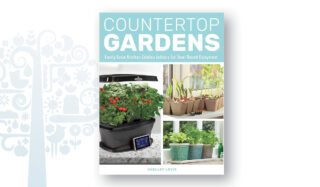
Countertop Gardens
You may worry you don’t have enough space or natural light to grow food indoors, but Shelley Levis aims to bust those myths! In her book Countertop Gardens: Easily Grow Kitchen Edibles Indoors for Year-Round Enjoyment, Levis covers all the basics to help those new to indoor growing get off to a good start. Whether you’re interested in hydroponics, aquaponics, or growing in good old-fashioned dirt, this book simplifies setting up an indoor garden in compact spaces (think kitchen counters, windowsills, and even pantries!). Get help creating the optimum environment for various food crops, from mushrooms and lettuce greens to tomatoes, peppers, onions, and herbs. Levis offers tips for selecting the perfect countertop growing devices and several DIY projects for less tech-savvy people who want to keep it simple. Once your garden is up and running, a troubleshooting chapter will help things run smoothly. This book is an excellent read for novice gardeners, opening the world of indoor growing to a whole new group of people.
Home Hydroponics
Have you ever dreamed of having a lift-top coffee table with an integrated deep water culture (DWC) hydroponic system? In his book, Home Hydroponics: Small-Space DIY Growing Systems, Tyler Baras shows us that building your own isn’t totally out of reach. Full disclosure: the hydroponic coffee table isn’t for beginner builders with small budgets, but Baras offers many DIY projects to suit all capabilities and price points, such as suction cup plants (low), salad bowl and bar cart gardens (low to moderate), lettuce lockers (high), and more. This book is perfect for growers of all experience levels. It shows many possibilities for small-scale hydroponic systems in the kitchen, dining and living rooms, bedroom, and bath. The DIY projects offer complete material lists and step-by-step guides to getting the job done. Baras also covers all the fundamentals you need to know about hydroponic growing, from lighting and nutrients to the maintenance and plants best suited for these systems. Two birds, one stone: this book will make you a better grower and builder!
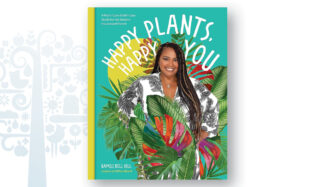
Happy Plants, Happy You
The benefits of gardening are plentiful, and in the dark days of winter, plants can help slow things down and boost your mood, among other things. In Happy Plants, Happy You: A Plant-Care & Self-Care Guide for the Modern Houseplant Parent, Kamili Bell Hill (@PlantBlerd) takes a unique approach to caring for houseplants. In addition to offering tips on plant selection and how to care for them, this book connects spending quality time in an indoor garden with self-care. Rather than mindlessly tending to houseplants, Bell Hill encourages us to take the opportunity to press pause and check in with ourselves as we go about watering, feeding, and pruning. She believes houseplants can teach many lessons on relationships and the importance of give and take. For example, much like getting rid of a dead leaf, sometimes the things bringing you down also have to go! This book is affordable therapy, helping readers choose beautiful plants and avoid toxic relationships with plants and people. Bell Hill will give you a list of tools you need for thriving houseplants and help you let go of the things in your life that aren’t working, whether the suffering cactus or something (or someone) else.
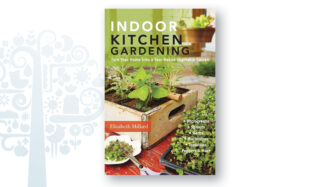
Kitchen Gardening
Have you ever considered building a tabletop mushroom farm? All you have to do is innoculate a log with some shiitake spawn, and away you go! In her book Indoor Kitchen Gardening: Turn Your Home Into a Year-Round Vegetable Garden, Elizabeth Millard proves that gardening isn’t an activity only reserved for the great outdoors! From mushrooms, sprouts, and microgreens to tomatoes, peppers, and more, Millard has plenty of growing advice for those striving to be more self-sustainable. Her book covers everything from seed to harvest and the things in between. Learn how to tackle problems that might arise in your grow and properly store homegrown goods. For good measure, Millard provides delicious and nutritious recipes to make with your harvest. With chapters devoted to individual crops, this book is easy to follow and helps you tailor your indoor growing venture to specific plants. A must-read for anyone looking to avoid the grocery store!
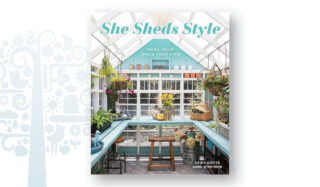
She Sheds Style
If you have a gardener mom, girlfriend, wife, or BFF who also loves to read, She Sheds Style: Make Your Space Your Own is the perfect addition to their library. Written by Erika Kotite, this book is spectacular from A to Z and offers readers a glimpse at the She Shed revolution. Learn how to build or turn an existing outbuilding into a gorgeous recluse from our fast-paced world. The She Shed can be a place for storing, growing, and potting plants. But why not make it multi-purpose and create space for snoozing, painting, reading or welcoming friends and family? With fantastic photos that inspire, this book brings a new meaning to indoor growing. It’s about making a peaceful and beautiful space for you and your plants to thrive! An excellent gift idea for a wonderful woman in your life, this book offers a dreamy escape from the cold winter days ahead.
All of the above books are published by Cool Springs Press. Check out quartoknows.com/Cool-Springs-Press for their incredible collection of gardening reads.
I first read these inspiring (and somewhat daunting) words in a now antique guide to indoor gardening. This well-thumbed, early growers’ manual sported a black and white photo of its author, his back characteristically turned towards the camera as he regarded his magnificent indoor garden. The vibe was that you could grow ‘anything’ you wanted indoors despite the weather outside.
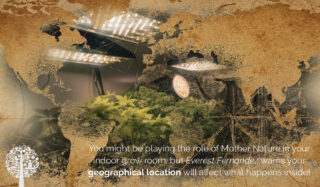
Since then, my idealistic notion of a discrete indoor garden has collided with the reality of running them in different parts of the world. I have erected grow tents and constructed grow rooms around the UK, USA, Canada, Portugal, and France. The primary thing I’ve learned during this time is that what can work for one indoor grower simply won’t cut it for another—and the fundamental differentiating factor is geography.
Unless you’re growing in a subterranean bunker hundreds of feet below the surface, your indoor growing environment will be inexorably subject to your geographical location. Think of the outside world as your indoor grow room’s ‘base climate’. It’s the foundation upon which you must build your indoor growing environment.
English Garden
As an indoor grower, I had it easy in Britain. For a nation that loves to discuss the weather, it’s pretty unremarkable. It seldom gets extremely hot or cold, and the humidity remains moderate throughout the year. As such, installing an air conditioner or dehumidifier never occurred to me. Instead, I just vented the hell out of my rooms with the biggest extraction fans my neighborhood was willing to collectively ignore and hoped for the best. The primary purpose of air exchange was to mitigate the inevitable increase in air temperature generated by old-school HPS and metal halide lamps.
Mercifully, I only ran small rooms. Air exchange was a three-for-one deal, though—exhausting the hot air from near the ceiling of my grow room and replacing it with cooler, fresh air drawn from an adjacent room also helped to regulate humidity and maintain atmospheric carbon dioxide levels.
O Canada
Things changed on Vancouver Island, BC. My grow rooms expanded in size, and the wattage of my lights increased from 600W to 1000W. The winters were much colder, and the summers much hotter (or was it that wooden buildings provided less insulation than the brick I was used to?). Also, I needed to tackle humidity head-on with a chunky dehumidifier (when it rains in a place for nine months straight, there’s little point trying to regulate humidity with air exchange alone). It wasn’t all bad news, though. Electricity was much cheaper than in the UK, and the tap water was so pure I thought my Bluelab EC truncheon was broken (it wasn’t—it’s still going strong to this day! I’d never known such pure water to come out of a tap)!
Growing in a French Wine Cellar
When I eventually settled in the south of France, near the Mediterranean coast, a whole new Dunning-Krueger rollercoaster ride began. The mild winters were very welcome. The hot summers were a bit of a shock, though—I’d never experienced heat above 110°F (43°C)! Fortunately, my grow room was safely ensconced in an old wine cellar carved into the rock 300 years earlier. The house above was constructed of stone walls over three feet wide at their base. I’d never known insulation like it. But now I have another problem—aridity! The cacti and succulents growing at the side of the road paid testimony to the fact that only specialist plants can survive year-round here. The dry air wreaked havoc on my seedlings, forcing them to over-transpire, leading to stress and nutrient toxicities like I’d never seen before. I countered this by switching to soilless potting mixes to control the available nutrition more carefully and conservatively.
Meanwhile, I invested in a humidifier and connected it to my reverse osmosis water purifier. The water coming off the Pyrenees was the hardest I’d ever encountered—pushing 0.7 mS or even 0.8 mS (350 – 400 PPM) out of the tap. First, I had to pass it through a water softener, then through RO. I then had to visit three grow stores before I found some Calmag for sale!
Being so well-insulated and having switched to LED grow lights by this time, I was amazed that I still had to heat my grow room in May! The increased air temperature meant that my nutrient solution also started to warm—so my final investment was an aquarium chiller (so much for energy efficiency). Ultimately, I decided to invest in side lighting to increase my daytime air temperatures as it pained me to run a heater in my grow room at 25°C outside.
Seal the Deal
I bit the bullet and sealed my grow room—something friends in BC had been encouraging me to do for years. By generating my own supplemental carbon dioxide and running a powerful dehumidifier, I could harness the heat produced by my lights rather than vent it away. It was also much easier to retain some of that transpired or generated humidity in my grow room—so crucial in those early vegetative days.
Lessons Learned
I’ve learned many lessons over the years. The first one is: never trust a generic ‘my way or the highway’ grow guide! Always take into account the author’s location. Also, if you plan to grow indoors year-round, you may need to change tack a little with the seasons. For example, NFT tanks work well in a cooler winter grow room, but in summer, you could be better off filling some pots with media and giving your roots extra insulation.
Finally, always consider the implications of the precise location of your grow. An attic indoor garden in the UK may suffer from bigger temperature extremes than a basement grow room in Spain. Don’t make choices that limit your wiggle room further down the line. If high air temperatures are a recurring issue and an AC unit is out of the question, you can still mitigate any attendant issues by using larger containers and soilless media (so you can dial down nutrient strength and provide roots with plenty of insulation).
Investing in a nutrient chiller is also highly recommended for growers in warmer climates. It’s incredible what the aerial parts of plants can tolerate if their roots are nice and chill!
New research has found that overdose prevention centers in New York City have not led to an increase in crime. This is despite concerns that the establishment of harm-reduction centers would cause crime to skyrocket. The new findings add to previous research that demonstrated the centers’ potential in decreasing overdose deaths.
Overdose-prevention centers allow individuals to use illegal substances in a supervised environment, helping reduce the risk of harms associated with drug use, such as a fatal overdose.
The study was carried out by researchers at Brown University, the University of Pennsylvania and the University of Connecticut. For their research, the investigators examined crime trends in NYC’s first government-sanctioned overdose prevention centers, which were launched two years ago. They then compared their findings to areas close to more than 15 syringe service programs that did not provide resources to prevent overdose.
The researchers also analyzed 311 and 911 calls, drug-possession arrests, public nuisances, law enforcement summons for criminal infractions and medical events. They observed no considerable increases in calls for emergency services or crimes recorded by law enforcement in neighborhoods where the prevention centers were located.
In addition, they recorded no statistically significant spike in either violent or property crime near these overdose prevention centers. This is despite a reduction in the number of drug-possession arrests made as the state continues to reprioritize law enforcement.
In their report, the researchers stated that statistically significant decreases in narcotics enforcement by the police around these centers was observed, adding that this was consistent with NYC’s commitment to ensuring that individuals could access the centers without any interference by the police. The researchers also noted that more studies were needed to establish that overdose-prevention centers wouldn’t be linked to localized increases in disorder and crime in the long-term.
At the moment, however, the findings strengthen arguments from harm-reduction advocates on the minimal risk associated with using overdose-prevention sites to help alleviate the risk of overdose deaths, as the opioid crisis rages on.
The research’s findings were published by the American Medical Association in “JAMA Public Health.”
A separate study published in 2022 determined that trained staff intervened in more than 100 overdose instances two months after the first overdose prevention center was launched in NYC. The staff are said to have alleviated risks of overdose by administering oxygen and naloxone as well as offering other services to prevent death. Naloxone is a medication that has been approved by the FDA to reverse an opioid overdose.
The positive role that overdose-prevention centers are playing, contrary to the views of detractors, may mirror the positive impact that marijuana companies such as SNDL Inc. (NASDAQ: SNDL) are having in spite of prohibitionists’ alarmist claims that legalizing cannabis does more harm than good to society.
About CNW420
CNW420 spotlights the latest developments in the rapidly evolving cannabis industry through the release of two informative articles each business day. Our concise, informative content serves as a gateway for investors interested in the legalized cannabis sector and provides updates on how regulatory developments may impact financial markets. Articles are released each business day at 4:20 a.m. and 4:20 p.m. Eastern – our tribute to the time synonymous with cannabis culture. If marijuana and the burgeoning industry surrounding it are on your radar, CNW420 is for you! Check back daily to stay up-to-date on the latest milestones in the fast -changing world of cannabis.
To receive SMS alerts from CNW, text CANNABIS to 888-902-4192 (U.S. Mobile Phones Only)
Please see full terms of use and disclaimers on the CannabisNewsWire website applicable to all content provided by CNW, wherever published or re-published: https://www.CannabisNewsWire.com/Disclaimer
Many of us are now realizing that this experience we call life, or what we know to be our life, is not an even playing field. It may take a person years to come to the realization that, in some way, the game of life is rigged. We always like to think that we know what’s going on, even when we have the niggling suspicion that we don’t. Life is a game of participation and players. And at various stages, a particular view, or perception, of life and reality is supported and promoted over and above any alternatives. And this chosen central narrative is made to seem reasonable to us, even when, upon closer examination, it is not.
Everything we are told may appear reasonable initially because it is modelled, or programmed, to fit a very specific reality model. If our perceptions of reality were to shift, just a little, then we would see (or rather, perceive) that these current patterns of thinking are completely skewed. Yet the main consensus narrative story – or reality model – that we adhere to keeps this skewed vision as a seemingly straight line. Most of the time we are unable to see, or we fail to see, the fundamental wrongness that lies at the heart of the main narrative. And this is the Inversion.
Of course, there have been people who from time to time attempted to point out these discrepancies. Many of them were ridiculed, persecuted, ostracized, or worse (and anything in-between). It would be fair to say that much of what passes for the mainstream dominant narrative – the human story – is an inversion. It can be said that the story we cling to is somehow topsy-turvy, or upside down. And from this topsy-turvy position it is very difficult to see things as they are, the right way up. The double disadvantage here is that the dreamer is not only dreaming within various levels but is also viewing the dream from the wrong side up. The act of dreaming is also inverted. Naturally, from this viewpoint it is hard to know what is right and wrong, or up or down. And it is very difficult to see the nature of this dreaming inversion precisely because it is propagated as ‘normality.’ We don’t know what we don’t know.
What we do know, however, is what we are told to know. And that is the nature of the dream conditioning. Further, the inverted bandwidth in which we tend to exist within is a tiny band of possibility. Anything beyond those restricted bands is categorized and marked as abnormal, or paranormal (meaning, beyond normal). What is in fact regarded as ‘normal’ is an extremely limiting range of the programmed story. And this normalcy is often then validated and generated by a person’s own internal narrative. When the line between the thought itself and what is doing the thinking is erased, or blurred, then we come to believe that we are our thoughts. The first step to be taken is to recognize, and accept, that our experience of life is itself part of a larger collective narrative as much as it is part of one’s individual story.
The larger collective story – that is, human history – is constructed from fragments that are collated and framed together. It is a mosaic that is attempting to be a whole, integrated picture. And yet, in order to fit the fragments together there are filters that function to place these pieces into a pre-arranged narrative. What is being put together by the grand notion of history is a work of fiction that is injected with enough fragments of facts to make the conditioned perspectives of the chroniclers seem plausible. Within this grand scheme of history lies the lesser groupings of cultural identities that bind us within further levels of the collective dreaming. The cultural story is yet another narrative fitted into the already narrow bandwidth of our perceptual dream story.
Human history has long been a history of the power of the collective story narrative to hold individual minds captive – or captivated. And from this has arisen the great deception – the Inversion of a lesser reality.
And so – what are you going to do about it … ?
DISCOUNT CODES:
IN THE UK: The code – INV20 – will give 20% off pre-orders until 31 October ordered direct from the publisher: https://spirit.aeonbooks.co.uk/product/inversion/95215
IN THE US: The code – INV20 – will give 20% off pre-orders until 30 October ordered direct from the publisher WITH FREE POSTAGE WITHIN US: https://spirit.aeonbooks.com/product/inversion/95215
“We are bleeding at the roots, because we are cut off from the earth and sun and stars, and love is a grinning mockery, because, poor blossom, we plucked it from its stem on the tree of Life and expected it to keep on blooming in our civilized vase on the table” ~D.H. Lawrence
The earth is a part of us. It’s not a commodity that belongs to us, it’s a sacred community to which we belong. Unfortunately, modern culture has become an abstraction of an abstraction that distracts us from union with the natural world. We’ve become twice removed from the sacred community to the extent that we don’t even know that we don’t know there’s a serious problem.
We’re overly domesticated, overly governed, and overly lawyered. Our hearts have become machines, there’s no feeling, no hunger, no soul. There’s only prescribed conditioning, unhealthy excess, and mealymouthed one-upmanship. Culture has become a tyrant.
And there’s only one solution to tyranny: fierce freedom, unapologetic freedom, no-holds barred freedom. The kind of freedom that upsets the settled, reconditions the conditioned, and upends all outdated apple carts. A freedom so ferocious that the Powers That Be piss in their privileged pantaloons.
When culture itself is the tyrant, heroism becomes an act of reconditioning cultural conditioning. The hero’s journey must become a quest to seek union with cosmos, to reunite Nature and the human soul, and to reawaken the God within. The hero must face the dragon of cultural conditioning with the courage to recondition it.
Here are three ways to get started on this most vital path: To stop bleeding at the roots, disconnected from the source, and start reclaiming our place as a healthy species in the interconnected cosmos.
1.) Seek solitude and meditation:
“Too much security becomes boredom, and boredom leads to a decline in vitality. Man has surrounded himself by walls and has built his narrow ‘human world’ as a center of security; but the security has begun to stifle him.” ~Colin Wilson
Freedom is not a given. It must be earned. It must be cultivated, practiced, and acted upon daily. The moment freedom is taken for granted is the moment it is lost.
In the crashing plane of an unfree world, a free human is someone who puts the oxygen mask on themselves first in order to be there for those who are incapable, or too ignorant, to become free.
The oxygen mask is meditation and solitude. The source is Nature, away from the things of man. The oxygen is sacred alignment with cosmos and the interconnectedness of all things. We must learn how to turn away from the grind before it grinds us into a pulp. We must learn to overcome the default setting.
We should seek solitude and meditation in the wild. We should bask in otherworldliness, wear eccentric masks, wield centering energy, connect the finite with the infinite, discover the difference between healthy and unhealthy, and then return and share our magic elixir with the “tribe.”
As Rumi said, “There is a voice that doesn’t use words. Listen.”
The most powerful way to hear the “voice that doesn’t use words” is through solitude and meditation. Beyond the banshee scream of culture, where No-mind is free to remind you that you are a force of nature first and a human being second.
Solitude is powerful because it separates us from the rat race and reveals interconnected beauty. We go from being a rat in a cage to a creature enthralled by its connection with Cosmos. We go from being a millstone in a daily grind to being a whetstone we can sharpen ourselves against. We go from being a cog in the clockwork to an alarm clock that awakens us to higher awareness.
In solitude, we can no longer pretend that we are asleep. In meditation, we can no longer pretend that everything isn’t connected to everything else.
Most members of the herd never taste solitude. They get caught up in the rat race, trapped in their cultural conditioning, stuck in religious indoctrination, imprisoned in political brainwashing. They lose sight of the underlying essence. They sacrifice their wildness for mildness. And when their life requires a little bite, they discover that they have no teeth.
Solitude rewilds the domesticated animal and teaches it how to regrow its teeth. In conservation biology the term “rewilding” is the rehabilitation process of captive animals. In the case of preventing ourselves from bleeding at the roots, the captive animal happens to be human.
Solitude and meditation is a way to plant ourselves in Infinity.
2.) Transform triviality into vitality:
“Death reveals to us that our lives have been one long miscalculation based on triviality.” ~Colin Wilson
Shed outdated skin. Cut the dead weight. Burn off the dross. Get ahead of the curve. Life is too short to waste precious energy on outdated concepts or living in regret. The past is the past. Forgive yourself and forgive your ancestors for their ignorance. It’s okay to move on.
As Joseph Campbell said, “We must be willing to get rid of the life we’ve planned, so as to have the life that is waiting for us. The old skin has to be shed before the new one can come. If we fix on the old, we get stuck. When we hang onto any form, we are in danger of putrefaction. Hell is life drying up.”
Don’t allow your life to dry up. Don’t allow your trivial ego and base pride to soak up all your vitality. You are the tip of the spear of human evolution. What came before you may have made you, but it doesn’t own you. It’s your responsibility alone to break free.
It is the trivial that has plucked you from the source. The trivial is anything that prevents you from connecting with everything else. It’s anything that distracts you from the soul. It’s anything that prevents you from becoming one with all things.
The best way to transform triviality into vitality is through healthy nonattachment.
Healthy nonattachment is a way to transcend egocentric codependence through soulcentric interdependence. It teaches you how not to take yourself or your ideas too seriously. You see how everything is transitory. All things are fleeting. The be-all-end-all is always beginning and always ending. The wisdom of nonattachment is the ability to remain connected to everything else with neither pride nor ego messing up the works.
It takes courage to choose a flexible disposition over a rigid expectation. It takes courage to choose humility over pride. It takes courage to choose uncomfortable nonattachment over comfortable attachment.
Learn from your mistakes and the mistakes of others, lick your wounds, quiet your ego, and transform triviality into vitality. Stand on the shoulders of giants in order to see further and farther than they ever could. Capitalize on the ignorance of our species’ past. Rise up as a shining example of how to be a healthy human being despite an unhealthy world.
3.) Make a virtue of your peculiarities:
“There’s a point, around the age of twenty, when you have to choose whether to be like everybody else the rest of your life, or to make a virtue of your peculiarities.” ~Ursula K. Le Guin
The keyword here is virtue. Preventing our roots from bleeding out hinges on eight core virtues: courage, curiosity, temperance, humility, liberty, honor, wisdom, and humor. These virtues are vital rungs on the ladder toward achieving wholeness in character and fulfilling our life’s purpose. They lead to moral virtue, which is best encapsulated by the concept of arete. And arete cultivated over a lifetime can lead to eudaimonia: human flourishing.
This kind of character creates an antifragile spirit despite an otherwise fragile culture. With a character such as this, we can stand tall, strong, sincere, and fierce. We become a force of nature to be reckoned with. A dynamo amidst dominoes. A lion amongst men.
With the sharpness of our mettle, we’re able to cut through all golden calves, superficial hierarchies, and delusions of grandeur.
The only sin is unfulfilled potential. It is the darkest place we can sink. It’s the only thing worthy of fear. The only true failure is to abdicate the responsibility of fulfilling our potential. So, we abdicate to no one. No authority. No state. No God. Not even Death.
As Oscar Wilde truly said, “Disobedience was man’s original virtue.”
Instead, we go all-in on our peculiarities. We double down on our uniqueness. We individuate our individuality.
True value is emboldened uniqueness. Everything else is moonshine. Everything else is pretend forgiveness. Everything else is a false virtue. Everything else is faux medicine. Emboldened uniqueness is our potential. It’s our deepest longing to create and express our own values. This uniqueness is our life’s purpose, our soul signature.
True power comes from emboldening what makes us different. We should assert this uniqueness, even if that offends some people along the way. Sometimes what makes us different may not be agreeable to others. Oh well. As long as we are being authentic. As long as we are being genuine, sincere, and real, we should let our freak flag fly, let our Shadow shine, let our art have some shock value. Party-poopers be damned!
Should our medicines clash, so be it. We can learn from the collision. We can glean greater medicine compounded from the confrontation. Iron sharpens iron. Diamond sharpens diamond.
As Epictetus said, “Don’t explain your philosophy. Embody it.”
Image source: Elk Deity by Graham Yarrington
About the Author:
Gary Z McGee, a former Navy Intelligence Specialist turned philosopher, is the author of Birthday Suit of God and The Looking Glass Man. His works are inspired by the great philosophers of the ages and his wide-awake view of the modern world.
This article (How to Stop Bleeding at The Roots) was originally created and published by Self-inflicted Philosophy and is printed here under a Creative Commons license with attribution to Gary Z McGee and self-inflictedphilosophy.com. It may be re-posted freely with proper attribution, author bio, and this statement of copyright.












Recent Comments