A few of the world’s greatest thinkers refuted the common notion of ancient primitivism. They understood that prehistoric man was not the bestial creature beloved of historians and history books.
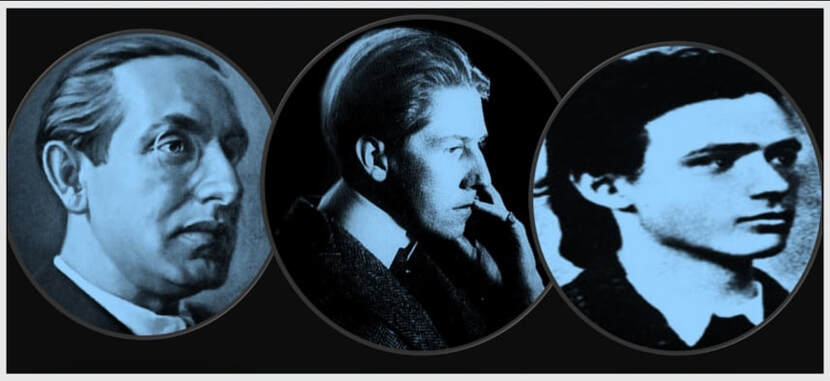
Social critics such as William Blake, Julius Evola, Schwaller de Lubicz, Rudolf Steiner, Helena Blavatsky, and others, seriously doubted the historical record, pointing to structures such as the Great Pyramid in Egypt as evidence of high prehistoric civilizations. Given that structures of similar majesty exist the world over – and that there is no record of the antecedent stages of development essential for them – we are right and rational to doubt inadequate conventional attitudes about the past.
Schwaller set out to solve the riddle. The outcome was his masterwork, The Temple of Man (1957), demonstrating that the Luxor temple is of immense geometrical complexity, and that it is a symbolic representation of a man – a kind of gigantic hieroglyph…One of Schwaller’s main insights was that the temple also contains many examples of the geometrical proportion known as the ‘Golden Section’ (and called by the Greek letter phi)…and it also plays a central part in the precise location of sacred sites – Colin Wilson (The Atlantis Blueprint)
…the Great Pyramid revealed an extraordinary knowledge of mathematics and geography. Its four sides are aligned exactly to the four points of the compass, and its site is exactly 30 degrees north of the equator – precisely one-third of the distance from the equator to the pole. Evidence that the Egyptians knew the length of the equator and its distance from the poles and that the Pyramid itself is intended to represent half of the earth, from the equator to the North pole, indicates that the Egyptians of 2,500 BC had knowledge of worldwide geography – ibid
Most people simply accept official accounts of humanity’s past without question. If it’s in the history books and encyclopedias, and if most archaeologists and anthropologists teach it, why should I think differently and rock the boat?
It takes a while to realize that the “experts” have it all wrong, from top to bottom, and have many subversive reasons for propagating historical disinformation. It doesn’t take much for the average accredited scholar to fall in line with his peers and stick to the favored narrative. In fact, he’s is royally compensated for doing so. He doesn’t want to be penalized, spurned and impoverished by the system for speaking out against mainstream narratives.
The good news is that certain men and women have spoken out, and were not intimidated by the corrupt academic system. Men such as L. A. Waddell, Comyns Beaumont, John Allegro and Barry Fell were outspokenly critical of the official record, particularly in terms of religion. Their ideas on the origins of Judaism and Christianity, etc, were highly controversial, fascinating and revolutionary. Their ideas are still academically taboo.
What must happen is for each person to ask themselves why we are inclined to believe that men of prehistory were primitive. Does it make any sense at all to believe it? What if the opposite is true? After all didn’t Plato himself hold that many ancient civilizations had existed before his time, and that they were sophisticated and advanced?
There have been a thousand holocausts, which have occurred in a thousand ways and will recur, both by fire and by water and by many other means – (Priests of Egypt to Solon, father of Plato)
It’s wrong to expect the whole world to radically change its view of antiquity, no matter how many spunky revisionists appear from time to time. Whereas in previous years dissenting voices were summarily silenced, it’s no longer as easy to quell dissent.
Also as more archeological sites are excavated, findings continue to vex experts and contradict the official narrative. The cat was set among the pigeons in the 1940s after the discovery of the Dead Sea Scrolls and Nag Hammadi Library. The clutch of biblical experts in charge of their collation and decipherment had the devil of a time keeping the lid on the controversial material, even though their campaign of deception persisted for over forty years.
A few years ago a massively funded National Geographic exploration of the underwater shelves and coastlines of Britain and Ireland confirmed once and for all the theory of catastrophism not uniformitarianism, the official paradigm. Why has this monumental discovery had zero effect in schools and colleges where kids are still taught falsities about the earth?
Despite widespread academic chicanery, it’s imperative that we become familiar with the controversial theories of eminent independent scholars such as L. A. Waddell, John Allegro, Barry Fell, Thomas L. Thompson, Niels Peter Lemche, Michael Cremo, Charles Hapgood, and others of their sort. A great deal depends on it.
But the question remains, what kind of men were the ancients? Were they rude and bestial? Were they chronically insecure and fearful? Did they cower when thunder shook the skies? Did they think lightning was caused by the wrath of the gods? Did they think of floods, disease and enemies as responses to their disobedience toward the gods? A reading of the Hebrew Bible certainly gives that impression.
On the condition of early man, historian Mircea Eliade tells us:
It is from this original and originating experience – feeling oneself “thrown” into the middle of an apparently limitless, unknown and threatening extension – the different methods of orientation are developed; for it is impossible to survive for any length of time in the vertigo brought on by disorientation – (A History of Religious Ideas, Vol. 1)
Eliade addresses the common notion that early man lived in sheer terror of existence, but fails to question where we get this unfalsifiable idea. Might not a psychologist say it’s a case of projection? Is it not a case of temporal fallacy and modern bias, by which we arrogantly and falsely construe the character and lifestyle of the ancients?
After all, what does it signify if indeed our forebears were riddled with fear about life? What does it tell us about their consciousness? And, more importantly, what evidence is there to refute this outlook? Might not it have been a simple case of rational fear in the face of objective threats to their safety, as we experience today?
Apologists for the official view remind us that there was a lot to be fearful about in ancient times, and we’re not just talking bad weather. The constant threat of fearsome wild animals prevented feelings of security for early tribespeople. Threat of attack by all sorts of predators preoccupied them, and a great deal of time was spent being on guard against it, especially during the night. There were no romantic strolls through the forests for these folks.
The reality of daily combat with deadly animals led to all sorts of rites and customs in which animal-spirits were placated and venerated. Tribal chiefs more a lion’s tail as part of their kingly regalia and hung leopard pelts over their doors to signify status. Pharaohs made a point of displaying personal prowess through ritualistic lion hunts, and many a shaman took to wearing skins and horns to display their “animal” knowledge, connection with nature and conquest over the so-called spirit world.
So yes, there was a lot to fear. No one doubts that. But what we blithely refer to as “fear,” could also be more correctly described as awe, wonder and reverence. I suppose we haven’t bothered considering the difference between “reverent fear” and other cruder forms and instances of the emotion.
In any case, we cannot discount the fact that ancient man was in many ways more rational and sophisticated than moderns generally accept. Again, we need only cite the existence of the Great Pyramid. Where did it come from? Who erected it and how?
One doesn’t need to look far to find convincing evidence of prehistoric superiority. Skeptics simply cannot account for the mathematical and geometric sophistication of the earth’s many cyclopean structures. Who erected them, and how and why were they built? Each structure’s existence challenges and dismisses the arguments of hardline skeptics unwilling to grant the ancients any kind of prowess.
Christopher P. Dunn, the British toolmaker and engineer already mentioned, has examined the Great Pyramid from the engineering point of view. His study led him to conclude…that the Egyptian pyramids and temples ‘reveal glimpses of a civilization that was technically more advanced than is generally believed’ – Colin Wilson
Schwaller de Lubicz had argued in his “Sacred Science,” that it seemed to prove that the ancient Egyptians knew about the precession of the equinoxes in the Age of Taurus, more than 6,000 years ago – ibid
Clearly, early man’s fear didn’t prevent him excelling in cyclopean architecture and being a mathematical genius.
Structures such as the Great Pyramid, Stonehenge and Avebury, etc, ensure that we never wholly accept the contemptuously limited view about prehistoric man and his abilities. There’s obviously more to it. A monkey may at some point learn how to use a tool, but isn’t likely to learn how to make one from scratch, not on any sophisticated level.
If a man decides to erect a massive pyramid with 2.5 million blocks of stone – which no modern crane can budge – he’s obviously not doing it for mere decorative purposes. He may, in fact, be honoring his race or ancestors. He may be intent on preserving the memory of a great king, or may be venerating a deity. Guess what? He may even be showcasing an idea. What does that do for our low assessment of his character and consciousness?
Again, if ancient man created complex symbolic languages – barely decipherable by modern experts – he must have done so for a reason.
In other words, although it is clear that ancient man feared certain phenomena, he did so rationally. This is because his understanding of reality was also rational. Which means he was a rational being. If it were otherwise, we’d not have the incomparably brilliant philosophies of Lao Tzu, Heraclitus, Democritus, Plato and Aristotle, etc.
In fact, even before the Athenian sages, we have the wisdom of the Egyptians, Babylonians and Persians. Where did it come from? Why did ancient man develop technical skill and philosophical insight, and was he nothing more than a brutish “primitive” before doing so?
Clearly, our assessments are mostly based on non-objective criteria. We judge early man based on modern achievement. However, as several thinkers have shown, it’s not a particularly strong position, given that we aren’t as advanced as we stubbornly and arrogantly believe.
I would sooner take instruction from the builders of the temple of Luxor, than from the creators of napalm – John Anthony West
A few scholars hold that all the physical and intellectual marvels of early man were relatively minor compared to what existed before their time. They came to this conclusion because it’s what most indigenous tribes themselves believe and claim.
Spokesmen from many tribes repeatedly tell of ancient civilizations of great eminence. Instead of “great men theory,” they have “great races theory,” insisting that the noblest people existed in a period known as the “golden age.” It was these beings who were truly “civilized.”
Prominent Vedic scholars and Brahmin priests in India have expounded the same ideas for centuries. For instance, in the ancient Puranas we read the following:
All kings occupying the earth in the Kali Age will be wanting in tranquility, strong in anger, taking pleasure at all times in lying and dishonesty, inflicting death on women, children and cows, prone to take the paltry possessions of others, with character that is mostly tamas, rising to power and soon falling. They will be short-lived, ambitious, of little virtue and greedy. People will follow the customs of others and be adulterated with them; peculiar, undisciplined barbarians will be vigorously supported by rulers. Because they go on living with perversion, they will be ruined. And Dharma becomes very weak in the Kali age, and people commit sin in mind, speech, and actions…Quarrels, plague, fatal diseases, famines, drought, and calamities appear. Testimonies and proofs have no certainty. There is no criterion left when the Kali age settles down. People become poorer in vigor and luster. They are wicked, full of anger, sinful, false, and avaricious. Bad ambitions, bad education, bad dealings, and bad earnings excite fear. The whole batch becomes greedy and untruthful. Many sudras (low castes) will become kings, and many heretics will be seen…There will arise various sects; sannyasins (holy men) wearing clothes colored red. Many profess to have supreme knowledge because, thereby, they will easily earn their livelihood. In the Kali age, there will be many false religionists. India will become desolate by repeated calamities, short lives, and various diseases. Everyone will be miserable owing to the dominance of vice and Tamoguna; people will freely commit abortion…Earth will be valued only for her mineral treasures. Money alone will confer nobility. Power will be the sole definition of virtue. Pleasure will be the only reason for marriage. Lust will be the only reason for womanhood. Falsehood will win out in disputes. Being dry of water will be the only definition of land. Praise worthiness will be measured by accumulated wealth. Impropriety will be considered good conduct, and only feebleness will be the reason for unemployment. Boldness and arrogance will be equivalent to scholarship. Only those without wealth will show honesty. Just a bath will amount to purification, and charity will be the only virtue. Abduction will be marriage. Simply to be well dressed will signify propriety…And any hard-to-reach water will be deemed a pilgrimage site. The pretense of greatness will be the proof of it, and powerful men with many severe faults will rule over all the classes on earth. Oppressed by their excessively greedy rulers, people will hide in valleys between mountains, where they will gather honey, vegetables, roots, fruits, birds, flowers and so forth. Suffering from cold, wind, heat and rain, they will put on clothes made of tree bark and leaves. And no one will live as long as twenty-three years…Thus in the Kali Age humankind will be utterly destroyed.
– (Translation from Sanskrit by Cornelia Dimmit)
In the extraordinary Kalki Prophecy of ancient India, the present age is known as the “Age of Filth.” Ancient Vedic texts refer to it as the blackened “Kal Age” of iron and tears, a time of moral inversion, hedonism and utter corruption.
From early Irish mythology, we read:
I shall not see a world,
Which will be dear to me:
Summer without blossoms,
Cattle will be without milk,
Women without modesty,
Men without valor.
Conquests without a king,
Woods without mast,
Sea without produce.
False judgements of old men,
False precedents of lawyers,
Every man a betrayer,
Every son a raider.
The son will go to the bed of his father,
The father will go to the bed of his son.
Each his brother’s brother-in-law.
He will not seek any woman outside his house.
An evil time.
Son will deceive his father,
Daughter will deceive.
– The Morrigu’s Prophecy
A very early Irish lamentation, dating from before the arrival of the Celts and Gaels, reads:
Then she added a prophecy in which she foretold the approaching end of the divine age, and the beginning of a new one in which summers would be flowerless and cows milkless and women shameless and men strengthless, in which there would be trees without fruit and seas without fish, when old men would give false judgments and legislators make unjust laws, when warriors would betray one another, and men would be thieves, and there would be no more virtue left in the world.
– Prophecy of Queen Badb (Bave)
Similar refrains are found in the Norse Edda and Voluspa, and in Finnish texts. For example, the Norse concept of Ragnarok, the “decline of the gods,” has destruction and apocalypse as central themes. In the Voluspa we read:
Brothers will fight and kill each other,
Sisters’ children will defile kinship.
It is harsh in the world,
Whoredom is rife.
An axe age, a sword age,
Shields are riven.
A wind age, a wolf age,
Before the world goes headlong.
No man will have mercy on another.
Mircea Eliade tells us:
…in the last period of paganism the Germans were extremely concerned with eschatology. The end of the world was made an integral part of their cosmogony – (History of Religious Ideas, Vol. 2)
The most complete and dramatic description is supplied by the poem Voluspa…The well-known cliches of all apocalyptic literature make their appearance: morality declines and disappears, men kill one another, the earth trembles, the sun grows dark, the stars fall; freed from their chains, the monsters descend on the earth; the Great Snake emerges from the Ocean, bringing on catastrophic inundations…finally the whole earth is swallowed by the Ocean, and the sky crumbles – ibid
Prophecies of the Cherokee and Apache Indians specifically reference the degeneration of humankind and apocalypse that inevitably destroys future civilizations. Given these dire refrains and predictions, we see why certain later thinkers were not eager to laud the modern world.
Julius Evola, Schwaller de Lubicz and Rudolf Steiner were among those original thinkers who did not accept that our ancient forebears were fear-ridden primitives.
Man is perfect at his origin, a divine being who has degenerated into what we are – Schwaller de Lubicz
Skeptics usually explain the golden age theory away. As far as they are concerned it’s a matter of magical or animistic thinking, without credibility or substance. Others reduce it to a case of envy on the part of backward tribespeople in the face of overwhelming modern progress and plenty. For them the mentality is: Sure, you whites are full of yourselves and boastful about your achievements, but in ancient times our forefathers were way ahead of you.
The problem with this dismissal is that white races also speak of prehistoric marvels. Nordic and Finnish texts and folklore allude to primordial high civilizations, even speaking of a so-called “Arctic Homeland” (Ultima Thule) referred to by the ancient Greeks as Hyperborea – the extreme northern paradise.
Some skeptics conceive of it as an epiphenomenon of one’s personal craving to return to the womb. However, since this is physically impossible, the human mind conjures the phantasmagoria of a “surrogate womb,” which can or will be accessed. This takes the form of a utopian future civilization, thought to be a reproduction of a vastly ancient golden age of the gods, when peace and harmony reigned supreme. Even the Platonists held that the earlier the epoch, the more sophisticated and tranquil the civilization. It’s an intriguing theory.
In any case, those tribes preserving details of a prehistoric paradisal age regard themselves as lesser in terms of intellect and creativity, viewing their own cultures as relatively inferior to those of bygone epochs. Despite modern marvels, members of these tribes refuse to change their attitude about this, maintaining that today’s human being is an inferior specimen to that which existed in the idyllic past. This premise has been taken seriously by a few open-minded scholars.
Helena Blavatsky (1831-1891) was a Russian mystic who developed a convoluted but intriguing theory about the devolution of spirit. In her opinion modern races are descended from at least seven “root races.” (Here for more…)
One of these open-minded scholars was the eminent Scottish engineer Alexander Thom (1894-1985). Working from within the “system,” he discovered evidence that ran contrary to officially held ideas about the construction of ancient megalithic sites. The skills used in their construction were extremely advanced and their measurements uncannily precise.
Prof. Thom discovered that many perfectly placed stones aligned with constellations, stars and luminaries, and that the mathematics employed in the various stone circles was more precise and perfect in Britain and Ireland. The standard of measure got less and less accurate as one moved eastward across Europe.
Crucially, Prof. Thom noted that since the stone circles and other sites in the west were of an earlier date than those in the east, the art and science of megalithic construction must have began in the west and later moved to the east, transported by those with less time, skill and care. He speculated that the font of mathematical prowess was in the prehistoric west, and offered substantial proof to back his controversial theory. Of course, he and his astonishing findings were summarily ignored.
It follows that when marvelously accurate structures are found in eastern lands – such as the Great Pyramid and Baalbek Stone – it is quite logical to suppose they were built by the apprentices of globe-trotting sages from the west, known universally as the Arya. Sadly, this proposition is still unacceptable to most academics, compromising the lies they’ve swallowed for so long.
It is remarkable that 1000 years before the earliest mathematicians of classical Greece, people in these islands (the British Isles) not only had a practical knowledge of geometry and were capable of setting out elaborate geometrical designs but could also set out ellipses based on Pythagorean triangles – Prof. Alexander Thom (Megalithic Sites in Britain, 1968)
The builders of the Stone Age monuments of the British Isles used a unit of length that was defined to one ten-thousandth of a millimeter. That unit is fundamental to the Sun, Moon and Earth – Butler & Knight (Civilization One)
Was there a super-advanced culture in prehistory? If not, how can it be that the supposedly unsophisticated people of Stone Age Britain possessed a fully-integrated system of measurement based on a deep understanding of the solar system? – ibid
This west to east migration of the elements of civilization – particularly in regards mathematics, astronomy and megalithic construction – has been completely verified by the research of Ralph Ellis.
Recently, engineer Scott Onstott has categorically proven that many columns, obelisks, statues, cathedrals, and civic buildings throughout the world – dating to relatively recent times – have been purposely aligned not only to heavenly bodies, but one to another. The elaborate geometrical networks he has discovered are based on dimensions and numbers considered sacred by the ancients.
The writers John Michell, Gerald Hawkins, Henry Lincoln, David Wood, Alan Butler, William Dafoe, Stephen Knight, Ralph Ellis, and others, have analyzed man-made structures all over the world which are likewise aligned to each other or to planets, stars, sunrises, sunsets, lunar phases, eclipses and so on. Since mathematical skills of this highly advanced kind must have developed over long expanses of time, we are forced to realize that early man’s capabilities long preceded the evidence we see in stone. The starting point of this vast process can’t even be guessed.
…prehistoric man already behaved in the manner of a being endowed with intelligence and imagination – Mircea Eliade
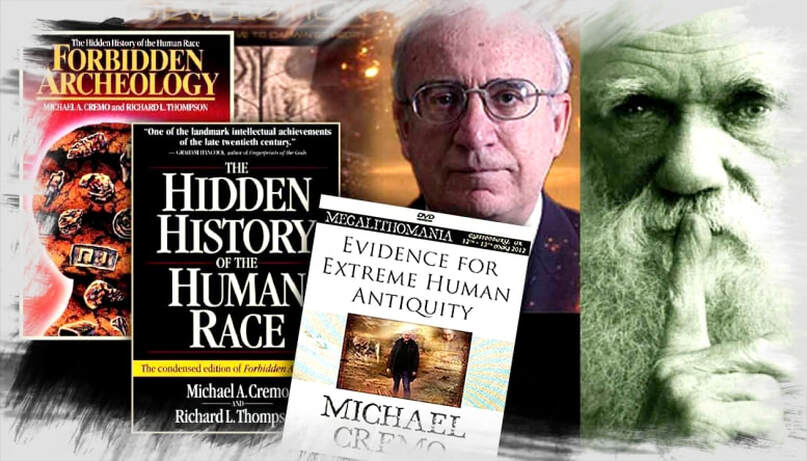
Anthropologist Michael Cremo raises the important question of human devolution in his books and talks. He has also found evidence of sophisticated human civilizations dating back millions of years. (Here for more…)
So is it all simply a matter of infantile thinking and wish-fulfillment? Most believe so, and most intellectuals – who on the surface accept the complexity of structures such as the Great Pyramid and Baalbek Stone, etc – give the matter little thought. We conclude that it is their fear we’re dealing with.
Their thinking runs along these lines: Just as a fanciful girl may daydream about her “true” parents being royalty, soon to return and claim her, so too can a whole tribe or society fancifully feel that their ancestors were veritable gods.
Of course, the problem with these rationalizations is that they can all be wrong. Blake, Steiner, Blavatsky, de Lubicz, d’Olivet, Evola, Spengler, Tilak, Donnelly, and others, might be right. After all, might not spiritual declination precipitate historical decline? Might not a spiritual sleep have fallen upon us, preventing us recognizing our previous majesty?
Why could the soul not have devolved from higher to lower states? Under the technological facade, are we moderns really that advanced? Many may not be inclined to agree. And what if it is finally proven that our ancestors were more sophisticated and skillful than us? What will that do for our image of ourselves and our future potential?
However, even without all the highfalutin theories about the preeminence of the ancients, we need only ask ourselves whether our current relationship with nature and animals is wholesome and just. For all our technical capability, are our grotesque cities and institutions conducive to life?
Maybe it is by way of massive acts of dissociation and self-deception that we fix a temporal divide between ourselves and the ancients. Maybe the belief in superior ancestors isn’t due to infantile hankering, but to a deeper rational need to reclaim the past in a healthy way. Maybe it’s the result of our subconscious recognition that something is lost to us, something mighty and wondrous, and perhaps this longing is spiritual in nature, as Blake and Blavatsky believed. For all our technical prowess and expertize in so many fields, we know inwardly that we’re fatally emotionally and spiritually impoverished.
Take herbalism for example. We find that the ancients – be they Celts, Tibetans or Native American Indians – were exceptionally knowledgeable in this field. Their proficiency with medicinal plants had to be the result of the meticulous observation and testing of nature over millennia.
Take physical health and the weakness of our immune system for example. Why all the illnesses, diseases and infirmities? Why so many constitutional ailments, disturbances, pathogens and cancers? Is it all a sign of a weakened degenerated soul?
Is the dreadful phenomenon of human devolution revealed by humankind’s immunal weakness and susceptibility to numerous illnesses?
Take astronomy as another example. As the eminent astronomer Jean Sylvain Bailly discovered, some enormously lengthy astronomical cycles, known to the ancients and recorded by them, can only be seen and measured from lands on the forty fifth latitude of the earth. This in turn means that a single homogeneous community of expert stargazers had to occupy a specific region in Europe or the Near East for at least 100,000 years.
We’re talking a school of astronomers whose data on the movement of the stars was meticulously preserved from time immemorial. Given that it takes millennia to slowly develop this level of sophistication, we see that thousands of years elapsed before history acknowledged the existence of such a community.
This strongly corroborates the statements of numerous native societies insisting that the ancients were godlike beings possessed of vast knowledge.
Toward the close of the eighteenth century the celebrated astronomer, Bailly, published a work entitled “The History of Ancient Astronomy,” in which he endeavored to prove that a nation possessed of profound wisdom and great genius, and of an antiquity far superior to the Hindus or Egyptians, “inhabited the country to the north of India, or about fifty degrees north latitude.” This writer has shown that “the most celebrated astronomical observations and inventions, from their peculiar character, could have taken place only in these latitudes” – Godfrey Higgins (Celtic Druids)
But this is not the only anomaly upsetting the apple-cart. Add to it the existence in Peru of the Nazca Lines, visible only from the air. Add the extraordinary vases of feldspar and quartz which simply could not be shaped and hollowed out without unbelievably sharp tools and immense heat. What about the antiquity of hieroglyphics and alphabets, and the numerous weighty sarcophagi in Egypt and Malta that cannot be reproduced today. Top engineers can’t explain how they were carved out, or what kind of tools were used.
The Baalbek Stone and others found in the Great Pyramid cannot be lifted by any modern crane. The huge slabs of red granite under the Sphinx were brought to the Giza Plateau from hundreds of miles away. No one can explain how they were cut, transported and laid in place. And what of the evidence in Egypt of iron smelting at temperatures exceeding 1,000 degrees Celsius? What of the complex mining operations in Africa known to have gone on 100,000 years ago? What about the cave art from 90,000 years ago, so beautifully and precisely drawn as to be still be discernible and evocative today? What about the tools found in Ethiopia, dating to 175,000 years ago? What about the mortar found between blocks in ancient temples, dating back 200,000 years? What about the ocher found in temple paintings dating back 300,000 years? What about the antiquity and astronomical precision of the Mayan Tzolkin calendar? What of the atomic theories expounded in the Vedas, thought to date back to at least 2,000 years BC? And what about the piece of woven cloth found inside a nugget of amber dating back 25 million years? On and on go the examples.
…the “First Time” constitutes the Golden Age of absolute perfection, “before anger, or noise, or conflict, or disorder made their appearance.” Neither death nor disease were known during this marvelous period, called “the time of Ra.” At a certain moment, as a result of the intrusion of evil, disorder appeared, putting an end to the Golden Age – Mircea Eliade
Central to all magical techniques was the invocation of the First Time. By the First Time the Egyptians meant the nontemporal realm in which archetypal events enacted by the gods take place – Jeremy Naydler (Temple of the Cosmos)
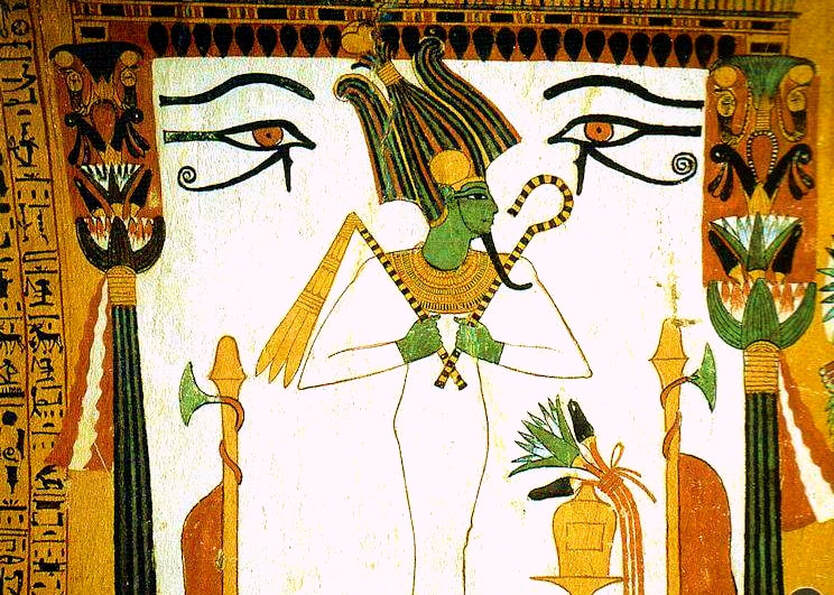
Speaking of antiquity, it is possible that certain mythical deities – Cernunnos, Osiris, Ptah, Gilgamesh, Hephaestus, Hermes, Dionysus, Prometheus, etc – represent the ancient past and painstaking accumulation of a race’s skill and wisdom. Certain holy and exalted ones may typify the “godlike” abilities of the ancients, personifying the lost state of consciousness from which later humanity descended. They may represent mysterious beings or archons who transmitted “divine” powers to humanity
…no idea is as absurd as the idea of progress – Julius Evola
Evola believed that humanity is not the result of the “ascent of man” from mammals, but of a separate origin better called a “descent”…and the summit from which humanity has degenerated…was destroyed in a catastrophe, probably due to a change in the inclination of the earth’s axis – Jocelyn Godwin
Devolution theorists are of the opinion that the scientific skill evident in today’s world is but a remnant of much earlier expertize. Those tribes and races we deem primitive are, as most of them assert, descended from highly advanced predecessors whose relationship with time, cosmos and being was far beyond our understanding.
These mysterious forebears had a far more sensitive and wholesome connection with the cosmos than any modern man can possibly comprehend and attain. For example, the Irish Druids refused to cut any living plant with a sharp blade. They had no concept of nature as “lower” or debased, and it was forbidden to teach children and give instruction while indoors. Their grove-schools had no ceilings and rooves.
One of the main reasons why moderns resist the concept of devolution, and have entrained one another to see only evidence for “evolution” is because of the fear which arises if the former theory is taken seriously.
If an immensely long process of spiritual, moral and technological declination is occurring, the outlook for the future isn’t good. It means that the process continues despite what one thinks and does. It’s a process sure to continue until the doomsday point arrives.
This means that the human race is terminal. As William Blake warned, there is indeed a point of no return for humanity, and we’re very close to it. Some say we’re already far beyond it, and that the last great “high” for humanity will be its own inevitable cataclysmic obliteration.
Many things are known to the wise. They foresee many things; the decline of the world and the end of the Aesir – (The Voluspa)
We’ve all listened to others at the cost of our own sanity and sovereignty. Gods, Gurus and Governments all have one ‘stinky’ thing in common, and that stink is telling you how to think. How to be, not be, choose, move, live in both this life and in many ways what’s coming from the/their beyond.
Yikes and yuck. From a very young age I hated being told what to do and especially how to spend my time. From then until this very moment I struggle getting a hold of the real me inside the cacophony of fears, lies, promises, hopes and nightmare dreams all passed along to me as ‘non-negotiable’. Hmmm…I have seen the only thing, perhaps, non-negotiable is death and its coming for all of us.
From there and that I have decided to assure myself I will always listen to my heart and highest self. Even when lost, sad, tired and lonely my only answer is generally to answer to myself. Do I make mistakes, pffff…..more than I can possible count, but from there I’ve seen I can choose again or else I lose the most important part of myself….my ability to dream and imagine more and better than I see now.
We hope you enjoy this chat, Cambell and I had on the ‘dangers’ of falling under the spells of another…person, system, religion, group, rules, laws, anything really that does not have your best interests at heart…Your Heart!
“The important thing is this: to be able at any moment to sacrifice what we are for what we could become.” ~Charles Du Bos
Beyond all comfort zones lies the unknown, the unexplainable, the otherworldly, the mysterious. It’s a scary wasteland of shadowy unfamiliarity. It outflanks you with the oppression of its unpredictability. It threatens your faux somethingness with its fierce nothingness.
But therein lies your life’s ultimate task. Out there—in the great unknown—there are adventures to be had. There are labyrinths to conquer. There are whetstones upon which to sharpen the blade of yourself. There are demons to be pressurized into diamonds. There are Hero’s Journeys waiting to be self-actualized.
All you need is the courage to face it. The courage to forsake the comfort zone. The courage to transform boundaries into horizons. The courage to take a leap out of belief (closed to what you wish the truth would be) and into faith (openness to what the truth could be).
Such courage can be found in the archetype of the existential outlaw: the psychosocial symbol for courage in the face of fear, mortality, impermanence, and nihilism.
When you don the cloak of the existential outlaw, passion becomes providence. The kind of passion that is primal and primordial. The kind of passion that makes you come alive. It’s a force of nature within—quintessential, sacred, and hungry for interdependence.
It resurrects the primitive truth seeker within. It reignites the primal spark. It reawakens the wayward inclination to take on that rugged journey toward the sublime. It’s a vital sacrifice of what you are for what you could become. It’s a surrender to the Great Mystery.
When you’re in the throes of existential banditry, you’re a reborn reveler reveling in the immortal awareness that lies beyond space and time. You’re a transcendental drifter, a wayward warrior, an aesthetic arrester. You’re the Overman’s Oversoul, numinous and magnanimous, and filled to bursting with agape love and amor fati.
Unruly and untamed, existential outlaws defy all authorities, all laws, all gods. They stretch comfort zones until they snap back. They challenge abyss’s to staring contests. They kneecap all high horses. They shine their nefarious black light into the blinding light of the Ivory Tower. They existentially crush out.
They do so in order to discover the universal laws that bind all things. To tap the lodestone of the cosmic fountainhead that makes all things possible. To discover what keeps everything connected to everything else.
Thus, the great importance of donning the cloak of the existential outlaw for yourself. It’s vital that you do so. Because nobody else can do it for you. Because most will never do it for themselves, let alone for each other. So it’s on you.
It’s your responsibility alone to spearhead the evolution of the species. It’s on you to be the forerunner of the forgotten secret that everything is connected. It’s on you to pioneer the Truth Quest despite the “truth.” It’s on you to have the metaphysical grit to take on nihilism in all its deceptive forms. It’s on you to finally say YES to the neglected whispers of the blood.
The blood of the species yearns for the radical elevation of our collective consciousness. It longs for the courage to cut the puppet strings that keep it connected to outdated reasoning, to move into the unknown, to live dangerously.
The existential outlaw is the essential outcast, the necessary outlier, the vital exile. Searching the nooks and crannies of the forbidden reaches. Roaming the wilds for magic elixir to bring back to the “tribe.” Wandering through the depths of solitude with the broken compass of his heart. Listening intently to the wisdom of a “language older than words.”
The existential outlaw is a lone wolf, a periphery keeper tasked with maintaining the crossroads that bridge the gaps between worlds. A mighty howl in an otherwise dwarfing cosmos, the lone wolf joins forces with the void with pluck and aplomb, with tenacity and candor, with fierceness and grace. Transforming boundaries into horizons, inverting shadows, and reinventing God.
The lone wolf brings this medicine back to his people in the form of deep philosophy and even deeper mystery, helping the people to see the ordinary as extraordinary and the mundane as sacred.
As Tolstoy said, “For man to be able to live he must either not see the infinite or connect the finite with the infinite.”
Existential outlaws are busy connecting the finite with the infinite lest they lose sight of the infinite. They dance between worlds with dangerous flair and soul-shocking art, bridging gaps with mystic recalibrations and relearned myth. They are pathfinders in a world hung-up on well-trodden paths. They are trailblazers wherever the trail has been lost. They are torchbearers whenever the path has gone dark.
It is of the first order of importance to don the cloak of the existential outlaw for yourself. Grab ahold of it and let it grab ahold of you. Use it to empower you. Use it as a beacon of light in the dark. Use it as a beacon of darkness in the blinding light. Use it to sharpen your mettle and fulfill your greatest potential.
Challenge yourself to be uncomfortable. Cut the strings. Stretch your soul.
Take the lasso of your comfort zone and toss it around the horizon of your fear. Pull it toward you. Get your fear behind you where it can push you further rather than ahead of you where it will only hold you back. Nobody else can do this for you. This is your responsibility alone. Don’t wait.
Don the cloak of the existential outlaw and defy fear. Defy death. Defy culture. Defy even God.
Defiance is the heart of human brilliance. Without it we are finished as a species. Without it we will atrophy and wither into scapegoat slaves, mediocre moppets, petulant puppets, and laughable lapdogs wallowing at the feet of someone else’s decree.
But if we defy—if we challenge the gods, if we steal fire, if we question all answers, if we turn all the tables, flip all the scripts, push all the envelopes, and meltdown all the golden idols—then we escape the trap of comfort and certainty. We escape the tyranny of nihilism. We unleash the soul.
The world vitally needs more unleashed souls. All too many souls are moored by egoic forces. Whether those forces are personal or cultural, they must be overcome. And they can only be overcome by individuals who have defied, rather than deified, the nihilism that surrounds them.
Gary Z McGee, a former Navy Intelligence Specialist turned philosopher, is the author of Birthday Suit of God and The Looking Glass Man. His works are inspired by the great philosophers of the ages and his wide-awake view of the modern world.
This article (Why You Should Become an Existential Outlaw) was originally created and published by Self-inflicted Philosophy and is printed here under a Creative Commons license with attribution to Gary Z McGee and self-inflictedphilosophy.com. It may be re-posted freely with proper attribution, author bio, and this statement of copyright.
CBC covered a new private cannabis store in New Brunswick, McCannabis in Salisbury. New Brunswick currently lists six private cannabis stores, six farmgate stores, and 26 Cannabis NB locations.
In Newfoundland, Taylor Giovannini, co-owner of Oceanic Releaf, is making news again along with Atlantic Cultivation’s CEO Chris Crosby as they discuss cannabis excise taxes and the absurd $1 per gram federal rate, 75 percent of which goes back to the province.
The Prince George Citizen featured the region’s newly-licensed micro cultivator Kush Mountain Craft Cannabis. The owners were the recipients of a $150,000 loan from Community Futures to assist in the $3 million start-up.
Winnipeg Free Press covered the impending closure of the Cronos cannabinoid factory in Winnipeg. The 84,000-square-foot facility was purpose-built for Apotex in 1990 at a cost of about $50 million. Cronos Group Inc. bought the former Apotex Fermentation plant in 2019 for an undisclosed sum, partnering with Boston-based Ginkgo Bioworks Inc. to produce cultured cannabinoids.
Tilray announced it is taking on full ownership of the cannabis beverage company it ran with Molson Coors Canada, Truss, which is behind the XMG, Little Victory, Mollo, Veryvell, House of Terpenes, and Bedfellows Liquid Arts brands.
Finance & Markets
Auxly Cannabis Group Inc. shared their Q2 2023 financial report, withtotal net revenues of $22 million, a decrease of $2 million or eight percent from the previous quarter and a decrease of $5.3 million or 20 percent compared to the same period in 2022. The company says it still managed to retain the #5 LP position in Canada with a 5.2 percent market share and continued to improve sales in the pre-roll segment, with Back Forty Wedding Pie growing to become the #1 non-infused pre-roll SKU nationally in the quarter.
Approximately 85 percent of cannabis sales during the period originated from sales to British Columbia, Alberta, and Ontario. Net losses for the three months ended June 30, 2023, were $12.9 million.
Organigram announced a deal to supply 4C LABS cannabis for distribution to medical cannabis patients in the UK. Under the terms of the agreement, OGI expects to supply approximately 600 kilograms. The Canadian producer now has international supply agreements in place with Israel, Australia, Germany, and the United Kingdom.
MediPharm Labs Corp. announced financial results for its second quarter, which ended June 30, 2023. The company completed its first commercial delivery to the United States. The delivery consisted of clinical trial material for a fully funded large-scale phase two clinical trial.
MediPharm’s Canadian medical cannabis revenue for Q2 2023 was $3.8M versus $0.2M in Q2 2022 and $0.6M in Q1 2023, driven by the integration of the VIVO medical channel, Canna Farms. International Medical revenue in Q2 2023 was $3 million. The growth of International Medical was largely driven by the integration of VIVO’s Australian business, Beacon Medical Australia.
Revenue for Q2 2023 of $9.6 million increased approximately 120% versus Q2 2022 and 64% versus Q1 2023.
High Tide announced a new store in Oshawa, Ontario, their 51st in Ontario. High Tide’s Canna Cabana now has 155 locations across Canada.
Delta 9 Cannabis released its Q2 2023 report. The cannabis producer, retailer, and distributor had net revenue of $18.3 million for the second quarter of 2023, an increase of 4% from $17.5 million for the same quarter last year. Gross profit was $5.2 million, an increase of 12% from $4.6 million for the same quarter the previous year. Loss from operations was $3.5 million for the second quarter of 2023 versus a loss from operations of $3.4 million for the same quarter last year. The release also included earnings reports from Q1.
Rubicon Organics shared their Q2 2023 financial results. The certified organic producer reported net revenue of $11.3 million (28 percent increase) and $20.1 million (44 percent increase) for the three and six months ended June 30, 2023.
This quarter included the introduction of three new flavours of live rosin edibles under its brand, 1964 Supply Co.
SNDL released its Q2 2023 report. Revenue for its cannabis retail locations was $71.9 million for the second quarter of 2023, with a $17.8 gross margin and $2.3 million in earnings. The report also notes its “data licensing program is driving improved profitability and supplier relationships.”
SNDLs cannabis production saw net revenue of $20.9 million, a gross margin of -$1.2 million and a loss of $14 million. After recently “rightsizing” its Alberta facility, SNDL has now centralized most manufacturing activities and consolidated processing, labelling, and excising at its Kelowna, BC facilities.
SNDL’s business is operated and reported in four segments: Liquor Retail, Cannabis Retail, Cannabis Operations, and Investments. With its ownership interest in Nova, SNDL is Canada’s largest private-sector cannabis retailer, operating 196 locations under its four retail banners: Value Buds, Spiritleaf, Superette, and Firesale Cannabis.
As of August 11, 2023, the Spiritleaf store count is 98 (21 corporate stores and 77 franchise stores), the Value Buds store count is 91 corporate stores, the Superette store count is five corporate stores, and the Firesale store count is two corporate stores.
Fire & Flower announced that Fika Cannabis was the winner of an auction for aspects of the cannabis retail company and brand. The deal still needs to be completed, and more details are expected.
Two BC cannabis companies are at odds over payment for a large quantity of cannabis, according to two filings in BC court this past week.
In a filing from August 10, cannabis grower Okanna Craft said that Joint Venture Craft Cannabis (JVCC), a cannabis processor, owes it payment for 76 kg of cannabis based on a purchase price of $3.41 per gram.
In their statement of defence, JVCC denies the claims and says their agreement with Okanna Craft was based on consignment, not a set purchase price, and that it had difficulty selling cannabis for Okanna due to issues with quality.
Okanna Craft is located in Kelowna and has two micro cultivation licences, a micro processing licence, and a nursery licence. JVCC is located in Salmon Arm and is a processor that packages and processes cannabis and brings it to the provincial retail markets in Canada on behalf of growers.
The Notice of Civil Claim from Okanna Craft alleges that the two companies entered an agreement in 2021 that would allow JVCC to process, package, and market Okanna Craft’s cannabis to the provincial retail markets, at which point Okanna would receive payment.
Okanna further alleges that it has made 13 separate shipments of cannabis to JVCC since August 2021, each sold at different prices, for a total of 167,295 grams. The company says JVCC has paid Okanna Craft for 75,975 grams and argues JVCC still has 64,629 grams of unsold cannabis in their processing facility in Salmon Arm.
Okanna also alleges that JVCC refuses to pay them the agreed-upon price of $3.41 per gram, is charging additional fees for marketing they say was not part of the original agreement, and has failed to sell their cannabis in a timely manner.
In their statement of defence, JVCC denies Okanna’s claims and argues that Okanna Craft maintained ownership of all cannabis in its possession through a consignment deal, whereby the grower would be paid once cannabis was successfully sold. JVCC denies that it had an agreement to purchase the cannabis outright and maintains that the agreement for payment took into account “various deductions for costs and expenses, as well as other factors such as the retail price for the cannabis.”
In addition, JVCC alleges that it applied various price deductions for these fees with each batch Okanna Craft delivered to be processed, and the cultivator continued to deliver subsequent batches of new cannabis to be processed.
The statement of defence goes on to argue that JVCC had a written agreement that Okanna Craft did not guarantee a specific price, and that the price per gram for its cannabis “may vary based on demand and the offers to purchase from wholesalers” and was “exclusive of transportation costs, customs, tariffs and duties, insurance, and any other similar financial contributions or obligations relating to the sale” of the cannabis, as well as costs related to packing, crating and boxing, and that the agreed purchase price would be for salable product only.”
JVCC argues that the cannabis it received from Okanna was of poor quality and it possesses a “small amount” of Okanna’s cannabis that it was unable to sell, which it claims Okanna has refused to take back.
None of these allegations have been proven in court.
As the use of psychedelics like mescaline, ayahuasca, psilocybin mushrooms, and DMT enter the mainstream, the question is, how do we make the most of these experiences?
Assuming that we haven’t been reckless and disrespectful to such sacred substances and have adequately prepared beforehand (using the “set and setting” principles), how do we properly integrate the experiences we have into our everyday lives?
The topic of psychedelic integration is often forgotten about when it comes to plant medicine journeying and the use of psychedelics for therapeutic and spiritual purposes.
I mean, it’s exciting to prepare for your cosmic voyage and have the kaleidoscopic experience. But it’s not as “fun” to actually go to the effort of integrating what you find during the inner journey.
As someone who has experimented with a lot of different psychedelics through the years, I write this guide for those of you who want to practice psychedelic integration and who are sincere about having a truly transformative experience that doesn’t just fade with time.
For those of you who have been through a plant medicine journey with a group of people or a psychedelic experience by yourself but have been given no resources for aftercare, this guide is also for you.
I believe everyone who hosts and consumes the use of psychedelics needs to get a reality check when it comes to using these substances. Not giving one’s clients information on how to integrate their discoveries is irresponsible and wildly negligent, in my opinion.
Not only does a lack of integration prevent us from truly making use of the gift that these plant medicines and teaching substances have given us, but it actually cheapens the experience in my perspective.
You can keep taking magic mushrooms all the time, but without integrating what you learn, it’s just another fun and escapist outlet like alcohol. If fun and escapism are all you want to use plant medicine for, fine. But if you want to use these substances for spiritual and healing purposes (which is what I believe they’re here on this planet for), integration is crucial.
Table of contents
Warning:
Psychedelics are illegal not because a loving government is concerned that you may jump out of a third-story window. Psychedelics are illegal because they dissolve opinion structures and culturally laid down models of behavior and information processing. They open you up to the possibility that everything you know is wrong.
― Terence McKenna
I’m obligated to mention here that by writing this article and offering this advice, I am in no way condoning the use of psychedelics for all types of people, particularly if the country you live in hasn’t legalized the substances yet (so don’t go out and get yourself in trouble or imprisoned!).
I am not a medical professional, nor someone trained in psychedelic integration. I’m simply offering my own insight based on direct personal experience with psychedelics.
Please be smart and mindful. If you have a pre-existing mental health disorder, I highly recommend talking to your therapist first. The use of psychedelics often brings up a lot of unprocessed inner trauma, and in some cases, this can actually be re-traumatizing. So proceed with utmost caution.
With that said, it is my personal opinion that psychedelics and plant medicines are a blessing to humanity and that they should be legalized both recreationally and for spiritual, religious, and healing purposes. I hope that one day, psychedelics and plant medicines will be revered for their profound gifts and potential everywhere.
What is Psychedelic Integration?
Psychedelic integration is the practice of reflecting on, processing, and making changes within oneself and one’s life based on the epiphanies, deep insights, and realizations gained during a psychedelic experience.
Examples of Psychedelics / Plant Medicine
LSD is a catalyst or amplifier of mental processes. If properly used it could become something like the microscope or telescope of psychiatry.
— Stanislav Grof, M.D.
There are many psychedelics and plant medicines in use today, some quite fringe (like salvia divinorum and iboga) and others more popular. Below I’ll list some of the more popular psychedelics:
Ayahuasca
Dimethyltryptamine (DMT)
Ecstasy
Lysergic acid diethylamide (LSD)
Marijuana (cannabis)
Mescaline
Psilocybin mushrooms
Why is Psychedelic Integration Necessary?
Psychedelic integration is needed so that we can authentically heal and transmute old trauma, find greater interconnectedness, see through ego illusions, and access our Soul and True Nature.
How Do Psychedelics & Plant Medicine Work?
Although many of us think of psychedelics as dangerous drugs, it’s time for a rethink. They are non-toxic, non-addictive, have very few side effects, and could potentially offer relief for people suffering from a range of psychological difficulties.
— Dr. Rosalind Watts, Ph.D.
Other than the purely neurochemical explanation of how psychedelics activate serotonin receptors, among other parts of the brain, psychedelics, and plant medicines are a mystery.
In other words, there are many opinions out there as to how they work. Some people, for example, believe that psychedelics and plant medicines open up gateways to different dimensions of time and space – and even to other realms of existence.
Others believe that psychedelics and plant medicines are “teachers” in the sense that they are sentient beings here to help humanity awaken. Writer and author Graham Hancock in his book Supernatural: Meetings with the Ancient Teachers of Mankind, for example, provides some convincing arguments that psychedelics were actually responsible for the development of the modern human mind.
Writer and philosopher Aldous Huxley once wrote that psychedelics “cleanse the doors of perception,” kind of like a squeegee cleans the dirt from a window, or a cloth removes the dust from a mirror.
Another explanation comes from English writer on philosophy, the occult, and mysticism, Colin Wilson, who shares the following:
Psychedelic drugs, which have the effect of immobilising the ‘logical mind,’ and putting the subliminal powers in the driving seat of personality, can produce revelations of beauty or of horror. The mind that opens itself to ‘subliminal meanings’ has shed its defences, thrown away its insulation, its ‘shock absorbers.’ Daylight consciousness has the refuge of common sense, of ‘objective reality’: But in subliminal states, the dividing line between reality and one’s personal fantasies becomes blurred; and without a certain knowledge and discipline, the mind is at the mercy of its own tendency to morbidity.
As you can see, Wilson errs towards a more negative psychoanalytical view of psychedelics, which I don’t think is completely unwarranted (as there is such a thing as a “bad trip,” as most people are already aware of by now).
However, we can see that there are many possible angles and explanations of how psychedelics work and the treasures and traps connected with them.
Whatever angle we adopt, I believe it’s accurate to say that psychedelics have a way of weakening the ego and opening us up to new possibilities.
Why Do “Bad Trips” Happen? (& How to Stop an Unsafe Trip)
Bad trips happen when the ego is in the driving seat.
The ego is the belief in an isolated “me” that wants to escape pain, seek out pleasure, and be in control of everything because it believes itself to be a separate part of existence.
You’ll know that you’re having a bad trip based on, well, how bad it feels!
Anxiety, panic, paranoia, terror, flashes of traumatic memories, scary visions, overwhelming sensory input, bizarre creatures, non-dual mind implosions, disorienting ego death – this is what a bad trip feels like.
However, here I want to point out that “bad trip” is a misnomer because all trips, no matter how difficult, have the capacity to heal. A more accurate description would be an “unsafe trip” in which you were unprepared in some way to deal with what came up.
Having experienced many unsafe trips in the past (including one from a terrifying 7-gram mushroom trip in which I thought I was literally going crazy – not recommended at all), I can say that yes, you will survive them. And yes, they end. But please, try to prevent them from happening in the first place by remembering the “set and setting” principles of good tripping.
SO, how do you stop a bad or unsafe trip?
The best thing to do is to let go. Put your hands over your heart and ask for guidance. Call on your Soul to lead the way. Trust in love. Choose love. Call on your spirit guides, bodhisattvas of compassion, beloved ancestors, Spirit, or anything that brings you comfort. Breathe. Curl up in the fetal position and hold onto the ground. Say a comforting prayer or mantra.
I know this all sounds very cliche, but believe me, when you’re in the bowels of a deeply shitty psychedelic voyage, this is all you can do.
Just know that you’ll make it, and it will end, and you’ll be fine. 🙂
In the future, be more prepared. Have a much smaller amount, gather some resources to have on hand that comfort you (like a soft blanket, water, soothing music, pet, etc.), get into your heart space and out of your head, and make sure that you’re in a safe and familiar place.
Psychedelic Integration: 5 Ways to Process Your Epiphanies
Now we get to the juicy stuff.
How do you process and integrate what came up during your psychedelic journey?
In the past, I had so many profound experiences that I regret not properly exploring, digesting, and translating into my everyday life.
Although I don’t “trip” as much anymore (and if I do, it’s usually once or twice a year at a very low amount), I do find these psychedelic experiences way more valuable than tripping more often and at higher quantities, but not taking the time and space to truly process them.
Here are five forms of psychedelic integration that you might like to explore (plus a bonus tip!):
1. Write down your experiences and insights (it’s the first best thing you can do)
Getting all of your discoveries, visions, realizations, and breakthroughs down on paper is crucial. Not only is journaling about your experiences a wonderful way of processing what you went through, but it can also lead to even further insights.
Not only that but writing down and journaling about your experiences in your journal (or even better, a dedicated psychedelic integration journal) also gives you a record that you can refer back to and meditate on again in the future.
Our memories are fragile, so be sure to write it all down! It’s much easier to integrate that way.
2. Explore your top three takeaways from the experience that you want to remember
“I’ll never forget this experience!” you might think soon after your trip ends. Wrong! Yes, you will likely forget most of the details of what happened, as well as the delicious clarity, peace, and even love that such experiences might evoke within you.
As such, seize the chance while it lasts and identify the top three takeaways from your experience. What deep reflection, self-insight, mystical understanding, or breakthrough “lightbulb” epiphany moments do you want to continue to digest long after the psychedelics have exited your system?
Write them down in your journal. One cool trick I’ve learned is to use a sticky note to write down the main realizations and stick them on the corner of your mirror so that you can see and read them every day.
3. Create a piece of art that represents the experience and what you learned
Before you raise a hand of objection, no, you don’t need to be an artist to create a piece of art to reflect what you learned.
(In fact, sometimes it’s better if you’re not that artistic, as it helps you to avoid certain artistic rules and formalities that can get in the way of creating something truly expressive of how you feel.)
Choose a medium that is simple enough for you to access, or that is already on hand. Pencils and texters are a good starting place. If all you have are black pens, feel free to just use that. Draw whatever comes to mind without correcting yourself too much. Just let it all flow out.
If you prefer a more structured approach, I recommend creating a mandala.
Mandalas:
Mandalas are symbolic of integration and wholeness. Psychoanalyst Carl Jung once encouraged his patients to draw mandalas for their own therapeutic healing process, and he also drew mandalas himself to facilitate the integration of the conscious and unconscious mind. These days, many therapists also recommend their patients draw mandalas.
Draw a free-hand circle on a piece of paper (or, if you prefer a precise circle, find a can of beans or something circular to trace around). Then, proceed to draw inside the circle in whatever manner you like. I find that drawing symmetrically and in a mirrored fashion helps to facilitate the psychedelic integration process.
4. Vow to change something in your life and create a new habit or ritual
Ask yourself, “What can I change in my life based on my psychedelic experience?” or “What ritual can I create that can help me to heal and move on?”
Perhaps you need to focus more on reconnecting with your body, so you might take up pilates, yoga, or walking around town more.
Maybe you need to write a letter to a dead family member expressing all of your hurt and disappointment, then burn it and scatter the ashes to the winds.
Perhaps you’ve been spending too much time on your phone, and so you may decide to do a social media detox three times per year or set a “no phone after 5 pm” rule and go out in nature instead.
To effectively practice psychedelic integration, something needs to change in your life. Some kind of habit needs to be established. So take some time to consider what that might be.
5. Reconnect with your inner child and befriend your shadow
Psychedelics and plant medicines reveal the parts of our psyches that need healing – and these parts often concern the wounded inner child and the shadow self.
Committing to some form of inner child work or shadow work can be a powerful form of psychedelic integration. Little by little, you can work to reclaim the parts of your psyche that your inner journeying may have revealed were feeling cut off or rejected.
(Bonus!) 6. Meditate and contemplate on your process two or more months later
It can take a while for the psyche and ego structure to return to “business as usual.” That’s why I recommend revisiting what you’ve journaled about, drawn, committed to, or what habits you’ve created based on your initial experience two or more months later.
Ask yourself:
What has changed within me?
Is there anything else I need to integrate or explore?
How could I do things differently next time?
What am I grateful for?
Do I need further help?
Sometimes Professional Psychedelic Integration Therapy is Needed
If you’ve had a particularly traumatic experience with psychedelics or plant medicines, it’s not always possible to only rely on what I’ve shared above. Sometimes, you may need some kind of professional psychedelic integration therapy.
There are many trained professionals these days who offer this kind of service both online and in-person. So do a search on your search engine for the keywords “psychedelic integration therapy near me” and see what comes up.
***
Psychedelics and plant medicines are a tremendous gift to humanity, offering us a doorway into the deepest recesses of our hearts and minds.
As agents of change, they need to be used with caution and respect – and part of that involves knowing how to integrate the discoveries we make while journeying with them properly.
I hope this guide on psychedelic integration has been of use to you. Please share it with a friend or someone you know who might benefit from this advice if you think it may help them.
I believe psychedelics have tremendous potential, but they need to be approached in an intelligent way. Not knowing how to integrate our experiences of “ontological shock” and ego dissolution that we’ve had is unwise and, quite frankly, wasteful.
There is nothing more beautiful than a deep, life-changing insight that has been thoughtfully integrated into your everyday life.
If you’ve enjoyed this topic of psychedelic integration, you might be interested in my article on spiritual integration on the spiritual awakening path, for further reading.
So, tell me, what have you learned while on psychedelics? How did you manage to integrate these discoveries? I’d love to hear below!
***
Thanks for being here. I have a request: if you can think of someone who may benefit from this article, could you please share it by using one of the social buttons below? As someone who is entirely self-employed and relies on shares and traffic to this website to make a living, I’d appreciate it if you take a moment to do this. Thank you!
About Aletheia
Aletheia is a prolific psychospiritual writer, author, educator, and guide whose work has touched the lives of millions worldwide. As a survivor of fundamentalist religious abuse, her mission is to help others find love, strength, and inner light in even the darkest places. She is the author of hundreds of popular articles, as well as numerous books and journals on the topics of Self-Love, Spiritual Awakening, and more. [Read More]
In an unprecedented move, New York made history by making marijuana legally available for purchase at a special farmers’ market for adults only in Ulster County. The main goal of this creative move was to address the oversupply situation that many marijuana growers are currently in.
While stringent security measures ensured that only those with verified IDs could enter the farmer-market space, the scene within the event resembled that of a conventional farmers’ market, complete with sprawling tents, neatly arranged tables, inquisitive consumers and well-informed farmers.
The event, held in New Paltz, was New York’s first attempt at staging a pop-up market solely for cannabis. Despite the continuous rain, eager consumers formed queues as four cannabis farms prepared to engrave their names in history.
According to the stipulations set by the state, licensed dispensaries were mandated to oversee the sales process at such pop-up events. The Marijuana Growers Showcase took place just outside the former New Paltz courthouse, which has seen countless people sentenced for petty marijuana possession violations in the past.
The intention behind these pop-up ventures is to extend a helping hand to New York’s farmers, who now find themselves grappling with an abundance of harvested cannabis. CBS New York’s visit to Hepworth Farms in June showcased the predicament faced by more than a hundred cannabis farms that are burdened with copious unsold inventory due to the sluggish establishment of retail outlets under the intricate state licensing framework.
Rick Weissman from High Falls Canna noted, “Despite the state’s well-meaning intentions, the issuance of licensed dispensaries has been painfully slow. We have 290 cultivators but only 21 dispensaries.”
Last year’s cultivation efforts were undertaken with the understanding that there would be around 70 open dispensaries by this point, illustrating the discrepancy between projections and reality.
“This scenario has a dual perspective,” mused Jens Verhaegh of Supernaturals NY. “Not only has the state recognized the substantial revenue potential that it missed out on due to the gradual rollout, but it also underscores the significance of expediting the process.”
With an established tax rate of 13%, New York projects a revenue inflow exceeding $1 billion from legal cannabis sales by 2028. Anticipated in the upcoming months is the emergence of cannabis markets across various locations in New York. The pop-up market is set to operate every week until Dec. 30, 2023, marking a unique and evolving chapter in the state’s history.
If the pop-markets serve their stop-gap role of helping growers sell the bulk of their stockpiled marijuana, other cultivation companies may also enjoy the impetus they need to get modern cultivation equipment from various manufacturers such as Advanced Container Technologies Inc. (OTC: ACTX) to scale up their operations as more retailers are licensed by the state.
NOTE TO INVESTORS: The latest news and updates relating to Advanced Container Technologies Inc. (OTC: ACTX) are available in the company’s newsroom at https://cnw.fm/ACTX
About CNW420
CNW420 spotlights the latest developments in the rapidly evolving cannabis industry through the release of two informative articles each business day. Our concise, informative content serves as a gateway for investors interested in the legalized cannabis sector and provides updates on how regulatory developments may impact financial markets. Articles are released each business day at 4:20 a.m. and 4:20 p.m. Eastern – our tribute to the time synonymous with cannabis culture. If marijuana and the burgeoning industry surrounding it are on your radar, CNW420 is for you! Check back daily to stay up-to-date on the latest milestones in the fast -changing world of cannabis.
To receive instant SMS alerts, text CANNABIS to 21000 (U.S. Mobile Phones Only)
Please see full terms of use and disclaimers on the CannabisNewsWire website applicable to all content provided by CNW420, wherever published or re-published: http://CNW.fm/Disclaimer
Do you have questions or are you interested in working with CNW420? Ask our Editor
The Psychedelic Club of Denver has announced that it will hold the city’s first-ever Psychedelic Cup, an event that will see locals compete in cultivating magic mushrooms at home. Club President Jonathan Cherkoss said that the event may also be the first of its kind in the entire state.
He noted that the competition would be based on potency analysis rather than psychedelic consumption, stating that Altitude Consulting will conduct the potency testing. Competitors will drop their psychedelic mushroom samples at Altitude Consulting where analysts will conduct a seven-panel test to determine potency levels.
Although the competition will have no judges and the magic mushroom samples aren’t meant for consumption, Psychedelic Cup winners will be ranked based on the results from several kinds of tests. According to Cherkoss, the competition’s main objective isn’t to award the most potent magic mushroom sample. Instead, the club president says, the goal is to collect data on different types of psychedelic mushrooms to fill critical knowledge gaps and aid in the development of better psychedelic-based treatments.
Cherkoss notes that while America still doesn’t have a medical psychedelic industry, the data gathered through the Psychedelic Cup will help inform people about psychedelics and allow them to make better-informed decisions regarding psychedelic-assisted therapy.
Psychedelics attracted a great deal of scientific attention in recent years due to their potential mental health benefits. Research has revealed that psychedelics such as psilocybin (magic mushrooms), LSD, MDMA and ketamine may be able to treat several mental health disorders, especially when paired with traditional talk therapy.
These findings have been so encouraging that investors are pouring millions of dollars into studying the connection between psychedelics and mental health to help develop psychedelic-based therapies for the masses. Furthermore, lawmakers in several states are either working on or considering psychedelic legalization to reduce the barriers to psychedelic research and encourage the development of safer, more effective mental health treatments.
In late 2022, Colorado voters approved a measure to decriminalize psilocybin mushrooms and created a regulatory framework for healing centers where patients could undergo psychedelic-assisted therapy under the guidance of trained facilitators. The state then approved a measure legalizing testing laboratories for psychedelic compounds, a significant step forward in psychedelic regulations, Cherkoss said.
He also stated that allowing testing labs for psychedelics would be especially helpful to the public because several decades of federal prohibition have significantly hampered psychedelic research and limited our knowledge of proper dosing.
The Psychedelic Cup adds to the information-gathering efforts of industry actors such as Compass Pathways PLC (NASDAQ: CMPS) as the world seeks to learn everything possible about these hallucinogenic compounds and their medical potential.
About PsychedelicNewsWire
PsychedelicNewsWire (PNW) is a specialized content distribution company that (1) aggregates and distributes news and information on the latest developments in all aspects and advances of psychedelics and their use, (2) creates PsychedelicNewsBreaks designed to quickly update investors on important industry news, (3) leverages a team of expert editors to enhance press releases for maximum impact, (4) assists companies with the management and optimization of social media across a range of platforms, and (5) delivers unparalleled corporate communication solutions. PNW stays abreast of the latest information and has established a reputation as the go to source for coverage of psychedelics, therapeutics and emerging market opportunities. Our team of seasoned journalists has a proven track record of helping both public and private companies gain traction with a wide audience of investors, consumers, media outlets and the general public by leveraging our expansive dissemination network of more than 5,000 key syndication outlets. PNW is committed to delivering improved visibility and brand recognition to companies operating in the emerging markets of psychedelics.
To receive instant SMS alerts, text “Groovy” to 844-397-5787 (U.S. Mobile Phones Only)
Please see full terms of use and disclaimers on the PsychedelicNewsWire website applicable to all content provided by PNW, wherever published or re-published: https://www.psychedelicnewswire.com/Disclaimer
Do you have questions or are you interested in working with PNW? Ask our Editor
(CNW) Smiths Falls, Ont. — Canopy Growth Corporation will hold its 2023 Annual General and Special Meeting in a virtual format. The meeting will begin at 1:00 PM ET on September 25, 2023, and will be conducted by live audio webcast at www.virtualshareholdermeeting.com/WEED2023.
Shareholders of record as of the close of business on August 3, 2023, and shareholders holding a legal proxy for the meeting, are eligible to vote at the meeting. Shareholders will find important information and detailed instructions about how to participate in our virtual meeting in the proxy statement that is available at: www.canopygrowth.com/investors/investor-events/annual-general-and-special-meeting-2023/.
Shareholders who are eligible to vote have been mailed a notice of internet availability in accordance with securities regulations which will provide instructions on how to access proxy materials and vote their shares. Shareholders are encouraged to vote and submit proxies as early as possible in advance of the meeting by one of the methods described in the proxy statement.
Leamington, Ont. — Cannabis company Tilray Brands Inc. has signed a deal to acquire the stake in Truss Beverage Co. that it does not already own from Molson Coors Canada.
Financial terms for the 57.5 per cent stake in the cannabis-infused drink maker were not immediately available.
Truss brands include XMG, Little Victory and Mollo.
The company says cannabis-infused drinks present a significant opportunity for growth.
Advertisement
Tilray Canada president Blair MacNeil says the deal positions the company at the forefront of the sector.
Earlier this month, Tilray announced a deal to buy eight beer and beverage brands from Anheuser-Busch Companies LLC.
































Recent Comments