We have a body, sensations, mind and thoughts but no matter how deeply we identify with any of these attributes, none of them are “us.” We can see this by recognizing that some entity is aware of all of these aspects – so we cannot be any of them. We can focus on our innate Awareness.
Then a day or so after the piece was posted, I was sent an email that would allow me to screen Fantastic Fungi. Many of you may have seen it but I am old and too cheap for Netflix.
Fantastic Fungi is a 2019 documentary film directed by Louie Schwartzberg that explores the world of fungi and their power to heal, sustain, and contribute to the regeneration of life on Earth. Their web page literally invites the visitor to “CONNECT WITH NATURE’S INTELLIGENCE”,
[Note: You can take a quiz on the website that told me my mushroom type is the Reishi – the Queen of Mushrooms. Apparently, I am “an unflappable old soul and a natural leader” and my next step is to “Embrace the joy and beauty of mushrooms.”]
How Can this Connection Be Achieved?
One of the film’s narrators so eloquently states, in comprehending the reality of fungi — “Our task today is to understand the language of Nature.” – Paul Stametz
It is precisely this sort of insight that I felt resonated with my previous piece in a way that suggested synchronicity. At one point the film literally states that the existence of fungi is an example of the vast intelligence of nature – that is behind DNA — and runs our organisms without our conscious participation.
I think a vital theme of the film is that our connection with Nature, or the language we need to use, is much deeper than the language with which I am writing this article.
Rather our connection with Nature is best achieved by a merger of feeling, sensation and thought as we imagine a computer-like network of organisms that send signals between trees and other life forms. We have now discovered that these mycelium are using similar electrical and biochemical signals as we transmit or receive through our own brains.
The Magic of the Mushroom Happens Beneath the Surface
I was under the mistaken impression that fungi essentially refers to mushrooms but the film explains that they are merely a fraction of the organism (which they say is neither animal nor vegetable but essential for the survival of both) is above ground; under the surface there is an immense dense and continuous growth of Mycelium, the network of interconnected threads that runs for miles beneath the earth, and communicates like our brain, using electrolytes and biochemical reactions.
The film uses a nice analogy to emphasize the critical role fungi play in Life on our planet…
“Fungi are like the eggs in a cake. Flour and sugar don’t connect unless you have eggs. Plants and animals don’t connect unless you have fungi.” Giuliana Furci
As the cake analogy suggests, the role of fungi interconnects with everything living on this planet. And believe it or not, that even includes us.
I have to say this profound message, which many of us blithely articulate that “everything is connected” is communicated effectively right at the beginning of this film with music, imagery and amazing photography, but the narrative takes us beyond the intellect and into the gut and heart.
As one watches one cannot help but be affected by the obvious connection between the elements described – and our own existence.
One’s growing intimate familiarity with the subject matter as one learns all about this critical life-sustaining organism goes ever deeper, to a more visceral experience.
The film goes into the medicinal and healing properties of fungi and describes how an extract was used to save bee populations by affecting the virus that has been killing off colonies.
It’s not a big leap to contemplate that within the vast array of fungi on the planet, many probably endangered, are the potential means to heal many human maladies, both physical and psychological.
It’s worth noting that this currently is the domain of the for-profit pharmaceutical industry.
Discovering the Healing Properties of Fungi
But when considering that these life forms contain within them the very biochemicals that can be used to treat so many ailments, one might suspect again that Nature has provided the means for our own healing if only we can connect with its essence – which I believe is infinite intelligence and love.
As someone who has been recovering from a brain injury, I was so intrigued by an experiment on mice with psilocybin. The mice had been conditioned to associate a sound with pain, so when they heard it they cowered in fear. With the psilocybin, they no longer made that connection. This is being considered as a treatment for Alzheimer’s but given its obvious effect on the brain, it may be very effective for all sorts of trauma.
It turns out that Lions Mane grows neurons – it stimulates neuroplasticity – exactly what I sought to heal my own brain.
It also turns out that the Mayans had “mushroom stones” in the shape of a mushroom that they used for divination and worship.
A True Sacred Science Touching Metaphysics
Andrew Weil asks a fascinating question relating to our very connection with the natural world – “Why do mushrooms produce molecules that fit receptors in the human brain and body?”
Science isn’t very good at the “why” questions generally – but this one, if you let it sit can take you beyond modern science.
If it becomes deeply obvious that everything in Nature is intelligently programmed in some completely logical way, then it can sink in that Nature itself IS infinitely intelligent.
Inevitable Resistance from the Establishment
The film also reminded me of a time when mushrooms actually were allowed briefly in the culture and resulted in people “who weren’t going to fight your wars” – concurrent with the protests that greeted Johnson and Nixon and resulted in these “drugs” being suppressed as illegal.
Like marijuana, they clearly had the effect of loosening our “conditioning” to societal norms and allowed for greater freedom of perspectives and thought. It was the time of Tim Leary and Ram Dass, and also Dr. Andrew Weil…
The film points out the consequences of having such life-affirming substances made illegal as creating an inner conflict within the user that can result in “a bad trip” – due to the contradiction between the wants and needs of the organism and the dicta of society.
Acceptance Could Lead to a Shift in Consciousness
This is a very insightful comment on the current schisms in our society as we begin to (hopefully) shift from one paradigm of reality as being a species separate from Nature to a new sense of integration and wholeness.
The film is a hopeful look forward in its description also of how psychedelic research has been resumed with great potential benefits to humanity, along with a deeper understanding of our relationship to nature.
I Had a Brief Glimpse – And Now It is Real
At the end of the film, when they described the effects of psilocybin as being life-changing, I was reminded of a few experiences I had in college in my early 20’s and now looking back I can see how they may have shaped the person I’ve become. I had one experience where I remember how words and language lost all of their meaning and I felt deeply connected to the very essence of what I was. The film has helped me contextualize that.
There are many people who believe that the Earth, and perhaps even the Sun and other planets and stars are living entities – not as a metaphor but literally.
I have always liked the metaphorical concept, especially with respect to the planet we inhabit, seeing the natural world as an expression of the planet itself.
Now when we consider that the Earth also managed to “Fungi” creating an intelligent network of mycelium beneath the surface of the earth by which other life forms can thrive and even communicate with the same biochemical and electrical signals as we have within our own organism, the concept of a living earth, a living Sun and a living universe becomes less poetic and much more tangible.
Besides expressing its infinite intelligence the existence of fungi also shows Life “naturally” expressing Love.
Tom Bunzel was a contributor to Collective Evolution and now writes for The Pulse.
A New York court has blocked the official launch of marijuana dispensaries in the state following a decision by a judge to halt the retail licensing process. The court sided with a lawsuit filed by disabled veterans who argued that New York’s licensing policy, which prioritizes entrepreneurs who were harmed by cannabis criminalization, is unconstitutional.
Social equity has been a key aspect in many state marijuana programs in the United States, with most programs including provisions meant to reinvest in individuals and communities that were disproportionately affected by the war on drugs. Individuals from Black and Brown communities were and still are significantly more likely to be arrested for cannabis.
Marijuana enforcement caused significant long-term harm to these communities, and social equity policies are designed to allow these communities to profit from the lucrative cannabis industry. In New York, these provisions included providing prioritized licensing access to individuals who were harmed by the failed drug war.
However, the lawsuit against cannabis regulators claimed that prioritized access to licensing is unconstitutional and asked the court to halt the retail license issuing process. New York Supreme Court Justice Kevin Bryan ruled in favor of the disabled veterans, stating in his order that the licensing program could cause “irreparable injury, loss, or damage” if it moved forward.
This licensing program would have given certain victims of the drug war and nonprofit organizations that serve former convicts priority access to the first retail dispensary licenses. The state also created a special program to pair entrepreneurs with prior convictions with capital and real estate. However, close to two and a half years after New York legalized cannabis, less than 20 businesses started through the program are open.
Even though the state prioritized people with past cannabis convictions or family members of those individuals, the 2021 cannabis legalization law defined social and economic equity applicants as women-owned businesses, service-disabled businesses and minority-owned businesses, as well as individuals from communities that bore the brunt of the war on drugs.
This isn’t the first time cannabis regulators in New York have faced a lawsuit. A similar lawsuit filed by a coalition of medical cannabis businesses in March claimed that the state overstepped its authority by making the first pool of licenses available only to people with cannabis convictions or their relatives. The memo filed with the suit claimed that the New York Office of Cannabis Management and the Cannabis Control Board along with their top officials “overstepped their rule-making authority.”
Another suit from November caused a judge to temporarily halt the issuing of cannabis dispensary licenses in Brooklyn and certain parts of New York.
All these legal bottlenecks are hamstringing many companies, including ancillary ones such as Advanced Container Technologies Inc. (OTC: ACTX), that would in one way or the other tap into the opportunities presented by a thriving cannabis industry in New York State.
NOTE TO INVESTORS: The latest news and updates relating to Advanced Container Technologies Inc. (OTC: ACTX) are available in the company’s newsroom at https://cnw.fm/ACTX
About CNW420
CNW420 spotlights the latest developments in the rapidly evolving cannabis industry through the release of two informative articles each business day. Our concise, informative content serves as a gateway for investors interested in the legalized cannabis sector and provides updates on how regulatory developments may impact financial markets. Articles are released each business day at 4:20 a.m. and 4:20 p.m. Eastern – our tribute to the time synonymous with cannabis culture. If marijuana and the burgeoning industry surrounding it are on your radar, CNW420 is for you! Check back daily to stay up-to-date on the latest milestones in the fast -changing world of cannabis.
To receive instant SMS alerts, text CANNABIS to 21000 (U.S. Mobile Phones Only)
Please see full terms of use and disclaimers on the CannabisNewsWire website applicable to all content provided by CNW420, wherever published or re-published: http://CNW.fm/Disclaimer
Do you have questions or are you interested in working with CNW420? Ask our Editor
The American Psychedelic Practitioners Association (APPA) and nonprofit BrainFutures have teamed up to publish the first-ever guidelines for psychedelic-assisted therapists. These new guidelines will establish standards for the relatively new field of psychedelic-assisted therapy as the segment matures amid positive legislative changes and increasing research.
A working group of professional experts from different disciplines in the nascent psychedelic field created the guidelines with the aim of educating and guiding therapy practitioners before psychedelic-assisted therapy models start being used outside of research and clinical trials. Psychedelic-assisted therapy presents an exciting new paradigm in psychiatry because it has the potential to deliver significant relief with minimal adverse side effects.
While conventional mental health treatments such as antidepressants require daily use to be effective and often cause significant side effects, psychedelics have shown that they can offer long-term relief at minimal doses and are relatively safe to use. However, most psychedelic research is still in its infancy, and the federal government still classifies psychedelics such as psilocybin and LSD as Schedule I drugs with no medical applications.
More permissive policies have enabled a recent surge in psychedelic research, which has in turn encouraged lawmakers in several U.S. states to consider legalizing psychedelics for their mental-health applications.
Research has found that psychedelic-assisted therapy can be quite effective at alleviating the symptoms of mental disorders, including anxiety, depression, eating disorders and post-traumatic stress disorder (PTSD). Many patients with these conditions often fail to respond to traditional treatments and are sorely in need of safer and more effective treatment options.
For psychedelics to become a viable alternative, mental-health practitioners will require specialized training to guide patients through psychedelic sessions before taking them through talk therapy. The new guidelines focus on licensing requirements for psychedelic-assisted therapy practitioners, the specialized training the practitioners will require, and the need for receiving and documenting consent from patients before treatment begins.
Regarding consent, the guidelines cover the potential uses of touch while filing patient consent forms and the patient’s right to refuse touch during treatment except for situations where touch is needed for harm-reduction purposes. Furthermore, the guidelines emphasize the need for comprehensive treatment beforehand to determine a patient’s entire health history and the importance of creating open, culturally sensitive and respectful environments to make patients feel safer during treatments.
UC San Francisco School of Nursing Clinical professor and working group member Andrew Penn, MS, PMHNP, said that research guidelines are focused on “legitimizing psychedelic-assisted therapy and making it a professional field.”
This positive step of publishing guidelines for therapists who hope to use psychedelics to treat patients sends a positive signal to companies such as atai Life Sciences N.V. (NASDAQ: ATAI), which are advancing psychedelic drug-development programs.
About PsychedelicNewsWire
PsychedelicNewsWire (PNW) is a specialized content distribution company that (1) aggregates and distributes news and information on the latest developments in all aspects and advances of psychedelics and their use, (2) creates PsychedelicNewsBreaks designed to quickly update investors on important industry news, (3) leverages a team of expert editors to enhance press releases for maximum impact, (4) assists companies with the management and optimization of social media across a range of platforms, and (5) delivers unparalleled corporate communication solutions. PNW stays abreast of the latest information and has established a reputation as the go to source for coverage of psychedelics, therapeutics and emerging market opportunities. Our team of seasoned journalists has a proven track record of helping both public and private companies gain traction with a wide audience of investors, consumers, media outlets and the general public by leveraging our expansive dissemination network of more than 5,000 key syndication outlets. PNW is committed to delivering improved visibility and brand recognition to companies operating in the emerging markets of psychedelics.
To receive instant SMS alerts, text “Groovy” to 844-397-5787 (U.S. Mobile Phones Only)
Please see full terms of use and disclaimers on the PsychedelicNewsWire website applicable to all content provided by PNW, wherever published or re-published: https://www.psychedelicnewswire.com/Disclaimer
Do you have questions or are you interested in working with PNW? Ask our Editor
(Globe Newswire) Vancouver — EnWave Corporation has signed a Technology Evaluation and License Option Agreement with Moleciwl Cyf, a Welsh toll-manufacturing start-up that will provide value-added processing and drying services to fruit and vegetable growers across the United Kingdom.
During the term of the agreement, Moleciwl Cyf will lease a pilot-scale vacuum-microwave machine to facilitate in-house product development, and market-testing for domestically-grown dried fruit and vegetable products destined for snack and ingredient applications. If the technology evaluation is successful, the agreement provides Moleciwl Cyf with the right to license EnWave’s Radiant Energy Vacuum (REV) technology, the company’s proprietary vacuum-microwave platform, to process fruit and vegetable products in Wales.
EnWave has licensed its technology to more than 50 companies globally, with many licensed partners successfully using REV drying machinery to produce high-quality fruit and vegetable products. REV technology enables controlled, homogeneous, low-temperature removal of moisture from food materials, allowing for high retention of nutrients, natural flavor, bright color and the creation of unique textures.
About Moleciwl Cyf
Advertisement
Moleciwl Cyf is a Welsh start-up focused on producing dried fruit and vegetable snacks and ingredients sourced from the United Kingdom region. The primary business model is to offer contract drying service for the many growers in the region that are seeking value-added formats for marketing their produce. The company has a distinct focus on upcycling produce into value-added ingredients with a mission to reduce food waste in the region. Moleciwl Cyf is working closely with the Welsh government to support various government initiatives surrounding the country’s agrifood industry, including food waste reduction, food security, upcycling, and job creation.
(AP) Berlin — Germany’s Cabinet on Wednesday approved a plan to liberalize rules on cannabis, setting the scene for the European Union’s most populous member to decriminalize possession of limited amounts and allow members of “cannabis clubs” to buy the substance for recreational purposes.
The legislation is billed as the first step in a two-part plan and still needs approval by parliament. But the government’s approval is a stride forward for a prominent reform project of Chancellor Olaf Scholz’s socially liberal coalition, though significantly short of its original ambitions.
The bill, which the government hopes will take effect at the end of this year, foresees legalizing possession of up to 25 grams (nearly one ounce) of cannabis for recreational purposes and allowing individuals to grow up to three plants on their own.
Advertisement
German residents who are 18 and older would be allowed to join nonprofit “cannabis clubs” with a maximum 500 members each. The clubs would be allowed to grow cannabis for members’ personal consumption.
Individuals would be allowed to buy up to 25 grams per day, or a maximum 50 grams per month — a figure limited to 30 grams for under-21s. Membership in multiple clubs would not be allowed. The clubs’ costs would be covered by membership fees, which would be staggered according to how much cannabis members use.
The government plans a ban on advertising or sponsoring cannabis and the clubs, and consumption won’t be allowed within 200 meters (656 feet) of schools, playgrounds and sports facilities, or near cannabis club premises.
Officials hope their plan will help protect consumers against contaminated products and reduce drug-related crime. Health Minister Karl Lauterbach said he expects the system to produce “very competitive” prices, “so we think that we can push back the black market well with these rules.”
At present, “we have rising consumption, problematic consumption,” Lauterbach told reporters. “It simply couldn’t have carried on like this.”
The center-right opposition argues that the government is pressing ahead with legalizing a risky drug despite European legal obstacles and expert opinion. An organization representing German judges says the plan is likely to increase rather than decrease the burden on the judicial system and could even increase demand for black-market cannabis.
Some advocates of legalization aren’t happy either.
“What we’re getting from the health minister is overregulation, a continued stigmatization of cannabis users and a much too tight regulatory corset, which simply makes it impossible for many, many (cannabis clubs) to work,” said Oliver Waack-Jurgensen, who heads the Berlin-based High Ground “cannabis social club” founded last year. He is also on the board of a national association representing such clubs.
Lauterbach rejected the objections.
“The fact that it’s being attacked from both sides is a good sign,” the minister said. He added that “approval with much more liberalization, like for example in Holland or some American states, would have led to consumption expanding,” and that those who oppose any legalization “have no answer” to rising consumption and crime, and a burgeoning black market.
The legislation is to be accompanied by a campaign meant to sensitize young people to the risks of consuming cannabis.
The government says it plans to follow the new legislation by mapping out a second step — five-year tests of regulated commercial supply chains in select regions, which would then be scientifically evaluated.
That’s far short of its original plan last year, which foresaw allowing the sale of cannabis to adults across the country at licensed outlets. It was scaled back following talks with the EU’s executive commission.
Approaches elsewhere in Europe vary. The Netherlands combines decriminalization with little market regulation.
Dutch authorities tolerate the sale and consumption of small amounts of the substance at so-called coffeeshops but producing and selling large amounts of it, necessary to keep the coffeeshops supplied, remains illegal. Amsterdam, long a magnet for tourists wanting to smoke weed, has been cracking down on coffeeshops.
The Dutch government, meanwhile, has launched an experiment it says aims to “determine whether and how controlled cannabis can be legally supplied to coffeeshops and what the effects of this would be.”
In Switzerland, authorities last year cleared the way for a pilot project allowing a few hundred people in Basel to buy cannabis from pharmacies for recreational purposes. The Czech government has been working on a plan similar to Germany’s to allow sales and recreational use of cannabis, which isn’t finalized.
Denmark’s capital, Copenhagen, has proposed legalizing weed but has has been turned down by parliament. France has no plans to liberalize its strict cannabis rules.
In March 2020, an unprecedented shock wave reverberated worldwide as a virus grabbed hold of life as we knew it. As the manager of a community garden, I had to send everyone home and lock the gates. My brilliant and eclectic group of volunteer gardeners were suddenly full of fear and confusion, and I initially wondered how they would cope.
Anxious and Alone
The social isolation resulting from lockdowns and restrictive measures raised the roof on anxiety and depression levels. People accustomed to being social with friends and family were told to stay home. This meant being utterly alone with negative thoughts and no apparent end in sight for many. The decline in mental health was tangible and has continued to be over the past two years. People have lost confidence and purpose as life took an unexpected turn.
As the realisation of the enormity of the global pandemic hit, the dual priorities of making sure the garden and its gardeners were looked after enabled me to reopen our community space. Set in a town in NW England, an area of high socio-economic deprivation, our community garden brings opportunities and escapes to people of all ages and backgrounds in a region where resources are limited. We worked on reduced hours with fewer individuals, but we got cracking anyway.
Mental Health Break
The natural world initially prospered in those strange times. Fewer vehicles on the roads and fewer planes in the skies. The air felt cleaner, and birdsong was more audible. Weeds shot up everywhere, and we had plenty to do throughout the growing season. And how people needed something positive to do to combat the fear and clear brains dizzy with confusion and anxieties. Our community garden gave us the chance to be in touch with others, rebuild assurance and, very importantly, relax within the safety of green space.
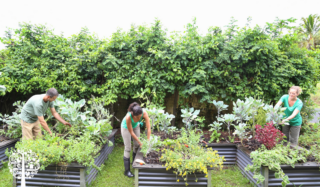
Gardening’s mental health benefits are abundant. Spending time outdoors, whatever the weather, is liberating and can decrease feelings of confinement. Engaging in uncomplicated tasks such as seed sowing, planting, shifting horse manure or turning compost enables one to switch off and do something mindlessly productive. There is the simple pleasure of helping something grow. It teaches patience, and all stages of the process can be meditative. In a community garden, the bounty is shared amongst the group that has tended to and harvested the crop. As a result, people become more self-sufficient and more resilient. Beetroot and kale on toast are delicious additions to our daily menus.
The Physical Benefits
My referrals come from agencies that work with people who are overweight, mentally ill, or have long-term injuries or illnesses. People want to lose weight, become fitter, and gain self-esteem, but the prospect of a gym or an exercise class is unappealing. And so they turn to the garden and the outdoors where they won’t be judged or questioned. Plants are good for that! A garden can easily cover an acre, so inadvertently, a gardener may walk a few thousand steps during a session. Gentle weight-bearing exercise (moving a half-filled wheelbarrow, forking over a raised bed) and using different muscles (squatting to dig or pull weeds out) develop strength and boost overall physical health, sparking positive hormones into action.
Happy Hormones
Endorphins, our ‘feel good’ neurotransmitters, are released with exercise and when we laugh. Our garden bursts with laughter as people let go of trauma, sadness, grief and isolation. A quiet corner serves as a meditative space, another chance for endorphins to gently course through the body and ease the mind.
Dopamine releases as we take pleasure in something, like the first red tomato or a bee sucking nectar from honeysuckle. The satisfaction with achieving something also releases these happy hormones. Physical labour, such as digging, sawing, banging nails with a hammer to fix a bed edge, or shifting horse muck relieves stress and pent-up emotions and releases serotonin. Being outdoors in the light, be it full sunshine or hazy winter mornings, also allows our happy hormones to do their jobs. The physical and the mental work together in harmony.
Gardening, especially in a community setting, allows people to find a renewed sense of purpose. Opening the gates and welcoming individuals back to the garden is essential now. The act of growing is a joy, and it is lovely to see how many people are realising that gardening with others is one of the best ways to counter the post-traumatic stress that has affected our world. Together, we can plant some seeds of hope and look to brighter days ahead.
The U.S. marijuana sector persists in allocating substantial financial resources toward influential advocates, aiming to sway senators into endorsing marijuana reform. Nonetheless, this endeavor faces a potential impediment in the form of an imminent government shutdown, capable of profoundly disrupting the legislative schedule of Congress.
During the first six months of 2023, marijuana enterprises and industry coalitions invested more than $2.4 million in lobbying efforts directed at the Senate, according to the latest disclosures in federal lobbying records. This falls short of the $2.9 million expended during the latter half of 2022, including the session following the general election, when the prospects of marijuana banking reform appeared remarkably promising.
While certain corporations have trimmed their expenses or completely revoked contracts due to economic challenges facing the sector, other entities have come to terms with the reality that lobbying expenditures are an essential investment for their survival.
However, the outcomes of those efforts so far bear a frustrating resemblance to the past: well-received and long-anticipated reforms, such as guaranteed access to banking services and more ambitious objectives such as rescheduling, persist as tantalizingly close yet unattainable. As lawmakers disperse for the August recess, the possibility of the SAFE Banking Act being ratified within President Joe Biden’s inaugural term remains viable, albeit subject to change.
Yet, the likelihood of success will gradually diminish without the passage of critical spending bills, as indicated by congressional staff members and lobbyists on Capitol Hill.
Following the resumption of sessions on Sept. 5, 2023, Congress’s principal focus will be on ratifying the essential spending legislation to prevent a government shutdown on Oct. 1. A government shutdown is set off when Congress fails to pass the necessary funding bills, resulting in substantial disruption, a scenario that is currently foreseeable, as recently pointed out by the Brookings Institution, a think tank situated in Washington, DC.
As the interval without a spending debate increases, the time allocated on legislative calendars for other legislative actions decreases. This encompasses the consideration of the SAFE Banking Bill, which is slated to undergo a comprehensive markup hearing in the Senate Banking Committee, a precursor to the final Senate floor vote. The procedure advocated for this year experienced a major milestone when the bill obtained an informational hearing in mid-May.
However, a markup hearing, a session involving the introduction and debate of amendments to potentially modify the bill, was initially promised for the summer months, first in June and then in July. However, disagreements between bipartisan representatives regarding the final form of the bill, coupled with the aim of securing additional Republican endorsements to ensure the bill’s passage, prompted the Senate to adjourn for the August recess without holding this hearing. Additionally, complications have arisen from requests by companies that have existing bank accounts.
Nonetheless, observers in Washington broadly concur that significant hurdles persist for this proposal, primarily concerning antimoney laundering provisions and the ability to garner adequate Republican support to ensure passage in the full Senate. Lobbying records substantiate the evidence: while rescheduling and the potential establishment of a nationwide legalized marijuana industry akin to Canada’s aspirations endure as long-term goals, the SAFE Banking Bill remains the paramount priority of the marijuana sector.
For some companies that have chosen a pharmaceutical path to cannabis product development, such as IGC Pharma Inc. (NYSE American: IGC), access to banking services isn’t an issue because they engage in a federally accepted business, unlike mainstream marijuana companies which are only state approved.
NOTE TO INVESTORS: The latest news and updates relating to IGC Pharma Inc. (NYSE American: IGC) are available in the company’s newsroom at https://cnw.fm/IGC
About CNW420
CNW420 spotlights the latest developments in the rapidly evolving cannabis industry through the release of two informative articles each business day. Our concise, informative content serves as a gateway for investors interested in the legalized cannabis sector and provides updates on how regulatory developments may impact financial markets. Articles are released each business day at 4:20 a.m. and 4:20 p.m. Eastern – our tribute to the time synonymous with cannabis culture. If marijuana and the burgeoning industry surrounding it are on your radar, CNW420 is for you! Check back daily to stay up-to-date on the latest milestones in the fast -changing world of cannabis.
To receive instant SMS alerts, text CANNABIS to 21000 (U.S. Mobile Phones Only)
Please see full terms of use and disclaimers on the CannabisNewsWire website applicable to all content provided by CNW420, wherever published or re-published: http://CNW.fm/Disclaimer
Do you have questions or are you interested in working with CNW420? Ask our Editor
BC’s first cannabis farmgate licence was issued recently to a micro grower in Salmon Arm.
ShuCanna Growers, a micro cultivator and processor located on the Trans Canada Highway on the outskirts of Salmon Arm, recently received their Production Retail Store (PRS) licence from BC’s Liquor and Cannabis Regulation Branch (LCRB).
The store plans to open soon.
The province previously licensed two other farmgate stores through special arrangements with two First Nations-owned cannabis producers, both licensed in 2022. ShuCanna’s licence represents the first formal farm-to-gate licence issued by the province under its PRS licence, launched late last year. As of press time, only one other PRS applicant is working through the process, the Victoria Cannabis Co on Vancouver Island.
“It’s very hard for the micros to get to market. This is how we can ensure we have a way to sell what we grow.”
Terry Robinson, ShuCanna Growers
The PRS farmgate licence allows federally-licensed cannabis cultivators to operate their own store at the same location as their facility and sell their products directly without going through the province’s central distribution system. These stores can operate as typical retail stores, carrying the same products as any other cannabis store in BC, and they can choose to only carry their own exclusive products.
Although ShuCanna is still going through the final stages of opening its store, once fully stocked, it will be a complete, formal retail store located in the same building as its cultivation and processing facility. ShuCanna will carry its own cannabis, with various other products available.
Terry Robinson, owner of the facility, says he was eager to apply as soon as BC announced its licensing program in late 2022. While it was a lengthy and pricy process, including nearly $10,000 in provincial fees—not to mention municipal licensing fees and the cost of renovating and then stocking and staffing the store—Robinson says it was fairly easy.
“The biggest problem is we were the first, so nobody knew what was going on. We were being passed to different departments. But hopefully, that makes it easier for the next person.”
ShuCanna first received their micro cultivation licence in May 2021 and then their micro processing and federal sales licences in November 2022, just as BC began allowing people to apply for a PRS “farm to gate” licence.
As a micro, ShuCanna operates with a small staff of about a half dozen people, with Robinson, like the owners of most micros, wearing numerous hats, including master grower and head of security, and dealing with much of the day-to-day operations. He’ll now also be hiring budtenders to run the store.
This represents the end of a very long process Robinson has had his eye on for many years. Now that they are licensed, he says he still has more hoops to jump through to begin placing and receiving orders from the LDB, the cannabis wholesale agency in BC.
But he hopes their own cannabis flower and pre-rolls, grown and packaged on-site, won’t have to go through that process, giving his store an edge.
“It can take nine months to get our product to retailers if we go through another processor who then goes through the LDB. That’s the advantage of a farmgate licence; we can take our product from one room directly into the store.”
Getting products accepted by the BC LDB to go through that process can be a challenge for micros, he says, making farmgate, as well as BC’s direct delivery program, vital to the survival of micros.
“For us, I think farmgate is paramount,” says Robinson. “It’s very hard for the micros to get to market. This is how we can ensure we have a way to sell what we grow. We’re excited. It took a long time to get here. We still have a lot to do, but I think this is going to help a lot.”











Recent Comments