The BC government is reviewing its rules about cannabis sampling between producers and retailer stores.
While some provinces allow cannabis producers to provide product samples to retailers, some say BC is lagging behind.
Provincial regulations in BC currently prevent producers from providing such samples. A representative with the province’s Ministry of Public Safety and Solicitor General—the agency that oversees the cannabis file—tells StratCann that it is currently reviewing the rules about cannabis sampling between licensees, such as federal producers and provincial licensees.
Product sampling is critical to making informed wholesale purchasing decisions for licensed retailers. Sampling is also an important sales tool for producers.
Some other provinces allowed such samples from the beginning of legalization, like Ontario and Saskatchewan, while Alberta recently began allowing them earlier this year.
A spokesperson for the Cannabis Cultivators of BC, representing a handful of producers, says its members would love to see the province create an accessible cannabis sampling program. This would allow producers to inform retailers of what is already on the market and what is coming soon.
“Allowing cannabis sampling gives retailers the ability to touch, see, and feel the products they plan on bringing into their stores, increasing transparency in the process and instilling confidence in what they recommend to their consumers.
“Items for consideration could include making sampling available for products prior to provincial launch by BCLDB and allowing producers to distribute samples directly from their own facilities. Aspects which would help our sector improve speed, remove administrative burden, and remain responsive to changing consumer and retailer needs.”
Jaclynn Pehotam, the executive director of the Retail Cannabis Council of BC (RCCBC), says it has been lobbying the BC government to make such changes.
“Product sampling is critical to making informed wholesale purchasing decisions for licensed retailers. Sampling is also an important sales tool for producers,” Pehota tells StratCann. “RCCBC made a formal recommendation in April 2023 that representative samples of any cannabis product in the market should be allowed on a B2B basis in BC.”
“RCCBC has expressed to our partners in government that members are eager to see sampling implemented,” she adds. “The delay with implementation of sampling is obviously disappointing, but we are actively encouraging our regulators to take action to align BC with other Canadian markets that have already taken this important step.”
Pehota says she would also like to see producers able to ensure any such allowances are not adding additional paperwork requirements for producers.
Jeff Guignard, Executive Director at Alliance of Beverage Licensees (ABLE BC), which recently launched its cannabis division to represent industry concerns, says it’s high time BC made such changes, especially since it’s allowed in some other provinces.
“Sampling products in this industry has been part of the culture for generations, so we should be encouraging that activity in a legally licensed framework,” says Guignard. “I absolutely think that being able to provide samples to retailers in a responsible manner is a natural evolution for the industry. It’s allowed in other provinces. It’s time for BC to catch up.”
BC has yet to provide a timeline on when they will make any decisions on whether or not to allow sampling. The province recently announced they were seeking industry feedback on removing provincial rules on promoting locations for cannabis consumption and allowing cannabis consumption on patios. That feedback period is open until August 11.
“We live in a fantasy world, a world of illusion. The great task in life is to find reality.” ~Iris Murdoch
The task of finding reality is easier said than done. It requires seeing how everything is connected to everything else. It requires sacrificing both dependence and independence to interdependence. It requires seeing past cultural conditioning, religious indoctrination, and societal brainwashing. In short: it requires doing as Miyamoto Musashi suggested, “Think lightly of yourself and deeply of the world.”
The cosmos created the star that exploded to create the carbon that created the earth that evolved to create life which evolved to create you. It’s all connected. The acorn’s task is to fulfill its purpose and become a tree. The caterpillar’s task is to fulfill its purpose and become a butterfly. The eaglet’s task is to fulfill its purpose and become an eagle. Likewise, the immature (egocentric, uninitiated, unenlightened) human’s task is to fulfill its purpose by becoming a mature (soul-centric, initiated, enlightened) human.
Human maturity requires seeing reality the way it is. The reality is that nature made you a human. And becoming a mature human requires living up to your fullest, most virtuous potential.
Life is a mission:
“Very few people are artists in life. The art of life is the most distinguished and rarest of all the arts.” ~Jung
Fulfilling our potential is the supreme human task. True happiness comes from living a life of health and virtue and fulfilling our greatest potential. So, the first question is: what are health and virtue?
-What is health?
Health is primary. Health is the benchmark. It’s foundational, the core of universal law. And moderation is health’s secret decoder ring. Without this benchmark, you cannot discern what is useful from what is not. Without this benchmark, you cannot discern when you’ve gone too far.
When you use health as a benchmark, you realize that health is not a matter of opinion. Rather, it is dictated by an indifferent universe with universal laws that apply to everyone, despite our interests, biases, opinions, or beliefs. And this applies to everyone not only physically, but mentally and spiritually as well.
But health will only get you so far. It can teach you moderation, but it won’t get you outside the box, the comfort zone, the domesticated bliss, the indoctrination, or the cultural conditioning. Only virtue can do that.
-What is virtue?
A robust character hinges on eight core virtues: courage, curiosity, temperance, humility, liberty, honor, wisdom, and humor. These virtues are vital rungs on the ladder toward achieving wholeness in character and fulfilling your life’s purpose.
This kind of character creates an antifragile spirit despite an otherwise fragile and spiritless world. With a character such as this, you can stand tall, strong, sincere, and fierce. You are a true force of nature to be reckoned with. A dynamo amidst dominoes. A lion amongst men.
With the sharpness of your mettle, you’re able to cut through all golden calves, superficial hierarchies, and delusions of grandeur. You’re able to cut through all so-called authorities. Indeed, the only authority is “to cut.” The only answer is to question. Everything is a building block. Everything is a whetstone.
The only sin is unfulfilled potential. It is the darkest place you can sink. It’s the only thing worthy of fear. The only true failure is to abdicate the responsibility of fulfilling your potential. So, you abdicate to no one. No authority. No state. No God. Not even Death…
Death is a duty:
“Soon you will have forgotten all things; and all things will have forgotten you.” ~Marcus Aurelius
Death is a duty. It is not something to fear. It is not something to fret over. Just as nature has assigned you to be healthy and virtuous and to fulfill your greatest potential, nature has also assigned you to die.
Indeed. Life is less about getting what you want and more about making the best of what you get.
So, if fulfilling our potential is the supreme human task, then true happiness must also come from living adventurously and dying well. So, the second question is: what does it mean to live adventurously and to die well?
-What is living adventurously?
Living adventurously is living dangerously. It’s taking strategic risks. It’s gambling on the edge, with an edge. It’s overreaching comfort zones and overcoming safety nets. It’s the ability to laugh and be laughable in the face of self-seriousness. It’s the ability to be bloody-minded in a world of sheepishness.
When you’re living adventurously, you’re ahead of the curve. You’re discovering new ways of being human in the world. You’re a force of nature first, a person second. You’re able to climb the mountain of darkness and pain and angst and punch Tribulation in the face. You’re able to take risks, turn tables, flip scripts, push envelopes, and challenge the gods. You’re a force to be reckoned with rather than a thing to be forced.
Why live adventurously? Because then you have your courage in front of you where it can be a spearhead. You’re able to live a courage-based lifestyle rather than flounder in the fear-based lifestyle of the masses.
As Nietzsche advised, “The secret of reaping the greatest fruitfulness and the greatest enjoyment from life is to live dangerously.”
-What is dying well?
Dying well is about discipline. It’s about using everything you’ve learned from health, virtue, and adventure, and combining them into a daily practice. It’s transforming pain into self-discipline. It’s allowing the routine to tear you down and build you back up, again and again. Then it’s about rerouting routine. It’s manifesting resilience despite resistance.
The undisciplined mind (unintegrated shadow) looks at death like a beast it should fear. The disciplined mind (integrated shadow) looks at death like a beast it must ride into fearlessness.
Mortality is always a dance between death and rebirth. A human fulfilling his potential dances this dance well. He (or she) respects death. He reveres impermanence. He honors mortality. He pays homage to finitude even as he respects Infinity.
He walks with death at his side. It gives him perspective. Death becomes a kind of compass he uses to navigate the infinite. Death teaches him how to live well in order to eventually die well. He is at peace with the fact that he is going to die. This peace transforms fear into the fuel needed for fearlessness.
Fear becomes a reason for heroism rather than an excuse to remain a victim. It becomes a cape a hero wears as he stares into the abyss of the human condition. He doubles down on fear because he realizes that heroism is forged in the crucible of risk. He seeks out challenging experiences that will make him come alive despite death. For coming alive is what it’s all about.
As Marcus Aurelius said, “It is not death that a man should fear, but he should fear never beginning to live.”
Gary Z McGee, a former Navy Intelligence Specialist turned philosopher, is the author of Birthday Suit of God and The Looking Glass Man. His works are inspired by the great philosophers of the ages and his wide-awake view of the modern world.
This article (Life is a Mission; Death is a Duty) was originally created and published by Self-inflicted Philosophy and is printed here under a Creative Commons license with attribution to Gary Z McGee and self-inflictedphilosophy.com. It may be re-posted freely with proper attribution, author bio, and this statement of copyright.
The state of Florida has awarded medical cannabis business licenses to two Black farmers under a bill that was signed into law last month. Governor Ron DeSantis signed Bill HB 387 into law in late June, finally giving members of the Black farming community a chance to enter the state’s mammoth medical marijuana industry.
The legislation was originally written to allow eligible doctors to use telehealth to renew medical cannabis patient licenses but was later amended to include language that would address the issue of providing Black farmers with Medical Marijuana Treatment Center (MMTC) licenses. These farmers had been part of a class action lawsuit against the U.S. Department of Agriculture (USDA), which was sued in the 1990s for racially discriminating against Black farmers in its farm loan and assistance allocation.
Florida’s medical marijuana law requires that at least one medical cannabis business license go to an African-American farmer covered by the class action litigation. But while the state’s medical cannabis bill became law in 2017, the state Department of Health began applications procedures for this special license in 2022.
Regulators initially intended to issue the license to one Black farmer, but other applicants held up the process after making an administrative and legal challenge. Lawmakers responded by passing HB 387, a bill that ordered the Florida Department of Health to issue licenses to all eligible applicants.
Soon after Governor DeSantis signed the measure into law, the state health department issued two licenses to 12 of the individuals who applied for the special licenses in 2022. The legislation also requires the department to approve license applications for applicants who were considered to have met all licensing requirements by an administrative judge.
Terry Donnel Gwinn and Shedrick McGriff are now the first Black farmers to receive a license to cultivate, process and sell medical marijuana. These two farmers were the only ones among the 12 applicants to meet the condition of having no deficiencies in their medical marijuana applications. Furthermore, the two managed to submit the $5 million bond required by the state before they could receive their licenses and begin operations.
Black Americans have had a sordid history with cannabis and cannabis criminalization in the country. For decades, they have been much more likely to be arrested for cannabis use despite similar use rates as white Americans and are also more likely to receive much harsher sentences. As a result, most states included social-equity provisions in their cannabis laws to ensure that Black Americans had the chance to benefit from an industry that was once used to persecute them.
Although Florida doesn’t have a particularly stellar record with cannabis social equity, this development shows that regulators are trying to reinvest in the Black community.
As more equity applicants join the marijuana industry, there will be more opportunities for various companies such as Advanced Container Technologies Inc. (OTC: ACTX) to register increased sales to the different entities participating in the value chain.
NOTE TO INVESTORS: The latest news and updates relating to Advanced Container Technologies Inc. (OTC: ACTX) are available in the company’s newsroom at https://cnw.fm/ACTX
About CNW420
CNW420 spotlights the latest developments in the rapidly evolving cannabis industry through the release of two informative articles each business day. Our concise, informative content serves as a gateway for investors interested in the legalized cannabis sector and provides updates on how regulatory developments may impact financial markets. Articles are released each business day at 4:20 a.m. and 4:20 p.m. Eastern – our tribute to the time synonymous with cannabis culture. If marijuana and the burgeoning industry surrounding it are on your radar, CNW420 is for you! Check back daily to stay up-to-date on the latest milestones in the fast -changing world of cannabis.
To receive instant SMS alerts, text CANNABIS to 21000 (U.S. Mobile Phones Only)
Please see full terms of use and disclaimers on the CannabisNewsWire website applicable to all content provided by CNW420, wherever published or re-published: http://CNW.fm/Disclaimer
Do you have questions or are you interested in working with CNW420? Ask our Editor
Chronic pain is one of the most prolific causes of disability on the planet, forcing millions of people worldwide to deal with debilitating pain on a daily basis and costing the global economy billions of dollars. Although the condition occurs due to a variety of reasons, the similarity among all people with chronic and neuropathic pain is that it causes significant physical and mental suffering, as well as stress and insomnia that exacerbate the risk of developing depression.
The physical limitations neuropathic pain places on patients can also prevent people from taking part in day-to-day activities and favorite hobbies, reducing their quality of life and increasing their depression risk.
Researchers are now looking into the possibility of treating both neuropathic pain and depression with psilocybin, the main psychoactive agent in magic mushrooms. Prior studies have already shown that psychedelics such as psilocybin can deliver long-term relief against mental disorders, including depression and anxiety. Unfortunately, depression tends to be associated with chronic pain, which can be quite hard to treat and often leaves patients addicted to pharmaceutical opioids.
Ahmad Hammo, a third-year bioengineering student at the University of Pennsylvania School of Engineering and Applied Science, is running a pilot study exploring magic mushrooms’ potential as a treatment for both depression and chronic pain. Hammo explains that the “strong correlation” between the two conditions piqued his interest in whether psychedelics could potentially treat both chronic pain and depression simultaneously.
However, the findings on chronic pain and depression come from studies that looked at the effect of psychedelics on one condition rather than both, and research specifically looking at psychedelics as potential treatments for chronic pain is sparse. Hammo’s study will be among the first to analyze the potential benefit of using psilocybin to treat depression and chronic pain simultaneously.
As more of these studies are conducted, startups such as Delic Holdings Inc. (CSE: DELC) (OTCQB: DELCF) are likely to be validated in the direction they are taking to develop additional treatments from different psychedelics.
NOTE TO INVESTORS: The latest news and updates relating to Delic Holdings Corp. (CSE: DELC) (OTCQB: DELCF) are available in the company’s newsroom at https://ibn.fm/DELCF
About PsychedelicNewsWire
PsychedelicNewsWire (PNW) is a specialized content distribution company that (1) aggregates and distributes news and information on the latest developments in all aspects and advances of psychedelics and their use, (2) creates PsychedelicNewsBreaks designed to quickly update investors on important industry news, (3) leverages a team of expert editors to enhance press releases for maximum impact, (4) assists companies with the management and optimization of social media across a range of platforms, and (5) delivers unparalleled corporate communication solutions. PNW stays abreast of the latest information and has established a reputation as the go to source for coverage of psychedelics, therapeutics and emerging market opportunities. Our team of seasoned journalists has a proven track record of helping both public and private companies gain traction with a wide audience of investors, consumers, media outlets and the general public by leveraging our expansive dissemination network of more than 5,000 key syndication outlets. PNW is committed to delivering improved visibility and brand recognition to companies operating in the emerging markets of psychedelics.
To receive instant SMS alerts, text “Groovy” to 844-397-5787 (U.S. Mobile Phones Only)
Please see full terms of use and disclaimers on the PsychedelicNewsWire website applicable to all content provided by PNW, wherever published or re-published: https://www.psychedelicnewswire.com/Disclaimer
Do you have questions or are you interested in working with PNW? Ask our Editor
A new study from Statistics Canada has found that 1 in 20 Canadians who had consumed cannabis in the past year were at risk for cannabis use disorder.
Researchers asked Canadians about their cannabis usage in 2019 and 2020, with an estimated 6.5 million saying they had consumed cannabis in the previous 12 months.
Of those respondents, more than one-third (38 percent) said they used cannabis less than once a month, while one-quarter reported using cannabis weekly or one to three times a month. Another 26 percent said they used cannabis daily or almost daily.
While more than three-quarters (77.3 percent) of those who reported using cannabis at least once in the past year said they would not have a problem quitting, just under five percent were found to be at risk of cannabis use disorder—the equivalent of 299,543 Canadians in total. Most of these respondents were single men aged 25-44 who started using cannabis at 15 or younger.
About one in five of those Canadians said that their cannabis use led to health, social, legal or financial problems, and they were more likely to fail to accomplish expected tasks due to their cannabis use.
Unsurprisingly, the study found that cannabis users who were at the highest risk of addiction were those who used cannabis frequently. Single or never-married people, men aged 18 to 24 years and from lower-income households, people diagnosed with an anxiety or mood disorder, or who started consuming cannabis at age 15 or younger, monthly or more, were also at higher risk.
The results of a new study out of California call into question the accuracy of field sobriety tests from law enforcement officers in detecting THC impairment.
The study, published in Jama Psychiatry in August 2023, was conducted from February 2017 to June 2019 at the Center for Medicinal Cannabis Research, University of California, San Diego. Results were analyzed from August 2021 to April 2023.
Researchers gave 121 participants a cannabis joint to smoke, with another 62 receiving a placebo, and then had law enforcement officers trained in field sobriety testing determine which participants were impaired.
While these experts had a relatively high accuracy rate in determining which of the 121 who smoked a THC joint had done so, it also found they thought that about half of those who smoked the hemp joint were also impaired.
The placebo joint smoked by 62 people contained only .02 percent THC, with others receiving joints rolled with cannabis that contained either 5.9 percent THC or 13.4 percent THC. Participants could smoke as much of the joint as they chose.
The participants aged 21 to 55 had used cannabis in the past month.
Officers classified 98 participants, or 81 percent of the THC group, as being impaired, while they found half (31) of the non-THC group also to be impaired. Officers used a simulated driving test and standard field sobriety testing such as a one-leg stand.
Of the 128 participants law enforcement officers said were impaired, they suspected 127 as having consumed THC.
The study concludes that, due to the high rate at which the officers determined people from the non-THC group as being impaired, field sobriety testing on its own may not be enough to accurately determine THC impairment.
This recent study out of California, where field sobriety testing was first introduced in the 1970s, further emphasizes this uncertainty. Combined with how long cannabis can stay in the bloodstream, long past any likely impairment, this only adds to the difficulty in accurately determining cannabis impairment.
A 2021 report from Quebec based on coroners’ and medical examiners’ report data from toxicological analyses found that when cannabis was present, 20 percent had a THC blood concentration between 0.5 and 1.9 ng/mL, 44% between 2.0 and 4.9 ng/mL, and 36 percent over 5 ng/mL. Canada’s prohibited blood drug concentration (BDC) level is between 2 ng and 5 ng THC per ml of blood.
A THC rate below 2 ng/ml does not necessarily indicate recent use, while a rate over 5 ng/ml is associated with impaired driving and recent use. In addition, a rate over 5 ng/ml increases the likelihood of an impairment-responsible crash. Polydrug use was found in 79% of cases.
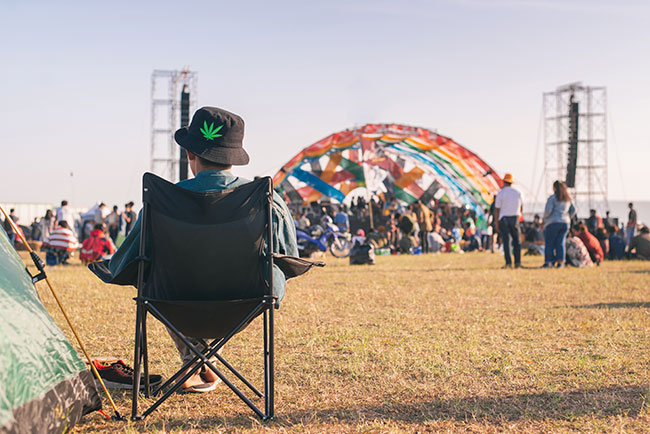
With long days and warm weather here, patios and verandas across the country are filled with Canadians looking to relax, reenergize and enjoy some good food and music. But how many wouldn’t also mind having a toke from their rosin pen or flower vaporizer, or to sip on a CBD-infused lemonade while lounging in public recreational areas?
Nearly five full years after the legalization of recreational cannabis it remains unclear if, let alone when, cannabis will get to enter the privileged arena of public consumption spaces that alcohol has enjoyed for decades.
The stats on beer and wine sales
Canadians’ tastes for social lubricants is changing. The latest report on beer and wine consumption from Statistics Canada showed that in 2021/2022, the volume of beer sold per person hit the lowest level ever recorded since we began tracking data in 1949. Meanwhile, the volume of wine sold in the same timeframe sank by 516 million litres – the largest decrease since 1949. These statistics aren’t a random outlier due to the economy, or the COVID-19 pandemic, they represent a larger macro trend.
Beer sales by volume per person are down just over 47 per cent since sales peaked in 1973, and sales by volume are down almost 25 per cent since 2009. As beer and wine sales continue to trend lower in volume, despite inflation-related rises in profits, cannabis continues to eat a larger portion of the recreational drug lunch.
Advertisement
Recreational cannabis sales totalled $4 billion in 2021/2022, compared to $8.1 billion in wine sales and $9.1 billion in beer for the same calendar year. This, in spite of the fact that retail cannabis sales are prohibited at venues where alcohol sales enjoy. Think of only having access to alcohol at the LCBO, and forget concerts, live sports and festivals.
In a country bent on increasing GDP through cannabis sales, I wonder with these changing trends, when and where does the public consumption of cannabis fit in?
The co-location of cannabis and alcohol in Manitoba
The nuances surrounding the sales of retail cannabis are unique from province to province, which can make the rules of regulation unclear. Lisa Hansen, communications analyst for the Liquor, Gaming and Cannabis Authority of Manitoba, said in a comment, “the LGCA does not prohibit licensing a cannabis retailer on the basis of location or type of venue, [but] cannabis cannot be consumed in public spaces in Manitoba. Smoking and vaping cannabis in public is prohibited under The Smoking and Vapour Products Control Act…and ingesting edibles in public is not allowed.”
Hansen continues: “another consideration is the co-location of alcohol and cannabis sales. Canadian research has shown that combined use of cannabis with liquor increases risk. For this reason, cannabis retail cannot occur in premises in Manitoba where liquor is sold.”
Canadians’ opinions on public consumption spaces for cannabis remains unclear, if not only for a lack of data. However, a 2023 opinion poll gathered by the British Columbia Ministry of Public Safety shows almost 15 per cent of the B.C. population is interested in going to a public consumption space.
As many LPs and retailers look for avenues towards achieving market capitalization figures initially promised at the start of legalization, cracking open the doors into tourism and hospitality could be the solution.
Edmonton’s We Know Training on public consumption spaces
“I think [public consumption spaces for cannabis] is an overwhelming opportunity,” says Nathan Mison of Diplomat Consulting, an Edmonton based strategic advocacy and consulting company that has partnered with We Know Training and CannSell to create the first of its kind cannabis hospitality sales training program.
“I always believe the true way that you change cannabis culture is by opening it up for more people to consume it in a way that they understood, which was through food and drink, mirroring the alcohol experience,” continues Mison.
Polling data demonstrates that 66 per cent of Canadians who have not tried cannabis would be open to the experience if it came in an ingestible format. Similarly, 27 per cent of travellers would like a cannabis experience when they travel, says Mison. “I don’t understand why the cannabis sector wouldn’t support [public consumption spaces]. I don’t understand why the tourism and hospitality sector wouldn’t support it.”
Ontario’s political resistance to public consumption
It seems as though resistance to public consumption spaces is coming largely from the political and regulatory sectors. After a failed bid in March 2023 by the Ontario Chamber of Commerce calling on the Ontario government to modernize retail cannabis regulations, such as introducing pop-up cannabis-only ingestion sites for outdoor sporting events and concerts, Premier Doug Ford stated: “I don’t like the idea of having a lounge outside and they’re smoking doobies or weed or whatever the heck they call it now.” The OCC clarified “it has never called for any action that would contravene the Ontario Smoke-Free Act.”
Provincial regulators have mostly punted the issues of public consumption spaces back to politicians. The Alcohol and Gaming Commission of Ontario said in a request for comment about public consumption spaces, that “it is not appropriate for the AGCO to comment on matters relating to government policy…The possible changes of [public consumption spaces] would be a matter of federal and provincial policies and legislations.”
Compromises on co-location can be made without compromises on health
“Public health is an important consideration,” says Omar Khan, chief communication and public affairs officer at High Tide Inc., Canada’s largest cannabis retailer with over 150 retail locations nationwide.
“I think there are ways to safeguard public health, while expanding access to legal cannabis in some of these venues,” says Khan. One idea, particularly at music festivals, might be to sell cannabis in designated consumption areas where alcohol is not sold.
The United States has already begun experimenting with consumption spaces in certain states where cannabis is legal.“I believe California just recently passed a law allowing this as well,” says Khan. “I think we have a lot of examples for the government in Canada to choose from should they wish to follow in a way that is respectful of public health concerns.”
“Any product sold through our stores has already been tested by Health Canada, it’s in childproof packaging, it’s being sold in an age-restricted environment,” he says. Khan recognizes the rampant contamination of illicit products and the “strong public health argument to be made that the more we can reasonably expand access to legal cannabis, the more we will reduce the market share of the illicit market.”
As those with stakes in the regulated cannabis sector continues to focus on the problems and impacts of the illegal markets on the legal sector, it’s important for regulators and politicians to remain cognizant of the health impacts of the illicit sector and how stonewalling public consumption spaces actually emboldens the illicit market, says Mison.
“It’s pretty fascinating that one of the tenets of the Cannabis Act was the elimination of the illicit market, and the regulators whose responsibility it is to mandate and regulate the legal sector doesn’t have any comments on the public health consequences of the illicit sector…It rings a little empty,” he continues.
Five years later, Canadians continue moving forward in a post-prohibition world, yet the question still remains: will we be able to one day purchase and consume cannabis products at a major league sporting event, concert or festival?
“I absolutely believe that the opportunity to consume cannabis at an Oilers game or an Elks game in the future will happen,” says Mison. “I believe that the first step will be through food and drink; it will not be through combustion. But, you know, I think those things will come.”











Recent Comments