

THC Derivatives and Their Creation Process
As cannabis legalization continues to spread, more data is constantly being collected about the compounds found within the cannabis plant and THC derivatives.
Apart from hundreds of cannabinoids, there is a giant variety of terpenes, flavonoids along with other compounds. Even the primary psychoactive ingredient, the phyto-cannabinoid tetrahydrocannabinol (THC), is now more understood and scientists and cannabis manufactures are continuously improving extraction and purification procedures.
Nowadays many THC derivatives have been developed to create new synthetic products or to make in the laboratory related cannabinoids found in the plant in traces.
The Progenitor of THC and All THC Derivatives (THCA)
Tetrahydrocannabinolic acid (THCA) is the precursor of THC. THCA does not bond to cannabinoid receptors, making it the only form of THC that is not psychoactive. In terms of extraction, THCA has a major advantage over other forms of THC. [1] Stems, leaves, and roots all provide an abundant quantity of THCA. [2] THCA can be obtained in crystalline form and it can reach a purity of around 99%. [3]
To produce this concentrated form, it is essential to avoid heat in the extraction process, which means that it relies primarily on solvent based extraction. [4] Cannabis plant material is first mixed with a solvent like hexane, and the solution is placed it in some kind of rotary vessel. [5]
@media(min-width:0px){#div-gpt-ad-extractionmagazine_com-medrectangle-4-0-asloaded{max-width:300px;width:300px!important;max-height:250px;height:250px!important;}}
The kinetic motion separates the cannabinoid from the solvent, which then evaporates away. Chromatography is then used to remove any other impurities, which involves adding additional chemicals like silica or alumina and repeating the process in the rotary vessel. [6] This isolates the THCA into chemically bonded crystals with exceptional purity.
The Primary Form of THC (Delta 9 THC)
When THC is described, usually they are referring to delta-9-tetrahydracannabinol (THC). Though it will vary by strain, THC tends to make up approximately 30% of the cannabinoids in cannabis. [7] This means that THC is the primary psychoactive ingredient. THC can be isolated using various methods.
One of them is known as supercritical extraction, which employs solvents at the supercritical state such as carbon dioxide (CO2) among others in order to selectively extract the desired cannabinoid or cannabis constituent. [8] The yields of the extraction are similar to other methods, but supercritical extraction is safer by comparison. By releasing the pressure in the extraction chamber, the carbon dioxide evaporates as a gas, leaving only the THC extract.
Ethanol can also be used as a solvent for a chemical based extraction, but instead of relying on pressure, heat is the primary driver. [9] This is because ethanol has a significantly lower boiling point than THC.
Finally, another THC derivatives production method is called isomerization. [10] This has the regulatory advantage of being derived from CBD, but it is chemically complicated as it requires the cannabinoids be dissolved in an acidic solvent like battery acid, muriatic acid, or vinegar. The procedure itself is simple: the solution sits for 24 hours before filtering out the acid and any contaminants. Owing to the nature of the solvents, though, there is a higher potential for error.
The Cannabidiol Derived Cousin (Delta 8 THC)
While slightly milder in potency than THC-9, Delta-8 tetrahydrocannabinol (THC-8) is derived from a complementary cannabinoid: cannabidiol (CBD). CBD is not psychoactive, but THC-8 is. Because of this, D8 falls into a legal loophole, as CBD products are legal in the United States while Delta-9 THC is still federally illegal. [11]
The THC-8 psychoactive effects are similar to that of THC-9, but with less paranoia. [12] There are still some remaining concerns about THC-8, revolving around how it is extracted. THC-8 does occur naturally in cannabis, but in traces. The conversion of CBD to THC derivatives -8 can be done with the isomerization process. [13]
@media(min-width:0px){#div-gpt-ad-extractionmagazine_com-box-4-0-asloaded{max-width:300px;width:300px!important;max-height:250px;height:250px!important;}}
By mixing CBD with various acids, this can lead to a lot of byproducts, many of which are not found in cannabis at all. One study found that up to 47% of D8 products may consist of largely harmful materials, and many other contain ingredients where the effects on humans are unknown. [14] The amount of byproducts varies by brand and methods of isomerization.
Because THC-8 is unregulated, there is very little testing on what may be contained in these products, and none of them have been approved by the FDA. Because of this, THC-8 may pose a greater risk to consumers than other THC derivatives, and as a response, several states have chosen to criminalize THC-8 until more data emerges about the safety regarding human consumption.
THC Derivatives: the Synthetic Alternative (THCO)
Numerous synthetic cannabinoids have been developed, but one of the most closely related to the original organic compound is tetrahydrocannabinol acetate (THCO). THCO is produces by taking THC-8 derived from CBD, and going one step further by adding acetic anhydride. [15] THC derivatives -O have multiple advantages over THC-8 and THC-9 that is isomerized from CBD.
By becoming THCO, terpenes and other cannabis compounds are stripped from the original product. Arguably, this may be a way to remove some harmful byproducts associated with THC-8 synthesis, but this has not been definitively proven.
Additionally, some evidence suggests that THCO may be 3x more potent than THC-9. [16] THCO is not completely risk-free, though. This compound should only be synthesized in a certified laboratory with experienced professionals, as acetic anhydride is highly flammable.[17] Additionally, there is some evidence that vaping THCO may lead to long-term lung damage, but more data is needed to confirm this connection. [18]
The Most Potent THC Derivative (THCP)
Discovered accidentally in 2019, tetrahydrocannabiphorol (THCP) is a cannabinoid with a longer alkyl side chain that allows it to bond 33 times more effectively to CB1 receptors than Delta-9 THC. [19][20] This makes THCP the most potent cannabinoid derivative, but owing to its recent discovery the least understood. Another reason for this lack of knowledge is because it also only appears naturally in trace amounts.
Because of this, it is only realistically obtained through extraction procedures, specifically those relying on CBD derivation similar to Delta-8 THC isomerization. There is hope that THCP may provide a safer option for consumers, as the extraction method also goes through a dewaxing and chromatography procedure that may provide a purity of up to 95%.[21]
Because this compound is so new, it is difficult to determine both how effective this procedure is, and what any long term consequences it may have for users. An initial study on zebrafishes found that exposure to THC derivatives -P may have detrimental neurological effects, but the same study was not repeated on humans. [22]
The Cannabinoid Alternative to Stimulants (THCV)
By hampering appetites and providing an energizing boost, tetrahydrocannabivarin (THCV) is often described as having an effect similar to stimulants. This THC derivative may provide a mitigating effect to some negative consequences of THC-9 consumption. [23] This is because THCV can help to limit connections of THC to CB1 receptors, creating a milder psychoactive experience overall. [24]
The downside to this derivative is that it is typically found in significantly lower amounts than THC. Because of this, users may need to take it in larger amounts compared to THC, which can also mean it becomes more expensive to extract a large amount to provide a noticeable response. [25]
Similar to THC-9 extraction, one of the most effective extraction methods is supercritical extraction using either carbon dioxide or ethanol. [26] While the effects of THC derivatives -V may be promising, its availability on the market is still limited, despite studies that indicate it is safe for consumption. [27]
References:
-
- McAllister, Sean D., Liliana Soroceanu, and Pierre-Yves Desprez. “The antitumor activity of plant-derived non-psychoactive cannabinoids.” Journal of neuroimmune pharmacology 10 (2015): 255-267.
- Fournier, Gilbert, et al. “Identification of a new chemotype in Cannabis sativa: cannabigerol-dominant plants, biogenetic and agronomic prospects.” Planta Medica 53.03 (1987): 277-280.
- Shoyama, Yoshinari, et al. “Structure and function of∆ 1-tetrahydrocannabinolic acid (THCA) synthase, the enzyme controlling the psychoactivity of Cannabis sativa.” Journal of molecular biology 423.1 (2012): 96-105.
- Křížek, Tomáš, et al. “Menthol-based hydrophobic deep eutectic solvents: Towards greener and efficient extraction of phytocannabinoids.” Journal of Cleaner Production 193 (2018): 391-396.
- Wianowska, D., A. L. Dawidowicz, and M. Kowalczyk. “Transformations of Tetrahydrocannabinol, tetrahydrocannabinolic acid and cannabinol during their extraction from Cannabis sativa L.” Journal of analytical chemistry 70 (2015): 920-925.
- man STANASZEK, Ro, and Z. U. B. A. Dariusz. “A COMPARISON OF DEVELOPED AND VALIDATED CHROMATOGRAPHIC METHODS (HPLC, GC-MS) FOR DETERMINATION OF DELTA-9-TETRAHYDROCANNABINOL (A 9-THC) AND DELTA-9-TETRAHYDROCANNABINOLIC ACID (A 9-THCA-A) IN HEMP.” (2007).
- Souleman, Ahmed MA, et al. “Determination of delta-9-tetrahydrocannabinol content of cannabis seizures in Egypt.” Asian Pacific Journal of Tropical Medicine 10.3 (2017): 311-314.
- Grijó, Daniel Ribeiro, Ignacio Alberto Vieitez Osorio, and Lúcio Cardozo-Filho. “Supercritical extraction strategies using CO2 and ethanol to obtain cannabinoid compounds from Cannabis hybrid flowers.” Journal of CO2 Utilization 28 (2018): 174-180.
- De Vita, Daniela, et al. “Comparison of different methods for the extraction of cannabinoids from cannabis.” Natural product research 34.20 (2020): 2952-2958.
- Kiselak, Thomas D., Rachel Koerber, and Guido F. Verbeck. “Synthetic route sourcing of illicit at home cannabidiol (CBD) isomerization to psychoactive cannabinoids using ion mobility-coupled-LC–MS/MS.” Forensic science international 308 (2020): 110173.
- 5 things to know about Delta-8 tetrahydrocannabinol: Delta-8 THC. (2022). PubMed, 119(1), 21–22.
- Kruger, Jessica S., and Daniel J. Kruger. “Delta-8-THC: Delta-9-THC’s nicer younger sibling?.” Journal of cannabis research 4.1 (2022): 1-8.
- Twohig, Marian, et al. “CHARACTERIZATION OF DELTA-8 THC DISTILLATES USING HIGH RESOLUTION MASS SPECTROMETRY (HRMS).”
- Erickson, Britt E. “Delta-8-THC craze concerns chemists.” Chem. Eng. News 99 (2021): 25-28.
- Holt, Alaina K., Justin L. Poklis, and Michelle R. Peace. “∆ 8-THC, THC-O Acetates and CBD-di-O Acetate: Emerging Synthetic Cannabinoids Found in Commercially Sold Plant Material and Gummy Edibles.” Journal of Analytical Toxicology 46.8 (2022): 940-948.
- Volpe, Kyle, and Rachel S. Wightman. “Delta-what? Deciphering the world of cannabinoids.” Rhode Island Medical Journal 105.7 (2022): 37-41.
- Valera-Zaragoza, M., et al. “Thermal stability and flammability properties of heterophasic PP–EP/EVA/organoclay nanocomposites.” Polymer Degradation and Stability 91.6 (2006): 1319-1325.
- Munger, Kaelas R., Robert P. Jensen, and Robert M. Strongin. “Vaping cannabinoid acetates leads to ketene formation.” Chemical Research in Toxicology 35.7 (2022): 1202-1205.
- Peterson, Codi. “CRx MAGAZINE.”
- Citti, Cinzia, et al. “A novel phytocannabinoid isolated from Cannabis sativa L. with an in vivo cannabimimetic activity higher than Δ9-tetrahydrocannabinol: Δ9-Tetrahydrocannabiphorol.” Scientific reports 9.1 (2019): 1-13.
- Palmieri, Sara, et al. “Cannabinoid profile in Cannabis sativa L. Samples by means of LC-MRM/IDA/EPI analysis: a new approach for cultivar classification.” Journal of Agricultural and Food Chemistry 70.12 (2022): 3907-3916.
- Banskota, Arjun H., et al. “9, 10-Dihydro-5-hydroxy-2, 3, 6-trimethoxyphenanthrene-1, 4-dione: A new dihydrophenanthrene from commercial cannabis and its effect on zebrafish larval behaviour.” Natural Product Research 36.14 (2022): 3553-3558.
- McPartland, John M., et al. “Are cannabidiol and Δ9‐tetrahydrocannabivarin negative modulators of the endocannabinoid system? A systematic review.” British journal of pharmacology 172.3 (2015): 737-753.
- Raffa, R. B., & Ward, S. A. (2011). CB1-independent mechanisms of Δ9-THCV, AM251 and SR141716 (rimonabant). Journal of Clinical Pharmacy and Therapeutics, 37(3), 260–265.
- Englund, Amir, et al. “The effect of five day dosing with THCV on THC-induced cognitive, psychological and physiological effects in healthy male human volunteers: a placebo-controlled, double-blind, crossover pilot trial.” Journal of Psychopharmacology 30.2 (2016): 140-151.
- Aizpurua-Olaizola, Oier, et al. “Identification and quantification of cannabinoids in Cannabis sativa L. plants by high performance liquid chromatography-mass spectrometry.” Analytical and bioanalytical chemistry 406 (2014): 7549-7560.
- Jadoon, K. A., Ratcliffe, S., Barrett, D. A., Thomas, E., Stott, C., Bell, J. D., O’Sullivan, S. E., & Tan, G. W. (2016). Efficacy and Safety of Cannabidiol and Tetrahydrocannabivarin on Glycemic and Lipid Parameters in Patients With Type 2 Diabetes: A Randomized, Double-Blind, Placebo-Controlled, Parallel Group Pilot Study. Diabetes Care, 39(10), 1777–1786.
CannStandard: Dried Flower Price Outline 2021-2023
Introduction
The cannabis industry in Canada has been evolving rapidly since legalization in 2018, and with this evolution comes fluctuating prices and market trends. This article delves into a comprehensive analysis of the average prices of whole flower cannabis products across nine provinces and two territories from January 2021 to June 2023. By examining data obtained from publicly available listings on private and provincial webstores, we aim to provide valuable insights into the pricing dynamics and trends in the Canadian cannabis market.
Scope
The provinces included in the analysis are Alberta, British Columbia, Manitoba, Newfoundland, Northwest Territories, Ontario, Saskatchewan, Yukon Territory, New Brunswick, Nova Scotia, and Prince Edward Island. The data is from publicly available listings displayed online at private and provincial webstores. Prices are in Canadian dollars without sales tax included.
We have calculated the average prices for whole flower cannabis available in each major package size, including 1 gram, 3.5 grams (commonly referred to as an eighth), 7 grams (a quarter), 14 grams (a half-ounce), and 28 grams (an ounce).
Price Averages
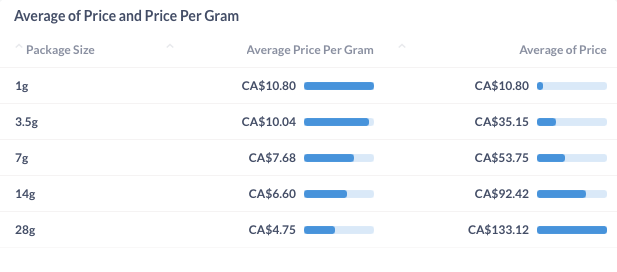
Looking at the static averages from January 2021 to June 2023, the average retail price without tax of whole flower cannabis ranged from $10.80 for a 1-gram package up to $133.12 for a 28-gram package.

The average price per gram of whole flower cannabis decreases as the package size increases. Moving from a 1-gram package to a 3.5-gram package, the average price per gram drops from $10.80 to $10.04, representing a decrease of approximately 6.92%. Transitioning to a quarter-ounce or 7-gram package, the average price per gram drops to $7.68, indicating a further decrease of around 23.11% compared to the 3.5-gram package. For a half-ounce or 14-gram package, the average price per gram drops to $6.60, reflecting a decrease of approximately 14.06% compared to the 7-gram package. Finally, when moving to a full ounce or 28-gram package, the average price per gram drops below five dollars to $4.75 per gram, indicating a decrease of around 27.27% compared to the 14-gram package.
In terms of savings from the largest (28g) to the smallest (1g) package size, transitioning from a full ounce or 28-gram package to a 1-gram package offers the highest savings of approximately 56.48%.
Monthly Price Per Gram Trends
One Gram Packages
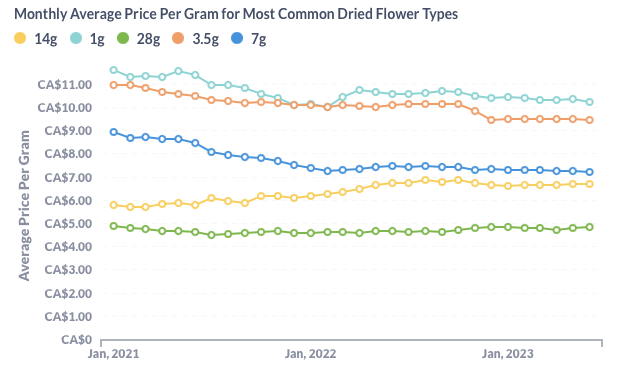
In June 2023, the average price for a 1-gram package was $10.26, down 1.1% from last month’s average of $10.38.

Eighths
For a 3.5-gram package in June 2023, the average price was $9.48, down 0.34% from $9.52 last month.

Quarter Ounces
The average price for a 7-gram package in June 2023 was $7.26, down a quarter of a percent from $7.28 last month.

Half Ounces
For a half-ounce package, the average price in June 2023 increased by 0.28% from $6.73 in May to $6.74 in June.

Ounces
In June 2023, the average price per gram for an ounce package was $4.86, up 0.34% from May 2023’s average of $4.84.

Brand Level Price Averages
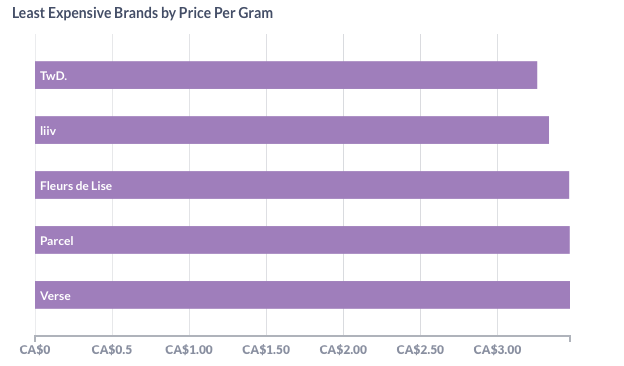
Checking in on brand-level maximum and minimum price averages in the market over the last 30 days, we observe the five least expensive brands across any package size as TwD. ($3.26), liiv ($3.33), Verse ($3.45), Fleurs de Lise ($3.47), and Grasslands ($3.49).
The most expensive brands across any package size are HighXotic ($14.03), Celebrity ($13.48), Carmel Cannabis ($13.18), Next Friday ($12.55), and Lot420 ($12.28).
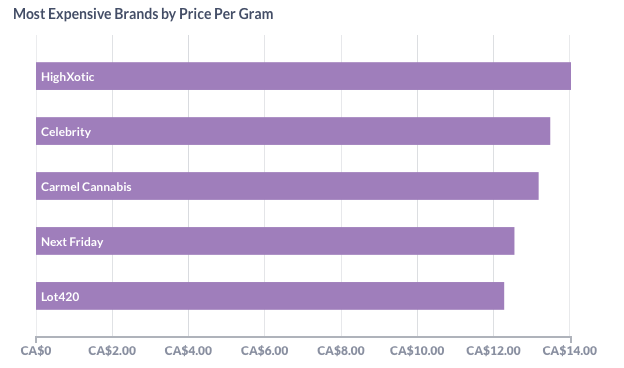
This report is available in full on CannStandard.ca. Sign up for a free trial for a live filterable version.

The grind towards sustainable cannabis packaging in Canada
It’s not hard to find licensed producers, governments and cannabis retailers who recognize sustainability as a worthy goal. The real challenge for the Canadian cannabis industry is developing a clear definition of sustainability and creating a roadmap to get there.
Governments focused on recycling
Regarding packaging, Health Canada has much to say about materials, colours and branding elements and little about sustainability. Its Packaging and labelling guide for cannabis products acknowledges that “plastic pollution is a growing problem in Canada and around the world” and encourages innovation in packaging so long as it satisfies regulatory requirements.
Reducing plastic waste, says senior media relations advisor Tammy Jarbeau, falls under the purview of Environment and Climate Change Canada, adding that, “I believe here at Health Canada for food product packaging, our role is to set the standards for what is included in the package and not necessarily what the package is made of.”
In an emailed statement, a separate Health Canada representative noted that amendments to the Cannabis Regulations to allow accordion or peel-back labels on smaller packages create more flexibility for licensed producers to use non-plastic packaging alternatives such as cardboard.
Advertisement
“Canadian governments have the right ideas, and I believe they are trying to help by requesting LPs and processors to use sustainable packaging,” says Joel Darichuk, calling it “a start.” A veteran with over 25 years in the packaging industry, Darichuk is the CEO and GM of CannaGreen Packaging, which produces cannabis packaging and supplies, focusing on sustainable and responsible manufacturing processes.
While he sees recyclability as an excellent first step, he’d like governments to educate industry players on biodegradable and compostable packaging and encourage sustainable production practices across operations, not just in packaging.
Mika Unterman agrees that governments should be doing more. She’s a circular economy and reverse logistics consultant, and the founder of Apical – a consortium that helps cannabis companies adopt sustainable packaging.
“Government lags behind the business community, generally speaking, which is why they are focused on recycling and regulating what you can call recyclable or recycled content,” she says. While recyclable packaging is ultimately a good thing, its impacts are limited when only nine per cent of the plastic goods Canadians throw in their bins are actually recycled.
Instead, Unterman wants to see governments and crown corporations “investing in the reuse infrastructure that we all need to meet our climate goals.”
The industry’s role
For her part, Unterman encourages licensed producers and retailers to think long-term, arguing it’s not only the right thing, it’s also the cost-effective thing to do.
She understands that sustainability programs can seem like added expenses but says that LPs operating in provinces with extended producer responsibility (EPR) programs in place probably aren’t capturing their true packaging costs, anyway.
“Ontario’s EPR will make LPs financially responsible for the waste they put into the market,” she says. The province’s Blue Box program begins transitioning to a new regulatory framework in July. It will soon see manufacturers across industries bearing the costs of municipal recycling programs. However, she says that most LPs bury the costs of EPR within general and administrative expenses, obscuring the cradle-to-grave cost of their packaging.
The way forward
For a functioning model of sustainable packaging, Unterman suggests looking to another well-loved plant-based product: beer. In Canada, a standard refillable beer bottle is reused an average of 15 times before being recycled into a new one, while aluminum cans are infinitely recyclable.
Standardizing cannabis packages would require a high degree of collaboration, both across production, retail and government sectors and within them. “For LPs, the sustainability transition can be costly if they seek to do it all on their own. But they can save money if they collaborate with competitors,” says Unterman, who doesn’t believe standardization poses a risk to sales.
“I understand the importance of having a unique look, but given the current way sales are done – we don’t see the packaging until after purchase – what does a unique jar or tube do for the brand? And what is the good of differentiation if we are literally destroying the planet in the process?”
Darichuk acknowledges that a lot of the changes he’d like to see, such as better government-led sustainability education and tax credits for producers who use local sustainable packaging, are complex. He says he’d love to get in a room with manufacturers and government bodies to work towards shared goals, and offers a quick win that would reduce packaging output and divert sales from illegal markets.
“A simple but successful change that would reduce packaging is to simply allow 100 mg packaging of edibles,” he says, allowing consumers to buy the same amounts of edibles in fewer packages. Indeed, public consultations on proposed amendments to the Cannabis Regulations surfaced back in 2019 and are likely to do so again when the government publishes the results of this year’s public review, but so far expanding the edible THC limit has been a non-starter with Health Canada.
Despite significant setbacks like this and the shuttering of Terracycle’s cannabis recycling program, the industry does have a few good-news stories to draw from: Nova Scotia LP Aqualitas uses ocean waste for its 100 per cent-reclaimed plastic packaging, and Alberta-based [Re] Waste works with companies such as High Tide and Nova Cannabis to collect used packaging and turn it into “reusable and functional products” – including its own collection bins. Darichuk is particularly proud of the work CannaGreen has done to reduce waste. Still, there is much work to do before the industry can call itself sustainable.
“It takes time to do this well,” says Unterman. “I see the industry in a scarcity mindset, fighting tooth and nail to survive. I understand the need to focus on the short term. But doubling down on a sustainable strategy that could reduce costs and make a business viable in the next 18 to 24 months, when others are ignoring the opportunity, is undoubtedly a competitive advantage.”

420 with CNW — Study Finds Medical Cannabis Beneficial to Military Veterans’ Quality of Life

According to a new study, the vast majority of American military veterans who use medical marijuana claim noticeable increases in their general well-being. The study, conducted by a team from the University of Utah, the University of Massachusetts and various marijuana research institutes, analyzed survey data from more than 500 veterans who openly admitted to using marijuana. The goal was to gain deeper insights into the motives and outcomes of their cannabis usage.
Interestingly, approximately 67% of respondents disclosed that they use marijuana on a daily basis. For 30% of these veterans, marijuana serves as a valuable substitute for conventional medications such as nonsteroidal anti-inflammatory drugs and antidepressants. Even more striking, 21% claimed that marijuana allowed them to cut down on opioid-based prescriptions, which can be particularly concerning given the ongoing opioid crisis.
Unquestionably, the study’s results are overwhelmingly positive, with an impressive 91% of veterans affirming that medical marijuana significantly enhances their well-being.
This research holds particular significance for veterans, considering the disproportionate prevalence of post-traumatic stress disorder (PTSD) and alarming suicide rates within the community. Many veterans have turned to cannabis as a viable treatment option, as evident in a 2019 survey conducted by the IAVA, where 20% of veterans used cannabis for medical use and 66% for recreational purposes.
The Department of Veterans Affairs currently allows veterans to discuss their marijuana use with doctors. However, doctors are legally barred from issuing medical marijuana recommendations. Nevertheless, there are efforts in Congress to change this, with a bipartisan bill aiming to grant doctors the ability to recommend medical cannabis in legal states.
Lawmakers have also shown interest in exploring the potential benefits of psychedelics for active duty military personnel and have initiated a medical cannabis “pilot program” through the National Defense Authorization Act (NDAA). Similarly, the Senate Veterans Affairs Committee approved a bill to study the therapeutic potential of marijuana for veterans with specific conditions, marking a groundbreaking step in cannabis legislation.
Representative Mariannette Miller-Meeks introduced a separate bill to promote research into marijuana’s medical potential for veterans with chronic pain, PTSD or other pertinent disorders as determined by the VA secretary.
Despite Congress’s previous failure to pass a marijuana and veterans research bill, there remains a strong coalition of more than 20 veterans service organizations (VSOs) advocating for further research and legislation in this area.
It isn’t surprising that enterprises such as IGC Pharma Inc. (NYSE American: IGC) are seeking to take the medical use of cannabis compounds a step higher by commercializing formulations that have been subjected to FDA scrutiny and oversight.
NOTE TO INVESTORS: The latest news and updates relating to IGC Pharma Inc. (NYSE American: IGC) are available in the company’s newsroom at https://cnw.fm/IGC
About CNW420
CNW420 spotlights the latest developments in the rapidly evolving cannabis industry through the release of two informative articles each business day. Our concise, informative content serves as a gateway for investors interested in the legalized cannabis sector and provides updates on how regulatory developments may impact financial markets. Articles are released each business day at 4:20 a.m. and 4:20 p.m. Eastern – our tribute to the time synonymous with cannabis culture. If marijuana and the burgeoning industry surrounding it are on your radar, CNW420 is for you! Check back daily to stay up-to-date on the latest milestones in the fast -changing world of cannabis.
To receive instant SMS alerts, text CANNABIS to 21000 (U.S. Mobile Phones Only)
For more information please visit https://www.CNW420.com
Please see full terms of use and disclaimers on the CannabisNewsWire website applicable to all content provided by CNW420, wherever published or re-published: http://CNW.fm/Disclaimer
Do you have questions or are you interested in working with CNW420? Ask our Editor
CannabisNewsWire420
Denver, Colorado
http://www.CNW420.com
303.498.7722 Office
Editor@CannabisNewsWire.com
CNW420 is part of the InvestorBrandNetwork.
TAKE THE CORRECTION

TAKE THE CORRECTION
Think about this. Have you noticed how comfortable people are in their misery? Think of the word ‘settled’, that’ll make it clear. People are settled down in their routine lives, in their homes, and in their occupations. And in where they go and in what they do, they’re settled! They are “comfortable in what they’re doing.” At the same time their inner life, their feelings screaming out in contradiction to what they said. Have you ever tried to correct someone, and you knew of course that they were all wrong about something? They were behaving in a way that was self-defeating. And this person you tried to correct got mad, struck back, became hostile toward you.
Do you just suppose that maybe you are living that way? And Reality, Truth, God is trying to get through to you, and telling you that you are wrong, and you rebel angrily and foolishly instead of listening? Do you suppose it’s a possibility that unseen to yourself, you are fighting instead of receiving?
Have you ever had that experience yourself? Where someone tried to correct you, and you reacted with hostility toward them? When someone tries to correct us as far as our inner life is concerned, about where an authentic spiritual life is concerned, wouldn’t it be wise, wouldn’t it be sensible, wouldn’t it be practical, wouldn’t it be new and different to simply listen to what is being said? Endure the discomfort of being corrected in order to authentically be right. In order to cancel out the contradiction, in order to not suffer from being our old selves anymore. I’m talking about men and women dressed in mental and spiritual rags, having nothing that is truly spiritual, but calling it that, calling it right. And Reality comes along, even in a small incident out in the world — I’m talking about how you behave down at the supermarket. How you behave at home when you’re corrected over a small thing. See, there’s rightness on many levels. Someone tries to correct you in some little, small thing. And all of a sudden because it’s true, you react in hostility and resentment. Right? Ever had that? Some little correction that people make. Look at the point of that, that there are hundreds of opportunities every day for us to begin to cancel out what has been tormenting us. You’re in torment. I know you are, and you know you are. And if you resist and fight what I just said, you just tormented yourself again.
For the third time I’m going to repeat a certain point. Because I know that it’ll get through to you sooner or later if you’re receptive to it. Why are you pretending that it doesn’t hurt? If you stop the pretense, the time will come when you won’t hurt. But pretense protects your hurt. If you protect your pretense, you perpetuate the pretense and you perpetuate the pain that always goes with pretense.
I’ll give you a clue how to do that. What happens inside of you when a Truth or a correction comes to you? Now real slow. What happens inside of you? Look at the stream of it. First of all, the immediate tension! Second, there’s the resistance. You yourself have to determine by observing it, all the reactions that go on inside of you when you are corrected!
Let me tell you something that’s absolutely magnificent! You didn’t resist it. You didn’t fight it, but something that has taken over your life did it! See? Your real nature can never fight Truth. Now if that’s true, then what is fighting correction? What is fighting is all these pretenses that have come and taken possession of our lives, taken us over? So, it seems as if it’s impossible to change our behavior, to change our reactions.
Now, I’ve given you a clue. And that clue is called honesty. If you can be honest, just in this little investigation that I talked about, begin to see how you react when something or someone comes along and tries to straighten you out. If you can see that there’s something inside of you that doesn’t want to accept it, then add to that this fact. The fact that this is something that is alien to me. Something that has taken me over, taken possession of me. If you can see that, you can go on to the point where you see that your real nature — as I just explained — your real nature never has anything to do with self-punishing behavior. Absorb it all. Learn it all. Take it all inside. And Reality will do the rest. It will change you.
WHEN DELIRIOUS, GO SERIOUS
THERE IS NO POWER IN THIS WORLD WHATEVER. You must never acknowledge anything as being superior to the Spirit of Truth. There is no power in this world whatever. Dark forces are a bluff. Notice when you’re overwhelmed. Become utterly serious. Say, “I am going to become serious
Success, Failure, And Toxic Shame The “I’m Not Good Enough” Program
Success, Failure, And Toxic Shame
The “I’m Not Good Enough” Program
The vast majority of people have internalized unconscious toxic shame. One aspect of it to avoid facing/feeling the pain within is creating a false personality, an “idealized self” in which one shows oneself to the world. It’s inauthentic and a lie to the Self [and others], but it is unconscious. Hence most people are not aware of it.
Most conventional self-help industry techniques showing you how to become rich, successful, attractive, etc., target this insecure false personality [trying to make it more perfect] that has been created based on internalized toxic shame.
Underlying this false self is an unconscious program running of “I’m not good enough” and tries to complete itself via external means, but it’s a bottomless hole.
A lot of highly successful people and entrepreneurs are driven by this internalized toxic shame to become “super-achievers” and workaholics [which is often praised as a “good virtue” in our society where pathologies have become normalized]
Many famous entrepreneurs, influencers, and celebrities, who people look up to as role models, are, in fact, deeply wounded individuals that use their work, achievements, and success to cover up deep-rooted insecurities based on toxic shame.
It is a trauma response. They need to identify with external success and the image they have built around it and do more and more in order to avoid feeling the pain of shame. Narcissism is also a trauma response based on the unconscious “I’m not good enough program,” needing validation from the outside.
But internalized toxic shame can also show itself in the “under-achiever”, the “loser” and addict in the alley, the person wallowing in misery, and victim/blame, projecting their suppressed shadow on anyone who is successful or wealthy, showing society the middle finger.
Super-achievers and under-achievers are two sides of the same “internalized shame” coin. They define each other and project on each other. Both are driven by the false personality.
As John Bradshaw wrote in “Healing the Shame That Binds You”:
“Toxic shame is unbearable and always necessitates a cover-up, a false self. Since one feels his true self is defective and flawed, one needs a false self that is not defective and flawed.
It is crucial to see that the false self may be as polar opposite as a superachieving perfectionist or an addict in an alley. Both are driven to cover up their deep sense of self-rupture, the hole in their soul.
They may cover up in ways that look polar opposite, but each is still driven by neurotic shame. In fact, the most paradoxical aspect of neurotic shame is that it is the core motivator of the superachieved and the underachieved, the star and the scapegoat, the righteous and the wretched, the powerful and the pathetic.
Alice Miller, in her powerful book, The Drama of the Gifted Child, has described the paradoxical fact that many highly gifted, superachieving, and successful people are driven by a deep-seated chronic depression, resulting from their true and authentic selves being shamed through abandonment in childhood.
More often than not, these narcissistically deprived [narcissistically wounded due to childhood wounding, absent parents or when shame-based parents where not able to meet the needs of their kids but tried to get their needs met through them] are talented, gifted, highly successful superachievers who have been praised and admired for their talents and achievements.
Anyone looking at them on the outside would believe these people have it made. They appear strong and stable and full of self-assurance. This is not the case. Narcissistically deprived people do well in every undertaking and are admired for their gifts and talents, but they have a deep sense of emptiness and aloneness.
The demand for a false self to cover and hide the authentic self necessitates a life dominated by doing and achievement. Everything depends on performance and achievement rather than on being. Being requires no measurement; it is its own justification. Being is grounded in an inner life that grows in richness. “The kingdom of heaven is within,” says the Scripture.
Toxic shame looks to the outside for happiness and validation, since the inside is flawed and defective. Toxic shame is spiritual bankruptcy.” [end quote]
Many of us also have internalized toxic shame. I would go even so far as to say that everyone has it to varying degrees, just like everyone is wounded/traumatized to varying degrees. In most people, it is unconscious.
They are not aware of it whatsoever and mistake the false self (trauma response) for the true Self and stuff any pain and shame deep into the unconscious while crafting a false personality mask for the outside world.
Social media is full of these artificial false personalities presenting a fake public image.
We also live in a world where pathology has become normalized. We worship, respect, and adore people who are “successful,” mostly in terms of money, power, and popularity/fame, engaging in positive shadow projections. We worship the false personality at the cost of Essence. Most people are more impressed by appearance than substance.
On the other side of the coin, many people also envy and are jealous of other people’s success, but they don’t want to admit that to themselves either because it would bring up their now suppressed shame and unconscious “self-hatred”.
Instead, they tend to gossip and talk s*it about successful people, engaging in negative shadow projections, which creates relief, a dopamine hit, and helps them to avoid facing the pain within. Usually, they are stuck in victim mentally, believe the world owes them, and blame others for their misery.
It’s the never-ending shadow dance until we take back our projections, face ourselves, and the shame buried deep under the false personality.
There’s nothing wrong with success in the martial world, obviously, and I encourage everyone to create abundance, get out of the matrix poverty program [corrupted spiritual/religious teachings have contributed to the scarcity program over thousands of years], be creative, use your will and talents, and embrace entrepreneurship, take risks, self-actualize, and live an abundant and prosperous life. More power to you!
The question is only, where is the drive coming from, and how attached are you to it and identified with it?
People always say, just follow your “dream” and manifest your desires, goals, and aims. But rarely do people ask where their desires, aims, and goals come from to begin with.
Most of them are programmed/conditioned by upbringing, unconscious reactions to the internal parental image [Mommy/Daddy wound], social/cultural programming, media, what society tells you success is all about, and what you “need” or “be” to be “happy.”
In short, most of what people think they want are not their desires at all. And most often, it is a trauma response to cover up a hole within via external striving for “success.”
It’s like trying to fill a bottomless hole and a vicious cycle. A lot of [unnecessary] suffering is based on it, and it’s an epidemic – the dark side of the “self-help motivational entrepreneur” space that strengthens the false personality to be “successful” at the cost of the real “I”.
So the question is, who are “you” really? And what “I” wants this or that? Again, nothing wrong with desires, dreams, and goals, but where are they coming from? As long as they are based on the false personality, social programming, or as a trauma response, you will never ever find true happiness, fulfillment, or love.
As Bradshaw said, “Toxic shame looks to the outside for happiness and validation.”
As long as you look you externally for your happiness, fulfillment, and joy, you are acting from unconscious shame, disconnected from essence. There is nothing to be ashamed of it [no pun intended]. Facing it and owning it is the way the through.
I’m not taking myself out of the equation. I can see in my life how some things I did were driven by the internalized toxic shame I wasn’t aware of – a trauma response due to childhood wounding. I’ve seen myself fall into both roles at times: the underachiever and the overachiever. The only way out is to feel that shame and transmute the false personality in order to connect to the real “I”, which is the Divine/Kingdome within.
This process is not comfortable at all. It requires courage, vulnerability, and humility. It doesn’t happen overnight or over a few weeks or months, either. It’s a process, most often going over lifetimes, and it is part of the awakening and individuation process – an important step that cannot be skipped.
It is a descent into darkness and uncovers many suppressed emotions going back to childhood and even lifetimes.
But the only way out is in and through, according to the Law of Ascent and Descent.
“You must be willing to come out of hiding and embrace your toxic shame. If you refuse to admit your powerlessness and the unmanageability of your life you cannot find the inner strength you’ve been covering up because you feel flawed and defective.
Hell, in my opinion, is never finding your true self and never living your own life or knowing who you are. This is the fate that lies at the end of the journey of ever-deepening toxic shame.”
– John Bradshaw
On the other side of the coin, being “shameless” is also rooted in unconscious toxic shame, ironically. It is very important to note that there is such thing as healthy shame and even healthy guilt as an aspect of conscience stemming from the real “I.”
For more on this topic, listen to our podcast episode “How To Heal Toxic Shame And Not Feeling “Good Enough”
Godspeed. Bernhard Guenther


The Way I See It by Elva Thompson

The Way I See It by Elva Thompson
“Do not be misled by what you see around you, or be influenced by what you see. You live in a world which is a playground of illusion, full of false paths, false values and false ideas. But you are not part of that world.” Sai Baba
The Shift of Ages
A galactic wave is sweeping through our solar system ushering in the Shift of Ages. A Shift that happens at the end of a 26,000 year cycle called ‘the grand year’. The old cycle ended on December 21st, 2012, and we are now beginning to see planetary changes in real time. The electromagnetic frequency of Earth is changing, our poles are shifting, and we are seeing ‘abnormalities’ not only in the ‘seen’ physical world but in our own consciousness. We are becoming aware of our spiritual nature and realising that we are more than the physical body, and the societal labels that define us.
How it starts
When we are born into this reality, the programming begins immediately and is re-enforced from the cradle to the grave. We are taught the art of separation and individualisation. We are given labels
 and classified as male, female or other, we belong to a race, a culture, a religion, a political party, an income bracket and a profession.
Humanity has been engineered to self-identify with the labels of human life, and the labels given to them by society is the sum of who they are. The 3D matrix feeds and re-enforces their bubble-ised sense of reality through its education systems, media, entertainment, religions, political thinking, and social mores.
When people self-identify with their labels and most people do…the ‘I am so and so’, they are limited in their awareness, and this limitation is expressed in a low vibrational state of consciousness. Aspects such as hate, arrogance, envy, jealousy, gossip, competitiveness, greed and the need to control others is a hallmark of a dense, slow, sense bound vibration.
As a result of generational conditioning, we no longer see ourselves as eternal, divine beings that are everything that exists. Instead, we are myopic mice fully absorbed by ‘I am’ and its labels and its world. The more we focus on our labels the more disconnected we become from the spiritual world and expanded levels of consciousness.

 The threefold nature of man
Man has a physical body, a soul and a spirit.
In metaphysical understanding, the body and soul are experiences in the third dimension. What we call the soul is the energetic record of debt from the lives we have led in the flesh. It is our personal akashic record that is recycled through reincarnation. Energetic debt is what keeps us chained to the wheel of rebirth…. life after life in this cruel programme.
Fear

 Fear is the fundamental of this third dimension of fire. It is what keeps us alive in this reality, but it is also a weapon that allows others to control us. Fear rules the simulation and when we leave the body…die in a fearful, depressed or violent state, the frequency of our perception, our personal resonance pattern prevents us from leaving the matrix and its levels. As a result, we keep recycling from one level of the simulation to another. We are locked in.
Getting through the ring pass not
Earth is encircled by radiation belts called the Van Allen Belts. The ancients called this barrier The Ring Pass Not, symbolised by the worm Ouroboros, a snake eating its own tail. NASA has admitted that they cannot pass through the
 Van Allen belts which puts everything about the moon landing and visiting other planets in the impossible category!
The Ring Pass Not is a vibrational fence that surrounds the planet and has the frequency of visible light. If we are not in an elevated state of awareness when we die, if we are not vibrating faster than the visible light spectrum then we cannot get through the frequency barrier. This esoteric fact is symbolised by the worm Ouroboros. This shows us the never-ending cycle of re-incarnation.
The agenda of the satanic elite is to keep humanity in an instinctual, low and fearful vibratory state so that when the Shift takes place: the evolution of the life waves, billions will not be able to take part because of their discordant resonance patterns. They will just be recycled for the next round in the conflict zone…but most people welcome the idea of reincarnation. Their self inflated ego cannot bear the thought of its own annihilation. These folk are the ‘hive mind of the matrix and are well adjusted to the sickness called human life.
Right is might

 In this day and age our society is concerned with martial values, the glorification of war, the playing on instincts of aggression and the acceptance of cruelty as a valid way of getting needs met. It is cruelty towards others and the kingdoms of nature that is dragging down the spiritual evolution of the human race.
72 billion animals and 1.2 trillion aquatic animals are killed each year for their flesh, glands and hides. Creatures that are often boiled alive. Others housed in overcrowded filthy, inhumane conditions. Cruelly treated by their licensed torturers, never seeing the sun or green grass.
Surely, the flesh of such creatures is a poison to the human spirit saturated as it is with fear and suffering.
Some people tell me that the animals they eat are grass fed and killed humanely. Can murder ever be humane and free from fear? I don’t think so.
Massive karmic debt
Mankind is loading upon itself a karmic debt of enormous weight and proportions by its collective treatment of the animal kingdom. We will eventually learn from personal experience that we cannot hurt the One Life without bringing retribution upon ourselves. Such is the Law of Return.
Man digs his own misery pit…
“Nothing so endangers the fineness of the human heart as the possession of power over others; nothing so corrodes it as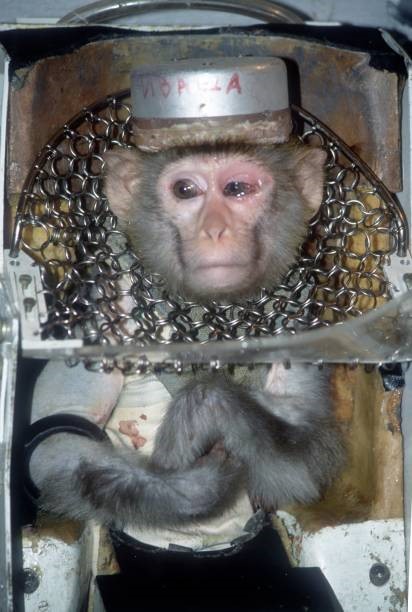
 the callous and cruel exercise of that power; and the more helpless the creature over whom the power is cruelly and callously exercised, the more the human heart is corroded. John Galsworthy.
Metaphysical understanding. Who are the animals?
Sir George Trevelyan introduced me to a concept, a new biology which changed my perception of animals and the natural world. The first creation story in Genesis tells us that god created all the physical form of animals, vegetables, birds and fish before Man appeared on the scene. Man was the finished product, the symphony of all created life. The microcosm of the macrocosm.
Human embryos go through the fish, bird and mammal stage in their development. I think that is evidence enough to see that the human archetype contains all life forms.
There is only One Life.
Here is what Sir George has to say.
“Thus the ruminants may be seen as the digestive system externalised. The lion seems to be the chest in specialised development, the rythmic system of heart and lungs. How slight are its digestive organs, how powerful its mane and thorax. The eagle, representing the bird kingdom, is seen as a metamorphosis of head and larynx. It has no great intestine, its body is a system of warm air sacks to keep it floating in the air. Here are the beasts of the Evangelists, bull, lion and eagle, the fourth being the Angel Man, the Archetypal Idea. The understanding is that every animal species is a part of (man) externalized and specialized before the central being of Man became fully embodied.” Sir George Trevelyan.
Waking up to the One Life
Spiritual truths can only be apprehended with intuitive awareness, and as we refine our consciousness we will discover the divinity within all created things, and our connection with all life. We will come to understand the real meaning of That Art Thou. Of our connection to the One Life and our responsibilities to it. Animals, birds and fish are truly our greater body. We are related to all of life and their secrets lie within us.

 Spiritually awake people do not gorge on the corpses of spirit infused beings.
Esoteric history has a name for dead flesh eaters.
It is GHOUL.
Until next time, Much love.
[embedded content]
About the Author



Are you awake? What is “awake”?
Are you awake? What is “awake”?
by Tom – MofWooFoo
Did you ever think that there is no one who knows anything for sure? It can seem for sure, but one must always be open to the possibility of delusion and that it is seemingly impossible to have all the facts, with the emphasis on “all”.. This might be the first real step to “waking up”. When you realize that there is nothing solid to cling to, and knowing this, we all need to loosen our grip on our beliefs and “let go”. Accept that you are floating in the “unknown” with everyone else and that everything relies on improvisation, responding to each moment genuinely, honestly, and openly. Become innocent, drop all desire for absolutes and recognize that they don’t exist and enjoy floating with the flow of unknowing, with a courageous faith like a newborn who can only flow with the flow. This is waking up, becoming innocent once again with genuine humility, meaning feeling no better or worse than anyone else, and enjoying the end of comparing and competing.
Realizing the hopelessness of certainty, of never truly knowing something 100%. We all can unite, and transform our time to one of innocence, humility, and compassion. How sweet life is in such an environment. Opening and deepening the exploration of freedom, how to live freely, being the pioneers, the first or one of the first to live in real FREEDOM. Freedom must be responsible, used only for good. Freedom is a force for “good” or it isn’t freedom, it is nihilism.
That being said, perhaps it is necessary to realize that the human species is insane. Making the same mistakes over and over is what is one idea of insanity. And that is what humanity incessantly does, is doing. It explains to some degree, how humanity has come to the brink of extinction. And it implies that a lot of people should be considered insane, and explains why so often their decisions are faulty, and how there are people who will kill others. But I suppose for the sake of clarity we should agree on a definition of “insanity” or “santiy”. Excuse me while I google. After googling about it, I discovered that there is no definitive definition that I could find. So, it seems I must supply my own definition, which is “crazy”, or when someone does or is doing something that seems to make no sense (faulty reasoning) or doing something that undermines the quality of one’s existence. So, smoking cigarettes is a form of insanity, as well as any compulsive habits, if the results are detrimental. To be “sane” would be to always be behaving in one’s best interests, that is, genuine best interests, or one could say, to always attempt to satisfy one’s needs. Now, I will google it. (You can see that I am letting you see my every move. I have no secrets, I am transparent, vulnerable, nevertheless, I am a little bit mysterious) Soundness of judgement, reason, soundness of mind is sane. Ok, now we all know what we are talking about.
In our small pueblo, with its constant invasion of foreigners, nestled in the Andes, deep in s. Ecuador, the locals pretty much unanimously agree that the gringos or extranjeros are for the most part “loco”. And who would dare argue that? It might be insane to try. Regardless, what we need to recognize is that to “wake up” is to realize that we are all dealing with an “insane situation” with many insane people. I have a tendency to treat everyone as if they were “normal”, but this is proving to be a disastrous mistake. Now, imagine a world where everyone is insane, it would definitely be different than the one we know, because in our world, people can carry on, as if they were sane, for the most part, like a politician or a soldier, so it can be tricky to perceive, especially if you happen to be lacking a very refined sensing ability to sense insanity. It is not easy, considering everything that we have been considering.
It follows that no one can know if and/ or how insane or sane one might be. We only have what other people reflect back to us and maybe how we are doing as far as getting our needs met, and how we are feeling now and most of the time (our “default” feeling). One can see that it is virtually impossible to assess our own sanity with 100 % accuracy, which takes us back to one of the opening premises, that there seem to be no absolutes that anyone can know for sure.
This, I believe, is perhaps the first step to “waking up” and it leads to an individual who is humble, open minded, compassionate or empathetic, and self confident all at the same time. With this combination, one can begin to “let one’s light shine”, and to shine it more and more, making one’s good vibes more and more apparent, penetrating, powerful, and far reaching. Emoticono smile It creates the possibility for unity and harmony while removing those obstacles which keep us divided.

Image from ‘Unsplash’
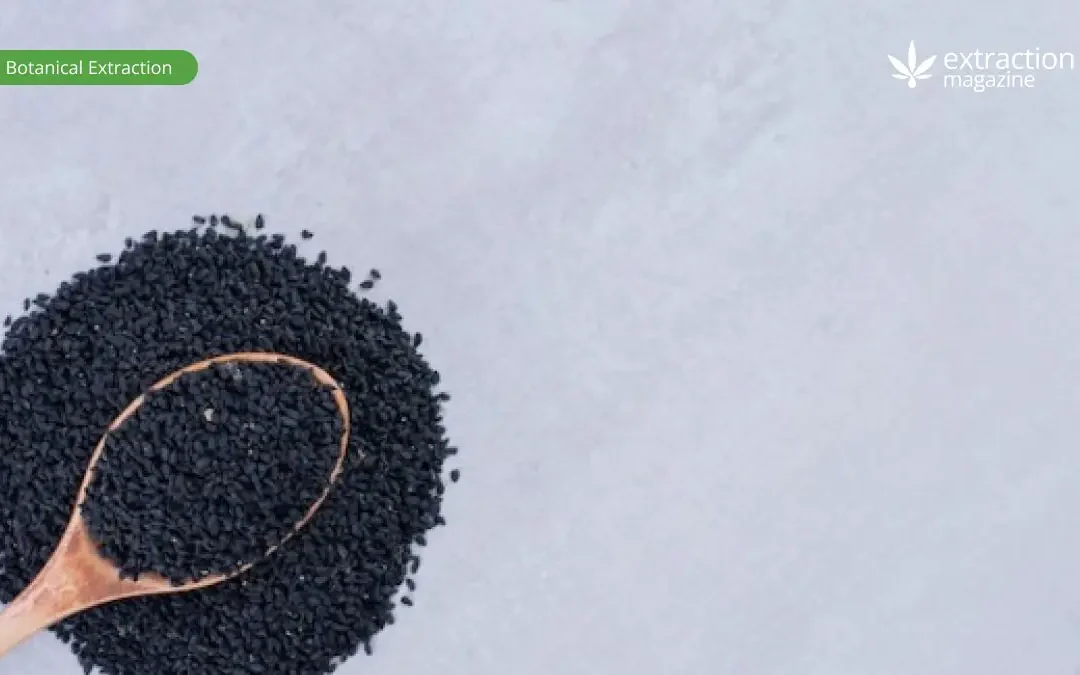
Ergot Alkaloids in Morning Glory Seeds
Ipomea genera contains more than 500 species, both of climbing plants or shrubs and belong to the family of Convolvulaceae. The beautiful funnel-shaped flower usually blooms in the morning, giving to the plant the generic name Morning Glory. Chemical studies confirmed the ethnobotanical research findings on the use of these plants in rituals as hallucinogens.
The alkaloids responsible for the psychotomimetic effects found in Morning glory plants belong to the class of ergot alkaloids and they include different compounds which are tryptophan-derived toxins. The identification of these secondary metabolites started in 1918 with the isolation of ergotamine by A. Stoll and the later collaboration with A. Hoffmann who performed the synthesis of novel compounds related to ergot alkaloids including methylergometrine and lysergic acid diethylamide (LSD) .
What is Ergot?
Ergot fungi are a group of ascomycetes belonging to the genus Claviceps. The most widely known fungus belonging to this genus is the Claviceps purpurea and it can develop on cereals or flowering grass as a parasite.
The infestation by fungal spores in the host plant happen in the ovary during fertilization. Ergot produces a fruiting structure called sclerotium producing alkaloids in high concentrations such as ergotamine among others. [1]
The development of the sclerotium on ears of corn or rye as a parasite can lead to serious concerns in terms of myco-intoxications, inducing serious adverse effects that have been known since Middle Ages with the name of ergotism. [2] The convulsive symptoms such as spasms and psychosis induced by long-term ergot poisoning and the incurrence of gangrene due to vasoconstriction are the main signs of ergot intoxication.
There is also a theory proposing that the Salem witchcraft of 1692 was caused by the symptoms of convulsive Ergot poisoning, which were considered as signs of demonic affliction by the community. [3] Ergot is a rich source of the precursor lysergic acid to synthesize Lysergic acid diethylamide (LSD): ergotamine.
What are Ergot Alkaloids?
Ergot alkaloids are well known for their effects at physiological level, that can be both beneficial in health care or detrimental for abuse if humans and animals are exposed to their toxicity. [1]
To make an example, even if ergot alkaloids caused ergotism afflictions, they were also used as ancient remedies to promote abortion and to stop maternal bleeding after childbirth, due to the effects on uterine contractions. Ergot alkaloids are 3,4-substituted indole derivatives with an essential structural element, the tetracyclic ergoline ring system that is variously substituted at C-8. [1]
Ergot alkaloids are often divided into 3 classes according to their structure:
- Clavines;
- Lysergic acid amides;
- Ergopeptides.
The effects of ergot alkaloids are linked to their agonist, partial agonist, and/or antagonistic effects at biogenic amine receptor sites. These have a complex effect on cardiovascular functions, suppress prolactin secretion and enhance uterine motility.
Moreover, their toxicity can result in:
- Vomiting;
- Decrease circulation;
- Gangrene;
- Nausea;
- Rapid and weak pulse;
- Coma (in extreme cases). [4]
More than 80 ergot alkaloids have been isolated. Among the most noteworthy ergot alkaloids there are:
- Lysergic acid;
- Ergonovine;
- Methylergonovine;
- Lergotrile;
- Ergotamine;
- Bromocriptine;
- Others.
Ergot Alkaloids and Morning Glory Flowers
Ergot alkaloids have been found also in higher dicotyledonous plants such as Morning Glories, including Ipomoea asarifolia and Turbina corymbosa, Ipomoea violacea, Argyreia nervosa (Hawaiian Baby Woodrose) species among others. [1] Recent researches sustain that during evolution these plants or a predecessor plant recruited a clavicipitaceous fungus forming a symbiosis. [1] And both the host plant and parasitic fungus benefited from this symbiosis.
The gene cluster encoding the enzymes of the ergot alkaloid pathway have been sequenced highlighting a conserved sequence in dicotyledonous plants that seems the result of an ecological optimization process forming compounds capable of protecting the plant and the fungus from predators, but also stabilizing their symbiotic interaction.
The alkaloids produced by the parasitic fungus do not remain in the fungal mycelium but are translocated via the fungus trichomes into their plant host. And this could explain why this class of alkaloids is produced in plants such as Morning glory.
Extraction of Ergot Alkaloids from Morning Glory Seeds
Many methods have been developed in order to highlight the presence of ergot alkaloids in plants infected by the Claviceps fungus. Nevertheless the techniques applied are generally laborious and time-consuming.
In order to successfully extract ergot alkaloids such as ergine (D-lysergic acid amide, LSA) and ergometrine from Morning glory seeds and evaluate the relative concentrations, various innovative methods have been compared. [5]
Three different advanced extraction methods were applied and evaluated to check the best suitability for ergot alkaloids extraction and determination:
- Microwave-assisted extraction (MAE);
- Ultrasound-assisted extraction in ultrasound bath (UAE-B);
- Sonotrode (UAE-S).
Among these techniques, UAE-B resulted as the best method for ergot alkaloid extraction. Thanks to ultrasonic waves the extraction time and the extraction efficiency are greatly improved compared to other methods. The solvent mixture used for extracting alkaloids included methanol and water and the whole process was optimized in order to perfectly tune extraction temperature, time and solvent mixture. [5]
Among the compounds found in different varieties of Morning glory seeds there are:
- Ergine;
- Ergometrine;
- Penniclavine;
- Chanoclavine;
- Lysergic acid hydroxyethylamide (LSH);
- Lysergol and their isomers.
Interestingly when a single seed was analyzed the relative abundance of the ergot alkaloids ergine and ergometrine vary greatly going from close to the limit of quantification (LOQ) to almost two times greater than the mean concentration. This can explain the serious risk of overdose or intoxication of people experimenting Morning glory seeds.
Compared to seeds, the concentration of ergot alkaloids in aereal plant samples appears to be 12-fold lower. It should be noticed that MAE extraction led to unexpectedly high ergine concentration compared to other methods. This is due most likely to the decay of analytes during the extraction procedure because of microwave energy.
Main Ergot Alkaloids
Ergine
This is the simplest of the ergot alkaloids. Ergine is also known as lysergic acid amide (LSA) and it has a similar structure of LSD. The psychotropic action is due to the interaction of the molecule with 5HT2A receptors, exerting a partial agonist action on them.
There is still a lack of information but it seems that ergine is the main serotonergic psychedelic contained in Morning glory seeds, nevertheless it seems that when extracted and isolated, ergine is only mildly psychoactive.
For this reason the hallucinogenic effect seems to be due to a mix of ergoline alkaloids.
Ergine can interact with serotonin, adrenergic and dopamine receptors, but has lower affinity to them compared to the synthetic counterpart LSD, that is definitively more potent.
The legal status of this molecule depends on the country.
The possession of the isolated compound is illegal both in USA and UK also because ergine is the precursor for the synthesis of LSD. Nevertheless the plant and seeds of Morning glory can be cultivated, sold and distributed.
Ergometrine
Ergometrine is also known as ergonovine. This compound has a medical use in obstetrics to cause uterus contractions or to stop post-partum bleeding. If the compound is administered orally it can cause vomiting and nausea.
Rarely hypertensive reactions and cardiac arrest have been described. Ergometrine leads to psychedelic effects at high doses and this can be due to the interaction with 5HT2A receptors. Because of possible precursors to synthesize LSD, this compound is listed in Table I of controlled substances.
References:
[1] Steiner, Ulrike; Leistner, Eckhard (2018). Ergot Alkaloids and their Hallucinogenic Potential in Morning Glories. Planta Medica, (), a-0577-8049–. doi:10.1055/a-0577-8049
[2] Dellafiora L, Dall’Asta C, Cozzini P. Ergot alkaloids: From witchcraft till in silico analysis. Multi-receptor analysis of ergotamine metabolites. Toxicol Rep. 2015 Mar 23;2:535-545. doi: 10.1016/j.toxrep.2015.03.005. PMID: 28962389; PMCID: PMC5598484.
[3] Spanos NP. Ergotism and the Salem witch panic: a critical analysis and an alternative conceptualization. J Hist Behav Sci. 1983 Oct;19(4):358-69. doi: 10.1002/1520-6696(198310)19:43.0.co;2-g. PMID: 6361114.
[4] Hodgson, Ernest (2012). [Progress in Molecular Biology and Translational Science] Toxicology and Human Environments Volume 112 || Toxins and Venoms. , (), 373–415. doi:10.1016/B978-0-12-415813-9.00014-3
[5] Nowak J, Woźniakiewicz M, Klepacki P, Sowa A, Kościelniak P. Identification and determination of ergot alkaloids in Morning Glory cultivars. Anal Bioanal Chem. 2016 May;408(12):3093-102. doi: 10.1007/s00216-016-9322-5. Epub 2016 Feb 12. PMID: 26873205; PMCID: PMC4830885.
Recent Comments