More than 30 states now allow their residents to purchase and even grow medical cannabis to treat several allowed conditions. Even though cannabis users typically tend to be younger, a decent portion of medical marijuana patients are older people dealing with conditions such as insomnia and chronic pain from arthritis.
For a lot of medical marijuana patients, especially older ones, the “high” that comes with consuming THC cannabis isn’t always welcome. Some patients have taken to using cannabis alongside CBD (cannabidiol) to reduce the high, while some researchers have even developed a cannabis strain that delivers the benefits without the high.
However, a recent study from the University of New Mexico (UNM) has revealed that feeling high after taking medical marijuana is associated with greater symptom relief. The research’s findings, which were published in the “Frontiers in Pharmacology” journal, found that patients who feel high after medicating tend to feel greater relief from their respective symptoms.
University of New Mexico associate professor of psychology and senior study author Jacob Vigil explains “feeling high” as feelings of euphoria and impairment. While this mental state is usually the goal for recreational users, some medical marijuana patients see it as a hindrance.
Vigil and his colleagues sought to determine whether the state of impairment and euphoria limited marijuana treatment or is simply an unavoidable part of treatment. The research team partnered with the cannabis-tracking treatment app ReLeaf to examine data from an estimated 2,000 medical marijuana patients collected during some 16,000 sessions with medical cannabis.
They found that 49% of the patients experienced the telltale signs of marijuana high with side effects such as red eyes and dry mouth. Furthermore, 7.7% of the patients saw greater symptom relief and higher levels of peace and relaxation while 20% experienced side effects. Although feeling high was associated with feelings of confusion, clumsiness, and even paranoia, it also caused feelings of happiness, optimism and gratitude.
The researchers surmised that feeling high may be a “fundamental aspect” of taking therapeutic marijuana rather than a hindrance to avoid.
Regarding the proliferation of high-THC products in the market, the research team noted that high THC levels had no correlation with greater symptom improvement. Rather, the researchers suggested that high-THC products only increased relief from symptoms if patients were feeling high. The effect was especially pronounced in participants suffering from fatigue, pain, anxiety and depression.
Researchers say the study highlights the complicated way marijuana interacts with human bodies and points to a future where cannabis treatments are highly customized for each patient.
With this mounting evidence of marijuana’s medicinal effects, it is highly likely that the drug development pipelines of companies such as IGC Pharma Inc. (NYSE American: IGC) will yield viable formulations that meet the FDA’s requirements.
NOTE TO INVESTORS: The latest news and updates relating to IGC Pharma Inc. (NYSE American: IGC) are available in the company’s newsroom at https://cnw.fm/IGC
About CNW420
CNW420 spotlights the latest developments in the rapidly evolving cannabis industry through the release of two informative articles each business day. Our concise, informative content serves as a gateway for investors interested in the legalized cannabis sector and provides updates on how regulatory developments may impact financial markets. Articles are released each business day at 4:20 a.m. and 4:20 p.m. Eastern – our tribute to the time synonymous with cannabis culture. If marijuana and the burgeoning industry surrounding it are on your radar, CNW420 is for you! Check back daily to stay up-to-date on the latest milestones in the fast -changing world of cannabis.
To receive instant SMS alerts, text CANNABIS to 21000 (U.S. Mobile Phones Only)
Please see full terms of use and disclaimers on the CannabisNewsWire website applicable to all content provided by CNW420, wherever published or re-published: http://CNW.fm/Disclaimer
Do you have questions or are you interested in working with CNW420? Ask our Editor
The two landed in Beaver Island Park on Grand Island, NY, a 950-acre park just across from the Canadian border, with 49 kilograms of cannabis. US Border Patrol says they then located the cannabis in four red duffle bags.
At the time, agents reported seeing a helicopter flying unusually low and hovering over the parking lot of the park.
As part of the investigation, authorities used radar data to conclude that Assi and his partner turned off the transponder on the helicopter, failed to check in with the required towers, and failed to submit a required flight plan. This data came from the US Federal Aviation Administration and the US Customs and Border Protection Air and Marine Operations, as well as Nav Canada, a privately run, not-for-profit corporation that owns and operates Canada’s civil air navigation system.
They also located surveillance footage from a helipad in Canada that the two individuals flew from, which showed them preparing the flight, as well as taking off and landing after the incident on Beaver Island occurred.
Sentencing is scheduled for October 16, 2023.
US seizures of Canadian cannabis are not uncommon. Large seizures increased significantly while the US/Canadian border was closed to non-essential traffic during the height of the COVID-19 pandemic.
While there were around 135,000 kg seized at this border in the fiscal years of 2020 and 2021, only 23,000 kilograms were seized in 2022, and about 13,000 so far for the fiscal year 2023 (beginning October 2022), with nearly 10,000 kg of that being seized in March, April and May 2023.
A group of researchers in Vancouver are trying to help cannabis pre-roll manufacturers better understand the most effective and efficient particle size for ground cannabis flower in a joint.
“Our aim is to provide cannabis pre-roll manufacturers with tools to better control the delivery of cannabinoids upon smoking of a pre-roll, thus allowing the user to be better informed on the amounts being consumed during joint smoking” notes a paper shared online earlier this year. Researchers also shared their findings at the e Canadian Chemistry Conference and Exhibition in Vancouver in June.
With the growing popularity of pre-rolls, which continue to increase in popularity in Canada, the research team wanted to look at how the particle size of ground cannabis flower impacts the effectiveness of cannabinoid delivery to the consumer.
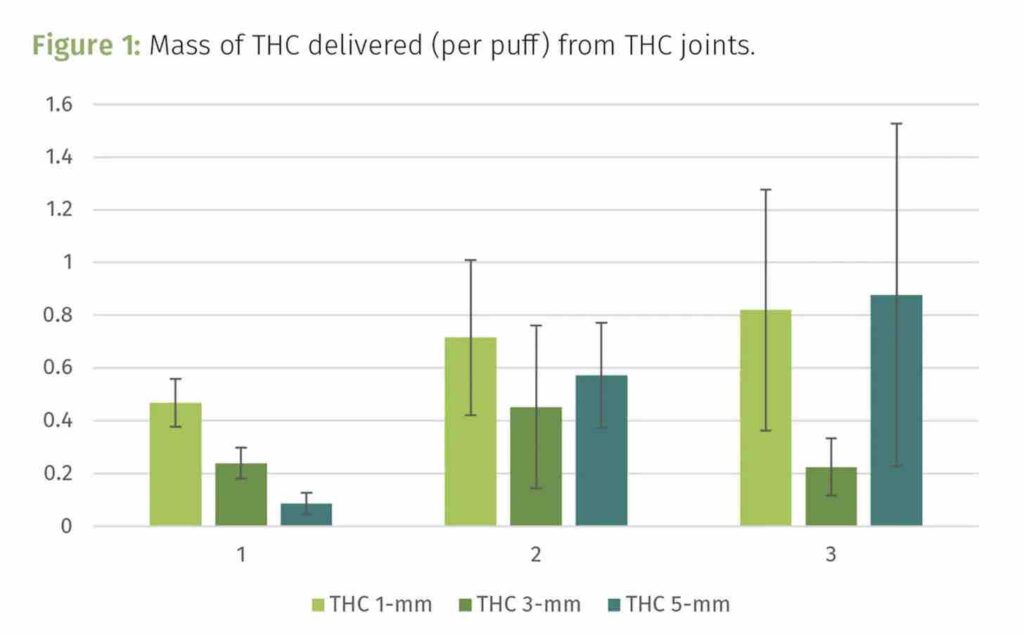
The study looked at samples of ground cannabis separated into 1, 3, and 5-mm particle sizes. They rolled half-gram joints and “smoked” 18 of them using a Cambustion Smoke Cycle Simulator. The machine takes a 50 cc “puff” of cannabis at a time until the pre-rolls are finished.
Researchers took a sample via a filter from three puffs of the joint, taken at the beginning, middle, and end of the joint, and then analyzed those filters to see the total amount of cannabinoids present.
They found that the lowest amount of cannabinoids was delivered at the beginning of the joint, with the highest at either the end or the middle.
Both the 1-mm and 3-mm joints showed around a 50% increase in THC delivery from the first sampled puff to the middle of the pre-roll, while the 5-mm samples showed a 500 percent increase.
The results also showed that the amount of CBD delivered in each measured puff was higher than that of THC in absolute terms, ranging from 2.3 mg/puff to 6.1 mg/puff. The 1-mm and 3-mm particle sizes showed an increase in the amount of CBD delivered from middle to end, while the 5-mm CBD particles showed larger increases at the end of the joint.
Overall, the results showed that a smaller particle size burned more easily, which they say should create more “high potency” puffs.
The 1-mm and 3-mm ground cannabis particle sizes delivered 16–19 mg of THC, in comparison to the 5-mm joint which delivered 28 mg of THC. When measuring CBD, they found that the 5-mm particles delivered around 100 mg CBD per half-gram joint, compared to the 1-mm and 3-mm joints which reached around 90 mg CBD per pre-roll.
So while only about half (34–59 percent) of the THC in each joint was transferred to the theoretical consumer, the amount of CBD transferred in each puff was closer to 100%.
However, while the smaller particle size seemed to be more efficient at delivering THC to the consumer, it also meant the joint would burn faster, potentially countering this effect. Whereas a larger particle size was less efficient in delivering available THC but because it burned slower, it might provide more THC overall throughout the course of consuming the pre-roll.
This same trend was not noticed with CBD.
“Analogous to a kindling fire that burns vigorously, it would make sense that a 1-mm particle size leads to a greater propensity for uncontrolled combustion,” notes the research paper.
“In the case of the larger 5-mm particle size, the low reproducibility could simply be attributed to the additional puffs these joints needed to ignite at first. Moreover, as these joints took significantly longer to complete and thus have larger puff counts, it is unsurprising that the puff count reproducibility might be slightly higher. However, the kindling analogy does not appear to apply to the 1-mm CBD joint which smoked very reproducibly, suggesting that other factors might be encouraging controlled burning, such as flower humidity.”
“There’s a lack of quantitative research on joint smoking. I want to understand what happens during inhalation on the chemistry side,” researcher Markus Roggen, president and chief science officer of Delic Labs, a cannabis and psilocybin research facility in Vancouver, British Columbia told Scientific American.
All four researchers involved, Tim Sun, Dr. Hart Plommer, Sajni Shah, and Dr. Markus Roggen are with DELIC Labs in Vancouver, Canada. Direct correspondence to: [email protected]
“Faith is, above all, openness – an act of trust in the unknown.” ~Alan Watts
The human condition has a glaring hangup. It has hitherto been brainwashed into believing that it needs to believe. It’s addicted to belief. It’s hung-up on being hung-up. As a result, it has doubled down on the delusion that its beliefs are the truth at the expense of Truth itself. It has forsaken the Truth Quest for the “truth,” and thereby lost sight of the path.
Ironically, the cure for this malady is faith. Which is often confused as belief. But really, faith is the opposite of belief.
Faith is openness to what the truth could be. It’s an infinite question mark that cuts through cosmos to continue the quest. It’s a vulnerable posture regarding reality, a sacred hope. Whereas belief is what one would “wish” the truth to be. It’s a full stop period mark that ends exploration. It’s an invulnerable posture regarding reality, a profane front.
Belief is pretense in hard makeup. Faith smears the makeup, thereby revealing that the Self is masks all the way down perceiving delusions all the way up.
Alan Watts said it best, “We must here make a clear distinction between belief and faith, because, in general practice, belief has come to mean a state of mind which is almost the opposite of faith. Belief, as I use the word here, is the insistence that the truth is what one would “lief” or wish it to be. The believer will open his mind to the truth on the condition that it fits in with his preconceived ideas and wishes. Faith, on the other hand, is an unreserved opening of the mind to the truth, whatever it may turn out to be. Faith has no preconceptions; it is a plunge into the unknown. Belief clings, but faith lets go. In this sense of the word, faith is the essential virtue of science, and likewise of any religion that is not self-deception.”
In the battle against bewitchment, all beliefs, no matter how well-intended, are a hinderance to clear thought. The greatest fight in the war between belief and delusion is against our own bewitchment. Fixed beliefs are self-reinforced bewitchment. Faith breaks the spell by ushering in mindful nonattachment to ideas and ideals.
Faith is a deep understanding that we are fallible creatures floundering within an infallible universe. We are finite beings perceiving an infinite cosmos. It’s a profound realization that we are imperfect mortals vainly attempting to conceive of a cosmos that is ultimately beyond our conception. But faith is also a deep hope that we might catch a glimpse of the absolute.
Belief, on the other hand, is what happens when we become attached to our flawed interpretations. It’s a vain attempt at pigeonholing the absolute into a nice little digestible package.
Faith is letting go of our interpretations and renouncing our attachment to a particular result. It’s a deep curiosity regarding the absolute, whether it’s easy to swallow or not.
Belief is limiting; faith is limitless. Belief is mental slavery; faith is mental liberation. Belief is attachment; faith is nonattachment.
Ultimately faith is courage. It takes courage to choose uncomfortable nonattachment over comfortable attachment. It takes courage to question beliefs rather than cling to cultural conditioning. It takes courage to be vulnerable to the trials and tribulation of the Truth Quest rather than get caught up in the placating delusions of a particular “truth.” It takes courage to allow the journey to be the thing rather than get hung up on a destination.
Cast aside the security blanket:
“Security is a false God. Begin to make sacrifices to it and you are lost.” ~Paul Bowles
Belief is also a false God. Don’t sacrifice clear thinking for outdated indoctrination and conditioning. When it comes to spirituality, “firm ground upon which to stand” is overrated. Better to float. Better to fly. Best, to intimately, and vulnerably, swim through it all.
Cultivate the “skyhook” of Faith lest the “deadweight” of Belief hold you down.
As the mighty Krishnamurti explained, “A truly spiritual person is not one who is encrusted with beliefs, dogmas, rituals. He has no beliefs; he is living from moment to moment, never accumulating any experience, and therefore he is the only revolutionary being. Truth is not a continuity in time; it must be discovered anew at every moment. The mind that gathers, holds, that treasures any experience, cannot live from moment to moment discovering the new.”
Remain open to discovery. Don’t let the shiny ring of your “precious” belief distract you from discovering something greater. Stay open and curious. Be like a still pond. Receive but do not keep. Be reflective but do not cling. The only way to grasp truth is to let go of your need to grasp it. Be a mirror instead, and the truth will reveal itself. Just be sure to let it go, and then move onto the next reflection.
As Edward Abbey said, “A good philosopher is one who does not take ideas seriously.” Be a good philosopher. Cut through all red tape. Kneecap all high horses. Dethrone all gods. Inflict yourself with good questions. Stay ahead of the curve. Let faith be your spearhead. Double down on your curiosity. Use it to overwhelm and overcome your certainty.
Nothing is certain. Nothing is secure. Nothing remains the same. A good philosopher simply has the courage to point this out. A good philosopher has faith that there are no absolute answers only astute questions.
Be audacious. Be impudent. Be insouciant. In a world hung up on being secure, be explosive. Trigger the easily triggered. Beleaguer the bystanders. Drop colorful paint bombs into black and white thinking. Count coup on the gods.
Use faith as a tool to wedge out belief. Use it to surrender to curiosity rather than cling to certainty. Use it to “entertain a thought rather than accept it.” Use it to “swim” rather than “stand.” Use it to creatively Flow rather than obsequiously kowtow.
As Buckminster Fuller said, “Belief is when someone else does the thinking.” Don’t allow anyone or anything else to do your thinking for you. Neither priests nor politicians. Neither philosophies nor religions. Neither idealogues nor demagogues. Use faith to see through the veil. Use it to pierce holes through the status quo smokescreen. Use it to smash through idols, ivory towers, and golden cows. Use it to crush out fragility with antifragility.
Truth is a moth-eaten curtain stretched across the cosmos. Forsake belief as the outdated thought mechanism that it is and cultivate faith to see through the holes in the fabric.
About the Author:
Gary Z McGee, a former Navy Intelligence Specialist turned philosopher, is the author of Birthday Suit of God and The Looking Glass Man. His works are inspired by the great philosophers of the ages and his wide-awake view of the modern world.
This article (Faith vs. Belief: The War Between Truth and Delusion) was originally created and published by Self-inflicted Philosophy and is printed here under a Creative Commons license with attribution to Gary Z McGee and self-inflictedphilosophy.com. It may be re-posted freely with proper attribution, author bio, and this statement of copyright.
(CNW) Smiths Falls, Ont. — Canopy Growth Corporation has completed all conversions pursuant to the US$100,000,000 senior unsecured convertible debentures, sold to an institutional investor in February 2023.
Since the beginning of fiscal 2023, Canopy Growth has completed numerous balance sheet actions to strengthen its financial position, while implementing a business transformation plan with the goal of improving profitability. In addition to the aforementioned that preserves liquidity, the balance sheet actions completed by the Company to date include:
Equitization of $263 million of the 4.25 per cent unsecured notes due in July 2023;
Paydown of USD$188 million (or 25 per cent of the principal) of the senior secured term loan at $0.93 per dollar of debt;
Refinanced $100 million of the 4.25 per cent unsecured notes due in July 2023 held by Greenstar Canada Investment Limited Partnership, a wholly-owned subsidiary of Constellation Brands, Inc. in order to extend the maturity date to December 31, 2024; and
Generated $81 million in cash proceeds during the most recent fiscal quarter from the disposition of five facilities with additional agreements in place to generate up to $150 million in total proceeds by September 30 of this year.
“Today’s announcement underscores our continued commitment to deleveraging and strengthening Canopy Growth’s financial position. When paired with our ongoing cost reduction program in Canada which is on track to achieve $240–$310M in total savings by March 2024, we are well positioned to achieve improved profitability, enhance financial flexibility, and support long-term value creation.” — Judy Hong, CFO, Canopy Growth
The company is also undertaking a review of additional strategic options to further improve liquidity and minimize cash burn.










Recent Comments