A guidebook that may help military veterans explore psychedelic treatments as possible therapies for mental health conditions like post-traumatic stress disorder was recently published. The guide, dubbed The Veteran’s Guide to Psychedelics, was launched on October 22nd.
It was developed specifically for veterans by the Heroic Hearts Project, in partnership with Matt Zemon, an author and educator. Zemon explained that the guidebook would help veterans that had turned to psychedelics for healing by assisting them in making informed decisions and empowering them to reclaim control over their emotional and mental health.
The guide provides a holistic framework for individuals to prepare, maneuver, and integrate their experiences with the entheogenic substances. It includes customized exercises to help veterans, emotionally, physically, and mentally prepare for psychedelic treatment.
The guide also provides step-by-step insights into ceremonial and medical settings, helping ensure that veterans possess the tools required to navigate their psychedelic experiences. In addition, it includes safety protocols, journaling and expert guidance to empower individuals on their journeys.
Heroic Hearts Project founder, Jesse Gould, revealed that the guidebook summarizes years of experience and dedication focused on ensuring individuals possess the right support and knowledge to access these healing practices in an informed and responsible way.
This almost 300-page resource has received support from various thought leaders in the fields of psychedelic research, trauma recovery, and mental health. Multidisciplinary Association for Psychedelic Studies (MAPS) founder, Rick Doblin, stated that the guidebook helped pave the way for individuals who wanted to access these life-saving therapies.
Dr. Bessel van der Kolk also applauded the resource for affording veterans the guidance and knowledge required to responsibly engage with psychedelic treatments.
Rear Admiral Losey, a retired Navy SEAL, also voiced his support for the guidebook. In his statement, he noted that the resource responsibly laid out important information for those who were searching for a way back to their best.
This release comes as more and more veterans call for psychedelic-assisted therapy reform. A number of veterans’ organizations have already pushed for Congress to increase access to psychedelics as well as cannabis, citing the urgent need for new treatments for a range of mental health conditions.
Additionally, the Veterans Affairs department has acknowledged the increasing support for psychedelic drugs. Dr. Shereef Elnahal, the department’s Under Secretary for Health, stated earlier in the year that this was an unstoppable narrative.
States like California and Massachusetts are also considering measures that’d expand veterans’ access to these drugs.
The guidelines above may be a good stopgap measure, but a better solution entails having approved psychedelic treatments on the market. Entities like Compass Pathways PLC (NASDAQ: CMPS) are working to see that their development pipelines yield FDA-approved psychedelic medicines.
About PsychedelicNewsWire
PsychedelicNewsWire (“PNW”) is a specialized communications platform with a focus on all aspects of psychedelics and the latest developments and advances in the psychedelics sector. It is one of 60+ brands within the Dynamic Brand Portfolio @ IBN that delivers: (1) access to a vast network of wire solutions via InvestorWire to efficiently and effectively reach a myriad of target markets, demographics and diverse industries; (2) article and editorial syndication to 5,000+ outlets; (3) enhanced press release enhancement to ensure maximum impact; (4) social media distribution via IBN to millions of social media followers; and (5) a full array of tailored corporate communications solutions. With broad reach and a seasoned team of contributing journalists and writers, PNW is uniquely positioned to best serve private and public companies that want to reach a wide audience of investors, influencers, consumers, journalists and the general public. By cutting through the overload of information in today’s market, PNW brings its clients unparalleled recognition and brand awareness. PNW is where breaking news, insightful content and actionable information converge.
To receive SMS alerts from PsychedelicNewsWire, text “Groovy” to 888-902-4192 (U.S. Mobile Phones Only)
Please see full terms of use and disclaimers on the PsychedelicNewsWire website applicable to all content provided by PNW, wherever published or re-published: https://www.PsychedelicNewsWire.com/Disclaimer
“Learn the rules like a pro so you can break them like an artist.” ~Pablo Picasso
Rules are meant to be broken. It’s one of the oldest aphorisms in human history. But there’s a difference between breaking them like a pro and breaking them like an amateur.
Amateurs have no discipline. They are all chaos and no direction. They have potential but no potency. Their incompetence is outshone only by their ignorance. They break the rules like a toddler having never understood them.
A professional has discipline. They guide chaos into catharsis. Their potential is made poignant by their potency. Their competence leads to curiosity, creativity, and courage. They break the rules like an artist by first learning the rules like a pro.
A true professional digs deep. His (or her) discipline takes him into the nuts and bolts of the universe. What is my place here in this vast cosmos? What does it mean to be healthy despite entropy? What does it mean to be alive in a universe that is mostly not alive?
The rules of the universe are dictated by Universal Law. Alignment with Universal Law requires a deep understanding of what is healthy and what is not. Health is foundational. It’s the core of Universal Law. It’s that which speaks a “language older than words.”
The dance begins by properly interpreting this language. It begins by learning the rules dictated by the universe (often despite your opinions or cultural conditioning). It begins by discerning what is healthy and what is not. It begins by having the discipline to become aware of the rules that cannot be broken (Universal Law) and the rules that must be broken (human laws not in alignment with Universal Law).
As Herman Hesse said, “As anywhere else in the world, the unwritten law defeated the written one.”
Discipline is a sacred alignment with the unwritten law of health. When you align yourself with health, you align yourself with Universal Law. Thus, the sacred dance with the cosmos begins and the professional emerges.
In order to dance, you must have something to dance on. In order to fly, you must have something to fly through. In order to be free, you must have something to be free from.
Fall in line to learn where the lines are drawn. Tether your ego to learn discernment. Keep your shadow in check to learn boundaries. But eventually you must break rank to learn when boundaries must be transformed into horizons.
In your youth it was necessary to fall in line, tether the ego, and keep the shadow in check to achieve discipline; but in your maturity, it is vital that you integrate them in order to achieve wholeness. True wholeness implies a breaking away from cultural conditioning. It implies the integration of opposites. It implies exploration of the unknown. This is where artistry comes in.
The secret is strategically expanding and contracting. Break the rules, expand past your comfort zone, have a painful adventure, then contract back into your comfort zone to heal. Break, expand, venture, contract, heal. Then repeat. Discipline keeps the cycle going.
It’s an iterative dance. And it is meant to be difficult. It’s meant to be challenging. It’s not for the faint of heart. There’s a ruthlessness to it, an existential violence, a self-inflicted quality that strikes the soul. The goody two-shoes must leave their comfy shoes behind. The self-righteous must learn how to be wrong. The snowflakes must learn how to melt. The amateurs must sacrifice their ignorance on the Vesuvian slopes of their discipline,
Learn the rules like a pro in your comfort zone. Then break them like an artist by stretching it. But it’s a deep stretch. A soul-stretch. It will test your character. It will push your beliefs off a cliff. It will toss you naked and screaming onto the unforsaken path of your own Truth Quest.
As Descartes said, “If you would be a real seeker of truth, it is necessary that at least once in your life you doubt, as far as possible, all things.”
Breaking the rules like an artist will cause you to doubt all things. But it becomes a sacred doubt, a hallowing howl, a symbolic death. Suddenly you are free in a way that you never thought possible. You are free to question things, to turn tables, to flip scripts, to push envelopes. You are free to wield outlaw magic: to write outlaw words with outlaw symbols on outlaw flags. You are free to be reborn.
This newfound freedom actually reinforces the rules of the cosmos, it strengthens the Universal Law that binds all things. And from the nest of the Phoenix, you see how everything is connected to everything else. Your iteration gives way to cosmic beauty.
As Nietzsche said, “I want to learn more and more to see as beautiful what is necessary in things; then I shall be one of those who make things beautiful”
Beauty comes from discipline and creativity. The discipline to align yourself with Universal Law. The creativity to be defiantly Dionysian despite a rigid Apollonian world. The discipline to hold the tension between opposites. The creativity to transform pain into a painting or misery into music or anger into poetry. The discipline to balance chaos and order. The creativity to transform chaos into catharsis.
To make things beautiful, you must learn how to be violent in your art so that you may be peaceful in your life. Indeed, art that doesn’t do violence to one’s settled state is not art at all. As the artist Banksy tagged, “Art should comfort the disturbed and disturb the comfortable.”
This is the epitome of learning the rules like a pro so you can break them like an artist.
Disciplined art transcends the “solid phase” of the Self and moves directly into the “vapor phase” of the Soul, providing a sacred space for healthy introspection regarding the human condition and its place in the universe.
As Frank Herbert wrote, “Deep in the human unconscious is a pervasive need for a logical universe that makes sense. But the real universe is always one step beyond logic.”
So it goes with audacious art. It’s always one step beyond reason. Just as the artist is one step beyond the professional.
Image source: Acid Skull by Gus Fink Visionary Artist
About the Author:
Gary Z McGee, a former Navy Intelligence Specialist turned philosopher, is the author of Birthday Suit of God and The Looking Glass Man. His works are inspired by the great philosophers of the ages and his wide-awake view of the modern world.
This article (How to Break the Rules Like an Artist) was originally created and published by Self-inflicted Philosophy and is printed here under a Creative Commons license with attribution to Gary Z McGee and self-inflictedphilosophy.com. It may be re-posted freely with proper attribution, author bio, and this statement of copyright.
It’s the season of ghosts and ghouls! Almost every porch, front door, and neighbourhood tree celebrates with spooky spider webs, plastic skeletons dangling from tree limbs, and jack-o-lanterns. In the United States alone, Americans spend about $2.36 billion on plastic single-use Halloween decorations yearly. It gets scarier: 40% of consumers buy pumpkins to carve, but 60% of those ghouls and goblins are tossed into the garbage. This adds up to1 billion pounds of pumpkins sent to landfills annually, where they rot and emit greenhouse gases into the atmosphere. That’s genuinely spine-chilling!
Nature can be just as spine-chilling as plastic spider webs, maybe even more. Look around the garden and check out these eerie alternatives for a creepy and sustainable Halloween.
Leaves
Fallen leaves are easy to find this time of year. Use this bounty to cover your front steps or walkway. The rustling sound the blanket of leaves makes as the ghosts and ghouls trample through creates an eerie ambience.
Try filling an old white pillowcase or sheet with fallen leaves, tie the opening so they don’t fall out, and hang it by the front door. Leaves are also great stuffing for homemade scarecrows.
Leaves make excellent garden mulch, so scatter them on top of all your garden beds. As they decompose, they add nutrients, such as nitrogen, back into the soil, feeding the microbial life beneath the surface. Leaf mulch also keeps the perennial roots of your favourite summer daisies warm and snug through the winter.
Pumpkins
After the days of pumpkin lighting are over, don’t toss the pumpkin; add it to the compost or straight onto the garden. As it decomposes, the soil is nourished.
Seed Heads
Seed heads of summer favourites such as echinacea or sunflowers make a ghoulish flower bouquet inside or outside. Add corn husks to the bouquet, then fill large vases or containers. After the trick-or-treating, hang the seed heads on shrubs and trees in the garden for the birds to enjoy and spread the corn husks onto garden beds as mulch.
Sticks
It’s not hard to find sticks lying on the ground. Gather up a few and fashion them into a star shape. Tie the sticks together with the garden string and then weave the string between the sticks in a circle around the star shape to create a web. It’s easy to dismantle, and the sticks can make an insect hotel for ground bees, beetles and other insects the garden needs to thrive.
Pinecones
Large or small pinecones are easy to find and have many creepy features. Tie them together to make a door wreath interspersed with sticks and leaves. How about a spider with stick legs? Fill a bucket or plant container with pinecones and add some orange lights. Add them to the insect hotel in the garden when you no longer need them for Halloween. Their crevices make nice, warm hiding places for beetles.
Retail cannabis sales were up month-over-month in every province in August except BC, which saw a slight decline from July. (“c” data quality: good)
Winnipeg cannabis retailers are increasingly suffering from smash-and-grab style break-ins, writes the Winnipeg Free Press. Author Tyler Searle speaks with Dawn Le Sage, inventory manager at Star Buds Cannabis Co., whosays the store has been hit seven times in the last 18 months.
The Regional Municipality of Grand Falls, New Brunswick is calling for more measures to be taken to prevent the establishment of illegal cannabis stores on its territory and elsewhere in New Brunswick, reports the Acadie Nouvelle.
An unlicensed cannabis shop in London, Ontario, Spirit River Cannabis, which was raided by police this summer, has reopened in a new trailer just metres away from one that previously housed the business, reports the London Free Press’ Dale Carruthers.
An Ontario Superior Court Justice approved another stay extension relating to the BZAM/Final Bell case through to and including December 2, 2024, and approved the Share Purchase Agreement dated August 23, 2024, among BZAM Holdings Inc. as vendor, BZAM Management Inc. as target, 1000912353 Ontario Inc. as Purchaser and Wyld Canada Inc. as an interested third-party.
High Tide Inc. announced a new Canna Cabana in Kingston, Ontario, as of 4:20 PM on October 31st, 2024. This opening will mark High Tide’s 186th Canna Cabana branded retail cannabis location in Canada, the 72nd in the province of Ontario, and the first in Kingston.
Quebec cannabis company The Good Shroom Co Inc. announced the launch of DYP’s, a THC-infused pouch product, into the Alberta market. Resembling nicotine pouches like Zyn and Zonnic, the DYP pouches contain 10 mg THC and come 10 to a pack.
UCalgary will host a “Cannabis Cafe” on November 4 and 7. The Cannabis Cafe is a space for people to learn more about recreational and medicinal use in an informed way. The event will include trivia and discussion about cannabis, harm reduction, and challenging cannabis-related stigma.
A new video from the National Institute of Public Health of Quebec (INSPQ) presents the details of the Quebec cannabis control regime and its impacts compared to the rest of Canada.
The McGill Research Centre for Cannabis and the QAQCC will host the 4th Cannabis Scientific Symposium: From Plants to People from May 5-6, 2025, at the RI-MUHC in Montreal, QC. More info available here soon.
A suspended Saskatoon pharmacist accused in the trafficking of Oxycodone, cannabis, and meth was committed to stand trial on seven drug and weapon-related charges. The investigation began in January 2023 after pills seized at three locations were traced back to Ternan and the pharmacy. Officers found 20,285 grams of methamphetamine, 8,040 grams of cannabis, and hundreds of Oxycodone pills. Three men were charged.
The New York Attorney General secured a US$9.5 million judgment against an unlicensed cannabis store owner: a combination of $1 million from the profit of sales and more than $8.4 million in administrative fines and penalties. The owner had been previously warned.
The Federal High Court in Lagos on Wednesday convicted and sentenced a 41-year-old Canadian woman, Adrienne Munju, to 11 years imprisonment for importing 35.20 kilogrammes of “Canadian Loud” (Cannabis) into Nigeria. Referencing several recent seizures of cannabis from Canada totalling 341.025 kg, the country’s Deputy Narcotics Commander, Tin Can NDLEA, Adanu Edoh, said, “What you are seeing now, they are all coming from Canada, which we never expected that drugs will come from there.”
Retail cannabis sales were up month-over-month in every province in August except BC, which saw a slight decline from July. (“c” data quality: good)
Winnipeg cannabis retailers are increasingly suffering from smash-and-grab style break-ins, writes the Winnipeg Free Press. Author Tyler Searle speaks with Dawn Le Sage, inventory manager at Star Buds Cannabis Co., whosays the store has been hit seven times in the last 18 months.
The Regional Municipality of Grand Falls, New Brunswick is calling for more measures to be taken to prevent the establishment of illegal cannabis stores on its territory and elsewhere in New Brunswick, reports the Acadie Nouvelle.
An unlicensed cannabis shop in London, Ontario, Spirit River Cannabis, which was raided by police this summer, has reopened in a new trailer just metres away from one that previously housed the business, reports the London Free Press’ Dale Carruthers.
An Ontario Superior Court Justice approved another stay extension relating to the BZAM/Final Bell case through to and including December 2, 2024, and approved the Share Purchase Agreement dated August 23, 2024, among BZAM Holdings Inc. as vendor, BZAM Management Inc. as target, 1000912353 Ontario Inc. as Purchaser and Wyld Canada Inc. as an interested third-party.
High Tide Inc. announced a new Canna Cabana in Kingston, Ontario, as of 4:20 PM on October 31st, 2024. This opening will mark High Tide’s 186th Canna Cabana branded retail cannabis location in Canada, the 72nd in the province of Ontario, and the first in Kingston.
Quebec cannabis company The Good Shroom Co Inc. announced the launch of DYP’s, a THC-infused pouch product, into the Alberta market. Resembling nicotine pouches like Zyn and Zonnic, the DYP pouches contain 10 mg THC and come 10 to a pack.
UCalgary will host a “Cannabis Cafe” on November 4 and 7. The Cannabis Cafe is a space for people to learn more about recreational and medicinal use in an informed way. The event will include trivia and discussion about cannabis, harm reduction, and challenging cannabis-related stigma.
A new video from the National Institute of Public Health of Quebec (INSPQ) presents the details of the Quebec cannabis control regime and its impacts compared to the rest of Canada.
The McGill Research Centre for Cannabis and the QAQCC will host the 4th Cannabis Scientific Symposium: From Plants to People from May 5-6, 2025, at the RI-MUHC in Montreal, QC. More info available here soon.
A suspended Saskatoon pharmacist accused in the trafficking of Oxycodone, cannabis, and meth was committed to stand trial on seven drug and weapon-related charges. The investigation began in January 2023 after pills seized at three locations were traced back to Ternan and the pharmacy. Officers found 20,285 grams of methamphetamine, 8,040 grams of cannabis, and hundreds of Oxycodone pills. Three men were charged.
The New York Attorney General secured a US$9.5 million judgment against an unlicensed cannabis store owner: a combination of $1 million from the profit of sales and more than $8.4 million in administrative fines and penalties. The owner had been previously warned.
The Federal High Court in Lagos on Wednesday convicted and sentenced a 41-year-old Canadian woman, Adrienne Munju, to 11 years imprisonment for importing 35.20 kilogrammes of “Canadian Loud” (Cannabis) into Nigeria. Referencing several recent seizures of cannabis from Canada totalling 341.025 kg, the country’s Deputy Narcotics Commander, Tin Can NDLEA, Adanu Edoh, said, “What you are seeing now, they are all coming from Canada, which we never expected that drugs will come from there.”
Pertaining to the Manipulation of the Human Nervous System
by Mojmir Babacek
In the year 1962 the American scientist Allan H. Frey carried out experiments with pulsed microwaves, which produced clicking, buzz, hissing or knocking sounds in the heads of people at a distance of up to several thousands yards. In his report, he also wrote that with the change of parameters he can produce pins and needles sensation or perception of severe buffeting in the head and claimed that this energy “could possibly be used as a tool to explore nervous system coding… and for stimulating the nervous system without the damage caused by electrodes“ (see this).
In other words, Allan Frey was on the path to finding the way how to manipulate the human nervous system at distance. This was quickly understood by the U.S. Government. For the next two decades Frey, funded by the Office of Naval Research and the U.S. Army, was the most active researcher on the bioeffects of microwave radiation in the country. Frey caused rats to become docile by exposing them to radiation at an average power level of only 50 microwatts per square centimeter. He altered specific behaviors of rats at 8 microwatts per square centimeter. He altered the heart rate of live frogs at 3 microwatts per square centimeter. At only 0.6 microwatts per square centimeter, he caused isolated frogs’ hearts to stop beating by timing the microwave pulses at a precise point during the heart’s rhythm (see this and this).
In 1975, Allan Frey published his research on blood-brain barrier in the Annals of the New York Academy of Sciences, where blood-brain barrier (protecting brain from poison entering it together with blood) of rats, illuminated by pulsed radiofrequency, allowed dye to penetrate into their brains. His findings were confirmed by 13 different laboratories in 6 countries and with the use of different animals.
In 2012, Allan H. Frey wrote an article where he described how the American Brooks Air Force falsified his experiment by selecting a contractor, who injected the dye into the intestines instead of into the blood, and in this way made sure that the dye will not appear in the brain. This was supposed to help the U.S. Air Force to obtain the aproval of people to build radars in their vicinity. According to Frey, the same Brooks Air Force Base later tried to “discredit unclassified research in the microwave area” in order to cover “a classified microwave-bio weapons program.”
Allan Frey concluded: “funding for open microwave-bio research in the United States was essentially shut down.” For that matter the general public (in the whole world) does not know anything about the possibility to control their brain activity at distance by the effects of pulsed microwaves on their nervous system until now.
In March 2021, the American scientist James C. Lin wrote an article on Havana syndrome, where he wrote that this trouble caused to American diplomats and government agents in Cuba and elsewhere, was most probably produced by pulsed microwaves (see this).
On December 5 2020 the U.S. Academy of sciences published a study on Havana syndrome, where it stated:
“Overall, directed pulsed RF (radio frequency) energy, especially in those with the distinct early manifestations, appears to be the most plausible mechanism in explaining these cases among those that the committee considered.”
But on March 2, 2023 the American television CNN published an article on the report of the 7 U.S. intelligence agencies. It said that “there is no credible evidence that a foreign adversary has a weapon or collection device that is capable of causing the mysterious incidents“ (Havana syndrome). In this way the U.S. intelligence agencies tried deny the validity of the scientific report by U.S. Academy of Science and to hide from the world general public the fact that pulsed microwaves can be used to attack their minds.
There is a large body of scientific experiments proving that extra low frequencies of electromagnetic radiation can produce effects in the human nervous system. What is common to microwaves and extra long electromagnetic waves is that both of them carry electric and magnetic fields. The neurons are full of ions and this electrolyte can easily function as an antenna, in which electromagnetic waves will produce electrical currents, which are essetial parts of nervous impulses in the brain.
At the International Conference on Nonlinear Electrodynamics in Biological Systems in 1983, sposored among others by the U.S. Air Force Office of Scientific Research and the Office of Naval Research, Friedeman Kaiser from the Institute of Theoretical Physics at the University of Stuttgart lectured on effects of extra low frequencies of electromagnetic waves on the human nervous system or “extreme high sensitivity of certain biological systems to very weak electromagnetic signals.” He stated:
“In the brain wave model… The external stimulus may only serve as a trigger to start an internal response signal… The system obeys the external drive, it oscillates with the external frequency…the slow external drive leads to an increasing modulation of the amplitude with the external frequency.”
He called this phenomenon “entrainment“ and suggested that “excitations of the proposed types could possibly lead to changes in the behavior and function of biosystems” (pg. 394). There is no better explanation for the Friedman Kaiser’s lecture than that the ELF electromagnetic frequencies produce electrical currents in the electrolyte inside of the nervous tissue. In the closing speech at that conference Samuel Koslov, a leading personality of the mind control project Pandora of the American Navy declared:
”If much of what we have heard is indeed correct, it may be not less significant to the nation than the prospects that faced the physics community in 1939 when the long-time predicted fissionability of the nucleus was actually demonstrated. You may recall the famous letter of Albert Einstein to President Roosvelt. When we’re in a position to do so in terms of our proofs, I would propose that an analogous letter is required” (pg. 596).
Already in 1980 John B. Alexander, former director of the U.S. Los Alamos National Laboratory in his article in the Military Review on remote control of human brain’s activity, wrote:
”whoever makes the first major breakthrough in this field will have a quantum lead over his opponent, an advantage similar to sole possession of nuclear weapons.”
In 2014, Chinese scientists published the results of an experiment in which they searched for microwave conductivity of electrolyte solutions. In the introduction they stressed that their experiment “plays an important role in investigating the interaction between electromagnetic waves and biological tissues that have high water content and a significant concentration of ions.” For their experiment they used a solution of salt. The chemical formula of salt is NaCl. It means it contains atoms of sodium and chloride. Ions of both of those atoms play an important role in the firing of nerve cells. The experiment proved that this electrolyte is conductive for microwaves up to 20 GHz frequency (see this). It is highly reasonable to expect that if those microwaves are pulsed in the frequencies of the frequencies of activity of neurons in the brain they will be “entrained“ to oscillate with those frequencies.
The MCS America organization, which fights against pollution, confirms this conclusion in its study on Electromagnetic Fields Sensitivity. The study states:
“The body can collect the signal and turn it into electric currents just like the antenna of a radio set or a cell phone. These currents are carried by ions… flowing through the living tissues and in the blood vessels (a system of tubes full of an electrically-conducting salty fluid that connect almost every part of the body) when these currents impinge on cell membranes, which are normally electrically charged, they try to vibrate in time with the current” (let us note that a neuron is a cell as well).
The veracity of those “speculations“ or “conspiracy theories“ is confirmed by the experiment, where 20 volunteers were exposed to the pulses of 217 Hz used in cell phone telephony and at the recordings of their electroencephalograms evoked potentials (or simply told electrical currents in the frequency) of 217 Hz were found (see this) or another one, where cell phone microwaves pulsed in 11 to 15 Hz produced changes in EEG during the sleep in 30 volunteers (see this). As well Australian scientists found out that:
“Not only could the cell phone signals alter a person’s behavior during the call, the effects of the disrupted brain-wave patterns continued long after the phone was switched off (see this).”
To complete this information it is necessary to say that the nervous system functions digitally and nervous actions differ by frequency and number of nervous impulses in which great number of neurons synchronize their action. In this way the activity of the human brain can be completely controlled including the thoughts. Robert Becker, who has been twice nominated for the Nobel prize for his research on electric potentials in organisms published in 1985 a book “Body Electric“, where he quoted the experiment, which was released voluntarily on basis of Freedom of Information Act. The author of the experiment J. F. Schapitz stated:
“In this investigation it will be shown that the spoken word of hypnotist may also be conveyed by modulated electromagnetic energy directly into the subconscious parts of the human brain — i. e. without employing any technical devices for receiving or transcoding the messages and without the person exposed to such influence having a chance to control the information input consciously.”
In one of the four experiments subjects should have been given a test of hundred questions, ranging from easy to technical ones. Later, not knowing they were being irradiated they would be subjected to information beams suggesting the answers to the questions they had left blank, amnesia for some of their correct answers and memory falsification of their correct answers. After 2 weeks they had to pass the test again. The results of those experiments were never published. But evidently already at this time the secret services were working on technologies how to impose thoughts to human beings with the use of pulsed microwaves to transmit into human brains human speech in ultrasound frequencies, which the brain perceives, but the human being does not realize this since it is not hearing the speech.
For governments it is not difficult to pulse the cell phone signals in the brain frequencies and in this way manipulate the thoughts of their own or foreign citizens. The difference between pulsed microwaves and extra long electromagnetic waves is that pulsed microwaves can be targeted on one person (or the whole nation if cell phone signals are pulsed in brain frequencies) while extra long electromagnetic waves, transmitted in brain frequencies, with their length up to 300 hundred thousands kilometers will reach brains in large areas. For sure so far the legislations around the world (except the Chile and Brazil) do not prohibit such actions to the governments or anybody else on human brains (for example Elon Musk is building system of 20.000 satellites around the planet and working on neuralink research at the same time).
Neurotechnologists around the world, who do not dare to disclose the national security information they had to sign, before starting research in the area, are calling for creation of legislations protecting people against such manipulations of their minds (see this).
The proposal of such legislation presented to the European Union, signed by 11 world organizations, you can find at the address (see this).
*
Click the share button below to email/forward this article to your friends and colleagues. Follow us on Instagram and Twitter and subscribe to our Telegram Channel. Feel free to repost and share widely Global Research articles.
Mojmir Babacek was born in 1947 in Prague, Czech Republic. Graduated in 1972 at Charles University in Prague in philosophy and political economy. In 1978 signed the document defending human rights in communist Czechoslovakia „Charter 77“. Since 1981 until 1988 lived in emigration in the USA. Since 1996 he has published articles on different subjects mostly in the Czech and international alternative media.
In 2010, he published a book on the 9/11 attacks in the Czech language. Since the 1990‘s he has been striving to help to achieve the international ban of remote control of the activity of the human nervous system and human minds with the use of neurotechnology.
A cannabis store in BC has been ordered to pay a $1,000 fine for selling cannabis at too low of a price.
Cost Cannabis in Revelstoke, BC was ordered to pay a $1,000 fine after it was ruled in a hearing in October that it had violated provincial rules that prevent a retailer from selling cannabis at a price below the price that the licensee paid to the government for the cannabis, and below the wholesale price of the cannabis on the day the licensee sells it to the patron.
A Notice of Enforcement Action (NOEA) issued to the business alleged that on April 22, 2024, BC’s Liquor and Cannabis Regulation Branch (LCRB) received a complaint that the retailer was advertising all products and accessories in the store were for sale at 50% off.
Following that report, an LCRB inspector conducted an inspection of the store on April 25. In the report, the inspector noted that they had asked about four specific products, and the staff member they spoke with confirmed that their sale prices were lower than their list prices.
Screenshot
A few days later, on April 29, the same inspector then sent a request to the store licensee asking for a list of cannabis products inventory, a list of cannabis sales records, monthly Health Canada reports, and cannabis purchase records for January through April. The licensee provided responses to these requests in May, except for the monthly Health Canada compliance reports.
Through this process, the inspector determined that the retailer had sold products below the price they paid the provincial wholesale distributor (LDB) for them.
From the options of a one to three-day licence suspension and/or a $1,000-$3,000 monetary penalty, the licence holder received a $1,000 fine. This was because it was the retailer’s first violation of this type within a one-year period.
The retail licence holder admitted that the province’s minimum pricing rules had been broken, accepting a financial penalty, but also argued that the rule for minimum pricing is not effective in the government’s stated goal of preventing over-service and/or over-consumption.
Instead, they argue the rule should be changed.
“The Licensee says the historical illegal market in cannabis sales continues to be significant,” reads the document. “These ‘grey sale’ cannabis products can and are being sold cheaper than the government-supplied cannabis products, and this disparity is pushing the industry to remain underground. This (the underground market) is much more likely to be a source of over-service and over-consumption than sales by Licensees for less than the minimum pricing. This is especially concerning as the grey market products may be tainted and are not as safe as the government-supplied products.”
The licensee will be required to pay the $1,000 penalty to the general manager of the Liquor and Cannabis Regulation Branch, on or before November 23, 2024. Signs will also need to be posted within the store showing that a monetary penalty has been imposed, and be placed in a prominent location by a Liquor and Cannabis Regulation Branch inspector or a police officer.
Featured image of a Cost Cannabis location in Ontario
Recent research highlights the increasing use of marijuana among individuals undergoing cancer treatment and the associated implications of this trend. Various studies indicate that approximately 20%-40% of cancer patients turn to cannabinoids or medical marijuana to alleviate side effects such as stress, anxiety, insomnia, pain, and nausea.
The surge in marijuana use among cancer patients aligns with the rise in states that have legalized it for medical purposes. However, research into the safety and efficacy of which marijuana products can be used for managing side effects and symptoms associated with cancer has not kept pace.
In March this year, the American Society of Clinical Oncology (ASCO) released its first clinical marijuana use guidelines stating that the access and utilization of marijuana and/or cannabinoids by cancer adult patients had outstripped the body of research supporting their clinical applicability.
A significant issue stemming from this gap in scientific knowledge is that many cancer care professionals, including oncologists, feel unprepared to discuss medical marijuana with their cancer patients. One study revealed that while almost 40% of surveyed oncology nurses and oncologists felt comfortable providing advice on marijuana use, just roughly 13% considered themselves knowledgeable about it.
The studies, which were conducted at cancer centers recognized by the National Cancer Institute (NCI) and funded by the organization, were published as a group in JNCI Monographs in August.
For many years, cancer patients have turned to marijuana to alleviate various symptoms associated with cancer and other illnesses. However, until recently, such practices were largely illegal in the U.S. Even now, marijuana remains a Schedule I drug, which means it is still federally illegal. Yet, 24 states plus DC have legalized it for both medical and recreational use.
Approximately 75% of Americans now reside in a state where marijuana is legal in some capacity, per a Pew study. Furthermore, access to marijuana has become widespread, with roughly 15,000 dispensaries across the country.
While access to marijuana has grown, questions about its safety remain. One of the primary concerns is the potential interaction between marijuana and cancer treatments. Some small studies suggest that marijuana could reduce the effectiveness of immunotherapy treatments. Additionally, marijuana has sedative properties and may amplify the effects of other medications that cause drowsiness, increasing the risk of accidents or falls.
Despite these concerns, many patients believe the marijuana benefits outweigh its risks. This can make it challenging for healthcare providers to discuss the potential harms and the lack of robust scientific evidence with patients who may already have preconceived positive opinions about its use.
Experts advise healthcare providers to review the ASCO guidelines and stay updated on the growing body of research into the physiological and biological effects of marijuana. Furthermore, they recommend that cancer patients inform their oncologists of any supplements they are using, including marijuana products.
Studies, however, indicate that this is not occurring as frequently as it ought to—the JNCI study found that just 20% of marijuana users reported talking to their oncologist about their use.
The marijuana industry, including enterprises like Canopy Growth Corp. (NASDAQ: CGC) (TSX: WEED) would be comfortable when oncologists get ample information about the medicinal use of cannabis by cancer patients so that the best advice can be given by these professionals who are responsible for overseeing the treatment and management of issues arising after a cancer diagnosis.
About CNW420
CNW420 spotlights the latest developments in the rapidly evolving cannabis industry through the release of an article each business day at 4:20 p.m. Eastern – a tribute to the time synonymous with cannabis culture. The concise, informative content serves as a gateway for investors interested in the legalized cannabis sector and provides updates on how regulatory developments may impact financial markets. If marijuana and the burgeoning industry surrounding it are on your radar, CNW420 is for you! Check back daily to stay up-to-date on the latest milestones in the fast -changing world of cannabis.
To receive SMS alerts from CNW, text CANNABIS to 888-902-4192 (U.S. Mobile Phones Only)
Please see full terms of use and disclaimers on the CannabisNewsWire website applicable to all content provided by CNW, wherever published or re-published: https://www.CannabisNewsWire.com/Disclaimer
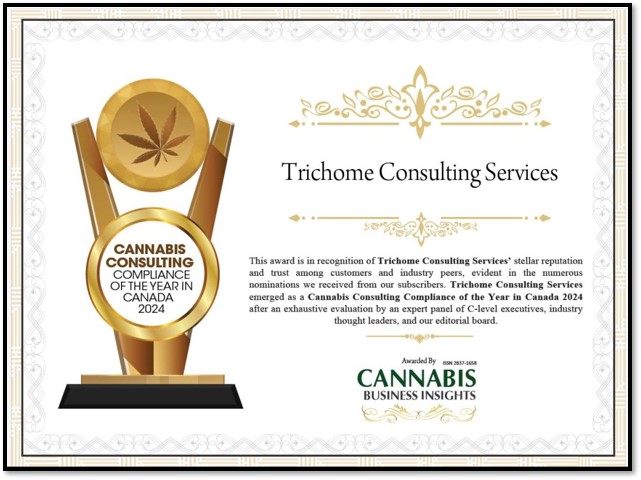
In a recent press release, Trichome Consulting Services (TCSI) announced that it has been awarded the prestigious title of Cannabis Consulting Compliance of the Year in Canada 2024. This award reflects the company’s exceptional reputation and the trust it has earned among its clients and industry peers.
TCSI emerged as the winner after an exhaustive evaluation process conducted by a distinguished panel of C-level executives, industry thought leaders, and an editorial board. The numerous nominations submitted by satisfied subscribers of TCSI underscored the company’s continued commitment to delivering top-tier consulting and compliance solutions in the cannabis sector.
“This recognition reaffirms our dedication to providing exceptional cannabis consulting and compliance services,” said John Karroll, Founder of Trichome Consulting Services. “We are honored by the trust our clients have placed in us, and we look forward to continuing to support businesses in the cannabis industry with the highest level of service and expertise.”
With a proven track record in helping cannabis businesses navigate complex regulatory environments, TCSI has become a trusted partner for companies across Canada, offering tailored compliance solutions and expert guidance. TCSI invites cannabis businesses looking for compliance support to reach out for a no-obligation video consultation to explore how the company can help them navigate the ever-changing regulatory landscape.
About Trichome Consulting Services
Trichome Consulting Services (TCSI) is a leading cannabis compliance and consulting firm dedicated to helping cannabis businesses across Canada meet their regulatory requirements. With a focus on providing practical and strategic solutions, TCSI is committed to ensuring its clients remain compliant and competitive in the fast-evolving cannabis industry.
TCSI experts crafting solutions built for global markets
TCSI delivers exceptional results through a distinguished team renowned in the cannabis industry. A team of specialists with deep expertise in compliance, site design, and other critical areas ensures clients have the tools and knowledge to excel while facilities meet stringent regulatory standards. Driven by a culture of excellence and global readiness, the team helps clients remain compliant while crafting world-class operational designs. This expertise empowers clients to confidently expand into global markets, backed by a team that understands local and international demands. Aiming for long-term success beyond immediate compliance requirements, TCSI guides clients through all the intricacies and operational demands, establishing itself as a prominent force in the global cannabis industry.
As the industry moves toward international trade, businesses face the added challenge of steering through the global cannabis market. This involves securing licenses in Canada and partnering with companies worldwide to expand into new markets.
TCSI has strong partnerships worldwide, including in Europe, Central America, and Australia, and ongoing discussions with governments in Mexico and Belize. Leveraging these relationships assists clients who want to export their products to varied countries, even those with stringent regulations.
(Globe Newswire) Oakville, Ont. – As Canadians gear up for Halloween festivities this weekend and into next week, MADD Canada is urging everyone to prioritize safety and avoid impaired driving. Whether you’re attending parties, trick-or-treating with the family, or heading out to haunted houses, the best way to ensure everyone gets home safely is by planning ahead for a sober ride.
“Halloween should be a time of excitement and joy for children, not tragedy,” said MADD Canada National President Tanya Hansen Pratt. “With so many kids walking door-to-door, often in dark costumes, we urge everyone to be extra cautious on the roads. The best way to protect these trick-or-treaters is by making safe choices and ensuring no one is driving impaired.”
Every year, hundreds of Canadians are killed, and thousands are injured in alcohol, cannabis and/or drug-related crashes. These tragedies are entirely preventable.
Everyone can do their part to keep Halloween celebrations and roads safe by:
Advertisement
Always planning ahead so you know how you are getting home safely;
Never driving a car, boat, ATV or any other vehicle while impaired;
Never getting into a vehicle being operated by someone who’s impaired;
Calling 911 if you see a driver you suspect is impaired.
Those looking for a safe, sober and reliable ride home at the push of a button can check out Uber, MADD Canada’s Official Designated Rideshare APP. Visit https://www.uber.com/ca/en/ for more information.


















Recent Comments