(CNW) Veendam, Netherlands – Bedrocan International, the world’s most experienced producer of pharmaceutical-grade medicinal cannabis, is returning to the Canadian medicinal cannabis market. The company purchased a facility in Scarborough, the former home of Bedrocan in Canada, and was recently granted a cultivation license by Health Canada. These steps fulfil Bedrocan’s long-held promise of returning to Canada to grow standardised medicinal cannabis for Canadian patients. The company intends to start production in early 2025.
Bedrocan is solely focused on producing medicinal cannabis and is known for its high-quality cannabis products with consistent levels of THC and CBD. Bedrocan’s CEO Jaap Erkelens on Bedrocan’s attention to patients: “We have had a strictly pharmaceutical approach since our foundation in 2003. We use the knowledge we have acquired in more than twenty years of business to produce cannabis products that benefit patients exclusively. In the same vein as prescribing physicians, patients want a reliable, standardised product with the same therapeutic effect time after time.”
The intention is for Bedrocan to bring several standardised cannabis products to the Canadian market of which the Bedrocan® product is the most well-known. The cannabis products will be distributed through a third party via the medical sales channel to registered patients.
Bedrocan was previously active in Canada but ceased its activities after a partnership with Canopy Growth was terminated. Bedrocan has always expressed its intention to return to Canada one day. “We are thrilled to be coming back to Canada,” said Erkelens. “We look forward to serving patients in Canada and positively impacting the Canadian healthcare landscape.”
Three men who were part of a plan to bring millions of pounds worth of cannabis from Canada in Britain, hidden in mattresses, have been jailed for a total of nearly 20 years.
The cannabis arrived in Liverpool from Canada in January 2024. Eight bed frames were found to contain 668 sealed packages of cannabis weighing a total of 334kg, according to the UK’s Crown Prosecution Services.
The three men, Weiji Chen, 29, and John Kinsella, both of Liverpool, had previously pleaded guilty to the offences of importing and supplying cannabis between September 2023 and 16 January 2024. Luke Kinsella, John’s younger brother, 23, of no fixed abode, pleaded guilty to being concerned in the supply of cannabis.
Authorities say Chen was responsible for arranging for the cannabis to be imported into the UK from Canada. John Kinsella was one of Chen’s regular customers who wanted some of the imported cannabis to supply it to others. Luke Kinsella was also involved with unloading the imported cannabis.
Chen and John Kinsella first began smaller test runs of importing cannabis from Canada into the UK using the postal service, the court heard.
The conspiracy started in September 2023 when a number of ‘test runs’ were undertaken, arranged by Chen and John Kinsella, prior to the larger January importation. These importations were of a much smaller scale and were sent direct from Canada into the UK using the postal service.
Senior Crown Prosecutor Olivia Cristinacce-Travis, from the complex casework unit of CPS Mersey-Cheshire, said: “Over a few months, Weiji Chen and John Kinsella were involved in the importation of cannabis into Liverpool docks on an industrial scale, valued at over £2 million.
“The two men and Luke Kinsella had planned on supplying high-strain cannabis across the North West region. Due to the sophisticated nature of the importation, this was a complex prosecution in which the CPS successfully worked with Cheshire Constabulary to build a strong case against each of the men, who all entered guilty pleas and have now been jailed for a total of 17 and a half years.”
Related Articles
Like the work we do at StratCann, and want to support independent media?
Marigold PR is proud to present the Radicle Femmes Holiday Networking Series, an initiative designed to empower and celebrate women in the cannabis industry. This event series will take place in three cities across Canada this November: Vancouver, BC; Calgary, AB; and Toronto, ON.
The events will draw a diverse audience of entrepreneurs, marketers, retail decision-makers, and LP representatives offering a relaxed environment to forge alliances, share experiences, and amplify the collective voice of women in cannabis. Attendees will enjoy food and non-alcoholic drinks, along with gift bags filled with goodies from Marigold PR and partnering brands.
Partners include Spark Creative, Sense & Purpose, Frankie Smoke, Blunt Botanicals, Social Smoke Co, Sister Merci, Jane West, Jane Dope, Stewart Farms, Christina Michael, Cannabis MarketSpace, Grow Opportunity, StratCann, ADCANN, Cannabis Retailer, Mixed Suite Media, and Maggie Jane.
Marigold PR has been uniting women in cannabis since 2017, fostering insightful conversations and networking opportunities for hundreds of women across the country. The inaugural Radicle Femmes event held on International Women’s Day 2024 ignited a sense of purpose within the cannabis community seeing over 170 attendees and underscoring the importance of investing in women.
Join us in shaping a more inclusive and equitable future for women in cannabis.
Spots are limited and pre-registration is required.
On Oct. 17, 2018, the Canadian government legalized the recreational use of marijuana. Given the legislation’s upcoming sixth anniversary, one researcher believes the time has come to assess how the process has impacted the medical marijuana market.
Associate professor Michael Armstrong, who specializes in operations research, conducted a new study demonstrating that while recreational legalization did see fewer patients remain in the medical market, the medical program is still running. Armstrong reveals that following recreational legalization, many individuals left the medical marijuana system, some of whom shouldn’t have been there in the first place. Data from the study reveals that patients who remained in the program increased the sizes of their purchases and stabilized their purchasing rates, which suggests that there is a need for a medical marijuana system.
The study analyzed data collected between 2017 and 2022, with a focus on how many patients registered to use medical marijuana, how much they purchased per order and how often their purchases were made. Armstrong also examined behavioral patterns that coincided with the Cannabis Act’s passage in June 2018, recreational sales launch in October of the same year, and the arrival of edibles and other products in stores in December of the following year.
The study found that while patient registration had been rising before recreational marijuana was legalized, the number of Canadians who sought medical marijuana licenses started changing after July 2018. Armstrong observed that following the act’s passage, Alberta recorded the highest reduction in registrations in the entire country. By contrast, rates of registration in Ontario slowed down during that period then gradually declined.
The study also demonstrated that there was minimal change to purchase sizes or registrations after marijuana stores first opened and sales began in October 2018. However, the frequency of medical marijuana purchases did decrease. Armstrong attributed the decline to retail stores offering the same products as medical stores, which offered consumers additional access to the products.
When marijuana offerings expanded to include products such as vapes, beverages and edibles, a huge change in patient behavior was observed, with registration rates dropping during this period. In the same period, product purchases in every order rose and purchase frequencies stabilized.
Armstrong doesn’t expect any major fluctuations in these trends in the future — unless the government makes changes to the accessibility of medical marijuana or the current pricing structure. He argues that the removal of sales tax or excise tax on medical marijuana would make it more attractive and cheaper to consumers than recreational marijuana.
It would be interesting to examine how different Canadian cannabis companies, such as Aurora Cannabis Inc. (NASDAQ: ACB) (TSX: ACB), are tailoring their operations and products to suit the recreational and medical cannabis market segments around the country.
About CannabisNewsWire
CannabisNewsWire (“CNW”) is a specialized communications platform with a focus on cannabis news and the cannabis sector. It is one of 60+ brands within the Dynamic Brand Portfolio @ IBN that delivers: (1) access to a vast network of wire solutions via InvestorWire to efficiently and effectively reach a myriad of target markets, demographics and diverse industries; (2) article and editorial syndication to 5,000+ outlets; (3) enhanced press release enhancement to ensure maximum impact; (4) social media distribution via IBN to millions of social media followers; and (5) a full array of tailored corporate communications solutions. With broad reach and a seasoned team of contributing journalists and writers, CNW is uniquely positioned to best serve private and public companies that want to reach a wide audience of investors, influencers, consumers, journalists and the general public. By cutting through the overload of information in today’s market, CNW brings its clients unparalleled recognition and brand awareness. CNW is where breaking news, insightful content and actionable information converge.
To receive SMS alerts from CNW, text CANNABIS to 888-902-4192 (U.S. Mobile Phones Only)
Please see full terms of use and disclaimers on the CannabisNewsWire website applicable to all content provided by CNW, wherever published or re-published: https://www.CannabisNewsWire.com/Disclaimer
A Quebec company that helps bridge the gap in medical cannabis access launched a new study this week that will look at the outcomes and effectiveness of different medical cannabis treatment plans.
Santé Cannabis, a community-based centre focussing on medical cannabis care and clinical research for more than a decade, will be drawing on this experience to lead the recruitment of 3,000 people using cannabis for medical purposes.
The study is also supported by grants from Aurora Cannabis, Tilray Medical, and Vectura Fertin Pharma, a Singapore-based company working with cannabinoids. Santé is also seeking assistance from other organizations.
“This study will investigate outcomes of a new wave of medical cannabis product formats, including capsules, tablets and innovative sublingual products, as well as new cannabinoid formulations such as CBN and CBG,” says Dr. Lorne Wiseblatt, a family medicine and palliative care physician with Santé Cannabis. “As clinicians, we must uphold our responsibility to support our patients with safe and effective treatment options.”
Dr. Michael Dworkind, the Medical Director & Co-founder of Santé Cannabis and an Associate Professor in Family Medicine at McGill University, adds:
“While medical cannabis has been legally accessible in Canada for almost 25 years, there are still many unanswered clinical questions to support its therapeutic use for conditions including chronic pain, epilepsy, spasticity, sleep, anxiety, and depression. This is such an important initiative to prioritize patients’ needs in the age of cannabis legalization.”
Santé Cannabis has—with the help of its team of physicians, nurses, and support staff—provided assessment and support to more than 20,000 patients since 2014, and is Canada’s first independently accredited cannabis Contract Research Organization (CRO).
The organization also holds four Cannabis Research Licences, allowing it to conduct clinical trials and observational studies. It also launched a patient-centred Psychedelic-Assisted Therapy program in 2024 to advance access to legal treatments, improve research & insurance coverage, and lead the development of innovative supportive care models.
There were more than 180,000 medical client registrations with federally licensed sellers of cannabis for medical purposes in March 2024, the most recent figures available. The average daily amount authorized by healthcare practitioners for individuals registered to access cannabis for medical purposes from federally licensed sellers was 2.4 grams per day.
by John & Nisha Whitehead, The Rutherford Institute
“In questions of power then, let no more be heard of confidence in man, but bind him down from mischief by the chains of the Constitution.”
—Thomas Jefferson
Public trust in the government to “do what is right” understandably remains at an all-time low.
After all, how do you trust a government that continuously sidesteps the Constitution and undermines our rights? You can’t.
When you consider all the ways “we the people” are being bullied, beaten, bamboozled, targeted, tracked, repressed, robbed, impoverished, imprisoned and killed by the government, one can only conclude that you shouldn’t trust the government with your privacy, your property, your life, or your freedoms.
Consider for yourself.
Don’t trust the government with your privacy, digital or otherwise. In the more than two decades since 9/11, the military-security industrial complex has operated under a permanent state of emergency that, in turn, has given rise to a digital prison that grows more confining and inescapable by the day. Wall-to wall surveillance, monitored by AI software and fed to a growing network of fusion centers, render the twin concepts of privacy and anonymity almost void. By conspiring with corporations, the Department of Homeland Security “fueled a massive influx of money into surveillance and policing in our cities, under a banner of emergency response and counterterrorism.”
Don’t trust the government with your property. If government agents can invade your home, break down your doors, kill your dog, damage your furnishings and terrorize your family, your property is no longer private and secure—it belongs to the government. Hard-working Americans are having their bank accounts, homes, cars electronics and cash seized by police under the assumption that they have allegedly been associated with some criminal scheme.
Don’t trust the government with your finances. The U.S. government—and that includes the current administration—is spending money it doesn’t have on programs it can’t afford, and “we the taxpayers” are being forced to foot the bill for the government’s fiscal insanity. The national debt is $35 trillion and growing, yet there seems to be no end in sight when it comes to the government’s fiscal insanity. According to Forbes, Congress has raised, extended or revised the definition of the debt limit 78 times since 1960 in order to allow the government to essentially fund its existence with a credit card.
Don’t trust the government with your health. For all intents and purposes, “we the people” have become lab rats in the government’s secret experiments, which include MKULTRA and the U.S. military’s secret race-based testing of mustard gas on more than 60,000 enlisted men. Indeed, you don’t have to dig very deep or go very back in the nation’s history to uncover numerous cases in which the government deliberately conducted secret experiments on an unsuspecting populace—citizens and noncitizens alike—making healthy people sick by spraying them with chemicals, injecting them with infectious diseases and exposing them to airborne toxins. Unfortunately, the public has become so easily distracted by the political spectacle out of Washington, DC, that they are altogether oblivious to the grisly experiments, barbaric behavior and inhumane conditions that have become synonymous with the U.S. government, which has meted out untold horrors against humans and animals alike.
Don’t trust the government with your life: At a time when growing numbers of unarmed people have been shot and killed for just standing a certain way, or moving a certain way, or holding something—anything—that police could misinterpret to be a gun, or igniting some trigger-centric fear in a police officer’s mind that has nothing to do with an actual threat to their safety, even the most benign encounters with police can have fatal consequences. The number of Americans killed by police continues to grow, with the majority of those killed as a result of police encounters having been suspected of a non-violent offense or no crime at all, or during a traffic violation. According a report by Mapping Police Violence, police killed more people in 2022 than any other year within the past decade. In 98% of those killings, police were not charged with a crime.
Don’t trust the government with your freedoms. For years now, the government has been playing a cat-and-mouse game with the American people, letting us enjoy just enough freedom to think we are free but not enough to actually allow us to live as a free people. Freedom no longer means what it once did. This holds true whether you’re talking about the right to criticize the government in word or deed, the right to be free from government surveillance, the right to not have your person or your property subjected to warrantless searches by government agents, the right to due process, the right to be safe from militarized police invading your home, the right to be innocent until proven guilty and every other right that once reinforced the founders’ belief that this would be “a government of the people, by the people and for the people.” On paper, we may be technically free, but in reality, we are only as free as a government official may allow.
Whatever else it may be—a danger, a menace, a threat—the U.S. government is certainly not looking out for our best interests, nor is it in any way a friend to freedom.
Remember the purpose of a good government is to protect the lives and liberties of its people.
Unfortunately, what we have been saddled with is, in almost every regard, the exact opposite of an institution dedicated to protecting the lives and liberties of its people.
“We the people” should have learned early on that a government that repeatedly lies, cheats, steals, spies, kills, maims, enslaves, breaks the laws, overreaches its authority, and abuses its power at almost every turn can’t be trusted.
So what’s the answer?
For starters, get back to basics. Get to know your neighbors, your community, and your local officials. This is the first line of defense when it comes to securing your base: fortifying your immediate lines.
Second, understand your rights. Know how your local government is structured. Who serves on your city council and school boards? Who runs your local jail: has it been coopted by private contractors? What recourse does the community have to voice concerns about local problems or disagree with decisions by government officials?
Third, know the people you’re entrusting with your local government. Are your police chiefs being promoted from within your community? Are your locally elected officials accessible and, equally important, are they open to what you have to say? Who runs your local media? Does your newspaper report on local events? Who are your judges? Are their judgments fair and impartial? How are prisoners being treated in your local jails?
Finally, don’t get so trusting and comfortable that you stop doing the hard work of holding your government accountable. We’ve drifted a long way from the local government structures that provided the basis for freedom described by Alexis de Tocqueville in Democracy in America, but we are not so far gone that we can’t reclaim some of its vital components.
As an article in The Federalist points out:
“Local government is fundamental not so much because it’s a “laboratory” of democracy but because it’s a school of democracy. Through such accountable and democratic government, Americans learn to be democratic citizens. They learn to be involved in the common good. They learn to take charge of their own affairs, as a community. Tocqueville writes that it’s because of local democracy that Americans can make state and Federal democracy work—by learning, in their bones, to expect and demand accountability from public officials and to be involved in public issues.”
To put it another way, think nationally but act locally.
As I make clear in my book Battlefield America: The War on the American People and in its fictional counterpart The Erik Blair Diaries, there is still a lot Americans can do to topple the police state tyrants, but any revolution that has any hope of succeeding needs to be prepared to reform the system from the bottom up. And that will mean re-learning step by painful step what it actually means to be a government of the people, by the people and for the people.
ABOUT JOHN W. WHITEHEAD
Constitutional attorney and author John W. Whitehead is founder and president of The Rutherford Institute. His most recent books are the best-selling Battlefield America: The War on the American People, the award-winning A Government of Wolves: The Emerging American Police State, and a debut dystopian fiction novel, The Erik Blair Diaries. Whitehead can be contacted at staff@rutherford.org. Nisha Whitehead is the Executive Director of The Rutherford Institute. Information about The Rutherford Institute is available at www.rutherford.org.
Connect with The Rutherford Institute
Cover image based on creative commons work of GDJ image_pdfimage_print
Truth Comes to Light
Truth Comes to Light highlights writers and video creators who ask the difficult questions while sharing their unique insights and visions.
Everything posted on this site is done in the spirit of conversation. Please do your own research and trust yourself when reading and giving consideration to anything that appears here or anywhere else.
On October 9, Ontario Provincial Police in Orillia executed a search warrant in Ramara Township, seizing several thousand cannabis plants and more than 100 kilograms of dried cannabis.
Police say seven individuals between the ages of 56-68 y/o face multiple charges in connection with the raid. The search warrant was executed on the property with the assistance of neighbouring street crime units.
Law enforcement say they began an investigation into the property in August, which was connected to a personal or designated medical production licence. The “grow was outdoors and significantly over the licensed amount” said OPP in a media release.
Police seized 2,125 cannabis plants and 111 kilograms of dried cannabis.
Charged have been laid against Yong Li, 68, of Ramara, Lifang Yang, 56, of Scarborough, Xuan Zhu, 56, of Thornhill, Yanling Su, 57, of Markham, Yanbing Li, 60, of no fixed address, Wu-qin Su, 59, of Scarborough, and Jiezhen Chen, 57, of Vaughan, with possession for the purpose of distribution and unlawful cultivation of cannabis.
Related Articles
Like the work we do at StratCann, and want to support independent media?
Tilray Brands, Inc. brought in $200 million in net revenue and gross profit of $59.7 million in the first quarter of 2025, but still saw a net loss of $34.7 million (all figures in US dollars).
This is an increase in net revenue from Q1 2024 ($177 million) but down from $229.9 million in net revenue and gross profit of almost $82.4 million in the previous quarter (Q4 2024).
The company, which has operations in Canada and the US, as well other countries like Germany, reported a net loss of $34.7 million in Q1 2025, which covers the three months ended August 31, 2024. This is up from a $15.4 million loss in the previous quarter and a net profit of $21.2 million in the same quarter in the previous year (Q1 2024).
Tilray’s net revenue from its cannabis operations in the most recent quarter were $61.2 million, down from $70.3 million in Q1 2024. It’s revenue from sales of Canadian medical cannabis were nearly $6.3 million while revenue from sales of adult-use, non-medical cannabis in Canada were $57.2 million.
Revenue from wholesale cannabis was $5.5 million while revenue from international cannabis sales was $12.2 million. Tilray incurred nearly $20 million in excise costs for sales in Canada in the three months ended August 31, 2024 for total net revenue of $61.2 million from cannabis sales from its Canadian operations.
Screenshot
Tilray’s revenue from Canadian adult-use cannabis was down from $71.2 million in the same quarter in 2024, while medical sales were up slightly from $6.1 million in Q1 2024. Wholesale revenue was up slightly while revenue from international sales increased by about $2 million.
“We’re not going to play in areas where it’s just all about price,” said Simon. “Our teams have done a great job…educating consumers [that] they’re going to have to pay a little more for the quality of products they’re getting.”
Irwin Simon, Tilray
In an earnings call, said Tilray CEO Irwin Simon has probably lost “well over” $200 million due to price compression over the last three years, which accounts to challenges with their bottom line, something they say they see beginning to stabilize.
Rather than fighting against this price compression, Simon says the company is focussing on educating its customers about the need to pay more for high quality products.
“We’re not going to play in areas where it’s just all about price…,” said Irwin. “Our teams have done a great job…educating consumers [that] they’re going to have to pay a little more for the quality of products they’re getting.”
Tilray sells medical cannabis under the Tilray, Aphria, CC Pharma, and Symbios brands. It sells adult-use cannabis under the brands Bake Sale, Broken Coast, Canada, Chowie Wowi, Good Supply, HEXO, Mollo, Original Stash, Redecan, RIFF, Solei, the Batch, and XMG.
In a company press release, Simon added: “As the Chairman and CEO of Tilray Brands, I am excited to lead a company that is disrupting the CPG industry through innovative products that are transforming the way consumers eat, drink, and unwind with cannabis, hemp and beverage products. Our investments in the cannabis, wellness, beverage, and distribution industries are focused on shaping the future and staying ahead of the curve. We are dedicated to executing our strategic plan to increase revenue, drive operational efficiencies, and improve margins and profitability while investing in our continued growth. Our commitment to innovation and growth is unwavering.
“We believe that there is a greater likelihood that the upcoming U.S. Presidential elections will result in improved regulatory changes in the cannabis industry, as both candidates have publicly confirmed their support for further legalization. We are optimistic about the future of the cannabis industry and look forward to the potential opportunities that lie ahead.”
My highlight from the show? The one-on-one with Tommy Chong where he signed two High Times magazines of him on the cover. There’s a video of me in a vintage yellow High Times t-shirt sitting on a white CANNA couch talking to Chong. Basking really, what a beautiful genuine soul.
As an aside, I hope to interview him when I’m not quite so smitten.
I discovered High Times in a box in storage as a kid. With them, my mother’s t-shirt from 1975. A natural investigator, I found the artifacts from my folks’ heyday, including their stash grown by my uncle in the Cowichan Valley.
All this to say is that I come by it honestly, for better or for worse. This interest in exploration and the human relationship to substance, as chemists of the imagination.
I had some fun in Edmonton!
Advertisement
Another highlight? The “Tommy Returns Home” interview by his son, Paris Chong. The comedic edge sprinkled with outdated colloquialisms lent itself to a glimpse inside what they called “the Tommy Chong approach to life.”
First a musician and later a comedian – after hearing some of the greats play the guitar, he decided it best to go into comedy full-time.
Besides, “what do you call a musician without a girlfriend?” asked Chong. “Homeless!”
I reflect on the power and genius of the comic. Allowed a hall pass to places otherwise forbade. Not something that can be learnt, really. Techniques massaged but the satire inherent. The secret sauce being the outrageous and the self-deprecating.
Chong spoke about Richard Marin. “Don’t you have a nickname?” he asked. “Yeah, Cheech!”
Advertisement
Chong and Marin? No.
Richard and Tommy?
He left the session screaming it into the wind: “Cheech and Chong!”
From Left: Kieley Beaudry, Alena Jenkins, Luke Dickson, Nick Van Dam.
Crafting for Success
Producing with retailers in mind – expertly moderated by Kieley Beaudry – was a discussion that focused on the producers’ relationship to the retailer, specifically hinged around the premium market segment and the cannabis connoisseur.
Advertisement
Beaudry also presented a call to action for listeners advising they contact the AGLC, instigating a conversation about what they do and do not like about provincial policies.
Speaking from a group of people still in this space six years in, “as a licensed producer, at the end of the day it’s only going to come down to the economics,” said Cannara’s Nick Van Dam. “It’s okay to have a mass marketed brand that’s there for the everyday consumer. For Cannara, we’re targeting a more refined consumer.”
Van Dam suggested to LPs, regardless of market segment, that they should “evaluate and be aware of how a market can potentially change; be aware of the risks.”
Alena Jenkins of FivePoint Cannabis is the last of the boutique cannabis retailers from her original group. She said: “when it comes to inventory decision making, it’s a value proposition. I’m not afraid of bringing in expensive items, in fact I like having expensive items on my menu. But the value has to be there, and it has to be there consistently.
“You get one bad lot, especially when you’re in that premium market, it’s not acceptable and you will lose brand allegiance from that retail purchaser and the consumer. So, if you’re going to be playing in that premium market, you better be coming out with premium products; it’s as simple as that.”
How far we’ve come from dry oregano pot, to the premium weed of the new millennium a quarter of a century in: “when it comes to determining your price, your price must match what you’re producing,” said Beaudry. But the difficulty of the elevated market segment is the reality of running into debt. “We can’t run an entire industry at a loss,” said Jenkins.
Luke Dickson from Simply Solventless Concentrates commented on the seasonality of the industry. Take note of industries with seasonal offerings, such as alcohol and cosmetics. Insofar as rotational SKUs, which we love, some categories are more conducive, like flower and vapes.
“Rosin, not distillate,” said Van Dam. “You can build interesting things with variety, especially when the brand keeps delivering on what they said they were going to do.” And in order to compete with the illicit market, “find out what the consumers of the illicit market are looking for.”
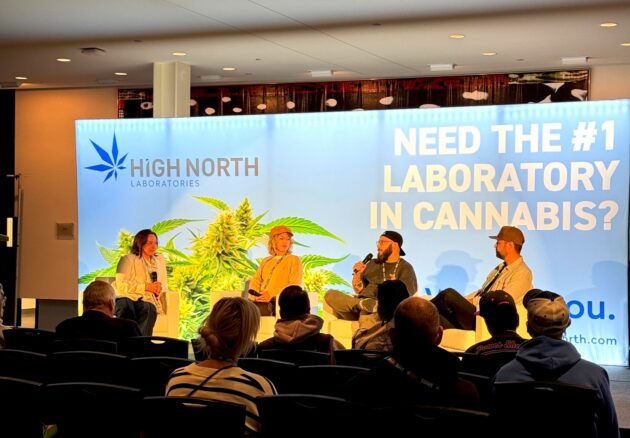
Alexandre Gauthier, Origine Nature & John Slaughter, High North.
The Science of White Ash
The grower workshop on new post-harvest research hosted by Alexandre Gauthier and John Slaughter, in collaboration with McGill University, presented their findings on water activity, organoleptic testing (sensory testing) and the composition of dry flower.
Slaughter spoke of the water activity and the risk of losing three per cent weight of crops if not monitored correctly. He pinpointed the decision to and sometimes pain point revolving around moving flower from the dry room into cure.
“Water activity is the answer for ‘is it ready to leave the dry room?’” said Slaughter. “Is it active, can mould grow on this area? That’s what you all want to know.
“If you really want to know loss on drying, (and this is what international markets do), there are different machines including a vacuum oven machine that will actually tell you what out of this is moisture, not terpenes. That difference and those tests are real; they’re legit.” Slaughter recommends Aqua Lab for precise water activity measurement.
Gauthier spoke about water activity used in other industries such as in food, especially frozen food.” Origine Nature employs strict data collection, especially in visual graph representations. Data is king.
“We trust no one but God. For everyone else, there’s data.”
Tobacco companies always conduct an ash study, and here the experts provided results of their ash studies. “Burning black doesn’t correct itself through curing,” Slaughter said; “water activity in itself will not save you.
“Water activity will make ash whiter by 15-25% but it won’t solve black ash problem.” Other factors to consider include nutrient content and drying techniques, which is why producers use graphs to compare different growing and drying methods.
Gauthier called Rubicon Organics and Jack Daniels the big brothers in the testing space, who are doing an excellent job as well with in house sommeliers and leveraging the Ganjier program. Employ organoleptic testing by trained sommeliers who evaluate taste, aroma and combustion quality. Don’t rely on “band-aid solutions” like chemical additives without first comprehending their full effects on the plant.
“Get ego out of the way and grow to what the consumer wants,” said Gauthier.
Slaughter knows “every country online is buying Canada’s weed.” We need the standardization that makes consistent and predictable products for export. “Medical grade products must have analytics dialed in,” he said. “We believe in Canada and want to be the No. 1 worldwide known for great cannabis.”
Moderator Dr. Av Singh, Dustan McLean & Ron Herrington.
Growers and Genetics
The emphasis on pro growers at each of these events is paramount. Whether they’re the Indigenous entrepreneurs and leaders in the space who are healing their communities and returning peoples’ abilities not only to walk with ease using cannabis products, but to dance and celebrate in ceremony.
Or they are the legacy market breeders and geneticists who are crafting the next smoke for the people. At the end of the day it’s about everyone’s ability to work together.
To welcome the illicit market into the legal market. To unite the regulated market with the sovereign red legacy market, where the wellness factor underpins all the work being done in this space, through the acknowledgement that we’re all open for business and are interested in a common future in good health and prosperity.
The Growers Lunch, toasting those who are the beating heart of this market sponsored by Biofloral, was another great success.
And as partial sponsors since 2018, publisher Adam Szpakowski and I welcomed a room of growers and ancillary businesses. Even I admitted to have been a ‘Fuck Corporate Weed’ kinda gal, and you all changed my mind.
But even in a corporate environment, we learn by listening to the elders that it is the pursuit of economic equality and mutual respect that brings us all together. And we thank the geneticists who offer a road map for the coming years in this industry, such as with Dustan McLean and Ron Herrington who are diversifying the gene pool by introducing heirloom genetics.
“2.5 years ago I finished fruit,” said Herrington, “and now I’m into funk. I want serious gas,” he said; “camphor smell. Not so much herbal but camphor and gassy smell.”
He predicts that over the next 3-4 years, the trends will be in favour of camphor flavours.
California Governor Gavin Newsom approved a measure that will allow the operation of marijuana cafés, modeled after those in the Netherlands. The law is set to come into effect on Jan. 1, 2025, subject to local government approvals.
Last year, Governor Newsom vetoed a similar proposal from Assembly Member Matt Haney, which would have permitted California’s cannabis retailers to run full kitchens and host events. Newsom’s main concern at the time was the lack of adequate worker protections in the bill.
In his latest signing statement, he expressed support for Haney’s improvements to the current bill. These changes include protecting employees’ right to wear masks, with employers covering the costs, and requiring that workers be informed about the dangers of secondhand marijuana smoke. Newsom also stressed that businesses that fail to follow these safeguards will not be viewed favorably.
The marijuana café law might be the only reprieve for California’s cannabis industry for the time being. The governor’s proposed $291 billion budget for FY 2024–2025 doesn’t include any cuts to the fees or taxes imposed on cannabis businesses.
Just a day earlier, Newsom vetoed a bill, AB 1111, that sought to allow small cannabis producers to sell their products directly to users, citing concerns about its wide scope. Further, he stated that the measure’s eligibility criteria, which included most licensed cannabis growers, could potentially strain the state’s cannabis control department’s regulatory efforts and disrupt the existing retail licensing structure.
The veto has been met with disappointment from advocates within the cannabis industry, particularly those representing small growers. The Origins Council, which represents around 800 producers in the Emerald Triangle, voiced its frustration, noting that small businesses are essential to the sustainability and equity of California’s cannabis market.
The bill, had it been signed into law, would have permitted small farmers to sell up to $175,000 worth of cannabis products at approved events, starting in January 2026.
Over the past few weeks, marijuana industry groups and advocates, such as the Origins Council, Equity Trade Network and Supernova Women, pushed hard for Newsom’s approval through various campaigns.
Despite the veto, Newsom noted that he was open to considering a revised version of the bill next year that would be more narrowly focused. He underlined that future legislation should address the major issues that the cannabis sector is currently facing, such as increased access to legal cannabis products and competition from unregulated sources.
This authorization of cannabis cafes in California is likely to be followed by marijuana companies, including SNDL Inc. (NASDAQ: SNDL), because it could usher in a new dynamic within legal marijuana markets in different jurisdictions. This is because when California leads the way, other jurisdictions often take a leaf from what has worked in the Golden State.
About CNW420
CNW420 spotlights the latest developments in the rapidly evolving cannabis industry through the release of an article each business day at 4:20 p.m. Eastern – a tribute to the time synonymous with cannabis culture. The concise, informative content serves as a gateway for investors interested in the legalized cannabis sector and provides updates on how regulatory developments may impact financial markets. If marijuana and the burgeoning industry surrounding it are on your radar, CNW420 is for you! Check back daily to stay up-to-date on the latest milestones in the fast -changing world of cannabis.
To receive SMS alerts from CNW, text CANNABIS to 888-902-4192 (U.S. Mobile Phones Only)
Please see full terms of use and disclaimers on the CannabisNewsWire website applicable to all content provided by CNW, wherever published or re-published: https://www.CannabisNewsWire.com/Disclaimer

















Recent Comments