
by Grow Up Conference | Oct 1, 2024 | Grow Opportunity, Media Partners
“The lack of accurate, standardized testing protocols for cannabis beverages is allowing products with THC levels an average of 41 per cent above legal limits to flood the market,” stated Callum Hanton, CEO of Bubble Bud Inc. “Some beverages were tested to be overdosed by over 71 per cent. Not only does this compromise product consistency and market integrity, it also exposes consumers to serious health risks from unknowing overconsumption.”
Bubble Bud Inc. has been at the forefront of addressing cannabis beverage testing issues since 2020. In collaboration with Agilent Technologies, the company developed a dedicated testing protocol that revealed significant discrepancies between existing methodologies and actual THC content. Their 15-month research showed that many products in the market contained higher THC levels than labelled. Following external validation to ensure data accuracy, the company shared its findings with Health Canada in January 2024.
Bubble Bud is calling on the regulated cannabis industry to join in prioritizing consumer safety and advocating for collaboration between industry, government, and regulators to enhance THC regulation enforcement and develop more effective testing protocols.
“We applaud Minister Nally for recognizing these risks and publicly calling out the need for change, but the Government of Canada and Health Canada must step up and implement robust, consistent testing methodologies across the board,” Hanton concluded. “We need to protect public health, uphold market integrity, and create a fair, safe market for both consumers and responsible producers and urge Health Canada to match Alberta’s urgency in addressing this critical issue.” Minister Dale Nally, Alberta’s Minister of Service Alberta and Red Tape Reduction, spoke at the 2024 GrowUp Conference earlier this week, highlighting this critical issue of inaccurate THC labelling in cannabis beverages.
by Grow Up Conference | Oct 1, 2024 | Grow Opportunity, Media Partners
(Globe Newswire) Toronto – TerrAscend Corp., a leading North American cannabis company, today announced that certain entities consolidated by the company in Michigan have completed the second draw of US$26 million in gross proceeds of the company’s senior secured term loan for total gross proceeds of US$140 million from funds managed by FocusGrowth Asset Management, LP, a leading capital provider to the cannabis sector, along with other members of a loan syndicate, which was previously announced on August 2, 2024.
The proceeds from the second draw were used to pay down the company’s higher interest Michigan debt. The Loan included an initial draw of US$114 million in gross proceeds, which was completed in August 2024, bringing the total gross proceeds under the transaction to US$140 million.
The Loan carries an interest rate of 12.75 per cent, matures in August 2028, contains no prepayment penalties and is guaranteed by the company and TerrAscend USA, Inc. No warrants were issued as part of the Loan. The loan is secured by the consolidated entities in Pennsylvania, California and Michigan, as well as certain entities in Maryland.
Ventum Capital Markets acted as the exclusive financial advisor to the company for the Transaction.
by Grow Up Conference | Oct 1, 2024 | Grow Opportunity, Media Partners
I’ve been breeding for just over 20 years now and growing for 30. I’m from Alberta, so we had to do everything very quietly. There was no real set culture in Alberta like there is in in B.C. and in lower Ontario; we’re a very conservative province. We had to be very quiet with what we were doing and it was tough to get genetics, short of driving to Vancouver.
I unfortunately lost my daughter to a fentanyl overdose; she was an opioid addict. I talked to Frenchy Cannoli shortly after that and it was a blessing. We talked for two hours about different terpenes, funny enough, that we were going to look for to help with this opioid crisis. That day I set out to create a cultivar to help battle the opioid crisis, and it’s still something we’re working on. There’s two major compounds we’re looking for: myrcene and caryophyllene.
We’re trying to create a cultivar that can help those people stop the need to use, and it’s something that we’re going to keep working on. And there’s a whole other myriad of things we look for when it comes to breeding structure, like how does it grow in a commercial facility?
Some cultivars are really beautiful at home in a tent, but you want to bring them to the commercial game and you can’t, because they’re just too much plant work and too much overhead. So how do you get that plant into something that’s commercially viable to grow?
I have also created a cultivar that pulls up 30 per cent less water than any other cultivar studied. It’s great for drought-stricken areas and went 28 days without being watered. I also grow on Galiano Island in B.C., and we have a lot of water restrictions there.
Some guys just want to breed for that high THC. Other guys want to breed for terpenes. Right now, at Big League Genetics, we sell mainly to Germany and Australia, and in Germany, they’re after terpene content. They don’t care about the THC; they want the experience. I think that’s something we need to be driving home more: the experience of cannabis and not the numbers. There is amazing stuff that’s 1:1 out there, and they make you feel fantastic.
I had a Violator Kush that was lightning in a bottle. When we had it on the legacy market, we couldn’t keep the packs; they were gone as soon as they were ready. We brought it to the legal market, did a proper COA on it, and my business partners said, ‘nobody’s going to want this.’ I said, ‘Get it into a market and just let them try it.’ It went to the OCS and it sold through right away.
I find with high THC, it’s a quick ramp up and I’m back down again. Whereas I find something that’s a little lower THC, higher CBD or even just lower THC and higher terpene content, sometimes I find those highs last longer, or it’s more enjoyable to smoke. Those super high THC for the most part are not the most tasty. I like something that I can sit back and relax with; that’s part of the experience. I can put it out halfway through and come back to it, and it still tastes delicious. At Ganjier, that’s called the ashtray test.
I breed for flavour. I look for dance partners: who’s going to make a real good dance partner coming from stable parents?
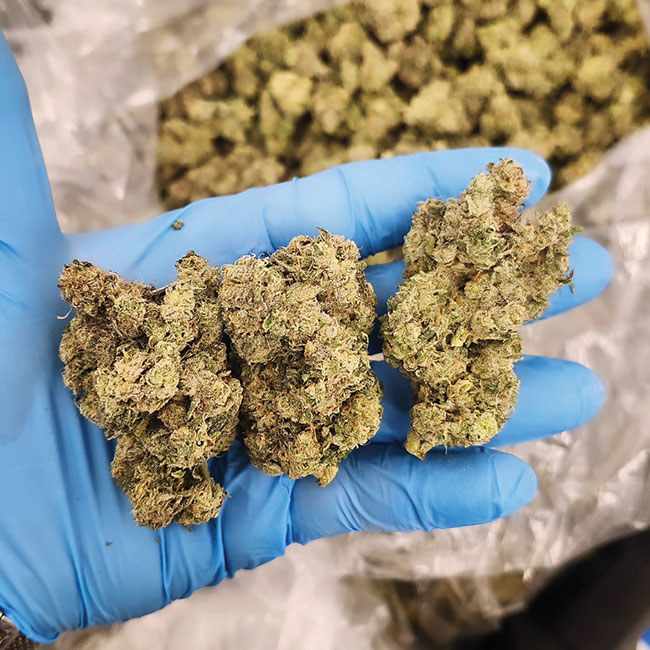
Gush Mintz by the team at Big League Cultivation. In Germany, where they export, buyers are seeking terpene content over THC – experience over the numbers.
Cherry pie is one of them out of California. I grow a lot with cherry pie; it’s a very dominant genetic plant, it’s a very crystally plant, it will pass on a lot of trichome structure to anything I put to it. It’s also delicious. I’m a cherry and grape fan. I love gas. I do like garlic as well.
As a breeder I take the Rick Ross McDonald’s approach to breeding, and I think a lot of LPs need to start this as well. We need to start telling the customer what’s on the menu and not asking them what they need. We need to force the narrative to our side, saying ‘this is what you need to smoke, and it will make you feel amazing. I promise you don’t need to worry about the numbers.’ McDonald’s doesn’t ask you what burger you want. They figure it out. They do research themselves, they’re ahead of the game, and they drop products and then they’ll pull them back if it doesn’t work. They have standards.
For me, White Widow Skunk, all the old standards, we need to bring those back to market. I have those as the standards and then we have our little exclusives that come in and out. I like to mix old school stuff with some new school stuff, so people get to experience a bit of both as a bit of a bridge; it’s been very successful for me.
My Thailand Wedding was at the Grow Up Conference four years ago, and no one was ready for it. Now I’m getting requests for the genetic constantly because it grows incredibly well in Ontario and Quebec, but it’s the old school flavour with some new school structure. I have some plants that grow the smallest little flowers, they are so bold, but it’s not commercially viable. How do I get that into another plant?
I think about what people like, and I try to be ahead of the game by about two years. I find, you don’t chase today’s trends, you create tomorrow’s. I’m not chasing a trend; I’m creating the next smoke for the people.
Dustan McLean was a founding partner and head of cultivation for Parkland Flower Inc. He is now the head of cultivation and master grower for Big League Cultivation in Alberta. In 2024, Dustan was named one of Canada’s Top 50 Cannabis Leaders.

by Grow Up Conference | Oct 1, 2024 | Cannabis News Wire, Media Partners
Delaware, Ohio, has put a temporary pause on recreational cannabis businesses operating within its city limits; the city council voted 5 to 2 to enforce a six-month moratorium. This decision halts recreational marijuana businesses from opening in the city, giving officials time to consider how to best regulate them. The move follows the approval of Ohio’s Issue 2, which legalized recreational marijuana in November 2023.
The ban applies strictly to businesses and does not affect residents using cannabis in their homes. Although the council has the authority to lift the moratorium before the six-month deadline, opinions on the matter varied.
Councilmember Cory Hoffman, who ultimately supported the ban, stated, “I don’t think we need any kind of moratorium currently. The state is issuing licenses, so I believe Delaware should allow businesses to operate here.”
Despite this, other members, such as Vice Mayor Kent Shafer, argued that the city needed more time to decide on regulations that align with local standards. Shafer noted, “We’re not looking to ban these businesses, but we need time to discuss any potential additional limitations.”
In addition to the moratorium, the city is also reviewing separate legislation that could place further restrictions on the location of certain businesses, including those selling cannabis, tobacco or vape products. The proposed ordinance would prohibit these establishments from setting up within 500 feet of places such as parks, schools, playgrounds, churches and libraries. It also includes a clause to prevent two or more similar businesses from being within one mile of each other. The rule would apply only to businesses of the same type, meaning a vape shop could be near a marijuana dispensary, but two vape shops could not be within a mile of each other.
The new regulations would also limit the types of signage businesses can use. Temporary signage, such as banners or yard signs, would be banned, and flashing or animated signs would not be allowed. Businesses would also be limited to only two illuminated window signs.
More than 56 townships or municipalities in Ohio have also enacted moratoriums on recreational marijuana businesses. As in other states where recreational marijuana has been legalized, Ohio permits local governments to set their own rules about whether marijuana sales can take place within their borders.
Many of these moratoriums, like Delaware’s, are temporary, providing time for local authorities to evaluate existing laws and address potential conflicts.
The cannabis industry, including leading companies such as TerrAscend Corp. (TSX: TSND) (OTCQX: TSNDF), could be hoping that the different local authorities in Ohio finalize their rule-making processes so that adults who would like to consume marijuana can access the products easily.
About CNW420
CNW420 spotlights the latest developments in the rapidly evolving cannabis industry through the release of an article each business day at 4:20 p.m. Eastern – a tribute to the time synonymous with cannabis culture. The concise, informative content serves as a gateway for investors interested in the legalized cannabis sector and provides updates on how regulatory developments may impact financial markets. If marijuana and the burgeoning industry surrounding it are on your radar, CNW420 is for you! Check back daily to stay up-to-date on the latest milestones in the fast -changing world of cannabis.
To receive SMS alerts from CNW, text CANNABIS to 888-902-4192 (U.S. Mobile Phones Only)
For more information, please visit https://www.CannabisNewsWire.com
Please see full terms of use and disclaimers on the CannabisNewsWire website applicable to all content provided by CNW, wherever published or re-published: https://www.CannabisNewsWire.com/Disclaimer
CannabisNewsWire
Denver, CO
www.CannabisNewsWire.com
303.498.7722 Office
Editor@CannabisNewsWire.com
CannabisNewsWire is powered by IBN

by Grow Up Conference | Oct 1, 2024 | Extraction Magazine, Media Partners
Even today, the single word “psychedelic” can still lead to completely opposite reactions.
There are those who let themselves be carried away by the sweet and confused memories of an experimental youth, those who want to keep away even from the sound of this mysterious and frightening word, those who with genuine curiosity want to get closer to this fascinating world, and those who study and do research to find innovative solutions to problems that afflict many people.
By psychedelic substance, we mean any compound capable of influencing the central nervous system (CNS), thus changing the normal functioning of the brain and generally altering perceptions, moods, and behavior. [1] Substances capable of generating these behavioral alterations are commonly called psychotropic drugs.
It should be noted that the word “drugs” can be used to refer to medicines or substances that have been considered legal for years and that many of us regularly take, such as nicotine or alcohol. Some drugs can be useful to compensate for malfunctions in our body, mental or physical illnesses. Although we know that humans have been experimenting with psychedelics for thousands of years, the in-depth study of these substances is a relatively recent matter.
The “Birth” of Psychedelic Drugs
The most accredited theory assumes that the co-evolution of the animal and plant kingdoms led to the creation of the first drugs. To protect themselves from large herbivores of the past, many plant species developed metabolic pathways that led to the production of extremely powerful chemical substances: alkaloids.
An alkaloid is an organic compound, usually plant-based, that has the ability to cause significant physiological changes even after taking just a small dose. [2] The use of psychotropic substances has accompanied the development of human civilization since its inception. Hallucinogenic plant derivatives and alcoholic fermented drinks have been found in archaeological sites of the prehistoric age.
Paleolithic man had a knowledge of the effects of the herbs he collected and used for recreational, nutritional, and healing purposes.
In general, this is a behavior that also occurs in other species besides humans: numerous cases of living beings consuming plants with medicinal or, sometimes, simply intoxicating effects have been documented. The tendency to use narcotic substances is inherent to the animal kingdom itself. The reason has to be found in the adaptogenic function that some plants possess. Certain natural active ingredients improve the body’s resistance to environmental stressors and increase the possibility of adaptation and survival in a given habitat.
The First Traces of Use of Psychoactive Substances
Many researches and studies have been done to trace and date excavations and fossils found in the most disparate parts of the world. We must start from the assumption that in any part of the world, wherever there was abundant flora, the psychotropic substances contained in them were more or less used.
In the European area of prehistoric times there was a great variety of species and fungi with psychoactive properties, such as hemp (Cannabis sp.), ephedra (Ephedra sp.), opium poppy (P. somniferum), some members of the Solanaceae family, such as black henbane (Hyoscyamus niger), deadly nightshade (Atropa belladonna), jimsonweed (Datura sp.) or mandrake (Mandragora officinarum) but also hallucinogenic mushrooms such as the liberty cap (Psylocybe semilanceata), ergot fungus (Claviceps purpurea), or even the fly agaric mushroom (Amanita muscaria), among many others.
It is important to underline how these plants and fungi, despite being known for their psychoactive and psychotropic effects, could also be used for other purposes, such as the production of fiberl. Others, however, were used as food for animals or simply accidentally collected as infesting plants in the fields. Therefore their presence in archaeological sites does not necessarily mean that they were used by man as mind-altering substances.
One of the earliest findings testifying the presence of psychotropic plants in the Old World is that of a middle paleolithic burial cave in Shanidar, northern Iraq, approximately 60,000 years BC. A number of medicinal plants were found around the skeleton of an adult man aged between 30 and 40, including ephedra, a natural stimulant. [2]
Some evidence of the use of psychotropic substances by man dates back 7,000 years ago and comes from some rock representations in a cave in Tassili N’Ajjer in Algeria. The ancient illustrations depict priests holding mushrooms in their hands.
Some archaeological remains of “mushroom stones” highlight how in Guatemala in 1500 BC, there was a real mushroom cult. Instead, they date back to 1000 B.C. the Mexican statues depicting the Psilocybe mexicana, in which divine figures emerge from the bodies of the fungi, testifying to their spiritual value.
Petroglyphs depicting anthropomorphic figures with mushrooms attached to their heads date again to 1000 B.C., which tell us of the use of Amanita muscaria intoxicating mushroom, among the Čukotka people in Siberia.
The oldest evidence for peyote, on the other hand, is from 3700 B.C. from Native Americans in the Rio Grande area. In Shumla caves have been found remains of “peyote buttons” and small carvings showing a cactus. The Peruvian Chavin stone from 1300 B.C. has a carved sculpture showing a deity holding a San Pedro cactus. Peyote has been used for ceremonial purposes in many cultures in Texas and Mexico as early as 1000 BC. [3]
Psylocibin
As mentioned, the first uses of psilocybin date back thousands of years ago, but even in recent decades, this substance has aroused renewed interest in the field of medical research, more specifically in psychological therapy. Western medicine became interested in this substance in 1958, when it was first identified and isolated.
It was subsequently synthesized by Albert Hoffman in 1959. In 1960, psilocybin was widely used in the treatment of psychological disorders such as depression or to treat addictions, with time and diffusion, this substance also became famous for recreational use, from 1970 onwards, its use in the medical field slowly waned. Since the late 1990s, psilocybin has regained some popularity, but only ever as a recreational drug. [4]
Peyote
Peyote (Lophophora williamsii) is a well-known cactus with psychotropic properties found mainly in northern Mexico, one of the most renowned hallucinogenic plants in the world. This plant was used in shamanic rites of the pre-Hispanic period. In fact, these rituals have been practiced by native populations since very ancient times and have partially fallen into disuse since the period of Spanish conquest. At the center of these rituals was the cult of Peyote. Based on some rock paintings and archaeological excavations, it has been deduced that these rituals date back 3000 years ago, this cactus was already known and used in very ancient times.
The ethno-geographical origin of Peyote appears today to be a fairly large area north-west of Mexico, corresponding to the territories of the Tarahumara, the Cora, and the Huicholes. From here, the ritual and medicinal use of the cactus spread to the south with the Toltecs and Aztecs in the classical era, and then to the north in a much more recent era towards the Indians of the Great Prairies in the 19th century.
Here, the use of peyote became a true sacrament, at the center of a syncretic cult that, at the end of the century, catalyzed the hopes of rebirth of the “native” nations with various shaman-preachers. The name peyote derives from peiotl of Nahuatl origin, a language of the Aztecs, a name that probably refers to the silk cocoon due to the white fuzz that covers the button-like surface of the cactus. The scientific name Lophophora also etymologically means “ridge-bearing”. [5]
LSD
LSD (lysergic acid diethylamide) is a psychedelic substance capable of causing behavioral changes, sensory amplifications, a sense of peace, extreme calm, but also hallucinations, or the famous bad trip, anxiety, fear, and psychological discomfort. Since its discovery, LSD has often been used in clinical trials on patients and even by psychiatrists themselves. Its use soon went beyond medical boundaries and spread very quickly as a recreational drug. LSD was first synthesized in 1938 by the Swiss chemist named Albert Hoffman (1906–2008).
After having brilliantly completed his studies, Hoffman joined a chemical-pharmaceutical laboratory in Switzerland as an assistant to dedicate himself to the search for natural molecules that could be used for the creation of new drugs. In 1938, Hoffman first systematized this powerful molecule, with similar structure to ergot alkaloids: in fact these fungi contain ergotamine which is the precursor of the lysergic acid.
After some unsatisfactory tests on animals, Hoffman accidentally absorbed a very small dose through his fingertips, thus experiencing sensations that were unusual for him, such as dizziness, restlessness, and hallucinations, which vanished after a few hours. A few days later, the chemist decided to voluntarily take LSD to confirm the origins of the sensations he had previously felt.
From here, experiments began in which Hoffman described the various sensations, both positive and negative, that this new substance caused him. LSD quickly spread even outside the academic sphere, influencing the cultural and social aspects of the time, which is why at the end of the 1960s LSD was declared illegal by the United States government. [6]
References:
[1] Baron S, Linton S, O’Malley MA. On Drugs. J Med Philos. 2023 Nov 3;48(6):551-564. doi: 10.1093/jmp/jhad035. PMID: 37352546; PMCID: PMC10629940.
[2] Guerra Doce E., The Origins of Inebriation: Archaeological Evidence of the Consumption of Fermented Beverages and Drugs in Prehistoric Eurasia. «Journal of Archaeological Method and Theory», 22 (2015), p. 715.
[3]https://www.slow-news.com/serie/il-lungo-viaggio-storia-universale-della-psichedelia/le-sostanze
[4] Filip Tylš, Tomáš Páleníček, Jiří Horáček, Psilocybin – Summary of knowledge and new perspectives, European Neuropsychopharmacology, Volume 24, Issue 3, 2014, Pages 342-356, ISSN 0924-977X,https://doi.org/10.1016/j.euroneuro.2013.12.006.
(https://www.sciencedirect.com/science/article/pii/S0924977X13003519)
[5] B. de Sahagún, Historia general de las cosas de Nueva España, riportato in W. La Barre, The Peyote Cult, New York, Schocken Books, 1959, p. 10. L’opera del frate castigliano fu pubblicata per la prima volta in Messico nel 1829-30, cosicché il primo resoconto pubblicato sul cactus “divino” è quello di J. Cardenas nel 1591.
[6]https://www.swissinfo.ch/ita/scienza/60-anni-per-l-allucinogeno-lsd/3270724#:~:text=Nel%201963%20scadde%20il%20brevetto,la%20Sandoz%20cess%C3%B2%20la%20produzione.

by Grow Up Conference | Oct 1, 2024 | Media Partners, Stratcann
Sixteen men were arrested on October 1 in Quebec in connection with the production, trafficking, distribution and sale of illicit cannabis in Montérégie.
The Sûreté du Québec’s Cannabis Smuggling Investigation Service conducted its investigation in collaboration with the Saint-Jean-sur-Richelieu Police Department, the Richelieu-Saint-Laurent Intermunicipal Police Department and the Longueuil Agglomeration Police Department.
The arrests took place in Brossard, Carignan, Chambly, Napierville, Saint-Alexandre-d’Iberville, Saint-Constant and Saint-Jean-sur-Richelieu.
The arrests come from previous searches carried out by law enforcement, particularly in September 2023, on production sites operated by individuals police say are linked to organized crime.
These individuals were primarily producing cannabis using Health Canada registration certificates for personal or designated production for medical purposes, but police say their investigation found the sites were being used in violation of those medical allowances.
More than 200 police officers worked on this investigation while the arrests on the morning of October 1 used more than 30 police officers, including the Sûreté du Québec’s tactical intervention group.
Coordinated by the Ministry of Public Security, the ACCES Cannabis program (Actions Concertées pour Contrer les Économies Souterraines) is a government initiative set up in 2018 to combat cannabis smuggling at all stages of supply, from illegal production to neighbourhood smuggling, throughout Quebec. Its objective is to promote the integrity of Quebec’s tax system, reduce the accessibility of cannabis for young people and direct consumers to a legal and safe market.
Recently, Sûreté du Québec also said it had seized thousands of illegally-grown outdoor cannabis plants so far this year. Investigators from the ACCES Cannabis Unit of the Quebec City Police Department (SPVQ) recently arrested a 47-year-old man during a search of a business on rue Saint-Joseph for the illegal sale of cannabis and its derivatives.
Like the work we do at StratCann, and want to support independent media?

by Grow Up Conference | Oct 1, 2024 | Media Partners, Stratcann
To date, Health Canada has issued just two Notice of Violations associated with potential violations of promotion prohibitions since October 17, 2018.
Between October 17, 2018 and March 31, 2024, Health Canada assessed 1,541 cases of potential non-compliance related to promotions. This resulted in 134 actions taken, the vast majority of them compliance emails or letters or compliance promotion emails or calls.
Despite all of this activity, as of the end of March 2024, the federal agency has only issued two Notice of Violations (NOV) associated with potential violations of promotion prohibitions since October 17, 2018.
Just 11 of those 134 actions taken included warning letters, and 32 resulted in referrals to RCMP.
Health Canada also says they conducted five inspections at promotional events from April 1, 2018, to March 31, 2019, two in Toronto, one in Oro-Medonte, Ontario, one in Victoria, BC and one in Regina.
The federal Cannabis Act includes several different enforcement tools that can be considered when deciding on the appropriate enforcement actions to prevent or address non-compliance. While these tools do include options, from calls and/or letters to suspension or cancellation of a federal licence, the issuance of a ministerial order, or the issuance of administrative monetary penalties (AMP) of up to $1 million, the federal government tends to take a soft-touch approach, focussing more on first informing licence holders of their potential violations of federal rules before escalating to more significant penalties.
Health Canada uses information from both internal and external sources to help it identify any possible risks to public health and public safety, but a spokesperson for the agency tells StratCann that they do not collect data that shows how they became aware of any potential issues.
A media representative with Health Canada tells StratCann that the agency could, in the future, publish Notices of Violations or information related to administrative monetary penalties on its website once it has been determined that the recipient committed a violation.
Related Articles

by Grow Up Conference | Oct 1, 2024 | Media Partners, Psychedelic News Wire
The U.S. Drug Enforcement Administration (DEA) recently announced new production quotas for controlled substances under schedules 1 and 2. The new quotas show increases in the supply of psychedelics such as ibogaine, psilocybin and psilocyn, which the federal agency notes shall be used for research purposes.
Specifically, the 2024 quotas for psilocyn and psilocybin have risen to 36,000 grams and 30,000 grams respectively. Ibogaine’s quota has also risen, from 150 grams to 210 grams, to help meet the increasing demand for research.
The agency’s increased focus on the production of psychedelics comes at a time when more anecdotal reports and studies are highlighting the potential these substances have in managing various mental-health conditions. For instance, studies have found that ibogaine may be useful in treating addiction. Advocates and researchers are calling for the DEA to support further studies on the substance.
In its statement, the DEA added that it remained committed to ensuring that all patients with legitimate medical needs can access prescribed drugs.
Cannabis production quotas remain unchanged, however, with the DEA maintaining its aggregate quota of 6.6 million grams since 2023. Quotas for other drugs such as mescaline, LSD, MDMA and DMT also remain the same.
This stability in marijuana production quotas comes as the agency prepares to decide on its rescheduling in December. This comes after it was recommended that the drug be rescheduled to schedule 3. Other substances under this schedule include ketamine and anabolic steroids.
Currently, cannabis is classified under schedule 1 of the Controlled Substances Act. Drugs under this classification are said to have no accepted medical use along with a high potential for abuse. If the drug is rescheduled, it could change how scientists access the drug for research, eliminating it from the aggregate production quota process.
A recent report by the Congressional Research Service notes that rescheduling may not eliminate all barriers in research, however. The report explains that researchers and drug sponsors of cannabis or CBD-containing drugs can only benefit from looser restrictions linked to rescheduling if congressional action is taken.
In other news, the DEA is expected to take part in a hearing involving a proposed ban on DOC and DOI. The two psychedelic compounds are analogs of DOM, a hallucinogen classified under schedule 1. These compounds act on an individual’s central nervous system and are highly selective agonists for serotonin 2 receptors in the brain.
The 10-day hearing comes after a lawsuit that challenged the scheduling process for these compounds was dismissed by a federal court.
These increasing production quotas for psychedelics suggest that more companies are joining the likes of Compass Pathways PLC (NASDAQ: CMPS) in studying hallucinogens with a view to leveraging their therapeutic potential.
About PsychedelicNewsWire
PsychedelicNewsWire (“PNW”) is a specialized communications platform with a focus on all aspects of psychedelics and the latest developments and advances in the psychedelics sector. It is one of 60+ brands within the Dynamic Brand Portfolio @ IBN that delivers: (1) access to a vast network of wire solutions via InvestorWire to efficiently and effectively reach a myriad of target markets, demographics and diverse industries; (2) article and editorial syndication to 5,000+ outlets; (3) enhanced press release enhancement to ensure maximum impact; (4) social media distribution via IBN to millions of social media followers; and (5) a full array of tailored corporate communications solutions. With broad reach and a seasoned team of contributing journalists and writers, PNW is uniquely positioned to best serve private and public companies that want to reach a wide audience of investors, influencers, consumers, journalists and the general public. By cutting through the overload of information in today’s market, PNW brings its clients unparalleled recognition and brand awareness. PNW is where breaking news, insightful content and actionable information converge.
To receive SMS alerts from PsychedelicNewsWire, text “Groovy” to 888-902-4192 (U.S. Mobile Phones Only)
For more information, please visit https://www.PsychedelicNewsWire.com
Please see full terms of use and disclaimers on the PsychedelicNewsWire website applicable to all content provided by PNW, wherever published or re-published: https://www.PsychedelicNewsWire.com/Disclaimer
PsychedelicNewsWire
San Francisco, CA
www.PsychedelicNewsWire.com
415.949.5050 Office
Editor@PsychedelicNewsWire.com
PsychedelicNewsWire is powered by IBN
by Grow Up Conference | Sep 30, 2024 | Cannabis News Wire, Media Partners
A recent federally funded study published in the “Journal of the American Medical Association (JAMA) Network Open” has revealed that cognitive functions such as inhibitory control, reward response and working memory do not change significantly after a year of cannabis use. The study refutes the long-held notion that marijuana use impairs memory and brain function. It involved adults who typically used cannabis for issues such as depression, anxiety, pain or sleep problems.
The research team conducted the study on 57 patients who had recently received medical cannabis certification in the Boston area. Brain activity was monitored using functional magnetic resonance imaging (fMRI) while participants performed various cognitive activities. Brain activity was evaluated at the beginning of the trial and again after a year of marijuana use.
The fMRI scans showed no discernible changes in brain activation related to mental activities even after a year of consuming medical marijuana. Furthermore, there was no correlation observed over time between the frequency of cannabis use and changes in brain activity.
In a statement summarizing their findings, the researchers emphasized that medical cannabis users who typically consume it in small to moderate doses to manage medical symptoms often experience minimal long-term neural changes in areas such as working memory, inhibitory control and reward processing. They reiterated that no notable differences were observed in brain activity between the initial and follow-up scans taken a year later.
These results may provide reassurance to individuals who rely on medical cannabis to manage their health concerns but are worried about the potential long-term effects on their brain health. However, the researchers recommended that further studies be conducted, particularly focusing on higher doses of cannabis, more frequent usage and studies involving younger individuals.
The study findings align with recent research that suggests prescribed medical marijuana has minimal short-term impact on cognitive function, even for those managing chronic illnesses.
While more research is necessary to fully understand the long-term consequences of marijuana use, a growing body of evidence indicates that some concerns may have been exaggerated. For instance, a study from last year found that cancer patients who used medical cannabis reported clearer thinking and better pain management.
Another study involving young people at risk for psychosis found that consistent marijuana use—more than two years—did not lead to early psychosis, as some critics of cannabis claim. Instead, it was linked to slight improvements in cognitive abilities and a reduction in the use of other drugs.
Furthermore, an analysis of data from about 65 million health insurance policyholders by the AMA revealed no discernible increase in diagnoses for psychosis in places where the drug has been allowed as opposed to those where it has not.
As more misconceptions about the effects of marijuana on the brain are debunked, the overall industry could grow more explosively and other verticals, such as the one in which Innovative Industrial Properties Inc. (NYSE: IIPR) operates, are set to also experience faster growth.
About CNW420
CNW420 spotlights the latest developments in the rapidly evolving cannabis industry through the release of an article each business day at 4:20 p.m. Eastern – a tribute to the time synonymous with cannabis culture. The concise, informative content serves as a gateway for investors interested in the legalized cannabis sector and provides updates on how regulatory developments may impact financial markets. If marijuana and the burgeoning industry surrounding it are on your radar, CNW420 is for you! Check back daily to stay up-to-date on the latest milestones in the fast -changing world of cannabis.
To receive SMS alerts from CNW, text CANNABIS to 888-902-4192 (U.S. Mobile Phones Only)
For more information, please visit https://www.CannabisNewsWire.com
Please see full terms of use and disclaimers on the CannabisNewsWire website applicable to all content provided by CNW, wherever published or re-published: https://www.CannabisNewsWire.com/Disclaimer
CannabisNewsWire
Denver, CO
www.CannabisNewsWire.com
303.498.7722 Office
Editor@CannabisNewsWire.com
CannabisNewsWire is powered by IBN
by Grow Up Conference | Sep 30, 2024 | Cannabis News Wire, Media Partners
The National Cancer Institute recently published scientific articles on cancer and cannabis to help individuals better understand questions they may have on how patients perceive marijuana. The articles, which were published in a special issue of the “JNCI Monographs,” discuss the results from federal surveys on patients from cancer centers in different parts of the country. This includes areas where marijuana is still outlawed, allowed for medical use only or is legal.
In the introduction, the National Cancer Institute explained that the project’s objective was to address major gaps in knowledge in our understanding of marijuana and cancer. This would, in turn, allow readers to learn more about how patients with cancer accessed and used the substance, and evaluate the perceived benefits and risks with the drug’s use, among other things.
One of the studies included in the report focused on patients who used medical cannabis to manage cancer-related pain as an alternative to opioids. The researchers discovered that their findings showed that patients were using marijuana regardless of its legality in the state they resided in.
A separate analysis discovered that the most common consumption mode for marijuana by patients was gummies and smoking, with the main reasons for use being mood, insomnia and pain. Another study examined the use of cannabis by patients living with cancer in different stages, discovering that survivors who had been diagnosed with the illness at its advanced stages were more likely to consider using marijuana than patients who had been diagnosed at the early stages.
Another study that was included in the report examined prescription opioids and marijuana use among cancer patients, with researchers observing that marijuana was used to manage symptoms of cancer, as well as an alternative to opioids.
In their report, the researchers noted that most participants used marijuana because it was safer, while others preferred it because it was less addictive. Some also preferred it because it had fewer side effects.
Professor Rebecca Ashare, the lead author of this study, revealed that the focus needed to be on educating providers on how to discuss the co-use of opioids, marijuana as well as their substitution.
The recently published monograph can be found online.
In other news, research published earlier in the year found that some minor cannabinoids may have anti-cancer effects on leukemia. The study examined minor cannabinoids and multiple myeloma, testing how cell models responded to cannabinoids such as CBN, CBC, CBG and CBDV.
The researchers determined that these compounds held the potential to be anticancer agents for multiple myeloma, primarily because of their cytotoxic effect on the cancer’s cell lines.
The growing attention that federal health authorities are giving to medical marijuana is likely to send positive signals to cannabis companies such as Tilray Brands Inc. (NASDAQ: TLRY) (TSX: TLRY) regarding the possible future changes in marijuana policy at the federal level.
About CannabisNewsWire
CannabisNewsWire (“CNW”) is a specialized communications platform with a focus on cannabis news and the cannabis sector. It is one of 60+ brands within the Dynamic Brand Portfolio @ IBN that delivers: (1) access to a vast network of wire solutions via InvestorWire to efficiently and effectively reach a myriad of target markets, demographics and diverse industries; (2) article and editorial syndication to 5,000+ outlets; (3) enhanced press release enhancement to ensure maximum impact; (4) social media distribution via IBN to millions of social media followers; and (5) a full array of tailored corporate communications solutions. With broad reach and a seasoned team of contributing journalists and writers, CNW is uniquely positioned to best serve private and public companies that want to reach a wide audience of investors, influencers, consumers, journalists and the general public. By cutting through the overload of information in today’s market, CNW brings its clients unparalleled recognition and brand awareness. CNW is where breaking news, insightful content and actionable information converge.
To receive SMS alerts from CNW, text CANNABIS to 888-902-4192 (U.S. Mobile Phones Only)
For more information, please visit https://www.CannabisNewsWire.com
Please see full terms of use and disclaimers on the CannabisNewsWire website applicable to all content provided by CNW, wherever published or re-published: https://www.CannabisNewsWire.com/Disclaimer
CannabisNewsWire
Denver, CO
www.CannabisNewsWire.com
303.498.7722 Office
Editor@CannabisNewsWire.com
CannabisNewsWire is powered by IBN





Recent Comments