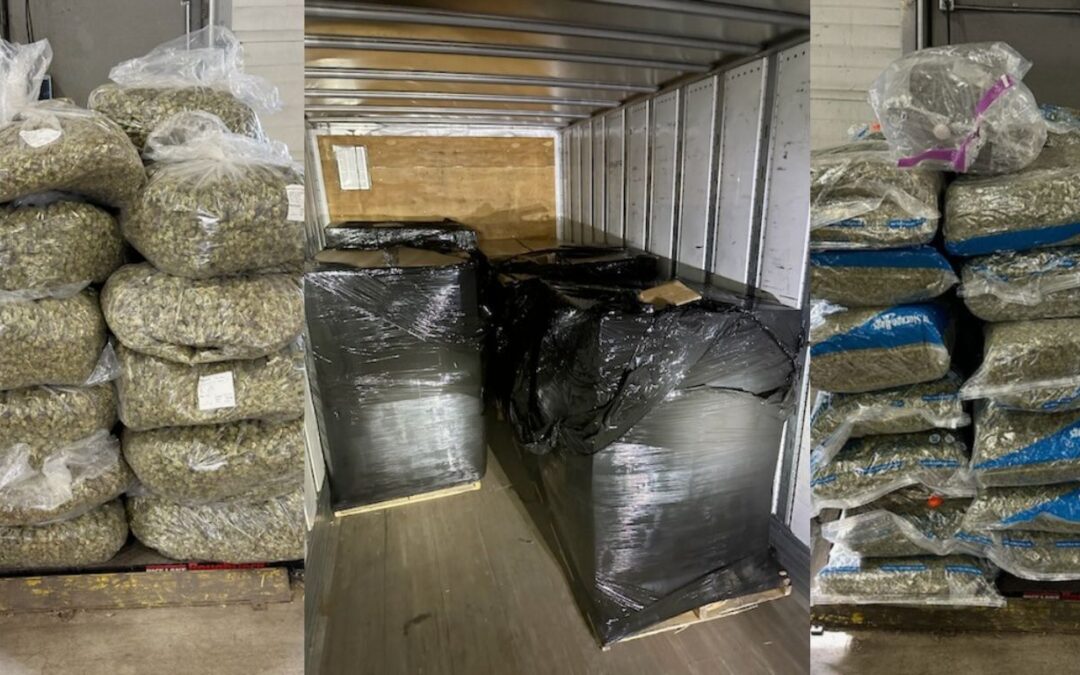
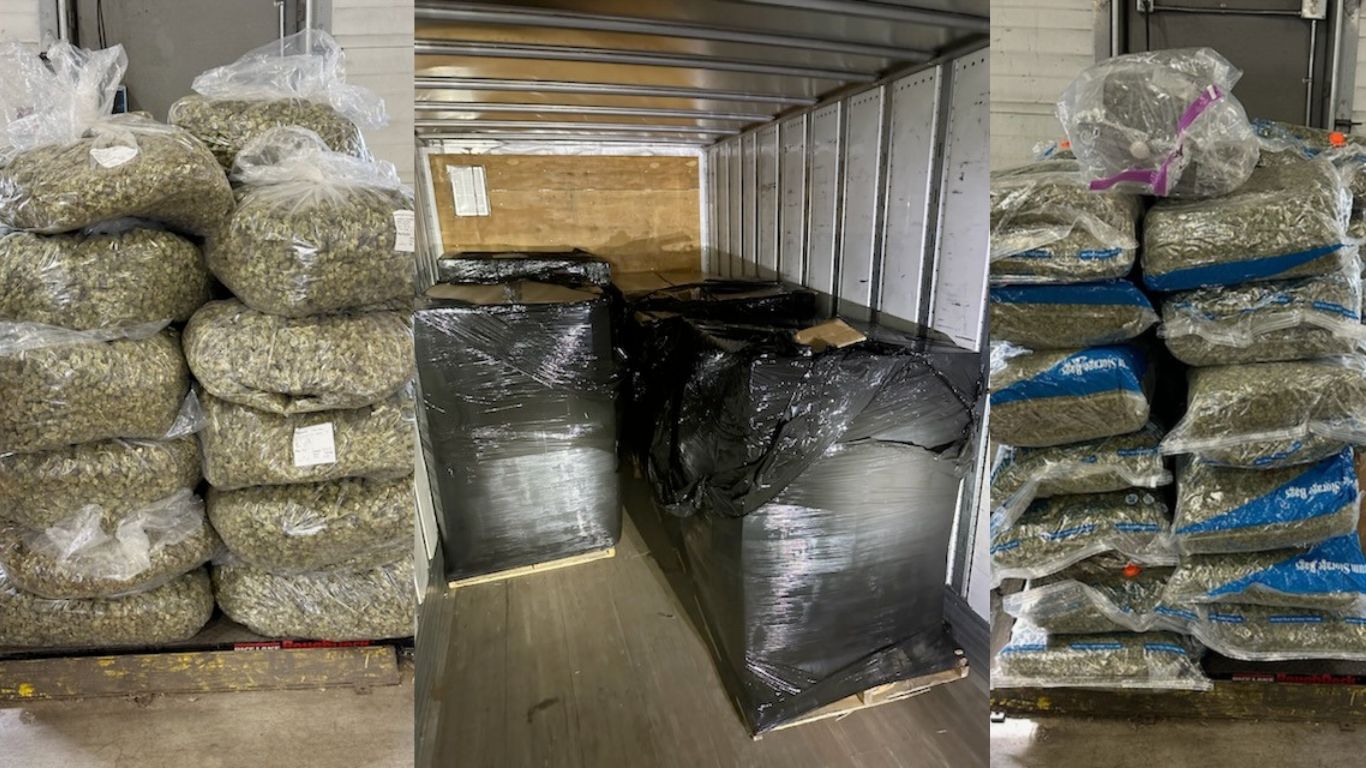
RCMP in Manitoba seized around 600 kg of cannabis during a traffic stop in Portage la Prairie on September 4.
The RCMP Roving Traffic unit conducted a traffic stop on an eastbound commercial vehicle on Highway 1 in the rural municipality of Portage la Prairie, about an hour east of Winnipeg.
The traffic stop led to a load inspection, which resulted in the discovery and seizure of approximately 600 kilograms of illicit cannabis on several pallets. Police arrested a 65-year-old male from Toronto, who will face charges under the Cannabis Act, Excise Act, and Liquor, Gaming and Cannabis Control Act.
RCMP continue to investigate.
“We continue to enforce the laws against illicit cannabis as it’s possession is a criminal offence and is an issue of public safety,” said Inspector Michael Gagliardi, Officer in Charge of RCMP Traffic Services. “Anyone purchasing illicit cannabis does not know where it came from or what it could be cut with. Often, illicit cannabis is associated with organized crime and all the other criminal elements that entails.”
Officials with New Brunswick’s Justice Department say they have made the “largest” seizure of illegal cannabis ever in Atlantic Canada.
Public Safety Minister Kris Austin issued a statement today saying an assortment of products, including 432 kilograms of dried cannabis, were believed to be headed for more than 30 unlicensed dispensaries in New Brunswick, Nova Scotia and Quebec.
Peace officers with the department executed a search warrant on Aug. 30 at a residence in Moncton, N.B., and three people were later arrested.
A 53-year-old man from Markham, Ont., and two people from Scarborough, Ont. — a 45-year-old woman and a 68-year-old man — are facing charges under the federal Cannabis Act and the Criminal Code.
Among other things, officers seized 8,000 pre-rolled cannabisjoints, 1,600 edible products, 925 electronic vape products, 540 grams of hashish and $143,000 in cash.
Austin says illegal cannabis is unregulated and may not adhere to the strict quality control and labelling requirements of the Cannabis Act, putting users at risk.
In a news release, the Justice Department said the operation “is believed to be the largest cannabis seizure in Atlantic Canada.”
“This seizure will disrupt the distribution network of dozens of unlicensed cannabis dispensaries, not only in New Brunswick but throughout Canada,” Austin said. “This is crucial, as illegal cannabis contributes to and supports organized crime.”
This report by The Canadian Press was first published Sept. 11, 2024.
The U.S. is divided when it comes to state and federal marijuana policy, but recent political developments could move the country toward greater acceptance of cannabis. Both major presidential candidates have signaled support for a proposed federal policy change that would reclassify marijuana as a less dangerous drug. Public approval of marijuana has grown significantly, and so has the number of states where it’s legally sold in stores. Several additional states will decide this fall whether to join 24 states and Washington, D.C., in legalizing the drug for recreation. A total of 38 states allow medical use of marijuana.
New research has determined that classic psychedelics including psilocybin and LSD are well tolerated in research and clinical settings, with rare adverse events occurring. For their study, the researchers focused on evaluating the severity, frequency and nature of adverse events linked to psilocybin, LSD, 5-MeO-DMT and DMT.
The researchers carried out a meta-analysis and systematic review that studied data obtained from 114 studies that involved more than 3,500 participants. The studies included were drawn from different databases, including Web of Science, PsycINFO, MEDLINE, and Scopus. The research covered studies published up to Feb. 8, 2024. They also had two independent reviewers who screened and selected studies that centered on research or clinical settings where the psychedelics were administered.
Adverse events were classified by type of study population and timescale, with the investigators applying a hybrid approach to include all reported adverse events following the administration of classic psychedelics. In addition, the researchers confirmed the presence of adverse events of special interest such as manic symptoms, suicidality, hallucinogen persisting perception disorder, cardiovascular events and psychotic disorders.
The investigators discovered that nonserious adverse events and serious adverse events that needed psychiatric or medical attention were rare in studies that involved the administration of classic psychedelics in monitored research or clinical settings. They found that only about 4% of participants with pre-existing neuropsychiatric disorders experienced serious adverse events, which included convulsive episodes, suicidal behavior, worsening depression and psychosis.
However, no severe adverse events were reported among healthy participants. Nonserious adverse events such as headaches and paranoia weren’t common either.
In modern research settings, the investigators found no reported cases of persistent psychotic disorders, death by suicide or hallucinogen-persisting perception disorder following the administration of psychedelics.
These findings demonstrate the difference in safety profiles between recreational and clinical settings, with the researchers finding that most catastrophic events reported in recreational use such as suicides and persistent psychotic disorders weren’t observed in trial participants. In their report, the researchers highlighted the need for more thorough pharmacovigilance practices to quantify the benefits and risks of psychedelics accurately.
The researchers also noted that concerns over incomplete adverse events reporting called attention to the need for improved safety monitoring as psychedelics gain more popularity in therapeutic use. Of all the studies evaluated, only 20 studies reported all adverse events and only 16 studies chronicled systematic approaches to adverse-event evaluation.
Researchers involved in the study included Jared T. Hinkle, Marianna Graziosi, Sandeep M. Nayak and David B. Yaden.
Startups in the psychedelics space such as atai Life Sciences N.V. (NASDAQ: ATAI) are likely to analyze the recommendations made by this study in order to glean insights that can enrich their efforts to develop psychedelic drugs that pass the scrutiny of regulators.
About PsychedelicNewsWire
PsychedelicNewsWire (“PNW”) is a specialized communications platform with a focus on all aspects of psychedelics and the latest developments and advances in the psychedelics sector. It is one of 60+ brands within the Dynamic Brand Portfolio @ IBN that delivers: (1) access to a vast network of wire solutions via InvestorWire to efficiently and effectively reach a myriad of target markets, demographics and diverse industries; (2) article and editorial syndication to 5,000+ outlets; (3) enhanced press release enhancement to ensure maximum impact; (4) social media distribution via IBN to millions of social media followers; and (5) a full array of tailored corporate communications solutions. With broad reach and a seasoned team of contributing journalists and writers, PNW is uniquely positioned to best serve private and public companies that want to reach a wide audience of investors, influencers, consumers, journalists and the general public. By cutting through the overload of information in today’s market, PNW brings its clients unparalleled recognition and brand awareness. PNW is where breaking news, insightful content and actionable information converge.
To receive SMS alerts from PsychedelicNewsWire, text “Groovy” to 888-902-4192 (U.S. Mobile Phones Only)
Please see full terms of use and disclaimers on the PsychedelicNewsWire website applicable to all content provided by PNW, wherever published or re-published: https://www.PsychedelicNewsWire.com/Disclaimer
The Alt Pro Expo, presented by Trinity Hemp, is coming to Atlanta on Oct. 10-12, 2024. Atlanta has a vibrant history with a legacy of smoke-shop culture. The southern city attracts retailers and buyers from neighboring cities, blending seamlessly into the new-age Alternative Products scene. Atlanta offers several recreational options to the attendees of the Expo.
The Alternative Products Expo presents a dynamic platform for learning, exhibitions and collaborations in the Alternative Products industry. It brings together manufacturers, retailers, professionals, consumers, and enthusiasts, showcasing the latest products and services in the counterculture industry.
The Alternative Products Expo in Atlanta will offer unique opportunities to the local community. Alternative product traders can showcase their exhibits to world leaders, distributors, investors, and consumers looking for innovative products. They can set up booths, pitch their business ideas and products, or hold one-on-one conversations with potential investors and buyers.
The alternative product category includes a broad spectrum of herbal products, CBD, derivatives, vape products, energy boosts, mood changes, mushrooms, functional beverages, and dietary supplements, to name a few.
The Expo comes up with lucrative offers, product launches, and show-exclusive prices to the attendees of the Alternative Products Expo. The event is a haven for consumers and investors, as registered buyers and reputed brands showcase their bestsellers and trending innovations at the expo platform. Notable media and marketing partners will provide substantial media coverage and phenomenal social media marketing of the event.
Alternative Products Expo, previously known as USA CBD Expo, has evolved over the years to host one of the finest expos for the counterculture industry. It brings the brightest minds, top industry professionals, and promising newcomers for a memorable lifetime experience.
If you are flying or driving to one of our upcoming AltProExpo events [Atlanta 2024, Miami 2025, Medellin Colombia 2025] you can claim a free $125 flight voucher for 2 people per company, or one $125 voucher if you are driving 3+ hours.
In addition, you may qualify for a free entry pass plus travel coverage. If you own any of the following, we will help cover your flight to bring you to our shows:
Smoke Shop
Gas Station
Distributor Chain
Any business where vape, cannabis, hemp, mushrooms, etc., are sold
CannabisNewsWire (“CNW”) is a specialized communications platform with a focus on cannabis news and the cannabis sector. It is one of 60+ brands within the Dynamic Brand Portfolio @ IBN that delivers: (1) access to a vast network of wire solutions via InvestorWire to efficiently and effectively reach a myriad of target markets, demographics and diverse industries; (2) article and editorial syndication to 5,000+ outlets; (3) enhanced press release enhancement to ensure maximum impact; (4) social media distribution via IBN to millions of social media followers; and (5) a full array of tailored corporate communications solutions. With broad reach and a seasoned team of contributing journalists and writers, CNW is uniquely positioned to best serve private and public companies that want to reach a wide audience of investors, influencers, consumers, journalists and the general public. By cutting through the overload of information in today’s market, CNW brings its clients unparalleled recognition and brand awareness. CNW is where breaking news, insightful content and actionable information converge.
To receive SMS alerts from CNW, text CANNABIS to 888-902-4192 (U.S. Mobile Phones Only)
Please see full terms of use and disclaimers on the CannabisNewsWire website applicable to all content provided by CNW, wherever published or re-published: https://www.CannabisNewsWire.com/Disclaimer
After purchasing the retail brand earlier this year, High Tide is launching Queen of Bud branded white label products in its Canna Cabana stores in British Columbia, Alberta, Saskatchewan, Manitoba and Ontario.
High Tide will first launch smoke-eliminating candles in its retail locations, followed by products like a Zippo lighter, as well as pre-rolls and infused blunts in provincial markets where white label cannabis products are allowed.
“Our announcement today follows Alberta’s decision to allow white label sales and underscores how timely our strategic acquisition of the Queen of Bud brand was,” said Raj Grover, founder and CEO of High Tide in a press release. “The thoughtfulness and diligence of our team have brought these highly differentiated and unique products to market for our ELITE and Cabana Club members… New and innovative cannabis product, such as raspberry chocolate diamond infused rose petal blunts and a mango honey live rosin chamomile petal blunt, will launch in the coming weeks, as these products are accepted by provincial wholesalers.”
High Tide plans on the Queen of Bud brand playing a significant part in the company’s approach to white label products, Grover adds with a goal of in-house brands accounting for around one-quarter of all in-store cannabis SKUs within the next five years.
The Queen of Bud Crystal Smoke eliminating candles will be available to High Tide’s ELITE and Cabana Club. The company also recently re-launched its Canna Cabana website for its flagship retail brand, providing an improved experience for its ELITE and Cabana Club members.
High Tide also opened its 183rd Canna Cabana location, which is in Lucan, Ontario. Canna Cabana is the second largest cannabis retailer in the world by store count, and the largest in Alberta.
The cannabis company also recently announced it is partnering with Aberta-based Positive Intent Events (PIE) to bring the Canna Cabana store to event locations across Canada.
“As Canada’s largest retail cannabis chain, we intend to bring the power of our innovative and disruptive discount club model that has helped us achieve almost 11 market share in the Canadian provinces where we operate, into the nascent world of cannabis sales at adults-only events, such as music festivals, comedy shows, and business conferences,” said Raj Grover in a press release earlier this week.
“Partnering with High Tide allows us to seamlessly grow across Canada as regulations make space for cannabis to be included as part of hospitality and tourism,” said Daffyd Roderick, Managing Partner, Positive Intent Events.
“The positive reception we received at the Edmonton International Fringe Theatre Festival confirmed that the public is very ready to embrace cannabis and make it a responsible part of their entertainment experiences,” added Roderick.
Peace Naturals Project Inc. has recalled two lots of cannabis products sold in Ontario due to incorrect cannabinoid values on the products’ labels
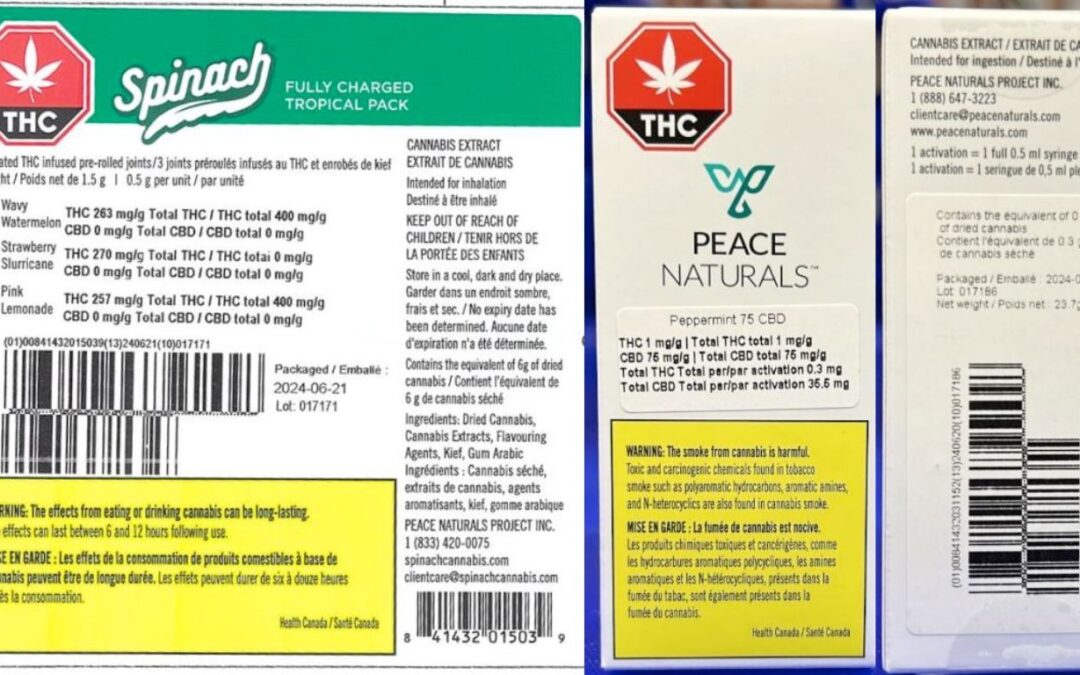
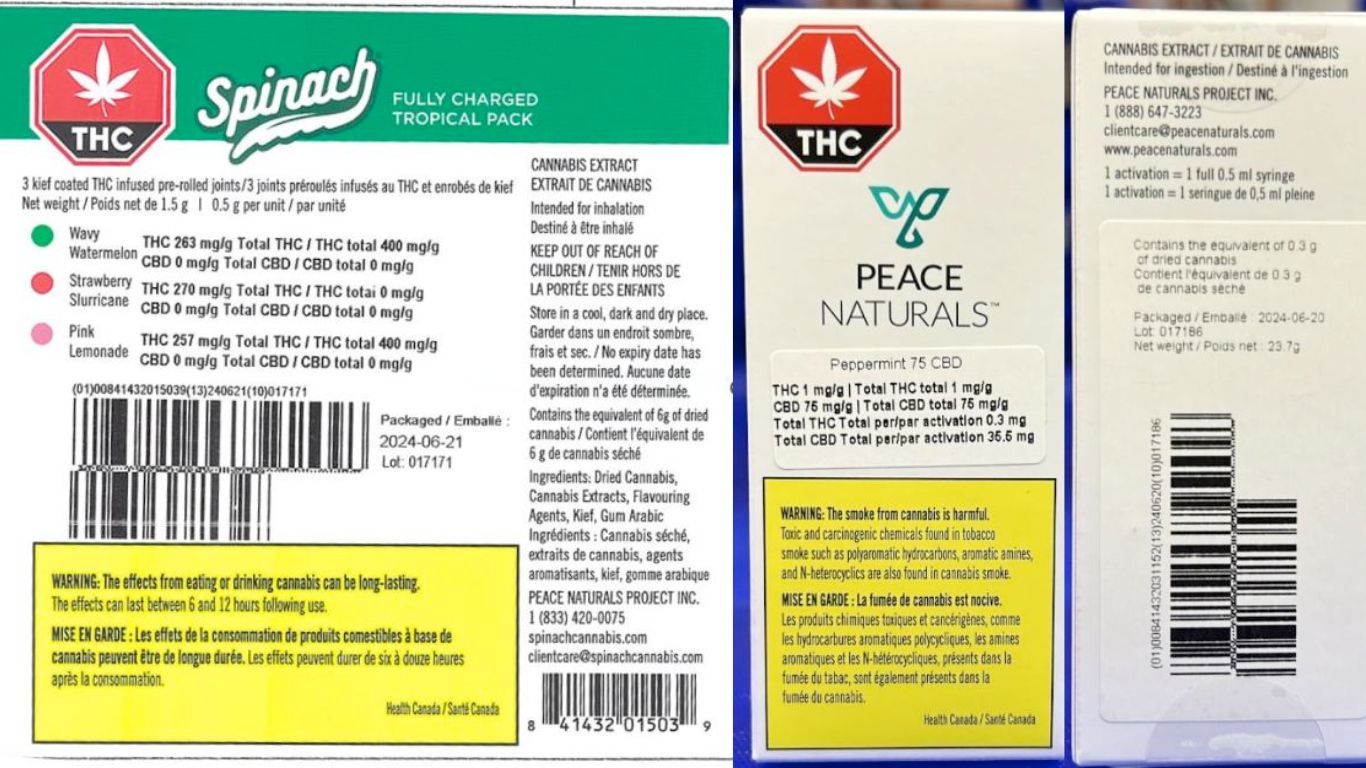
The cannabis producer recently recalled one lot of its Spinach Fully Charged Tropical Pack infused pre-rolls cannabis extract and one lot of its Peace Naturals Peppermint 75 CBD cannabis extract.
The total labelled THC for the former is lower than the actual total THC (Lot #017186). The products were labelled as having 0 mg/g THC, while the product should have been labelled as having 400 mg/g THC.
The total THC labelled and total THC per activation for the Peace Naturals Peppermint 75 CBD (Lot #017171) is labelled lower than the actual total THC and the actual total THC per activation, respectively. Total THC is labelled as 1 mg/g, while the actual value is 2 mg/g. The total THC per activation is labelled as 0.3 mg/g. The correct amount is 1 mg THC per activation.
There were 456 units of the recalled Spinach Fully Charged Tropical Pack infused pre-rolls sold in Ontario and 96 units of the recalled Peace Naturals Peppermint 75 CBD. The OCS first listed the recalls on September 6.
Health Canada says that, as of September 10, the Peace Naturals Project Inc. has received two complaints, one for each product, in connection to the labelling. Health Canada has not received any complaints related to the recalled lots. Neither Peace Naturals Project Inc. nor Health Canada have received any adverse reaction reports for the recalled lots of cannabis products.
Health Canada reminds consumers who wish to return an affected product to contact the retail store where the product was purchased.
This is the tenth product recall notice issued by Health Canada so far this year. Labelling errors remain the most common issue for a cannabis product recall in Canada.
A ruling on whether to change cannabis classification to a less dangerous substance in the United States is not expected until after the November election, making it a significant topic in the closely contested presidential race.
Last week, the U.S. Drug Enforcement Administration scheduled a hearing on the proposed changes for Dec. 2, 2024. Given this date, a final decision might not be made until the next presidential administration. Although there’s a chance it could happen before the end of President Biden’s term, marijuana attorney Brian Vicente notes that issuing a decision before Inauguration Day would be a rushed action.
The matter may draw fresh focus to the positions taken by presidential contenders regarding marijuana.
Vice President Kamala Harris has shown support for cannabis decriminalization and expressed disapproval of the drug’s current Schedule 1 listing, where it is classified along with LSD and heroin. Harris’s stance has changed over time, though. She took part in enforcing marijuana laws while serving as California’s attorney general in 2010 and opposed the state’s recreational cannabis legalization.
On the other hand, Donald Trump, the GOP nominee, recently expressed support for a marijuana legalization initiative in Florida, reflecting his growing belief that individuals should not be jailed for cannabis use because it is legal in a majority of states. During his 2016 presidential campaign, Trump supported medical cannabis and suggested that states should decide the legality of cannabis. However, during his term, Jeff Sessions, the then-attorney general, reversed an Obama-era directive that limited federal crackdowns on the cannabis industry in states where it was legal.
Marijuana rescheduling would mark the biggest change to drug policy in the United States in 50 years and might have a significant impact on younger voters. Nonetheless, organizations such as Smart Approaches to Marijuana are against the proposal. Kevin Sabet, president of the organization, contends that insufficient evidence exists to support placing cannabis in the less hazardous schedule 3 category, where it would be placed with drugs such as ketamine.
Sabet stated that the DEA’s decision to hold a hearing was a success in making sure that medical science, not politics, would be the deciding factor. He added that his resistance to the proposal is backed by attorneys general from 18 states.
Rescheduling could enable state-licensed cannabis enterprises to claim federal tax deductions that are presently unavailable to anyone engaged in the trade of schedule I or II substances. Some advocates also hope that rescheduling could push Congress to enact laws that would make it easier for banks to provide services to marijuana businesses. Currently, because of its legal classification, most banks are hesitant to offer financial services to cannabis businesses.
Moreover, rescheduling could also simplify cannabis research, as conducting authorized studies on schedule 1 substances is currently challenging. However, some advocates worry that the debate has become too politicized, with the focus on how rescheduling might impact the industry overshadowing the potential benefits.
All that entities such as Innovative Industrial Properties Inc. (NYSE: IIPR) can do is to wait for the next steps of the rescheduling process to play out so that once the final rule is published, they can determine how the change could impact their business projections.
About CNW420
CNW420 spotlights the latest developments in the rapidly evolving cannabis industry through the release of an article each business day at 4:20 p.m. Eastern – a tribute to the time synonymous with cannabis culture. The concise, informative content serves as a gateway for investors interested in the legalized cannabis sector and provides updates on how regulatory developments may impact financial markets. If marijuana and the burgeoning industry surrounding it are on your radar, CNW420 is for you! Check back daily to stay up-to-date on the latest milestones in the fast -changing world of cannabis.
To receive SMS alerts from CNW, text CANNABIS to 888-902-4192 (U.S. Mobile Phones Only)
Please see full terms of use and disclaimers on the CannabisNewsWire website applicable to all content provided by CNW, wherever published or re-published: https://www.CannabisNewsWire.com/Disclaimer
A new organization that hopes to help establish standards-based information about cannabis products and companies in Canada is hosting its first workshop in Ottawa in September.
The Cannabis Standards Alliance of Canada (CSAC) is a newly launched not-for-profit organization seeking to establish enforceable industry standards and provide consumers and industry with evidence-based information about cannabis products.
In their first workshop on September 20, the new association will focus on the accuracy of THC values on dried cannabis flower products. The goal of the workshop will be to create standards for sampling practices by producers and analytical labs for testing purposes such as sample selection and preparation.
“CSAC provides the cannabis sector with an alternative to lab shopping/THC inflation, creating a level playing field for producers, labs and dispensaries of all sizes,” said Pierre Killeen, the organization’s Executive Director, in a press release. “Going forward, the Cannabis Standards Alliance of Canada will develop additional enforceable standards helping the sector capitalize on the many opportunities of legal cannabis, both here in Canada and internationally.”
Killian has an extensive history in policy and public affairs and was most recently the executive director of the Institute on Cannabis and the VP of legislative and regulatory affairs at the Cannabis Council of Canada. Before that, he was VP of corporate communications and government relations at Hexo, a Quebec-based cannabis producer.
An investigation by the New Brunswick Department of Justice and Public Safety, in partnership with the Sûreté du Québec, has led to the seizure of over 432 kilograms of dried cannabis believed to be destined for more than 30 unlicensed stores in New Brunswick, Nova Scotia, and Quebec.
Officials say it is believed to be the largest cannabis seizure in Atlantic Canada. Three men from Ontario, a 53-year-old man from Markham, a 45-year-old woman from Scarborough, and a 68-year-old man from Scarborough, were arrested. They face charges under the federal Cannabis Act and Section 354 of the Criminal Code. Section 354 is for “knowing that the property was obtained or derived directly or indirectly by the commission of an offence.”
“Our government has focused on reducing crime and our investments are paying off,” said Public Safety Minister Kris Austin. “This seizure will disrupt the distribution network of dozens of unlicensed cannabis dispensaries, not only in New Brunswick but throughout Canada. This is crucial, as illegal cannabis contributes to and supports organized crime.”
Items seized include:
432.43 kilograms of cannabis bud, valued at over $1.4 million
8,080 pre-rolled cannabis joints
1,658 edible products
925 electronic vape products
241 grams of cannabis derivatives
540 grams of hashish
one kilogram of THC crystals
$143,485 in cash
Images shared by NB Justice and Public Safety show a large amount of dried cannabis, along with package vapes and “copycat” edibles.














Recent Comments