
by Grow Up Conference | Sep 9, 2024 | Media Partners, Stratcann
On September 3, RCMP in Nova Scotia seized thousands of grams of cannabis from an unlicensed store, including a variety of “copycat” edible items.
East Hants District RCMP executed a search warrant at a storefront in Mount Uniacke, about an hour northwest of Halifax. Investigators say they located and seized around ten thousand grams of dried cannabis, as well as items associated with the illegal sale of cannabis, and a truck and trailer.
An image of the copycat products includes products packaged to look like common children’s cereals like Apple Jacks, Trix, and Fruit Loops, along with candy-like Kit Kat, Hershey, Skittles Nerds, and more.
“We located and seized cannabis products in bags and boxes that look like regular chocolate bars, candy, and cereal,” says Sgt. Scott Macrae, Operations NCO for East Hants District RCMP, in a press release. “Using branding and logos similar to familiar products means that these items could easily be consumed by kids who don’t realize that they are eating a cannabis edible.”
Such products are not uncommon in the illicit market. In December 2022, Health Canada released a warning regarding so-called “copycat edibles” increasingly being sold illegally across Canada and are often made to look like common sweets and snack foods.
While executing the search warrant, officials arrested two men, a 33-year-old of Kentville and a 29-year-old from Falmouth. The two are facing charges under the Cannabis Act, including possession for the purpose of selling and promotion of cannabis. Both men have been released pending upcoming court appearances.
The Nova Scotia Liquor Corporation operates 50 NSLC cannabis stores in the province. Google Maps shows one unlicensed cannabis store in the Mount Uniacke area, Greenwolf Cannabis. There was no answer when StratCann called the location prior to publication.
Law enforcement in Nova Scotia arrested three men on August 27 in Amherst when the Cumberland Integrated Street Crime Enforcement Unit (CISCEU) executed a search warrant at a trailer where cannabis was allegedly being sold.
On August 26, Kings District RCMP in Nova Scotia executed new search warrants at two illegal cannabis storefronts, one on Hwy. 12 in Welton Landing and one on Commercial St. in New Minas. Both locations were the subjects of previous warrants executed in July 2024.
Several staff members were arrested, and officers executed search warrants, leading to seizures of illicit cannabis, tobacco, and psilocybin. Officers also seized a trailer and pickup truck.

by Grow Up Conference | Sep 9, 2024 | Cannabis News Wire, Media Partners
Donald Trump recently stated that he was confident Florida voters would pass the cannabis legalization initiative during the November ballot. He emphasized that since marijuana is already legal in many other states, it is unfair for someone to be prosecuted as a criminal in Florida.
In addition, Trump attacked the status quo regulations, saying they endanger public health, destroy lives and expose individuals to fentanyl-contaminated marijuana. If voters approve the measure, he encouraged lawmakers to take action by passing legislation outlawing marijuana use in public places.
Former Florida GOP chair, Senator Joe Gruters, praised Trump’s support for legalization. He said, “I am extremely proud to have President Trump join us in our effort to end the unnecessary incarcerations and arrests of adults for minor cannabis possession and to provide Floridians with the same freedom to access safe, vetted products that over half of the nation already practices.”
In line with Trump’s position, Gruters has pledged to support legislation that would outlaw marijuana use in public places should voters approve the legalization initiative.
Trump told a news reporter at a press conference in August 2024 that he was increasingly inclined to believe that people should not be criminalized for using cannabis, especially since the substance is becoming legalized nationwide. He suggested that he would soon make public his formal stance on the Florida marijuana ballot initiative.
Roger Stone, a longtime ally and Republican strategist, who resides in Florida and supports the legalization initiative, later commented that if Trump does endorse the measure, it would almost certainly lead to its approval.
Meanwhile, Representative Nancy Mace, who is sponsoring the States Reform Act to federally legalize cannabis, expressed her hope that Trump will support the Biden administration’s effort to reschedule cannabis. She also noted that many GOP lawmakers in Congress have been hesitant to embrace cannabis policy reform due to fear.
In his recent comments, Trump also criticized Vice President Kamala Harris for her record on marijuana prosecutions, claiming that she incarcerated thousands of Black individuals for cannabis-related offenses. Although this characterization of Harris’s record is somewhat exaggerated, it highlights Trump’s evolving stance on cannabis decriminalization and his willingness to leverage the issue in the political arena.
Harris has chosen Minnesota Governor Tim Walz as her running mate. Walz has been a strong advocate for marijuana reform, supporting various legislations in Congress and, as governor, signing a comprehensive marijuana legalization bill into law last year.
Marijuana companies such as Curaleaf Holdings Inc. (CSE: CURA) (OTCQX: CURLF) will be watching the presidential campaigns to see whether momentum is created for making serious changes at the federal level with regard to marijuana policy.
About CNW420
CNW420 spotlights the latest developments in the rapidly evolving cannabis industry through the release of an article each business day at 4:20 p.m. Eastern – a tribute to the time synonymous with cannabis culture. The concise, informative content serves as a gateway for investors interested in the legalized cannabis sector and provides updates on how regulatory developments may impact financial markets. If marijuana and the burgeoning industry surrounding it are on your radar, CNW420 is for you! Check back daily to stay up-to-date on the latest milestones in the fast -changing world of cannabis.
To receive SMS alerts from CNW, text CANNABIS to 888-902-4192 (U.S. Mobile Phones Only)
For more information, please visit https://www.CannabisNewsWire.com
Please see full terms of use and disclaimers on the CannabisNewsWire website applicable to all content provided by CNW, wherever published or re-published: https://www.CannabisNewsWire.com/Disclaimer
CannabisNewsWire
Denver, CO
www.CannabisNewsWire.com
303.498.7722 Office
Editor@CannabisNewsWire.com
CannabisNewsWire is powered by IBN

by Grow Up Conference | Sep 9, 2024 | Grow Opportunity, Media Partners
(CNW) Calgary – Decibel Cannabis Company Inc., a market leader in premium cannabis and extract manufactured products, announces the company’s flower strategy has exceeded its expectations and is pleased to provide an update alongside other corporate matters.
This July, the company announced a refocus on its dried flower consumer, along with a reorganization of dried flower processing across its facilities. The preliminary results of these initiatives are very positive and although these efforts are still in their early stages, the company anticipates that the successful reception will continue.
“We are excited by the overwhelmingly positive feedback we have received from Provincial boards, retailers, budtenders, and consumers of our reposition of QWEST dried flower and pre-roll products. We are delivering on the promise to provide great quality product at an exceptional value to the flower consumer in Canada. Equally important, as demand is outpacing our current supply, we have established a plan to allow us to satisfy the great demand for our product in Canada while meeting the needs of our international partners in Australia, Israel, UK and Germany,” said CRO Adam Coates.
Domestic Flower Strategy
Decibel’s hero craft cannabis brand, QWEST, was re-launched in Alberta, BC & Ontario this July with the slogan “More Dank, Less Bank” appealing to flower consumers looking for true craft quality flower at an approachable price point. Supporting the launch campaign was a sampling program focused on budtenders and retailers to reintroduce them to our craft quality and unique strains:
- 98% of survey respondents who received an educational product sample indicated they would recommend QWEST flower products to their customers1;
- Depletions from AGLC, BC LDB and OCS distribution centres increased by over 500% since launch2;
- Decibel’s retail market share in dried flower has grown by over 400% in the past 4 weeks3;
- As demand continues to grow from consumers, we expect more listings to follow from the respective boards; and
- Initiated the development of new product pipeline for 2025 that will expand the QWEST brand through great quality ready-to-consume formats and premiumization of dried flower products at great prices.
|
___________________________________________
|
|
1 Decibel Prepared Survey, participants in most recent QWEST sampling program under
|
|
2 AGLC Licensed Producer Inventory Report, BC LDP Provincial Wholesale Activity Report, and OCS Sale of Data Report
|
|
3 HiFyre Retail Analytics, Licensed Producer Sales, National Data
|
International Flower Update
- United Kingdom: the company has received its first purchase order (“PO”) and expects to ship its first order of QWEST branded dried flower products to the UK before the end of September;
- Australia: the company has received advanced PO’s through the end of 2024 to support the growing demand of its flower products, with its next shipment expected before the end of September;
- Israel: the company expects to ship its first order of dried flower to its new distribution partner in Israel in the coming week; and
- Germany: the company expects to ship its first flower products to Germany by the end of 2024.
Annual Meeting Update
The company has applied to the Court of King’s Bench of Alberta under Section 132(2) of the Alberta Business Corporations Act for an extension of time to call its annual meeting of the shareholders of the company to a date not later than December 31, 2024.
The company filed its originating application with the Court on September 6th, 2024 and the application will come for a hearing on September 19th, 2024 at 10:00 am MT. The hearing will be conducted in person.
The company will also file applications for exemptions from the TSX Venture Exchange and other applicable regulatory bodies to similarly extend the deadline to hold the annual meeting under the applicable rules, policies and regulations.
Resignation of Officer
The company accepted the resignation of Warren Matzelle, chief product development and marketing officer effective as of September 6th, 2024.
by Grow Up Conference | Sep 9, 2024 | Grow Opportunity, Media Partners
(Globe Newswire) Vancouver – Rubicon Organics Inc., a licensed producer focused on cultivating and selling organic certified and premium cannabis, is pleased to announce that Jesse McConnell has been appointed to the company’s Board of Directors after receipt of security clearance from Health Canada. Mr. McConnell was elected to the Board by the shareholders at the Annual General Meeting on July 31, 2024, but his appointment to the Board was subject to being granted security clearance by Health Canada.
About Jesse McConnell
Jesse McConnell was the Co-Founder of Rubicon Organics in 2015 and served as its CEO from May 20, 2015, to December 31, 2022, Mr. McConnell is an entrepreneur, investor and cannabis expert who has worked in the premium cannabis industry in Canada and the US for over two decades. Previously, Mr. McConnell co-founded Whistler Medical Marijuana Corp., which was eventually acquired by Aurora Cannabis Inc. in 2019 for $175 million. Mr. McConnell holds a Bachelor of Arts, Economics (Honors) from Memorial University and a Master of Arts, Philosophy (Honors) from University of Victoria. He is also a member of the Northern Lights chapter of the Young Presidents’ Organization.
DSU Grant
The company has awarded a total of 140,459 Deferred Share Units (DSUs) under its Omnibus Equity Incentive Plan to a director as compensation for their upcoming service. These DSUs will vest after twelve months from the grant date and can only be redeemed if the holder ceases to be a director of the Company or in accordance with the provisions of the Omnibus Equity Incentive Plan.
by Grow Up Conference | Sep 9, 2024 | Cannabis News Wire, Media Partners
Recently, VP Kamala Harris’ campaign penned a memo criticizing former president Donald Trump for boldly flip-flopping on various issues, including cannabis reform. In the memo, the campaign accused Trump of making things up just months before the election.
This comes after Trump indicated in a social media post that he supported a ballot initiative that would legalize the recreational use of cannabis in the state of Florida, where he resides. In his statement, the former president requested that the state legislature ban the use of cannabis in public spaces, then he added that individuals need not be termed as criminals when the drug’s consumption was legal in many other states across the country.
He also added that there was no need to waste taxpayer money by arresting individuals with personal amounts of cannabis on them.
In the memo, a communications aide in Harris’ camp, Ian Sams, brought up how during Trump’s tenure, the department of Justice clamped down on cannabis offenses. The former president’s stance on cannabis seems to change constantly. During his tenure, the aforementioned department announced that it would be eliminating a policy that restricted federal prosecutions for cannabis sales in states where it was legal. A few months later, Trump retracted this.
In 2018, the former president expressed his support for a bipartisan measure that would protect procannabis laws at the state level. The measure, dubbed the STATES Act, would allow states to enforce their own regulations on the production and distribution of cannabis. A year later, he used part of his salary to fund a campaign calling attention to the negative effects of cannabis use.
In a statement, a campaign official from Trump’s camp maintained that Trump had consistently supported the issue being addressed at the state level for years now.
The memo comes only days after Harris sat for an interview with CNN, over a month after Biden abandoned his bid for re-election. Harris rolled out her campaign for president soon after, having been vice president under Biden during his tenure.
It hasn’t yet been made clear how Harris’ views on different policies differ from the incumbent president, with Harris herself noting in the recent CNN interview that her values hadn’t changed. This statement was made about a question on whether or not the border needed to be decriminalized.
Her team argues, however, that her record while in office shows that she’s evolved when it comes to some issues, claiming that this isn’t the case for Trump.
The wider cannabis industry, including entities such as SNDL Inc. (NASDAQ: SNDL), will be happy that the U.S. presidential campaigns are bringing marijuana policy to the fore of national-policy discussions.
About CannabisNewsWire
CannabisNewsWire (“CNW”) is a specialized communications platform with a focus on cannabis news and the cannabis sector. It is one of 60+ brands within the Dynamic Brand Portfolio @ IBN that delivers: (1) access to a vast network of wire solutions via InvestorWire to efficiently and effectively reach a myriad of target markets, demographics and diverse industries; (2) article and editorial syndication to 5,000+ outlets; (3) enhanced press release enhancement to ensure maximum impact; (4) social media distribution via IBN to millions of social media followers; and (5) a full array of tailored corporate communications solutions. With broad reach and a seasoned team of contributing journalists and writers, CNW is uniquely positioned to best serve private and public companies that want to reach a wide audience of investors, influencers, consumers, journalists and the general public. By cutting through the overload of information in today’s market, CNW brings its clients unparalleled recognition and brand awareness. CNW is where breaking news, insightful content and actionable information converge.
To receive SMS alerts from CNW, text CANNABIS to 888-902-4192 (U.S. Mobile Phones Only)
For more information, please visit https://www.CannabisNewsWire.com
Please see full terms of use and disclaimers on the CannabisNewsWire website applicable to all content provided by CNW, wherever published or re-published: https://www.CannabisNewsWire.com/Disclaimer
CannabisNewsWire
Denver, CO
www.CannabisNewsWire.com
303.498.7722 Office
Editor@CannabisNewsWire.com
CannabisNewsWire is powered by IBN
by Grow Up Conference | Sep 9, 2024 | Grow Opportunity, Media Partners
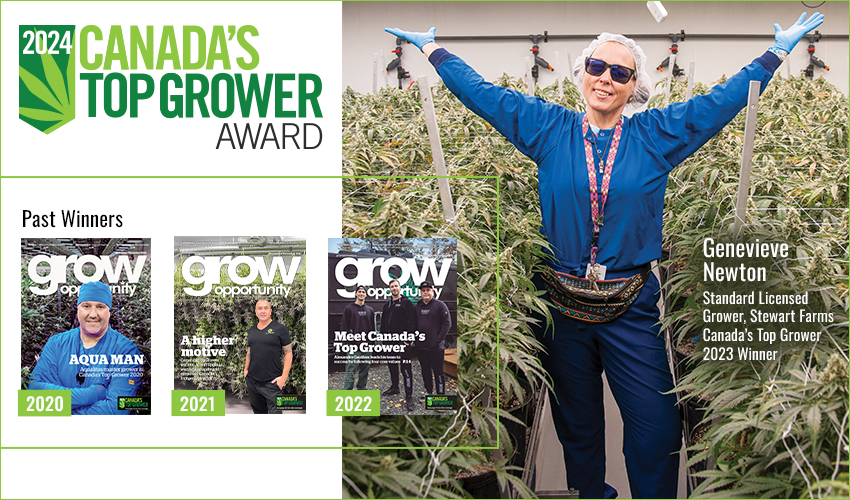
This year, Grow Opportunity welcomes 2022 Top Grower Award winner Alexandre Gauthier, director of cultivation at Origine Nature, to the panel of Top Grower judges alongside Av Singh, Stacie Hollingworth and David Kjolberg.
Last year, the 2023 winner Genevieve Newton, sat down to discuss winning the award and achieving her five-year goal in two.
“It’s funny,” she says, recalling the first award winner back in 2019. “[Gregg Wigeland] used to be the master grower at Sundial when I was a lowly grunt,” she says. “He won that award when I was still cleaning up plant piss off the floor; I remember him winning that!” Newton found time to discuss her well-earned spotlight, eight years in the making: “It means so much to me,” she says. “It was a sign I needed that I’m still needed in this industry.”
Newton is a second-generation farmer, having learned her gardening skills from her dad and grandpa growing up in Saskatchewan. She knew her dad was also growing in his closet, but weed wasn’t her thing at the time.
“For four years while I was sober, I was searching for happiness,” says Newton, “something to replace my addictions, my drinking. That is how you stay sober – you replace that with something you love,” she says. “I tried all these things, and it was this thing. That was what it was.”
by Grow Up Conference | Sep 9, 2024 | Media Partners, Stratcann
As the Canadian cannabis industry continues to weather the financial storm that has washed away the embarrassment of riches it once had, the abbreviation CCAA has been heard more often than people would like.
The Companies’ Creditors Arrangement Act is federal assistance that allows financially troubled companies to restructure their affairs with creditors and avoid bankruptcy. With more companies entering into this arrangement, there have been rumblings of different businesses using the program in questionable ways.
“The CCAA process is available to companies with over $5 million in creditors in Canada, and historically has been an important way for companies to restructure to survive and reduce job loss,” said Margaret Brodie, CEO of Rubicon Organics. “Unfortunately, what we have seen in the cannabis industry is certain companies pick and choose where to pay.”
Brodie added that typically, these companies don’t pay smaller LPs and ancillary cannabis companies; they do not remit the cash received from the provinces for excise, or they don’t pay their licensing fees.
“When a company who is planning to go into CCAA continues to order cannabis or other goods and accepts services from suppliers (eg. sales agencies, marketing agencies, other consultants), or uses the excise cash from the provinces for other purposes (such as paying consulting or services companies that are owned by the operators) before a known CCAA filing is being put in, it is unethical to me, as the directors and officers know that those suppliers will likely not get paid, or [will receive] a small portion of what is owed,” she said.
Brodie added that the main issue is that they have not seen “consistent repercussions” for companies that engage in these actions.
“While I don’t agree with the level of excise being paid, wiping the slate clean for some but not all companies is not competitive, especially when there are rumours of some LPs using the excise funds received from the provinces intentionally as working capital to undercut competitors on pricing, and drive large budgets to get their product on shelf,” she said. “This practice is really impacting the reputation of the cannabis industry and penalizing those who are paying their bills.”
The taxman cometh
Regarding the excise taxes and other government fees on cannabis, at this point, there is a chorus line of LPs and others in the industry who are highly vocal about the challenges this creates and the need for an adjustment.
An Access to Information request from 2023 released a briefing note to the Minister of Finance discussing the financial distress in the cannabis industry. Some of the important takeaways included the fact that in 2022, 14 cannabis companies filed for CCAA, which represented 36% of all CCAA filings.
Another 12 companies filed a “concern” with the Office of the Superintendent of Bankruptcy in 2023. Only 322 of 808 current cannabis excise license holders were active and remitting excise duties to the CRA as of September 2023.
The document went on to say that a consequence of these firms going out of business has been the “discount selling of their remaining stock”, which further drives down cannabis prices and keeps more viable products stagnating in inventory.
“The industry has been quite loud and consistent in voicing their objection to the current rate of taxation,” said Chris Nyberg, Partner at MLT Aikins. “[The federal government] treats cannabis more like tobacco than liquor.”
Nyberg went on to say that this is apparent both on the Health Canada side as well as the CRA taxation side. “If you look at how they’re taxing cannabis it’s much more punitive than liquor. Some LPs have planned for that better than others.”
Nyberg said that he believes some companies didn’t expect how fast the excise taxes would accumulate once they started selling products, and he added that in some cases, payment is due before cash comes in from the provinces.
“We’re getting to (and in some cases past) the point now where [companies] are looking at this and saying they don’t have a sustainable way to clear up that debt,” he said.
Regarding the suggestion that some companies are shirking their responsibilities and operating when they should be consolidating, Nyberg said there are basically two types of companies he sees seeking creditor protection. The first are companies that are genuinely insolvent and are acquired by a third party in a proceeding, where new management and owners come in, and they run their business according to the rules.
As for the others, he said that in some cases, the purchaser is part of a syndicate of the same people that caused their LP to go insolvent in the first place, and they are utilizing CCAA for the purpose of cleaning debts up for their own benefit.
“It is ultimately up to the CRA and Health Canada to object to the structures put forward by the insolvent companies in the process. It’s how the insolvency system is designed,” he said. “My biggest issue with how this unfolded is that the CRA has wildly different approaches across Canada, which seems to disproportionately favour insolvent companies in Ontario.”
Nyberg said there are many instances in Ontario where the CRA simply didn’t show up to proceedings. “If they don’t object, then the court doesn’t know that there’s anything to object to,” he said. “In other cases [CRA has] actually acquiesced to or approved these transactions, and that is diametrically opposed to how they handle it in Western Canada, where they regularly show up and object to standard relief and actively go after directors personally.” He added that people are specifically filing in Ontario because there’s significantly easier treatment from the CRA.
Brodie has also recognized this issue, feels there need to be some changes, and has some suggestions on how to do it.
“CRA and Health Canada need to treat companies consistently,” she said. “Were CRA excise as a first priority, payable through CCAA, and there was personal liability of the directors and officers when it came to the responsibility for excise tax, it would encourage more careful use of that cash and remittance to government.”
She went on to say that, at the moment, the CRA is approaching this on a case-by-case basis and that if she were a director who was held liable and learned that in another case someone else was not, she would be furious.
“In addition, were CRA to apply commercial interest rates on those companies who are not paying their excise, it would have a significant impact, as effectively there are some companies that are getting low interest working capital loans from the government or loan forgiveness,” she said.
Should there be no changes to how the CCAA process works for cannabis companies, Brodie had this to say about levelling the playing field in other ways:
- Pay excise from the province directly to the CRA (federal government), like alcohol. These excise funds are not revenue to the LPs or short-term loans.
- Push LPs going through CCAA to have to resubmit for their sales license; thus, in the interim, they will only be allowed to sell business to business.
Nyberg believes that, on paper, there is no easy answer, as the CRA electing not to renew licenses of the people who owe significant outstanding excise taxes will likely kill many LPs. While some in the industry think that letting this group fail is the right approach, the mass layoffs would likely become a political issue in the run-up to the next federal election. It’s also likely that any spectre of debt forgiveness would attract significant criticism from those LPs who have been playing by the rules.
“I don’t know if there’s an easy fix for the federal government here, other than CRA putting in a formal program to amortize some of this debt over a longer term, or there being some consideration of the statutory priority of excise tax, but that’s a policy issue for the government to consider,” he said.
As for Brodie and other LPs who feel changes need to be made much sooner than later, she closed her comments by saying the first logical step is equal treatment as best as possible among all industry players.
“I think this is a legacy issue from Prime Minister Trudeau,” she said. “Canada led the world being the first G8 country to legalize marijuana, but the government needs to pick up the recommendations from the Cannabis Act Review panel and provide consistent enforcement to LPs and to the legacy market to create a healthy, competitive industry in Canada. Otherwise, I fear we are losing our advantage to compete on a global scale.”
It should be noted that StratCann reached out to other licensed producers who concurred with these concerns, and one in particular who did not, but none agreed to come on the record.
by Grow Up Conference | Sep 9, 2024 | Media Partners, Stratcann
Until now, cannabis retail staff in Ontario had to complete the CannSell program to be permitted to work in a cannabis retail store. Now, there are two options. Earlier this month, the Alcohol and Gaming Commission of Ontario (AGCO) approved a new training program for cannabis retail staff in Ontario.
The new training provider is Cannabis Training Canada (CTC), and their course, CTC 1: Retail Certification Program, has been approved to meet the mandatory training requirements set out by the AGCO.
Cannabis Training Canada (CTC) was established at the start of cannabis legalization with a clear mission: to partner with both government bodies and private retailers to elevate the standard of cannabis education.
Since then, CTC has successfully collaborated with provincial governments in Nova Scotia (NSLC), British Columbia (BCLDB), the Government of Nunavut, and various private retailers nationwide.
Why choose CTC over CannSell?
Cannabis Training Canada offers a fresh and modern approach to cannabis retail training and delivers on affordability. At just $64.99 per participant, it is a more cost-effective option for retail staff compared to other programs, with many discounts available.
In addition to being more affordable, CTC’s platform is designed with the user in mind. The interface is intuitive and easy to navigate, so employees can focus on learning rather than wrestling with complicated technology and boring lesson structures. This user-friendly approach reduces the time it takes for staff to become certified and allows them to start contributing to their workplace more quickly.
Superior content for a changing industry
The cannabis industry is evolving rapidly, and so is the knowledge required to succeed in it. CTC recognizes this and has developed a curriculum that is not only comprehensive but also reflective of the latest industry trends and regulations. The CTC 1 program provides in-depth training on key topics such as product knowledge, compliance, responsible sales, and customer service. This ensures that retail staff are not just meeting the minimum requirements, but are also fully prepared to excel in their roles.
Moreover, CTC places a strong emphasis on responsible cannabis retailing, equipping employees with the tools they need to educate customers compliantly and promote safe consumption practices. This commitment to responsible retailing benefits customers and helps businesses build a positive reputation in their communities.
What this means for Ontario’s cannabis industry
With CTC now approved by the AGCO, cannabis retailers in Ontario have a new choice for staff training. As CTC continues to expand its presence in Ontario, the goal is to significantly alter the landscape of cannabis retail training, offering a more modern, affordable, and effective alternative to the existing options.
- StratCann readers: use promo code CTC10 for 10% off courses until November 30, 2024.
Content sponsored by: Cannabis Training Canada

by Grow Up Conference | Sep 7, 2024 | Garden Culture Magazine, Media Partners
With the climate crisis on minds worldwide, many have turned to water conservation techniques in the garden. Of course, any effort to save a precious natural resource is valid, from xeriscaping to collecting rainwater. But how do you grow if there’s no potential for irrigation? For many, the mere idea of no water is enough to send them running. But not for the team at Drylands Agroecology Research (DAR). Based in Colorado, the organization is up for the environmental challenge, transforming dry, marginalized landscapes into lush ecosystems – without water.
Spearheaded by Nick DiDomenico and Marissa Pulaski, DAR designs and implements natural infrastructure to create pathways and catchment systems for water from existing precipitation. In a climate that only gets about 16 inches of rainfall a year, that’s a tall order, but DAR is proving that achieving lively landscapes in semi-arid conditions is possible, one farm at a time.
Regenerating Dry Land at Elk Run Farm
It all started in 2015 when DAR began managing Elk Run Farm, a 15-acre parcel of degraded land in the Colorado foothills. A former cattle ranch, the sloped property was arid and had little vegetation thanks to years of overgrazing. Refusing to accept that the land was useless, DiDomenico got to work, following permaculture principles to regenerate the fields. Pigs, chickens, and sheep helped build topsoil and bring new life to the pastures while an exotic forest garden was planted. Largescale earthworks called contour swales were built to manage the water flow on the property. The swales are ideal for hillsides, catching and retaining every drop of water and resulting in moist pockets perfect for planting trees.
“People thought they were nuts,” explains Amy Scanes-Wolfe, Community Outreach Director at DAR. “They knew they’d only be able to irrigate [the trees] once, which is the day they were planted, and then there would never be water again.”
Despite widespread doubts, DAR set about planting over 1,000 trees, including apple and pear trees, mulberries, plums, and nurse plants to help fix nitrogen in the soil. The trees were planted about a foot and a half apart, assuming most would die. But that didn’t happen. Several years later, DAR is tracking a 79% survival rate on the trees, an incredible victory, and proof that the contour swales are collecting enough water to sustain an ecosystem. Meanwhile, the new microclimate helps cool things down.
Today, Elk Run Farm is far from what it once was, a green oasis bursting with fertility and wildlife. As the pilot research project, DAR continues to collect data from the farm as it refines its selection of perennial crops, grain crops, and forest garden systems. But while it takes time for natural systems to establish, the beauty is that once they do, most of the hard work is over.
“We put a lot of effort into getting that system going, and then if we do nothing at all, it will keep regenerating,” explains Scanes-Wolfe. “So, as those trees grow, they create this cooler, moister microclimate and habitat, and birds are coming in and pooping seeds. Between those swales, we practice regenerative grazing with either cattle or sheep.”
Seeing is believing, and after witnessing the wild transformation at Elk Run Farm, other farms are knocking on DAR’s door, looking for help in their land regeneration and growing ventures.
Yellow Barn Farm Land Regeneration Project
Last fall, DAR broke ground at Yellow Barn Farm, a former large-scale equestrian center in Longmont, CO, that was once home to over 50 horses. Windy and exposed, the property spans 60 acres, 50 of which have no potential for irrigation. The farm had fallen victim to a monoculture system and over- and undergrazing, and in 2020, the devastating Calwood Fire swept through the area, scorching the surrounding land.
The owners of Yellow Barn want to regenerate the farm and grow high-quality food on a small scale, eventually setting up a CSA. The property also serves as a community hub for sustainability education; anyone interested in land rejuvenation and carbon sequestration is welcome to come and witness DAR and other environmental organizations work their magic.
“We are trying to create a new type of ecosystem,” says Scanes-Wolfe. “It’s not native, but it feeds people and has all the benefits of a wild ecosystem, like habitat and carbon.”
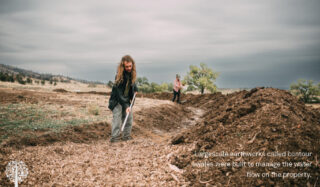
With the help of a $100K grant from the Woodard & Curran Foundation, DAR has created 17 contour swales across the 50 acres. Cattle move between the swales following rotational grazing, and this spring, 6,000 fruit and nurse trees are being planted where the water has accumulated over the winter. While the swales are always filled with mulch and compost for water retention and to help build fertility, this time, DAR has experimented by layering oyster mushroom mycelium into two-thirds of the trenches. The team will monitor how this impacts tree health, but initial research suggests the mycelium will boost moisture retention by about two or three times.
“It’s fascinating to see! It’s already completely colonized,” says Scanes-Wolfe. “We were walking around seeding one of the berms the other day, and there was this web of white mycelium across the top of the mulch. If lucky, we might even get mushrooms out of the system!”
Escaping the destructive ways of monoculture, DAR is diversifying the grasslands and using three different seed mixes, including native grasses, wildflowers, and traditional forage grasses for cattle.
“We hope that whatever we seed there will make its way into the pasture below, so this is our chance to put some diversity in the seed bank so that as the cattle come through, it germinates,” explains Scanes-Wolfe.
The Solution to Regenerate Yellow Barn Farm
Volunteers and corporate groups are helping with this spring’s tree planting, and for DAR, this is where the fun truly begins. With agriculture being a massive driver of the current climate crisis, planting trees and building soil is primarily believed to be the solution. While the trees may not go into the world’s greatest soil, they will help build it over time. They’ll also be removing CO2 from the air, and a grant from Boulder County will help DAR quantify the carbon being sequestered in the system at Yellow Barn Farm.

Ultimately, DAR strives to avoid the band-aid solutions we often see regarding environmental repair. For example, rather than focusing on reducing how much water we use, DAR views its mission more as developing the landscape’s capacity to hold water so that when it does rain or snow, the moisture stays in the ground.
People beyond Yellow Barn Farm are taking notice. DAR receives interest worldwide, including from a farmer in Kenya who recently reached out for advice on regenerating dry farmland. Scanes-Wolfe says the current project at Yellow Barn Farm is helping DAR develop a training system so the organization can consult on other projects and educate on how to read landscapes and understand how to regenerate them so they can thrive.
“We are designing systems that sequester carbon but also support biodiversity, restore hydrological cycles, and feed humans,” she says. “[The goal] is to create something that actually solves a lot of problems and gets to the root of what’s going on.”
As the world copes with more environmental disasters such as wildfires, drought, and erratic weather patterns, DAR is a beacon of hope, restoring, repairing, and regenerating dry and degraded land in Colorado using natural systems. Nobody said it would be easy, but someone’s got to do it, and DAR is happy to lead the way.
by Grow Up Conference | Sep 7, 2024 | Media Partners, Stratcann
This past week at StratCann, we shared our monthly cannabis industry jobs update and looked at the BCLDB’s most recent annual report.
Organigram closed its second round of BAT funding, Cronos was found to be trying to engage in “reverse hijacking” of a domain name, and Safari Flower exited creditor protection.
Also, the SQDC released its most recent quarterly report. BC’s Surrey wants cannabis store applications sent in by September 17, and Victoria’s Rifflandia will be hosting a cannabis space along with local retailers Seed & Stone and Songhees Cannabis.
In other cannabis news…
High Tide Inc. re-launched its Canna Cabana website for its flagship retail brand, providing an improved experience for its ELITE and Cabana Club members. The company also opened its 183rd Canna Cabana location, which is in Lucan, Ontario.
In a story our readers will recognize from last week’s Week in Weed, Post Media looked into a recent Alberta court case involving a man who was found to be impaired by cannabis following a Standardized Field Sobriety Test. The court rejected his argument that the evidence did not establish his impairment.
Delta 9 Biotech says the company has decided to wind down the operations of its distribution wing, Delta 9 Logistics, effective September 30, 2024. Notices have been sent to clients.
Shakir Tayabali is departing his role as the CEO of the Independent Retail Cannabis Collective (IRCC). Mandesh Dosanjh, Executive Chair, is stepping into the role of interim CEO while IRCC seeks a more permanent replacement.
Tamara Lovi has been appointed as new Chair of the Cannabis Council Of Canada (C3). Lovi has been a member of the Board for two years and has an extensive background in the pharmaceutical industry.
Deputy Minister Simon Kennedy is stepping down from his role at ISED on September 13. Mr. Kennedy oversaw Health Canada’s implementation of the government’s initiative to legalize and regulate cannabis, including passage of the Cannabis Act, and in his capacity at ISED, served as a valuable voice on the agency’s now-mostly-neglected cannabis file. Kennedy was named Deputy Minister of Innovation, Science and Economic Development, effective September 3, 2019.
The Saskatchewan Liquor and Gaming Authority (SLGA) is seeking a permanent full-time Reporting Analyst within our Regina Head Office, reporting to the Manager, Cannabis Policy and Analysis.
Avail Medical, a clinic that specializes in providing access to cannabis for medical purposes, announced Victoria’s first multidisciplinary clinic focused exclusively on veteran healthcare. The clinic will offer a wide range of exclusive products and services for veterans of the Canadian Armed Forces, including an “exploration into psychedelic-assisted therapy.”
Mark Johnson, a lawyer who ran for the Conservatives in Toronto in the 2021 federal election, penned a piece claiming that Canadian society has basically collapsed since legalization. The highly inaccurate article serves to highlight how many on that side of the aisle continue to look at this file through the lens of reefer madness, not supposed Conservative issues like streamlining regulations or lowering taxes. Earlier this year, Johnson also said legalization itself was “misguided”.
Kind Gardens held their sampling-focused event for budtenders in Edmonton on September 5.
An opinion piece in the Toronto Star looked at the number of cannabis stores closing in Canada’s largest city, calling for measures to help existing stores stay open and what to do with all the empty storefronts.
Humber College held a Become a Cannabis CEO event earlier this year at its Lakeshore Campus, aimed at empowering Black, Indigenous and other racialized communities to enter or advance their careers in the cannabis industry.
A recent study said that THC’s effects were significantly increased by CBD, rather than moderated by the,m as has been previously accepted as fact.
International cannabis news…
Politico took another look at the ongoing and slow evolution of Germany’s approach to cannabis legalization.
California Governor Gavin Newsom proposed emergency regulations aimed at reining in the manufacture and sale of illegal hemp products that contain intoxicating cannabinoids such as THC.
And finally, Donald Trump offered muted support for cannabis legalization in Florida, contradicting the state’s Republic governor Ron DeSantis. Trump also said there would need to be rules in place to “prohibit the use of it in public spaces, so we do not smell marijuana everywhere we go, like we do in many of the Democrat-run cities”—a real champion of legalization, clearly. :/





Recent Comments