Late last month, regulators in California withdrew the license of a cannabis testing laboratory. This development comes after it was determined that the lab tampered with equipment and faked test results so it could provide passing test results to marijuana products that were possibly contaminated with mold and dangerous pesticides.
In 2022, the state’s Department of Cannabis Control found that California Cannabis Testing Labs engaged in activities that posed a threat to public health. According to its report, the department rejected the company’s application for an annual license and withdrew its provisional license as well. A notice issued last month by Deputy Director Michael Cheng listed alleged violations unearthed at the Northridge-based firm.
The alleged violations include:
tampering with lab equipment so the equipment would be unable to detect pesticides and solvents identified as cancer risks by the Center for Disease Control and Prevention (CDC)
retesting samples to produce artificially inflated and/or false THC levels
intentionally faking bench sheet records for mycotoxins and pesticides
The company’s lab director is also said to have signed a certificate of analysis for a marijuana product that reported no detection of chlorfenapyr, a pesticide. However, tests carried out later by the state on samples gathered from the same batch found almost 600 times the amount of chlorfenapyr permitted under Californian law.
The company is owned by Melissa Mabe, Krishna Chivukula and Roger Chivukula.
David Hafner, a spokesperson for the state’s cannabis control department, revealed that the company had already requested a hearing concerning the status of its license. The company’s license, which was first issued in 2019 July, is listed as cancelled on a state database.
Currently, it remains unclear how many products tested by the lab were sold to consumers in the state.
The report also reveals that three recalls were issued in March, May and June this year for marijuana products the laboratory had approved, which were later found to be contaminated with aspergillus, a type of mold. In July, another mandatory recall was issued for vaporizer cartridges that were tainted with chlorfenapyr.
These issues come at a time when the marijuana industry is dealing with growing concerns over testing, with deliberate falsification of test results becoming a significant problem.
Other violations the company may have committed include:
not accurately reporting total THC levels on certificates of analyses
not adhering to standard procedures for testing for pesticides
faking certificates of analysis by reporting inaccurate results from laboratory data
These stern actions being taken against testing labs accused of acting unprofessionally are a welcome step for licensed companies across the industry, such as TerrAscend Corp. (TSX: TSND) (OTCQX: TSNDF), because they work so hard to build their reputations for manufacturing safe and high-quality products for their consumers, and entities that try to cut corners spoil the reputation of the entire industry.
About CannabisNewsWire
CannabisNewsWire (“CNW”) is a specialized communications platform with a focus on cannabis news and the cannabis sector. It is one of 60+ brands within the Dynamic Brand Portfolio @ IBN that delivers: (1) access to a vast network of wire solutions via InvestorWire to efficiently and effectively reach a myriad of target markets, demographics and diverse industries; (2) article and editorial syndication to 5,000+ outlets; (3) enhanced press release enhancement to ensure maximum impact; (4) social media distribution via IBN to millions of social media followers; and (5) a full array of tailored corporate communications solutions. With broad reach and a seasoned team of contributing journalists and writers, CNW is uniquely positioned to best serve private and public companies that want to reach a wide audience of investors, influencers, consumers, journalists and the general public. By cutting through the overload of information in today’s market, CNW brings its clients unparalleled recognition and brand awareness. CNW is where breaking news, insightful content and actionable information converge.
To receive SMS alerts from CNW, text CANNABIS to 888-902-4192 (U.S. Mobile Phones Only)
Please see full terms of use and disclaimers on the CannabisNewsWire website applicable to all content provided by CNW, wherever published or re-published: https://www.CannabisNewsWire.com/Disclaimer
The amount of cannabis sold in BC continues to increase while the price continues to decrease, according to the LDB’s newest quarterly report.
The provincial cannabis wholesaler’s Q1 2024 report shows 36,418,336 grams sold in April, May, and June 2024, and more than $140.5 million in wholesale sales. The former represents an 18.8% year-over-year increase from Q1 2024, while the latter is a 10.6% increase over the same period.
Grams sold and wholesale sales were also up from the previous quarter, a period that saw some of the first declines in the province since legalization.
The average price of a gram of cannabis continues to decline in BC as well, down 6.9% from Q1 2023 to $3.86, while the price of a gram of dried flower dropped 6.3% from Q1 2023 to just $3.19.
The number of retail stores in BC increased year-over-year, from 485 at the end of June 2023 to 505 at the end of June 2024, and up from 501 at the end of March. BC breaks down stores into four regions of the province: the lower mainland, the island, the interior, and the north. Three of these regions saw total store counts increase compared to the same period in 2023, while the interior showed its second quarter of declines, down two stores from Q1 2023 and one store from Q3 2023.
Sales of eighths of dried flower continue to decline in terms of grams sold, down 18.6% year-over-year, while 7-gram SKUs increased 64.2%, 14/15-gram SKUs increased 22.7%, and 28-gram offerings increased 13.8% from the same period in 2023.
Year-over-year variance in terms of units sold increased across all product categories except topicals and ingestible extracts, which declined by 11.6% and 32.4%, respectively. The decline in ingestible extracts was due to Health Canada pushing back on certain products within the category, such as Glitches and Jolts.
Within those categories, sales in units of capsules and pills increased 7.9% but were dragged down by a 20% decline in sales of oils and tinctures and a 72.5% decrease in ingestible extracts. Capsules and pills represented 50.1% of total units sold in this category, while oils and tinctures represented 33.5% and other ingestible extracts were 16.4%
In the topicals category, balms saw a 39.6% year-over-year increase, face masks, topical oils, and sprays saw a 299.3% increase, but all other categories saw double-digit declines.
The most significant growth in the vapes category continues to be disposables, with units sold increasing 69.4% year-over-year ($3.4 million in wholesale sales). Infused pre-rolls increased by 24.7% in terms of units sold compared to the same period in 2023, for a total of $18.6 million in wholesale sales. Infused pre-rolls were again the top-selling ingestible extract in Q1 2024, at 46.7% of all units sold, compared to cartridges at 37.7%.
Resin and Rosin sales increased year-over-year by 50.9% in terms of units sold, while diamonds, wax, and crumble declined by 12.2%.
Direct delivery
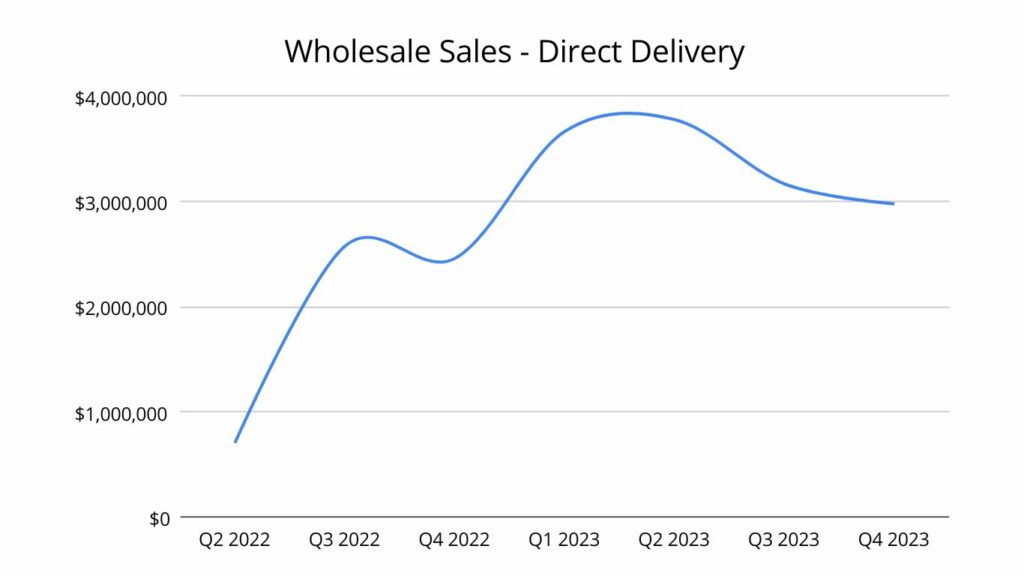
Sales in BC’s direct delivery system, however—which allows some BC cannabis producers to ship products directly to retailers, bypassing the BC LDB’s central distribution warehouse—show an opposite trend, with prices increasing and sales declining.
The total grams sold through the program (617,359) declined 20.8% in Q1 2024 compared to Q1 2023, while wholesale sales ($3 million) fell 18.9%. Meanwhile, the price of all cannabis sold through the program increased by 2.4% to $4.81 a gram, while the price of flower increased by 3.3% to $4.15.
Despite these year-over-year declines, the total grams sold in the program did increase slightly from the previous quarter by 14,834 grams. At the same time, wholesale sales remained relatively steady at about $3 million. The price of cannabis also declined slightly from the previous quarter, at $4.94 a gram for all cannabis and $4.42 a gram for dried flower.
The amount of beverages, pre-rolls, and topicals sold in the program continues to increase year-over-year and compared to the previous quarter. Flower showed a slight increase in sales compared to the previous quarter but was down 8.5% year-over-year. The amount of cannabis plants sold through the program continues to increase, while seed sales show a slight year-over-year decrease but a quarterly increase. Plant sales are higher than seed sales by a significant margin.
Pre-rolls are the most commonly sold product in this category, followed by flower and inhalable extracts.
(CNW) Smiths Falls, Ont. – Canopy Growth Corporation, a world-leading cannabis company dedicated to unleashing the power of cannabis to improve lives, announced today that Mr. David Klein, CEO, Canopy Growth, will be retiring at the conclusion of the company’s current fiscal year ending March 31, 2025. Until this date or such time that a successor is named, Mr. Klein will continue in his role as CEO and as a member of the company’s board of directors to advance Canopy Growth’s strategic objectives including profitability and ensure an effective transition.
The board is in the process of securing a globally recognized search firm to initiate a comprehensive CEO selection process focused on identifying a candidate with the right mix of skills, experience, and expertise to lead the company in its next chapter of growth.
Since joining Canopy Growth as CEO in January of 2020, Mr. Klein successfully led the transformation and development of Canopy Growth to meet the vast opportunities presented by the global cannabis market. Under his leadership, the Company established a foundation for multi-market cannabis leadership through its transformation to an asset light model in Canada and across a range of international markets, including Germany. In addition, Mr. Klein oversaw the launch and advancement of Canopy USA as a first of its kind structure to offer the company’s shareholders unique exposure to the rapid growth and opportunity presented by the U.S. cannabis market ahead of federal permissibility.
This announcement follows the company’s first quarter fiscal year 2025 results, which were issued on August 9 and highlight the progress that has been made in enhancing Canopy Growth’s financial foundation. This includes realizing a 67% increase in gross profit year-over-year, delivering a consolidated gross margin of 35%, and driving a broad-based improvement across key financial metrics.
“Over the past four years, we have transformed Canopy Growth into a focused, asset-light, and financially disciplined organization that is well-positioned for sustainable growth. It has been an honor to lead Canopy Growth through this critical chapter in our evolution, and I am deeply thankful to all our team members for their dedication, and to our shareholders for their support,” said David Klein, CEO, Canopy Growth. “As we look to the next six months and beyond, I remain focused on driving Canopy Growth to profitability while supporting the smooth onboarding of a new CEO to lead the company forward in its next phase of growth. My experience at Canopy Growth has only deepened my belief in the power of cannabis to improve lives, and I am confident in the ability of our Company and team to continue bringing that vision to life.”
“On behalf of the Board, I want to express our gratitude to David for his exceptional leadership and commitment to Canopy Growth. David has been instrumental in navigating the company through a major transformation, establishing Canopy USA, and positioning us as a stronger, more focused organization poised for leadership across the most exciting global cannabis markets,” said David Lazzarato, Chairman of the Board, Canopy Growth. “The Board remains confident in the Company’s strategic direction as well as its leadership team, and we are committed to appointing a new CEO who will continue to drive our ambitious vision forward, ensuring that the Company remains at the forefront of cannabis innovation and growth.”
(Globe Newswire) Toronto – Lifeist Wellness Inc., a health-tech company that leverages advancements in science and technology to build breakthrough ventures that transform human wellness, is pleased to report that it has completed, pursuant to a share purchase agreement entered into on August 16, 2024 with an arm’s length party, the acquisition of the shares of 1000594871 Ontario Corp., which holds key intellectual property resulting from a patent application and all rights thereto.
The acquisition of this intellectual property will provide shareholders with upside exposure to new developments in the cannabis industry and form the cornerstone of an IP portfolio for Lifeist, even as the company divests itself of CannMart and moves away from direct cannabisoperations and contact with the flower. This IP acquisition is in keeping with Lifeist’s pursuit of diverse opportunities in the wellness space while reducing costs to maximize shareholder value.
The acquired patent application addresses very attractive product technologies for the high-potency cannabis concentrates market, which was worth $6.17 billion USD in 2023 and is projected to grow to $44.35 billion by 2032 with a compound annual growth rate (CAGR) of roughly 24.5% between 2024 and 2032.1
The patent application covers “liquid compositions for an electronic vaporizer comprising: (a) at least about 90 wt% of a mixture of one or more cannabinoids, the mixture of one or more cannabinoids comprising at least about 85 wt% tetrahydrocannabinol (THC) and at least 0.1 wt% tetrahydrocannabinolic acid (THCA); and (b) from about 3 wt% to about 7 wt% of a mixture of one or more terpenes. Also provided are methods for preparing a liquid composition for an electronic vaporization device comprising: (a) thermally decarboxylating THCA in crystalline form to obtain a THC oil; and (b) mixing the THC oil with (i) a cannabis distillate oil comprising at least about 50 wt% THC, and (ii) one or more terpenes; and liquid compositions prepared by said methods. Also provided are cartridges configured to operatively couple with an electronic vaporizer comprising said liquid compositions.”
The patent application was purchased for consideration of 1,000,000 common shares of Lifeist. In addition, in the event the patent is issued (the “Issued Patent”), Lifeist or 4871 is required to pay to the vendor of 4871 50% of all net revenue generated from the Issued Patent up to a maximum amount of CDN$1,000,000 and in the event a of a sale, assignment, transfer or other disposition of the Issued Patent during the term of the Issued Patent, Lifeist or 4871 is required to remit 50% of the consideration received on closing of such sale as well any deferred consideration once paid, up to a maximum, in the aggregate, of CDN$1,000,000.
Lifeist also reports, further to its June 30, 2023 news release, as required by the approval of the TSXV in connection with the Consulting Agreement dated June 30, 2023 and as amended on February 1, 2024, entered into by the Company with Singular Narrative Management Ltd. for the provision of strategic business consulting, product development, and brand marketing services to the Company as well as other services that do not include investor relations or promotional activities, that it has issued 1,211,202 common shares and 742,981 common share purchase warrants to acquire up to 742,981 common shares as payment to Singular of the monthly fee of $40,000 for services provided in the months of April, May, June and July 2024, calculated in accordance with the amended Consulting Agreement. The common shares were issued at deemed prices ranging from $0.063 to $0.20 per share. The warrants have an exercise price of ranging from $0.08 to $1.00 per share and expire 5 years from their respective date of issuance.
The Company also reports that in accordance with TSXV policies it has entered into a new similar Consulting Agreement with Singular continuing Singular’s provision of strategic business consulting, product development, and brand marketing services to the Company as well as other services that do not include investor relations or promotional activities (the “Services”).
Pursuant to the Agreement, Lifeist shall pay a reduced monthly fee of $20,000 to Singular for the provisions of the Services, after such services have been provided in the particular month, to be satisfied in common shares of the company and common share purchase warrants, with the number of (i) Shares issuable to Singular determined by dividing $20,000 by the 5-day volume-weighted average price for the last five days of the month in which the services are provided and (ii) Warrants issuable to Singular determined by dividing $20,000 by such VWAP. The exercise price of the Warrants shall equal the greater of the “Market Price” (as defined in Policy 1.1 of the TSXV) on the trading day prior to the date of issuance of the Warrants and $0.05 and the Warrants expire five years from the date of issuance.
In addition to the monthly fees set out above, pursuant to the Agreement, the Company shall issue to Singular on the date on which the initial first monthly fee is due to Singular under the Agreement such number of common shares (“Shares”) in the capital of Company and Share purchase warrants of the Company determined in accordance with the Agreement for an additional $31,200 to compensate Singular for a certain shortfall in the fees payable under the terms of the previous agreement with Singular.
The term of the amended Agreement is for an additional of 6 months and may be terminated by either party with 30-days’ prior notice and is automatically renewable thereafter for additional one-month periods unless otherwise terminated by either party.
The Agreement and payment thereunder which constitutes a Shares for Services transaction under the policies of the TSXV remains subject to acceptance of the TSXV.
While the beginning of cannabis legalization in Canada was characterized by a surplus of product, many in the industry now say that trend has been shifting to a shortage in recent months.
This is good news for cannabis growers, as it means having more leverage on the market, putting brokers and third-party processors in a less-than-ideal position for potentially the first time.
Jacquie Trombley, director of sales, marketing, and product development at Agmedica Bioscience Inc. in Ontario, says she has seen a significant shift in 2024 from a buyer’s market to a seller’s market.
Agmedica sells in Canada’s medical and non-medical markets, both under their own brands and in the B2B market, and exports to international markets.
“Historically, we would usually have at least some inventory in our vaults, but right now the majority of the requests we receive for product go unfilled,” explains Trombley. “We get asked for product pretty much every day, and we cannot meet the demand.”
This is in part because of the increasing demand of the export market, she says, but it’s also the result of the number of cannabis producers closing up shop. Some struggling producers who might have been desperate to move products at a discounted rate are now out of the market, and, over time, this benefits those who have been able to stick it out.
This is reflected by the increase in price for not only top-quality flower, but also the rise in price for smalls and trim, which generally aren’t making their way to the international markets.
“Pricing has come up dramatically,” she continues. “We used to sell A [grade] flower for what we’re selling B [grade] flower for now. B flower and trim pricing has probably doubled.”
Another big turn, says Trombley, is payment terms for growers who are selling to processors, something that is arguably more impactful than the price increase, Where various consignment deals and terms have been common for growers in the first few years of legalization, meaning full payment might not have been provided for some time after product had sold in a provincial market.
“We are no longer offering terms to B2B domestic buyers because you just might not get your money,” she continues. “There’s been a significant shift to 100% cash up front and we’re getting it! Before the product leaves our facility.”
This is a big deal for small growers who are struggling to keep the lights on.
“Right now, I think some of those smaller companies absolutely can demand cash up front right now, or at least improved payment terms.”
Steve Clark, founder of the Canadian Cannabis Exchange, says the issue is something many in the industry have been discussing this year.
“We are seeing domestic supply shrinking in a number of ways,” says Clark. “The closures of growing facilities and reduction and square footage of Canopy in Canada. The companies who were producing for their own internal supply in these facilities have flipped from net sellers to net buyers, (further taking supply off the market), and the pull from export into intensive markets is reducing overall flower availability.”
Michael Gorenstein, president and CEO of the Cronos Group, another cannabis company that sells domestically and in international markets, made similar comments on a recent quarterly report earnings call.
“We’ve really seen a huge shift in the supply dynamics where we’ve had significant oversupply in the past,” said Gorenstien.
Although he says he still believes there is a large supply of low-quality cannabis flower in the market, this isn’t necessarily a product with much market demand. Quality cannabis, he says, is a different story.
“As we said in the past, there’s a difference between available cannabis inventory and available inventory that’s sellable as quality flower,” continued Gorenstien. “While there’s plenty of the former, there is now a shortage of high quality desirable flower that is sellable to consumers in Canada.”
The company’s most recent quarterly report also noted: “We are anticipating shortages in raw materials and may be unable to obtain adequate supplies of raw materials in a timely manner and at commercially reasonable prices.”
Attracting Birds to Your Garden: Do our feathered friends need bird feeders?
Who doesn’t love a bird feeder? They attract many birds, and you can spend endless hours watching them. But there’s a growing debate about whether bird feeders do more harm than good for our feathered friends.
Habitual Feeders
One of the most compelling arguments against having bird feeders in the garden is that birds can become habituated to them. A 2021 research paper published the in the journal Biological Conservation suggests that the constant supply of peanuts and seeds offered to the great or blue tit in British gardens has caused the bird’s strength and population to increase. This has upset ecological balance, as the bird has been winning contests for prime nesting locations over its subordinate cousins, the willow tits, whose population has declined by 40%.
Territorial Issues
Some birds, like hummingbirds or starlings, become territorial over feeders, excluding others from them and denying them a food source. I’ve broken up aggressive chirping and clacking of wings in my garden as one hummingbird tells another to get lost.
Cleanliness
It’s a lot of work to keep a bird feeder clean. Whether it’s a nectar feeder or one with birdseed, wash all feeders with warm, soapy water every two days and replace the food. Hummingbird feeders must be cleaned daily in hot weather, as heat can breed bacteria.
Birds poop in their food. If this happens and another bird eats the contaminated seeds, it will get sick. The same goes for you if you touch the feeder and don’t wash your hands afterward.
Feeders also spread diseases such as the avian flu. Two years ago, an outbreak in North America spread by wild birds inspired experts to recommend taking down feeders to help stem the disease.
Attracting Undesirables
Bird feeders attract undesirables to the garden, such as rodents, raccoons, and even predatory aggressive crows. All of the above are looking for birdseed or other snacks. All a cat has to do is sit by a bird feeder to be well-fed.
Native Plants: The Right Food
With all this stacked against them, is there any reason to have a bird feeder? Gregor Beck is a senior strategist for Birds Canada, a non-profit organization advocating for bird conservation.
“You might think that birds are getting most of their food from feeders, but they are foraging more diversely than you might think,” he explains.
Planting native shrubs and plants increases your region’s biodiversity and provides a more diverse range of bird food choices. Berries, seeds, flower nectar, and the insects that call the plant home are excellent for birds. Also, native species are the plants most familiar to birds who call your region home.
Beck encourages gardeners to think seasonally. Don’t tidy up the garden in fall, but keep the seed heads on the plants all winter; have both summer berry-producing plants and winter ones available, like holly.
“Bird feeders, especially in cold weather, are a very good supplement for food,” Beck says. “They are also a wonderful way for people to connect with birds.”
So, we can make the feeder obsolete and enjoy our feathered friends by planting a garden of favorite bird treats. Good for the environment and for the birds!
For more information on bird-friendly gardens, check out Birds Canada’s website, birdscanada.ca.
Also, inspectors and law enforcement in New Brunswick have been busy raiding unlicensed stores, hitting several locations this past week.
In other cannabis news…
Truck News provided a reasonably in-depth report on impaired driving rates in Canada, noting that while Canadian truck drivers who cross the US border have maintained a low rate of positivity of cannabinoid detection (1%) pre-and post-legalization, the rate of those who are not crossing the US border has increased slightly, from 5.31% to 7.68%. The article also, refreshingly, notes that a positive test does not necessarily indicate impairment at the time of testing.
Canopy Growth Corporation announced that CEO David Klein will be retiring at the conclusion of the company’s current fiscal year ending March 31, 2025, or when the board names a successor. Some say the role will go to a person who can remove an ancient sword from a stone, while others say it will come down to a majority vote of the board.
Martin Cash at the Winnipeg Free Press spoke with Delta 9 founder John Arbuthnotabout the company’s current financial challenges. “What we did not anticipate,” says Arbuthnot, “Was escalation of hostilities from our senior lenders at Sundial.”
Pure Sunfarms Corp. announced it has completed the first phase of its wildlife enhancement project through the Beneficial Management Practices program. Funding for this project has been provided by the Governments of Canada and British Columbia through the Sustainable Canadian Agricultural Partnership, a federal-provincial-territorial initiative under the Beneficial Management Practices Program. The program is delivered by the Investment Agriculture Foundation of BC.
Following their Q3 2024 report last month, Cannara Biotech has now announced what they say was a strong July, which they will be discussing during a live investor webcast on Tuesday, August 20, 2024.
Lifeist Wellness Inc. and its subsidiary CannMart Inc. have entered into a services agreement and a share purchase agreement with Simply Solventless Concentrates Ltd (SCC) to provide operational support services to CannMart, pending SSC’s acquisition. Lifeist will pay SSC a monthly service fee.
On August 14, 2024, members of the Waterloo Regional Police Direct Action Response Team completed two Cannabis Act search warrants at illegal cannabis stores on King Street East and on Walnut Street. A large quantity of various cannabis products, currency, and a quantity of illicit prescription pills were seized. Two were arrested.
Officials in Californiaseized more than 2.2 million illegal cannabis packages marked with the universal symbol of legal California cannabis. Much of the packaging resembled popular food and candy brands that could appeal to children, including items resembling Twinkies and Sweet Tarts.
Officials in Nigeria say they found 265.25 kg of cannabis (in Sherwood hockey bags, naturally) imported from Montreal at the Tincan seaport in Lagos on August 7, and another 37.5kg in a container from Canada on August 8.
Finally, Business of Cannabis reports that the Netherlands has again delayed the official start of its ‘controlled cannabis supply chain experiment’ amid ongoing challenges in establishing domestic supply. The country’s approach officially began with a preparatory phase in December 2023, where a few coffee shops were selected to receive relatively small amounts of legally grown cannabis. The second phase, the “experimental” phase, would mean expanding the program across the country, something politicians connected to the program now say they are not quite ready for.
A recent scientific review has delved into the possible therapeutic benefits of marijuana-based medicine for treating Tourette syndrome (TS), revealing that medical cannabis might significantly help reduce the intensity of premonitory urges and tics associated with the condition.
The review’s authors examined nine studies with 401 TS patients. The findings suggest that while more research is necessary — particularly studies involving larger participant groups, standardized dosages and consistent drug formulations — marijuana-based medicine (MBM) holds promise as a treatment option for individuals with TS.
“The current study demonstrates promising and perhaps advantageous results with MBM in terms of reducing the intensity of premonitory cravings and tics,” the authors noted. They said that considering the few therapeutic choices now accessible to TS patients, these findings may be especially important.
Although there are several treatments available to lessen the frequency and intensity of tics connected to TS and improve the quality of life for patients, the authors observed a notable deficiency of strong evidence to support the efficacy of these treatments. Currently, the FDA has only approved three drugs to treat tics: aripiprazole, haloperidol and pimozide. But since there isn’t a single treatment that works for everyone, several other agents, including MBM, have been suggested as viable solutions.
The review included both cohort studies and clinical trials, and it included comparisons between measurements obtained before and after cannabis administration. The significance of the findings was evaluated using a 95% confidence interval.
The meta-analysis encompassed three trials, out of which one demonstrated a noteworthy decline in overall scores, the second showed a considerable reduction in scores and the third revealed no significant variation with the use of marijuana-based treatment.
According to the authors, their study is the first comprehensive meta-analysis and review of MBM’s efficacy in TS patients using a variety of measures. They did concede that there are questions regarding the study’s findings’ generalizability due to the very small data set and that more research is needed.
As per the Tourette Association of America, there are specific states, including Ohio, New Jersey, Missouri, Minnesota, Illinois and Arkansas, that acknowledge TS as a qualifying diagnosis for medical cannabis. In certain states, medical professionals are permitted to recommend marijuana for any disease they think would benefit from it, especially if other treatments have failed.
There is growing momentum in the United States to loosen regulations surrounding medical marijuana research. Even though reclassification by itself wouldn’t make recreational or medical cannabis markets lawful in any state, it might have several effects on government workers, taxation, research and other sectors.
The full benefits of the medical cannabis products from the thousands of licensed marijuana companies such as Curaleaf Holdings Inc. (CSE: CURA) (OTCQX: CURLF) are unlikely to be fully known in the years to come until extensive research is done to document how different groups of patients respond when they consume these products.
About CNW420
CNW420 spotlights the latest developments in the rapidly evolving cannabis industry through the release of an article each business day at 4:20 p.m. Eastern – a tribute to the time synonymous with cannabis culture. The concise, informative content serves as a gateway for investors interested in the legalized cannabis sector and provides updates on how regulatory developments may impact financial markets. If marijuana and the burgeoning industry surrounding it are on your radar, CNW420 is for you! Check back daily to stay up-to-date on the latest milestones in the fast -changing world of cannabis.
To receive SMS alerts from CNW, text CANNABIS to 888-902-4192 (U.S. Mobile Phones Only)
Please see full terms of use and disclaimers on the CannabisNewsWire website applicable to all content provided by CNW, wherever published or re-published: https://www.CannabisNewsWire.com/Disclaimer
Department of Justice and Public Safety peace officers in New Brunswick seized cannabis and tobacco products from an unlicensed store in Riverview on August 2, arresting two employees.
Riverview is located just outside Moncton. The products were seized from the L’Nuk Trading Post at 767 Coverdale Rd. The two employees arrested, a 21-year-old and a 31-year-old, face charges under the Cannabis Act and the Tobacco Tax Act. The investigation is ongoing.
Department of Justice and Public Safety peace officers seized:
28,830 cigarettes
7.6 kilograms of dried cannabis
414 grams of hashish
1,409 joints
70 cigars
$10,778 in cash
361 edible cannabis products
68 cannabis vapes
49 flavoured vapes
The report also says a 35-year-old man was arrested on Aug.13, when officers seized $26,154 and cannabis products. He is also facing charges under the Excise Act and Cannabis Act.
A video shared on a social media account connected to the L’Nuk Trading Post on August 15 shows officers at a second L’Nuk Trading Post location in Moncton, with a large crowd assembled. A message on the post says officers conducted raids at both the Riverview and Moncton locations on August 15, as well.
The Moncton store, located at 575 Main St., also faced enforcement action in August 2023, when officers seized 7,719.5 grams of dried cannabis, 690.4 grams of hashish, 171.3 grams of psilocybin (magic mushrooms), 246 grams of cannabis shatter, an undisclosed quantity of assorted cannabis products, edibles, contraband cigarettes, and $10,432 in cash.
The store quickly reopened following that raid. The business’ social media accounts describe the business as Indigenous-owned and indicates “We don’t sell products, we share our tradition.”
A video shared on Facebook in May 2023 shows several store employees and First Nations representatives delivering a letter to the RCMP stating that the store is operating under territorial rights, which they argue does not need a licence from the province. The store is located just a few doors down from an RCMP station.
Former National Assembly of First Nations Chief Del Riley also appears in the video, and he’s been working with many First Nations communities in Canada to make similar arguments for sovereignty for cannabis retailers on First Nations land.
The province’s Public Safety Minister, Kris Austin, told media earlier this year that there is nothing the province can do to enforce its provincial cannabis rules on businesses operating on First Nations reserves. She instead argues the issue is up to the federal government to enforce.
New Brunswick has been conducting numerous raids following the passage of a new law earlier this year giving more enforcement power to inspectors. Authorities first applied these new laws in a seizure on July 24 in Saint John.
Several different cannabis products were seized from an unlicensed cannabis store in Fredericton, New Brunswick, on July 23 during a joint operation involving Justice and Public Safety peace officers and Fredericton Police.
In June and July, inspectors seized cannabis products from unlicensed stores in Moncton. No one was arrested at the time, but authorities say the investigation is ongoing.
(Globe Newswire) Montreal – Cannara Biotech Inc, a vertically integrated producer of premium-grade cannabis and derivative product offerings at affordable prices with two mega facilities based in Quebec spanning over 1,650,000 sq. ft., today announced that the company has achieved its highest national market share of 3.2% in July 2024 which places Cannara as the 9th largest licensed producer in Canada by market share1.
“We are thrilled to report that July 2024 marks a significant milestone for Cannara, with our highest monthly national retail sales in the company’s history, including an approximate 11.8% market share in Quebec1. This achievement is a testament to the dedication and hard work of our entire team, as well as the growing demand for our premium cannabis products. We look forward to discussing these results in more detail during our upcoming investor webcast, where we will provide further insights into our third quarter of 2024 financial performance and future growth strategies,” commented Nicholas Sosiak, CFO of Cannara.
Cannara will host a live investor webcast on Tuesday, August 20, 2024, at 2:00 PM ET. Nicholas Sosiak, CFO, will lead the presentation, covering key aspects of the business and delivering a detailed update on Q3 2024 financial results. Following the presentation, investors will have the opportunity to participate in an interactive Q&A session.










Recent Comments