
by Grow Up Conference | Aug 9, 2024 | Media Partners, Stratcann
Health Canada is seeking feedback on the Pest Management Regulatory Agency’s (PMRA) new proposed approach for registering pesticide uses on cannabis and industrial hemp.
While pesticide registrations for cannabis in Canada have historically focused on microbial products and non-conventional pesticides (biopesticides) like canola oil, sulphur, or garlic powder, Canada is now looking to also identify other potential risks, including risks from ingestion or from inhalation due to smoking or vaping of products made from crops that have been treated with either a biopesticide or conventional pesticide.
Health Canada anticipates that as the industry grows, producers of cannabis and industrial hemp crops could face serious disease, insect and weed pressures, which could create a desire for these companies to use more conventional chemical pesticides for adequate control.
Currently the PMRA considers seven use-site categories as appropriate: Food crops grown in greenhouses or other enclosed structures; Non-food crops grown in greenhouses or other enclosed structures; Terrestrial non-food and non-feed seed, fibre, and industrial crops; Seed and plant propagation materials: food and feed; Seed and plant propagation materials: non-food and non-feed; Terrestrial feed crops; and Terrestrial food crops.
Health Canada’s Pest Management Regulatory Agency has invited the public, stakeholders, and partners to submit written comments on Regulatory Proposal PRO2024-03, entitled Consultation on the proposed approach for registering pesticide uses on cannabis and industrial hemp: use-site categories, data requirements and label statements.
That public consultation is open from August 9 to October 7. Following that timeline, Health Canada will make the consultation results available on its website. The final version of the policy will be published on PMRA’s Policies and Guidelines website.

by Grow Up Conference | Aug 9, 2024 | Media Partners, Stratcann
Canopy Growth Corporation reported $23 million in gross profit in Q1 2025, a 67% increase from Q1 2024, but also posted a $127 million loss, a nearly 204% increase from Q1 2024’s loss of $41.9 million.
This is a decrease in net revenue and net loss from the previous quarter, Q4 2024, in which Canopy reported $72.8 million in net revenue and a net loss from continuing operations in fiscal 2024 of $483.7 million for the three months ended March 31, 2024.
Despite continued losses, Canopy CEO David Klein remains positive.
“The fundamentals of our business continue to strengthen, and our focus on profitable revenue generation is yielding clear results as we set the stage for growth in the second half of fiscal 2025. With our core businesses delivering adjusted EBITDA profitability and primed for growth, paired with Canopy USA’s positioning to benefit from near-term market opportunities in the U.S., Canopy Growth is advancing rapidly and is well established for multi-market cannabis leadership.”
Net revenue from Canadian cannabis sales, both medical and non-medical, for the three months ended June 30, 2024, was $37.7 million. Cannabis sales in international markets brought in another $10.1 million and sales for Storz & Bickel were $18 million, for a total of $66.2 million in net revenue.
The company reported incurring $7.5 million in excise tax from Canadian adult use (non-medical) sales in Q1 2025 and $2.1 million in excise from medical sales.
The segmented gross margin for Canadian cannabis sales was $12.1 million, while international cannabis markets were $3.6 million, and Storz & Bickel was $7.3 million. After a $29.1 million operating loss and $93.9 million in other expenses, loss before income taxes was $123 million.
While $37.7 million of Canopy’s sales in the three months ended June 30, 2024, were from Canada, $15.5 million were from Germany, $8.6 million were from the US, and another $4.4 million were from other parts of the globe.
Canopy attributes a year-over-year decrease in Canadian adult-use cannabis sales to “supply constraints for certain products as a result of financial difficulties with our contract manufacturers and lower sales velocity due to increased price competition.”
The company attributes its year-over-year increase in Canadian medical cannabis sales to an increase in the average size of medical orders, an increase in the percentage of insured customers, and a more extensive assortment of cannabis product choices offered to its customers.
These increases were somewhat offset by a year-over-year decrease in the total number of medical orders, which Canopy says is due to an increasing number of adult-use cannabis retail stores across Canada. As of June 21, 2024, there were 3,663 authorized retail cannabis stores in Canada, down from 3,689 in March, but this number is still higher than the same reporting period in the previous year.
Canopy’s international cannabis sales remained relatively stable compared to the same quarter in 2024, which it says is due to increased sales in Poland and decreased sales in Australia.
Revenue from sales of Canopy’s control of Storz & Bickel was $18.5 million in the first quarter of fiscal 2025, up from $18.1 million in the first quarter of fiscal 2024. Canopy attributes this 2% increase in year-over-year sales to the growth of its Mighty vaporizer and contribution from its newly launched portable vaporizer in the third quarter of fiscal 2024.
The gross margin for Canopy’s Canada cannabis segment was $12.1 million in the first quarter of fiscal 2025, or 32% of net revenue, compared to a $300,000 loss in the first quarter of fiscal 2024, or -1% of net revenue.
Canopy has two cannabis cultivation facilities in Canada: a greenhouse facility in Kincardine, Ontario and its DOJA facility in Kelowna, British Columbia. The Kincardine facility has European Union Good Manufacturing Practices (“EU GMP”) certification which allows for export to medical markets in Europe and other medical cannabis markets around the world.
The company also operates a processing facility at its flagship site in Smiths Falls, Ontario.
Canopy sells in Canada under the Tweed, 7Acres, DOJA, Vert, Hi Way, Deep Space, Wana, and Spectrum, while international sales are under Canopy Medical and Spectrum Therapeutics.

by Grow Up Conference | Aug 9, 2024 | Media Partners, Psychedelic News Wire
Legislators in the state of Massachusetts have forwarded a measure focused on military veterans to the governor’s desk for approval. The measure includes provisions to establish a psychedelic working group to conduct research and give recommendations on the potential therapeutic benefits of psychedelics like MDMA and psilocybin.
In particular, the group would explore whether psychedelic therapy was linked to improved outcomes among veterans diagnosed with a range of mental-health conditions while also looking for alternative mental-health treatments for veterans. The measure, titled the HERO Act, was initially introduced by Governor Maura Healey in November 2023.
It should be noted that the language in the proposal wouldn’t immediately establish a framework to legally access psychedelics. The working group would also be required to file a report with its recommendations and findings along with a pair of joint legislative committees and the clerks of the senate and house by Jan. 1, 2025, at the latest.
Prior to this, the house and senate had approved different versions of the measure and psychedelics provisions. The house version of this proposal had included an amendment that would have added a section to establish a pilot program looking into medical marijuana as an opioid alternative for veterans.
However, bicameral negotiators during a committee meeting agreed on a final version that has now been approved in both chambers. Final passage of this bill comes after a joint legislative committee advised legislators not to approve a broader resolution to legalize psychedelics.
William F. Galvin, secretary of the Commonwealth, verified in July that activists had gathered enough valid signatures, 13,073 to be precise, for this resolution to be brought before voters in Massachusetts. Legislators were required to consider the psychedelics proposal, which was spearheaded by Massachusetts for Mental Health Options. This was after state-certified advocates submitted valid signatures during a petitioning round in 2023.
Earlier in May this year, the Special Joint Committee on Ballot Initiatives published a majority report which formally recommended against passing the resolution as drafted. Before giving this recommendation, the panel had held a hearing to acquire expert feedback on the resolution.
Thus far, eight cities in the state have also approved policies to deprioritize enforcement of laws against psychedelics locally. They include Amherst, Easthampton, Medford, Provincetown, Northampton, Cambridge, Somerville and Salem.
Meanwhile, a separate committee advanced a measure at the beginning of this year that would legalize psychedelic therapy in the Commonwealth. If approved, the measure would also establish a framework to license facilitators who would oversee the therapeutic, spiritual and medical applications of psilocybin.
As more states take steps to reform their psychedelics laws, start-ups such as Seelos Therapeutics Inc. (NASDAQ: SEEL) could see this as a bullish sign for the psychedelic-based treatments they are working to develop and get approved by the FDA.
About PsychedelicNewsWire
PsychedelicNewsWire (“PNW”) is a specialized communications platform with a focus on all aspects of psychedelics and the latest developments and advances in the psychedelics sector. It is one of 60+ brands within the Dynamic Brand Portfolio @ IBN that delivers: (1) access to a vast network of wire solutions via InvestorWire to efficiently and effectively reach a myriad of target markets, demographics and diverse industries; (2) article and editorial syndication to 5,000+ outlets; (3) enhanced press release enhancement to ensure maximum impact; (4) social media distribution via IBN to millions of social media followers; and (5) a full array of tailored corporate communications solutions. With broad reach and a seasoned team of contributing journalists and writers, PNW is uniquely positioned to best serve private and public companies that want to reach a wide audience of investors, influencers, consumers, journalists and the general public. By cutting through the overload of information in today’s market, PNW brings its clients unparalleled recognition and brand awareness. PNW is where breaking news, insightful content and actionable information converge.
To receive SMS alerts from PsychedelicNewsWire, text “Groovy” to 888-902-4192 (U.S. Mobile Phones Only)
For more information, please visit https://www.PsychedelicNewsWire.com
Please see full terms of use and disclaimers on the PsychedelicNewsWire website applicable to all content provided by PNW, wherever published or re-published: https://www.PsychedelicNewsWire.com/Disclaimer
PsychedelicNewsWire
San Francisco, CA
www.PsychedelicNewsWire.com
415.949.5050 Office
Editor@PsychedelicNewsWire.com
PsychedelicNewsWire is powered by IBN

by Grow Up Conference | Aug 9, 2024 | Cannabis News Wire, Media Partners
A recently conducted analysis has determined that most cannabis recalls are circulated too late, even when products contain unhealthy levels of pesticides or mold. This comes at a time when a growing number of people are raising concerns about product safety.
The analysis focused on product recalls in the following state-regulated cannabis markets: New York, Michigan, Massachusetts, Colorado and California.
CANNRA executive director Gillian Schauer said that states had different authority and capacity to recall products. The analysis determined that in some of these markets, recalls weren’t frequent, despite claims made by state authorities and whistleblowers that testing laboratories were manipulating results deliberately to please their clients.
Regulators in California announced six compulsory product recalls last month after an investigation determined that some cannabis products cleared for sale had detectable pesticide levels. Ten months have passed between the recalls and products being put up for sale now, which increases the likelihood that the items with issues have long been ingested by consumers or thrown away.
Last year, the Cannabis Control Commission (CCC) in Massachusetts published a bulletin to alert the public that a test kit used to measure microbial contaminants may have possibly had defects. While the CCC noted that the department of enforcement and investigation was actively looking for the products with issues, they issued no recalls.
It remains unclear how many of the affected products were sold to consumers. This is a huge issue, particularly since the actual numbers of recalled products sold to consumers aren’t usually made public by governments at the state level.
The analysis also investigated recent mandatory recalls issued by regulators in the aforementioned states, apart from New York, determining that the recalls lagged by months. In one instance, California recalled products about seven weeks after they were cleared for sale. By then, it was too late to recover most of the affected products because they’d already been purchased by consumers.
Despite the immaturity of the multibillion-dollar regulated marijuana industry, regulators continue to emphasize the importance of product safety. To help with this, regulations have been modified to expedite recall response times while also prioritizing products that may pose huge health risks to consumers.
A good example of such is the introduction of reference labs run by states. The state of Oklahoma recently afforded its medical cannabis authority the power to launch a reference laboratory. Michigan is also expected to launch a reference laboratory toward the end of the year.
The cannabis industry has come a long way to reach the level where the substance is legal in many states, and it would be unfortunate if public trust starts eroding due to ineffective systems of recalling products suspected to have issues. It becomes vital then for cannabis brands such as Verano Holdings Corp. (CSE: VRNO) (OTCQX: VRNOF) to do everything in their power to cement their reputation for quality.
About CannabisNewsWire
CannabisNewsWire (“CNW”) is a specialized communications platform with a focus on cannabis news and the cannabis sector. It is one of 60+ brands within the Dynamic Brand Portfolio @ IBN that delivers: (1) access to a vast network of wire solutions via InvestorWire to efficiently and effectively reach a myriad of target markets, demographics and diverse industries; (2) article and editorial syndication to 5,000+ outlets; (3) enhanced press release enhancement to ensure maximum impact; (4) social media distribution via IBN to millions of social media followers; and (5) a full array of tailored corporate communications solutions. With broad reach and a seasoned team of contributing journalists and writers, CNW is uniquely positioned to best serve private and public companies that want to reach a wide audience of investors, influencers, consumers, journalists and the general public. By cutting through the overload of information in today’s market, CNW brings its clients unparalleled recognition and brand awareness. CNW is where breaking news, insightful content and actionable information converge.
To receive SMS alerts from CNW, text CANNABIS to 888-902-4192 (U.S. Mobile Phones Only)
For more information, please visit https://www.CannabisNewsWire.com
Please see full terms of use and disclaimers on the CannabisNewsWire website applicable to all content provided by CNW, wherever published or re-published: https://www.CannabisNewsWire.com/Disclaimer
CannabisNewsWire
Denver, CO
www.CannabisNewsWire.com
303.498.7722 Office
Editor@CannabisNewsWire.com
CannabisNewsWire is powered by IBN

by Grow Up Conference | Aug 9, 2024 | Extraction Magazine, Media Partners
Asia is the home to more than half of the world population, with over 4 and a half billion inhabitants, separated into 48 distinct countries. In totality, only 19 provinces of Asia have adopted Medical Cannabis laws. It’s said that less than 1% of the population admits to using cannabis. This is twice as true in the few remaining communist countries that still exist, a majority of which reside on Asian soils. China led the way as the largest known communist ran government, as well as Loas, Cuba, North Korea, Vietnam and distant Japan. From the Asian Pacific islanders all the way inland, we can see a very expansive and unique viewpoint of law sets within each defined nation and culture.
It is always recommended and crucial for business travelers and tourists to thoroughly understand the specific legal context of the country they are visiting. In addition to that, engaging in any cannabis-related activities in jurisdictions with strict laws can result in serious legal consequences. In general
North and South Korea
Places like North Korea are kept extremely private in their beliefs and government structure, so in many places foreigners cannot gain access to the local information of laws and rules. With deeply ingrained punishment fears a large portion of Asian governments still carry a deep stigma with the Cannabis plants and enforce harsh punishments including death sentences in more than one country.
In contrast South Korea became the first East Asian country to legalize Medical Cannabis which is defined by the governing of similar to America and is strict in its policy with only chronic cancer, aids and epilepsy patients having access.
Thailand
One nation that has been recently in the highlights of Cannabis evolution is Thailand. Recently fully legalized for adult use and Medical Cannabis combined, there is no limit on the number of plants a local can cultivate, as there has been given a free reign to cultivate as long as not gaining commerce from it. The boom of industry has been an enormous green rush, seeing over a million different forms of Cannabis dispensaries and businesses form with little to no government oversight.
Ran by the Department of Thai Traditional and Alternative Medicines (DTTAM), the current laws are in the process of being turned back to have a stricter governance plan in place by the end of the year for high tetrahydrocannabinol (THC) containing products.
- >0.2% THC – Industrial Hemp
- <0.2% THC – Medical or adult Cannabis use
Currently an entrepreneur must seek a license from the Thai FDA to create fully legal hemp products, which are lawful only if they contain less than 0.2% of THC and this can be sold without restrictions. In all aspects of cannabis consumption anyone under the age of 20, pregnant or breastfeeding are not allowed to consume or possess any part of the plant. Penalties in place for growing for commercial intent without permits now stand at – 1-3 years prison sentence + 20-30,000 Baht fine. Larger quantities can evoke a sentence up to 15 years with Drug Cartels still receiving the Death penalty.
India
India has always led the way as a large producer of Hemp and Hemp products, even though American prohibition Hemp oils and seeds have been traded in the health and wellness sector of commerce. When it comes to Cannabis with high THC delta 9, the country is still torn into many cultures, many of which still find the intoxicating effects of Medical Marijuana a negative thing. Nationwide, Cannabis is considered illegal. States such as Odisha have stepped up to create their own legal Cannabis state and the region is expanding from the tourism caused by it.
Other states, including areas as far down as the Purple Kush Valley, are well known for their cannabis-friendly culture though they still are governed by prohibitionary laws. Many women in India still battle with the stigma of dirtiness if involved with the plant and on a social level and groups of women fight for their rights to be part without prejudice and persecution of misogyny. The Yogi culture has used cannabinoids in spiritual practice for centuries and the unity of those vibrations still exist in protected areas.
In general, India can be considered a very spiritual and welcoming country to the cannabis culture with fines for foreigners’ possession being minimal and punishments for locals growing without permits as little as 6 months in jail and 10,000 Rs fines.
China
The world’s largest communist nation has now entered a very prominent stance on industrial hemp, being the producer of over 70% of the planet’s textile biomass. Cannabidiol (CBD) containing products can be seen sold on local shelves. Recreational Cannabis use is still frowned upon even with a strong illicit underground culture and people caught using the plant can face up to 15 days in local jails and can be fined 2,000 Yuan. Severe penalties are imposed on those captured during smuggling.
Taiwan sets itself to strong policies with categorizing Cannabis as a strict schedule 2 narcotic which holds the penalty of life imprisonment if caught cultivating, manufacturing or distributing the drug.
Cambodia
This country remains a cannabis friendly destination for consumers with a very socially accepted experience that can be seen in public throughout the country. A plethora of restaurants cater to cannabis infused foods and drinks openly and can be an entertaining experience to visit and consume. Cannabis is technically illegal in the nation, but local law enforcement does not condemn it and has never been seen as a problem within its borders.
Vietnam
Cannabis is easily obtained and its use is widely ignored by local law enforcement. Traffickers and large cartels will be punished with years of imprisonment, as cannabis is technically illegal, nevertheless it has reached a point of social de-stigmatization within its borders.
Malaysia
This country is in the process of legalizing medical cannabis, but currently remains illegal for recreational use, with a mandatory death sentence for those caught trafficking.
Philippines
It has a strong cannabis underground culture, but remains illegal with imprisonment for those found selling or distributing cannabis inflorescences and derived products.
Saudi Arabia
This country is amongst some of the strictest countries with public whippings given to known consumers and death penalty for those caught smuggling.
Mongolia
This very remote and ungoverned country possesses a rich cultural background in cultivating and using Hemp products, with a small cultural awareness of high THC medical cannabis, cannabis remains prohibited by governing laws.
Tibet
Even if this is a sovereign nation of sacramental use of cannabis in religious rights, cannabis is prohibited and carries a weight of 5 years imprisonment if caught cultivating it. Tibet has long been researched as having been the birthplace of several base strains of original Landrace Cannabis with proof of its use dating back 1000’s of years.
Japan
The persecution of the cannabis and hemp plants started following the American enforced law prohibiting its use imposed after World War 2. Cannabis has been considered taboo though its use in all aspects of life, can be dated back several thousand years. Industrial hemp has now made a comeback and is thriving on the island. Recently, in late 2023 Japan has legalized medical cannabis, but laws have yet to be structured or implemented. There is a small underground of hemp enthusiasts that can be found in the mountains that preserve the rich history with the Hemp Museum venues.
Indonesia
It continues to hold a strict policy against the cultivation or use of cannabis and Hemp with penalties reaching over 5 years in prison if caught cultivating illegally.
Nepal
This continues to be a cannabis friendly place, offering many adventures to tourists. Many retreats have been created to allow the spiritual and cultural practices of the region to be taught to the cannabis curious.
Wrap-up of Cannabis consumption in Asia
With much of Asia being the ground zero of many forms of cannabis and hemp genetics, with its use dating back from the beginning of time, it is intriguing to see the amount of continued prohibition that centers around the plant. Regions such as Pakistan that have a strong cannabis and hash culture are leading the way to bring this reborn commerce back onto the continent. Traveling with the intent to consume in many regions can be a dangerous decision and take time to due diligence on areas of interest to you. Get to know the culture and laws well before deciding to travel and stay aware of the effects of cannabis products that have potentially been tainted with obscure substances.
References:
1. https://ddb.gov.ph/
2.https://vietnamlawmagazine.vn/
3.https://www.bangkokpost.com/topics/1700988/cannabis-law
4.https://economictimes.indiatimes.com/small-biz/sme-sector/from-textiles-to-plastic-india-needs-to-get-high-on-hemp/articleshow/105946819.cms?from=mdr
5.https://www.scmp.com/business/companies/article/3005011/mania-chinas-hemp-related-prompts-stock-regulator-crack-down
6.https://thediplomat.com/2017/04/beware-vietnams-death-machine/
7.https://www.cannabisbusinesstimes.com/author/cnnphilippines/
8.https://www.arabnews.com/node/2485891/saudi-arabia
by Grow Up Conference | Aug 9, 2024 | Media Partners, Stratcann
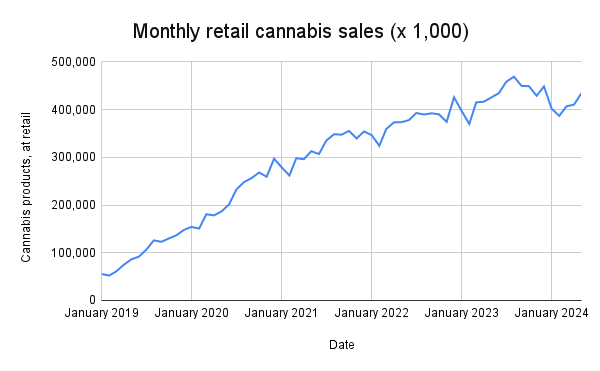
Retail cannabis sales continued to rebound in May following declines from a peak last summer.
Retail cannabis sales in Canada were $434.5 million (seasonally adjusted), up from $410.5 million in April and $406.8 million in March. Sales dropped to $402 million in January and $386.8 million in February, following a spike in sales at $448.7 million in December.
Cannabis sales continue to increase year over year, with spikes in sales in the summer and the winter holiday season, but the pace of those annual increases has been slowing in the last few years as the market appears to be reaching a possible saturation point.
The current high mark for sales was August 2023, when retail cannabis sales reached $469 million. The previous high water mark was December 2022 at $425.9 million.
The number of cannabis stores in Canada has also been slowing in many provinces and even declining in some in 2024.
As of June 21, 2024, there were 3,663 authorized retail cannabis stores in Canada, down from 3,689 in March. This figure excludes provincial online stores.
The declines came from BC and Alberta, with BC showing 25 fewer stores and Alberta losing 44. All other provinces showed increases or stayed the same.
- British Columbia: 487 public and private stores either open or “coming soon,” down from 512 in March (-25)
- Alberta: 708, down from 752 in March (-44)
- Saskatchewan: 187, up from 185 in March (+2)
- Manitoba: 206, 124 of which are in Winnipeg, up from 204 in March (+2)
- Ontario: 1,807 listed as authorized to open, up from 1,778 in March (+29)
- Quebec: 99, up from 98 in March (+1)
- New Brunswick: 27 public stores, up from 25 in March, plus eight private stores and six farmgate stores, for a total of 41 (1 more private store is expected to open in late June) (+2)
- Nova Scotia: 50, up from 49 in March (+1)
- PEI: 5, up from 4 in January (+1)
- Newfoundland and Labrador: 59, up from 55 in March (+4)
- Northwest Territories: 6 brick-and-mortar locations, plus 1 private online store
- Nunavut: 2, up from 1 in March (+1)
- Yukon: 6

by Grow Up Conference | Aug 8, 2024 | Media Partners, Stratcann
The Canada Border Services Agency (CBSA) seized 32 kg of cannabis leaving Canada from Toronto Pearson International Airport in two separate seizures in the last week of July.
The CBSA seized the cannabis, and RCMP Federal Policing Central Region arrested and charged Kery Maddison, 36, and Stanford Wint, 53, with Possession for the Purpose of Export contrary to section 11(2) of the federal Cannabis Act.
On July 25, 2024, CBSA stopped Maddison, a Canadian citizen, after she was found with approximately 23.25 kgs of cannabis concealed inside her luggage. Then, just three days later, on July 28, 2024, CBSA stopped Wint, a Canadian permanent resident, after 8.8 kgs of cannabis was found concealed inside his luggage.
Both are scheduled to appear in court on September 5, 2024.
“The RCMP Border Integrity Program is committed to preventing and disrupting cross-border criminal activity,” said Insp. John McMath, OIC Toronto Airport Detachment Border Integrity. “These seizures highlight the great work and collaboration between RCMP and CBSA officers to intercept shipments of cannabis and other illegal substances at Canada’s busiest airport.”
Seizures of cannabis leaving Canada are not uncommon. The CBSA recently seized more than 200 kilograms of cannabis in a targeted investigation in an Ontario border town and 140 pounds of cannabis at the Halifax Stanfield International Airport destined for the UK.
The CBSA has seized 5,656,165 grams of cannabis so far in 2024, along with 304,785 grams of hash. From 2023-2024, the agency reports seizing more than 23,553,038 grams of cannabis products and 126,210 grams of hash.
by Grow Up Conference | Aug 8, 2024 | Cannabis News Wire, Media Partners
A new survey reveals that Florida’s initiative to legalize marijuana, set to be on the ballot in November, has enough support to potentially pass, boasting majority approval across various demographic groups.
The poll, conducted by the University of North Florida (UNF), indicates that 64% of likely voters favor the marijuana reform proposal. This percentage exceeds the 60% threshold needed to amend the state constitution. The survey respondents were provided with the complete text of Amendment 3 as it will appear on the ballot.
The data shows that Democrats are the most supportive group, with 79% backing the initiative, independents at 63% with GOP supporters at 50%. Additionally, the poll reveals widespread support across different age and racial groups, as well as among both those who voted for President Joe Biden (78%) and Donald Trump (50%) in the 2020 election.
Polls on the Florida initiative have consistently shown that most people support it, even though not all of them have shown the necessary 60% of votes to pass. The most recent survey results, which were released less than four months before election day, give supporters of the proposal hope.
However, the current 64% support is three points lower than the figures reported by UNF in a previous poll. Michael Binder, a political science professor at UNF, noted that the effectiveness of the opposition’s efforts to reduce support remains uncertain.
The poll surveyed 774 voters in Florida between July 24–27, with a margin of error of ±4.6 percentage points. Another opposition group, Vote No On 3, recently conducted its poll, which also found 64% support for the reform.
Governor Ron DeSantis attacked Amendment 3 earlier this month, making inflated assertions about its possible implications, which Amendment 3’s proponents have refuted. He contended that the amendment would grant an unrestricted right to marijuana usage, implying that it would provide more protection than the First and Second Amendments’ guarantees of free speech and the right to bear arms. Furthermore, he falsely claimed that the majority of Colorado voters regretted legalizing marijuana, even though current polls show that the state’s citizens remain strongly in favor of the change.
POB Ventures, a consortium of cannabis companies, donated $100,000 to DeSantis’s political action committee, the Florida Freedom Fund, to aid in opposition to bills on abortion and marijuana. This donation significantly boosted the campaign’s funds, which had been modest at the start of July.
Patrick O’Brien, POB Ventures CEO, noted that he isn’t opposed to the legalization of cannabis for adult use in general. He did, however, voice concerns with the referendum initiative’s exact wording, which permits regulators to issue more licenses rather than requiring them to.
Questions about the motives behind the donation to DeSantis’s PAC are likely to persist, especially following a CBS News Miami report suggesting that unnamed hemp entities have pledged to support DeSantis’s fight against the cannabis legalization measure, promising a collective $5 million contribution to the state GOP party. This pledge comes after the governor vetoed a bill that could have drastically impacted the hemp market by banning most cannabinoid products.
Despite recent donations, the DeSantis campaign is still far behind the prolegalization campaign, Smart and Safe Florida, in terms of fundraising, with the latter having raised more than $60 million since 2022.
Meanwhile, a Fox News survey conducted last month found that two-thirds of Floridians are in favor of the marijuana proposal, with the measure receiving greater support than the governor. Across the political spectrum, the majority of respondents to the survey supported legalization.
The entire marijuana industry, including entities such as Green Thumb Industries Inc. (CSE: GTII) (OTCQX: GTBIF), will be waiting with bated breath to see whether voters make Florida the latest state to legalize recreational marijuana in the country this November.
About CNW420
CNW420 spotlights the latest developments in the rapidly evolving cannabis industry through the release of an article each business day at 4:20 p.m. Eastern – a tribute to the time synonymous with cannabis culture. The concise, informative content serves as a gateway for investors interested in the legalized cannabis sector and provides updates on how regulatory developments may impact financial markets. If marijuana and the burgeoning industry surrounding it are on your radar, CNW420 is for you! Check back daily to stay up-to-date on the latest milestones in the fast -changing world of cannabis.
To receive SMS alerts from CNW, text CANNABIS to 888-902-4192 (U.S. Mobile Phones Only)
For more information, please visit https://www.CannabisNewsWire.com
Please see full terms of use and disclaimers on the CannabisNewsWire website applicable to all content provided by CNW, wherever published or re-published: https://www.CannabisNewsWire.com/Disclaimer
CannabisNewsWire
Denver, CO
www.CannabisNewsWire.com
303.498.7722 Office
Editor@CannabisNewsWire.com
CannabisNewsWire is powered by IBN
by Grow Up Conference | Aug 8, 2024 | Media Partners, Stratcann
Village Farms International, Inc. brought in USD$40.7 million in cannabis sales in Canada in the second quarter of 2024, $10.7 million in gross profit, and $1.4 million in net income (reported in US dollars).
While cannabis sales in Canada increased by $12.7 million compared to the same quarter in 2023 ($28.1 million), gross profits on those sales actually declined slightly from $10,716,000 to $10,705,000. Branded sales in the Canadian cannabis market were $50.4 million, while non-branded sales were $8.3 million.
The company attributes the increase in cannabis sales in the Canadian market primarily to a 32% increase in net branded sales and an 182% increase in non-branded sales. The latter increase is attributed to “improved supply conditions and pricing created by the shift of many producers to asset-light models, including sales of non-brand-spec inventory.”
The company reports incurring excise duties on its Canadian cannabis sales of $20 million (CAN$27 million) for the three months ended June 30, 2024, or 39% of gross branded sales. Village Farms says the Canadian excise duty is the single largest cost of participating in the branded adult-use market in Canada.
Pure Sunfarms was one of three Canadian cannabis companies named by the Israeli Commissioner for Trade Levies at the Ministry of Economy and Industry in an investigation into “product dumping” of Canadian cannabis into the Israeli market. The preliminary report proposes a 74% levy on imports from Pure Sunfarms.
Village Farms International operates two cannabis facilities for the Canadian legal adult use (recreational) market and for export to international markets like Israel, Germany, Australia, and the United Kingdom. The company’s Canadian Cannabis segment is made up of Pure Sunfarms in BC and an 80% ownership in Rose LifeScience in Quebec.
International sales increased by 9% in Q2 2023, primarily due to higher sales to Germany and the UK. These were partially offset by lower sales to the Australian cannabis market.
The company also holds 85% ownership of LeliHolland, which has one of ten licenses to cultivate cannabis legally in the Netherlands under that country’s Closed Supply Chain Experiment program. Located in Drachten, the facility is targeted to begin production in the fourth quarter of 2024.
In the US, Village Farms owns Balanced Health, which focuses on consumer CBD products. It had $4.3 million in sales and $12.3 million in losses.
The company also sells produce and energy through its renewable natural gas project.
Village Farms posted sales of $92.2 million in the three months ended June 30, 2024, and a loss, including non-controlling interests, of $23.6 million.
Featured image via Twitter
by Grow Up Conference | Aug 8, 2024 | Grow Opportunity, Media Partners
(CNW) Calgary – High Tide Inc., the high-impact, retail-forward enterprise built to deliver real-world value across every component of cannabis, announced today that its Cabana Club loyalty program has surpassed 1.5 million members across Canada. Membership has increased 5% since June 13, 2024, when the company reported Q2 2024 results. This represents an annual growth rate of 37%. More than 1.2 million members have joined the loyalty program since the company unveiled its innovative discount club model in October 2021, an increase of more than 400% since its launch.
“I am thrilled that our first-of-its-kind discount club model in cannabis has grown by more than 400% in just a few short years. This rapid surge in loyalty has resulted in our Canna Cabana store network generating more than 111% growth in same store sales since the launch of the discount club model. With our long-term goal of reaching at least 300 locations across Canada we believe our Cabana Club membership trajectory will keep growing to beyond 2 million members in the months and years to come,” said Raj Grover, CEO of High Tide.
New Belleville store
The Canna Cabana retail cannabis store located at 150 Sidney Street, in Belleville, Ontario will begin selling recreational cannabis products and consumption accessories for adult use today. This opening will mark High Tide’s 181st Canna Cabana branded retail cannabis location in Canada, the 66th in Ontario and the first store in Belleville.
Belleville is located on the Bay of Quinte, along the northern shore of Lake Ontario. In between Toronto and Ottawa, Belleville is a short drive from the internationally renowned Prince Edward County, with sandy beaches and award-winning wineries. This new Canna Cabana location will be one of the first cannabis stores in the southwest end of the city, with nearly exclusive access to over 30,000 residents within a three-kilometer radius. Anchor tenants of this high-volume shopping plaza include a major North American discount retailer, a large Canadian pharmacy chain and several quick service restaurants.
“I am pleased to announce the opening of our first Cabana in Belleville, as we continue to selectively and strategically expand our innovative discount club model into underserved communities. The Ontario cannabis market, the largest in Canada, holds great potential for the future expansion of our Canna Cabana brand as we continue building towards our goal of 150 locations across the province. Our focus will always be to offer an unbeatable selection and prices to communities across Ontario and beyond,” added Mr. Grover.




Recent Comments