
by Grow Up Conference | Aug 7, 2024 | Media Partners, Stratcann
Aurora Cannabis reported an increase in net revenue and net income in the three months ending July 30, 2024, driven by increased exports, domestic medical sales, and plant propagation sales.
The cannabis company reported $83.4 million in net revenue in the first quarter of 2025, a 12% increase from the previous quarter compared to $74.7 million in the same quarter in 2024.
The company also reported $5.1 million in net income, up from a $28.3 million loss in the same period last year and a $20.8 million loss in the previous quarter (Q4 2024).
Medical sales revenue was $47.2 million, a 13% year-over-year growth, while non-medical sales were $11.5 million, a 10% YOY decline.
Net revenue from wholesale bulk cannabis sales was $1.6 million, up from $371,000 in the same quarter in the previous year.
Aurora attributes its increase in medical cannabis sales in Canada as a result of additional product offerings to both insurance and non-insurance covered patients.
The increase in exports was primarily due to increased sales to Australia. Aurora’s main medical markets are currently Canada, Germany, the UK, Poland, and Australia, as well as the Caribbean, South America and Israel. MedReleaf Australia is also seeking to expand sales into New Zealand.
Aurora is one of three active in-country producers of medical cannabis in Germany and recently received its production and R&D license under the new cannabis law. The company intends to use that facility to serve not only the German market but also all medical markets in Europe and any future opportunities for non-medical sales in the region, although it says it has no current plants to expand production in Germany.
Aurora also reported a significant increase in revenue from plant propagation from its Bevo vegetable and ornamental plants operation in the former Aurora Sky facility in Edmonton, Alberta. Revenue from plant propagation brought in another $23 million, a 16% YOY increase and a 122% increase from the previous quarter. Aurora attributes these increases to the “seasonality” of the Bevo business, “which delivers higher revenue in the late winter and spring months as orders are fulfilled.”
The company reported $8.6 million in excise taxes from $91.9 million in revenue from sale of goods, $2.9 million from medical sales, and $5.7 million from non-medical “consumer” sales.
Aurora sells medical products under the brands CanniMed, +Aurora, MedReleaf and WMMC. Non-medical brands include Greybeard, drift, San Rafael ’71, and Tasty’s.
Related Articles
by Grow Up Conference | Aug 7, 2024 | Garden Culture Magazine, Media Partners
Farmers and gardeners are notorious for not recognizing their wisdom and intuition. All too often, they delegate “simple” tasks to less seasoned employees who unknowingly perform their responsibilities without the care and attention required. In farming and gardening, no task is more complex than watering, and unequivocally, it is the task that is done most poorly and leads to subsequent plant health issues. In controlled environment agriculture (CEA), the most common questions asked are, “How much water do I give and how frequently should I water?” and as any good consultant would respond, my answer is, “Well, it depends,” reminding them that watering is not for dummies!
Water, Water, Everywhere
Water is the universal solvent; we are about 60% water; plants are about 80% water; water is life, and the fun facts are endless, but when farmers water their crops, they should think about creating the right environment for their plant’s roots. Other than anchorage and energy storage, the primary function of roots is to facilitate water and nutrient uptake while maintaining the ability for gas exchange. In organic systems, nutrient availability is facilitated by microbes within the rhizosphere, allowing elements and molecules to enter the plant passively via osmosis in water or actively pumped across channels and membranes. The energy required to do so comes from respiration, where the plant root takes in oxygen to reduce carbohydrates like glucose (the end product of photosynthesis). Soil biology and soil chemistry take much of the glory regarding soil health. However, soil physics is mainly responsible for creating a root-friendly environment, which includes ample air pockets for gas exchange. Water with adequate dissolved oxygen (5 to 10 ppm) will help ensure the proper microbial populations and provide the necessary oxygen for respiration and nutrient uptake. Some common overwatering symptoms include leaf curl (low turgor pressure) and leaf yellowing (lack of nitrogen) triggered by anaerobic conditions hampering nutrient uptake.
Goldilocks’ Water
Often overlooked, water temperature significantly impacts plant growth and vigor. Plant roots cannot regulate their temperature, and once temperatures in the soil or media go outside the Goldilocks zone (for most plants, root zone temperature of 15°C to 24°C), plants will go dormant as a result of limited root system functionality, such as slowing down enzymatic reactions or altering microbial populations. Drastic fluctuations in root temperature can cause significant stresses in a root system, increasing the plant’s susceptibility to pests and pathogens. For most of the growing season, especially in controlled environment agriculture, water temperatures will range between 16°C and 20°C. Water temperatures exceeding this point will create a more hospitable environment for pathogens like Pythium or fusarium and, therefore, should be avoided.
Catering to your Plant’s Water Needs
The most significant influence on your watering regime will be your crop choice and the media in which you choose to grow it. Ideally, you have selected a crop suited best for your environment in terms of temperature, photoperiod, and humidity but have also considered soil type. Some plants can tolerate “wet feet,” meaning they can survive and even thrive in saturated soils or poor drainage. In contrast, most plants prefer well-drained soils, and once again, this primarily draws on soil biology and physics. Understanding your soil type and plant’s needs will help determine the amount and frequency of watering required for your crop. Most plant roots require 100% humidity at all times, or the root tips may die back. The vast majority of water and nutrients are taken up at the root tip, and if they die, a root must regenerate a new root tip before growing forward. A media designed to allow for depletion zones is always best to stimulate advanced root growth. Once a root has absorbed all the water and minerals in a particular zone, it will extend itself in search of more, thus creating a more robust root system with increased surface area.
Routine versus Recipe
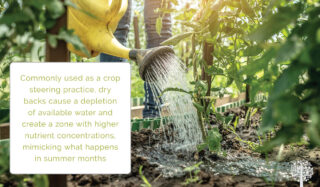
A technique employed by many growers is called dry back. Commonly used as a crop steering practice, dry backs cause a depletion of available water and create a zone with higher nutrient concentrations, mimicking what happens in summer months. More commonly used by growers using stone wool or coco, carefully managed living soil systems can benefit from dry backs if the soil has ample wetting agent to allow the media to re-saturate. Whether watering by hand or using automated watering via emitters, many gardeners follow two fundamental rules:
- Transpiration before irrigation – meaning they will get into a routine of having the first watering event at least an hour after sunrise (or lights on).
- The last irrigation event will be at least a couple of hours before sundown (lights off).
These two principles help ensure a dry back, allowing air pockets to recharge. It is important to note that the language used is “routine” and not “recipe.” Watering should be done around the same time every day as a routine, but the grower ultimately has to decide whether the plant needs watering.
Although not ideal for efficiency, hand-watering with the proper nozzle can be the best irrigation method. The best hand waterers are patient because watering should mimic gentle rain, not tidal waves.
The next most important influence on your watering routine is the environment. Farm laborers are often blamed for overwatering or underwatering a crop when the real culprit is an unstable environment. Fluctuations in temperature or humidity will have concomitant effects on water uptake (and, by association, nutrient uptake). High temperatures coupled with lower humidity will cause excessive water loss, and plants may wilt from drought, while the opposite is true for low temperatures and high humidity.
In this situation, transpiration is reduced, and water is not being taken up as readily. If your watering routine is not modified, you will create a saturated soil with plants exhibiting symptoms of stress. In CEA, the perfect storm for molds and mildews arises from an environment inhibiting water uptake, which would limit calcium uptake, resulting in weaker cell walls, and presto, a fungal germination tube, can more readily penetrate the leaf surface and infect the plant. Once again, Nature can be a great reminder of the difference between routine and recipe. Cloudy days and days with high humidity must be met with changes in irrigation amounts and frequency to prevent overwatering.
For too long, watering has been viewed as an afterthought, a less important variable than lighting or nutrients (and this article does not even address the importance of water quality). More recently, there has been an increased emphasis on root zone manipulation, and companies are creating sensors that measure soil moisture and dissolved oxygen in soil water, etc. These tools will undoubtedly help in the future, but farmers must continue to hone their intuition on what a healthy plant looks like and place greater value on the role of watering.

by Grow Up Conference | Aug 7, 2024 | Garden Culture Magazine, Media Partners
This edition of Garden Culture Magazine is all about how the pros grow, and we are lucky to have more than a few expert gardeners on our team of writers. Their articles have already offered insight into what makes their gardens tick, but we’d like to leave you with some final words of wisdom to help you boost your growing game! Enjoy our list of 5 Cool Ways To Grow Like A Pro.
Indoor Irrigation
“In controlled environment agriculture, proper watering is often overlooked,” says Garden Culture’s Av Singh, PhD, and regenerative gardening advocate. “Whether growing in coco, stone wool, or living soil, watering is critical for proper gas exchange at the roots, nutrient uptake, and microbial life.” What’s the answer to consistent and uniform re-saturation? An irrigation system! Growers can adjust flood heights and drip times to apply the appropriate amount of water as they steer their plants through all growth phases. Hand watering is also possible, but inconsistencies throughout the crop are more likely. Researching the ins and outs of proper irrigation is critical. “The use of wetting agents, good quality water at the right temperature, and adequate dissolved oxygen goes a long way in the health of your plants,” Av explains.

Soil Health is Crucial
Everything begins with the soil; if your dirt isn’t top shape, your plants will never reach their full potential. “My number one growing rule is “Soil health = plant + human health,” says our long-time contributor and gardening pro Anne Gibson. “Biologically active, fully mineralized soil is the basis for growing pest and disease-resistant plants, especially edibles.” We recommend building a living organic soil, beginning with ingredients like peat moss, coconut coir, leaf mold, or partially composted pine bark as a base. The base accounts for one-third of the mix. Next, select a blend of perlite, rice hulls, or volcanic rocks for aeration and moisture retention. The final third of the soil mix should be excellent quality, well-rotted compost. Additional organic amendments and minerals will further enrich the soil and help balance pH; consider alfalfa, hemp, barley, guano, blood and bone meal, kelp, or crushed oyster shells. “Even if your soil has all 17 elements for healthy growth, optimum nutrient uptake is pH-dependent,” Anne says. “I aim for a 6.4 soil pH to maximize mineral nutrition.”
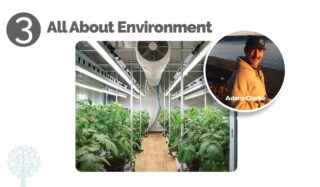
All About Environment
“Environment, environment, environment! If your room isn’t maintaining conditions, you will never grow your crop to its potential,” explains our friend, writer, and grow room consultant Adam Clarke. Ensuring your room has quality and adequately maintained HVAC equipment is crucial. Think of the HVAC system as the heart of your grow room; the quality of the air and general environmental conditions depend on this machine. Unfortunately, Adam says most growers don’t sanitize or service their equipment, which can lead to mold and other diseases that result in crop death. Most air handlers, mini splits, or other HVAC systems come with factory-equipped filters that need constant maintenance. Inspect your filters every month; most of the room’s air runs through these units, so that’s where you’ll find any bugs, mold, or particulates. If you do find some problems while inspecting the filters, don’t stress. “Most issues can be fixed and paid for in a single crop, assuming the HVAC isn’t complete junk,” reassures Adam.

Don’t Overcomplicate (or Oversimplify) Things
Whether growing in soil, peat, or coco, the function of any substrate is to allow plants to put down some roots and support growth. It’s common for new gardeners to be intimidated by growing media other than soil. However, Garden Culture contributor and seasoned grower Everest Fernandez encourages people to try other growing methods. “Beginners often oversimplify organic growing and overcomplicate hydroponics/soilless,” he says. “I’d encourage beginners to embrace soilless potting mixes first. If you run into difficulties (e.g. low humidity), you can plug in a humidifier—but what if your humidifier breaks or you don’t have one? Soil growers are stuck with dimming lights as their only real option, whereas soilless folks can reduce the concentration of their nutrients.” Soilless media retains moisture and lets the gardener control nutrients and fertilising for optimal plant growth. Modern farming practices have tapped into the benefits of using inert, soilless media to allow for more crop precision. It’s worth a try at home, too!

Always Be Collaborating
There are so many relationships at play when growing plants; recognizing and appreciating every one of them can make gardening much more meaningful and almost spiritual! Our Xavi Kief grows food and medicine for their family and community while striving to deepen their connection with the living planet and all of its inhabitants. “Always Be Collaborating,” Xavi says. “You’re never cultivating in a vacuum, so whether combining experience and resources with other growers or celebrating community with microbial, plant, and animal companions, honor the uncountable generations that persisted to bring you all together in the present moment. Share the struggles and the successes!” It’s spiritual, and we dig it.

by Grow Up Conference | Aug 7, 2024 | Cannabis News Wire, Media Partners
The state of Missouri has placed a ban on the sale of candy, beverages and other edible products manufactured from intoxicating substances derived from hemp. Missouri is not the only state to regulate and/or impose a ban on delta-8 THC, with the move coming after the state’s governor Mike Parson issued an executive order on the same last week.
The ban is set to go into effect from Sept. 1, 2024.
In his order, the governor stated that lack of research on delta-8 THC and similar unregulated CBD compounds as well as health concerns were the basis for the ban. He added that the executive order did not forbid the consumption of psychoactive products based on hemp, noting that the regulations weren’t implemented to punish consumers.
During an interview with reporters at his Jefferson City capitol building office, Gov. Parson explained that the objective of the ban was to safeguard the safety and health of Missourians, particularly children, who were the most vulnerable. Intoxicating compounds have become popular since the production of hemp was legalized with the passage of the 2018 Farm Bill. The bill’s passage created a loophole that allowed the “legal” use of these compounds. Currently, these compounds are found in candies, lotions, vapes, tinctures and more.
Paula Nickelson, director of the state’s Department of Health and Senior Services, revealed that there had been reports of children as well as adults being hospitalized after consuming the substances, which were sometimes sold in packaging similar to candies marketed for kids. She advised that products with these substances be thrown away.
In Missouri, the recreational use of marijuana is legal for individuals 21 years of age and older. The state legalized adult use marijuana in 2022 following the passage of Amendment 3, becoming the 21st state in the country to do so.
Despite this, beverages and candies with intoxicants derived from hemp are sometimes used as alternatives to alcohol or marijuana. The regulation of these products by the federal government is lacking, even as delta-8 THC continues to proliferate the market. This chemically manufactured compound has adverse side effects, having been produced synthetically.
It should be noted that this does not mean that CBD itself is an intoxicant. On the contrary, a drug that contains this compound was approved by the U.S. Food and Drug Administration in 2018 to help treat a pair of rare seizure disorders. Different studies have also determined that the nonpsychoactive compound possesses antioxidant and anti-inflammatory properties.
As regulations around delta-8 THC products evolve in different states around the country, marijuana companies such as SNDL Inc. (NASDAQ: SNDL) are likely to keep close tabs on the changes in order to see how they could impact their trajectories.
About CannabisNewsWire
CannabisNewsWire (“CNW”) is a specialized communications platform with a focus on cannabis news and the cannabis sector. It is one of 60+ brands within the Dynamic Brand Portfolio @ IBN that delivers: (1) access to a vast network of wire solutions via InvestorWire to efficiently and effectively reach a myriad of target markets, demographics and diverse industries; (2) article and editorial syndication to 5,000+ outlets; (3) enhanced press release enhancement to ensure maximum impact; (4) social media distribution via IBN to millions of social media followers; and (5) a full array of tailored corporate communications solutions. With broad reach and a seasoned team of contributing journalists and writers, CNW is uniquely positioned to best serve private and public companies that want to reach a wide audience of investors, influencers, consumers, journalists and the general public. By cutting through the overload of information in today’s market, CNW brings its clients unparalleled recognition and brand awareness. CNW is where breaking news, insightful content and actionable information converge.
To receive SMS alerts from CNW, text CANNABIS to 888-902-4192 (U.S. Mobile Phones Only)
For more information, please visit https://www.CannabisNewsWire.com
Please see full terms of use and disclaimers on the CannabisNewsWire website applicable to all content provided by CNW, wherever published or re-published: https://www.CannabisNewsWire.com/Disclaimer
CannabisNewsWire
Denver, CO
www.CannabisNewsWire.com
303.498.7722 Office
Editor@CannabisNewsWire.com
CannabisNewsWire is powered by IBN
by Grow Up Conference | Aug 7, 2024 | Cannabis News Wire, Media Partners
- The report explores the growth, competition, and consumer trends, for lesser known cannabinoids
- The report highlights a 5.4% revenue increase in the edible market for 2023, with total sales reaching $2.097 billion
- As consumer preferences shift towards edibles for their therapeutic effects and consistent experiences, the industry product landscape is set to evolve
With the increasing acceptance of cannabis use in society, the popularity of edibles—products containing cannabinoids that can be consumed as food or drink—has surged. While many consumers are familiar with edibles containing THC (tetrahydrocannabinol), known for its euphoric effects, or CBD (cannabidiol), recognized for its therapeutic benefits, there is a growing interest in edibles infused with non-intoxicating minor cannabinoids. These lesser-known cannabinoids offer unique properties and potential health benefits, driving significant market growth.
BayMedica, a subsidiary of InMed Pharmaceuticals (NASDAQ: INM), specializes in rare cannabinoids, and has published a report on the expansion of the minor cannabinoid market in 2023. Link to a full copy of the report can be found at https://cnw.fm/G09iZ.
The report, based on data from Headset, the largest industry dataset, explores the growth, competition, and consumer trends in ten regulated states, encompassing 85 million of the 158 million residents in areas where recreational cannabis is legal (https://cnw.fm/4bUnm).
The report highlights a 5.4% revenue increase in the edible market for 2023, with total sales reaching $2.097 billion. This growth is attributed to innovative developments in minor cannabinoid products. Among edible products, gummies demonstrated robust sales, while minor cannabinoid-infused edibles experienced an impressive 47% year-over-year growth, totaling $391 million in sales.
Despite a decrease in the average price of edible items from $14.29 to $12.54, the strong consumer demand and reduced production costs have made minor cannabinoids a strategic focus for brands aiming to secure a competitive position in the industry.
Minor cannabinoids, although less prominent than THC and CBD, are gaining attention for their distinctive properties and potential health benefits. These compounds, found in smaller quantities in cannabis plants, are transforming the cannabinoid landscape. Key minor cannabinoids include:
- Cannabichromene (“CBC”): Known for enhancing the body’s natural endocannabinoid, anandamide, by prolonging its presence in the bloodstream
- Tetrahydrocannabivarin (“THCV”): Non-psychoactive, it may suppress appetite and enhance focus and energy
- Cannabidivarin (“CBDV”): Similar to CBD, it potentially supports brain, immune, and gut health
- Cannabinol (“CBN”): Mildly psychoactive, known for its sedative and antibacterial properties, beneficial for insomnia and pain relief
The endocannabinoid system (“ECS”), discovered in the late 1980s, plays a crucial role in regulating various body functions. Every cell type has cannabinoid receptors that interact with over 140 known cannabinoids. The ECS’s therapeutic potential spans numerous diseases, though extracting minor cannabinoids is challenging due to their low quantities and the high cost of separation. BayMedica’s advancements in biosynthesis and synthetic chemistry now allow for commercial-scale production, opening new therapeutic avenues.
In 2023, nearly half of the top 50 selling edibles contained minor cannabinoids, reflecting a significant market trend. Leading brands are innovating with formulations that appeal to a diverse consumer base, allowing them to command premium pricing for minor cannabinoid products. These products have a 6.3% higher average price and a 73% higher average EQ (Equivalent) price compared to THC-only products, indicating a strong consumer willingness to pay for added benefits. The entourage effect theory suggests that combining minor cannabinoids with major cannabinoids like THC and CBD enhances medicinal benefits, such as pain relief.
Commercial adoption of minor cannabinoids in edibles provides insights into consumer preferences. CBN has emerged as a leader in sales, likely due to its sedative effects. CBG, while currently strong, may see a future decline as other minor cannabinoids gain traction. CBC and THCV have shown significant sales growth in 2023, driven by research into their potential benefits and increased production efficiency.
As consumer preferences shift towards edibles for their therapeutic effects and consistent experiences, the cannabis product landscape is set to evolve. Brands must align with these changing needs, emphasizing minor cannabinoids for holistic well-being. BayMedica remains committed to scaling operations and expanding product offerings to meet the rising demand for high-quality cannabinoids, supporting a broad and growing customer base.
For more information, visit the company’s website at www.InMedPharma.com.
NOTE TO INVESTORS: The latest news and updates relating to INM are available in the company’s newsroom at https://cnw.fm/INM
About CannabisNewsWire
CannabisNewsWire (“CNW”) is a specialized communications platform with a focus on cannabis news and the cannabis sector. It is one of 60+ brands within the Dynamic Brand Portfolio @ IBN that delivers: (1) access to a vast network of wire solutions via InvestorWire to efficiently and effectively reach a myriad of target markets, demographics and diverse industries; (2) article and editorial syndication to 5,000+ outlets; (3) enhanced press release enhancement to ensure maximum impact; (4) social media distribution via IBN to millions of social media followers; and (5) a full array of tailored corporate communications solutions. With broad reach and a seasoned team of contributing journalists and writers, CNW is uniquely positioned to best serve private and public companies that want to reach a wide audience of investors, influencers, consumers, journalists and the general public. By cutting through the overload of information in today’s market, CNW brings its clients unparalleled recognition and brand awareness. CNW is where breaking news, insightful content and actionable information converge.
To receive SMS alerts from CNW, text CANNABIS to 888-902-4192 (U.S. Mobile Phones Only)
For more information, please visit https://www.CannabisNewsWire.com
Please see full terms of use and disclaimers on the CannabisNewsWire website applicable to all content provided by CNW, wherever published or re-published: https://www.CannabisNewsWire.com/Disclaimer
CannabisNewsWire
Denver, CO
www.CannabisNewsWire.com
303.498.7722 Office
Editor@CannabisNewsWire.com
CannabisNewsWire is powered by IBN

by Grow Up Conference | Aug 6, 2024 | Media Partners, Stratcann
The Victoria Cannabis Buyers Club, an unlicensed medical cannabis dispensary that has been operating in Victoria since the 1990s, has been issued a $3.2 million fine from the province.
The fine was issued in July following a hearing and appeal. The total fine is $3,235,465.74, which is based on an amount equal to twice the retail value of the cannabis that was sold or possessed by the business for the purpose of sales.
The provincial government’s Deputy Director calculated that the retail value of the cannabis that VCBC sold and possessed for the purpose of sale was $1,617,732.87, following product and record expires in raids in 2019 and 2020. VCBC has until September 6, 2024, to pay the fine and can apply to appeal the ruling until that date.
BC’s Community Safety Unit (CSU) can undertake a range of enforcement activities against unlicensed cannabis retailers, including inspections, issuing tickets, obtaining warrants, conducting seizures, and more. The CSU can also recommend the prosecution of offences under the Cannabis Control and Licensing Act.
The province had previously proposed to fine the VCBC and Smith a combined $6.5 million for selling cannabis without a licence, including $3,235,465.74 to Smith personally.
However, in the most recent compliance order issued by the CSU, Meghan Oberg, Deputy Director of the CSU, says that she did find that Ted Smith was not personally selling cannabis contrary to provincial regulations. She notes, however, that she has not yet made a determination as to whether Smith or any of VCBC’s officers, directors or agents, may be liable for the monetary penalty imposed on VCBC. This would be determined in a separate hearing.
The CSU is expected to hold another written hearing to determine if the directors of the VCBC will be held personally accountable for $3.2 million, as has been the case with other unlicensed store operators.
A press release from the VCBC says that lawyers Kirk Tousaw and Jack Lloyd will be challenging the compliance order issued by the province.
VCBC Founder Ted Smith stated in a recent online post that stores like his have never been allowed to have storefront access under Canada’s cannabis laws.
“Patients continue to rely on the VCBC because limits on THC in edible products, restrictions on smoking lounges, high prices and the lack of information regarding the potential medical uses of cannabis products in recreational stores, are unacceptable. For these reasons, the 28 year old VCBC has defied the CSU and reopened after every raid, including a third raid in March 2023 for which a fine has not been issued yet. Soon after that raid, Tousaw and Lloyd filed lawsuits and injunctions against both the provincial and federal governments, though no date for that hearing has been set.”
In January, the government issued a $156,125.50 fine against Kit Warren, the operator of another Victoria Cannabis store who faced enforcement actions from the BCU in 2019 and 2020. Two people connected to another unlicensed cannabis store who faced more than $1 million in fines rejected an appeal at a recent hearing in January.
As of June 3, 2024, the BC CSU has conducted 342 education visits to unlicensed cannabis stores, taken 111 enforcement actions, conducted 1,635 investigations of online cases, closed 233 unlicensed cannabis stores, and seized $38.2 million in cannabis. The BCU reports that $1.49 million in penalties have been paid so far.
The Victoria Cannabis Buyers Club is one of the oldest and longest continually operating cannabis dispensaries/compassion clubs in all of Canada. It was started in 1996 by owner Ted Smith. While many medical cannabis dispensaries prior to legalization said they sought to fight for medical cannabis access, the VCBC is one of the few who have stuck to their guns on the issue of fighting for access. The club was also at the core of a court case many years ago that made non-flower products like “edibles” and ingestible oils legal for medical use.
by Grow Up Conference | Aug 6, 2024 | Cannabis News Wire, Media Partners
Researchers at the CU Anschutz School of Public Health have embarked on a paid study focusing on marijuana users to examine impairment levels. Over the past two years, the research has involved more than 200 participants aged between 25 and 55 years. Depending on the amount of marijuana consumed, each study session can last anywhere from three to five hours.
Dr. Ashley Brooks-Russell, a lead researcher at the school, explained, “This study allows us to observe the changes people experience after consuming cannabis, including alterations in driving behavior, reaction times, memory, blood composition and eye characteristics. Police officers, in particular, often examine eye changes as a sign of impairment during traffic stops.”
Brooks-Russell highlighted that cannabis impairment remains a significant issue, contributing to crashes and traffic stops. Unlike other drugs, detecting marijuana impairment is challenging due to the lack of straightforward tools for law enforcement. “We’re particularly interested in how daily cannabis users differ from occasional users. Many people use cannabis for medical reasons and develop tolerance, showing fewer changes compared to those who use it sporadically,” she added.
Participants are placed in a controlled environment during the study, where they consume high-concentration marijuana products such as edibles, dabs or vape pens. Once the substance takes effect, researchers conduct blood tests, administer various assessments on an iPad and evaluate participants’ driving abilities using a simulator. The driving simulator is not designed to measure one’s driving skill but rather to observe any negative changes in driving ability due to cannabis use.
The researchers have observed subtle driving impairments among occasional recreational marijuana users, such as weaving in traffic, delayed reaction times, memory lapses and eye changes.
“Our focus is currently on cannabis alone, but there’s potential to expand the study to include cannabis in combination with other substances. In real-world scenarios, people often use multiple substances that affect different brain parts, leading to varied effects. Understanding these interactions is crucial,” noted Dr. Brooks-Russell.
Additionally, the study aims to involve adults 65 years of age and older, because this demographic is experiencing the fastest growth in cannabis use. “In this age group, there are added complexities, like other medications they may be taking and normal cognitive decline associated with aging,” Brooks-Russell explained.
Ultimately, this research aims to develop a tool, similar to an alcohol breathalyzer, which could assist law enforcement in accurately detecting cannabis impairment and enhancing road safety. The entire cannabis industry, including established companies, such as Canopy Growth Corp. (NASDAQ: CGC) (TSX: WEED), is likely to take an interest in this ongoing study and any actionable outcomes that may result upon its conclusion.
About CNW420
CNW420 spotlights the latest developments in the rapidly evolving cannabis industry through the release of an article each business day at 4:20 p.m. Eastern – a tribute to the time synonymous with cannabis culture. The concise, informative content serves as a gateway for investors interested in the legalized cannabis sector and provides updates on how regulatory developments may impact financial markets. If marijuana and the burgeoning industry surrounding it are on your radar, CNW420 is for you! Check back daily to stay up-to-date on the latest milestones in the fast -changing world of cannabis.
To receive SMS alerts from CNW, text CANNABIS to 888-902-4192 (U.S. Mobile Phones Only)
For more information, please visit https://www.CannabisNewsWire.com
Please see full terms of use and disclaimers on the CannabisNewsWire website applicable to all content provided by CNW, wherever published or re-published: https://www.CannabisNewsWire.com/Disclaimer
CannabisNewsWire
Denver, CO
www.CannabisNewsWire.com
303.498.7722 Office
Editor@CannabisNewsWire.com
CannabisNewsWire is powered by IBN

by Grow Up Conference | Aug 6, 2024 | Grow Opportunity, Media Partners
COLUMBUS, Ohio (AP) — Recreational marijuana sales will begin across Ohio on Tuesday when the state issues its first operating certificates.
Nearly 100 medical marijuana dispensaries will be able to begin sales immediately, although it’s not clear how many will be ready to open, the Division of Cannabis Control said Monday.
Many will be ready right away while others could be delayed by staffing or inventory issues.
The first round of operation certificates will go to 98 locations, according to the Division of Cannabis Control.
Ohio voters last November overwhelmingly approved allowing those over 21 to possess, purchase and grow limited amounts of cannabis for personal use. But recreational sales remained on hold while the state set up a regulated system for legal marijuana purchases and worked out other rules.
The new law allows adults 21 and over to buy and possess up to 2.5 ounces (70 grams) of cannabis and to grow up to six plants per individual or 12 plants per household at home.
Legal marijuana purchases will be subject to a 10% tax, with the revenue to be divided between administrative costs, addiction treatment, municipalities with dispensaries, and paying for social equity and jobs programs supporting the cannabis industry itself.
by Grow Up Conference | Aug 6, 2024 | Grow Opportunity, Media Partners
By Sean Mott
Officers seized more than 3,000 grams of dry cannabis from an unlicensed dispensary in Moncton last week.
According to a news release from the Department of Justice and Public Safety, officers seized several items from Wolastoq Wellness at 899 Main Street on July 29.
Read the full story here.

by Grow Up Conference | Aug 6, 2024 | Grow Opportunity, Media Partners
Women in weed is a popular turn of phrase in the cannabis industry to describe the diverse and passionate professionals who work with the plant in some way. It can be a powerful representation of women who have made their careers in Canada’s legal cannabis industry.
It can also be used as a marketing ploy that tokenizes women and their relationship to the industry and the plant itself.
There isn’t one type of woman who works in weed; we aren’t a single entity with the same expertise or personalities. On all levels of leadership, women can be versatile advocates, patients and professionals with diverse skill sets, using their platforms to elevate each other. Behind closed doors, women in weed aren’t just mentoring each other. We also share experiences: discussing pay rates, outstanding invoices, and who our allies are (and aren’t).
Just like other industries, women in weed face unique challenges as opposed to their male counterparts, where efforts to include women can sometimes seem disingenuous. Nearly six years into legalization, women working in cannabis are still struggling for representation, navigating an overburdened industry and helping to build a more sustainable future.
Industry show panels, for example, typically offer a panel using the phrase to sell tickets to a ladies’ brunch-style event. Why is that an issue? Women aren’t discussing their careers as subject matter experts, often they’re simply talking about what it’s like to exist in the space as a woman. There is so much value in women in weed-type events, but they alone aren’t able to make large scale changes. For International Women’s Day, Radicle Femmes led by Marigold PR, with the OCS and Sister Merci, posed a question that I ask myself at every “Women in Weed” panel – why do we still need these events? These events are super fun and great networking opportunities but if the cannabis industry truly is progressive and inclusive, would we still need events or panels about being a working woman?
These breakout events exist because women still need safe spaces to grow as professionals. There have been advances over the years to improve inclusivity, but we are a far way from equal representation for women, non-binary folks, disabled individuals and people of colour disproportionately affected by prohibition. Layoffs and cutbacks have women questioning their role in the cannabis industry, even if they have been here for years. Women are a crucial part of diverse workspaces but are disproportionately affected by lay-offs
“Women have unique perspectives and passions they bring to the table, which can lead to better consumer loyalty and employee retention,” says Hilary Black, fractional chief impact officer who pioneers social change in the cannabis industry by “doing the work to ensure that the ethics of the plant are embodied in the business and the industries growing around the world.”
As companies struggle to keep their doors open, let alone turn a profit, these companies aren’t just surviving – they’re thriving. Black mentions how companies like Rubicon, Aqualitas, Organigram and Wana are killing it during such a volatile time for the industry. And they do it while maintaining a strong commitment to diversity. “There is some connection there, I think, around the fact that they are female-led companies. Not just the CEOs, they also have a high percentage of women on their boards and C-suite.”
Right now, the cannabis industry isn’t expanding and growing, instead, it’s consolidating and contracting, according to Black. “I would definitely say that there are fewer opportunities [for women and overall]. It has a lot to do with what is happening in the capital markets and happening in the industry in Canada.”
Another popular turn of phrase is “The future is female” – which alludes to both the women working in cannabis and the plant herself – but it hasn’t felt very true lately. The COVID-19 pandemic disproportionately impacted women-owned businesses in all sectors as well.
As layoffs and slashed budgets continue to rip through the industry over and over again, the pool of talented women who are now freelancing continues to grow. Aside from execs, one of the first line of professionals to go are typically diversity, social justice, sustainability, marketing, social media, PR and communications. A majority of these roles are held by women.
“Throughout my career, marketing is the first line to get cut, which is mostly made up of female professionals” shares Katie Pringle, CEO and co-founder of Marigold PR. “Even though studies have shown these roles are instrumental in building momentum and driving velocity for your business.”
“Right from the beginning of legalization, we saw brands hire huge marketing teams and structure themselves like traditional corporate companies,” says Pringle, noting that the cannabis industry needed more of a start-up approach. “Marketing budgets are significantly smaller than they used to be; everyone’s trying to do more with less.
Of course, it isn’t all doom and gloom. In her experience, Pringle has seen a lot of brands that value bringing women to the table but notes there is still room for growth. “We have a long way to go to catch up with other industries in terms of social responsibility like diverse and equitable initiatives.”
The future of women in weed
“When you ask about how sexism in the industry inhibits growth – that if you have an automatic denial of the merit of women, which is really what sexism is – then it’s much harder for women to be leaders and be in decision-making roles,” says Black.
Black notes that women are integral to the cannabis industry and stresses the need for more women in C-suite, boardrooms and beyond to create and maintain a more inclusive space. Of course, this can’t be done in an echo chamber and Black tells Grow Opportunity that industry can’t underestimate the value of consumer voices.
“These issues [of diversity] aren’t going to be solved by professional players alone,” says Black. “Consumers have an integral role to play in diversity by being intentional about the brands they purchase from. If there’s a product you really like but the company doesn’t have enough women in leadership positions – let them know.”
Purchasing power is one of the most impactful ways to create change as everyone is chasing brand loyalty in an oversaturated market. As my hero Ashleigh Brown, patient advocate and founder of SheCann, always says: “Patients and consumers need to vote with their wallets.”
In addition to consumer pressure, women in the industry need to keep leaning on each other and continue to persevere.
In contrast to boys clubs in cannabis, Pringle is proud of her female staff. “I kind of have a girls club, we’ve always promoted within. We do a lot of professional development and mentorship. I’ve watched my team advance significantly with that kind of attention and investment in their future.”
At the end of the day, most stakeholders want to create a diverse and equitable space. “There’s still a huge opportunity for women,” says Pringle. “I think we’re heading into another phase; the industry has been really hard and we’re making a comeback.” Women should look for “the kinds of rooms they want to be in,” advising those entering the market to network out of their comfort zones and not be afraid to initiate one-to-one conversations with other professionals in the industry.
Ashley Keenan is a journalist, consultant and patient advocate who uses reporting and storytelling to educate, entertain and empower folks curious about cannabis.



Recent Comments