
by Grow Up Conference | Jul 25, 2024 | Cannabis News Wire, Media Partners
Kentucky Governor Andy Beshear recently wrote to Anne Milgram, the U.S. Drug Enforcement Administration (DEA) administrator, to voice his backing of the Department of Health and Human Services’ proposal to relax cannabis restrictions. The proposal advocates for moving marijuana from Schedule 1 to Schedule 3 of the Controlled Substances Act (CSA).
Governor Beshear highlighted that this reclassification would offer patients a safer alternative to harmful opioids, ensuring continued access to reliable products. He also noted that such a move would aid communities in reducing illegal drug use and crime. Additionally, it would level the economic playing field for marijuana businesses and open doors for substantial research opportunities on medical cannabis.
“As a governor, my priority is advancing our state,” Beshear remarked. “Reclassifying cannabis to Schedule 3 is a sensible and crucial step forward for all Kentucky residents, particularly those suffering from serious medical conditions.”
Currently, cannabis is classified as a Schedule 1 substance, which includes substances such as LSD and heroin that are considered to have no recognized medical value. This classification deems marijuana more hazardous than Schedule 2 substances such as Vicodin, fentanyl, methadone, oxycodone and methamphetamine.
“However, the evidence is clear: cannabis has medical benefits and is already being used for medical treatments,” Beshear noted in his letter. “This is a widely acknowledged fact, supported by both parties. For instance, I signed a medical cannabis measure into law, which passed with bipartisan support from a Democratic governor and GOP legislative supermajorities.”
The medical cannabis legislation — State Bill 47 — is set to take effect on Jan. 1, 2025. Currently, the state is processing grower, producer and dispensary licensing applications in preparation for this change. Previously, only residents who met certain requirements could use small quantities of marijuana for medicinal purposes.
In addition, Beshear highlighted his initiatives to address the opioid issue, which he spearheaded while serving as the state’s attorney general. Compared to previous attorneys general, he filed the most individual opioid claims, which helped the state obtain nearly $900 million from businesses that took advantage of Kentucky communities.
The letter further pointed out that in 2022, opioid use resulted in 80,000 deaths across the United States, while marijuana use caused none. This striking disparity, according to Beshear, is the reason Kentucky’s Department of Behavioral Health, Developmental and Intellectual Disabilities, Cabinet for Health and Family Services and Office of Drug Control Policy all support the reclassification of cannabis.
This endorsement of federal marijuana policy reform by Beshear is likely to be welcomed by the broader cannabis industry and its leading actors, such as Aurora Cannabis Inc. (NASDAQ: ACB) (TSX: ACB), since it is a step in the right direction of ending prohibition.
About CNW420
CNW420 spotlights the latest developments in the rapidly evolving cannabis industry through the release of an article each business day at 4:20 p.m. Eastern – a tribute to the time synonymous with cannabis culture. The concise, informative content serves as a gateway for investors interested in the legalized cannabis sector and provides updates on how regulatory developments may impact financial markets. If marijuana and the burgeoning industry surrounding it are on your radar, CNW420 is for you! Check back daily to stay up-to-date on the latest milestones in the fast -changing world of cannabis.
To receive SMS alerts from CNW, text CANNABIS to 888-902-4192 (U.S. Mobile Phones Only)
For more information, please visit https://www.CannabisNewsWire.com
Please see full terms of use and disclaimers on the CannabisNewsWire website applicable to all content provided by CNW, wherever published or re-published: https://www.CannabisNewsWire.com/Disclaimer
CannabisNewsWire
Denver, CO
www.CannabisNewsWire.com
303.498.7722 Office
Editor@CannabisNewsWire.com
CannabisNewsWire is powered by IBN

by Grow Up Conference | Jul 25, 2024 | Grow Opportunity, Media Partners
by Grow Up Conference | Jul 25, 2024 | Grow Opportunity, Media Partners
by Grow Up Conference | Jul 25, 2024 | Grow Opportunity, Media Partners
by Grow Up Conference | Jul 25, 2024 | Grow Opportunity, Media Partners

by Grow Up Conference | Jul 25, 2024 | Media Partners, Psychedelic News Wire
Over the last couple of years, interest in psychedelics and their therapeutic potential has risen significantly. Psychedelics such as psilocybin have shown to be useful in treating a variety of conditions, including anxiety, addiction and depression.
Psilocybin is the primary psychoactive compound found in some species of hallucinogenic mushrooms. When administered, this compound synthesizes into psilocin and interacts with an individual’s serotonin receptors, altering their state of consciousness and giving way to changes in their mood as well as their perception of things.
Researchers have uncovered a lot about how psilocybin affects an individual’s behavior and brain. Below, we look at some studies that explore the compound’s potential, offering insight into its mechanisms of action and looking at its application in different conditions.
Psilocybin on anorexia nervosa
This study, which was recently published in “Molecular Psychiatry,” suggests that psilocybin may help individuals maintain their body weight better while also improving their cognitive flexibility. It should be noted that researchers used rat models for their study, and more research is needed to confirm these findings in people.
Psychedelic-assisted therapy for alcohol use disorder
A separate study looked at the impact of psilocybin-assisted therapy on the brain function of individuals with alcohol use disorder. The study, whose findings were reported in “Scientific Reports,” suggests that psilocybin can improve emotional processing and reduce the need for alcohol.
Despite these positive findings, further study is needed to test out these findings on a larger and more diverse population.
Psilocybin on exploration and learning
Research has also looked into how psilocybin affects reinforcement learning, with researchers observing that the psychedelic helped maintain learning capabilities and enhanced rates of learning when higher doses were administered. The researchers noted that further study was required to fully understand the drug’s impact.
Long-Covid and psilocybin
One case study examined the use of psilocybin and MDMA to help manage symptoms of long-Covid. The patient observed huge improvements in cognitive function, depression, anxiety and overall well-being after their psilocybin sessions.
In their report, the researchers highlight the need for more controlled studies testing psychedelics’ effectiveness in long-Covid management.
New cluster headache treatment
Research that looked into psilocybin’s potential in decreasing cluster headache frequency determined that the psychedelic saw an almost 50% drop in headache attacks. The researchers reported their findings in the “Journal of the Neurological Sciences.”
Psilocybin on brain connectivity
Investigators have determined that psilocybin gives rise to a state of hyperconnectivity in the brain. Their findings were reported in “Biological Psychiatry: Cognitive Neuroscience and Neuroimaging.”
Plenty of effort is also being directed by companies such as Seelos Therapeutics Inc. (NASDAQ: SEEL) toward leveraging the medicinal potential of psilocybin. It may not be long before approved psychedelic medicines hit the market.
About PsychedelicNewsWire
PsychedelicNewsWire (“PNW”) is a specialized communications platform with a focus on all aspects of psychedelics and the latest developments and advances in the psychedelics sector. It is one of 60+ brands within the Dynamic Brand Portfolio @ IBN that delivers: (1) access to a vast network of wire solutions via InvestorWire to efficiently and effectively reach a myriad of target markets, demographics and diverse industries; (2) article and editorial syndication to 5,000+ outlets; (3) enhanced press release enhancement to ensure maximum impact; (4) social media distribution via IBN to millions of social media followers; and (5) a full array of tailored corporate communications solutions. With broad reach and a seasoned team of contributing journalists and writers, PNW is uniquely positioned to best serve private and public companies that want to reach a wide audience of investors, influencers, consumers, journalists and the general public. By cutting through the overload of information in today’s market, PNW brings its clients unparalleled recognition and brand awareness. PNW is where breaking news, insightful content and actionable information converge.
To receive SMS alerts from PsychedelicNewsWire, text “Groovy” to 888-902-4192 (U.S. Mobile Phones Only)
For more information, please visit https://www.PsychedelicNewsWire.com
Please see full terms of use and disclaimers on the PsychedelicNewsWire website applicable to all content provided by PNW, wherever published or re-published: https://www.PsychedelicNewsWire.com/Disclaimer
PsychedelicNewsWire
San Francisco, CA
www.PsychedelicNewsWire.com
415.949.5050 Office
Editor@PsychedelicNewsWire.com
PsychedelicNewsWire is powered by IBN

by Grow Up Conference | Jul 24, 2024 | Media Partners, Stratcann
Border officers at Halifax Stanfield International Airport say they seized 140 pounds of suspected cannabis on Monday, July 22, in luggage destined for the UK.
Canada Border Services Agency (CBSA) intercepted four large suitcases around 10:30 in the morning, then located and boarded the associated aircraft, identified the two passengers, and arrested them for smuggling a controlled substance out of Canada.
The suspects were then escorted to CBSA detention cells inside the airport, assisted by officers of the Halifax Regional Police Airport Security Unit.
They were then interviewed by investigators from the Guns and Drugs Unit of the RCMP/HRP Integrated Criminal Investigation Division, leading to investigators seizing amounts of Canadian and American currency, as well as British pounds.
The suspects, who the RCMP identified as Rebekah Dublin, 22, and Shante Liverpool, 20, along with all evidence seized by the CBSA, were turned over to the Integrated Criminal Investigation Division for further investigation.
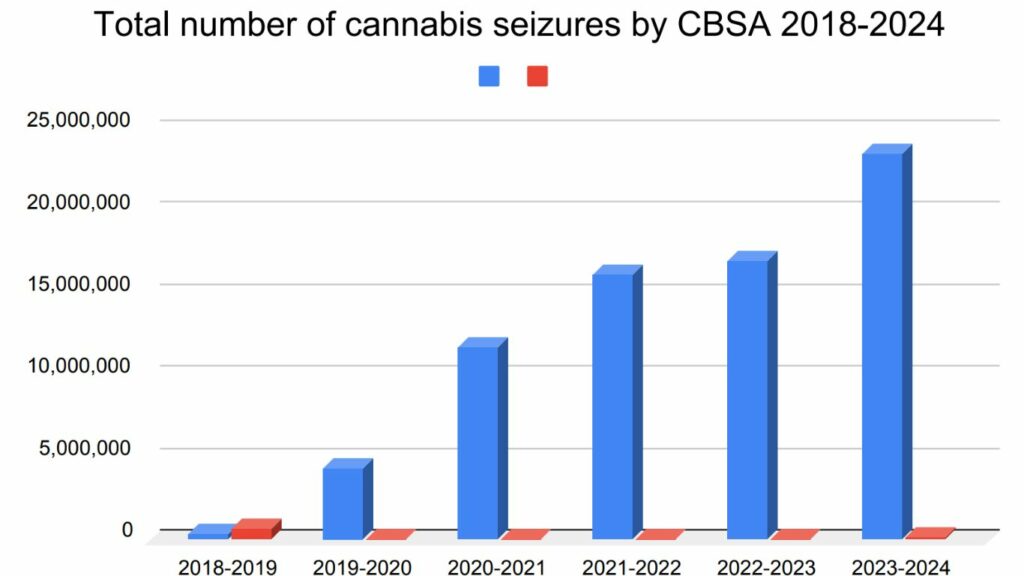
Reports of cannabis exports into the US and other markets are not uncommon. The CBSA reports seizing more than 23,553,038 grams of cannabis products in fiscal year 2023-2024 and 126,210 grams of hash.
The amount of such seizures has increased significantly in the past six years.
These numbers are up from 16,967,843 grams of cannabis products and 15,429 grams of hash in the previous year and 16,133,955 grams of cannabis products and 28,588 grams of hash in 2021-2022.
- In May, an investigation team seized 123 kg of cannabis, along with 11.5 kg of cocaine, ready for export at the Port of Montreal.
- In June, while examining outbound luggage at the Halifax Stanfield airport, CBSA seized 32 kg of cannabis. On June 18, CBSA officers at the Montreal Maritime and Rail Services intercepted 309.52 kg of Hashish hidden in cans of tomato paste.
- In May, border officials intercepted a package at the Montréal-Trudeau Airport that contained 120 kg of dried cannabis.
- In April, Montreal Maritime and Rail ServicesCBSA officers seized 275 kg of dried cannabis hidden in bags of wood pellets.
- In February, CBSA officials at Vancouver International seized over 180 kg of cannabis, and police in Québec said they arrested three people in connection with the illicit export of cannabis to the United States.
- In January, the CBSA intercepted 310 kg of cannabis in a container exported from Canada to the UK at Montréal Marine and Rail Services.
Related Articles

by Grow Up Conference | Jul 24, 2024 | Garden Culture Magazine, Media Partners
So, here we are about six months after making a classic New Year’s resolution to be healthier in 2024. One of the items on that get healthy to-do list was probably ‘start going to the gym.’ Well, how’s that one going for you these days? If you’re still going regularly, congratulations. If you’re not, you’re not alone.
But wait! Before you resign yourself to an unhealthy rest of the year, determined to try again next January, look at the gym you have right outside your door—the garden!
Forget The Gym: Health Benefits of Gardening
Fresh Air
Remember when we were kids, and our parents would yell at us to get off the couch and go outside to get some fresh air? Well, it wasn’t so that they could be alone for a while – fresh air is good for you (assuming that you live somewhere that the air is actually “fresh” or close to it).
Vitamins
Vitamin D is an essential nutrient, and one of the great providers of vitamin D is the sun. Depending on who you ask – 10 to 30 minutes of sunlight daily gets you much of the recommended D you need. So, just a short gardening session is already paying dividends.
Boost Immunity
Studies have also shown that time outside in nature can positively affect your immune health. And it isn’t all physical, either. Your mental health can also improve with time outdoors.
That’s something a crowded indoor gym can’t provide.
Exercise
Now, this is where a gym thrives. The gym’s exercise possibilities are almost endless with all that equipment, weights, and machines. But don’t discount your garden here, folks.
Just think about it: What are you doing when you garden? You’re walking around getting your cardio in. You’re crouching down and getting back up – squats, anyone? You’re carrying bags of dirt, potting plants, mulch, etc – do that enough, and a full upper-body muscle workout is happening. The day after some moderate to intense garden work, you’ll probably feel a little sore – just like the day after a hard session at the gym.
Set your Fitbit or Apple Watch to workout or yardwork mode and track your time in the garden; you might be surprised by the results.
Diet
If you’re like me, under ‘go to the gym’ on the “get healthy” resolutions checklist is ‘eat healthy’.
Fruits, veggies, leafy greens – depending on where you live and how big you decide to go, you can supply a good amount of your produce with a home garden. And there may not be any better way to improve our diets. Talk about farm-to-table!
Not only does it taste better than most of what we can get at our local grocery stores – but it’s super fresh, as organic as you want, and, in some cases, cheaper. That’s a win-win-win-win in my book.
Family & Friends
Gardening alone can have benefits; for some, it can be a spiritual and meditative practice. There are also social benefits to gardening, whether making friends and connections in a community garden or at your local nursery or even spending time with the family and encouraging your kids to get involved. And if not the kids, gardening with your partner can also be a time to bond and energize your relationship while getting healthier together.
And you can do all this without the person next to you taking selfie muscle photos in the mirror for their social media account!
by Grow Up Conference | Jul 24, 2024 | Cannabis News Wire, Media Partners
A number of European marijuana start-ups are thinking about listing in New York due to the anticipated reclassification of marijuana by federal authorities as a less harmful narcotic. Although the companies haven’t finalized their plans, they are drawn to the U.S. market’s increasingly favorable stance on cannabis and CBD products.
Statista estimates that this year’s CBD market might be valued at approximately $6.90 billion.
Under the new U.S. regulations, cannabis may be moved from the highly restrictive Schedule 1 of the Controlled Substances Act (CSA), which also includes LSD, heroin, and fentanyl, to the less restrictive Schedule 3, placing it in the same category as ketamine and anabolic steroids.
This move may encourage many cannabis companies in Europe and the United Kingdom to list on U.S. exchanges rather than European ones, where laws governing CBD products are still very strict. For example, whereas some European nations permit CBD e-liquids, they only allow CBD edibles if approved by the European Food Safety Authority.
Most European nations do not completely ban CBD products but enforce a limit on the quantity of THC, the main psychoactive component of marijuana. Certain nations, including the UK and Sweden, forbid the sale of any CBD products that include THC, while Andorra, Belarus and Albania have complete CBD bans.
Companies including London-based Grow Group and Wellford Medical have stated their intention to go public on NASDAQ early in 2025. Lisbon-based Somai Pharmaceuticals has hinted that it may seek a NASDAQ listing in addition to secondary listings on the Toronto Stock Exchange or the London Stock Exchange.
Despite these developments, federal rules in the United States still prohibit large U.S. marijuana companies, such as Curaleaf, Cresco Labs, Verano Holdings Corp. and Trulieve Cannabis Corp., from listing on U.S. exchanges, including the NASDAQ and the New York Stock Exchange (NYSE). As a result, many of these businesses choose to trade on Canadian platforms, including the Toronto Stock Exchange and the Canadian Securities Exchange. On the other hand, the United States does permit Canadian marijuana companies, such as SNDL and Canopy Growth, to list on its platforms.
A greater number of European and UK companies may choose to relocate from their home markets to the U.S. if cannabis is reclassified, especially given the difficulties major European stock exchanges like the LSE are having keeping up with company growth and IPO activity.
There has been growing pressure on the U.S. federal government to reclassify cannabis due to its medicinal and therapeutic benefits. Products containing CBD oil, including tinctures, lotions and candies, are given to treat pain and other side effects of chemotherapy, in addition to treating anxiety, discomfort and memory issues. Additionally, an increasing number of U.S. states have legalized recreational cannabis.
However, critics counter that marijuana might be toxic and could serve as a gateway drug for more potent substances.
As marijuana companies in Europe prepare to list in the United States, they will find other established companies such as Software Effective Solutions Corp. (d/b/a MedCana) (OTC: SFWJ) already accessing capital from North American investors, and competition for these resources could tighten even more.
NOTE TO INVESTORS: The latest news and updates relating to Software Effective Solutions Corp. (d/b/a MedCana) (OTC: SFWJ) are available in the company’s newsroom at https://cnw.fm/SFWJ
About CNW420
CNW420 spotlights the latest developments in the rapidly evolving cannabis industry through the release of an article each business day at 4:20 p.m. Eastern – a tribute to the time synonymous with cannabis culture. The concise, informative content serves as a gateway for investors interested in the legalized cannabis sector and provides updates on how regulatory developments may impact financial markets. If marijuana and the burgeoning industry surrounding it are on your radar, CNW420 is for you! Check back daily to stay up-to-date on the latest milestones in the fast -changing world of cannabis.
To receive SMS alerts from CNW, text CANNABIS to 888-902-4192 (U.S. Mobile Phones Only)
For more information, please visit https://www.CannabisNewsWire.com
Please see full terms of use and disclaimers on the CannabisNewsWire website applicable to all content provided by CNW, wherever published or re-published: https://www.CannabisNewsWire.com/Disclaimer
CannabisNewsWire
Denver, CO
www.CannabisNewsWire.com
303.498.7722 Office
Editor@CannabisNewsWire.com
CannabisNewsWire is powered by IBN

by Grow Up Conference | Jul 24, 2024 | Media Partners, Stratcann
A judge in Ontario has issued a 60-day conditional sentence order, to be followed by a year of probation and 100 hours of community service, to an employee arrested during a raid of an illegal psilocybin store.
Although the employee had only worked at the store on Queen St West in Toronto for two weekends before his arrest, the judge argued that he found it difficult to believe the employee’s claims that he was unaware the business was not legal.
The Crown had sought a six-month conditional sentence as a form of deterrence against others considering working at such an illegal store, while the man’s own lawyer called for a conditional discharge since he was only a minimum wage employee.
The Crown attorney argued that while the effects of psilocybin continue to be studied, she rejected the suggestion that the state of these types of businesses is comparable to the “legally ambiguous character” of cannabis dispensaries before the legalization of cannabis.
In his ruling, posted on July 23, Justice Brock Jones noted that the case law surrounding such “magic mushroom dispensaries” is still developing, emphasizing that anyone “employed at, managing, or owning such a business is engaged in criminal activity.”
Had the defendant, Fabricio Osores, worked in the store for a longer period of time, the judge said he would have likely agreed with the Crown’s recommendation for a six-month conditional sentence or potentially even a jail sentence. The mushroom store, Shroomyz, was a “blatantly illegal drug trafficking operation masquerading as a legitimate business,” said the judge.
The Shroomyz location at 488 Queen Street West in Toronto, where Osores worked, was raided on November 12, 2022, following a two-week investigation by Toronto Police Services (TPS). Police arrested Osores and another man and seized a large quantity of psilocybin products, such as gummies, oil, tea, dried mushrooms, and more than 1,500 pills, as well as more than $17,000 in cash.
Osores was 20 years old at the time of the offences and had no prior criminal record. His lawyer argued that Osores was unaware the business was illegal and was concerned that charges would impact his ability to visit the US in the future.
Although past court cases involving arrests connected to illegal mushroom stores that the judge referenced were more lenient, he argued that the illegal store’s “open and notorious features” were “extraordinarily aggravating,” saying there was a need to create a ruling that encourages general deterrence to such activities and behaviours.
The judge said in his ruling that being just a low-level employee does not shield the young man from responsibility for his actions. He expressed skepticism at the claims that the man was unaware the business was not legal.
“Advocates for change to our drug laws can pursue lawful means to achieve their goals,” writes Justice Jones in his decision. “They cannot decide to disregard a statute they disagree with. That is outright contempt for the rule of law.”
“Furthermore, if these stores continue to proliferate, and the prevalence of this criminal activity grows in the community, the more courts should emphasize deterrence and denunciation in their sentencing decisions,” he added.
Shroomy’z website currently lists two locations, both in Toronto, and offers sales online across Canada. Despite the raid in late 2022, a September 2023 Google Maps street view shows the store with a sign that says “open”.
Featured image via Google Maps





Recent Comments