Cervantes recounts the milestones in his career, including the translation of his books into Russian, Japanese, and various European languages. He highlights the booming popularity of his German editions, while holding up the iconic “Indoor/Outdoor Cultivation Bible” in “Italiano” during our video interview.
Having lived outside the United States for 25 years, Cervantes now resides in Spain where he tends to his backyard garden when he’s not traveling to cannabis conferences – or “fairs,” as he calls them – in Europe and North America.
Recently Cervantes attended Grow Up Conference & Expo in Toronto, and noted the camaraderie, professionalism and talent from growers and attendees. “I was amazed at just how smart those guys are, because there’s so many PhDs and it’s been open for so long,” he says, also noting the Canadian-Dutch partnerships, especially when applying greenhouse technology. Everything is dialed in, he says, “temperature and fertilizers and light; everything works in a perfect balance.”
Advertisement
Tommy Chong and Jorge Cervantes at Grow Up Toronto, 2024
“They’re taking clones this high [a few inches] that have recently been cloned and then putting them straight into flower, and they grow! They grow and they produce,” says Cervantes, who himself has lived in the Netherlands. “They always figure out how to do everything with the least amount of labour, and to use things twice or more times; they’re experts at it,” cutting time and utility bills as a result.
Cutting expenses is the place to be in this industry says Cervantes, “and the other thing is you got to get into heavy science so you know what the heck’s going on – you can’t be guessing about anything.”
From the beginning when all anyone was selling was seeds and fertilizer, Cervantes comments on the expansion of the industry: the commerce, the technology and practicality, and the research.
Impressive advancements in cannabis include the 25 American land-grant schools who have hemp programs and departments of study, similar of course to Canadian universities, as we now catch up on lost time due to prohibition. Cervantes cites the development of triploids, of genetics resistant to hop latent viroid, and the manipulation of autoflowers when “growing acreage of cannabis.”
Insofar as the smaller producers are concerned, Cervantes notes the focus on the soil and their proficiency in organic growing, and less progress in the area of genetics, which, he says, is where the PhDs come in. “Because I think that’s really important, to have PhDs everywhere, because you learn so much more. They know what stuff works and why, and they can do it again.”
Perspectives on cannabis descheduling
Cervantes awaits federal legalization or nationalization of cannabis in the United States, anticipating two big changes: “One is interstate dollars, and then the second one is banking.”
Once cannabis can cross state lines, the commodification of the plant will occur. A large percentage of the market he expects will be for oil production, where “field grown crops” can be homogenized into oil and edibles. “I think home growing is going to follow; it’s still kind of a novelty right now, but it’s going to follow a lot of vegetable and flower principles.”
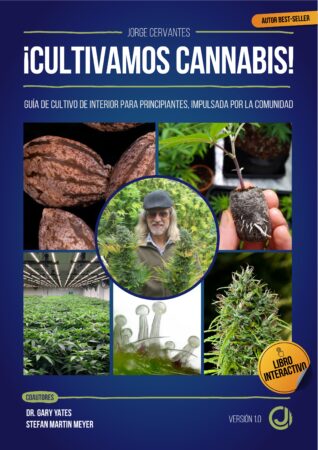
We Grow Cannabis! Translated into Spanish
Much of Cervantes’ audience includes the home growers, however “it does get complicated because a lot of people are still at this stage where they want to grow more and get big, but the market is already flooded,” he says. “In Oregon you can grow four plants per person, and it’s like, the neighbourhood kids don’t even steal it anymore!”
There’s always going to be the exceptionally talented growers, those who grow better than others, “those guys are really my audience,” Cervantes says. “Those are the ones I love. Those are the ones I came with; we came together.” Many of the larger producers began with Cervantes’ basics, and they’re “younger and stronger and smarter,” he says.
While Cervantes thought it would be legal in 1978, and again by 1990, “but then they cracked down; it’s just political football.” Of course the tax revenue incentive compels decision makers, “but the thing that’s slowing everybody down is nobody wants to pay for research because [the politics are] not stable enough.” As the U.S. inches closer to federal descheduling, Cervantes suspects “those who are academically oriented that have low expenses will stay because I see the market getting real tight.”
The research that the nationalization of cannabis in the U.S. will instigate surpasses recreational drug use but includes an array of other uses such as hemp fibre and animal feed. Cervantes provides the example of a grass seed farmer in Salem, Oregon who fed hemp to his racehorses and noticed a reduction in disease, better coats due to the omegas and a reduction or elimination of antibiotic use. “But he had to quit feeding them before the cut-off date because they would drug test the horses,” says Cervantes. “He went to the horse race commission in Oregon, and they said no. He was outside the building coming in, and they already told him no.” It takes time and it’s complicated, because “you’ve got to change a lot of minds.”
One way to change minds is to turn up the volume on science and the research demonstrating how producers operate. “If you can’t prove it, then nobody can invest in you. It’s that simple,” he says. Adding science to the equation can help producers and home growers alike skirt prevalent issues like hop latent viroid and maximize yields using cutting edge genetics. The lack of consistency comes through in this industry where Skittlez variety (and every grower claims to have the best Skittlez genetics) varies more than Black Cherry heirloom tomatoes.
A global sensation
What encouraged Cervantes to write about growing weed was the amount of misinformation circulating at the time.
“When I started it was pretty rough. It was cone reflectors with a halide light – a 1000-watt-er – hanging up over the garden,” he says. “I started asking questions and people gave me horrid answers; they couldn’t prove anything.”
His desire to learn and to teach others was the driving force behind his early work. “I just wanted a decent living, and I figured cannabis would be legal,” Cervantes says. “But I didn’t think much further ahead than that to be honest. I didn’t have some grand vision.”
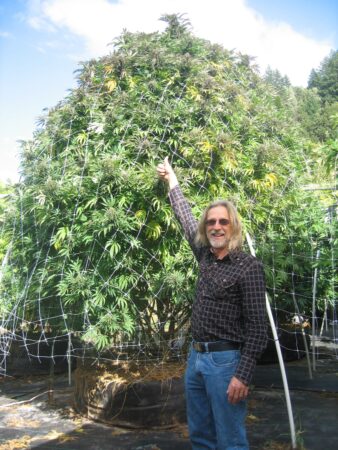
Jorge Cervantes in the garden, 2010
Cervantes is proud of everything he was able to accomplish as a result. All of the travel: the moving around from Vancouver, B.C. to the Netherlands and Spain – the fun that was had. These are his fondest memories, along with the book translation milestones.
Concealing his identity until 2010 was due to the global politics surrounding cannabis, where hydroponic stores in Italy were raided and pallets of his books were confiscated, or being searched at international borders including Canada. Back home, he once had his lawyer call law enforcement to question whether or not Cervantes would be arrested, and if he wasn’t, then what they were doing was called harassment.
The legend continues his dedicated work, with several projects on the go, predominantly hinged around the desire to see “science dominate cannabis genetics,” he says. However, to this day, it’s organic raised beds, sun grown in a greenhouse that’s “always been best for me.”
Cervantes looks forward to experimenting with the new iterations of LED technology, but will always appreciate the complete spectrum of outdoor growing most. “It’s harder to control,” he says, “but they also have more natural immunity,” which is why he uses activated compost tea. Specifically, a mixture of manure and compost, aerated in filtered water. Cervantes also spent a great deal of time studying microbiologist and soil biology researcher Elaine Ingham’s work.
While crossing the Atlantic has become a fixture in his life, at 70, Cervantes looks forward to spending time at home, conducting soil tests and growing in the backyard of his new home. Except for the “big fair in Las Vegas,” Cervantes expects to stay mainly in Europe for now. However he fondly recalls the Canadian spirit, where everyone “gets along and there’s no petty jealousies,” just people working together to succeed and relishing a sense of community.
“Because there’s no secrets,” says Cervantes, “it’s just called hard work.”