BC is updating its rules for how long cannabis can sit in its warehouse before it will be returned to the producer.
In a notice sent out to producers on Friday, May 17, the British Columbia LDB wholesale division noted upcoming changes to the inventory thresholds for licensed producers. This means changes to the maximum storage time at the LDB distribution centre in Richmond and a new maximum age limit at the time of delivery to the LDB distribution centre.
The stated intent of these changes is to improve product freshness. The change will also likely allow the LDB to maximize storage space in their 70,000 square-foot warehouse. There are more than 125 licensed cannabis producers registered to do business with the LDB.
Under the new rules, which the LDB will begin using in November 2024, cannabis flower, pre-rolls (including infused), and cannabis edibles products must be delivered to the LDB distribution centre within three months from the packaging date. Inventory of these products will be held for a maximum of six months from the date it is received by the LDB.
Other categories of cannabis products will be required to be delivered within five months from the packaging date. These categories will be held for a maximum of nine months from arrival at the LDB distribution centre.
Inventory that exceeds these timelines will be put on hold and returned to the producer. Any products that exceed the age limit at the time of delivery will be required to be pre-approved by the LDB demand planner.
Producers selling into BC must also provide the LDB with an estimated minimum shelf life before being registered for sale. Products with a Best Before Date or Expiry Date printed on the label must be delivered to the LDB with at least six months remaining until the stated Best Before or Expiry Date.
“We wear the mask that grins and lies, It hides our cheeks and shades our eyes.”
– Paul Laurence Dunbar
I’ve been ruminating on hate a lot recently.
We live in a culture where half the human experience is ruthlessly suppressed. You are scarcely allowed to express how you truly feel about something if it’s negative.
This is especially true in Canada, the Anglosphere at large, and to a lesser extent, Western Europe. Our good-natured politeness and emphasis on respectability, once reserved for better times and better people, have mutated into something else. For many, it serves as an excuse for avoiding necessary confrontation with individuals, groups, concepts, ideas, and anything under the sun. We suppress our true, visceral feelings every day. We give the benefit of the doubt to things we hate, requiring external validation for it to be acceptable. Today, it’s ‘love and light’ faux gurus all over social media. Some call it toxic positivity. Twenty years ago, there was the psyop of ‘World Music.’ This was Neo-hippie garbage, commercialized and packaged for boomers to gaslight their social circles. Nobody remembers this music, other than your school librarian who allegedly loved Africa and listened to it when you and the class were allowed your two minutes’of regime-approved book reading away from the buzzing fluorescent light.
Every day you are bombarded with meaningless, anti-negativity slogans like ‘live, laugh, love’ and ‘positive vibes only.’ Effeminate, impotent self-affirmation. Infinite quotes from figures like Nelson Mandela (“Resentment is like drinking poison and then hoping it will kill your enemies.”), or MLK, dedicated to the vilification of hate or anger (“Let no man pull you so low as to hate him.”). They’ve been quoted innumerable times over decades as anti-hate preachers of toothless ‘love.’ These are among the ancient saints of people today. People who express dislike for movies, music, TV shows, concerts, and unacceptable public behaviours are deemed ‘haters.’ Unhappy your favourite game franchise caught the eye of the masses, and now the marketers for the developer want to milk them of every last penny? The self-policing, soft-totalitarian environment denies you the right to feel the most basic of human emotions and has been around for a long time.
If you were born in the last forty years, you were told going to school to sit still, shut up, and listen. You are told it’s rude to point out hypocrisy, to question authority, to defy the mantra of the day. The first job you end up working requires you to eat shit with a smile as an alcoholic, divorced middle-aged father of two who lost custody of his kids takes out his impotent anger on you or your friends. He’s taking out his frustration on you because he won’t take his frustration out around the people he knows. He has to maintain the same repulsively fake air of respectability, politeness, and happiness they force onto him. They call it the ‘gold standard’ and ‘service with a smile.’ The boomers set up this service-sector wage slave economy after they gutted manufacturing and impoverished millions. Anyone from retail, to fast food, hospitality, and tourism has to deal with this. Ex-service workers treat service workers with respect and dignity, even if they’re frustrated because they know how it feels. The corporate culture of these places, originating from the values of our polite society, would subject us all to emotional cuckoldry outside of work. You make an off-colour joke at the office to your female colleague and sweat bullets for a week waiting for the HR write-up, or your two weeks’ notice if you’re unlucky. Walking on eggshells all day, every day, as the fat, disgusting, useless slob of a blue-haired alphabet person with a TikTok dedicated to building disability ramps for all buildings in the city waits for an opportunity to pounce on you. They will ruin your life and masturbate to it. You hate her with every fibre of your being, but you won’t say anything as you walk out.
From the States to Canada, from Down Under to Kiwiland and to Britain, we require social permission to do things. We need permission to protest (we have to see others protesting), we need permission to speak the truth (when we see other people trash-talk, we can join in and express disgust), and we need permission to steal food, but we tend not to start it. We feign politeness, kindness, and concern for people we don’t care about. We refuse to take the pastry sitting on the plate until someone else offers, and when we offer, we take no more than one. When you greet someone you know, you hit them with a ‘how are ya?’, they throw you a ‘not too bad, you?’ and you keep walking. If you’re not close, you don’t give a shit about their day and vice versa. Foreigners, rightly dislike this. They correctly identify this as confusing, and dishonest behaviour, but it is what it is. People without a ride to and from work will make endless inferences about how awful it’ll be to walk home in the rain, instead of just being direct. We offer to pay for meals, knowing we’ll be rebuffed as someone insists on splitting the bill. We allow people an out when organizing plans, ending a request to hang out with ‘if you feel like it’ or ‘if you’re not busy.’ When we fire employees, we facetiously tell them we’d rather they resign (if only because they can’t claim Employment Insurance). Many of these are common courtesies to us. Unfortunately, the Anglosphere is woefully unequipped to deal with people and cultures who assert their interests aggressively, especially through violence. The only demographic this doesn’t apply to is the working class and underclass, but even that has changed. I once worked construction. The big, bad foreman called a general assembly on the job site because someone wrote ‘nigger’ in the porta-potty, and as a big, tough, blue-collar conservative man, he wasn’t going to tolerate racism on his job site because he ‘didn’t see race.’ The individual who made the complaint was a sub-contractor. The fat wife of the head painter with a pink hard hat, angrily writing snappy #girlboss comebacks in permanent marker to the trash-talking in the John until she discovered the evil magic word that brought her to tears. It was later revealed, the Indigenous labourer wrote it, who didn’t get fired.
We’ve enjoyed a good-natured, safe culture for such a long time that we’ve forgotten how to express ourselves, going as far as to stamp out anything unpleasant. We speak in allegories, in euphemisms and metaphors. Terminal politeness has paved the way for dishonesty. Our fear, anger, rage, hatred, sadness, and disgust are not to be expressed, and if they are, it has to be funnelled to acceptable targets. You’re allowed to hate high taxes, high cost of living, high gas or food prices, wealth inequality. I sincerely don’t want to make the suppression of basic human emotions a political subject, as this is beyond and supersedes it, but unfortunately, it does manifest this way in day-to-day life. The redirection and suppression of anger and hate is intricately tied to the New Left. You’re allowed to hate low-hanging fruit like ‘racism,’ ‘sexism,’ ‘homophobia,’ ‘transphobia,’ ‘Islamophobia,’ fascism, communism, ‘politicians,’ sports teams, and mouthy MMA fighters. People print edgy shirts that say ‘Fuck Cancer,’ with a big fat middle finger to show your peers how tough they are.
Most of this is a performative substitution for hating individuals, ethnic, cultural, racial, and religious groups because in an alleged liberal democracy, you’re only allowed to be angry if it doesn’t ‘infringe’ on a group’s happiness, right down to the granular individual. Historically, the hatred of haters in these categories is rarely unjustified. Such was the case in times of war, famine, conflict or upheaval in general. You are not allowed to hate the people who hate you, are open about hating you, laugh and jeer about your dispossession, your collective suffering, your disenfranchisement, and increasing poverty, your lack of opportunities. You are not allowed to hate unelected managerial bureaucrats bribed with the most job stability, protective unions, the best benefits, and most generous vacations, who make or break the policies of ostensibly elected governments because this is a conspiracy. You don’t work hard enough; you’re just bitter. Oh, they’re doing better than you? It’s just all their hard work, bigot.
Cancel culture, though it is dying down now, was the peak of this emotional blackmail. As I write this today, that student at Ole Miss in the U.S., who mimicked a gorilla towards an obese black woman filming him at a protest, has been doxxed and kicked out of his fraternity. The very same people who ‘stand against hate’ hate you viscerally. That’s the irony. For the first time since the Second World War, it is socially acceptable to hate Jews, but mostly just because they’re ‘white, western colonizers’ like Ytpipo when they conquered North America, and not because the Jewish Republican Lobby, the ADL, SPLC, or CAHN, or for example the Bronsteins are extremely powerful ethnic interest groups in North American society. Women are only allowed to hate white men. The ‘man vs bear’ question exploding on social media is a reflection of this because statistically, men in general may be marginally more likely to be dangerous, the truth is that non-white men are leagues more dangerous. Women want to signal compassion and also their virtue, but when signalling virtue involves punching down, to oppressed categories they are between a rock and a hard place, so they redirect their criticism upwards to generic ‘men,’ who are mostly white. People tell you ‘just go outside,’ ‘log off,’ ‘work out,’ ‘eat better,’ ‘sleep more.’ All of these are valid solutions, and will help a great majority of people for whom these are the causes of their low moods. The thing is, they should be taking care of themselves anyway. You shouldn’t be looking at self-improvement as an antidote for your unhappiness (wash your penis, bucko), because chances are the hate, anger, and rage you feel is real. It’s not just ‘chemicals in your head’ that you simply need to ‘fix,’ even if the over-pathologizing Regime acolytes gaslight the public into believing it.
“Anyone can become angry — that is easy. But to be angry with the right person, to the right degree, at the right time, for the right purpose, and in the right way — this is not easy.”
~ Aristotle
Make no mistake, there are endless stories and metaphors, of the destruction that hatred can cause. Hatred is like a slow-burning fire. It’s not healthy to be hateful all the time. What makes it different from anger are its seething intensity and the potential to last long after the object of the hate ceases to exist, or even before it’s appropriate. Stories like Herman Melville’s Moby Dick are cautionary tales. Captain Ahab dies when he finally squares up with the white whale, Moby Dick, which he has obsessively hunted throughout the book. Ahab’s death is marked by a mix of irony and poetic justice. As the Pequod encounters Moby Dick for the final time, Ahab throws a harpoon at the whale, but the rope of the harpoon gets tangled around his neck. When Moby Dick swims away, Ahab is pulled overboard by the line and disappears into the sea. Poseidon laughs as he’s dragged down by the beast he sought to kill. Ahab’s destructive obsession had fatal consequences.
Homer, in the holy Iliad, says, “Sing, goddess, the anger of Peleus’ son Achilles that brought countless ills upon the Achaeans.” Achilles’ own grudge against King Agamemnon for stealing his love and warbride, Briseis, cost the Greeks countless lives during their siege of Troy. He refused to fight after being slighted, and Hector nearly torched their great ships in a Trojan victory. In Ásatrú religion, the death of Baldr, the god of light and purity, is a direct result of Loki’s hatred and jealousy. Loki’s actions, driven by spite, led to the tragic death of Baldr with a mistletoe spear, the only thing that could harm him. This event triggered the onset of Ragnarök, the doom of the gods and the end of the cosmos as foretold in Germanic belief. In the Christian Old Testament (1 Samuel 18-31), King Saul’s jealousy and hatred towards David, who was favoured by the people and seen as a more suitable king, led Saul to repeatedly attempt to kill him. Saul’s obsession consumed him, affecting his reign and leading to his eventual downfall and death, showing us how hatred can destroy from within. In Celtic religion, during The Second Battle of Mag Tuired between the Tuatha Dé Danann and the Fomorians, particularly notable was the enmity between the king of the Tuatha Dé Danann, Nuada, and the Fomorian king Balor. This battle, while not solely about personal vengeance, involved themes of resistance against oppression and the destructive consequences of prolonged hatred and conflict. The battle resulted in heavy casualties on both sides, emphasizing the high cost of enduring conflicts.
The takeaway from all of these examples is that if left totally unchecked, if allowed to fester and spread, hatred can destroy us all. It doesn’t matter how justified or righteous your cause. There is a threshold where, if passed, there are diminishing returns. Every high culture and heroic society has acknowledged this.
Step into my office, I work in the Hater building.
I am aware of the damage hatred can cause; I’m simply making the argument that it’s a necessary force, a power worth tapping into. I am demonstrating that there are clear risks to giving in to hatred, yet I am a hatred enjoyer. You might even call me a hate connoisseur if you will, a hate advocate. I wake up in the morning and embrace the je ne sais quoi of hate. The joie de vivre of hate. I understand the apprehension people have when embracing anger and hate. I believe in this world where everything is simulacra, I’d rather feel hate than fake my emotions.
Hatred is what you feel when you lose a job for arbitrary reasons. It’s what you feel when you’re cheated on and broken up with. It’s the force that drags your sorry feet to the gym. Hatred is the force you feel when your best friend betrays you, or when somebody cheats in a competition and you lose because of it. The defence of a broken heart, the virile response to injustice. It’s what you feel when lying on your application for college or university, stating you’re brown, results in preferential admission. It’s what you feel when everyone 35 and under is not going to own land or property when the majority of women will be middle-aged and childless by 2030. Hate allows you fight back against those who would do you harm. I don’t want to make this about grievances though because there’s another element to this. It’s the animating force of Themis, the great Titaness, and her sword, thirsty for righteous vengeance. Hatred allowed the French to rally around Joan D’Arc when the Burgundians burnt her alive, and England nearly conquered that entire country. Hatred powered Charles Martel when he beat back the Moors at Tours. Boadicea rose an army of allegedly 300,000 against the Romans when her husband died, she as betrayed, her daughters were beaten and raped by their occupiers, and their Iceni kingdom annexed by the Empire. Hate is neither here nor there. It is a destructive force, surely, but not evil. There is no love without hate.
You may have logical reasons for that feeling in your gut. You know the one I’m talking about. It makes you scowl and squint. When your colleagues and yourself are roped into a meeting at work to learn about the fun new ways you’re all about to be micromanaged. When you’re in the theatre and somebody yells at the screen or talks to the characters.
You’re not safe to express your visceral discontent though. Somebody will always come at you. In haste and indignant fervour, you always move to explain yourself.
You can explain crime statistics until you’re blue in the face. Yes, they commit 52% of all violent crime despite being 13% of the population. They’re 21 times more likely to assault you than the reverse. Their music sucks and is rarely good; their ‘cooking’ is disgusting, their idea of seasoning is not a pinch of salt, but an entire bag of dehydrated garlic over fresh ingredients, or they wash their greens in the bathtub with dish soap. They wash chicken that way too. You can explain how others are barbaric and savagely cruel to innocent animals. The repugnant rituals where they smear feces all over their bodies. You can explain that they abuse women, treating them like cattle, or dress little boys up as girls and defile them. You can explain you dislike that they’re loud in public, disrespectful of the silence, antisocial and violent, vulgar and crass. Yes, maybe they circumcise their infant boys with their teeth.
Your reasonable justifications, your good nature, your benefit of the doubt for their group behaviours slowly turning into an indiscriminate disdain. Over a long time, you grew to accept that individuals were not equal among themselves, nor were men and women, or races and ethnicities, cultures or religions. You knew that technically this made you a racist and sexist, but you didn’t care because you weren’t prejudiced or bigoted, and that was the real sin. Isms mean nothing. In our culture, they mean you’re a morally bankrupt person, a mean person, and nothing more. It’s an accusation of dishonesty, a refutation and disrespect of your well-meaning sincerity. Acknowledging the very real strengths and weaknesses of whole population groups was just being honest, if a little grim and callous. Your reasoning was educated and sound. You’re really into anthropology and evolutionary psychology. You’ve travelled abroad and witnessed the differences with your own eyes. You’ve spent so much time in and around multicultural, multi-ethnic, and multiracial cities. You understood that these differences, in their own separate contexts, were acceptable, and held no personal grudges. You could speak with confidence because you have the experience. This is emotionally exhausting and unreasonable. All of this may very well be true, but coming to terms with the fact you ‘just don’t loike ‘em, simple as’, is hard.
You don’t need to loike ‘em. You don’t need to pretend their third-world slop is good food, that their unibrows are distinguished, or their lack of hygiene is quaint. You don’t need to pretend their repugnant behaviour is quirky, their debauched indecency, their profligate attention-seeking or their total disregard for all things beautiful is edgy or cool. You don’t need to pretend you like their thrifted baggy clothes, their infantile obsession with Funko Pops, Zendaya, or Star Wars. Their music tastes, their idolatry of symbols like the hammer and sickle, or the raised black fist. Their sagging gunts, their disgust of the natural, noble and beautiful. Their disdain for the strong and healthy, their desire to destroy the world in their self-hatred. You don’t need to like the fact they work 8 consistent hours a day in an air conditioned office doing absolutely nothing for triple your salary, with a degree irrelevant to their position. Their non-stop whining, crying, and demands that you pour out every last drop of empathy you have to something 8000 kilometres away.
You have been gaslit over a lifetime into believing that you’re not allowed to hate and you need justifications for everything. Our culture has captured and monopolized hate, and wielded it against us. In the end, your nuance only counts to a select few of equally self-aware and conscientious people. Does it really matter if you’re a bigot?
Perhaps the most important person you’re trying to convince is yourself?
Feelings don’t care about your facts, and intuition trumps reason.
Embrace the scalding fire in your heart. You’re hot-blooded and indomitable. The power of life flows through your veins, the power of action. Ready to take on anything. The sweet cathartic release of fury. A primordial spirit, one of man’s earliest friends.
You will be free when you abandon the pretense that you need justifications for hate.
The White House hasn’t disclosed whether President Joseph Biden backs the U.S. Department of Justice’s (DOJ) proposal to reclassify cannabis after a review he initiated. During a conversation with Karine Jean-Pierre, the White House press secretary, reporters asked questions regarding the president’s stance on the DOJ’s proposal to shift marijuana from Schedule I to III.
Jean Pierre responded by noting that Biden’s administration would let the review process unfold, so she wouldn’t “preempt the matter.” She also stressed the president’s clear stance against incarcerating individuals solely for cannabis possession. Jean-Pierre has consistently refrained from directly addressing the administration’s stance on the rescheduling proposal. Nonetheless, she noted that the review directed by the president aligns with his promise to voters during the last election.
Biden has granted mass pardons twice to individuals convicted of federal cannabis possession offenses. Reclassifying marijuana to Schedule III wouldn’t legalize it or release individuals currently imprisoned for cannabis-related charges.
It’s worth noting that during his presidential campaign, Biden promised to reclassify cannabis as Schedule II substance, which is a stricter classification than what his administration is considering. Jean-Pierre reiterated that the president’s position on the matter is the reason behind his directive for the U.S. Department of Health and Human Services (HSS) and the DOJ to review the rescheduling of cannabis.
The White House has yet to confirm the status of the rescheduling proposal. While Jean-Pierre mentioned the proposal is with the DOJ, the department confirmed completing the review. It’s expected to have been forwarded to the White House Office of Management and Budget (OMB) for assessment before publication in the Federal Register for public input.
During a committee hearing last week, the head of the U.S. Drug Enforcement Administration (DEA) declined to comment on the department’s recent cannabis rescheduling decision due to the ongoing rulemaking process.
Last month, the press secretary reiterated Biden’s support for cannabis decriminalization. She also stressed that HHS’s rescheduling recommendation to the DEA was grounded in evidence and science, echoing the administration’s principles.
Both Biden and Vice President Kamala Harris have increasingly vocalized their support for cannabis policy reform leading up to the November election. Additionally, the top House Democrat noted that the administration’s move to reschedule cannabis is a positive step but advocated for further congressional action, including passing Senate Majority Leader Chuck Schumer’s legalization bill.
Conversely, a GOP senator argued that cannabis serves as a “gateway drug” and criticized Democrats’ legalization efforts as promoting criminal behavior. He also expressed concerns about marijuana banking legislation facilitating increased drug use in the United States.
All that marijuana companies such as Aurora Cannabis Inc. (NASDAQ: ACB) (TSX: ACB) can do at this point is to wait for the formal communication by the DEA regarding their stand on marijuana scheduling in light of the recommendation that the agency received from HHS.
About CNW420
CNW420 spotlights the latest developments in the rapidly evolving cannabis industry through the release of an article each business day at 4:20 p.m. Eastern – a tribute to the time synonymous with cannabis culture. The concise, informative content serves as a gateway for investors interested in the legalized cannabis sector and provides updates on how regulatory developments may impact financial markets. If marijuana and the burgeoning industry surrounding it are on your radar, CNW420 is for you! Check back daily to stay up-to-date on the latest milestones in the fast -changing world of cannabis.
To receive SMS alerts from CNW, text CANNABIS to 888-902-4192 (U.S. Mobile Phones Only)
Please see full terms of use and disclaimers on the CannabisNewsWire website applicable to all content provided by CNW, wherever published or re-published: https://www.CannabisNewsWire.com/Disclaimer
WASHINGTON (AP) — The Justice Department on Thursday formally moved to reclassify marijuana as a less dangerous drug, a historic shift in generations of U.S. drug policy.
A proposed rule sent to the federal register recognizes the medical uses of cannabis and acknowledges it has less potential for abuse than some of the nation’s most dangerous drugs. The plan approved by Attorney General Merrick Garland would not legalize marijuana outright for recreational use.
The Drug Enforcement Administration will next take public comment on the proposal in a potentially lengthy process. If approved, the rule would move marijuana away from its current classification as a Schedule I drug, alongside heroin and LSD. Pot would instead be a Schedule III substance, alongside ketamine and some anabolic steroids.
Advertisement
The move comes after a recommendation from the federal Health and Human Services Department, which launched a review of the drug’s status at the urging of President Joe Biden in 2022.
Biden also has moved to pardon thousands of people convicted federally of simple possession of marijuana and has called on governors and local leaders to take similar steps to erase convictions.
“This is monumental,” Biden said in a video statement, calling it an important move toward reversing longstanding inequities. “Far too many lives have been upended because of a failed approach to marijuana, and I’m committed to righting those wrongs. You have my word on it.”
The election year announcement could help Biden, a Democrat, boost flagging support, particularly among younger voters.
The notice kicks off a 60-day comment period followed by a possible review from an administrative judge, which could be a drawn-out process.
Biden and a growing number of lawmakers from both major political parties have been pushing for the DEA decision as marijuana has become increasingly decriminalized and accepted, particularly by younger people. Some argue that rescheduling doesn’t go far enough and marijuana should instead be treated the way alcohol is.
Democratic Senate Majority Leader Sen. Chuck Schumer of New York applauded the change and called for additional steps toward legalization.
The U.S. Cannabis Council, a trade group, said the switch would “signal a tectonic shift away from the failed policies of the last 50 years.”
The Justice Department said that available data reviewed by HHS shows that while marijuana “is associated with a high prevalence of abuse,” that potential is more in line with other Schedule III substances, according to the proposed rule.
The HHS recommendations are binding until the draft rule is submitted, and Garland agreed with it for the purposes of starting the process.
Still, the DEA has not yet formed its own determination as to where marijuana should be scheduled, and it expects to learn more during the rulemaking process, the document states.
Some critics argue the DEA shouldn’t change course on marijuana, saying rescheduling isn’t necessary and could lead to harmful side effects.
Dr. Kevin Sabet, a former White House drug policy adviser now with the group Smart Approaches to Marijuana, said there isn’t enough data to support moving pot to Schedule III. “As we’ve maintained throughout this process, it’s become undeniable that politics, not science, is driving this decision and has been since the very beginning,” Sabet said.
The immediate effect of rescheduling on the nation’s criminal justice system is expected to be muted. Federal prosecutions for simple possession have been fairly rare in recent years.
Schedule III drugs are still controlled substances and subject to rules and regulations, and people who traffic in them without permission could still face federal criminal prosecution.
Federal drug policy has lagged behind many states in recent years, with 38 states having already legalized medical marijuana and 24 legalizing its recreational use. That’s helped fuel fast growth in the marijuana industry, with an estimated worth of nearly $30 billion.
Easing federal regulations could reduce the tax burden that can be 70% or more for marijuana businesses, according to industry groups. It also could make it easier to research marijuana, since it’s very difficult to conduct authorized clinical studies on Schedule I substances.
Activists in Nebraska say they have met a pivotal requirement in the signature gathering process to put two measures to legalize medical cannabis on the ballot this November. This milestone was communicated in an email blast which was sent out on Tuesday to supporters.
Nebraskans for Medical Marijuana (NMM), the group behind this campaign, revealed that IT had so far collected a minimum of 5% voter signatures in 38 out of the 93 counties in the state. This meets one of the key requirements for the initiatives to appear on November’s ballot.
Crista Eggers, an NMM campaign manager, was quick to add that the job wasn’t complete yet because they needed to accumulate a buffer of valid signatures to be absolutely sure the measures will appear on the ballot. Eggers added that given their experience during two previous attempts to put medical cannabis on the ballot that failed for various reasons, it is only right that advocates don’t relax after gathering the minimum number of voter signatures. A buffer is important, she emphasized.
It should be noted that NMM failed to put its medical cannabis initiative on the last ballot because it lost a vital funding source, and the state Supreme Court blocked its effort in the prior election cycle.
The campaign aimed at taking maximum advantage of the primary elections on Tuesday and collect signatures to have more counties meeting the threshold of signed petitions prior to sending the collected signatures to the secretary of state of Nebraska. The group is also intensifying its appeal for donations to keep the campaign going.
The campaign is drumming up support for two initiatives. The first aims at codifying protections for medical professionals who recommend marijuana and also protect the patients who buy and possess the substance. It also seeks to ensure that penalties can’t be imposed under local and state law on qualifying individuals who possess, use or acquire limited amounts of medical marijuana for use in managing a condition for which medical marijuana was recommended. This initiative also protects caregivers who help patients use marijuana for medical purposes.
The second ballot measure aims at creating a medical marijuana commission in the state to regulate the registration and licensing of individuals and entities engaged in the possession, manufacture, distribution, delivery or dispensing of medical marijuana.
Nebraska governor, Jim Pillen, has voiced his opposition to the ballot measures. Eggers is unfazed and wants voters to decide on their own whether medical marijuana is good for the residents or not.
The entire cannabis industry, including leading companies such as Green Thumb Industries Inc. (CSE: GTII) (OTCQX: GTBIF), will be rooting for the people of Nebraska to have a say on whether medical cannabis becomes legal or not.
About CannabisNewsWire
CannabisNewsWire (“CNW”) is a specialized communications platform with a focus on cannabis news and the cannabis sector. It is one of 60+ brands within the Dynamic Brand Portfolio @ IBN that delivers: (1) access to a vast network of wire solutions via InvestorWire to efficiently and effectively reach a myriad of target markets, demographics and diverse industries; (2) article and editorial syndication to 5,000+ outlets; (3) enhanced press release enhancement to ensure maximum impact; (4) social media distribution via IBN to millions of social media followers; and (5) a full array of tailored corporate communications solutions. With broad reach and a seasoned team of contributing journalists and writers, CNW is uniquely positioned to best serve private and public companies that want to reach a wide audience of investors, influencers, consumers, journalists and the general public. By cutting through the overload of information in today’s market, CNW brings its clients unparalleled recognition and brand awareness. CNW is where breaking news, insightful content and actionable information converge.
To receive SMS alerts from CNW, text CANNABIS to 888-902-4192 (U.S. Mobile Phones Only)
Please see full terms of use and disclaimers on the CannabisNewsWire website applicable to all content provided by CNW, wherever published or re-published: https://www.CannabisNewsWire.com/Disclaimer
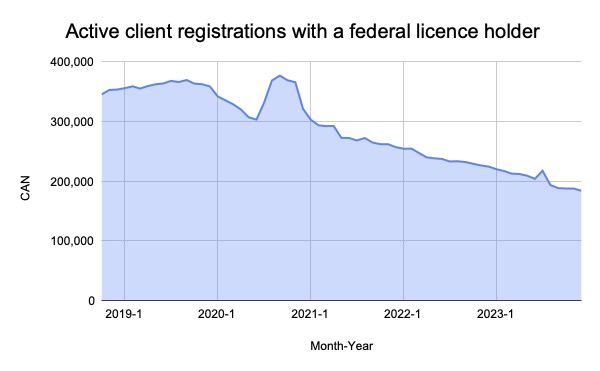
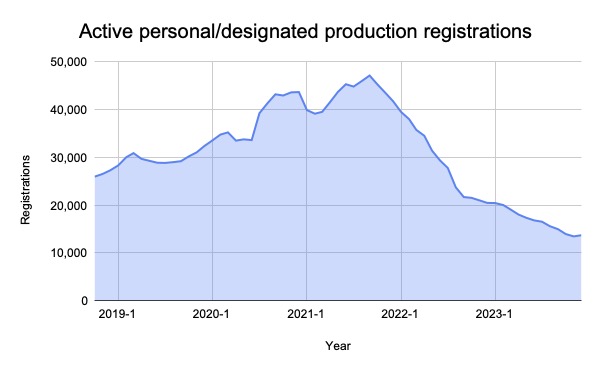
Participation in Canada’s cannabis for medical purposes access program continues to decline in the wake of legalization, with about 5,000 fewer medical client registrations and 1,200 fewer registrations for personal and designated cultivation.
The newest figures from Health Canada show that the number of medical client registrations fell 2% from 188,301 in September 2023 to 183,909 in December 2023. The number of people who registered with Health Canada for personal or designated cultivation of cannabis for medical purposes decreased by 9% from 14,944 in September 2023 to 13,672 in December 2023.
The majority of the decreases in registrations for personal/designated production were in Ontario (564), BC (145), and Quebec (143).
While declines in those accessing medical cannabis from licensed producers have been ongoing since mid-2019, in 2022, the number of designated and personal production licences issued began declining, as well.
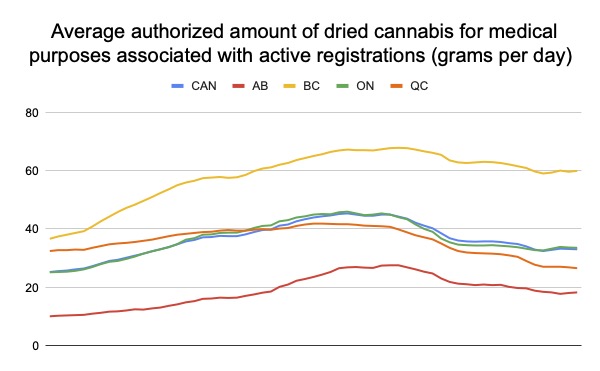
Despite these declines in registrations, the amount of grams per day associated with these designated or personal production licences has continued to be much higher, a trend Health Canada says is “concerning.”
While the average amount of cannabis authorized under the medical cannabis access program has been between 2-2.4 grams a day, the average authorized amount for those growing medical cannabis for personal use was 33 grams a day at the end of 2023.
Health Canada’s concern with these high numbers is the potential for these licences to be used for diversion into the commercial black market rather than for their stated personal medical use. The number of medical professionals authorizing these designated and personal production licences has steadily decreased for several months, from a high of more than 2,000 in 2019 and 2020 to just under 1,000 at the end of 2023.
The number of healthcare practitioners associated with active personal/designated registrations who authorized amounts equal to or above 25 grams per day reached a new low of 222 at the end of 2023, down from a peak of nearly 500 in late 2020.
Health Canada has been sharing data on the number of healthcare practitioners and the daily amounts authorized with these regulatory authorities since 2019 in an effort to address these higher-than-average authorizations.
There were 4,879 healthcare practitioners associated with medical cannabis registrations made in 2023 with federally licensed sellers. There were also 941 practitioners associated with active personal/designated production registrations. Of these, 222 had authorized amounts equal to or more than 25 grams per day, while 13 had authorized amounts equal to or above 100 grams per day.
The majority (78%) of healthcare practitioners who authorized more than 25 grams of cannabis a day were located in BC and Ontario. All authorizations equal to or above 100 grams per day were in BC and Ontario.
Health Canada also allows for the import and export of cannabis for medical purposes under limited circumstances. There were 78,761.49 endorsed kilograms of dried cannabis and 7,078.90 litres of cannabis oil exported from Canada in 2023.
In total, there have been 186,394.55 kilograms of dried cannabis and 40,057.84 litres of cannabis oil exported from Canada for medical purposes since October 2018.
Rules for imports of cannabis into Canada are much more strict and limited to medical and research purposes. In 2023, there were only 0.94 kilograms of cannabis imported into Canada and 14.57 litres of cannabis oil, both for scientific purposes only.
Since October 2018, Canada has brought in just 28.19 kilograms of cannabis from outside the country, and 28.84 litres of cannabis oil, both for scientific purposes only.
Rubicon Organics Inc. brought in nearly $9 million in net revenue in the first three months of 2024 while reporting a $1.7 million loss on operations and a $423,212 loss on adjusted EBITDA.
The certified organic BC cannabis producer reported net revenue of $8.9 million for the three months ended March 31, 2024, a 1% increase from the same period in 2023. This amounted to $2.4 million in gross profit.
With its Simply Bare, Wildflower, and 1964 Supply Co. brands, Rubicon is the one premium licensed producer across all product categories, according to data from Hifyre. The company also sells cannabis under the Homestead and Lab Theory brands.
Rubicon also recently launched a line of full spectrum extract vapes in Alberta, BC, and Ontario.
Rubicon CEO Margaret Brodie attributes the “challenging” first quarter to “seasonality and the overhang of weak consumer sentiment from 2023.” The company expects improvements in Q2.
“I expect to recover from this temporary dip from our streak of positive Adjusted EBITDA in Q2. In Q1, a changing product mix reduced our gross margin, but this spring we’ve shifted focus to higher-margin products, expecting improved results in Q2 and beyond. Our Q1 working capital investment for product launches is expected to come to fruition delivering further net revenue growth starting in Q2. Additionally, our first-half results are influenced by the ongoing one-time ERP implementation.”
The company is also launching several new cultivars like BC Organic Zookies, BC Organic Power Mintz, BC Organic Fruit Loopz, and Blue Dream.
The human endocannabinoids in each of our bodies have been discovered to correspond to other exogenous from plants like cannabis. It’s the endocannabinoid system–or ECS– that makes possible the interaction of phytocannabinoids with cannabinoid receptors then reap the potential psychoactive or therapeutic effects on our bodies. [1]
There’s quite a few ways to get those important cannabinoid compounds activated in your body and in unison with your own ECS, however there are big differences in their administration and consumption everyone should be up-to-date on.
Smoking Cannabinoids
An ancient Eurasian shaman gets buried with 800 grams of high-tetrahydrocannabinol (THC) cannabis around 750 B.C. near the Flaming Mountains of China. Several millennia later archeologists find the buried shaman and his well-preserved dried cannabis buds. This is one of the first actual physical discoveries of cannabis prepared to be smoked found in the world. [2]
People have been smoking cannabis for a very long time, but it seems the more ways there are to smoke it now, it’s all still relatively the same dried female flower that the shaman was smoking as well. The main idea is to apply heat to the dried bud and find a way to inhale the resulting cannabinoid-rich smoke. Combustion at around 1220°F or higher is necessary to do so. [3]
Instruments like glass and metal bowls and rolling papers for all sizes and shapes have been around for a long time and are still the main ways that people fire up their cannabis. Their popularity continues to this day in forms such as glass bongs, blunts, and pre-rolled cones. Smoking accessories similar to these are some of the first ways cannabis was consumed, and still continue on in popularity.
Vaping Cannabinoids
Vaping has risen in popularity over the last 10 or so years as a result of availability and convenience. This particular method of administration is when the heat source temperature is just slightly below the temperatures used for and smoking cannabis.
This lower level of heat from a result of electricity or battery-powered heat coils and ceramic ovens creates cannabinoid-rich vapor from the dried cannabis flower or concentrate-based hash oil starting with a temperature as low as 356-376°F however most people vape at a temperature that can reach very high levels that border more on the side of combustion instead. [4]
Vape Cartridges
Due to outlying factors like being discreet, convenient, readily available, and affordable, vape cartridges have become the standard for many cannabis consumers, much to the dismay of health officials and researchers due their often mysterious compositions. [4]
However, it’s not always just the cannabis extracts and oils that can sometimes contain adulterants themselves that can lead to potential adverse health effects. It’s also the harmful effects that the act of vaping itself can have on the lungs, respiratory system, and bronchioles that are of concern. [6]
Dry Herb Vaporizers are Recommended
Studies show that using a dry herb vaporizer such as a Volcano, can produce “therapeutically active cannabinoid vapors, but below the point of combustion where noxious pyrolytic byproducts were formed.” [5] Health-conscious reasons like that, along with the lack of any adulterants are why many health officials and experts consider dry herb vapes a top alternative to smoking cannabis or using vape cartridges.
Edibles
Eating your cannabis to derive effects from the cannabinoids has been popularized by numerous treats like brownies, cookies, gummies, and others. These are created in conjunction with a cannabinoid-rich extract of a carrier oil (olive, MCT coconut, avocado) or butter in their recipes.
Edibles as they are popularly known, have taken society by storm–everyone from celebrities to your next-door neighbor have tried them out. Unlike smoking or vaping, the edibles must be digested so that the cannabinoids can reach the bloodstream to take effect.
Since smoking and vaping give way to immediate effects they can be very convenient for that reason, while on the other hand ingesting edibles can take as long as your specific metabolism takes to digest them.
Edibles and Decarboxylation
To create these types of cannabinoid delivery systems, the cannabis must first be activated by a heat source–just like smoking and vaping–but performed differently. The act of is applying heat to dried cannabis in a covered container inside the oven or decarboxylation device somewhere in the range of 220-250°F for 30-60 minutes. [7]
This will activate the cannabinoids by removing a carbon atom from their molecular structure. The activated cannabis can then be infused with warm oil or butter for several hours to produce the ingredients necessary to create edibles.
Here are some other delivery methods that can found in an edible form:
Tinctures are born of a union of any of the aforementioned carrier oil types or grain alcohol and decarboxylated cannabis, tinctures are essentially a liquid that can be placed under the tongue for a quicker sublingual effect. Tinctures are popular due to their lack of any other ingredients like sugar, chocolate, gelatin, etc that are found in most common edible forms.
Sprays are sublingual sprays that are also created by extracting a concentrate of cannabis from decarboxylation and infusing them with a like alcohol into a spray bottle for super convenient administration of activated cannabinoids.
Capsules are typically made from infused MCT cannabis oil that is inserted into a pill capsule with a dropper or syringe. These are also popular for their no-nonsense consistency and convenient, discreet sizes.
Topicals, though not edible at all, are also infused oil, but mixed with lotion or shea butter products that are used by many people for their simple application and pain relief potential. These products seem to have a consensus that there is no psychoactive “high” when applied to the pain areas on the skin, since the decarboxylated oil they are derived from cannot break the skin’s blood barrier in humans. It is instead able to penetrate sore muscles and joint tissue. However, according to some researchers, there still needs to be more studies done to confirm this claim [8].
Cannabis Concentrates & Dabs
Concentrated forms of cannabis have seen a huge rise in popularity, despite being around in more simple forms for a long time. Hashish is essentially concentrated cannabis extract made from cannabis flower pollen and pressed together by a low heat source and/or pressure.
Hash has been smoked and consumed by people for thousands of years, but only recently have we seen cannabis culture embrace it so heavily in newer, more versatile forms. Many of these concentrates are created by several different extraction processes.
Dabbing
Dabs are extremely concentrated vapor clouds that are inhaled by the consumer in a dab rig or other vape device for a very intoxicating and concentrated effect. Heat is often applied by a handheld mini torch, lighter, or electronic device to the concentrated hash or bowl containing it.
Modern dabbing devices such as e-rigs, portable vaporizers, and glass dab rigs are capable of efficiently handling the application of heat sources needed to “dab” or consume any of the following very potent and sticky formulations that are found in most dispensaries and dab rigs in the U.S.:
Get Your Cannabinoids Administered Properly
The lack of a heat source will not allow cannabinoids to be activated in a manner that will work synergistically with the body’s own endocannabinoid system in order to get the potential effects that are being sought. Retail products like edibles and topicals will already be activated and ready for immediate application, while products like concentrates and dried flower will need the consumer to apply the heat themselves.
However you consume or use cannabis or cannabis products, the main idea is to get your brain’s cannabinoid receptors to receive the psychoactive or therapeutic effect you desire in an efficient manner that also works for your lifestyle, preferences, and pocketbook.
References:
[1] Crocq, M. A. (2020). History of cannabis and the endocannabinoid system. Dialogues in Clinical Neuroscience, 22(3), 223-228. https://doi.org/10.31887/DCNS.2020.22.3/mcrocq
[2] Russo, E. B., Jiang, H. E., Li, X., Sutton, A., Carboni, A., Del Bianco, F., … & Li, C. S. (2008). Phytochemical and genetic analyses of ancient cannabis from Central Asia. Journal of experimental botany, 59(15), 4171-4182.
[3] K. O’Brien Fehr and H. Kalant. 1972. Analysis of Cannabis Smoke Obtained under Different Combustion Conditions. Canadian Journal of Physiology and Pharmacology. 50(8): 761-767. https://doi.org/10.1139/y72-111
[4] Aston, E. R., Farris, S. G., Metrik, J., & Rosen, R. K. (2019). of marijuana among recreational users: A qualitative study. Journal of Studies on Alcohol and Drugs, 80(1), 56-62. https://doi.org/10.15288/jsad.2019.80.56
[5] Tashkin, D. P. (2015). How beneficial is vaping cannabis to respiratory health compared to smoking?. Addiction (Abingdon, England), 110(11), 1706-1707.
[6] Gieringer, D., St. Laurent, J., & Goodrich, S. (2004). Cannabis Vaporizer Combines Efficient Delivery of THC with Effective Suppression of Pyrolytic Compounds. Journal of Cannabis Therapeutics, 4(1), 7–27. https://doi.org/10.1300/J175v04n01_02
[7] Wang, M., Wang, Y. H., Avula, B., Radwan, M. M., Wanas, A. S., van Antwerp, J., Parcher, J. F., ElSohly, M. A., & Khan, I. A. (2016). Decarboxylation Study of Acidic Cannabinoids: A Novel Approach Using Ultra-High-Performance Supercritical Fluid Chromatography/Photodiode Array-Mass Spectrometry. Cannabis and cannabinoid research, 1(1), 262–271. https://doi.org/10.1089/can.2016.0020
[8] Patel, P. M., & Lio, P. A. (2021). Safety and Sourcing of Topical Cannabinoids: Many Questions, Few Answers. The Journal of clinical and aesthetic dermatology, 14(8), 49–51.
Island Genetics in Ladysmith, BC, is one of a handful of cannabis producers in Canada growing in living soil. They are part of an even smaller group of small-batch growers in Canada making a living selling their cannabis into international markets while they develop a brand domestically.
Starting as a group of friends growing cannabis for medical purposes for a handful of people under Canada’s old ACMPR regulations, Island Genetics received their commercial licence to cultivate and process cannabis in October 2022.
With a focus on small-batch cannabis grown in living soil—meaning soil they do not replace soil, instead regularly building up its microbiome crop after crop—the company is utilizing about half its total footprint. Although licensed as a standard cultivator and processor, they are currently growing in about as much space as a micro (200 m2).
Through connections the company’s CEO, Zach Chester, established in the international market, Island Genetics has ensured a steady sales channel for their product at a time when many producers are struggling to find sales in different provincial or domestic medical markets.
At the same time, Chester says he and the company’s modest team have been developing small runs of products for the local market, with a batch of live rosin sold recently through BC’s Direct Delivery program, and a SKU approved for sale in Ontario later this year.
This approach of starting small and slowly building the brand internationally and domestically has allowed them to grow at what Chester says is a sustainable pace.
While their first six crops have sold into Europe and Australia, they also have plans to develop a brand in the German medical cannabis market, all of which are eager for high-quality, small-batch products.
The biggest challenge in selling into the international market isn’t demand, explains Chester, but in consistently passing testing standards that can be much more strict than in Canada. While some might be concerned that a living soil product would have trouble passing those strict standards, he says they have been able to do so consistently due to their high standard of quality and cleanliness.
Although growing in living soil takes a bit more work and can sometimes mean a lower yield than hydroponics, the quality of the flower makes it all worth it, according to Chester. This higher quality is what has ensured that they’ve been selling out of everything they produce.
He says they also take a very scientific approach to their living soil, carefully analyzing both the soil and any amendments to it, to ensure they are producing the healthiest growing medium possible. In turn, this produces a healthier plant and a better quality flower.
Island Genetics utilizes data-driven organic growing practices
“I think there’s a lot more plant lipids that you get from having that large array of trace minerals and different mineral components always available to the plant,” says Chester. “I just feel there’s a more viscous quality in the smoke. More complex terpene profile, better flavour.”
Despite having so much success in the international market, Chester says his desire has always been to have a successful brand and to be able to sell into his home province. However, the lifeline of international sales has allowed him and his team to build that domestic brand on their own terms and timeline.
“I feel what we’re doing is unique, and we’re pushing what can be done with living soil. I want to be known for what we do, have our name on the package, and have that brand story out there. That is the goal. But that can’t be built overnight.
“We’re just kind of testing the waters here in Canada now. My buyers in Europe will buy everything we grow, but the dream is to have our own brand here. So I’m just slowly putting out different drops for Direct Delivery in the local market for small batch hash rosin runs. And so far it’s pretty much sold out immediately, so we’ll keep building that brand here, too.”
Securing those sales has also been with the assistance of several other local players, from partnering with cannabis marketers Highmark, and working with a neighbouring cannabis nursery, Life Cycle Botanics.
Although Island Genetics has its own veg room and its own extensive genetics library, Chester says he’s been very happy to work with Life Cycle Botanics to secure not only the kinds of high THC strains the market is demanding but also ensuring they’re coming from stable, clean genetics.
“They’ve been nothing but great. Very accommodating and easy to work with. They’ve worked out a custom approach for us, and I really like their approach, how rigorously they test their plants before putting them into production, and how strict their SOPs are, it makes me feel comfortable working with them.”
Although he understands he has to supply the market with the kinds of high THC flower consumers currently demand, Chester also says consumers are starting to realize there’s more to good weed than just THC. As that shifts, he and his team are ready with an array of landrace and other unique genetics that, while maybe being under 20% THC, have distinctive flavours and aromas that will help future brands stand out.
“I think consumers are starting to get smarter, from what I’m seeing. People are starting to notice the products that are better than others and I think people are going to start caring less about THC and more gimmick products and more about strains and who the producer is.”
“We still have a long way to go, but I think we’re starting to see things improve. There’s a lot of producers leaving the market right now, but as the supply balances out, the demand for a quality product will only get stronger. And we’re going to be ready to serve that market.”
















Recent Comments