

Radical Self-integration

Radical Self-integration

Radical Self-integration:

Strong Back, Soft Front, Wild Heart

By Gary Z. McGee

“The strong back is having grounded confidence and healthy boundaries. The soft front is staying vulnerable and curious. The mark of a wild heart is living out these paradoxes in our lives. It’s showing up in our vulnerability and our courage, and, above all else, being both fierce and kind.” ~Brene Brown

Integrating the self is no walk in the park. The self is a deliciously complex thing, multilayered and easily tricked into donning false armor.

Vulnerability is complicated. Sometimes we think we’re being vulnerable when we’re really just trapped inside the prison of our own comfort zone, wallowing in the false security and safety it bolsters, which ultimately blocks creativity, adventure, and authentic vulnerability.

Don’t get me wrong, comfort zones are important. They are good for creating boundaries and being a sacred space where we can lick our wounds, regroup, and come back stronger and empowered. It’s only when our comfort zone becomes armored that we run into problems. It’s when the front becomes armored that we lose the underlying essence of things; that we lose our creativity and adventurous spirit; that we lose the wild heart that keeps everything recycled and fresh.

As it turns out, the only real armor we need is a strong back…

Strong back:

“Stop wearing your wishbone where your backbone ought to be.” ~Elizabeth Gilbert

The problem with having a wishbone for a backbone is that there is never any self-improvement. The self exists in a limited, disempowered, codependent state. There’s only wishful thinking, magical thinking, and “thoughts and prayers” without any real thought. The self is trapped in the willfully ignorant prison of its own safe and secure comfort zone.

The key is to break the codependent cycle through courageous independence, which leads to provident interdependence.

Forget comfort; stretch your zone. Forget safety, risky endeavors are more fun. Forget security; there are adventures to be had that only dangerous freedom can allow. As Jan Sicero said, “There is no riskier risk than refusing to risk at all.”

Just remember to regroup with comfort, security and safety further down the line. Then repeat. Health is almost always cyclical.

Having a strong back is having proactive grounded confidence despite the safety and security of the comfort zone. It’s foremost in the character of true leaders.

Backbone first, wishbone second. Having a backbone is leading by robust and healthy example despite the weak and unhealthy crowd. Then it is going one step further and teaching that crowd how to be strong and healthy by showing them how to stop wearing their wishbone where their backbone should be.

Soft front:

“It’s very hard to have ideas. It’s very hard to put yourself out there. It’s very hard to be vulnerable, but those people who do that are the dreamers, the thinkers, and the creators. They are the magic people of the world.” ~Amy Poehler

The soft front is the creative front. It’s where the magic of the self meets the magic of the cosmos to create the magic elixir of divine union.

When we have an invulnerable front (hard front), we close ourselves off to the underlying magical essence of things. But when we have a vulnerable front (soft front), we open ourselves up to the Great Mystery of cosmos and our place in it.

This is where real magic is made. I don’t mean cartoon in the brain magic, or magical thinking. I mean authentic magic, integrated magic. The magic of imaginative interdependence and the sacred art that comes from it.

Combined with a strong back, a soft front is a true force to be reckoned with. A force of creative and interconnected nature: a cosmic hero who creates an immortality project born from confidence (strong back) and connection (soft front).

Wild heart:

“Chaos, leave me never. Keep me wild and keep me free so that my brokenness will be the only beauty the world will see.” ~R. M. Drake

Fearlessness has never been born from having a wishbone for a backbone or from having an invulnerable front. The only way to achieve a state of both fierceness and kindness is to integrate a strong back with a compassionate front. And the only way to maintain this sacred integration is to remain in touch with the bleeding wildness of your own heart.

The true paradox of the human condition is that we imagine the universe is the thing that is paradoxical, when it is really us. We are the paradox. A deliciously complicated paradox. Remaining in touch with our wild heart is a way to both honor this paradox as well as transform it into something that transcends itself.

Life is too short not to taste the delicious nectar of our own wildness, not to feel our deepest darkest wildness howling inside us. As Henry David Thoreau said, “In wildness is the preservation of the world.”

Wildness is freedom. There’s no better definition. When we’re in touch with our wildness, we are in touch with the freest aspect of ourselves. It tends to be counter-culture. It tends to be nonconformist. And rightly so. For wildness must defend itself against being controlled, domesticated, or brainwashed. It must defend its own freedom, or all is lost.

Luckily, as human beings, we have the option of being both wild and tame, both crazy and sensible, both fierce and kind. We contain multitudes. The wild within us only seeks to keep these multitudes as optional, to live out the vital paradox of being human.

As Walt Whitman famously articulated:

“Do I contradict myself?

Very well then, I contradict myself;

I am large, I contain multitudes.”

Image source:  Let Your Inner Light Consume You by Sara Shakeel

About the Author:

Gary Z McGee, a former Navy Intelligence Specialist turned philosopher, is the author of Birthday Suit of God and The Looking Glass Man. His works are inspired by the great philosophers of the ages and his wide-awake view of the modern world.

This article (Radical Self-integration: Strong back, Soft Front, Wild Heart) was originally created and published by The Mind Unleashed and is re-printed here under a Creative Commons license with attribution to Gary Z McGee and themindunleashed.com. It may be re-posted freely with proper attribution, author bio, and this statement of copyright.

The Garlic Mustard Enigma

The Garlic Mustard Enigma

natureofhealing.org

The Garlic Mustard Enigma

By

Spring has sprung!  ‘Tis the season of new growth, birdsong, and the pulling of garlic mustard! For those not interested in an interlude into the “weeds,” you can stop reading now.

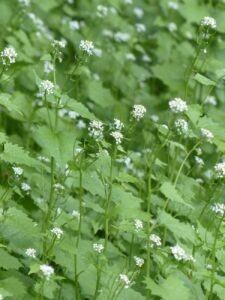
I offer a brief segue to speak for the plants. Because soon, people will become activists in large groups to pull a plant called garlic mustard (Alliaria petiolata) out of the ground to end its life. Why has this tradition taken root in the greater part of the U.S., before this plant sets seed?
imageHans from Pixabay” width=”266″ height=”355″>

Did Nature get it wrong?

Or is garlic mustard misunderstood?

What is a Weed?

Herbalists know that no plant is a “weed,” since each plant has a purpose. Weeds do not exist in Nature. According to medical anthropologist Ben Belek:

Weeds don’t exist in the wild. They can’t exist. A weed is only a weed when an onlooker says it is. The property of weediness, I reflected, is little more than herbage out of place. Only when a hardworking farmer extends her field to make room for a cauliflower patch, does the hitherto wild flora that lived and thrived there suddenly transform into a nuisance. Only with foreign settlement, does indigeneity become adversarial.

If people uproot garlic mustard, it is because they are convinced it is a non-native, invasive plant. End of discussion. However, if we can align ourselves with the plant kingdom, then we can better understand them. We are not so different from our plant allies. Most humans are transplants. When humans are forced to leave their home, it is called eminent domain.

If Ends of Discussions do not sit right with you, then you might be a contrarian! You might align with garlic mustard, the contrarian of the plant world!  Any good contrarian, anyone who rejects popular opinion, would not let the discussion end.

Our Nature Is Nature

Pulling garlic mustard where it is abundant prolongs its run. It also robs a great deal of nitrogen, macro- and micronutrients, and organic matter from the ecosystem.— Dr. Berndt Blossey, Cornell University

As we have begun this discussion, let us continue with some basic definitions that humans ascribe to the plant kingdom.

Invasive plants are plants that have been introduced to an ecosystem and are poised to take over.  According to Naturalists, invasive plants have aggressive root systems that spread long distances. They may smother other plants in the area. Some produce chemicals which impact the growth of plants around them. Basically, these plants dominate and some claims they don’t offer the benefits to local fauna. [There are politicians who qualify as invasive.]
imageIan Lindsay from Pixabay” width=”300″ height=”200″>

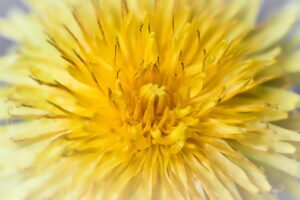
Consider the Dandelion (Taxacum officinale), a transplant from “somewhere else” that has naturalized itself in every part of the world but Antarctica! Sound similar to human migration? Today, the dandelion is listed as invasive only in Oregon and Alaska. Perhaps more people have come to appreciate her gifts and place in the world.

Dandelions were once native to Eurasia, before they have become native everywhere.  It is generally believed that the dandelion was first brought to North America on the Mayflower for its medicinal uses. In Europe, China, India and Russia dandelions were used to treat skin, infection, liver (root), kidneys (leaf) and digestive problems (the root balances HCL, aids constipation).

In Chinese Medicine, liver is known to be the seat of anger. Thus, dandelion leaves and roots help to detoxify an angry liver. As a flower essence, the sunny countenance of the dandelion works with the solar plexus to release trauma related to fears, ego, self worth, and personal power.

Non-native plants are also introduced plants, but they don’t have the negative reputation that invasive plants do. They could produce foliage or blooms that benefit local wildlife and they don’t take over their habitat. Dandelion qualifies here, too.

Native plants are well adapted to survive in their environment. They typically need less water, less fertilizing, and overall less care to fit in and thrive. Stay long enough in one place, and plants qualify as “native.”

Over time, the dandelion has gathered many names from the locals. In the case of the solar, resilient dandelion, she is known as all three: “native, non-native, invasive.” Beyond human classification, her flowers make a tasty jelly, while her roots make a great coffee alternative as a tea.

Garlic Mustard Misunderstood

Garlic mustard (Alliaria petiolata), too, has a lot to offer humanity. However, she is called pernicious, exotic, and a Class A noxious weed on a list of plants to be controlled. That’s a lot to overcome. With all the publicity, this plant that has captured the attention of plant lovers and haters, alike.  Insults aside, who is she really?

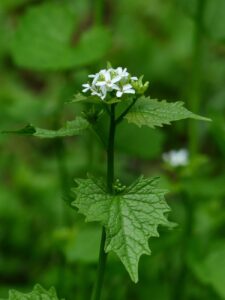
A member of the cabbage and broccoli family (Brassicaceae), garlic mustard grows 2-3 (up to 6) feet tall all over the Northeast and Midwest U.S. Lower leaves are kidney-shaped with scalloped edges. In spring, roots and new leaves smell like garlic, and small, four-petal white flowers appear clustered at stem ends, followed by long, skinny seedpods.

The family Brassicacea does not consider her evil. As a medicinal, the leaves and stems of garlic mustard are: antiasthmatic, antiscorbutic, antiseptic, deobstruent, diaphoretic, vermifuge and vulnerary.

According to Maude Grieve’s, A Modern Herbal, “The leaves used to be taken internally as a sudorific and deobstruent, to promote sweating and to treat bronchitis, asthma and eczema. Externally, leaves are antiseptic in gangrenes and ulcers, and against itching caused by bites and stings. The juice of the leaves taken alone or boiled into a syrup with honey is found serviceable in dropsy. The herb, when eaten as a salad, warms the stomach and strengthens the digestive faculties. The seeds have been used as a snuff to excite sneezing.”

This plant has the spicy tang of mustard with a hint of garlic, and can be used as a base for pesto and sauces, and to flavor salads, soups and other dishes. That qualifies as sassy, not noxious.

However, eating her leaves has not worked well as a control strategy. Plant stands can produce more than 62,000 seeds per square meter, and can self-pollinate, which helps it rapidly spread, to displace native plants along trails, in forests, and on riverbanks.
imageHans from Pixabay” width=”305″ height=”406″>

Out of the way, garlic mustard minds her own business, perfectly happy in a group, not bothering anyone, friend to the deer. After all, in the wilds of Nature, plants with such a bad reputation must work in creative ways to survive.

Self-Regulating Life Style

To survive, garlic mustard populations secrete a compound called sinigrin, a chemical that deters the growth of other plants and decreases competition.  In 2016, researchers at the University of Illinois found that within three decades, “sinigrin concentrations decrease as garlic mustard populations age, demonstrating evolutionary change due to ecological processes.” Garlic mustard declines when it reaches a balance with native species that re-colonize invaded areas.

One of the things we’ve seen over the last 20 to 30 years is that garlic mustard becomes less of an issue, and actually balances out over time.—Adam Davis, ecologist, U of I, and USDA Agricultural Research Service

Garlic mustard is self-regulating. Its life cycle runs about 20-30 years. As the plants age, they die off completely. Other species are then able to move back in.

If humans were to look closer to garlic mustard’s example, we might find we are not so different. Nature is self-regulating, just as we are.

The more deer in the area, the more garlic mustard. The deer are forced to eat the garlic mustard instead of the native plant species. Garlic mustard plays a role in defense of the collective plant world.

Doing Less is More

A decade-long Cornell University study of garlic mustard has shown that avoidance is the best way to manage garlic mustard.  Conservation biologist, Dr. Berndt Blossey, says:

Pulling up large swaths of garlic mustard is not only futile, it is worse than leaving it alone. It bears echoing: When well-intentioned people rip out this stuff, it actually prolongs the infestation period because the plant self-limits (more on that below) if undisturbed. Also, these mass garlic mustard-ectomy events do more damage to the ecosystem than the target species itself does. —Dr. Berndt Blossey

The study found (see video): “Side-by-side controlled trials showed that where garlic mustard is “managed,” the plants are considerably larger, and cover a much higher percentage of a site (at times by an order of magnitude) than the sections where nothing has been done. Not only that, but biomass on the managed sites tended to be roughly stable over the ten-year time frame studied, whereas it declined year after year in the unmanaged plots.”

Blossey says people wrongly conclude that “maple sap flows up from the roots during the day; goldenrod causes allergy symptoms; and garlic mustard wipes out native wildflowers and adversely affects salamanders.” Upon closer examination, these conclusions are demonstrably 100% false:

It turns out that while garlic mustard competes with native species, it does not displace them where deer are excluded or drastically reduced in number.  And it is earthworms, not our maligned invasive plant, which make a neighborhood less attractive to salamanders. —Dr. Berndt Blossey

Though it appears that garlic mustard displaces native vegetation with its prolific growth, what is really going on is a lack of cultivation of those native species.

Nature teaches that one can have intellect but not wisdom. Wisdom is not a group activity.  When it comes to the ways of garlic mustard, wisdom beats activism.

Culinary Benefits of Garlic Mustard

Why not eat the Invasives?

Garlic mustard has not only established herself in Nature, as food for deer, but is well known in foraging and culinary circles, and thus, local human economies. You can collect and dry the seeds of garlic mustard to make your own garlic mustard edibles, mayonnaise or dairy-free ranch dressing.  You can also purchase pre-made mustard.

Or take a hint from the Forager Chef and make yourself some garlic mustard shoots with ramp butter! Just make sure you harvest the ramps responsibly, as forager and author, Sam Thayer teaches!
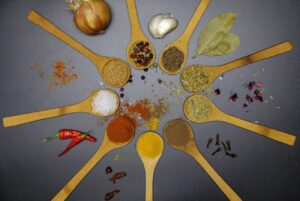
imageBruno from Pixabay” width=”387″ height=”259″>

According to Pascal Baudar, author of Wildcrafted Fermentation, a book about lacto fermentation of common wild edibles, stone ground black mustard seeds (Brassica nigra) make plant-based cheeses, fermenting mushrooms, sauces, soups, condiments, and more. Baudar says:

I don’t know why this resource is simply wasted, an L.A. Times article from 2019 called the plant “evil” because it covers our local hills. With such narrative, you’re going nowhere in terms of positive solutions. I wish the city had a special program to look at culinary solutions for the abundant wild food surrounding us.

I mean, instead of spending money on chemicals you probably could make money selling gourmet organic mustard with the profit going back to helping the environment. Why not? Some people would make a point to buy it.

Of course, in spring time you can also do all kinds of recipe with the leaves and flowers.  I think it’s much more creative than spraying Round-Up or wasting this delicious “unwanted” resource by throwing it away.Organic all the way.

Bauder shares garlic mustard recipes on his June 15, 2022 post Facebook page: “These days, I use a different technique. I soak the seeds for 3 days in a mix of 2 parts vinegar and 1 part wine and was able to make this wild “Dijon” mustard in 5 minutes during a class last weekend. Those “Invasive” plants can truly be gourmet food and so easy to procure. It took me 30 minutes to gather enough seeds to fill nearly 2 cups.

Be Like Garlic Mustard

If you have stood by, wondering why people expend so much time and energy on digging up plants in the wild, without understanding their unique qualities, then you, too, are a contrarian. Why not celebrate this unique quality with some garlic mustard, and dandelion tea?


Growing Relationships – Calgary 2024 Agenda

Growing Relationships – Calgary 2024 Agenda

Growing Relationships – Calgary 2024 Agenda | StratCann

Thanks to our sponsors for supporting StratCann’s work!

Growing Relationships – Calgary 2024 Agenda

We look forward to welcoming you to Growing Relationships in Calgary, AB, on Monday, May 6!

Below are the details for our Growing Relationships attendees. Please read the details fully and email us if you have any questions. We suggest you bookmark this page and have it handy on your phone for May 6, we will not have paper agendas for you, but we will have signage at the event.

TIME

The doors open at 8:45am MDT for registration, networking, and a light breakfast; programming will begin at 9:30am. We will end around 4:30pm, and invite you to head over to the Canadian Cannabis Exchange after-party to keep the conversations going! Your ticket may show an early time because StratCann is located in BC… but rest assured, in Calgary, registration opens at 8:45am!

VENUE

Growing Relationships is at the Calgary Marriott Downtown Hotel (110 9 Ave SE, Calgary). We will be in the Sunalta Room on the 2nd floor, with exclusive access to the rooftop patio. Look for signage in the lobby, and there is an elevator for anyone with mobility issues.

► Bring your government-issued ID, this is an age-gated event.

DRESS FOR THE WEATHER

We have exclusive use of the 2nd-floor Sunalta rooftop patio. This space will be available for informal networking throughout the day, and for the industry speed-dating if the weather cooperates. You may also wish to enjoy your lunch al fresco, so come prepared!

PARKING

The Marriott Hotel offers valet parking for a fee, and there are also (less expensive) parking lots nearby:

EVENT AGENDA

Time Monday, May 6, 2024
8:45-9:30 Registration & Light Breakfast
9:30-10:15 Welcome & Introductions
Industry Presentations
10:15-11:15 Industry Roundtable Workshop
11:15-12:30 Industry speed-dating
12:30-1:15 Lunch
1:15-1:30 Presentation
1:30-2:45 Producer Panel Discussion
2:45-3:00 Afternoon break
3:00-4:15 Retail Panel Discussion
4:20-4:30(ish) Closing remarks, prizes & wrap-up

INDUSTRY SPEED-DATING

This is a fun and fast-paced experience! We strongly encourage you to perfect your B2B elevator pitch before you arrive: craft a concise 1-minute introduction to showcase your brand and what you offer. We’ll guide you through this activity with the goal of making impactful connections that can be further developed throughout the day and beyond.

AFTER-PARTY MIXER

Join the Canadian Cannabis Exchange as they keep the conversations going at the after-party on Monday, May 6. We’ll be at Calgary’s infamous Palomino Smokehouse (109 7 Ave SW), just down the road from Growing Relationships!

TETHERBUDS

We’ve partnered with Tether as they deliver their Calgary Sampling Event the evening before Growing Relationships. Use promo code STRATCANN for 20% off any ticket type for you and your budtenders – grab your tickets here!

HASHTAGS

Help us keep the relationships growing, use the official event hashtags: #stratcannevents #growingrelationships

FEDERAL & PROVINCIAL REGULATIONS

Please note this event will adhere to all federal and provincial regulations. We appreciate your cooperation, participation and support.

Adult Only Event

This is an adult-only event (18+).

Please ensure you have your government-issued ID with you, or you may be denied entry.

THANK YOU TO OUR EVENT PARTNERS


Insight & News

Browse Categories

Thanks to our sponsors supporting StratCann’s work!
Recent Articles

SUPPORT INDEPENDENT MEDIA

If you’d like to support independent cannabis industry media, we have a simple way you can donate to our work!!

ADVERTISE WITH US

Put your business, brand and expertise in front of the Canadian cannabis industry.

Are you of legal age in your jurisdiction?
By clicking “Enter” you are verifying you are of legal age to view the content of this website, or click “Exit” to leave.


Radical Self-integration

How to Overcome ‘Psychic’ Predators – Part 2

How to Overcome ‘Psychic’ Predators – Part 2

By Makia Freeman

How can we overcome the psychic predators that have overtaken humanity’s mind – the Archons, Djinn, Demons, Kundabuffer, Mud Shadows or Flyers? Learn the strengths and weaknesses of these parasitic entities so that you may rise above them.

Shownotes:

*****

Makia Freeman is the editor of alternative media / independent news site The Freedom Articles. He is author of the books Break Your Chains and The International Satanic Network Exposed, the book series Controversial Truths Revealed (Cancer: The Lies, the Truth and the Solutions and 40 Incredible Real Life Alien Abductee and Contactee Experiences) and senior researcher at ToolsForFreedom.com. Makia is on Rumble, BitChute and Odysee.

Week in weed – April 27, 2024

Week in weed – April 27, 2024

This week from StratCann, the Manitoba NDP have tabled a bill to repeal the ban on growing cannabis at home and are “pausing” controlled-access retail licences for at least six months (there could be more on this next week).

We also shared a Canadian study looking at genetic markers for cannabis breeding, spoke with the Canadian Hemp Trade Alliance about the Farm Products Council of Canada seeking industry feedback on the Industrial Hemp Promotion-Research Agency, and reported on Indiva’s 2023 annual report.

The OCS released its Social Impact Report, and Health Canada issued a recall for an ounce sold in BC discovered through HC’s Cannabis Data Gathering Program.

The BC government says they have inspected 20 of their government-run BC Cannabis Stores to ensure they check IDs, with two subsequent enforcement actions.

US-based Curaleaf Holdings closed on the acquisition of Ontario’s Northern Green Canada, and a judge has postponed the BZAM/Final Bell trial.

In other cannabis news

A new study involving a McGill University researcher looks at how a mixed policy approach can control increases in cannabis consumption and combat the illegal market.

A budtender in Ontario is calling on the OCS and AGCO to adopt a sustainable packaging and container return program similar to Ontario’s The Beer Store. 

Hill Times ran an article on taxes and regulations with extensive quotes from Paul McCarthy from C3 and Beena Goldberg from Organigram. There’s nothing new here we haven’t heard for years now. 

On 4/20, CHCH News spoke with Romaine Francis at Sessions Cannabis, Oliver Coppolino from Cabbage Brothers, Aaron Lomax with Noods, and Daniel Bear from Humber College.

The same day, Prince George shut down a street in the downtown core for a street party and farmers market style cannabis event that was by all accounts a huge success. MyPGNow spoke with Alannah Davis from Dabble Cannabis Co. Liberal MP Patrick Weiler and others were in attendance, as well.

Canadian Running ran a piece on how cannabis may benefit runners

Canadian Cannabis sales declined (not seasonally adjusted) in every province except Nova Scotia in February. Sales figures for Canada in February 2024 were lower than they have been since February 2023.

Radio Canada spoke with Adam Greenblatt about the recent expert panel report on the Cannabis Act.

Greenway Greenhouse Cannabis Corporation announced that its cultivation facility in Leamington, Ontario, received CUMS-GAP and GACP certification

In law enforcement news, the OPP arrested six and seized 15,000 cannabis plants in a raid of a facility in Niagara.

A paper published in the journal ACS Omega has found that some cannabis rolling papers contain high levels of heavy metals

US-based Grön edibles, which sells in Canada through Indiva, told Benzinga that Canada is a much easier country to operate in than the US, given the national nature of legalization here compared to the state-legal only approach in the US.

In international cannabis news

US-based MedMen Enterprises Inc. announced that it made an assignment into bankruptcy pursuant to Canada’s Bankruptcy and Insolvency Act on April 24, 2024. The company lists several Canadian creditors owed nearly $1 million.  

New York just licensed a formerly illicit cannabis shop, contradicting several past warnings from the state government.

In an evolving story, New Mexico Gov. Michelle Lujan Grisham criticized the US Department of Homeland Security Secretary Alejandro Mayorkas’ response to cannabis seizures by border patrol agents in the state.

And finally, a new study challenged the stereotype that chronic cannabis users are lazy and unmotivated. The research surveyed 260 frequent users and found no significant drop in their motivation or effort levels while high compared to when sober.


Week in weed – April 27, 2024

OCS published its Social Impact Report

The Ontario Cannabis Store’s (OCS) Social Responsibility Strategy has distributed and invested over three-quarters of a million dollars and provided more than two dozen equity and access grants in its first three years of operation. 

The results of the program were shared in the OCS’ new Social Impact Report, published on April 26 to highlight the progress of the program since its launch in 2021. The agency’s first multi-year Social Responsibility Strategy is scheduled to run from 2021-2024. 

In April 2023, the OCS also launched its Social Impact Fund, which is dedicated to funding community projects and research initiatives that resonate with one of OCS’s three key pillars of social responsibility. Those pillars are

  • Sustainability: Establishing a Foundation for Sustainability.
  • Inclusion: Supporting a Diverse & Inclusive Industry.
  • Knowledge: Advancing Cannabis Knowledge & Promoting Responsible Consumption.

The OCS also launched its “Good All Around” social impact platform in 2023, with a goal of connecting Ontarians to the benefits and contributions of the legal cannabis framework.

Through these programs, the OCS has distributed $500,000 in funds to six organizations through the Social Impact Fund, $319,000 towards supporting Black-led initiatives, and $60 million back into the marketplace through OCS’s new fixed markup pricing structure and margin reduction.

The provincial agency also distributed 18 grants worth $56,500 to enhance the presence and participation of Black, Indigenous, and people of colour-owned cannabis businesses at industry events, mitigating cost and other participation barriers. It also provided another eight grants to increase industry event presence and participation of small Ontario-based cannabis businesses totalling $14,800. 

In addition, it provided an 8% wholesale rate adjustment on all cannabis products sold to Authorized Cannabis Stores operating on First Nation reserves and estimates it saved the industry around $10 million due to OCS’s insurance policy revision in 2022 to allow for easier access to the marketplace.

The OCS also provided 31 CannSell training vouchers prioritizing individuals who identify with equity-deserving and 2SLGBTQ+ groups. CannSell is a training program approved for legally authorized cannabis retailers in Ontario.

“The OCS has a mission to enable Canada’s largest and most vibrant cannabis marketplace through great customer experiences – including promoting safe access to legal cannabis, educating on responsible consumption and fostering a legal industry that reflects the population it serves,” says OCS president and CEO David Lobo.

“The Social Impact Report isn’t just a reflection of what we have achieved; it is a testament to our entire team’s commitment to environmental sustainability, diversity and inclusion, and improving cannabis literacy through education.”

The report also notes that the OCS has partnered with Climate Smart and initiated a Life Cycle Assessment. Climate Smart training focuses on how to understand, measure and reduce emissions. According to the report, a Life Cycle Assessment is a scientific methodology used to analyze the environmental impacts associated with all the life cycle stages of a product.

The OCS’ Life Cycle Assessment is based on a standard unit of 3.5 grams of dried cannabis, looking at the overall carbon footprint from seed to sale. 

In 2024, OCS is developing its next Social Responsibility Strategy (2025–28).

The full report can be read here


Not dwelling on it…

Not dwelling on it…

Not dwelling on it…

Years ago I was what is considered clinically depressed….

I had a peak experience which was to undo this. I was reading the Eagle’s Gift at the time; living in a two room apartment in the city where i was. I had been out and about wondering the parks and street… i often did!

I got home late – and was unable to sleep. I was preoccupied by my depression. I felt like the literal interpretation of the cloud that used to follow the Adam’s family around. Because i couldn’t sleep i decided to dip into my book – and hopefully fall asleep eventually. I read a few pages, however, i was too distracted to read as well, and was contemplating my predicament. Then i saw i realised that the thing that was destroying me was my internal dialogue!! It was the constant analysis of my depressive thoughts – in fact all my thoughts were caught in a loop of introspection. I was in deep analysis of my feeling. And because i wasn’t feeling ‘good’ this fed into my thought pattern – which in term made me feel worse. The dreaded infernal internal dialogue; I was deep in self-reflection and in a constant process of questioning and analysing myself. Why am i depressed?

What can i do to alleviate my depression? How long is this going to go on? so on and so forth…

Then the RULE emerged – and the voice of seeing – which simply said “STOP PROCESSING THE DEPRESSION”

Instantaneously, as the processing Stopped and the thoughts subsided and the internal dialogue ceased. I silently opened my book, and was dumbfounded, when after i found my place, i read that Don Juan was actually talking about depression in the portion of the book i was reading – i turned the book over to check i was reading the right thing, it seemed so unlikely… But more astonishing still, as i read the book, Don Juan started describing what i had just come to realise. He stated that depression comes from our energy body being damaged through the struggles of life. This depletion of energy causes a fissure in the luminous cocoon. The way we can overcome this – is he said by ‘not dwelling on the depression’ that is caused by the fissure.

There is a saying “energy flows where attention goes”, and in not paying attention to the gap, energy will eventually (if worked) come back. And when i say worked i mean through RECAPITULATION…..

A reliving of events – with the sweeping breathe; to recall the energy to the spot that has been depleted. This is as opposed to the circle of thinking about the depression which maintains the hole…. that was not only causing the depression but is in fact “The depression” itself.

With this process – i was reminded of a PING PONG ball that has a depression in it – not a hole as you see; but it has been dented – it is DENTED, it has a dwelling. its surface has become depressed…..How do you reverse the effect? – Well you get a hoover and suck the depression out – and then it pops and is WHOLE AGAIN… No longer depressed.

I read to the end of the chapter and fell asleep. I woke up sometime later in a hypnogogic state. I was awake but my body NOT. And i could see into the Spirit.

I looked out of the window to the tree that was my communal view, and there I SAW again a host of inorganic beings occupied each branch of this tall tree…. Like fireflies in the night ~

Lighting UP my mind……..

Vision of the Nagual

420 with CNW — Maine Sounds Alarm on Illicit Marijuana Linked to Chinese Gangs

420 with CNW — Maine Sounds Alarm on Illicit Marijuana Linked to Chinese Gangs

image

Maine is becoming the new hub for the illegal cannabis trade, with numerous unlicensed cultivation houses scattered across the state, according to a recent investigation conducted by CBS News. This trend mirrors a broader phenomenon unfolding countrywide, with illegal cannabis farms sprouting up in various states, such as Colorado, Oklahoma and California, as highlighted by the DEA’s former head of operations, Raymond Donovan.

Donovan attributes Maine’s strategic suitability for marijuana cultivation to its discreet geographical location and proximity to prominent distribution hubs such as New York and Boston.

A notable instance occurred in December when law enforcement authorities, after a comprehensive six-week probe, conducted a raid in Machias, uncovering a sizable facility housing more than 100 pounds of packaged cannabis and 2,600 plants. Chief of police Keith Mercier described it as one of the largest indoor cannabis cultivation operations he had encountered in his extensive career.

The operation involved a collaborative effort, with Machias police receiving assistance from various agencies including Homeland Security, the U.S. Federal Bureau of Investigation (FBI) and the U.S. Drug Enforcement Administration (DEA), among others. Since June 2023, Maine officials have executed search warrants at 34 properties associated with illegal cannabis activities, with ongoing investigations.

Surprisingly, investigations into the spread of illegal cultivation operations in Maine’s remote areas have pointed to involvement from Chinese organized crime networks. According to Donovan, these networks, which operate internationally, are linked to some of the largest black market cannabis trafficking operations. The issue prompted 50 U.S. legislators to address Merrick Garland, the U.S. attorney general, seeking clarification on China’s involvement in illegal cannabis activities across the country.

Maine Wire editor Steve Robinson has been monitoring the electricity usage of suspected illicit marijuana growers, a key indicator of illicit activity. He observed that such operations consume exorbitant amounts of electricity, necessitating significant upgrades to electrical infrastructure, which are often challenging to obtain.

Mercier acknowledged Robinson’s contributions, mentioning the utilization of his insights as a training tool prior to executing search warrants. The excessive electricity consumption, coupled with other red flags such as shuttered windows, strong odors and suspicious vehicular traffic, led law enforcement to the Machias operation, resulting in the arrest of three individuals on charges of unlawful cultivation.

Donovan highlighted a concerning aspect of the workforce involved in cannabis grow operations, revealing that some Chinese nationals are labor trafficking victims. Exploited under the guise of legitimate employment, these individuals are coerced into overseeing the cultivation process under duress, working under deplorable conditions for minimal compensation.

Further, he noted that the criminal groups are also often involved in more sinister drug trades, including the distribution of fentanyl. The authorities traced the connection between Chinese organized crime and illegal cannabis growers through the fentanyl distribution chain, observing that profits from fentanyl sales often circulate back to Chinese money brokers in Queens and Brooklyn, who are also involved in cannabis trafficking.

Despite marijuana’s legalization in several states, including Maine, its federal illegality persists. The thriving illicit market stems from the disparity between supply and demand, with regulations unable to meet consumer needs. Donovan expressed concern that lenient prosecution could embolden organized crime syndicates to target sparsely populated states such as Maine, exploiting lax oversight to expand their illicit operations.

Licensed companies such as Cresco Labs Inc. (CSE: CL) (OTCQX: CRLBF) also have to contend with the marijuana black market in the different markets in which they have operations. Decisively addressing this challenge will go a long way in allowing the legitimate companies in this industry to thrive.

About CNW420

CNW420 spotlights the latest developments in the rapidly evolving cannabis industry through the release of an article each business day at 4:20 p.m. Eastern – a tribute to the time synonymous with cannabis culture. The concise, informative content serves as a gateway for investors interested in the legalized cannabis sector and provides updates on how regulatory developments may impact financial markets. If marijuana and the burgeoning industry surrounding it are on your radar, CNW420 is for you! Check back daily to stay up-to-date on the latest milestones in the fast -changing world of cannabis.

To receive SMS alerts from CNW, text CANNABIS to 888-902-4192 (U.S. Mobile Phones Only)

For more information, please visit https://www.CannabisNewsWire.com

Please see full terms of use and disclaimers on the CannabisNewsWire website applicable to all content provided by CNW, wherever published or re-published: https://www.CannabisNewsWire.com/Disclaimer

CannabisNewsWire
Denver, CO
www.CannabisNewsWire.com
303.498.7722 Office
Editor@CannabisNewsWire.com

CannabisNewsWire is powered by IBN