One of the more significant stories of 2023 was that of ‘ingestible extracts’ – products sold for oral consumption that contain more than 10mg per serving and per package, as limited for edible products by federal regulations. StratCann was there for every step of this evolving industry subject, analyzing its impact on producers, distributors, retailers, and consumers.
The subject continues to evolve, with products appearing, disappearing, and, in some cases, reappearing again, while Health Canada maintains that these products are not compliant. Nonetheless, consumers love them based on all available sales numbers.
Health Canada also issued a warning to the public in March about these products, urging consumer caution.
On March 31, Organigram filed for a judicial review of Health Canada’s decision to require an end to sales of “edible extracts” that exceed the federal 10mg THC packaging limit.
Organigram’s argument in their application to the court was, in part, that the Jolts Lozenges are not edibles because they do not contain any sweeteners and that Health Canada was not transparent in their decision-making process.
In August, a judge approved Organigram’s application for judicial review of Health Canada’s decision to effectively ban these products. The case was then sent back to Health Canada for their opportunity to respond.
Rather than agreeing with Organigram’s contention that the products were compliant, the judge ruled that the federal health agency’s process to reach that conclusion was unfair and deserved further analysis.
The judge ruled that the unfairness of Health Canada’s decision on the ingestible extracts was partly due to it including additional factors in its decision-making process that Ogranigram was not given an opportunity to respond to.
In October, Organigram began offering their Jolts products again in several provincial markets, saying that Health Canada had accepted the Judge’s ruling and that its initial ruling on Jolts being out of compliance is void.
Following that announcement from Organigram in November, Health Canada said it was in the “redetermination process” regarding its initial ruling on Edison Jolts.
Interestingly, the disappearance of these products from shelves in BC appears to have led to an increase in the sales of cannabis oil capsules, with some consumers potentially discovering these products for the first time. While the capsules can still only contain up to 10mg THC each, they come in containers of 10, 30 or even 100, and at a much lower price.
Last week, Pennsylvania’s governor signed a measure that would allow all licensed medical cannabis grower-processors to sell their products directly to consumers. This came just days after the Senate approved the measure, which had been amended to grant independent dispensaries grower permits.
Under the bill, the state’s health department will establish a process that allows the 10 independent cannabis grower-processors in the state to apply to acquire dispensary permits for direct commerce. In addition to this, the four independent dispensaries in the state can also obtain permits to grow products in-house.
The bill, sponsored by Senator Chris Gebhard, replaces current regulations that prohibit more than five of the twenty-five grower-processor license holders in the state from holding dispensary licenses.
Under the current law, other holders of the grower-processor licenses have to sell their products to licensed dispensaries so that they can, in turn, be sold to patients. This had given some operators dominance over the state’s medical cannabis industry. With these new changes, it is expected that almost $2 million in revenue from permit and application fees will be generated. In the coming years, Pennsylvania should expect to generate roughly $90,000 a year from the same. Part of this revenue will be allocated to the Department of Health to offset administrative costs.
One provision in the resolution will prohibit licensees from permit transfers, which legislators argue will help prevent bigger companies from buying up permits and gaining monopoly over the market.
It is expected that Pennsylvania may soon legalize the recreational use of marijuana, just as other states in the region have done. Last month, voters in the state of Ohio legalized adult-use marijuana following the passage of the Act to Control and Regulate Adult Use Cannabis. The new measure, which went into effect earlier this month, will permit individuals aged 21 and older in the state to legally use and purchase the drug. Other states, such as New Jersey, legalized adult-use marijuana years ago.
A House committee in Pennsylvania recently held a second informational hearing on cannabis legalization as the call to enact reform continues to grow.Governor Josh Shapiro as well as U.S. Senator John Fetterman stated that the time had come for the state to make the change. Two bipartisan legislators are already looking for cosponsors to support their cause. The legislators, Senators Sharis Street and Camera Bartolotta, recently presented a resolution that would decriminalize cannabis and make simple possession a civil offense instead of a misdemeanor crime.
The ongoing evolution of the cannabis landscape in Pennsylvania is likely to be seen by the industry and leading companies in other jurisdictions such as Cresco Labs Inc. (CSE: CL) (OTCQX: CRLBF) as steps in the right direction.
About CNW420
CNW420 spotlights the latest developments in the rapidly evolving cannabis industry through the release of two informative articles each business day. Our concise, informative content serves as a gateway for investors interested in the legalized cannabis sector and provides updates on how regulatory developments may impact financial markets. Articles are released each business day at 4:20 a.m. and 4:20 p.m. Eastern – our tribute to the time synonymous with cannabis culture. If marijuana and the burgeoning industry surrounding it are on your radar, CNW420 is for you! Check back daily to stay up-to-date on the latest milestones in the fast -changing world of cannabis.
To receive SMS alerts from CNW, text CANNABIS to 888-902-4192 (U.S. Mobile Phones Only)
Please see full terms of use and disclaimers on the CannabisNewsWire website applicable to all content provided by CNW, wherever published or re-published: https://www.CannabisNewsWire.com/Disclaimer
Celebrate Boxing Week with Grow Up and Save Hundreds
Unlock Your 2024 Potential Now!
Season’s Greetings and warm wishes for a safe and joyous holiday season from all of us at Grow Up!
As we reflect on the year gone by and anticipate the big things in store for 2024, we’re thrilled to share an exclusive Boxing Week offer to help you save some money and elevate your business in the Canadian cannabis industry.
Boxing Week Exclusive Offer
Save hundreds this Boxing Week! Register before December 31, 2023, and receive a special 10% discount off early bird pricing on your booth purchase and/or ticket registration for either of our 2024 events. Simply use Promo Code: BOXINGWEEK23 to unlock your savings.
Unmatched Industry Engagement At Grow Up, we’re committed to providing unique value and opportunities that set us apart:
Direct Interaction: Speak directly with the actual growers, brand owners and decision makers.
Streamlined Lead Management: Enhance your follow-up strategy with our intuitive platform allowing you to effortlessly gather contact details of booth visitors, enabling seamless download and follow-up after the show, ensuring continuous engagement and post-show success. (included with your booth)
Targeted Networking: Our exclusive speed-networking events, official networking parties, awards, and growers luncheon pave the way for meaningful discussions and provide tailored opportunities to establish valuable industry connections. Relax and continue the conversation at the ‘CANNA Networking Lounge,’ designed to cultivate lasting industry relationships in a comfortable setting.
Cannabis Sampling: Explore the latest in cannabis brands in our Brands and Buyers / Sampling Zone, a highlight for many attendees.
Complimentary Retail Buyer Access: Retail store owners, managers, and buyers play a vital role in our Brands and Buyers Zone. We continue to offer complimentary tickets to qualified retail buyers to join us in Toronto and Alberta. Apply today Toronto Retail Buyer Application and Alberta Retail Buyer Application.
Grow Up Alberta: September 29 – October 1, 2024 Alberta Booth: Reserve Now Alberta Tickets: Register Now Retail Buyer Applications: Apply Now
We look forward to seeing you take part in shaping the future of the cannabis industry with us. Here’s to a prosperous New Year filled with growth, innovation, and success.
Wishing you a wonderful holiday season, The Grow Up Conference and Expo Team
This offer is our way of saying thank you for contributing to the growth of the cannabis industry. Let’s make 2024 a landmark year together!
The Speed Networking event provided a unique platform to connect and unlock new opportunities with some of the best in the Industry. Valuable insights and conversations during this event have led to meaningful collaboration.
Ian Scott
VP of Operations,Plantlife
About Grow Up Grow Up Conference and Expo is a Canadian-owned and operated leader in the cannabis industry, dedicated to driving innovation and community since 2017. We connect attendees with growers, brand owners, and key decision-makers. Our event is built a strong community of learning and growth among cultivation and retail professionals. Offering targeted networking events creates meaningful engagement and lasting relationships. Our Brands and Buyers Zone, featuring exclusive cannabis sampling opportunities, is specifically designed to promote commerce and market access for growers across Canada. This reflects our deep commitment and focus on growers achieving financial success and establishing a strong market presence, ultimately driving the industry forward.
Grow Up is more than just a conference and tradeshow; it’s a pivotal platform dedicated to shaping the future of cannabis in Canada and beyond, building strong, long-lasting relationships within the industry
The use of psychedelics has grown significantly these past few years as more data on the substances’ health benefits is revealed in studies. Given that the drugs are still illegal in most parts of the country, it is important to find ways to consume them legally. Below, we look at lawful ways one can undergo a psychedelic experience.
Psychedelic retreats
These retreats provide individuals with supportive and safe environments for psychedelic exploration using drugs such as ayahuasca, psilocybin, ibogaine and 5-MeO-DMT in countries where these substances are legal or not regulated, including Mexico and Jamaica.
Psychedelic retreats offer spaces to carry out sessions in the presence of seasoned facilitators and therapists, with users being able to undergo experiences either as individuals or in groups. While these centers are protected by law in most countries, it is important that one does their own research before settling on a retreat center where they can undergo a psychedelic experience.
Clinical trials
These trials are designed by experts in various areas of the biomedical sector, including psychology and neuroscience. The studies primarily focus on measuring the potential mental benefits of psychedelics in the treatment of conditions such as anxiety, post-traumatic stress disorder and depression.
In order to be eligible for clinical trials, individuals have to meet the inclusion criteria. Basically, this means that they have to be diagnosed with the condition the trial is investigating. Additionally, participants must be of legal age and not be on contraindicative medications.
Spiritual rituals
Psychedelic experiences are often seen as spiritual awakenings, and given that religious expression is protected by law, undergoing a spiritual ritual is basically legal.
Churches such as the Santo Daime use ayahuasca tea in their ritual ceremonies, allowing congregants to explore the unconscious mind and connect to the divine. It should be noted, however, that while these ceremonies are free, donations or voluntary work is appreciated.
Smartshops
These establishments, which originated in the Netherlands, are legally permitted to sell psychedelics. In the Netherlands, one can legally purchase and consume psilocybin truffles through these stores. It is important to note that psychedelics need to be used in a safe environment and with experienced individuals.
Psychedelic-assisted therapy
This is generally recommended for patients with treatment-resistant illnesses including depression, post-traumatic stress disorder and major depressive disorder, who have gained no benefit from conventional therapies.
People can access legal centers that offer psychedelic therapy in some states in the United States as well as in Australia. In Canada, individuals can access these services via the Special Access program. Thus far, only a few patients have been granted access to these therapies through the program.
The many clinical studies that are being conducted by various psychedelics startups such as atai Life Sciences N.V. (NASDAQ: ATAI) offer people who don’t find the prospect of traveling to a foreign country appealing an option of legally having psychedelic experiences under the watchful eye of trained professionals.
About PsychedelicNewsWire
PsychedelicNewsWire (“PNW”) is a specialized communications platform with a focus on all aspects of psychedelics and the latest developments and advances in the psychedelics sector. It is one of 60+ brands within the Dynamic Brand Portfolio @ IBN that delivers: (1) access to a vast network of wire solutions via InvestorWire to efficiently and effectively reach a myriad of target markets, demographics and diverse industries; (2) article and editorial syndication to 5,000+ outlets; (3) enhanced press release enhancement to ensure maximum impact; (4) social media distribution via IBN to millions of social media followers; and (5) a full array of tailored corporate communications solutions. With broad reach and a seasoned team of contributing journalists and writers, PNW is uniquely positioned to best serve private and public companies that want to reach a wide audience of investors, influencers, consumers, journalists and the general public. By cutting through the overload of information in today’s market, PNW brings its clients unparalleled recognition and brand awareness. PNW is where breaking news, insightful content and actionable information converge.
To receive SMS alerts from PsychedelicNewsWire, text “Groovy” to 888-902-4192 (U.S. Mobile Phones Only)
Please see full terms of use and disclaimers on the PsychedelicNewsWire website applicable to all content provided by PNW, wherever published or re-published: https://www.PsychedelicNewsWire.com/Disclaimer
We should never stop learning, for no one can have all the knowledge. From clean-fingernailed novices to grizzled spade-leaners, all growers should seek valuable and competent tips and advice from those who have walked the path before us. Detailed and gritty information is there for the taking these days, but it might be helpful to share some of the more general tips I’ve learned.
Never Give Up!
Think of failures as lessons; if you let them, every obstacle on the road can teach you something. It used to be yearly around midsummer when I wondered WTF I was doing. So many things went wrong, from terrible weather (I live in the North of England) or slugs that had eaten all my veg to an early crop-killing frost, a polytunnel picked up by the wind, and stolen strawberries. You get the idea.
This year, I have a resident mole, vole, and a rabbit that has taken care of most of my outdoor planted seedlings. Was I angry? Hell, yes. Will I give up? Not a bloody chance. Whenever I encounter an ‘oh-my-God-I-give-up’ moment, I breathe deeply (sometimes for a long while) and reconfigure it to a challenge. Gardening is a game; we can’t win every time, but we try new strategies and adapt. Once we can handle one scenario, a new lesson arrives. Rome wasn’t built in a day… or without a lot of swearing.
Establish Routine!
Be it your farm, grow room or house plants, work on a routine to help you manage it smoothly. Take house plants, for example. Depending on the volume of your indoor jungle, it may be hard to remember which plants need watering and when. I like to bring all my pots together on a slow Saturday morning and place them in a bath filled with a few inches of water plus a bit of feed or a nutrient enhancer. They slowly soak up what they need, and I can go about my morning. The plants return to their spot in the house once the pots feel heavy.
Similarly, if you’re managing a greenhouse or a growing space, it’s worth having a routine walk where you check all areas. Are the compost bays covered, and have the volunteers closed the taps? Are your timers and irrigation systems set correctly with no leaks? Checking those points becomes second nature in no time and helps you complete the new tasks that will undoubtedly arise.
Stop Apologizing!
This speaks to many aspects of life, largely thanks to social media. Unfortunately, a weird shame over our ordinariness and a desire to maintain a specific image has crept into the gardening world. So many of my clients will begin the garden tour with apologies for the weeds or overgrowth. Stop! Nobody should be judging your space; if they are, kick them out. We all have lives to maintain and other hobbies and chores on the to-do list. So get this perfect image of Monty Don’s garden out of your head unless you have an unlimited budget and an infinite army of volunteers.
More importantly, be grateful for the space you have, whether a 2m x 2m ‘yarden’ (as we call the Yorkshire-stone paved front yards of terraced houses of the North), access to a community garden, or the most beautiful and wildlife-filled fields and forests. It’s not a competition! Even one pot that brings one bee to its nectar or a smile to your face is a call for celebration.
Keep Learning Until You Drop Dead!
I am so happy that growing and gardening tasks are now considered cool! There are many incredible teachers out there with immense knowledge just waiting to be shared. From permaculture specialists, soil experts, and hot and cold climate gardeners to urban farmers and small space designers, there is a wealth of knowledge at our fingertips. The world of growing is constantly evolving, with new gardens being built and various methods trialed and tested on different soils. We live in an extraordinary time! I remember when I was closing Incredible Aquagarden’s Instagram as the project ended; there were no followers on the platform interested in plants or soil. Little did I know how the internet would change, and to this day, I take inspiration from many growers across the globe, listen to my favorite podcasts, and keep watching webinars that routinely blow my mind, even when I start to think I’ve seen it all.
Have Fun!
This one doesn’t need explaining. Do you like lying in a hammock with weeds around you all day? Good, because weeds are better than bare ground. Do you work in the garden non-stop from sunrise to sunset? Good, you should own your energy. Whatever is fun for you, please do it. What is the point otherwise?
California workers will soon enjoy official safeguards against discrimination related to their off-duty and off-site marijuana use following a change to the state’s Fair Employment and Housing Act, known as AB 2188, greenlit by Governor Gavin Newsom on Sept. 18, 2022, and set to take effect at the start of 2024.
Under the legislation, employers are barred from refusing employment, penalizing or terminating individuals based on their use of marijuana products outside of working hours.
Despite California’s pioneering move in 1996 to legalize medical cannabis and its subsequent approval of recreational use in 2016, AB 2188 stands out as the state’s inaugural law explicitly extending workplace protections to cannabis users, regardless of the purpose. AB 2188 introduces provisions that render employers unable to hold an applicant’s past cannabis use against them. Crucially, the measure shifts the focus of employment-related drug testing toward identifying impairment during work hours or on the premises, distancing itself from scrutinizing historical marijuana consumption.
Moreover, the new legislation outlaws inquiries into an applicant’s cannabis use history, preventing employers from delving into this aspect during the hiring process. This marks a significant departure from previous norms, where employers retained the right to discipline individuals for off-duty recreational and medical cannabis use.
For instance, if an individual engages in recreational cannabis use during their leisure time over the weekend and arrives at work on Monday, employers cannot penalize them based on their weekend marijuana consumption. AB 2188 heralds a departure from the previous legality of such punitive measures.
However, AB 2188 does carve out exceptions to these protections, allowing employers to regulate cannabis use during working hours. Specifically, the bill stipulates that employees are not permitted to possess, be under the influence of or use marijuana while on the clock. The legislation also emphasizes that its provisions do not impinge upon an employer’s prerogative to maintain a drug- and alcohol-free workplace.
Certain sectors, such as construction and building trades, along with employees or applicants seeking federal jobs requiring clearance from the Defense Department, may still face employment denial or disciplinary actions for marijuana use outside of work.
Anticipating the implementation of these restrictions, employers are urged to review and adjust their antidiscrimination and drug-use policies. Those covered by the legislation intending to conduct cannabis tests must ensure that their testing programs exclusively target psychoactive cannabis components. Employers are further encouraged to stay abreast of any pertinent updates to their policies, particularly concerning criminal background checks.
The implementation of this law in California brings the Sunshine State at par with jurisdictions where firms such as Canopy Growth Corp. (NASDAQ: CGC) (TSX: WEED) operate and adults are protected from job losses or other sanctions resulting from using marijuana while off-site or off-duty.
About CNW420
CNW420 spotlights the latest developments in the rapidly evolving cannabis industry through the release of two informative articles each business day. Our concise, informative content serves as a gateway for investors interested in the legalized cannabis sector and provides updates on how regulatory developments may impact financial markets. Articles are released each business day at 4:20 a.m. and 4:20 p.m. Eastern – our tribute to the time synonymous with cannabis culture. If marijuana and the burgeoning industry surrounding it are on your radar, CNW420 is for you! Check back daily to stay up-to-date on the latest milestones in the fast -changing world of cannabis.
To receive SMS alerts from CNW, text CANNABIS to 888-902-4192 (U.S. Mobile Phones Only)
Please see full terms of use and disclaimers on the CannabisNewsWire website applicable to all content provided by CNW, wherever published or re-published: https://www.CannabisNewsWire.com/Disclaimer
For many, that means having a focused approach to a specific product category. In the case of MTL Cannabis, which now has positive income and cash flow following a reverse takeover involving Canada House Cannabis Group Inc., that’s a “flower first” approach.
“The market continues to show that roughly $0.70 of every dollar spent is on flower products,” says Michael Perron, MTL Cannabis’s CEO. “For us, it’s the perfect alignment between our core competencies and what the market values.”
Focus is important. Trying to be all things to all people and spreading yourself too thin – as is the case with many large companies – can be hard to manage, and risky.
“I have an amazing one-of-a-kind cultivar – that’s the real star of the show – but the way I grow is also special,” says Jeff Aubin, president and CEO of Smoker Farms in BC’s Kootenay Boundary country. “I’ve been working with this strain for decades, and I know all the small, essential steps. We don’t roll out a new strain every 6 or 8 months.”
Other companies find success with unique production environments. Sweetgrass Cannabis, also in the Kootenay region, grows its certified organic crop using fresh local water from a nearby mountain.
“The Sweetgrass method consists of organic hybrid living soil,” says Julien Leclair, Sweetgrass’s master grower. “Our beds are full of earthworms. We have as close to a natural ecosystem as possible while growing indoors. Beneficial insects help us in our pest management control.”
Though these stories are varied, the common thread is that successful companies have deep engagement and knowledge – of their products and of their customers.
“We learned from the big businesses that you can’t just grow a lot of cannabis, sell it, and make a huge profit,” says Kevin Varner, master grower at Royal Harvest in Westbridge, BC. “Everybody has to find their lane, figure out what it is. It takes a lot of hard work, and you have to commit to it.”
Despite raising significant funds in the early days of legalization, larger cannabis companies have struggled. One reason, say many successful growers contacted by StratCann, is that they failed to understand the importance of collaboration and community.
“One of the big things we’re doing is working in collaborations,” says Varner. “Together, as a community, we can raise this industry up together, and make it work.”
This differs from some of the big companies, many of whom have attempted to dominate the market with an abundance of shareholder-subsidized, mid-grade flower. Unlike these organizations, smaller successful operations are more closely connected to their neighbours and customers, with an intense focus on quality and consistency.
“We’re heavily involved in our community,” says Aubin from Smoker Farms. “We hire eight people locally who have insight into the lives of cannabis growers, and what it takes to succeed.”
By emphasizing people as much as the bottom line, these growers have found that they’re more resilient, with less employee churn.
“It sounds as if the rest of the industry has a fairly high staff turnover,” says Gemma Hayes, Medical Care Coordinator at Sweetgrass. “In our entire time in operation, we’ve had one retirement and one person leave for their dream job. We’re a tight knit, close team. We all live in the same community, and are friends.”
Hayes says that Sweetgrass encourages a work-life balance while paying significantly above the living wage for the area. This can make a business more stable and help to ensure that product consistency and quality are maintained.
Success is a lifestyle
Growers contacted by StratCann were clear that, while a company must be run competently, there has to be an intimate relationship with the product itself, which requires significant commitment.
“For me, this isn’t a job – it’s a 24/7 lifestyle,” says Varner. “I’m in the garden on birthdays, holidays, anniversaries, to ensure the highest quality product. Everyone I know who’s succeeded has adopted this approach.”
Kevin Varner from Royal Harvest Cannabis
If the market has learned anything from the experience of the large cannabis companies, it’s that when business people with no prior engagement with cannabis grow large amounts of flower, failure is likely. By comparison, it’s the smaller-scale legacy growers, many of whom were never obsessed with getting rich, who are now running stable businesses.
In the example of Sweetgrass Cannabis, a certified organic producer, 90% of the team transitioned from legacy, with the majority working together for years before legalization.
“We treat the cannabis plants with a lot of respect,” says Leclair from Sweetgrass. “The staff are also passionate about growing good local organic food, and sharing different techniques.”
The cannabis culture in the Kootenays has also contributed to Sweetgrass’s success.
“The black market was different here than in other places,” says Hayes. “The whole community benefited, and there was a collaborative rather than competitive energy. There still is…We have highly experienced cultivation and production teams because of this local culture and experience.”
“Money doesn’t grow cannabis,” says Varner. “It takes the people who have the passion for it. It’s a living thing, and every step of the process counts – one day to us is a year to a plant. You can’t just throw a plant into a room with water and lights, and expect to sell it.”
“We always say, ‘Before there was a cannabis industry, there was a cannabis community’, says Perron from MTL Cannabis. “It’s something we’ve always known and believed in. We started with two brothers who loved to grow one particular type of plant: cannabis. We know that wherever you go from there, the flower comes first. It’s your foundation for everything else.”
The Right Decisions
Nonetheless, to succeed in a competitive market means making some hard choices.
“We aren’t selling any 14 or 28 gram bags,” says Aubin from Smoker Farms. “The price slope is too great, and it falls on the shoulder of the grower, given that the retailers and processors aren’t expected to make the same cuts. We won’t sell weed that cheap.”
Maintaining quality isn’t always easy. It means making tough decisions that support long-term sustainability, as opposed to short-term gain.
“Our ‘reject pile’ looks like many other places’ inventory,” says Hayes from Sweetgrass. “We won’t just release any good-looking flower onto the market. It has to satisfy many criteria before we’ll consider dedicating space in the grow room.”
These kinds of decisions can be difficult in a tough economic environment. However, for those companies that have managed to stay lean while maintaining deep connections to their communities and product, success is at hand.
“At the beginning of the journey we were close to bankruptcy after the first year,” says Aubin. “Our accountant was worried for us. But after our last visit, he’s impressed with the leaps and bounds we’ve made in the business.”
Imagine that there is an entity, God. Wait, this is not going to be religious at all. I only say to imagine God only for the sake of this discussion, its not important here whether there is one or not, that would be outside of this discussion. Then assuming this, what is God’s intention for creating us and the universe? lets narrow the question down to his intention for us? We drop into this life only to discover it piece by piece over time, to follow its clues to our rightful path, towards aligning ourself with all that is, flowing, harmonizing, connecting, being super spontaneous, always in the moment, balanced, grounded, humble, grateful, and funny, but not attached to any of it, nor to the drama, or the pleasure and the pain. God placed you here, you were born into it. Now it seems to want figuring it out. Like rats in a matrix we search for the door into freedom and fulfillment. It seems possible that no one has ever found it, but for those we call saints, gurus, or whatever, whom we imagine have found their way out and have lived on a higher plane, so to speak. They give us hope that it is possible.
Is it possible to waste this life, to not derive any or many of the positive aspects that this life offers, just from making wrong decisions, being in difficult circumstances, or living from fear. To waste something so infinitely precious, can hurt a lot. I am sure that we all want to live without regrets. The older one gets, the faster life seems to be going by, and one can’t help but think that its now or never, some call it “midlife crisis”.
When I am flossing and brushing my teeth, I often think, it seems that I just did this, now I am doing it again, every night I’m back here again, its always the same, each beautiful day, no matter how spectacular, ends in this mundane manner, for the rest of my life. It is a discipline, that most all of us do, privately, to save our precious teeth, and have a nice taste in one’s mouth, two big motivators. I know that it might seem prosaic of me to speak of such personal, mundane matters, but even the prosaic can be profound. And I am not just saying it for the sake of all those who may be leading a “pragmatic” existence, or for the sake of saying that even the ordinary can be extraordinary, which almost defeats the purpose of making the distinction between ordinary and extraordinary, it may as well be just one word, like “traordinary”, which is a combination of the 2 words. If you are in the process of creating a dictionary of new, original words, you can take this for a small royalty on every dictionary you sell, just one cent, that is all I am asking..
Thinking about ways of how to make some money, its almost the same of having to always brush one’s teeth, before going to bed. For many people, the mind keeps coming back to the same thing. Its like being chained to a wall. The mind should be free to wander and to be amazed, and not to keep stepping in the same holes, blind allies, and getting caught by all the delusions that hang like cobwebs in one’s mind.
The mind and the universe both seem infinite in different ways. The mind may be limited to the skull but seems unlimited in its capacity to store information, or it has no dimensions, being immaterial and is thus seemingly limitless as well. While they say the universe is forever expanding, meaning, i presume, that the “objects” in the universe are all traveling outward, away from each other at great speeds while the nothingness that has no end, more or less stays still in a somewhat static kind of backdrop. It could be the black curtain that comes down at the end, after all the lights are out, though I would prefer to think that the nothingness that exists after this life is beyond anything that we could imagine, and is neither dark or boring. It is impossible for our minds to conceive of the beginning of existence, since it is impossible to conceive of anything “always existing”, like our friend, god. we are always stuck with the question, then where did god come from? Maybe when we die, it all becomes clear and makes sense. And the distinction between ordinary and extraordinary is both for the sake of contrast, to remember to stay open to both the great and the small, as all is sacred and has value, and to send our love to every aspect of creation in an equanimical fashion.
Now if one could figure out “God’s intention”, one might be able to live in alignment and in harmony. Imagine that existence is a multi-leveled construction, analogous in some ways to a large cloud or a building, and the “matrix” is in the “basement” of existence, where there is no freedom, but rather only 2 types of slavery, chainless slavery with the illusion of freedom, and naked slavery which comes with chains and bars.
In the meantime, we are all looking for a way out of the “matrix”, to freedom, to alignment, to fulfillment. Maybe there is only one door… death. Or maybe there is an escalator to a higher level of existence, just one floor up, so to speak, a world where everything makes sense and we can feel “home”.
Four centuries ago authorities suppressed open investigation into a faulty paradigm. They are doing it again today…
Parts of this essay were taken from “WOKE. An Anesthesiologist’s View”
Exactly four centuries ago to the day Western Europeans watched the sun set at a point in the sky the furthest south of any all year, just like we (in the Northern Hemisphere) did today. Everyone knew the months ahead would bring more and more sunlight, but few knew why. With such regularity, why would anyone care?
The authority at the time (the Papacy) had a simple explanation: the sun, which orbited the Earth each day, actually moved in a corkscrew pattern. Over the next six months it would start spiraling northward, bringing longer days and shorter nights. It did so reliably every year. Six months later the sun would start corkscrewing its way south again until it reached its southernmost orbit again exactly one year from today. What’s the problem?
Their model was, of course, wrong.
But according to a poll conducted by the National Science Foundation in 2012, if you asked 100 people living in the United States if they thought the sun revolved around the earth you would receive about 25 affirmatives. 25% is an embarrassingly high number. If you are among the 75% who would have responded oppositely, meaning you believe the Earth in fact orbited the sun, how would you prove it to the other 25%?
How do you know you are correct? Simply saying we have pictures from space that prove it is a very weak argument. I would challenge you to show me a picture from space that demonstrates this incontrovertibly. What kind of picture would you need to prove it to yourself? More importantly, how did we know this to be true 60 years ago, before we had any cameras in space?
Perhaps you know this is true because you have been taught this or read it in a book. Did the teacher or book explain how we came to this conclusion or was it merely stated as fact? Perhaps you believe this mainly because most people believe this, and it would be impossible to fool the majority for so long about something so big. Do you believe this simply because this is what you have been told?
I suggest that if you don’t know how we figured this out, you don’t actually know that the sun is in the center of the solar system, you only believe it. There is a world of difference between knowing and believing. Believing has an element of uncertainty. Knowing doesn’t. Confusing the two can lead to unjustified confidence in an opinion.
How did we figure it out?
The survey results would have been very different relatively recently in our history. As explained above, four hundred years ago nearly 100% of Western populations still believed the Earth was the center of what we now call the solar system. How did this nearly universal view shift so drastically?
Even today it is clear that all celestial bodies rise in the East and set in the West. Putting ourselves stationary and everything else in motion is geo (and ego) centric given that motion is relative. Then again, why would this perspective be wrong? I wake up in the same place every day! What would lead me to believe that I was the one in constant motion?
Of course, all science textbooks today would place our sun in the middle of our solar system and the Earth in the middle of the moon’s orbit. If you trusted no one, including textbooks and your grade school teachers, how would you prove it to yourself? If you cannot prove it to yourself how would you be able to prove it to anyone else?
The first observant minds who woke up to the fact that we have a heliocentric (sun-centered) solar system that seems to remain relatively motionless against a backdrop of very distant stars were able to deduce it without supercomputers and satellite-based cameras. They did this with patience and keen observations over time. Whether it be 1623 or 2023, it is impossible to look out the window once and know what exactly is going on up there. As history has proven over and over, it is easy to arrive at the wrong conclusion if you only take a glance at something.
Here are some of the questions the model must explain:
Why is the midday sun higher in the summer?
First, they measured the position of the sun in the sky at its highest point (the zenith) throughout the year. The zenith of the sun varies by about 47 degrees between the winter and summer solstices (i.e. December 21 and June 21 in the Northern Hemisphere). In order to explain this with a geocentric (Earth-centered) model, the sun’s path around the Earth each day would not just be in one plane.
As mentioned above, it would have to corkscrew around it over a period of six months from the northernmost orbit to the southernmost and then head back North for the next six months. This would have been obvious to the earliest star gazers. Imposing that helical pattern did not prove the geocentric model wrong, it was just a necessary condition for it to be correct. If the sun in fact moved in that manner the geocentric model still works.
Why are certain constellations visible during certain seasons only?
The constellations were known to appear in the night sky at different times of the year. It was clear that the constellations that disappeared from our night sky during one part of the year did not cease to exist, they were in fact alive and well but were hidden behind the daytime sun. So, in a geocentric model the stars all revolved around the earth every day as well but just a tiny bit slower, one less revolution than the sun does in a year. This was the only way that the model could explain how they gradually appeared and disappeared as the seasons changed. If we assume that this is what they do, the geocentric model still suffices.
Why do certain stars change their position with respect to others during the year?
If you looked very closely, the position of some stars in the night sky relative to each other change very, very slightly depending on the season. The reason for this in actuality is because we are looking at the backdrop of stars from two different vantage points about 186 million miles away from each other. This is the diameter of the earth’s orbit around the sun. This effect, called stellar parallax, is similar to what you see if you hold your thumb at arm’s length and look at it with one eye and then the other. Your thumb will appear in a different position relative to the background depending on which eye you are looking from. Nonetheless, if all of these motions of the stars somehow occurred relative to each other over the course of the year while still revolving around the earth Every day, the geocentric model would still explain what is observed.
Why do a handful of celestial bodies (planets) move with respect to the stars?
The planets, in a geocentric model, would also revolve around the earth. They seem to move a slight bit with respect to the backdrop of stars each night as well. Interestingly they seem to be moving in one direction, slow down, reverse direction over a period of months and then return to their original direction again. This retrograde followed by anterograde motion is due to the different velocities and orbits of the planets around the sun. Some planets catch up to us in our position in our orbit and pass us, the Earth catches up and passes other more slowly moving planets in more distant orbits around the sun. If we maintained an earth-centered model we would have to admit that planets behave strangely. So what?
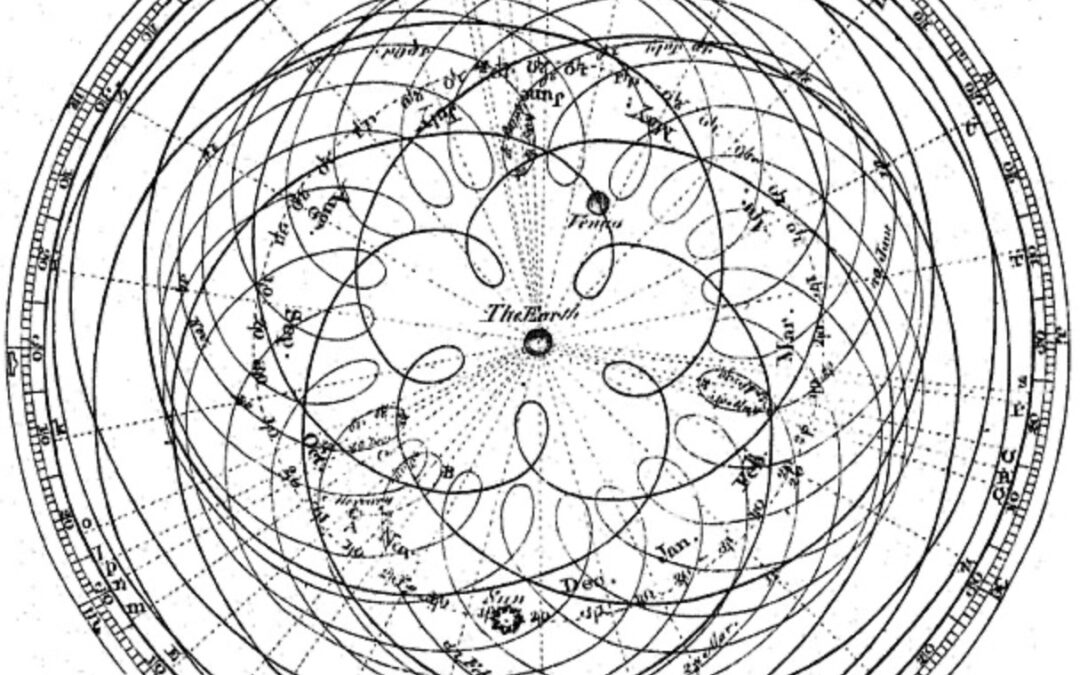
Geocentrists offered “simple” diagrams like this to explain the phenomenon (only relative motions of the sun, Venus and Mercury are given).
So, with all of these observations we still have two models that explain how our local universe is set up. One requires very complicated motions of the moon, stars, sun and planets with different periods of rotation around the earth with different speeds and directions. The other would be explained by the sun centered in the solar system with the earth and planets revolving around it. Both explain what is observed from Earth.
Is one model more valid than the other? If the only criteria to judge were the relative simplicity of each model we could easily say that one model is significantly more complicated than the other. But does this make it less valid? Occam’s Razor, the principle that the correct explanation is often the simplest, is only an observation, not a method of proof. There is no law that dictates that everything has to be simple. The fact that one model is more simple is not proof of its validity. However the model we choose has deeper implications about our relationship with the cosmos.
The First Western Heliocentrist
The man most often credited with being the first to put forth a heliocentric model of the solar system was Aristarcus of Samos, a Greek mathematician who lived around 270 BC. His idea did not change the popular narrative. His only argument was that his model was far simpler and elegant. Though it could explain the complex motions of all of these heavenly bodies in a straightforward way, it did not prove the geocentrists wrong. Nevertheless, by using his model, Aristarcus was able to make the first estimations of the relative size of the sun and moon and their distance from the earth.
Astronomers in the years that followed used the sun-centered model of the solar system to make their celestial predictions because it was easier. There would come a time, however, when their methods would become a liability. This brings us to a fascinating point in European history.
During the first few centuries after Aristarcus’ time those who espoused these two different models of our solar system co-existed peacefully. What do you suppose happened next? (Hint: it wasn’t the astronomers who hunted down people who disagreed with them and bludgeoned them with their sun-dials).
Why would subscribers to two different belief systems co-exist peacefully in Ancient Greece be at odds a few centuries later? Neither party denigrated those in the other camp. Each simply offered a different explanation of what we had all been wondering about for thousands of years. The astronomers did not pose any threat to those who chose to believe in the geocentric model. However they became a threat to an institution that sought to control how people thought–an institution that did not exist in Ancient Greece but flourished in the Dark ages.
Enter the Censors…
The centralization of power in the Catholic church began in the fourth century when Emperor Constantine converted to Christianity, ostensibly as a strategy to unify the expansive territory under his domain. Citizens of the Roman Empire lived in various climes, spoke different languages and adhered to different customs. Allegiance would have to come from a different source: a common system of beliefs.
The magnitude of the church’s authority, serving as the sole liaison between imperfect people and a perfect God, was indirectly related to an understanding of our planet and the heavens above. Humanity’s role in the universe as the recipient of the one inhabitable spot in the center of God’s creation raised the Church to an infallible status. What to do with the pesky astronomers who offered an explanation that not only challenged the Church’s model of how heaven and Earth were put together but also banished humanity to a smallish sized planet endlessly circling the sun like several others? The answers are obvious and the details have been sorted out over the centuries.
As has been repeated throughout our history, authority responds mercilessly when faced with the possibility of limitations to their power. It’s no different today. This may come as no surprise to some. To others, the idea that we, as educated individuals four centuries after the Renaissance, armed with the scientific method and the freedom to speak and worship as we please could ever be overtly or unknowingly be manipulated, is laughable. (If you happen to be in that camp, would you have been able to prove your position to the 25% who still believe the Sun orbits the Earth? Or did you have to defer to a “trusted” source to explain it to you first?)
During the rise of the Catholic doctrine in the fourth century there were still two perfectly valid models of our solar system. The astronomers, who were the tiniest of a minority, quietly continued to study the sky with an unspoken model of a sun-centered solar system while the majority, empowered by the union of church and state, persecuted them out of the fear of losing control over the way people thought.
This continued for nearly eleven centuries before an Italian astronomer, Galileo Galilei, pointed his telescope at the planet Jupiter and its moons and with careful observation, was able to easily show that not everything revolved around the Earth. All you had to do was look. Galileo was eventually brought to “justice” and was forced to live out his last years under house arrest because he refused to recant his position on the matter.
Although Prussian born mathematician Nicolaus Copernicus put forth a sun-centered model decades earlier, it was Galileo who posed the first real threat to the authority of the church because he was the first person to take things a step beyond Aristarcus by providing clear evidence that the Church doctrine was not just inconveniently complicated but clearly incomplete and possibly even wrong. Moreover, by using his primitive telescope any uneducated peasant could see it for themselves. One might guess, then, that that was the end of the geocentric model. It was not.
Independent thought has always been and will always be the greatest threat to authority. For many of us who enjoy life in a free society, the idea that a person would be punished for holding a contrarian belief, especially one that can be independently verified, is unthinkable. In Galileo’s day, his imprisonment was not only sanctioned by the powers that be, it was likely considered a holy act.
Though we may be free to believe and speak as we like in this society today, independent thought is only a seed. In the right environment the seed may grow into a mighty tree whose roots can shatter the deepest of foundations. However, in order to grow, a seed of independent thought requires proper soil: people who are willing tolook a little closer. If members of a society are not curious, even the most brilliant new idea will never be transformative. The idea will remain in the mind of the contrarian condemned to house-arrest. In order to be heard someone must be listening.
The absence of curiosity aside, if a society is unquestioningly trusting it can obviously be more easily manipulated too. I cannot speak to the level of curiosity amongst the Italian people in the early 17th century. We can be quite confident, however, that the church exacted unyielding control and that control was born of an unquestioningly trusting population. Corporeal punishment, imprisonment and executions were not physically conducted by popes, or cardinals or those who sat in the thrones of papal authority. Instead it was the faithful and devout who carried out what they believed was God’s will, which called for corrective measures against heresy.
Who or what is to blame for this systematic suppression of human thought over those centuries? The few who were in the highest positions of authority likely knew Galileo was not only on to something but was bringing attention to uncomfortable truths that were getting increasingly difficult to hide. It was their edicts that justified action against dissenters.
Neither can we excuse the “faithful” for their role. Judging them by today’s standards, they were deeply biased. They did not examine the basis of heretical arguments any more than their own unwavering belief in what they were told. As we have seen over the last few years, this arrangement may be more prevalent today than we realize, even in institutions that we believe operate outside of bias.
Galileo’s “seed” could not be planted. His imprisonment had little to do with that. It took another fifty years for the final breakthrough that validated Aristarcus’ model and catapulted Galileo from a heretic to martyrdom, earning him the posthumous title of “Father of Observational Astronomy”. He is also considered one of the fathers of the scientific method.
The Breakthrough
What was the breakthrough? Perhaps you have been able to deduce that whatever proof was eventually found must have been outside the realm of observational astronomy. Although Galileo demonstrated that the moons of Jupiter did not orbit the Earth (which was a matter of some inconvenience to the Church–and to Galileo himself eventually), he could not directly disprove the Earth-centrists for reasons outlined earlier. Simply looking at the sky from the surface of the Earth would never enable the observer to refute or prove either model definitively.
Of note, Galileo’s telescope also allowed the observer to clearly see that different portions of the planet Venus were illuminated at different times of the year. The “phases of Venus” could not be explained by an Earth-centered model. This was of little concern to the church who likely explained it as the one exception to their rule. There’s nothing to see here folks…
The proof came by way of the Law of Universal Gravitation put forth by Sir Isaac Newton in 1686 more than nineteen hundred years after Aristarcus’ day and fifty years after Galileo’s death. His law described the behavior of the motions of particles in the universe. These motions could be confirmed independently by empirical evidence. Once his Philosophiæ Naturalis Principia Mathematica was accepted as the means by which the motion of objects could be predicted, the Church was forced to concede because they could not explain the behavior of their model with his newly accepted law.
As a side note, it is Newton’s third law of motion, which simply states that for every action there is an equal and opposition reaction, that invalidates the official explanation around the “collapse” of the twin towers. If the top parts crushed the bottom parts to smithereens, they too would have been immediately pulverized in the process. The National Institute for Standards and Technology accepts this elementary law as indisputable, except when they are told to ignore it. But I digress…
A human being traveled to the moon just 360 years after Galileo “discovered” what Aristarcus had shown nearly two millennia before. How many centuries was this journey delayed because an alternative explanation in ancient Greece became a “conspiracy theory” against authority and convention? As tragic as it may seem, it should come as no surprise that Western civilization took nearly two thousand years to avail itself of a truth in front of its face. Several obfuscating factors were in play in the Dark Ages and well into the Renaissance when Galileo lived:
An accepted theory based on several pieces of evidence that each have a possibility of being wrong is instead regarded as a paradigm with too much supporting evidence to be inaccurate: Most people were not aware that the seemingly unassailable model of an Earth-centered universe was based on arbitrary choices about how to interpret what could be observed.
An incentive for upholding the ascendant position prevents an open investigation of an alternative theory: We can surmise that people were reluctant to peer through his telescope for several reasons. The idea that his model of the universe was correct would have been so preposterous that even checking would have invited ridicule from the “sane-minded” majority. There would also be the fear that he was correct. What if once you put down his telescope you would realize that the ground you stood on was no longer the stable center of God’s creation but a spinning rock tumbling around the sun like the other planets? Surely this would have crossed the minds of those who had the opportunity to look for themselves.
The risk of destabilizing a broadly trusted institution that serves as a common foundation uniting large groups of people makes individuals less likely to challenge authority or the authority of the majority: The Catholic Church’s control over people was directly threatened by Galileo’s proposal. With no logical argument to defend their position, their only choice was to silence him. Galileo held the Chair of Mathematics at Pisa and then later at Padua. He had been an important contributor to the Italian Renaissance before coming forward with his proof. If he was put on trial what would motivate anyone else to support him?
Galileo is one of the “Fathers of the Scientific Method” not because he refused to be swayed by the threat of condemnation or ridicule. He is credited with that title because he approached the evidence with a sincere desire to know the truth. Remaining objective requires one to consider the facts without dismissing them no matter what their veracity would imply. Galileo’s dedication to the facts still stands as the best example of what is required to remain free of bias and what potential benefit can be gained by doing so.
Of course all “conspiracy theorists” are not Galileos. Neither are all conspiracy theories true. However, can we be certain that all of them are false? At their very core, all large “conspiracy theories” directly or indirectly point at a central authority acting covertly and simultaneously at the media for either missing it or looking the other way. This continues to seem unimaginable to many people today.
In Galileo’s time the Church played the role of authority and the disseminator of information. Today we have a government chosen by the people and an explicitly independent press to hold their power in check.
Many admit that even a government freely elected by the people makes occasional mistakes and frequently keeps information from the public, but it would never do anything intentionally egregious to all of its citizens and then hide it. If it did, whistleblowers would come forward and the media would let us know about it. This is why most believe that such a deception could never occur. The idea that your lover could be in bed with your best friend is inconceivable—until it isn’t.
Long Covid or Long Covid Vaccine?
At this very moment we are in another dilemma about how to interpret what is going on around us.
There is consensus that there has been a jump in mortality rates of people of nearly all age ranges. This phenomenon emerged with an aggressive vaccine campaign. Is it “long Covid”? Is it from the mRNA shots? Is it both?
The parallels between present day and the Italian Renaissance are obvious. The same obfuscating factors are in play again.
In this short essay Josh Mitteldorf, PhD summarizes the undisputed facts around this topic:
The spike protein of the SARS-COV2 virus is itself toxic
Spike protein will be synthesized by a subgroup of vaccine recipients for an indeterminate amount of time
The synthetic mRNA is encapsulated within pro-inflammatory tiny bubbles of fat called lipid nanoparticles. We know that these particles do not remain in the arm but can circulate throughout the body. They migrate to the heart, the spleen, the ovaries and the brain
The rise of anecdotal reports of healthy athletes “keeling over” coincide with the deployment of the mRNA shots on a global scale
Unauthorized Science
Keeling over on the soccer field
I’ve been writing for ScienceBlog almost since its inception, and I feel grateful for the platform it has given me, and identified with the values and culture of ScienceBlog. Today, there appeared on this site the article, Study Helps Explain Post-COVID Exercise Intolerance…
With all that is observable how can we exonerate the mRNA products from any role in the tragedy unfolding in front of us? The key takeaway is that once again, those who have the authority to answer this question definitively aren’t interested in doing so.
What is it going to take to expose their conflict of interest? From where will the breakthrough come this time?
In Canna Pubco news, Canopy is getting rid of its This Works brands, Organigram posted a net loss of $248.6 million in 2023, and Auxly Ottawa recalled one lot of Mandarin Cookies from Manitoba due to a minor labelling error.
The National Post shared a piece on the “monopoly” the OCS enjoys on online sales, speaking with Jennawae Cavion, executive director of NORML Canada and owner of Calyx+Trichomes, along with Sam Gerges, owner of MaryJane’s Cannabis, and Nick Baksh of cannabis shop Montrose. Unsurprisingly, given the source, the piece quickly morphed into a call for more enforcement against illicit online retailers. The OCS had 42.8 million in sales through OCS.ca, their online consumer store, or about 3% of total sales for the OCS. This is down from $72.7 million in the previous year.
Trees Corporation announced that the company and its subsidiaries had received an order for creditor protection from the Ontario Superior Court of Justice under the Companies’ Creditors Arrangement Act. The Trees Group currently has 13 branded Trees storefronts in Canada, including nine stores owned and operated in Ontario and four stores owned and operated in BC.
Organigram appointed a new CFO, Greg Guyatt, formerly of Phoena Holdings Inc (formerly CannTrust), effective January 8, 2024.
Quebec’s Médicibis, owner of Mendo Medical, announced an agreement with Ontario micro cultivatorKilometer Cannabis Limited, operator of the Headwater Cannabis brand. The agreement means the Mendo Medical platform, mendocannabis.ca, will now include Headwater’s offerings.
Tilray announced the launch of two new cannabis edibles across Canada, including Ontario, British Columbia, Alberta, and Saskatchewan, under its Chowie Wowie brand. Both products have 10mg THC and 10mg CBD.
High Tide is opening a Canna Cabana location within the Tsuut’ina Nation in Alberta. This opening will mark High Tide’s 160th Canna Cabana branded retail cannabis location in Canada, the 78th in the province of Alberta, and the first Canna Cabana on the Tsuut’ina Nation. The Tsuut’ina Nation is located southwest of Calgary.
The Global Cannabis Times also recently interviewed Raj Grover, CEO of High Tide, where he says they are just 4.5% of Canada’s total brick-and-mortar store count, but 9.5% of the Canadian retail market share in terms of dollars.
The Good Shroom Co Inc., which sells cannabis products in several provincial markets under its Nordique Royale brand, as well as wellness beverages, released its financial results for the quarter ending October 31, 2023. The company saw revenue of $1,510,586 and $92,126 in net profit, primarily from cannabis sales. The same quarter last fiscal year was a net loss of $191,569.
An Enniskillen, Ontario, man who has been fighting to keep cannabis from being grown at a Tilray greenhouse just 28 meters from his home now has permission to be part of a hearing at the Ontario Land Tribunal. Cannim Canada, an Australian-based cannabis company, has already received a licence to cultivate and process cannabis at the Lasalle Line greenhouse.
A Colombian-Canadian cannabis company near Bogota is frustrated by regulatory red tape and political hurdles it says are stifling the country’s cannabis industry. Reuters reports that more than 17 acres of land owned by a Colombian-Canadian company near Bogota was once meant to grow 25 varieties of cannabis, but over the past year, weeds have overtaken greenhouses, and 200 of its 218 employees have been fired.
“We’re going from bad to worse. It’s slow agony and the clock is going against us with pressure from partners and without cash flow,” said the owner of the Colombian-Canadian company, who asked for anonymity because he is seeking new investment to save his $20 million business.
Hong Kong customs officers have arrested three men and confiscated 228kg of cannabis hidden in a seaborne tire shipment from Canada.
US President Joe Biden has announced pardons for certain federal cannabis convictions and clemency for 11 people imprisoned for non-violent drug crimes. The executive order covers those convicted under the federal law of simple possession, attempted simple possession, or use of cannabis. The White House has said thousands of people would be eligible for the pardons.


















Recent Comments