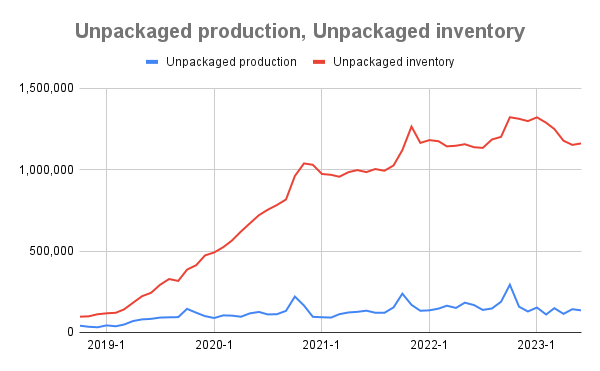
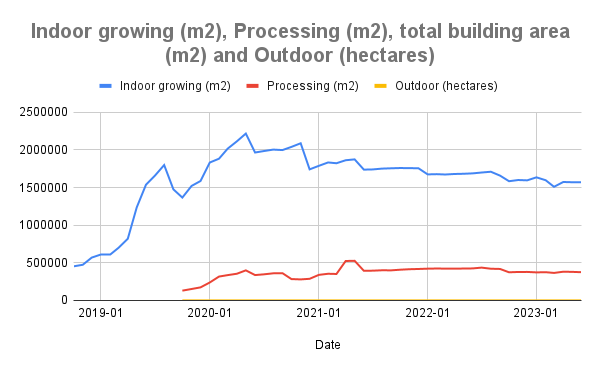
The amount of unpackaged inventory cannabis producers are sitting on has continued to decline from a peak in late 2022, while approved indoor grow space has been slowly declining from a peak in early 2020.
Approved outdoor production space has also declined from a peak in late 2021. Unsurprisingly, the estimated number of people employed on federally licensed cannabis production sites has also been declining from a peak in late 2021.
Dried flower still dominates cannabis sales, but cannabis extracts and edibles continue to slowly eat away at that market share.
While the volume of unpackaged, dried cannabis flower licensed producers have in their vaults is still over one million kilograms, that amount has been somewhat declining in 2023. The peak volume held by these processors was 1.3 million kilograms in October 2022.
The most recent figures provided by Health Canada, through June 2023, show that figure sat at about 1.2, a decline of approximately 161,000 kilograms, or 13%.
While not a significant decline, it does show a trend of a long-standing cannabis surplus is beginning to show signs of not only levelling out but even beginning to decline. This surplus of cannabis is a significant reason why prices have been dropping so significantly, often due to larger producers trying to offload large volumes from their vaults at cut-rate prices.
Unpackaged inventory of dried cannabis shows a similar decline, from a peak of 293,188 kilograms in October 2022 to 135,453 kilograms in June 2023. That number dropped even lower, to 110,290 in February of this year, a low not seen since January 2021.
Dried cannabis sales remain the most commonly sold product, with 53% of all medical and non-medical sales in packaged units, compared to 24% cannabis extracts and 22% cannabis edibles.
Cannabis extracts packaged sales, via Canada.ca
Cannabis edibles and extracts continue to eat into that market share dominated by dried flower. In October 2020, dried cannabis sales represented 68% of total sales, with 6,989,846 packaged units sold. At the time, edible cannabis sales represented 17% of total sales, while extracts were 15%.
By March 2022, dried cannabis sales represented 58% of total sales, edible cannabis sales represented 23% of total sales and cannabis extracts 19%.
Edible cannabis packaged sales, via Canada.ca
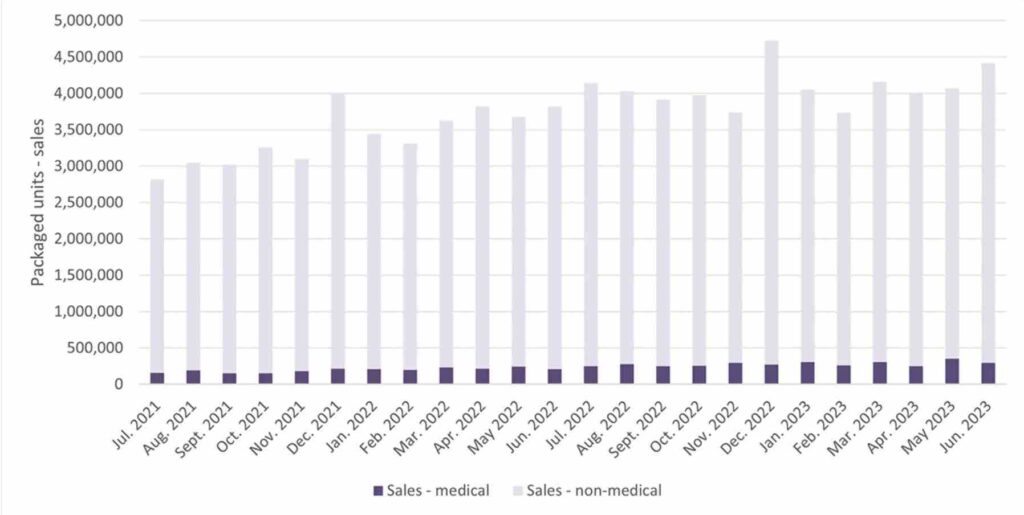
Edible cannabis packaged sales continue to increase year-over-year, with large spikes in December each year. There were 4.4 million packaged units of edible cannabis sold in June 2023, compared to 3.8 million in June 2022 (medical and non-medical).
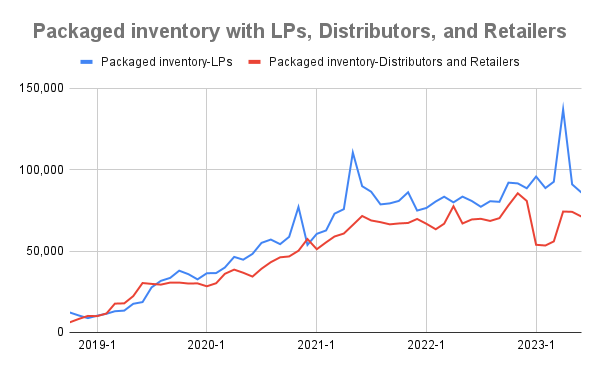
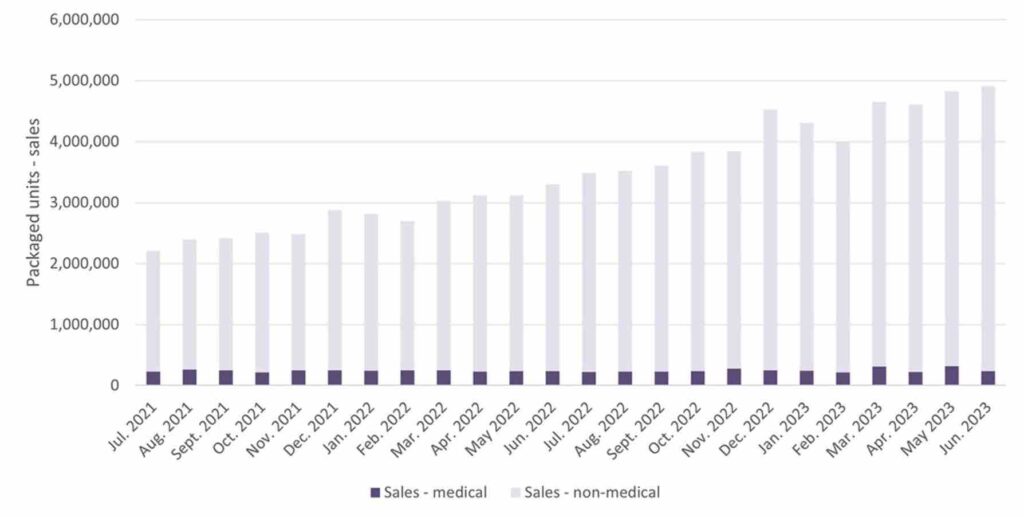
Packaged sales of cannabis extracts (medical and non-medical) have also been increasing, from 3.3 million in June 2022 to 4.9 million in June 2023. Meanwhile, packaged inventory of cannabis extracts held by producers, as well as provincial distributors and retailers, appears to be settling at around eight to nine million in each category.
Sales of cannabis topicals, which are still a small fraction of the overall market, have also been increasing, with 76,000 packaged units sold in the medical and non-medical stream in June 2023, down from a previous peak in December 2022 of more than 81,000 units sold, and up from June 2022’s nearly 58,000 units sold (medical and non-medical).
However, the total inventory of topicals held by licensed producers, as well as provincial distributors and retailers, has been declining significantly, from a peak of 553,077 units in March 2022 to 333,438 units in June 2023.
The number of non-flowering cannabis plants in Canada’s legal, commercial industry continues to fluctuate, seasonally, with spikes in inventory each May or June and declines later in the year. However, while the peak in May, 2022 was 3.7 million plants, 3.5 million in June, 2021, and 3.2 million in June, 2020, the high listed amount for 2023 was just over 3 million.
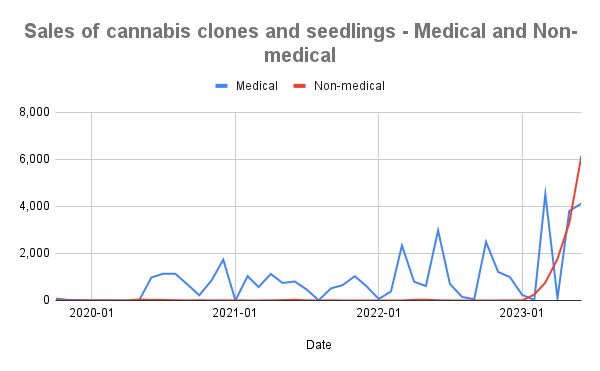
While relatively low, overall, the number of cannabis plants sold in the medical and non-medical channels spiked in 2023 as more cannabis clones made their way into the non-medical “recreational” market. More than 10,000 cannabis plants were sold to medical and non-medical consumers in June 2023, compared to just under 3,000 in June 2022 (and fewer than 1,000 in May and July 2022, respectively).
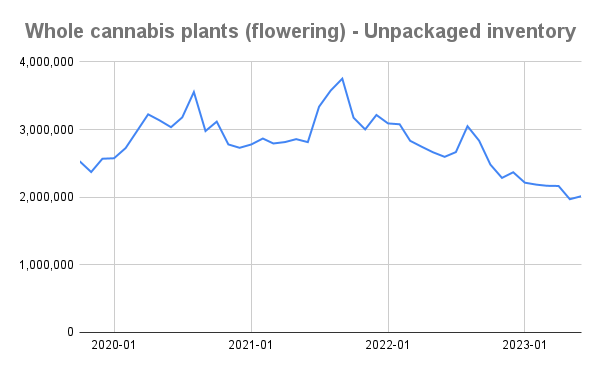
The number of flowering cannabis plants has also declined, from a peak of 3.8 million in September 2022 to a 2 million in June 2023.
The total amount of packaged inventory of seeds has also been declining, especially among provincial distributors and retailers, from a previous high of 136,767 packaged units in July 2021 to 59,699 in June 2023.
Sales of cannabis seeds continue to spike in the spring of each year, with 14,459 units sold in April 2022 and 14,784 sold in April 2023. The vast majority of these seeds were sold into the non-medical stream.
Wetiko, And How Ancestral Trauma & The Unlived Lives Of Parents Affect Us (And Your Children)
What many of us don’t see in ourselves is how the unconscious UN-PROCESSED trauma and UNLIVED LIFE (suppression) of our parents affect us, and not just what happened to us in childhood.
It is not only the apparent neglect, wounding, trauma, etc., many children or we may have experienced in childhood (especially in the first 3 to 7 years) that set up our whole adult life and resulting attachment styles and personality disorders (masks – trauma response) to varying degrees (many of the personality disorders (such as Narcissism) have become normalized in our pathological society.)
We are also UNCONSCIOUSLY affected by everything our parents avoided, suppressed (shadow), and were wounded/traumatized in their own lives and as children but never worked on it or were aware of it.
Obviously, you cannot blame your parents because a lot of the psycho-spiritual somatic work didn’t even exist back then (depending on how old your parents are) when spanking and letting babies “cry it out” were considered “therapy,” which just resulted in more trauma. Your parents were also affected by their parents, which goes down the ancestral line.
I painfully came to that realization in my own process throughout the years. Most of what I’ve been dealing with in my life was not just the obvious childhood wounds but the suppressed shadow and trauma of my parents going back generations down the ancestral line.
That’s why it is silly to think that there is anyone without trauma; it just varies and is deeply suppressed in most people, along with the shadow. Most people stuff it all down (like their parents did) and then compensate by creating a strong external fake persona that can be “charming,” “confident,” and even “successful” in the consensus world, but the achievement and desires are driven by unconscious internalized shame to avoid feeling this empty hole within, disconnected from Essence and the Divine within.
That’s also why as a parent, the BEST thing you can do for your children is to do the inner work so your children are not burdened with what you avoid facing within yourself. It also implies living a life you fully align with and being authentic, which means following your deeper calling and not suppressing it.
It implies facing all the self-defeating core beliefs you may have taken on unconsciously from your parents about men, women, relationships, money, abundance, creative expression, etc., so you don’t stuff it into the shadow of your unconscious only for your children to have to deal with it.
Obviously, no parent is perfect, so don’t be too hard on yourself either. What we need are not “perfect” parents (they don’t exist) but “good enough” parents, as Carl Jung said, and it simply starts with self-awareness, step by step (sometimes a step back), every day. And remember, all there is are lessons. Karma comes into play as well beyond the mind to grasp.
Paul Levy addressed this topic from the viewpoint of Wetiko in his newest book “Undreaming Wetiko”:
“Unresolved trauma passed down through the generations is cumulative—to the extent it is not consciously dealt with in one generation, it becomes more severe each time it is passed on to a subsequent generation.
Every one of us, whether we know it or not, has become who we are, at least in part, as a result of our parents’ unconscious, unprocessed trauma.
It is not just our bodies that are the offspring of our parents and our ancestry; our psyches are the offspring of our ancestral unconscious as well.
The portal out of which our personality crystallizes into who we are is informed by the unresolved karma and the unmetabolized trauma of our ancestors.
Our parents, who Jung suggests we should view as “children of the grandparents,” have been formed by their parents in a lineage that goes back through countless generations.
The repressed and unlived lives of the parents act like a contagious and malignant psychic virus that infects the surrounding field.
Whatever is repressed by the parents is nonetheless alive, covertly working in the surrounding environment, influencing the unconscious of the children.
The parents often remain blissfully unaware of how their repression affects other family members, who have to deal with the burden of their repressed contents.
This psychological virus is like a nonlocalized bug in the system that creates a disease and disturbance in the coherence of the family.
This virulent psychic pathogen germinates in and replicates itself through the unconscious of the children, which is the medium it uses to reproduce itself over time through the generations.
Parents’ self-reflection not only helps to heal both parents and children, it nonlocally sends ripples back through time, initiating a process of healing the entire ancestral lineage.”
More on that topic in our recent podcast with Paul Levy:
“Undreaming Wetiko: Breaking the Spell of the Nightmare Mind-Virus”
U.S. public transit organizations are urging the Department of Health & Human Services (HHS) to implement a system for utilizing saliva tests in drug screenings, specifically for cannabis and other substances. Advocates argue that this method is less invasive compared to traditional urine tests and provides a more accurate reflection of recent drug consumption, preventing individuals from facing consequences for substance use that occurred up to a month before testing.
The U.S. Department of Transportation (DOT) recently changed regulations to allow federally regulated transportation workers such as truckers, pilots and commercial drivers to employ oral fluid testing instead of urine drug testing. HHS has not yet certified saliva-screening laboratories or approved appropriate equipment for on-site saliva collection, despite the regulatory change.
The American Public Transportation Association (APTA) recently sent a letter to Xavier Becerra, the HHS secretary, urging the HHS to expedite the certification of testing labs. In a recent notice, HHS acknowledged the absence of certified laboratories capable of conducting drug-validity testing on oral-fluid specimens. According to APTA, the FDA, an arm of HHS, is also responsible for authorizing a minimum of one oral-fluid collection device to guarantee adherence to the DOT regulation concerning the oral-fluid testing system.
APTA, representing both private and public organizations employing about 430,000 individuals, outlined the advantages of oral-fluid drug testing. These include a less intrusive collection option that is gender neutral, eliminating the use of secured bathrooms. Additionally, saliva-based testing makes it possible to detect more recent drug use, which is important in situations involving post accident testing. The possibility of manipulation or intervention is also diminished by the transparency of the collection procedure.
The benefits were also underscored by the Albuquerque Transit Advisory Board, New Mexico, highlighting its gender-neutral collecting method and quicker identification of recent marijuana usage than urine testing.
In a recent meeting, the board urged the state’s congressional delegation to put pressure on HHS to approve at least two laboratories for oral-fluid testing. In addition, it requested that the city of Albuquerque amend its policy to incorporate oral testing and adhere to federal regulations mandating the use of oral fluid testing for direct observational testing of nonbinary and transgender staff members.
In a separate correspondence, the board urged Becerra to speed up the certification procedure for laboratories. The letter underlined how critical it is to solve the nation’s bus-driver crisis and allow agencies to hire and retain more mechanics and operators. It emphasized the necessity of striking a balance between safety concerns and the changing legal and societal context of drug usage.
With easily accessible certified labs that can accurately establish recent cannabis consumption, more people will be less hesitate to consume marijuana products from numerous companies such as Tilray Brands Inc. (NASDAQ: TLRY) (TSX: TLRY) while off duty because they won’t be victimized under the mistaken belief that they were under the influence while at work when an accident occurred.
About CNW420
CNW420 spotlights the latest developments in the rapidly evolving cannabis industry through the release of two informative articles each business day. Our concise, informative content serves as a gateway for investors interested in the legalized cannabis sector and provides updates on how regulatory developments may impact financial markets. Articles are released each business day at 4:20 a.m. and 4:20 p.m. Eastern – our tribute to the time synonymous with cannabis culture. If marijuana and the burgeoning industry surrounding it are on your radar, CNW420 is for you! Check back daily to stay up-to-date on the latest milestones in the fast -changing world of cannabis.
To receive SMS alerts from CNW, text CANNABIS to 888-902-4192 (U.S. Mobile Phones Only)
Please see full terms of use and disclaimers on the CannabisNewsWire website applicable to all content provided by CNW, wherever published or re-published: https://www.CannabisNewsWire.com/Disclaimer
Psychedelics have been subject to intense public and scientific scrutiny in recent years, thanks to claims of their medical efficacy. Countless studies have now found that psychedelics can induce profound mental changes in patients with hard-to-treat mental disorders such as post-traumatic stress disorder (PTSD) and major depressive disorder, putting psychedelics such as MDMA, LSD and psilocybin on track to becoming approved mental-health treatments.
However, long before scientists began running psychedelic clinical trials, regular and even casual psychedelics users knew one thing about this curious class of drugs: psychedelics could induce meaningful and often life-changing experiences in people who took them recreationally.
More than a century ago, Harvard philosopher William James inhaled nitrous oxide and noted that he felt a “tremendously exciting sense of metaphysical illumination.” The philosopher soon coined the term “noetic quality” of mystical experience to describe the powerful feelings of meaning he felt under the drug’s influence. This term described the feeling of confronting revelations of the highest magnitude and seeing the secret workings of your mind and the world laid bare.
However, due to the elusive quality of these encounters making them incredibly difficult to communicate, modern mainstream psychology has moved away from vague concepts such as noetic quality and adapted more objective and observable variables. More than a century after the Harvard philosopher came up with the term, a landmark paper by the late Roland Griffiths, founding director of the Johns Hopkins Center for Psychedelic and Consciousness Research, signaled the return of noetic insights to mainstream psychology, thanks to psychedelics.
According to Griffiths’ study, two-thirds of 30 volunteers who took psilocybin for two months rated the resulting psychedelic trips as among :five most meaningful experiences in their lives.” Subsequent studies that asked the same question found that up to 87% of participants rated their psychedelic experiences very highly, pointing to the exciting possibility that already existing chemicals may be able to help humans in their everlasting search for meaning.
Despite the recent rise in psychedelic-related studies, we still don’t fully understand how psychedelics address poor mental-health symptoms, let alone help people find meaning in their lives. Given that psychedelic use is intimately tied with socialization and rituality, studies that map out brain regions while under psychedelic influence fail to deliver actionable results in the underlying mechanisms of various psychedelics.
Still, the general understanding is that psychedelics interact with serotonin receptors in the brain to influence functions such as sleep and mood. The brain’s salience network, which helps us determine what matters the most to us, may also play a role in how psychedelics yield meaningful experiences.
Hopefully, the research and development programs being undertaken by a host of psychedelic startups such as atai Life Sciences N.V. (NASDAQ: ATAI) will help to shed more light on how psychedelic substances trigger the therapeutic effects that initial research has shown that they can have.
About PsychedelicNewsWire
PsychedelicNewsWire (“PNW”) is a specialized communications platform with a focus on all aspects of psychedelics and the latest developments and advances in the psychedelics sector. It is one of 60+ brands within the Dynamic Brand Portfolio @ IBN that delivers: (1) access to a vast network of wire solutions via InvestorWire to efficiently and effectively reach a myriad of target markets, demographics and diverse industries; (2) article and editorial syndication to 5,000+ outlets; (3) enhanced press release enhancement to ensure maximum impact; (4) social media distribution via IBN to millions of social media followers; and (5) a full array of tailored corporate communications solutions. With broad reach and a seasoned team of contributing journalists and writers, PNW is uniquely positioned to best serve private and public companies that want to reach a wide audience of investors, influencers, consumers, journalists and the general public. By cutting through the overload of information in today’s market, PNW brings its clients unparalleled recognition and brand awareness. PNW is where breaking news, insightful content and actionable information converge.
To receive SMS alerts from PsychedelicNewsWire, text “Groovy” to 888-902-4192 (U.S. Mobile Phones Only)
Please see full terms of use and disclaimers on the PsychedelicNewsWire website applicable to all content provided by PNW, wherever published or re-published: https://www.PsychedelicNewsWire.com/Disclaimer
What I choose to write about is not popular. The readership for the subject matter is few and far between. I am aware of this, and I embrace it. For the majority, personal awareness, evolution and understanding is irrelevant amidst the chaos, mania, narratives and psychoses of social reality. Amusement, entertainment, alternative, mainstream and social media, politics, religion, science and sports reign supreme in the clouded minds of the masses. Comments, likes and shares dictate what is heard, read and seen. Popular culture destroys creativity, consciousness, transcendence and transformation.
The Gravity of Truth
We frequently seek to discredit all that is true. Truth is a foreign language we dismiss due to its incompatibility with social reality. We deny it out of existence with our selective beliefs, information, narratives and perceptions. We emulate generational conditioning, enabling society’s profane paradigm. How we exist in social reality is not “real.” We simply construct personal delusions within its illusion to satiate our programmed appetites for social advancement. This is the vortex of society, transmuting our existence into virtuality. We cannot transcend the human aquarium when we refuse to believe it exists.
The Dark Arts
The superficial security blanket of social reality imprisons us into virtuality. Our anxieties, fears and insecurities are embellished and internalized until they become our psychosis. By premeditated design, we are victimized in every way. Authoritarian entities and organizations weaponize information with alternative, mainstream and social media via entertainment, news, politics, religion, science and sports. Our inherent human penance is to endure a perpetual state of delusion, fear and trauma. As we focus our attention upon the endless negativity in social reality, we sacrifice our universality.
The Lie of Belief
We seek God in the direst of times. For most of us, it takes an accident, deficit, harm, loss, scarcity or death to become present to experiences that transcend the triviality of social reality. When unbearable events transpire, we race to religion in supplication for the deficiencies of our being. We offer our personal power as payment to be saved from our self-subscribed fate. This is the lie we inherit from previous generations who brandish oblivion in the face of consciousness. However, congregational belief pales in comparison to pioneering our universal path with evolution, revelation and transformation.
“We succumb to our fear because we fail to relate with our soul.”
Social Enslavement
We all have a desire to shift our experience in social reality. Yet, we are instinctually and intellectually tethered in duality to a three-dimensional paradigm. In the Matrix movies, we are shown a powerful example of our social oppression. Human beings are kept in stasis, connected to wires ported into multiple locations of their bodies. They exist in a digital simulation, imprisoned in individual pods designed to harvest their energy. This enables artificial intelligence to keep them enslaved. Seem familiar? Creating freedom from societal devices requires us to sever our engagement with the vicious cycles of virtuality.
Rude Awakening
When we engage in social reality, we remain in our personal pods, tethered to the technology that separates us from our heart, intuition, soul and the universe. In the simulation of society, we exist in a waking slumber, stumbling in the darkness of our selective oblivion; ever deluded, devalued, fearful, insecure and traumatized. We are in the wake of a universal energetic shift to empower our creativity, consciousness, transcendence and transformation. Before we can become a unique expression of universal flow, we must detach from the simulation of social reality and free ourselves from the enslavement of its virtuality. The sleeper must awaken!
Find Your Flow
Each one of us is a unique being of universal energy. The shift is our opportunity to align, balance, center and express our universality. We are omnidimensional beings empowered by the universe. Our body and mind are simply applications our soul sources through our intuition and heart to navigate our way through the chaos, madness, narratives and psychoses of social reality. The equilibrium of our being is essential for our soul to express the resonance of universality. Our collective destiny is allowing our soul to empower our human experience.
Face the Music
The less we engage in social reality, the more we experience the universe and become an expression of our soul. In this new era, we are either an emulation in the simulation or in relativity with universality. We observe and experience .0005% of the known universe, even less through our filters of belief, delusion, interpretation and selective reality. We all must face the music of our social malevolence. No matter the measure of our egocentricity; arrogance, denial, desire, entitlement, greed and self-righteousness, our greatest opportunity in transcending social reality is to embody our soul.
The Path of the Soul
When we are born, we are in flow with universal energy. Most of us live our whole lives in social oblivion. In rare occurrences, we experience universality. However, due to our institutional, hereditary and social conditioning, we dismiss our universal experiences before they manifest. We misinterpret them as a flight of fancy and denigrate them with our egocentricity. We fail to shift our linear existence into omnidimensional experience. In this new era, our universal path does not unfurl before us, it resonates within. The path of the soul is empowering our human being with universality.
Health Canada has released guidance for cannabis producers on cannabis products with intoxicating cannabinoids other than delta-9-THC, including CBN.
Following up on a guidance document first floated to industry in early 2023, the federal health regulatory is now providing guidance on cannabis products intentionally or “deliberately” made with what it considers intoxicating cannabinoids other than delta-9-tetrahydrocannabinol (delta-9-THC).
Health Canada considers “intoxicating cannabinoids” as any cannabinoids that bind to and activate the type 1 cannabinoid receptor (CB1 receptor). The regulator says that any producer that intentionally includes any of these intoxicating cannabinoids in cannabis products for the purpose of getting around the federal regulatory controls on delta-9-THC could be increasing the risks to public health and public safety.
Those intoxicating cannabinoids include:
delta-8-THC
delta-10-THC
delta-6a-10a-THC
THC-O-acetate (THC-O)
cannabinol (CBN)
hexahydrocannabinol (HHC)
tetrahydrocannabivarin (THCV)
tetrahydrocannabiphorol (THCP)
tetrahydrocannabutol (THCB)
Because of this, Health Canada currently “recommends” that cannabis licence holders apply the specific controls for delta-9-THC to all cannabis products made to deliberately contain intoxicating cannabinoids.
This means that any of these currently listed intoxicating cannabinoids would adhere to the same restrictions and limits for total THC in cannabis products, such as the 10mg THC limit for edibles and the 1,000 mg THC limit for topicals and concentrates, including vape pens and carts.
This means that an edible product with, for example, 8 mg THC per package, could also only contain no more than 2 mg of any of these minor intoxicating cannabinoids.
Earlier this year, Alberta’s provincial distributor, the AGLC, had reportedly told some cannabis producers that it was including CBN within the federal 10mg THC limit for edibles. The AGLC says this was based on guidance from Health Canada, but was using a guidance document Health Canada published earlier this year that made no reference to CBN, only delta-8-THC and delta-10-THC.
Since that time, sources close to the issue tell StratCann that Health Canada has engaged some in the industry on the inclusion of CBN to this list of minor intoxicating cannabinoids. In general, any such changes to federal regulations include several layers of industry feedback and guidance documents to give industry time to adjust.
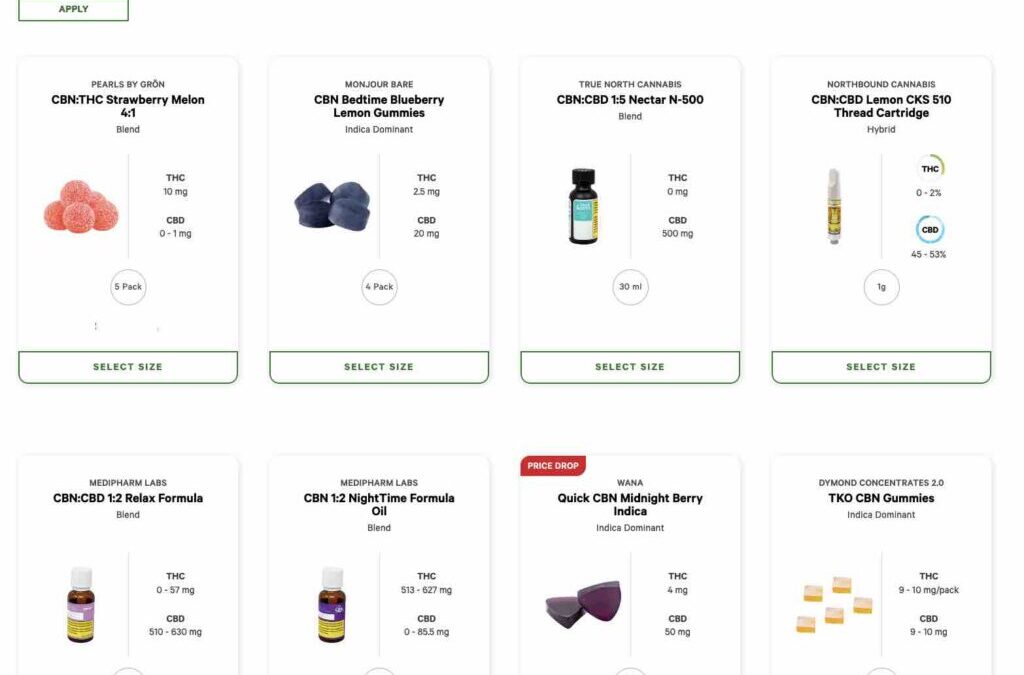
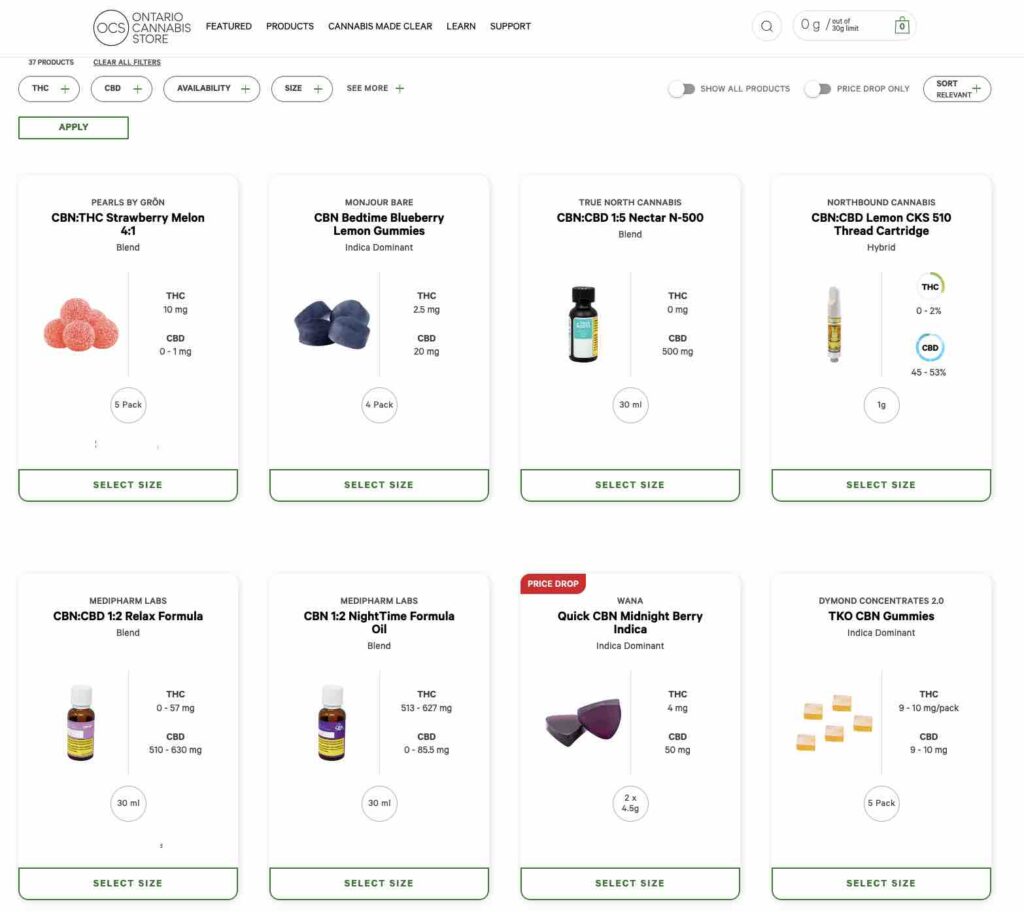
Products with CBN are already available in the market in several provinces.
Cannabis products containing CBN available on the OCS.ca
(Globe Newswire) Toronto — Avicanna Inc., a commercial stage, international biopharmaceutical company focused on the development advancement, and commercialization of evidence-based, cannabinoid-based products, is pleased to announce that it has closed a non-brokered private placement offering of 2,537,508 units of the company at a price of $0.35 per unit for aggregate gross proceeds of $888,127.80.
Each unit is comprised of one common share in the capital of the company and one-half of one (0.5) common share purchase warrant of the company; and, each warrant shall entitle the holder thereof to acquire one (1) common share in the capital of the company at an exercise price of $0.41 per share, subject to adjustment in certain events, until December 4, 2026.
The company has paid an aggregate total of $29,977.50 in cash finders’ fees and issued an aggregate total of 85,650 finder’s warrants in connection with the offering to certain finders in connection with subscriptions for Units made by purchasers introduced to the company by such finders. Each finder warrant entitles the holder thereof to acquire one common share in the capital of the company at an exercise price of $0.41 per share, subject to adjustment in certain events, until December 4, 2026.
The company intends to use the proceeds from the offering for general working capital purposes, general and administrative expenses, expenditures related to production and manufacturing, and research and clinical development.
Advertisement
The unit shares and warrants, and any securities issuable upon conversion or exercise thereof, are subject to a four-month hold period under applicable securities laws in Canada. The offering is subject to certain conditions including, but not limited to, the receipt of all necessary approvals, including the approval of the Toronto Stock Exchange.

















Recent Comments