The brief appearance of ingestible extracts on cannabis shelves and their subsequent disappearance has potentially introduced more consumers to cannabis oil capsules, say some BC cannabis retailers.
So-called ingestible extracts or “edible extracts”, sold with much more than the 10mg THC per package allowed in cannabis edibles, have become very popular with some consumers over the past year. Organigram’s introduction of their Edison Jolts, a 10mg THC lozenge sold with up to 25 each per package (250mg THC), first released in summer 2021, was soon followed by products like Aurora Glitches and several others in 2022 with similar high THC offerings per package.
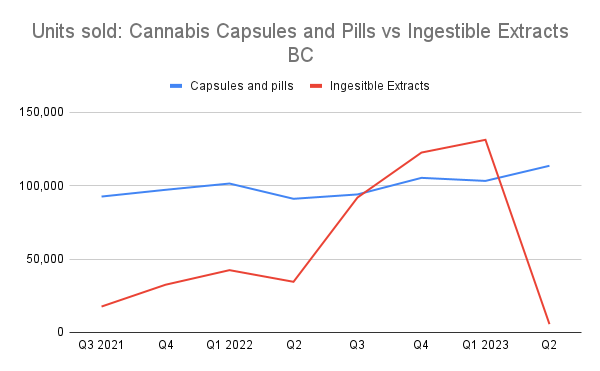
Sales of these products shot up over the last few quarters in BC before Health Canada put a stop to the fun earlier this year, declaring them to be non-compliant with federal regulations. In early January 2023, Health Canada sent a notice to producers highlighting their concerns. Companies had until May 31, 2023, to cease sales and distribution.
Although some retailers were able to stock up, many stores have since run out, and BC’s most recent quarterly report for Q2 2023 shows sales dropping significantly.
However, their disappearance from shelves has given at least some retailers an opportunity to tell consumers about another similar product that has been available since the beginning of legalization: cannabis oils and cannabis oil capsules.
While sales of cannabis capsules in BC slightly declined as ingestibles increased, their rapid decline in Q2 2023 was matched by a slight increase in the sale of cannabis oils.
Kayla DeFazio, an Assistant Manager at Spiritleaf in Maple Ridge, one of the top-selling stores in the province, says she has seen that trend play out in her store, often guided by herself and other employees.
Like the ingestible extracts, cannabis capsules offer consumers a similarly larger quality of THC per container, in individual servings of up to 10 mg THC, explains DeFazio, listing off one popular product in their store that offers ten, 50, and 100 capsule bottles with each capsule containing 10 mg THC.
“A lot of people really, truly think that it works best in a gummy. Maybe everyone else is finally catching on and realizing that is not the case.”
She points out that while these types of cannabis capsules have long been available, she thinks the conversation about the lack of these ingestible extracts has helped introduce them to many consumers who weren’t familiar with them. Consumers come in looking for ingestible extracts that they no longer carry, and they tell them about these other, similar products.
“We’re just trying to find a better solution for people. A lot of them have a higher tolerance, and they definitely need a higher dosage, so when we weren’t able to give them that with the (ingestible extracts), we tried to move them on to something as a different option. “
“A lot of people just really like the idea of having an edible, having a gummy, having different flavours,” she continues. “But then a lot of people were also turned off by the excess sugar. So once we showed them that there was a better price point and something maybe a little bit healthier, they had an easier time moving on to something new.”
“…a lot of people were also turned off by the excess sugar. So once we showed them that there was a better price point and something maybe a little bit healthier, they had an easier time moving on to something new.”
Trevor Pewarchuk, District Manager for Trees Cannabis, with multiple locations on Vancouver Island, says he’s also seen evidence of a similar trend in his stores.
Products like Edison Jolts and Aurora’s Glitches were “insanely popular,” says Pewarchuk, but he notes they quickly sold out once Health Canada told producers to stop shipping more to retailers.
Instead, some consumers have gone back to buying edibles or gummies, he says, but some are discovering they can get a similar product with the same effect without the added sugar and at a lower cost when they buy cannabis oil capsules.
“Generally, we would direct them in that case to an oil or a capsule option just because they tend to be the closest equivalent they can purchase with the max amount of active ingredient per dose,” explains Pewarchuk.
However, he says most of the customers who were interested in those higher potency items were edible consumers already, and they are now just purchasing multiple packs to get the same effect.
“Some are going to oils, but many are just shifting to buying multiple edibles or multiple beverages.”
“Generally, we would direct them in that case to an oil or a capsule option just because they tend to be the closest equivalent they can purchase with the max amount of active ingredient per dose.”
Meanwhile, in Vancouver’s first licenced cannabis store, Evergreen Cannabis, owner Mike Babins says this is a conversation he’s been having with consumers since edibles first began appearing in late 2019 or early 2020.
“As soon as edibles came in, anyone coming in looking for (a large amount), we immediately say to them that we’re happy to sell you that, but you can buy a jar of (capsules) that are the same thing. You can then go next door and get a pack of gummy bears if you really need candy. And you can save a lot of money.”
Babins says he thinks there’s still a lot to do to educate consumers about products like cannabis oils and capsules, with some consumers believing that being in an “edible” form somehow increases its potency.
“A lot of people really, truly think that it works best in a gummy. Maybe everyone else is finally catching on and realizing that is not the case.
“Maybe the public is finally getting informed and starting to understand that there are other higher THC options for edibles. The more people who understand that, the easier it’s for us to guide them in that direction and help them decide.”
As one attempts to make sense of the horrors of war that the global media flashes across screens and newsprint, day and night 24/7, one can feel a numbing sensation closing down one’s ability to respond, as an organic human being should respond.
The breathtaking volume of bombs, blood and brutality that form the centrepiece of the devastation in Gaza, comes on top of the seemingly interminable hostilities playing-out their realities in Ukraine.
In all of this, any sign of a credible, reasoned and rational intervention is lost beneath a sea of soulless, hypocritical statements from those in positions of ‘authority’ on the world stage.
National/geopolitical ‘positions’ taken by rolled-out representatives of the status quo, are held to be more important than responses that have some link to heart felt emotions.
Scenes of mass genocide and ethnic cleansing are condoned as ‘acceptable’ if those responding to the bloodbath see some political or geopolitical advantage in backing the cause of the chief protagonist.
Those who for long periods of their lives are deeply repressed and isolated, seek reprisals if ever the chance comes their way to breakout of slavery. This is, under permanent conditions of inhuman containment, an almost inevitable reaction.
One cannot judge behaviour patterns of those suffering under conditions of persistent repression, as being in any way comparable to what are considered acceptable behaviour patterns in times of relative peace and freedom.
The human struggle for a basic degree of liberty is forced into taking the form of a violent struggle when no other support intervenes to bring justice to bear.
This lack of coordinated intervention to end a massacre is the most perilous aspect of the Israel/Hamas conflict, and it the most telling indicator of the bankruptcy of what is considered to be ‘civilised society’.
A fear of going against the dogma of what constitutes the pecking order of the global power pyramid, appears to paralyse nations from coming together to enforce a humane path of conflict intervention and resolution, however tenuous that might initially be.
But the truth is, that behind this implausible state of impasse, is a small anti-life global cult that wishes to prolong the pain and destruction for its own ends, and covertly backs both sides of the conflict in order to produce the maximum disruption, chaos and death.
Yes, this is pure evil in action. It is the manifestation of a long standing, once covert, but now overt demonic ambition – whose roots go far back in human history – and which has recently emerged as the chief protagonist of disruptive chaos and division now manifesting at the foundational level of our daily lives.
The problem for all of us who are determined to resist the manifestations of such dark actors, is that this cult is very clever, highly deceptive and well disguised. It’s main agents wear a fixed smile, a pressed shirt and are very well rehearsed in powers of communication. Psychopaths in a suit.
One would never guess that they harbour an abiding hate for a creative, loving humanity. But they do.
Drawing back from the carnage of the battlefield into the intimacy of our own personal lives, it seems almost impossible to imagine that things could ever descend to such a state of brutality and disrespect for human life.
Yet, as I barely need to point out, a commitment to maintaining some form of civility, humanity and justice, in this fast moving aggressively competitive ‘Westernised’ world, runs only skin deep – amongst far too high a percentage of human beings.
Just under the surface one can’t fail to recognise the same symptoms of the degradation of fundamental human values which become explosively magnified in war time confrontations.
Holding the line of decency, respect and basic social justice – is not just an important aim for every feeling individual in this precarious moment of human history – it is an absolute imperative.
At a time when the political status quo is riven through with hypocrisy, immorality and arrogance, we have a very real war on our hands right here in our own backyards.
That which can turn into full blooded fascism at any moment, has its origins in a breakdown of the basic rights, freedoms and values of a sane society. That breakdown is already well advanced under the corporate, banker, military dictatorship that heads the dominant global power structures of today.
Let us not hesitate to recognise that ‘we the people’ who are possessed of warm hearts, courage and a deep sympathy for the plight of the downtrodden, are the resistance. We carry the flag of human honour.
Let us sever any lingering illusion that some existing political institution, or ‘fake saviour’ will come forward to bring dignity and basic equality back to human, animal and ecological life.
We must be fiercely realistic. With very few exceptions, those who politically represent their constituencies in the fake democracies of the world, are there to do the jobs the hidden deep state cabal has consigned them to fulfil.
We who refuse to be slaves to these puppets – and refuse to be sucked into their WEF led digital, hive mind artificial intelligence control programme – whose technological dictatorship is sucking-in all but the most determined freedom fighters – we are the ones who must carry forward the great struggle for human emancipation.
There is an unseen universal vibratory energy field which connects all those who share a deep aspiration and determination to bring about a better world.
It supersedes the primitive and polluting WiFi EMF radiation grid and cannot be brought under ‘surveillance’ programmes of central control. It is a common wavelength which connects-up spirit warriors wherever they are in action in the world.
We are being empowered to lead, initially on an individual by individual basis, but increasingly as an interconnected force of irrepressible positivity and power.
Know that you, who are reading this article, belong to this tribe. Have faith in your as yet untested powers and joyously step forth to be part of that unique fight for victory which will, one day, completely transform the face of earthly conflicts.
We are the resistance. And in our hearts we know, that to be unified within such an army means that we will also emerge as the most qualified arbiters of a universally longed for state of peace.
Peace, in my language, means a dynamic state of shared equilibrium. Every day we should fight for peace. It has nothing to do with ‘passivity’ which should be recognised as the most pervasive social sickness afflicting mankind at this pivotal moment of history.
Just around the corner there is a whole new world longing to be born. Will we ever find a more meaningful challenge than to bring it to birth?
Julian Rose is an early pioneer of UK organic farmer, a writer, broadcaster and international activist. He is author of three books, the most recent of which is ‘Overcoming the Robotic Mind’. Go to his website for further information www.julianrose.info
Overcoming the Robotic Mind – Why Humanity Must Come Through
Researchers have discovered that a common plant in Brazil contains the cannabis ingredient cannabidiol (CBD). This discovery creates new opportunities for the production of the well-known substance from alternative sources.
A group of scientists from the Federal University of Rio de Janeiro uncovered CBD in the flowers and fruits of the Tremamicranthablume (trema) plant, a common shrub found throughout Brazil. According to lead scientist Rodrigo Moura Neto, the plant, which is sometimes categorized as a weed, is a promising source of CBD.
CBD, recognized for its potential in managing anxiety, chronic pain and epilepsy, stands as a key active component in marijuana, alongside tetrahydrocannabinol (THC), which is responsible for inducing the “high” associated with cannabis use.
While CBD’s medicinal efficacy remains under scientific scrutiny, Neto’s chemical analysis confirmed the presence of CBD in trema while ruling out the existence of THC. This development points to the likelihood of discovering additional sources of CBD, evading the legal constraints tethered to marijuana, which remains prohibited in many regions, including Brazil.
“It presents a legal alternative to marijuana use,” said Neto, highlighting the ubiquitous growth of trema throughout Brazil and emphasizing its potential as a more accessible and cost-effective CBD source. He also noted that CBD had previously been found in a related plant in Thailand.
Additionally, a different study published in May 2023 in the “Nature Plants” Journal revealed that the woolly umbrella, a plant native to South Africa, contained more than a dozen different types of cannabinoids. Despite the plant’s inability to produce CBD or THC, researchers did discover notable concentrations of cannabigerolic acid (CBGA), cannabichromene (CBC) and cannabibigerol (CBG).
Although Neto has not yet formally published his findings, he stated that he intends to broaden the study’s emphasis to include improving trema CBD extraction techniques and evaluating the drug’s efficacy in treating patients for ailments that are currently being treated with medicinal cannabis.
The Brazilian government recently awarded his team a grant of 500,000 real ($104,000) to continue the research, which he predicts will take at least five years to finish.
According to a survey conducted last year by market research company Vantage Market Research, the global market for CBD is currently expected to be worth close to $5 billion. The study also predicted that the industry will likely expand to exceed $47 billion by 2028, primarily due to the substance’s increasing popularity in health and wellness.
These research findings could open up new opportunities for the wider cannabis industry, including established actors such as SNDL Inc. (NASDAQ: SNDL), which could explore diversifying their operations.
About CNW420
CNW420 spotlights the latest developments in the rapidly evolving cannabis industry through the release of two informative articles each business day. Our concise, informative content serves as a gateway for investors interested in the legalized cannabis sector and provides updates on how regulatory developments may impact financial markets. Articles are released each business day at 4:20 a.m. and 4:20 p.m. Eastern – our tribute to the time synonymous with cannabis culture. If marijuana and the burgeoning industry surrounding it are on your radar, CNW420 is for you! Check back daily to stay up-to-date on the latest milestones in the fast -changing world of cannabis.
To receive SMS alerts from CNW, text CANNABIS to 844-397-5787 (U.S. Mobile Phones Only)
Please see full terms of use and disclaimers on the CannabisNewsWire website applicable to all content provided by CNW, wherever published or re-published: https://www.CannabisNewsWire.com/Disclaimer
Recently, I came across a tweet by a clinical psychologist named Dr. Jonathan Stea who claimed that the snake oil salesmen of the past never went away. He named wellness coaches, alternative practitioners, and energy medicine physicians as the modern day versions of these traveling conmen who provided “magical” elixirs that were promoted as “cure-alls” for disease. We’ve all seen these characters in many Western films. These were the seedy individuals who attempted to profit off of disease by selling “cures” that they knew were outright fraudulent. In many cases, the claimed “active ingredient” was nowhere to be found. Even worse, in some instances, harmful toxins such as lead, mercury, and arsenic were present, as seen in analysis of the “patent drugs” stored at the Henry Ford Museum collection. While mercury and arsenic are known toxins today, they were regularly billed as “cures” by medical men in the 19th and 20th century for many conditions including syphilis and leprosy. We have defintely seen examples of these same disingenuous tactics that were employed by the great medical showman of the late 19th and early 20th century being promoted by those claiming to treat disease today. Thus, is Dr. Stea correct in saying that these greedy hucksters throwing out “cure-alls” to the gullible are still around? And if so, are the professions that he listed truly the modern day incarnations of these travelling conmen?
While the “snake oil” term has been co-opted to refer to anyone who deceives others for money, primarily through the selling of fake “cures,” snake oil wasn’t always seen in such a controversial light. In the mid to late 1800s, many Chinese immigrants were brought over to work on the transcontinental railroads. These immigrants took with them various different remedies, including one made from the oil of the Chinese water snake. This oil is said to be rich in omega-3 acids, and it was used by the immigrants to help reduce inflammation and arthritis after long days of hard back-breaking labor on the railroad. This oil was said to be very effective, and the Chinese immigrants eventually shared their oil with Americans who were reportedly impressed by the positive effects:
A History Of ‘Snake Oil Salesmen’
“The 1800s saw thousands of Chinese workers arriving in the United States as indentured laborers to work on the Transcontinental Railroad. According to historian Richard White’s book Railroaded, about 180,000 Chinese immigrated to the United States between 1849 and 1882. The vast majority of the workers came from peasant families in southeastern China and were signed to contracts that ran up to five years for relatively low wages (compared with their white counterparts), wrote David Haward Bain in his book Empire Express.
Among the items the Chinese railroad workers brought with them to the States were various medicines — including snake oil. Made from the oil of the Chinese water snake, which is rich in the omega-3 acids that help reduce inflammation, snake oil in its original form really was effective, especially when used to treat arthritis and bursitis. The workers would rub the oil, used for centuries in China, on their joints after a long hard day at work. The story goes that the Chinese workers began sharing the oil with some American counterparts, who marveled at the effects.”
As per custom, the Americans saw an opportunity to capitalize on this idea of powerful ointments intended to cure many ailments. Over time, numerous products were created containimg ingredients such as alcohol, heroin, and cocaine that were sold by men traveling across the country. These included products such as Cocaine Toothache Drops for dental procedures, Mrs. Winslow Soothing Syrup made up of opiates to sooth crying babies, Jems made from strychnine to treat lack of focus and sexual dysfunction, Tapeworm eggs used as a weight loss remedy, and Morley’s Liver and Kidney Cordial,claimed to cure “all diseases of the liver, kidneys, stomach, and bowels, such as Liver Complaint, Biliousness, Malarial Diseases, Indigestion, Constipation, Kidney and Bladder troubles and all Diseases arising from Impure Blood and Deranged System.”
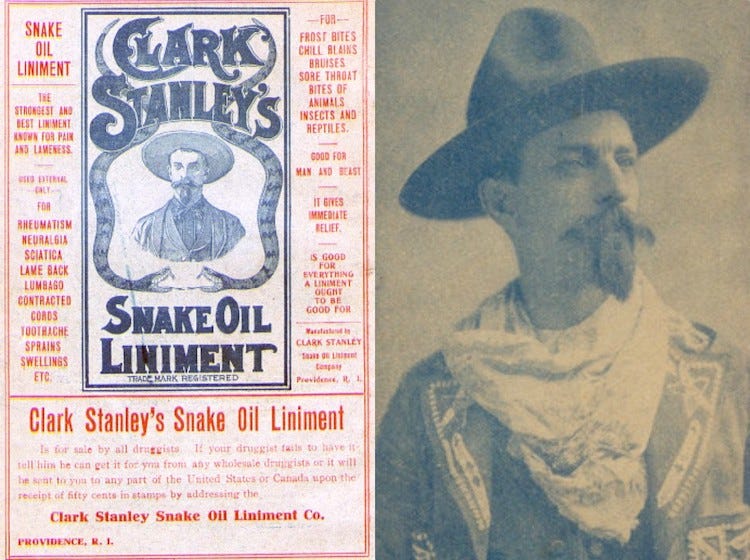
The most infamous case of snake oil fraud, and perhaps what ultimately led to this derogatory label being created from something with innocent roots, was that of Clark Stanley’s Snake Oil Liniment. This liniment was purportedly made from rattlesnake oil in order to capitalize on the goodwill of the Chinese oils. Rattlesnakes were settled upon as a replacement for the Chinese water snakes that were not available in the US. This oil was said to work for sciatica, rheumatoid arthritis, lame back, neuralgia, contracted muscles, toothaches, frostbite, swelling, etc. In an 1897 pamphlet titled The Life and Adventures of the American Cowboy, by Clark Stanley, Better Known as the Rattlesnake King, it is stated that Stanley learned of the formula for his remedy from his stay with the Hopi Indian tribe’s medicine men. Stanley, a self-proclaimed cowboy, had been bitten 100s of times by rattlesnakes, and always used a remedy. Apparently, the Hopi version was the best of the bunch supplying many proclaimed benefits, and this was what he said that he was selling to the public.
According to a 2008 article by Joe Schwarcz, the director of McGill University’s Office for Science and Society, Stanley was quite the showman. He would pluck out a rattlesnake from a sack, slit its throat, and then throw it in a pan of boiling water in front of a crowd of curious onlookers. Once the fat rose to the top, he would skim this off and use it to create and demonstrate the healing properties of his elixir. Stanley hyped up the crowd and used this excitement to sell his product.
“It must have been quite a sight at the World’s Exposition in Chicago in 1893. Clark Stanley, better known as The Rattlesnake King, reached into a sack, plucked out a snake, slit it open and plunged it into boiling water. When the fat rose to the top, he skimmed it off and used it on the spot to create “Stanley’s Snake Oil,” a liniment that was immediately snapped up by the throng that had gathered to watch the spectacle.
Little wonder. After all, Stanley had proclaimed that the liniment would cure rheumatism, neuralgia, sciatica, lumbago, sore throat, frostbite, even toothache.
It wasn’t too hard to convince the onlookers about the wonders of the liniment, particularly when it came to arthritis. All Stanley had to do was point out that snakes obviously did not suffer from this condition and seemed well lubricated internally. The crowd lapped up the hype and shelled out the money. And many claimed immediate relief from their pain.”
However, there was a glaring problem with Stanley’s rattlesnake oil. Upon a seizure of his product in 1917 as part of the Pure Food and DrugAct of 1906, chemical analysis by federal investigators apparently found that the product contained a mixture of mineral oil, beef fat, turpentine, camphor and red pepper — but not a single drop of rattlesnake oil. Due to his misleading of consumers by selling rattlesnake-less oil for over 24 years, Stanley was fined $20:
The story of Clark Stanley, the original snake oil salesman
“Oh, and Clark Stanley’s snake oil didn’t even contain snake. When federal regulators seized his product in 1917, they found it was a concoction of mineral oil, red pepper, turpentine, and cow fat. But by that point, he had already been selling the product for 24 years.
This episode shows that there is a long history of supposed medicines that promote healing effects containing ingredients that are not those listed as the star on the label. In some cases, opiates were sold which would have had an effect, but perhaps not in the way that was intended or as sold. In Stanley’s elixir, the snake oil was not present, but it did contain capsaicin from the red peppers which is a known anti-inflammatory agent. Despite the claim by federal investigators that Stanley’s oil did not contain any rattlesnake oil within it, the ingredients making up the elixir were considered to be all natural. The oil itself was said not to be toxic, and it was claimed to be helpful to many:
Snake Oil Salesman Shut Down by US Government
“Interestingly, though, although the snake oil that was examined had no actual snake oil in it, the red pepper and camphor that was there actually had a number of medicinal uses. Many of these medical uses correspond with Stanley’s claims. Today, a number of over-the-counter pain relievers use capsaicin as an active ingredient. Capsaicin is a natural remedy made from chili peppers. It works by inhibiting the pain receptors in the body.”
Stanley’s Oil was shut down after the federal investigation that was spurred by a 1906 act that looked at “preventing the manufacture, sale, or transportation of adulterated or misbranded or poisonous or deleterious foods, drugs, medicines, and liquors, and for regulating traffic therein, and for other purposes.” However, was Stanley’s elixir shut down solely due to the inaccurate label, or was he targeted as the fall guy by the emerging pharmaceutical empire that was being established at the time? Was the media frenzy during the Stanley incident an attempt to sway public perception in order to take out any competition? Were all of the snake oil salesmen really the charlatans that they were made out to be, or were they simply discredited and replaced by more successful and powerful conmen with greater financial and influential reach that wanted to corner the market and profit off of their compounds?
At the time that the federal government began shaking down and closing the businesses of those who were considered snake oil salesmen, there was a shuffling of the board taking place by powerful players with vested interests. A consolidation was occuring as the American Medical Association, established in 1847, began to claim ownership over those who were selling medicines and those who were considered healers in the late 19th and early 20th century. The AMA used its powerful advertising machine and long reach to discredit and wipe out the competition. The 1906 Pure Food and Drug Act was utilized as a crafty weapon to shut down those selling inaccurate or unlabeled medicines on the streets. The American College of Surgeons even adopted the entertaining tactics and showmanship of the snake oil salesmen in film and advertising campaigns in order to convince the public to turn to hospitals, places formerly known as “notorious death traps,” instead of seeking care from these products:
How snake oil got a bad name
Shifting fortunes
“What really sealed the fate of snake oil salespeople as the scammers and fraudsters we now take them to be, was not new information about the effectiveness of their wares, but rather the shifting fortunes of the medical marketplace. The 1906 Pure Food and Drug Act threw up new barriers to exactly the kind of unregulated interstate commerce that drove the medicine shows.
At the same time, professional medical organisations like the American Medical Association (AMA) began a powerful marketing campaign to discredit the competition, regardless of its ability to address and treat illness. Those who had been equal players in the 19th-century medical marketplace suddenly found themselves standing on the wrong side of history in the early 20th.
Given the contempt shown for the medicine show by groups like the AMA, it was somewhat ironic that another powerful medical association, the American College of Surgeons, adopted much the same format to hawk its own product: the standardised hospital. Sandwiching sermons of medical orthodoxy within a lineup of entertaining films, music and other exciting events, the college worked to convert the crowd from patent medicines to the care offered by their local hospital.
If the audience was sceptical and impatient for the show to go on, they had a right to be, since hospitals had long been notorious deathtraps. But both the familiarity of the format and the demonstrable improvements made to hospitals over this period made the travelling shows a raging success. Yesterday’s snake-oil sales tactics had become good medical practice.”
The instigation of this push to consolidate and centralize the medical practices in America were spurred by two very wealthy and influential businessmen: Andrew Carnegie, who helped build the American steel industry, and John D. Rockefeller, the Standard Oil tycoon. In the early 1900s, the AMA decided to enlist the services of Andrew Carnegie, a man with no background in education, to recommend an overhaul of the medical educational practices. This led to the hiring of a young man named Abraham Flexner, brother of the director of the Rockefeller Institute Simon Flexner, to tour the over 155 medical schools that were around in the country at the time. Flexner, with no medical background and little expertise himself other than writing a few papers on education, was selected to visit each school very briefly. Afterwards, he wrote a report that was published in 1910, infamously known as “The Flexner Report,” that recommended the closing of more than one-half of these schools, many of which were homeopathic and alternative medicine practices based on ancient healing traditions. His report insisted on improving the conditions in all of the remaining schools. It called for a specific program and curricula to be adopted by all remaining, as well as any future, medical schools. Most importantly, it stipulated that all schools must undergo regular reviews in order for the renewal of their long-term accreditation following the initial approval by the AMA. In other words, in order to remain a medical school and to receive funding, all schools needed to adopt the new medical system that was built upon germ theory and the emergence of petrochemical medicines as a form of treatment. All alternative schools that did not wish to play ball were forced into closure. The AMA was given full control over what would be considered medicine as well as those who could practice it.
Flexner’s report delighted Carnegie and his board so much that Abraham was invited to do the same for Great Britain and the European continent. Neither Carnegie nor Abraham Flexner were physicians or those with a higher degree in education. However, they were allowed to reshape the medical landscape in America and abroad. Coincidentally (or not depending on how you look at it), Abraham Flexner was invited to join the General Education Board of the Rockefeller Foundation as a full-time member. In that position, he helped to oversee the remaining medical schools as well as the establishment of new ones. With the backing of the Rockefeller Foundations money, Flexner was able to open many new and influential medical schools throughout the country that are still running today:
Leadership in American Medicine as I See It: A Background in the Beginning
“The American Medical Association (AMA), founded in 1847 and incorporated in 1897, became concerned about the state of medical education and reached out to Andrew B. Carnegie with a request to study the problem of medical education and to make recommendations for how to correct this unsatisfactory state.”
“Carnegie and John D. Rockefeller, both highly interested and motivated industrial titans, recognized the vast importance of an outstanding medical education system and obtained the advice of educators throughout the country. Once Carnegie appreciated the drastic state of medical education, Dr Henry Pritchett, president of the Carnegie Foundation Board and a major leader in higher education as president of Yale University, responded to the AMA request on Carnegie’s behalf by agreeing to study the situation and recommend changes to American medical education. In a rather brief period of time, Pritchett and the Carnegie Foundation board selected a general educationalist, Abraham Flexner—a little known educator from Louisville, Kentucky, whose educational writings were already familiar to Pritchett—to conduct the study and make the necessary recommendations.”
“During these years, while managing his own high school, Abraham Flexner published extensively on higher education subjects in various education journals. These articles became well known by important leaders of higher education, including Dr Pritchett and other major educators such as Dr Charles W. Eliot, then president of Harvard University. Flexner’s writings in the general educational literature so impressed Pritchett, then serving as president of the board of the Carnegie Foundation, that he invited Abraham Flexner to meet the board, and the board subsequently invited him to participate in the AMA’s request to initiate a study of American medical school education. Supported by a small grant from the AMA to the Carnegie Foundation for income and expenses, Flexner personally visited each of the US schools of medicine. Most of his medical school visits were very brief. He interviewed the faculty (frequently only 1 physician) and visited the school’s laboratory (which not infrequently involved viewing a skeleton). At the conclusion of such visits, he had no doubts about recommending that the AMA close the school. During that 1 year’s time, Flexner recommended the closure of one-half of the medical schools in the country.
At the conclusion of his visits, Abraham Flexner wrote a detailed report that included his now-classic paper on American medical education. This report was published in 1910 in Bulletin No. 4 of the Carnegie Foundation for the Advancement of Teaching. Flexner’s world-shaking and revolutionary report dealt in detail with his recommendations on medical education, research, and clinical practice in the United States. In his report, Flexner insisted on the need to improve conditions in all of the existing institutions, and he called for specific programs and curricula in all of the remaining and future medical schools. He further insisted in his recommendations that every medical school must have a full-time medical faculty for both the preclinical and clinical subjects, and he required a close teaching relationship between the students and their faculty. He recommended that all medical schools include full-time teaching clinics for private as well as disadvantaged patients. He insisted on the absolute necessity for all schools of medicine to establish ongoing research programs. He also stipulated that all schools of medicine must undergo continuous periodic review for renewal of their long-term accreditation following their initial approval by the AMA.
As stated above, Abraham Flexner recommended that fewer than one-half of the existing medical schools remain active; all others were to be permanently closed. These findings and recommendations were so well received and accepted by Dr Pritchett’s Carnegie board and the AMA that Abraham Flexner was invited soon thereafter to review and offer recommendations on the state of medical education in Great Britain and, later, on the European continent.
Abraham Flexner’s recommendations thus began a new era of enlightened American medical education. The impetus for these cataclysmic changes must be attributed to the AMA’s recognition of the necessity to correct the existing state of medical education in the US, its request to a handful of forward-looking champions of academic excellence in American medical education, and implementation by the outstanding and committed board of directors of the Carnegie Foundation. This public-spirited American philanthropist, the concern of the AMA, and the remarkable consultative review and implementation by Abraham Flexner provided the necessary impetus to invigorate the conduct, practice, and growth of American medical academia that was so desperately necessary. It is truly remarkable to think that neither Andrew Carnegie nor Abraham Flexner was a physician or an individual with a higher degree in education. These outstanding leaders were characterized by their recognition that a critical medical educational problem existed, and both men were committed to correct that situation by using their respective resources during a remarkably brief time period.
Soon after the publication of his report, Abraham Flexner was invited to join the General Education Board of the Rockefeller Foundation as a full-time member. He remained on this governing board for many years until he retired to his own private educational consultative practice. However, during these long years Flexner provided the continuous overview of each American medical school and also recommended the establishment of new schools of medicine. Among his major recommendations was to establish new medical schools at the universities of Chicago, Rochester, and Vanderbilt. Flexner, through his personal knowledge and contacts, persuaded Julius Rosenwald, Nicholas Eastman, and Cornelius Vanderbilt to contribute major private donations to these institutions. These donations were supplemented by the Rockefeller Foundation with at least matched contributions to ensure the founding of these medical schools. These schools and a good number of others (including Johns Hopkins, Yale, Iowa, and Cincinnati) remain among the major medical institutions of this country.
What should be very clear is that Abraham Flexner was a well-connected yet unqualified individual who was placed into a powerful position to do the bidding of the robber barons of the time, Andrew Carnegie and John D. Rockefeller. His report vilified and did away with many alternative schools that practiced chiropractic, naturopathy, homeopathy, holistic and herbal medicine. It allowed for the takeover of the modern medical system by those who were looking to peddle their petrochemical poisons that were created by the refinement of oils in order to sell them back onto the gullible public as “cures” for their ails. Flexner’s report created a culture that paved the way for the patenting and monetization of pharmaceuticals, allowing his bosses to profit handsomely from his work. This allowed for the practitioners of the allopathic model, consisting of the real snake oil-like practices of bloodletting, invasive surgery, and the injection of toxic heavy metals, to reframe themselves as “real medicine” in order to roll over the competition that mainly utilized natural ingredients that were now considered quackery:
How Rockefeller Created the Business of Western Medicine
“Certainly, Flexner’s report did have some valid points, but unfortunately the motives for the report were entirely driven my Rockefeller’s desire for complete control of the medical system. Based on the report, congress acted upon the Flexner’s recommendations and changed laws related to medical practice. Incredibly, allopathic medicine became the standard modality, even though at the time its main treatment methods where blood-letting, surgery (quite barbaric at the time) and the injection of toxic heavy metals (lead and mercury) to supposedly “displace disease”!
With new laws in place, Rockefeller teamed up with Andrew Carnegie and started funding medical schools all over America on the strict condition that they only taught allopathic medicine. Through the power of their huge “grants”, this powerful team systematically dismantled the previous curricula of these medical schools, removing any mention of the healing power of herbs or natural treatments. Teachings on diet and other natural (non-drug) treatments were also completely removed from medical programs.
After removing traditional medicine from medical schools, Rockefeller made sure to secure his monopoly by launching a targeted smear campaign against his competitors. Homeopathy and natural medicines were discredited and demonized through the newspapers and other media of the time. Some doctors were even jailed for using natural medicine treatments, including treatments that had been used safely and effectively for decades before. In a very short time, medical colleges were all homogenized. All the students were taught the same allopathic system and medicine was now defined as a process of prescribing patented drugs. “A pill for an ill” became the mindset of American medicine.”
While Carnegie gets the credit for funding Flexner’s report, the major player in this takeover of the medical system was, in fact, John D. Rockefeller, who supplied the patsy brother of one of his leading researchers Simon, to do their bidding. Why was a successful oil tycoon so interested in the medical system and abolishing alternative medical practitioners as well as those selling elixirs in the streets? Even though John had become very wealthy with his oil monopoly, there were investigations and threats of breaking his organization apart, which was ultimately decided by the Supreme Court on May 5th, 1911, a year after the Flexner Report was published. Thus, Rockefeller needed another avenue to capitalize and make money off of his product. He came across the idea of utilizing coal tar in order to create products that affect the human body. Scientists in the early 1900s were discovering that they could create many chemicals from the oil, and eventually decided that these could be used to create pharmaceutical products. Fortunately for Rockefeller, the compounds made from petrochemicals could be patented, thus creating a very profitable market for him. In fact, 99% of the pharmaceutical products today contain petrochemicals, so it is clear that this was a market that was of vast interest to Rockefeller and his Standard Oil monopoly. With much of the country still believing in the healing traditions of the past, he needed to wipe away the competition in order to corner the market. How fortuitous for Rockefeller that the Pure Food and DrugAct of 1906, which wiped out the snake oil salesmen, and the 1910 Flexner Report that took care of the alternative medicinal practices, paved the way for him to monopolize the healthcare market with his oil, petrochemicals, and money. Rockefeller’s General Education Board, headed by Abraham Flexner, provided hundreds of millions of dollars to doctors and scientists in order to get them on board with the allopathic model. Huge grants were given to scientists to discover chemicals in plants that had certain effects, and then recreate them synthetically so that they were just different enough in order to be patented. Rockefeller, with the help of his friend Andrew Carnegie and the stooge Abraham Flexner, wiped out natural medicine and created a model where a patented synthetic pill would be available for every ill.
Another motivating factor for this takeover of the modern medical system by John D. Rockefeller was the direct influence of his very own father, William Rockefeller, who was, in fact, a traveling snake oil salesman. He even lived a double life as a physician by the name of William Levingston:
1. His father was a con artist and a bigamist.
“The tycoon’s father, William Avery Rockefeller, was a traveling snake-oil salesman who posed as a deaf-mute peddler and hawked miracle drugs and herbal remedies. The smooth-talking huckster dubbed “Devil Bill” alternately fathered children—including the future industrialist—with his wife and mistress, the couple’s live-in housekeeper. The itinerant William Rockefeller also lived a double life posing as an eye-and-ear specialist named Dr. William Levingston, and in 1855 he secretly married another woman.”
According to a 2019 article also published on History.com, William Rockefeller would place huge wads of cash that he refused to keep in a bank lovingly in front of his impressionable son. This money came from a slew of shady business ventures including “pretending to be a deaf and blind peddler to posing as a doctor to hawk patent medicines.” The elder Rockefeller, who was known by the moniker “Devil Bill,” was suspected of horse stealing and was even indicted for rape in 1849. William was a bigamist who lived a double life, posing as the physician William Levingston during the last decades of his life. According to his associates, William “had a big jug of medicine and [he] treated all diseases from the same jug.” William would “laugh about his concoction magically being able to cure anyone willing to give him money.” Publicly, John would speak about building his career off of the teachings of his parents. However, John feared that the accusations of thievery, rape, fraud, arson, bigamy, etc., that followed his father would hurt his own carefully crafted image. “Devil Bill” mysteriously disappeared from public life, thus protecting his sons from his tarnished reputation. However, his whereabouts were eventually uncovered by reporter A. B. Macdonald on the insistence of Joseph Pulitzer in 1908. It was revealed that John and his brothers knew of William’s whereabouts all along and had been financially supporting him. When the story broke, John tried to move beyond his connection and similarities with his shady father, a man who “had no qualms about cheating others in the name of profit.” However, it is very clear that the apple did not fall far from the tree:
Tycoon John D. Rockefeller Couldn’t Hide His Father’s Con Man Past
“When he was a child, John D. Rockefeller watched his father count his money—huge wads of which he refused to keep in a bank and lovingly stacked in front of his impressionable son. “He made a practice of never carrying less than $1,000,” the oil baron recalled later in life, “and he kept it in his pocket. He was able to take care of himself, and was not afraid to carry his money.”
“In fact, William’s money had come from a slew of shady business ventures, from pretending to be a deaf and blind peddler to posing as a doctor to hawk patent medicines. But after his stratospheric rise to the heights of Gilded Age business, John D. Rockefeller did everything he could to downplay the exploits of his parent. He was in his sixties before accusations about his father’s unethical business practices and possible criminal behavior came back to haunt him—accusations that sparked a race to find out the truth about Rockefeller’s father.”
“John D. had spent a lifetime trying to bury the truth about a relative whose actions threatened the entire empire he had worked so hard to build. Though he publicly claimed he had built his career on the lessons of his parents, he had really only modeled himself after one, his strict mother Eliza. She had long since been abandoned by William Avery Rockefeller, the renegade husband she had been unable to reform.
Suspected of horse stealing and even indicted for rape in 1849, William had been an unstable father figure. But search as Tarbell might for the man nicknamed “Devil Bill,” she had not been able to track him beyond John D.’s young adulthood.
The oil magnate was incensed by what he saw as a maligning of his father. Though he typically refused to let down his guard, one journalist who showed him Tarbell’s story witnessed a rare crack in his famous veneer. “The poison tongue of this poison woman,” he ranted. “What a wretched utterance from one calling herself a historian.”
“Pulitzer sent star reporters across the country to try to track down William, but they came back empty-handed. Seven years later, in 1908, a World reporter named A.B. Macdonald finally got the scoop. But he was too late: William Rockefeller had died six months earlier.
That didn’t stop him from fleshing out the story of William Rockefeller in print. The article had even more bombshells about the magnates’ father: For years, he had lived under assumed names and was known as Dr. Levingston before his death. He “had a big jug of medicine and [he] treated all diseases from the same jug,” an associate recalled, remembering that the supposed doctor would laugh about his concoction magically being able to cure anyone willing to give him money.
The article also claimed that William Rockefeller had been a bigamist. During John D. Rockefeller’s childhood, he had lived with John D.’s mother, Eliza, but a mistress had lived under the same roof as a housekeeper. Eventually, he had remarried without obtaining a divorce, living a double life and splitting his time between two families. His new wife, Margaret Allen, ended up staying married to him for 50 years and did not realize he had not legally married her until after his death.
The accusations of quackery, rape and bigamy all flew in the face of the thrifty, wholesome image John D. Rockefeller had carefully crafted for years. They also represented serious moral outrages during a conservative era. But perhaps the most shocking accusation of all was that his sons had known his whereabouts for 25 years, and had been quietly supporting him.
This claim was vigorously denied by Frank Rockefeller, who called the story an “unqualified lie” in a statement. He stated that his father had been forced into seclusion “precisely to protect himself from being hounded by cranks and others who would break in upon the peace and quiet of his retired life.”
The story was true, however. The Rockefellers had known their father’s location for years and had been sending him money, perhaps in an effort to buy his silence. As for John D. Rockefeller, he ignored Pulitzer’s exposé and tried to move on—presumably eager for the public to forget his connection to—and similarities with—a father who had no qualms about cheating others in the name of profit. He had spent a lifetime trying to escape his roots, and wasn’t about to stop now.”
John D. Rockefeller used the example and teachings of his father to outcon the conmen. He utilized his vast wealth to influence schools, institutions, physicians, scientists, etc. The germ theory model of disease fit perfectly with his plans to sell his petrochemical poisons as “cure-alls.” He practiced the same snake oil principles to sell his elixirs to the public with mighty advertising dollars. To further these goals, in November of 1929, Rockefeller arranged a marriage and partnered with German pharmaceutical giant IG Farben (known as Bayer today) in order to control the pharmaceutical interests in the West. IG Farben was involved in war crimes during WW2 and was eventually dismantled into many companies after the war. However, this criminal involvement did not stop the Rockefeller’s, who went on to own over half the pharmaceutical interests in the US. To say that this venture was a lucrative undertaking for them is a huge understatement:
“In 1939 a “Drug Trust” alliance was formed by the Rockefeller empire and the German chemical company IG Farben (Bayer). After World War Two, IG Farben was dismantled but later emerged as separate corporations within the alliance. Well known companies included General Mills, Kellogg, Nestle, Bristol-Myers Squibb, Procter and Gamble, Roche and Hoechst (Sanofi-Aventis). The Rockefeller empire, in tandem with Chase Manhattan Bank (now JP Morgan Chase), owns over half of the pharmaceutical interests in the United States. It is the largest drug manufacturing combine in the world. Since WWII, the pharmaceutical industry has steadily netted increasing profits to become the world’s second largest manufacturing industry; [3], [4] after the arms industry.
The Rockefeller Foundation was originally set up in 1904 as the General Education Fund. The RF was later formed in 1910 and issued a charter in 1913 with the help of Rockefeller millions. Subsequently, the foundation placed it’s own “nominees” in federal health agencies and set the stage for the “reeducation” of the public. A compilation of magazine advertising reveals that as far back as 1948, larger American drug companies spent a total sum of $1,104,224,374 for advertising. Of this sum, Rockefeller-Morgan interests (which went entirely to Rockefeller after Morgan’s death) controlled about 80%. [5]See also AMA.”
John D. Rockefeller, the great robber baron, had succeeded in achieving even greater success than his father could have ever dreamt of. After crushing his competition in the oil industry through ruthless practices, he had successfully maneuvered his business interests and he had taken control of the medical industry in the US in order to further profit from the petrochemicals created from his oil monopoly. By the 1920s, Rockefeller controlled the oil, chemical, and medical industries. He could sicken people with his product and then sell it back to them as a “cure” for whatever ails them. John had taken the con that his father was selling to small crowds and perpetrated it on a massive scale. He had achieved the great American fraud that is still being run to this day. John D. Rockefeller was the greatest snake oil salesmen of them all, most assuredly laughing behind the scenes about his concoctions magically being able to “cure” anyone willing to give him money, just as his father did before him.
Dr. Johnathan Stea’s assessment that the snake oil salesmen of the past are still around today is an accurate one. However, it is not in the way that he intended it to be. The snake oil salesmen of today are not the wellness coaches (who don’t even sell products) or the holistic, homeopathic, and alternative medical practitioners who rely on the ancient healing traditions. The real snake oil salesmen are the ones tied to the allopathic medical system that was established by John D. Rockefeller. They are the ones now peddling his magical elixirs that are promised as “cures,” bolstered by millions in advertising campaigns. They are the ones selling opiates, chemotherapies, and synthetic toxins created from petrochemicals, keeping people addicted and dependent upon chemicals meant to suppress symptoms rather than cure disease. The only difference is that this practice, once demonized by the Rockefeller cartel in order to wipe away the competition, is now legitimized as “real medicine” once it was brought under their control in order to be profited from.
As a clinical psychologist, Dr. Stea should be looking at his own profession and the overreliance on ineffective and dangerous drugs meant as “cures” for mental disease. If he were intellectually honest enough to turn the spotlight onto his chosen career, Dr. Stea would realize that he, as well as the rest of his allopathic associates, are, in fact, the real snake oil salesmen.
Meanwhile, Health Canada still says cannabis intended to be consumed as food is not an extract, even as more products in this category appear and reappear on shelves.
In other cannabis news this past week…
A new online survey conducted by Research Co found that 64% of Canadians are in support of cannabis legalization. The survey also found that 53% of Canadians say they have never consumed cannabis in Canada. Of those who have used it, 4% say that all their cannabis products were purchased at a licensed retailer, while only 17% say they have never bought it from a licensed retailer.
The OPP published a five-year retrospective on legalization, referencing findings in the Minister of Health and the Minister of Mental Health and Addictions Expert Panel’s legislative review of the Cannabis Act.
The Calgary Herald spoke with Alberta cannabis retailers bemoaning provincial red tape and regulatory fees with comments from Brooks Pries of Strathmore’s The Garden Cannabis Co, Blaine Emelson of Bud Supply, with nine locations in the province, and Omar Khan of High Tide, which has 78 retail stores in Alberta under its Canna Cabana brand.
The article also included a comment from the office of Dale Nally, minister of Service Alberta and Red Tape Reduction, that said, “We want cannabis businesses to have the tools they need to succeed and grow, and we want Albertans to continue to be able to responsibly and safely enjoy the products and services they offer.”
Health Canada has also begun outreach to the industry on proposed guidance for microbial and chemical contaminant tolerance limits for cannabis products. The regulator is currently developing a guidance document to assist regulated parties in meeting this requirement. More info on this at StratCann soon.
Le Journal de Montreal reports that Uber Eats wants to deliver cannabis and related products for the SQDC based on a listing on the register of Quebec lobbyists. The article also mentions that the SQDC says its new warehouse will be operational in 2027.
Delta 9 Cannabis Inc. announced that it has been approved to supply recreational-use cannabis products to Cannabis NB for sale in New Brunswick. This is Delta 9’s ninth Canadian provincial and territorial supply approval after Manitoba, Saskatchewan, Alberta, British Columbia, Ontario, Newfoundland and Labrador, Yukon Territory, and the Northwest Territories.
Christina Lake Cannabis Corp in BC released its Q3 2023 report, posting a gross profit of $4 million and $495,000 in losses after expenses, attributing the decline in gross margin to a significant drop in the price of wholesale distillate, even as sales increase.
BC’s Human Rights Tribunal dismissed a complaint from a former KoppertCanada Ltd consultant who said she was constructively dismissed from her job after being in a cannabis farm gave her a “contact high” and symptoms stemming from a disability. The tribunal ruled that she had no reasonable prospect of success.
BC-based Community Savings Credit Union CEO Mike Schilling spoke to Business in Vancouver about his lobbying efforts in Ottawa as part of the Canadian Cannabis Council’s (C3) recent Grass on the Hill lobbying event, held October 16-18.
The Time Colonist in Victoria, BC, published an opinion piece focussed on “troubling” concerns relating to cannabis-related hospitalizations and claiming that cannabis use “rivals alcohol consumption as a leading cause of road-related accidents and fatalities,” a rather dubious claim.
Some councillors in Aurora, Ontario, want to put a cap on the number of stores in the city, keeping it to no more than the thirteen currently operating in the small city, saying the costs for things like city bylaws and law enforcement are too high for the city to bear.
A group calling itself Selkirk Innovates, led by cannabis advocates Tracey Harvey and Sarah Campbell, is seeking funding to create a cannabis tourism sector in BC’s Kootenay region and Cowichan Valley under the REDIP Economic Diversification stream.
A Kamloops man who was caught with more than a kilogram of illegal cannabis packaged for sale by the eighth, along with 94 grams of shatter, was given six months on house arrest.
In Colorado, policymakers are considering banning licensed cannabis businesses such as retailers, growers, and extractors from participating in unlicensed cannabis activities such as ticketed or money-oriented cannabis dinners and food pairings, movie screenings, art exhibitions, and other events where pot consumption is allowed.
In the mid-20th Century it was looking bleak for the Virus-Advocates & Germ Theory Enthusiasts.
They were faced with many failed experiments in their attempts to prove that viruses existed or could cause diseases as well as many contradictory ideas of what “viruses” were.
So, since they had ZERO evidence they simply reinvented the “virus concept” to suit their desire to make it appear to be real. It’s quite a story.
The reason there were so many contradictory ideas about ‘what is the nature of a “virus” ‘ was a direct result of the fact that the researchers never had a physical entity on hand in order to study. They could never find a physical “virus.”
The idea of a “virus” was nothing more than a fluid concept that was open to the interpretation by those who claimed to be “working with them” when they had, in fact, never found them physically in the first place.
Most of these researchers came from a bacteriological or chemistry background, and thus, they viewed the “virus” concept through their own lens and paradigms.
Regardless, there was – and still is today – no way to actually determine the true nature of something that cannot be seen or studied in reality and that only exists within the realms of the imagination.
Mike Stone of ViroLIEgy.com takes you through the history and – step-by-step – presents how the whole “virus concept” was made up – and has no basis in fact.
I Highly Recommend this important article which you can readHERE.
I used to think of cyclamens as houseplants that my aunt grew on her windowsill, but I knew half the story! Several years ago, a neighbor gifted me a “hardy cyclamen.”
Although skeptical, I planted it outside, and it has since survived snowstorms, torrential rain, and frozen ground. It blooms around the beginning of November each year.
These small, hardy plants have variegated leaves and four-petalled tubular red, white, or pink flowers. Their leaves add interest when other stalwarts have disappeared, and their flowers brighten up gloomy November days. This low-maintenance perennial chugs along, happy to be ignored and to do its thing.
Hardiness, Light and Soil
Most outdoor cyclamens are hardy to at least climate zone 6 (-23°C). Small compared to other perennials, they are great in a rockery, alpine, or woodland garden where they can get a sun-part shade mix.
Some varieties can tolerate dry soil, but most prefer to be kept moist. In the fall, the moisture from rain and dew permeating the underlying soil layers jumpstart its growing cycle. Beginning in early September, continue watering cyclamens, even though it’s time to cut back on water in the rest of the garden.
Propagation
All cyclamens grow from single perennial tubers (swollen underground stems). The roots are noncompetitive, so planting cyclamen under a tree or beside large shrubs will not cause problems between plants.
Seed propagation is the best way to grow a new cyclamen. As the flower fades, seed pods full of sticky, sugary-coated seeds form. When the pod feels soft, open and scatter the seeds around the parent plant or start a new colony somewhere else in the garden.
Once rooted, cyclamens prefer to stay put, with some varieties living 100 years in the same spot. Yikes! Choose that garden spot carefully!
Pests
Most pests, including slugs and snails, aren’t interested in this low-maintenance plant.
Varieties
Garden centers are full of hardy cyclamen this time of year, with these four being readily available and popular choices:
Cyclamen pseudibericum has large leaves that unfurl to a dark, glossy green, marked with bands of gray. Large, rose-purple or pale pink flowers bloom in early winter to spring. This variety enjoys medium shade and is hardy to zone 7 (-17°C).
Hederifolium (aka Everyman’s Hardy Cyclamen) tolerates partial shade better than other varieties. It can begin to flower in late summer, but it dazzles in mid-late November with its rounded, silver-green leaves edged with darker greens. The underside of the leaf is maroon, and the flowers are pink, purple, or dark magenta. It’s a toughie and doesn’t care if it gets buried under snow – it survives.
Purpurascens (The Near Year-Rounder)will bud in late summer, just after last season’s foliage goes dormant.
Cyclamen repandumis great in containers and actually prefers being potted. Hardy to Zone 7, its delicate pink flowers have a slight scent. It’s a great choice to add to that late fall planter or early holiday display on the porch or patio.
What a great gift I received when I got my hardy cyclamen. I look forward to it every November! Join me In December for the plant of the month as we grow and garden together.





















Recent Comments