(CNW) St. John’s, N.L. — Atlantic Cultivation, a craft cannabis cultivator and processor based in St. John’s, NL, has executed a significant acquisition, securing the Tantalus Labs brand. This strategic move extends Tantalus Labs’ legacy under the stewardship of Atlantic Cultivation, contributing to its role as a purveyor of premium cannabis products.
Embodying a shared commitment to excellence, the acquisition encompasses Tantalus Labs’ brands, remaining inventory, and transitioning the brand from its origins in British Columbia to a coast-to-coast national presence with Atlantic Cultivation.
“Atlantic’s dedication to quality, community, and providing access to premium cannabis products, which contribute to fostering an inclusive and flourishing craft cannabis industry, solidifies our collaboration with the Tantalus. This acquisition is founded upon our shared values, reflecting our unwavering commitment. We persist in our mission to elevate cannabis quality and ensure its widespread accessibility.” — Chris Crosbie, founder and COO, Atlantic Cultivation
With a mission to foster a sustainable cannabis industry, Atlantic Cultivation will continue to champion Tantalus Labs’ advocacy. Founder Dan Sutton expressed confidence in this collaboration, affirming “Tantalus Labs is proud of its historic market success delivering value and quality to customers across Canada. This relationship with Atlantic enables continued growth on that success.”
Advertisement
George Smitherman, president and CEO of the Cannabis Council of Canada says the acquisition is, “Celebrating the alignment of craft brands each noteworthy for commitment to their trade, authenticity to their community and region and above all, quality.”
Tantalus products will be available in Atlantic Cultivation’s retail network in Newfoundland and Labrador. As a leading private retailer in Eastern Canada, Atlantic Cultivation’s vertical integration and partnerships with high quality craft growers enhance its reputation for great cannabis products. Atlantic will continue working with suppliers for Tantalus products and introduce Atlantic’s indoor grown exclusive cultivars to the Tantalus product lineup across Canada.
“I can think of no better brand and operators to carry forward the commitment to Tantalus quality than Atlantic. Their reputation for top shelf cannabis empowers our portfolio, and together our brands represent the go-to trusted source for exciting cannabis worthy of deep customer loyalty.” — Dan Sutton, founder, Tantalus Labs
A cannabis producer in Newfoundland has completed a purchase of cannabis from a BC producer as it deals with restructuring.
Atlantic Cultivation in St. John’s, Newfoundland, a cannabis producer that also operates retail stores in Newfoundland, recently completed a purchase of cannabis from Tantalus Labs, located in British Columbia, as well as control of the Tantalus brand.
The sale includes the transfer of 70,853 units of packaged and unstamped inventory, including dried flower, pre-rolls, and infused pre-rolls, and 33,919 units of seeds, as well as some equipment like trimming machines and fans.
Tantalus products will soon be available in Atlantic Cultivation’s retail stores in Newfoundland and Labrador.
“This acquisition is founded upon our shared values, reflecting our unwavering commitment,” said Chris Crosbie, the founder and COO of Atlantic Cultivation, in a press release. He went on to say that the deal reflects the two companies’ shared values. “We persist in our mission to elevate cannabis quality and ensure its widespread accessibility.”
The move was part of a sale approved by the court following Tantalus Labs’ recent announcement that it had given notice to its creditors and would be pursuing bankruptcy.
Outside Tantalus Labs in Maple Ridge, BC
A court ruled in July that the sale could happen despite efforts by the CRA to destroy the products, as its excise licence was set to expire on July 10, 2023. Any sales of products would require an excise licence.
CRA told the court that on June 12, 2023, Tantalus had agreed to terms that would include seven monthly payments of $35,000 to begin June 30, in addition to its 11 ongoing payments for monthly excise taxes due, all pending notice of intent from Tantalus.
According to court records, the CRA agreement with Tantalus also stated that if the payments were not made on the agreed timeline, the CRA “may have to take legal action without further notice, including garnishing income, directing the sheriff to seize and sell assets, and use any other legal means to collect the amount due.”
Tantalus’ creditor, Sungrown Mortgage Corporation, had threatened to enforce its security against the property where Tantalus operates unless the latter agreed to several key points, including recognizing a debt of over $5.5 million owed to Sungrown as of June 28, 2023. Total debts for Tantalus were listed as over $14 million, including more than $4 million to the CRA. Tantalus’ total debts were listed as $14,023,083.82.
The property, including the 69,000 sq ft greenhouse with 38,000 sq/ft of growing space and a five-bedroom home, is currently listed for $5.56 million.
Tantalus said rushing the sale of its inventory of cannabis would force it to accept a lower price than if its excise licence was extended to allow it to pursue a more profitable deal.
Tantalus told the court it had approximately 345 kilograms of packaged inventory ready for sale, and 865 kilograms of bulk unpackaged cannabis inventory (trimmed and dried). The most recent court filings show that the remaining cannabis inventory as of July 25, 2023, consisted of 70,853 units of packaged and unstamped inventory, including dried flower, pre-rolls and infused pre-rolls, and 33,919 units of seeds.
A July filing shows Tantalus sold approximately 1,300 kilograms of bulk unpackaged cannabis inventory (trimmed and dried) to Atlantic. The sale proceeds were received on July 24, 2023, which court filings show to be for at least $1 million.
State cannabis regulators are informing congressional legislators that, in addition to providing the FDA with more regulatory power, their investigation into the absence of federal regulations for CBD products derived from hemp must consider other cannabinoids that are becoming more widely available, such as delta-8 tetrahydrocannabinol.
Last Friday, the Cannabis Regulators Association (CANNRA) sent lawmakers a letter with proposals for developing a framework for all hemp-derived cannabinoids in reply to a request for expert advice on CBD laws from major Senate and House committees. The group members’ combined experience managing state cannabis initiatives served as the basis for the application.
While CBD has received a lot of attention, all derivatives other than delta-9 tetrahydrocannabinol, including psychoactive substances such as THC-O-acetate and delta-8 tetrahydrocannabinol, were also widely deregulated when hemp was legalized federally under the 2018 Farm Bill. CANNRA argued that Congress renamed marijuana as hemp and effectively legalized it on a federal level, with no restrictions on products.
Although the DEA has stated that it views cannabinoids as illegal if they are synthesized, which is typical for delta-8 tetrahydrocannabinol, the demand for these products has grown with little enforcement. Numerous states have acted on their own to outlaw or regulate them.
The FDA has been under fire from a number of legislators and hemp stakeholders for not enacting CBD regulations, but CANNRA stated that it concurs with the FDA that it does not currently have the jurisdiction to create the kind of complete framework required for a market this complicated. According to the regulators, the FDA requires precise authority and brief timeframes for issuing regulations.
Furthermore, the association recommended that the FDA work in tandem with tribes, territories and states to ensure that regulations are not created in isolation. And states ought to have the authority to pass laws that go above and beyond federal minimum requirements to better safeguard their citizens and businesses, even though federal regulations are crucial.
The letter also offers thorough answers to some 24 specific queries outlined by the committees on the matter. These questions covered a wide range of topics, from the state of the CBD market today to the difficulties associated with the lack of regulations to the specifications for labeling and packaging.
CANNRA is not the only group that has replied to the request for information. The United States Hemp Roundtable also addressed the panel’s inquiries in a letter. In contrast to CANNRA, the group contended that Congress ought to order the FDA to act, disputing its claim that it lacks the appropriate power to create a cannabinoids regulatory framework.
The ATACH also replied with a letter stating that, although the FDA ought to regulate CBD, unregulated synthetic hemp intoxicants are the real issue. The group argued that the TTB, not the FDA, ought to regulate these goods.
Cornbread Hemp, a CBD company based in Kentucky, also gave the committees its take on the matter. In its view, the absence of FDA regulations has created a fragmented collection of state regulations that adversely affect businesses and perplex consumers.
As these anticipated regulations are codified, the market for the products commercialized by enterprises such as Advanced Container Technologies Inc. (OTC: ACTX) is likely to expand as more entities increase their cannabis production.
NOTE TO INVESTORS: The latest news and updates relating to Advanced Container Technologies Inc. (OTC: ACTX) are available in the company’s newsroom at https://cnw.fm/ACTX
About CNW420
CNW420 spotlights the latest developments in the rapidly evolving cannabis industry through the release of two informative articles each business day. Our concise, informative content serves as a gateway for investors interested in the legalized cannabis sector and provides updates on how regulatory developments may impact financial markets. Articles are released each business day at 4:20 a.m. and 4:20 p.m. Eastern – our tribute to the time synonymous with cannabis culture. If marijuana and the burgeoning industry surrounding it are on your radar, CNW420 is for you! Check back daily to stay up-to-date on the latest milestones in the fast -changing world of cannabis.
To receive instant SMS alerts, text CANNABIS to 21000 (U.S. Mobile Phones Only)
Please see full terms of use and disclaimers on the CannabisNewsWire website applicable to all content provided by CNW420, wherever published or re-published: http://CNW.fm/Disclaimer
Do you have questions or are you interested in working with CNW420? Ask our Editor
Idealism is based on the principle that the mind has a great bearing on how we experience reality. How do we get to speak about and describe reality, let alone experience it? We all agree that reality exists and that it’s not just a matter of words. But what is it really? And if our minds alter the reality we think we know, what is it like beyond the mind’s representation of it?
In the seventeenth century, Irish philosopher George Berkeley said that there is no such thing as matter or a material world. This is because what we call “matter” is nothing but an idea in our heads – hence idealism. It may be better expressed as idea-ism. Berekeley was ruthlessly mocked by one and all, particularly by hardline Materialists.
Now, after decades of exploration into the Quantum Universe, skeptics, physicalists and reductionists are forced to accept that the principles of Idealism are correct. Because it has been scientifically proven beyond all doubt that what we call matter (and reality) is indeed altered by he who observes it, materialism is rendered null and void for all time.
That is the major change in the zeitgeist of our times. Papers have gone flying and there’s a lot of bumbed folks out there licking their wounds.
Of course, the revival of Idealism has enormous ramifications for many areas of life. All sorts of cherished scientific paradigms – such as classical physics and neuroscience, etc – are undergoing major revision as I write. Reality is mind-dependent after all, like Berkeley, Blake, and many other sages of the past said, only to be ridiculed and professionally assassinated. All in the name of a lie.
Since it appears that we cannot penetrate into the mysteries of matter, and of creation, many are inclined to take refuge in skepticism. In fact, skepticism has been around since Plato’s age, maybe even before.
Later in history, skepticism seemed validated by the discoveries and statements of Immanuel Kant. He too believed that since ultimate reality is permanently screened and off-limits to human reason, what we call philosophy is not as unshakably founded and valid as we like to believe.
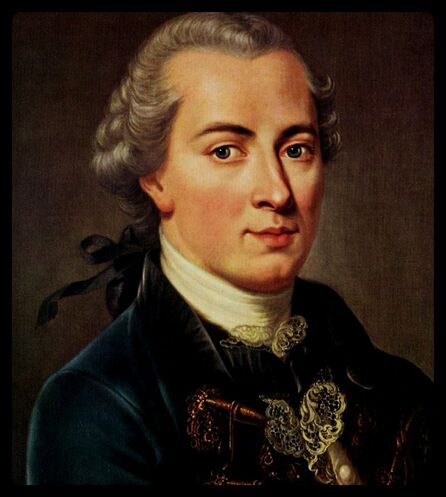
Immanuel Kant (1724-1804) was the first major thinker to scrutinize the limits of thought. Truth, he said, is really a subjective matter. Reality isn’t known as it is in itself, only as the mind shapes it. Since objective knowledge is a chimera, we are right to be skeptical about the role of philosophy. The only way out of skepticism is to have faith. This announcement was rejected by the German Idealists Johann Fichte, Friedrich Holderlin, Friedrich Schelling, Georg Hegel, and others. Even if the transcendent is elusive, it’s not because of the reasons put forth by Kant. Therefore, better explanations for the elusiveness of Spirit must be found. On no account, however, must philosophy be abandoned.
Although most of Kant’s statements were proven false, the world carried on as if nothing happened. Kant’s startling announcements were taken onboard and the insightful criticisms of his opponents, countering skepticism, were misrepresented and largely forgotten. It has had dreadful consequences for western civilization and has allowed all sorts of absurd movements and notions to thrive for far too long.
Shortly after Kant’s time, in Germany of the late eighteenth century, a major schism occurred between those affected and disaffected by the Kantian project.
The Romantics held that if the Absolute has hidden aspects – and if its nature can only be approximated – why think about it at all? In their minds questions of unshakable First Principles and a transcedent source of knowledge were absurdities. This was due to their reading of Kant.
Also, because Being precedes self-consciousness, the case for Being’s elusiveness is rendered a certainty. Therefore, it follows that since we cannot have direct and complete knowledge of Being, why indulge in philosophy at all? It leads only to nonsense, said the Romantics. Let’s direct attention and effort to purely human affairs and dump the metaphysics.
This edict was proposed, of course, in the name of freedom.
Fichte, Holderlin, Schelling and Hegel vehemently disagreed and actively attempted to save western philosophy from collapsing into insignificance at the hands of skeptics and Romantics.
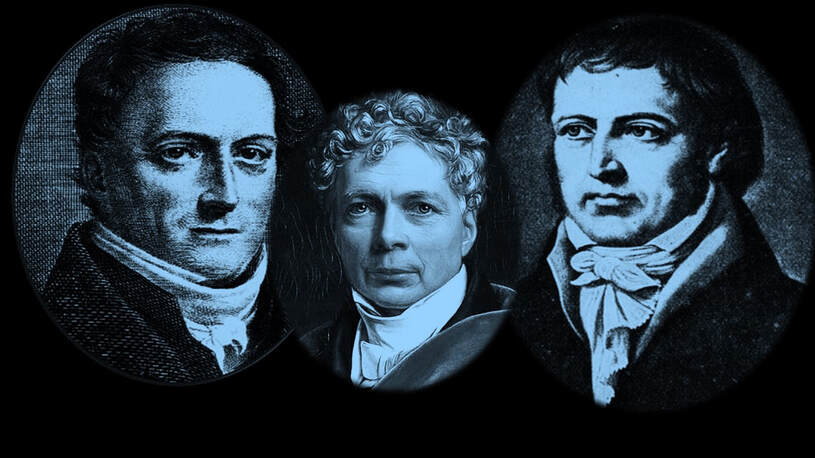
Johann Fichte (`1762-1814), Friedrich Schelling (1775-1854) and Georg Hegel (1770-1831). Fichte brilliantly pointed out the flaws in Kant’s elaborate theory of mind. A top professor, he was scurrilously accused of atheism and ousted. He lost everything. His dismissal emboldened the Romantics who had been his students. Hegel and Schelling, moved by his extraordinary ideas, took over and developed his work. Hegel adapted Fichte’s theory of Dialectics. The infamous terms Thesis, Antithesis and Synthesis were coined by Fichte not Hegel. Fichte believed and taught that all philosophy was based on fundamental First Principles, set down by the divine or “Unconditioned.” Discovering what it is to be a Self entails first discovering what is not the Self. His was, therefore, a philosophy of “negation.” Philosophy is grounded in this “I versus Not-I” dynamic. There is, therefore, an “I” in search of knowledge. Self-consciousness, then, is the basis of certainty, and point from which one reaches out to the world and the transcendent. Whatever the Self makes manifest during its interaction with the Not-I is the domain of and reason for philosophy.
Although the Romantics were seen as little more than revolutionaries and libertines, there were a few areas of agreement between the two contingents. Both agreed that history is an important factor. Indeed, it was at this time that history was first introduced as philosophically important.
For the Romantics, history was important, but it must not be absolutized or necessarily connected with any transcendent principle. It is not a manifestation of the Absolute, and is not, therefore, a central pillar of philosophy upon which certain knowledge stands. History merely records human activity and is not to be equated with Spirit (or Geist).
Friedrich Schlegel (1772-1829) and Novalis (1772-1801, real name Friedrich von Hardenberg), were the chief proponents of the Romantic school started at Jena university. Inspired by Friedrich Heinrich Jacobi, they founded journals in which they challenged the tenets of Idealism. Kant’s skepticism was their launching point. Given that certain knowledge about reality is unavailable, philosophy is rendered a meaningless discipline and must be rejected. There is no Absolute, no transcendent principle and no unrepresented cause of the cosmos. God is merely a figment of the mind, and a matter for art and literature. If we need a motivating ideal, let it be freedom. Let us bow before Liberty, Fraternity and Equality!
Hegel disagreed. History is very definitely to be equated with Geist, and since this word also connotes “mind,” we see the deep connections between the movement of the divine spirit and human reason. If they are not, says Hegel, one and the same, they are very closely related, and not just linguistically. It follows that by studying one, we study and uncover truths about the other. This is the First Principle that grounds and makes sense of philosophy. We philosophize because we can, because Spirit has endowed us with the capacity to do so.
However, despite the mind’s present abilities, the fact remains that until we attain full Self-consciousness, we will not find ourselves capable of understanding Spirit. For Hegel, and the other Idealists, it is, therefore, essential that the lineaments of Self-consciousness are examined and explained, along with speculations of a metaphysical nature. Any and all questions about the nature and purpose of Spirit are inseparable from inquieries into the mind posing said questions. Philosophy is inseparable from psychology.
Our ability to self-reflexively observe our minds with the mind, is no insignificant feat or accidental biproduct of physical evolution. It is an unexplained mystery and reason enough for philosophy. Philosophy’s foremost task is to explain how and why we get from unconsciousness to consciousness to self-consciousness states of being. What explains how we slowly passed through these three main stages, and numerous substages between, to successfully arrive where we are?
Along with this extraordinary capacity for self-awareness, we can, via reason, access the mind of Spirit, as it were, or, better said, we deduce the identity and purpose of Spirit. What we call history is the history of this unfolding process whereby man acquaints himself with the nature of the divine. How is it, Hegel demanded, that this cannot be a legitimate first principle? How can we not ground thought in this principle? Those who deny it are insane and dangerous. Do they believe we can go through life without a modicum of self-consciousness? Do they believe we are identical, in this regard, to animals?
That we are rational beings stands, said the Idealists, as proof of the existence and immanence of Spirit. Reason is, therefore, to be elevated to a first principle upon which all philosophizing and knowledge rest. This precept constitutes the heart of western culture and Western Mystical Tradition.
For the Idealists, reason is the bridge between the human and the divine. They denied the skepticism of Kant, and set out to find better ways to prove the connection.
For the Romantics and their progeny, reason evolved by way of a series of accidents and mutations. Spirit is just an empty term, a figment of language with no inherent substance or meaning. We waste precious time and resources taking it seriously. There are so many important social matters to attend to. Should we wish to entertain heady thoughts and ruminations, let us focus on art, music. drama, criticism and literary pursuits. If I disagree over a poem, I can express my points in journals, magazines, public debates and speeches. This is what practical reason is for, not abstraction and metaphysics.
Tragically, the approach and doctrine of the Romantics did not fade away. It continued to be purveyed by bohemians, socialists, revolutionaries, anarchists and artists right up to the present day.
The Romantic doctrine spread far and wide, influencing Feuerbach, Marx, Engels, and almost every thinker and writer of modern and Postmodern periods. It certainly influenced Nietzsche and Schopenhauer, and in later times its influence can be detected in thinkers such as Berlin, Russell, Moore, Wittgenstein, Popper, Foucault, Derrida, Rorty and others of their kind.
The few who championed Idealism were cast aside and forgotten. Hegel has been shamelessly dragged through the mud. There has been a long-standing campaign to misrepresent his profound corpus:
…an unparalleled scribbler of nonsense – Arthur Schopenhauer (on Hegel)
If I were to say that the so-called philosophy of this fellow Hegel is a colossal piece of mystification which will yet provide posterity with an inexhaustible theme for laughter at our times, that it is a pseudo-philosophy paralyzing all mental powers, stifling all real thinking, and, by the most outrageous misuse of language, putting in its place the hollowest, most senseless, thoughtless, and, as is confirmed by its success, most stupefying verbiage, I should be quite right – ibid
…what was senseless and without meaning at once took refuge in obscure exposition and language. Fichte was the first to grasp and make vigorous use of this privilege; Schelling at least equalled him in this, and a host of hungry scribblers without intellect or honesty soon surpassed them both. But the greatest effrontery in serving up sheer nonsense, in scrabbling together senseless and maddening webs of words, such as had previously been heard only in madhouses, finally appeared in Hegel. It became the instrument of the most ponderous and general mystification that has ever existed, with a result that will seem incredible to posterity, and be a lasting monument of German stupidity – ibid
Bertrand Russell was a tad more generous in his scathing diatribes against Hegel and German Idealism. Neverthless, he had as much contempt for Idealism as his predecessor.
I deal with this subject in Part Two of my forthcoming book, showing how the ideas of Martin Heidegger hearken back to those of Holderlin, Rilke and Schelling.
In the early twentieth century, Positivists overthrew the school of British Idealism. Men such as Karl Popper, Bertrand Russell, J. L. Austin, A. J. Ayer and G. E. Moore spent their time debunking Idealism. They carried on where the German Romantics left off. There can be no doubt that they attempted to dismantle the entire Western tradition, and undermine the core precepts of German mysticism and Idealism. Cleverly replacing the ideas of the Idealists with more mundane ones, pertaining to the value of art, drama, literature, liberalism, revolution and self-expression had universal appeal. Such ideas were accepted to bohemians, malcontents and “artists” far and wide.
This accounts for entire genres of art, such as Impressionism, Expressionism, Abstractionism, Dadaism, Surrealism and Modernism, etc. Artists, writers and film-makers, such as Bertolt Brecht, Walter Benjamin, James Joyce, Samuel Beckett, Harold Pinter, Max Ernst, Andre Breton, Jean Luc Godard, F. T. Martinelli, Salvador Dali, Henri Matisse, Pablo Picasso, Paul Klee, Wassily Kandinsky, Constantine Brancusi, Le Corbusier, Andy Warhol, Jackson Pollock, Damien Hirst and many others, to various degrees encapsulated the principles of the Romantics in their works.
The transgressive ideas of the Romantics culminated in Germany in the so-called “Weimar Republic,” the antetype of later debauched hedonistic communities and societies. Without the excesses of Weimar, there could be no Amsterdam, Reeperbahn, Christiana, Soho or Greenwich Village; no Hippy Movement, Berkeley, Woodstock, Burning Man or LGBTQ fiasco.
There’d be no drag-queens on parade, no cross-dressing extravaganzas, no policitcal-correctness, no entitled half-wits, drug-culture or drug-epidemics laying waste to the West.
…We cannot be calmed until the whole of Europe is in flames – Jacque Pierre Brissot (A leading French revolutionary)
Where did it all start…where did it come from?
More to the point, there’d be no Communism, Cultural-Marxism, Pluralism, Multiculturalism, Feminism or Relativism. Not outside a lunatic asylum that is.
We think it’s all new, something of our times. Actually, most of the sick aspects of western culture seen today derive from Germany of the 1790s. It was Germany’s and Europe’s fin de siecle, with characteristic upheavals. Although the two great wars hadn’t happened, Europe had experienced the Industrial Revolution, the French Reign of Terror, the Franco-Prussian War, the rise of Napoleon and French invasion of Europe. Republicans challenged monarchies and many an old order was brought to the brink.
When Napoleon crowned himself emperor, dismay swept Europe. Liberal thinkers everywhere, and every champion of Liberty, Fraternity and Equality was plunged into despair. Hopes for a better tomorrow were dashed, and many disgruntled types like Shelley, Bakunin, Proudhon, Kropotkin, Trotsky and Marx, etc, were even more determined to smash the old order.
It was these times that witnessed the rise of extremist socialism and philosophical relativism. There’s nothing new under the sun. Today’s media “talking-heads” rarely if ever speak of this. The average Millennial has no clue where it all began, or where his vagrant ideas come from.
The German Romantics were akin to today’s Millennials. They were the young “hipsters” of their age, of the fin de siecle. They were philosophical lightweights who envied the great thinkers of their time. As far as they were concerned, ideas were rotten just becaue they were old. They were to be trashed just because they were taught by goat-bearded fuddy-duddies in universities.
These young student upstarts were offended by the elusiveness of Spirit. If Geist cannot be delivered up on a silver plate, it’s not worth our time…Let’s get on with self-expression, social reform and having fun. The dionysian horde, opium-pipes in hand, stormed the streets and colleges, preaching radicalism and anarchy. Certainty is what we make it…Let’s not wait for a God to rescue us.
In their drug-drenched ardor, the Romantics committed themselves to utopian ideals. Today, the technocrat executes their mandate to build a “better” world. However, because their premises are absurd, they’ve delivered nothing less than a dystopia.
But where is the push-back? Who speaks against it? Why are the warnings of the few enemies of “progress” unable to get a decent hearing?
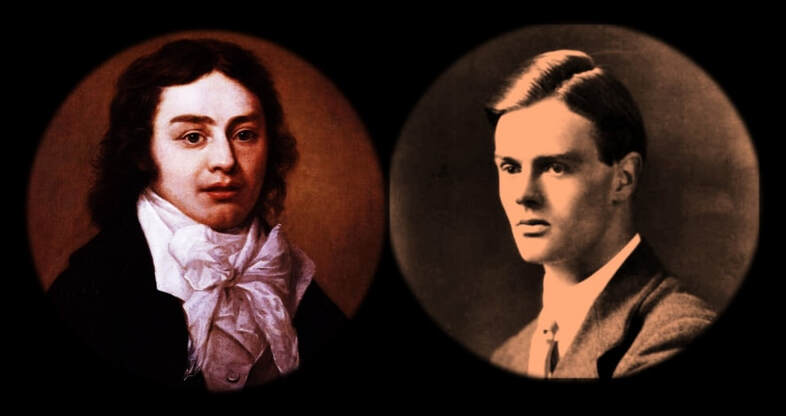
Taking his cue from his mentor Samuel Taylor Coleridge, English philosopher and linguist Owen Barfield sought to resolve the breach between Romantics and Idealists. He acknowledged the good in both camps, and also the flaws.
Coleridge, one of England’s foremost poets, had traveled to Germany to get as close as possible to the men involved in arguments and critiques about Kant’s skeptical philosophy. He listened to both contingents and made up his own mind about Kant’s extraodinary proposals about consciousness and reality. They were wrong, thought Coleridge. He aligned himself instead with the philosophy of nature as espoused by Friedrich Schelling. Indeed, Coleridge was soon given the title “the English Schelling.”
English poet Samuel Taylor Coleridge (1772-1834) and philosopher Owen Barfield (1898-1997). Barfield was a close colleague of C. S. Lewis and member of the Inklings. Coleridge was the chief British proponent of the philosophical ideas of the great Idealist Friedrich Schelling. Barfield’s reputation was occluded by the worldwide popularity of his colleagues C. S. Lewis and J. R. R. Tolkien. There can be no doubt, however, that Barfield was by far the greater thinker. (Here for more…)
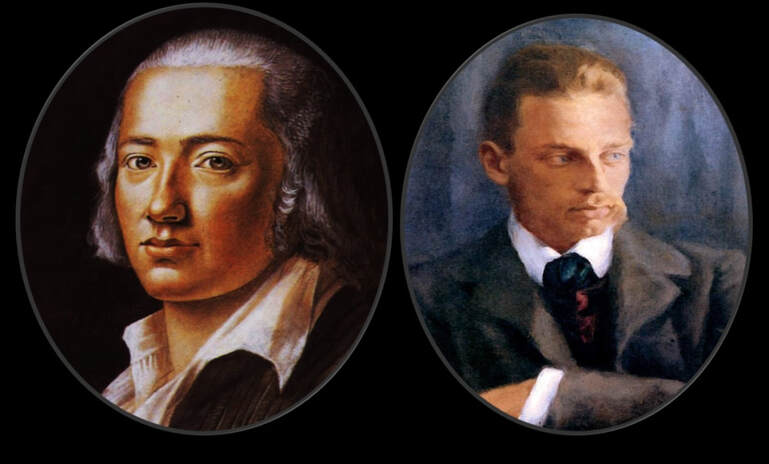
In his youth, Schelling was a fellow-traveler of the Romantics, and had a lot of time for some of their ideas, particularly those celebrating the Classical Period and Middle Ages. However, in the end he could not stomach their sneering dismissal of the relevance of philosophy. Although poetry and politics were not unimportant, there was no way they were to be exalted above philosophy. That was tantamount to extreme libertinism and amounted to the undermining of the entire Western tradition. Schelling tried to bring the Romantics to their senses, but it proved useless. He sided with his unshakable friend Friedrich Holderlin, and condemned the high-sounding Romantic doctrine in writing and speeches.
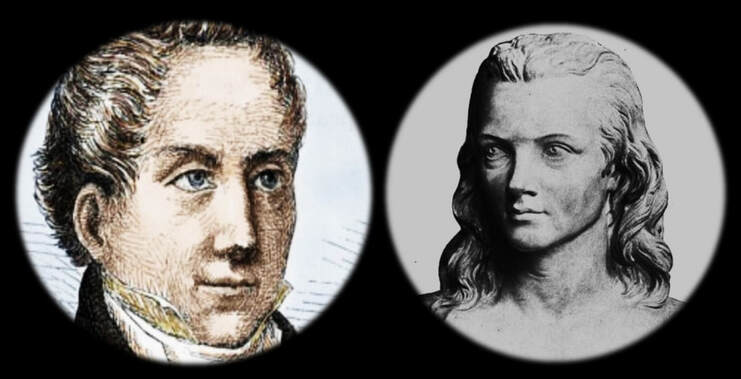
Poets Friedrich Holderlin (1770-1843) and Rainer Maria Rilke (1875-1926). Although Holderlin was affiliated with both contingents, he was a Classicist, taking his cues from the ancient Greeks. A student of Fichte, he was a friend of Schelling and Hegel. They looked to him as a mentor. He was Germany’s most respected poet, and was described by Martin Heidegger as “the most German of Germans.”
Coleridge and Barfield took a similar view. Despite the appeal of some Romantic ideas – those which inspired Shelley and other English poets – Romanticism’s project was ultimately wrongheaded. It could only lead to cultural chaos.
Barfield, however, hesitated before subscribing to the tenets of Absolute Idealism espoused by Fichte and Hegel. Nature was definitely a first principle, and was to be taken as the signature of the Absolute. History was also undoubtedly the process by which Geist or Spirit moves toward full Self-realization. And there can be no doubt that reason is a special endowment to man, that it indicates the benevolence of the divine.
However, despite the veracity of these Idealist principles, there was still the problem of radical skepticism to be addressed. If any part of Being or Spirit lies in darkness – if some part of the divine remains elusive – then it follows that – as Kant first enunciated – reason is not enough. This in turn means that the search for metaphysical knowledge is bound to be limited. Maybe, then, the Romantics and libertines had a point. Why bother philosophizing at all?
A decision, one way or the other, seemed impossible. Kant offerred faith and belief as the way out. If I have faith in something, I’m no longer in need of proofs for or against. I save myself from the never-ending round of heady intellectual critiques.
Barfield focused on this problem of Being’s elusiveness. He didn’t object to it. Like Holderlin and Rilke, he said that it should be revered and embraced as the foremost foundational principle of thought and philosophy. Barfield wholeheartedly agreed. Thus, he was more of an Idealist than a Romantic.
We are to be all right with Being’s elusiveness. The poet needs to change his disposition in terms of it, and so does the philosopher. Indeed, this is exactly the position taken by Barfield’s German contemporary Martin Heidegger. There are interesting parallels between the ideas of the two men. Both revered Holderlin and Schelling, and for good reason.
Like Heidegger, Barfield also implicitly remarked on the antipathy caused in humans by the elusiveness of Being.
Knowledge is based on understanding (standing-under), which implies that there is something to be understood. Being precedes self-consciousness and cannot, therefore, be understood in a conventional sense. Being “understands” all things, including human consciousness.
In language, Being appears in the form of the ubiquitous “is” – “It is raining outside,” “the tree is in the garden,” “the meal is ready,” “tomorrow is Saturday,” “it is a good feeling,” etc. Being is there at the base of everything, especially when we aren’t aware of it. As far as Fichte was concerned, since human “beings” ask the question of Being, and represent it in their language and speech (as “is”), Being and Self are intimately connected. They may even be one and the same.
When I ask questions about the sun and moon, or inquire into the nature of a river, cloud or tulip, it is not the same as asking about Being. When I ask about objects and entities in the world around me, I can come upon my answers without too much trouble. Moreover, my discoveries about tulips isn’t relevant to my status as a being. If, on the other hand, I inquire into the mystery of Being, what I discover has the greatest impact on me as a being. Conversely, questions about myself are simultaneously relevant to the nature of Being. For this reason Fichte saw the Self as inseparable from Being. The connection and relationship between the two is clearly a first principle of philosophy.
Questions about Being are born from wonder. But if Being is so insignificant and inherently meaningless, why would it ever become an object of thought and wonder? Why would our language be replete with it (in the form of “is”)? To reduce the concept of Being is to reduced, Selfhood to nothingness.
To wonder at the mystery of Being is to be able to wonder, which in turn means Being is a matter for us. Wonder is a response to it. Can this occur unless we, on some level, recognize Being’s presence however elusive it is? Being and wonder are, therefore, one and the same, just as Being and Self are one and the same. Take Being out of the equation, and we are left not with philosophy, but simple narcissism, perhaps not enough of that to even ask “who am I?”
Remember that the object of all knowledge is Self-revelation. Our questions about the external world of objects and entities are for the purpose of establishing the “Not-I,” all in the service of a better definition of “I.”
Strangely, there is also, as said, a feeling of animosity toward the mystery of Being. Instead of being an object of wonder, the hiddenness of Being offends us. So much so that almost everything we see in our world derives from it. Instead of reverence, we respond with hubris and rage to Mystery. This animosity toward nature and Being accounts for the rise of science, technology and religion. It’s the reason techne has superceded physis.
Science, technology and religion cannot be understood without an understandng of the nonconscious animosity toward the Unconditioned. Barfield also thought that evidence of this odd congenital hostility was to be found in our language.
Human antipathy toward nature’s mystery – the mystery of mystery – gave rise to Romanticism and relativism. Almost every writer on Romanticism states that it was simply a branch of Idealism, and that the ideas of the two schools at Jena had a lot in common. This is simply not so.
Schelling and Hegel were deeply involved in the debates of the time. Their teacher Johann Fichte had come under ferocious attack from his young histionic pupils who founded the Romantic movement. They too were hotly debated and mocked. Indeed, the lampooning of Hegel never abated. It continues to this day, while detractors ransack his great work, scavenging parts they redact and use to further their own worthless reputations.
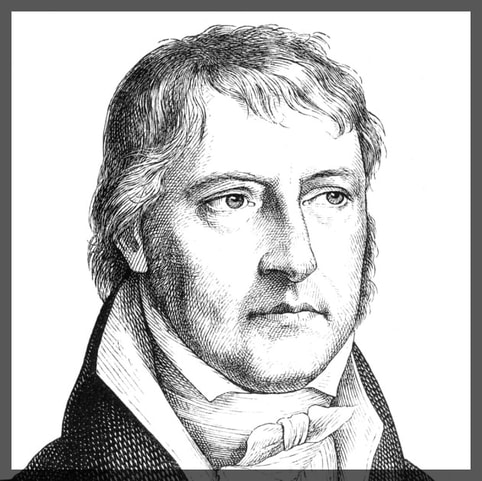
Hegel fought valiantly against Western civilization’s destroyers. His work is to be understood in this light. The Phenomenology of Spirit is a manual of Idealism, yes. It is also a defence against the onslaught of the Romantics. For this reason alone it must be treasured for all time.
Georg Hegel is the most misinterpreted and misrepresented philosopher of all time. His detractors, men such as Bertrand Russell, rained down diatribes against his terminology and style, but carefully avoided dealing with his philosophical insights. All his famous detractors – including Kierkegaard, Nietzsche, Schopenhauer and Marx, etc – appropriated his key ideas and liberally adapted them without citation. His book The Phenomenology of Spirit was written to counter the arguments of Romantics and skeptics. Deeply concerned about the threats to Western culture, he heroically struggled to reclaim philosophy and found it on adamantine principles. Among his profound insights was the role of history in the unfolding of Self-consciousness. Hegel succumbed to a cholera outbreak, and asked to be buried beside Fichte. (Here for more…)
In youth he was much attracted to mysticism, and his later views may be regarded, to some extent, as an intellectualizing of what first appeared to him as mystical insight – Bertrand Russell (on Hegel)
Fichte, Holderlin, Schelling and Hegel refused to follow the dortrines of Romanticism. If the Absolute is inaccessible, and if our knowledge of it is inadequate and faulty, don’t blame the Absolute and remove it from its rightful pedestal. Blame humanity. It is we who haven’t got it right. It is we whose metaphysical speculations are wanting.
Hegel’s attitude was optimistic and positive. Don’t scrap what great men of the past said about reality. Don’t abjure and replace philosophy. Accept its limitations and start again.
Science concedes that it has been forced to do this many times, as paradigms fall and get abandoned. So let us do likewise and let the phoenix rise from the ashes of the old. Let what is past nourish the new. Any other approach is absurd and leads only to irreverence, apathy, hedonism and despoilation.
No, said Hegel, let’s work to establish new foundations for philosophy. To use his own nomenclature – let us negate the negation, and build a new thesis. Long live the Dialectic!
CanMar, a Canadian cannabis recruitment company, recently launched Level Up a comprehensive program that equips budtenders with the essential knowledge, tools, and skills necessary to provide exceptional customer service, product knowledge and tailored recommendations within the retail space.
The Level UP program led by content creator Tabitha Fritz covers a wide range of topics, including cannabis cultivation, product manufacturing, consumption methods, and the intricate relationship between cannabis and the human body. Through engaging and informative modules, budtenders will gain a deep understanding of the subject matter and be equipped to address consumer inquiries with confidence and knowledge.
Developed with the unique needs of Canadian budtenders in mind, Level UP offers three crafted courses: Cannabis 201; Cannabis Products, & Cannabis Consumption; and Customer Service and the Customer-Focused Sales Methodology. Each course offers different levels of interaction with cannabis education experts, ensuring a well-rounded learning experience.
While each course is available for individual purchase, Level UP encourages budtenders to take advantage of the full-spectrum solution by enrolling in all three courses together. This comprehensive approach ensures budtenders have the knowledge and expertise to provide compliant recommendations in line with Health Canada regulations. Whether aspiring to enhance personal knowledge, pursuing a career in the retail industry, or preparing for opportunities within the cannabis sector, Level UP’s training program, in partnership with CanMar, a renowned leader in the field, offers an opportunity for professional growth.
Since 2017, CanMar has been a driving force in championing the Cannabis, Hemp, and Psychedelics (CHP) space. Today, they offer comprehensive recruitment and education services, supporting businesses in cannabis, psychedelics, hemp, wellness and other regulated sectors across North America.
Navigating the complex landscape of the cannabis and psychedelic industry proves a challenge for many, while professionals struggle to find suitable opportunities.
With a successful track record of placing over 1,500 top-tier professionals in the cannabis and psychedelics space, CanMar continues to expand its qualified database.
CanMar is currently beta testing a new online community platform called The CanMar Hub. This new platform seeks to address the challenges of censorship and networking within the cannabis and psychedelics industries.
CanMar’s platform caters to growing global industries, providing networking opportunities on an age-gated and compliant B2B, B2C and C2C marketplace, a global business directory, industry events, educational opportunities, and more.
Founder KD Khairah says that through his work over the years connecting professionals in the cannabis industry he saw how fragmented the industry was, with very few places to connect, and with companies relying too heavily on platforms like Facebook, Instagram, and Twitter, which can often have heavy-handed and inconsistent policies for products like cannabis.
“I saw that there is no space where the community can engage, especially on a global scale that was free from shadow-banning, diluted messaging, and other unnecessary censorship. Cannabis and psychedelics need to stop relying on other platforms to host us. We need to just create our own.” Whether you are editors looking for writers, or content creators looking to build their brand, they can all find a home by downloading the CanMar.io app.
In terms of recruitment, CanMar.io allows users to create a self-serve job board & applicant tracking system to manage their own specific needs.
Visit CanMar.io for recruitment, advertising opportunities, educational programs, and more.
Join our community with an Android or ios device today.
It’s carnage! The Swiss chard chewed to the ground, the sprouting peas vanished, and the new shoots on the delphinium devoured. The culprits are often snails, beetles, aphids, ants, slugs, and all the tiny creatures that call the garden home. Has this happened to you during the growing season? When these critters cross a line, some gardeners turn to Diatomaceous Earth (DE) to re-establish boundaries. Others want nothing to do with it.
Everything Old Is New Again
DE is an ancient remedy. Four thousand years ago in China,people noticed birds bathing in clay dust to control mites. Mimicking the observed natural behavior, they started using DE as a pest control.
DE is a white powder made from fossilized aquatic plants called diatoms. But don’t let the smooth chalky texture fool you. These tiny skeletal pieces are sharp, and small insects suffer miniature razor blade cuts when they cross them. If ingested, the powder will dry out their mucous membranes. So it’s no wonder that insects stay away from gardens containing DE.
How To Use DE
You should wear gloves, goggles, and a dust mask to prevent breathing in the particulates when using DE.
When purchasing DE, buy “Food Grade” soil and not the kind used for swimming pool filters, which has been processed differently and has a high silica content that is dangerous to the environment.
The best time to apply DE is on a dry day by sprinkling it directly on the ground around plants. Many gardeners recommend using it wet to avoid airborne dust particles.
Mix 473 milliliters of DE with four liters of water, and spray after a light rain or early morning when the dew is upon the foliage. The moisture will help the powder adhere to the plant.
Advantages
DE is safe for humans and non-toxic for pets. Food grade DE is sometimes used as a dietary supplement to help maintain the digestive tract, but only under stringent guidelines, so don’t try this without consulting a doctor.
Containing trace amounts of magnesium, iron, and calcium, DE is beneficial to the soil, increasing drainage and breathability and is often added to container plants to prevent root rot and stagnation.
It can absorb and slowly release fertilizers, making it a fantastic addition to bonsai potting mixes.
Since DE works physically on the bodies of insects, there’s no opportunity for them to develop a resistance to its effects as they can with other synthetically produced insecticides.
Disadvantages
Bugs must come into direct and prolonged contact with DE to be effective, so it will take time before the veggie garden snacking ceases.
Unfortunately, DE is easy to misapply and may contaminate non-targeted surfaces.
Whether or not it’s genuinely effective against slugs and snails is debated, but there’s no question it’s non-discriminatory and can do a lot of harm to the beneficial insects in the garden, like spiders.
And yes, there is a possibility it can hurt bees. Only apply DE on plants where you haven’t observed any bee activity. Like the other insects in the garden, they can inhale and be cut by DE, and right now, the bees need all the help they can get.
So, there you have it – the good, bad, and ugly of DE. Now you can make an informed decision on whether it’s right for your garden.
Peel Regional Police executed a search warrant at an unlicensed cannabis store in Mississauga on Friday, August 25, leading to the arrest of two men.
Investigators from the Peel Regional Police (PRP) Specialized Enforcement Bureau (SEB) opened an investigation into the illegal cannabis store earlier this month, located in the area of Dundas Street and Hurontario Street in Mississauga.
Police say the store has “shown a blatant disregard for law enforcement,” noting that eight search warrants were executed at the location between January 2019 and December 2022, along with “numerous calls for service.”
The City of Mississauga also worked with PRP SEB officers to establish an “enhanced physical barrier” of large concrete blocks to prohibit entrance to the establishment. Toronto has also used a similar approach, with mixed results, to deal with unlicensed dispensaries.
While serving the warrant, police say they seized various properties, including drugs, drug paraphernalia, Canadian currency, televisions, and a black handgun (BBgun).
Police arrested Dennis Arenburg, a 42-year-old man from Mississauga, who is charged with Possession for the Purpose of Distributing and Possessing Cannabis for the Purpose of Selling, and Hong Anh Vu, a 28-year-old man from Toronto, charged with Possession of Property Obtained by Crime, Possession for the Purpose of Distributing, and Possessing Cannabis for the Purpose of Selling.
Both were released on an undertaking to appear at the Ontario Court of Justice in Brampton on a later date.
As of publishing this article, Weed Releaf appears to still operate an online store, advertising cannabis at $13 a gram or as low as $50 an ounce.
In April, the city voted to begin allowing applications for cannabis stores, with several now operating in the municipality.
“The dispensary consistently reopens after it has been ordered to stop operations,” notes Shari Lichterman, Mississauga’s acting city manager, in the report at the time. “This operation has effectively cornered the illegal cannabis market in Mississauga and its central location provides easy access to consumers.”
In March 2020, we were given a remarkable opportunity to shift the paradigm of human being, expression and existence. A manmade virus infected us with widespread fear, driving us deeper into social and political anxiety, division, enslavement, judgement and isolation. We took the bait; hook, line and sinker, never questioning the artificiality besieging us. Amidst it all, the opportunity was to observe, distinguish and sever our conditioned dependence upon social reality. Alignment and relativity with our heart, intuition and soul was ever-present, expressed within the resonance of a universal energetic shift humanity had ever experienced.
Social Reversion
As with all things in society, the majority clung desperately to the simulation of social reality, unable and unwilling to break the vicious cycles enslaving us. We had the opportunity to experience and shift with the universal energy of this new era, transcending the duality of existence by becoming an expression of our soul. For many, the neurological dependence on the structure of artificiality proved insurmountable. When the chaotic fervor of the pandemic settled, we regressed and acquiesced to the virtuality of social reality. The webs of a new matrix were woven, enabling the dependency of its subscribers.
All That Was Lost
I spent the last three years creating and experiencing all I could to align with my heart, intuition, soul and the universe. I observed the abundance of transformation society dismissed and negated like weekly refuse. We wielded our fear and insecurity like a weapon against the opportunity of a lifetime. Over the last few years, universal possibility was so omnipresent, we could feel it in every experience. Each of us has the potential to become an expression of the universe. Yet, the seduction of the artificial security social reality provides proved irresistible to a deluded and susceptible society. Once again, we submitted to the totalitarian deception.
An Ordinary Life
We invest more energy and effort into financial wealth than physical health. Many people disregard wellbeing, but incessantly check the progress or decline of their assets, balances and investments. Career becomes the foundation upon which our delusionary lives are built. Though it may be an amazing experience having children, billions of lives are dictated by school and family functions, practices, social events, sports and daily activities and encounters. Social reality fills in the blank spaces of free time with amusement, media, politics and religion. The meager moments left to us are spent escaping the artificial reality to which we eagerly tether.
“Empowering our truth is our soul’s expression.”
Observations and Outlooks
After 52 years, I have observed the numerous nuances of oblivion in social reality. It is primal survival at its elementary core. The cruelty people commit to themselves and each other as they attempt to push their way ahead to what and where they “believe” they are entitled is at the root of our social violence. We all convince ourselves we are kind, loving and peaceful, though our thoughts and actions often exhibit our personal malevolence. We believe we are a part of community, yet how can we exist as such when we cannot even be with ourselves? However positive we project our outlooks; our eventuality is quite the contrary.
Personal Existence
We build a bubble between ourselves and the world with a strategic focus on personal survival. This is so endemic and inherent, we fail to observe the internal and external violence of our own egocentricity, pride and vanity. Our oblivion to the projection of our anxieties, fears, hatred, insecurities and judgement is what deceives us away from our soul and into the self-centric snare of our ego. We are programmed to interpret it as an expression of intelligence. The ego, as it exists in social reality, is a cerebral weapon, enslaving us into the duality of the mind and body. It inhibits our personal fulfillment, as well as our communal experience.
The Origin of Community
Just because we exist in an area with a group of people does not equate to community. My view on contemporary “unity” is akin to how democracy exists. Once in the history of humanity, there was a vision. Yet, the relative manifestation pales in comparison. Given its fragility within social reality, the last few years have shown us how swiftly our selective delusions destroy unity with the vanity and violence of self and familial survival. Community is a gathering of people empowering and inspiring each other with support and sustenance. The origin of authentic relatedness is our relativity with our soul.
Ancestral Universality
Social reality separates us from our soul and the universe. Our institutional conditioning indoctrinates us into a prison of private existence. Our primary motivation is what we gain instead of what we give. We are unable to transcend our inherent egocentricity. There is a stark distinction between community and society. Where the former empowers relatedness and belonging, the latter imposes isolation and singularity. We are all related. Our soul is the essence of our relativity. Our universal being enlightens and enhances our earthly experience. Being is the expression of our ancestral universality.
Soul Burst
The universe empowers our soul to express epiphany and insight with our intuition. This is our universality. Its omnidimensional emanations are received through our heart. Our heart center transposes universal energy into electromagnetic currents, illuminating our neural pathways for their translation and application. Our mind relays the momentum of this energy to our body. During this descension, most of our universality is lost. Transcending the neuroses of the mind and the habituation of the body empowers us to center our being into our heart and experience universality. Our soul sources consciousness to express the flow of the universe.
Being in Flow
The energy we experience reflects how related we are with our heart, intuition, soul and the universe. How it manifests in our present is established with our universal alignment, balance, focus and expression. The energetic shift of universality is available to all who choose to transcend the enslavement of egocentric existence within social reality. When we center our consciousness into our heart and heed our soul with our intuition, we are empowered by the infinite energy in the universe. We feel the resonance of universality synergize in every element of our being. It is the frequency of being one with the universal flow.
In an interview with Radio Canada, clinical psychologist Julia Santo says the legalization of cannabis has complicated, but also simplified, the exercise of her profession.
Village Farmsannounced the appointment ofOrville Bovenschen as President of Pure Sunfarms effective immediately. Mandesh Dosanjh has stepped down from his role at Pure Sunfarms and will move into a strategic advisory position for a transitional 90-day period. Bovenschen joined Village Farms as VP of European Business Development and Operations and was later named COO of Pure Sunfarms. He also formerly held several senior roles in cannabis, during which, among other things, he oversaw innovation and new product launches.
Loss from operations for the quarter was $12.1M compared to $11.7M in Q1 2023. BZAM says the increase in loss was driven by lower gross profit, and partially offset by the decrease in SG&A quarter-over-quarter.
The company has sold its Midway, BC facility (completed August 4, 2023), expects the Maple Ridge, BC facility sale to be completed in September 2023, and has achieved EU-GMP certification for its Ancaster, ON facility.
New products:
Organigramannounced it is launching new THCV gummies, CBG infused pre-rolls, and a high-potency 1×0.5g pre-roll under its Trailblazers brand.
Nova Scotia sold $29.1 million worth of cannabis in its first quarter of 2023, from April 1, 2023-July 2, 2023.
This represents a 6.7 percent increase in cannabis sales compared to the same period last year.
Nova Scotia cannabis sales led growth in local products sold through the Nova Scotia Liquor Corporation (NSLC), with a 22.2% increase in sales to $9.5 million.
Nova Scotia cannabis accounted for 32.6 percent of all cannabis sales in the province, which NSLC says is the largest seen to date. The province has said in the past that it is focussing on partnering with local cannabis producers to help fight the illicit market.
The price of cannabis sold in the province also continues to decline.
“This quarter, the average price of cannabis per gram was further reduced 2.1 percent to $6.02, compared to last year, as we work to impact illicit sales in the province,” said NSLC president and CEO Greg Hughes.
The average price per gram in Nova Scotia was $6.94 in their fiscal year-end report for 2021-2022.
The NSLC manages the sale of beverage alcohol and cannabis in Nova Scotia, with all of its profits going to help fund public services.


























Recent Comments